Clinical and psychosocial features of
heart failure patients admitted for
clinical decompensation
1 Nurse at the Municipal Hospital of Americana. Americana, SP, Brazil. [email protected] 2 Nurse. PhD. Professor of the Nursing Department at the
College of Medical Sciences at the State University of Campinas (UNICAMP). Campinas, SP, Brazil. [email protected] 3 Nurse. PhD. Professor of the
O
RIGINAL
A
R
TICLE
CARACTERÍSTICAS CLÍNICAS E PSICOSSOCIAIS DO PACIENTE COM INSUFICIÊNCIA CARDÍACA QUE INTERNA POR DESCOMPENSAÇÃO CLÍNICA
CARACTERÍSTICAS CLÍNICAS Y PSICOSOCIALES DEL PACIENTE CON INSUFICIENCIA CARDIACA INGRESADO EN HOSPITAL POR DESCOMPENSACIÓN CLÍNICA
RESUMO
Este estudo teve como objetivo identificar perfil sociodemográfico e clínico, história de hospitalizações por Insuficiência Cardí-aca (IC) e seguimento (consultas regulares, tratamento medicamentoso, fatores facili-tadores e dificulfacili-tadores do seguimento) do paciente internado por quadro de descom-pensação clínica. Foram entrevistados 61 pacientes com idade média de 58,1 (± 15,9) anos, 3,5 (± 4,4) anos de estudo e renda individual de 1,3 (± 2,4) salários-mínimos. A maioria dos sujeitos se encontrava em classe funcional III ou IV da New York Heart Association, tendo como causa mais fre-qüente de hospitalização, os sinais/sinto-mas da forma congestiva da IC. 75,4% dos sujeitos relataram acompanhamento clíni-co, porém de periodicidade irregular. Cons-tatou-se utilização de terapêutica medica-mentosa em proporção inferior à recomen-dada pela literatura. Os achados devem au-xiliar a identificação dos pacientes com maior risco de descompensação da IC e as-sim, desenhar e implementar intervenções específicas visando a redução das re-hos-pitalizações por IC.
DESCRITORES
Insuficiência cardíaca. Cuidados de enfermagem. Hospitalização.
Gláucia Margoto1, Roberta Cunha Rodrigues Colombo2, Maria Cecília Bueno Jayme Gallani3
ABSTRACT
This study had the purpose to identify the sociodemographic and clinical profiles, his-tory of hospitalizations due to Heart Fail-ure (HF) and follow-ups (regular appoint-ments, drug treatment, facilities and diffi-culties for follow-up) of patients admitted for clinical decompensation. Interviews were held with 61 patients, with average age of 58.1 (± 15.9) years, 3.5 (± 4.4) years of education and individual income of 1.3 (± 2.4) times the minimum wage. Most sub-jects were in functional classes III or IV of the New York Heart Association, having signs and symptoms of the congestive form of HF as the most frequent cause of hospi-talization. Of all subjects, 75.4% reported clinical follow-ups, although they tended to be irregular. The use of drug therapy oc-curred in lower ratios than that recom-mended in the literature. The findings must help to identify patients with higher risk of HC decompensation, and, as such, design and implement specific interventions aim-ing at reducaim-ing re-admittances due to HF.
KEY WORDS
Heart failure. Nursing care. Hospitalization.
RESUMEN
Este estudio tuvo como objetivo identificar el perfil sociodemográfico y clínico, la his-toria de hospitalizaciones por Insuficiencia Cardiaca (IC) y el seguimiento (consultas regulares, tratamiento medicamentoso, y, los factores facilitadores y dificultadores del seguimiento) del paciente internado por cuadro de descompensación clínica. Fueron entrevistados 61 pacientes con edad pro-medio de 58,1(±15,9) años, 3,5 (±4,4) años de estudio y renta individual de 1,3 (±2,4) salarios mínimos. La mayoría de los sujetos se encontraba en la clase funcional III o IV de la New York Heart Asociation, teniendo como causa más frecuente de hospitaliza-ción las señales/síntomas de la forma con-gestiva de la IC; 75,4% de los sujetos rela-taron acompañamiento clínico, sin embar-go este era de una periodicidad irregular. Se constató la utilización de terapéutica medicamentosa en proporción inferior a la recomendada por la literatura. Lo encon-trado debe auxiliar a identificar los pacien-tes con mayor riesgo de descompen-sación de la IC, y así, proyectar e imple-mentar in-tervenciones específicas que tengan como objetivo la reducción de las hospitalizacio-nes por IC.
DESCRIPTORES
INTRODUCTION
Nowadays, there is a growing number of people afflicted by heart failure (HF). In the United States, one in every three Americans presented a cardiovascular disease, totaling 84,700,000 subjects from 1999 to 2004, five million of these afflicted by HF. After age 65, the incidence of HF approaches 10 cases in every 1000 individuals(1). In spite of advances in
treatment, 300,000 patients die every year(2). In Brazil, there
are no epidemiological studies involving the incidence of HF. However, according to other countries, it is estimated that up to 6.4 million Brazilians suffer from HF. According to data from the SUS (Single Health System - Sistema Único
de Saúde) and the Ministry of Health, in the year 2000,
approximately 398,000 hospitalizations occurred due to HF, with the occurrence of 26,000 deaths. Nearly one third of hospitalized SUS patients with heart diseases have HF(3).
One of the greatest problems related to HF evolution regards the high rates of re-hospitalization(4-6) caused by
clinical decompensation. Besides resulting in high costs, these are related to worsening ventricular functions. Stud-ies have shown that each clinical decompensation event results in additional aggravations to the
myo-cardium due to HF remodeling, resulting in a functional degradation of the ventricle and worsening clinical situation(6).
In Brazil, according to the SUS(7),
approxi-mately 400,000 hospitalizations with a HF diagnosis occurred per year in 1998-2000. The analysis of the period from January 1995 to June 2002 points to a crescent number of cases after the second decade of life, with the numbers increasing twofold from the third to
fifth decade, even to the point of growing in the seventh decade, with 466,093 hospitalizations in the period(7).
Re-hospitalizations would be related, firstly, to the ex-istence of flaws in the hospital system itself, and, secondly, to behavioral factors(8). The following behavioral factors can
be mentioned: inadequate compliance with medication, difficulties to modify lifestyle and delays in seeking medical care when the clinical situation worsens(9). Studies have
shown that functional worsening of the NYHA class and the lack of planned follow-ups after the IC diagnosis(10), as well
as compromised quality of life (QL)(11) predict
re-hospital-izations within 30 and 60 days, respectively.
Therefore, factors that are external to the patient and that contribute to decompensate their clinical situation would include the lack of: documentation of the left ven-tricular function, continuity of patient monitoring after hospital discharge, successful stabilization of body weight, adequate system for early detection of patients with signs of worsening clinical situations, social support, healthcare education, as well as the incapacity of services to identify individual risks for re-hospitalizations due to non-compli-ance with the treatment.
Literature notes that half of all hospitalizations could be prevented by continuous clinical monitoring and healthcare education of patients, promoting treatment compliance(9).
The development and implementation of efficient strat-egies requires the identification of the particular sociodemographic and clinical profile of patients admitted because of clinical decompensation, which may vary ac-cording to region, local socio-cultural characteristics and the availability of healthcare services.
Acting upon the factors related to clinical decompensa-tion requires the work of a multidisciplinary team, due to the complexity of HF patients. The nurse, as a member of the multidisciplinary team, has the role of educator, which requires a precise diagnosis of the magnitude of the fac-tors related to the re-hospitalization problem and its de-termining factors in order to better implement the educa-tional strategies.
One of the largest teaching hospitals in the state of São Paulo registers a significant number of HF hospitalizations per year, but does not have data about the profile of the patients hospitalized due to clinical decom-pensation. Therefore, the objective of this study was to identify the sociodemographic and clinical profile, the history of HF hospi-talization and outpatient monitoring (regu-lar appointments, drug treatment, facilitating and hindering factors of the treatment) in patients hospitalized with decompensated HF in a teaching hospital in the State of São Paulo.
The data contained in this study should provide support to direct the clinical-educational activities of nurses towards HF patients, aiming to minimize situa-tions of clinical decompensation and their consequent re-hospitalizations.
METHOD
Study type
This is a descriptive, exploratory study.
Subjects
Subjects were patients of both genders, admitted due to HF decompensation, in the first 48 hours of hospitaliza-tion. Patients who were unable to effectively communicate verbally (due to neurological or psychiatric alterations) and had HF but were hospitalized because of other reasons that were not related to the decompensation were excluded. Sample size (n=61) was limited by the data collection pe-riod, which lasted from October, 2002 to August, 2003. The subjects were selected for the study successively, accord-Half of all
hospitalizations could be prevented by continuous clinical
monitoring and healthcare education
ing to the hospitalization date, provided that they did not present any exclusion criteria.
Data Collection
Data were collected in five inpatient units of a teaching hospital in the city of Campinas – SP, where decompensated HF hospitalizations are distributed. The following methods were employed: 1. self-report: individual semi-structured interviews, performed by any of the researchers. 2.
bio-physiological assessment: physical examination focused on
the identification of the main signs and symptoms related to HF, performed by the same researcher after standard-ization of techniques for its execution and assessment of the results. 3. data available on records: consultations to the hospital records archive.
Data collection instrument
The data collection instrument was specifically built for this study and submitted to content validation by three judges with expertise in cardiology and/or experience in the clinical approach of patients with HF. The instrument was divided in four sections: 1.) Sociodemographic
charac-terization – name, age, gender, hometown, education,
marital status, people the patient lives with, occupation, individual and family income; 2.) Interview – held in order to obtain the history of hospitalizations due to HF decom-pensation, information about clinical follow-up, attending pre-scheduled appointments and drug therapy used before the current hospitalization, and associated clinical condi-tions; 3.) Medical record checking, to obtain information such as etiology and functional classification of the HF be-fore and after the current hospitalization (prescribed dur-ing the current hospitalization); 4.) Physical examination – to identify the signs and symptoms of HF decompensation due to the hospitalization and on the day of the interview. The pre-test with five patients with decompensated HF con-tributed to the final version of the instrument.
Left ventricular hypertrophy (LVH) was assessed based on ecodopplercardiogram data, with the criteria for LVH presence being at least one of the findings: thickness of the myocardial septum or posterior wall of the left ven-tricle higher or equal to 11 mm, and ventricular mass of 259g for men and 166g for women(12).
Analysis of the results:
Data were submitted to descriptive statistical analysis, followed by associative tests with Fisher’s exact test or chi-square test for categorical variables, and Mann-Whitney’s test to compare continuous variables.
The study was approved by the Review Board of Faculdade de Ciências Médicas da UNICAMP (file CEP #233/ 2002). All selected patients signed the consent form.
RESULTS
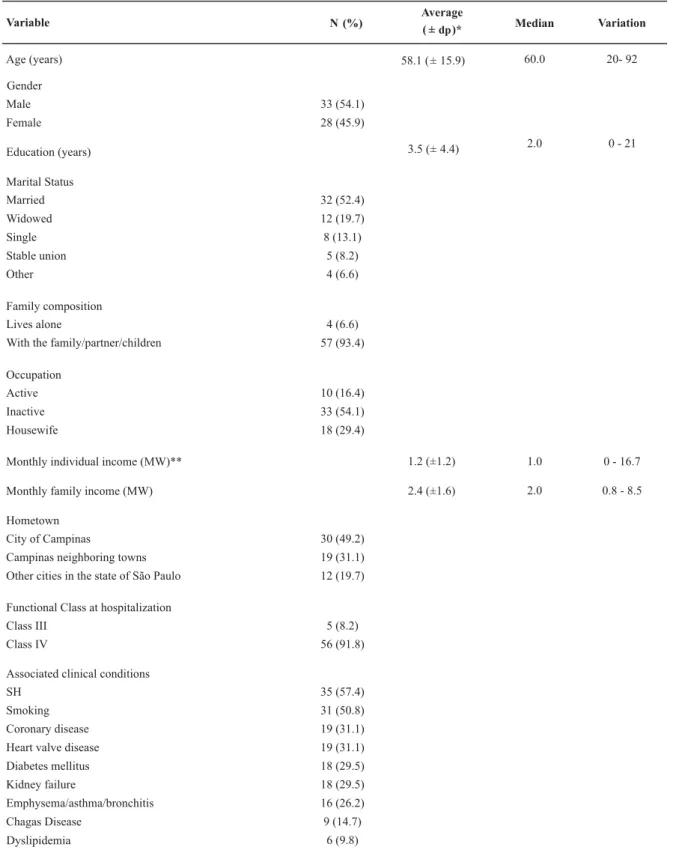
The 61-patient group had a slight predominance of males (54.1%); average age was 58.1 (±15.8) years and 3.5 (±4.4) years of education. Most subjects had a stable part-ner (60.6%), 34.4% lived with a spouse or children, 54.1% had no job, with a reported monthly income of 1.36 (±2.4) times the minimum wage (MW) (Table 1).
Only 29.5% (18/61) of the patients had HF hospital records of functional classification (FC) in accordance with NYHA before hospitalization. These 18 patients had been classified in the last clinical evaluation, previous to the hospitalization, such as: FC I: 5.5%; FC II 16.6%; FC III 50.0%; FC IV 27.8%. At the hospitalization, almost all patients (91.8%) were in FC IV.
Among the associated clinical conditions, systemic hy-pertension (SH) (57.4%; 35/61), heart valve diseases, kid-ney failure and coronary diseases were frequent, present in similar proportions (31%; 19/61).
Regarding the signs and symptoms resulting from HF, as recorded on the day of hospitalization, the following signs
are worth noting: lower limb edema (80.3%), fine rales (75.4%) and hepatomegaly (55.7%). Regarding symptoms, dyspnea (85.2%) stands out (Table 2).
Regarding the signs and symptoms investigated actively by the researcher, the most prevalent symptom was dysp-nea (96.7%), followed by fatigue (93.4%), coughing and palpitation, present in equal amounts (46.6%). As for the
signs, the fine rales (85.2%) and lower limb edemas (82.0%)
were noted (Table 2). The distribution analysis of the signs and symptoms among males and females showed a signifi-cantly higher frequency of coughing (p=0.0325 c2) and
Table 1 - Sociodemographic and clinical characterization of the 61 studied patients with decompensated HF - Campinas - 2002-2003
Variable N (%) Average( ± dp)* Median Variation
Age (years) 58.1 ( ± 15.9) 60.0 20- 92
Gender
Male 33 (54.1)
Female 28 (45.9)
Education (years) 3.5 (± 4.4) 2.0 0 - 21
Marital Status
Married 32 (52.4)
Widowed 12 (19.7)
Single 8 (13.1)
Stable union 5 (8.2)
Other 4 (6.6)
Family composition
Lives alone 4 (6.6)
With the family/partner/children 57 (93.4)
Occupation
Active 10 (16.4)
Inactive 33 (54.1)
Housewife 18 (29.4)
Monthly individual income (MW)** 1.2 (±1.2) 1.0 0 - 16.7
Monthly family income (MW) 2.4 (±1.6) 2.0 0.8 - 8.5
Hometown
City of Campinas 30 (49.2)
Campinas neighboring towns 19 (31.1)
Other cities in the state of São Paulo 12 (19.7)
Functional Class at hospitalization
Class III 5 (8.2)
Class IV 56 (91.8)
Associated clinical conditions
SH 35 (57.4)
Smoking 31 (50.8)
Coronary disease 19 (31.1)
Heart valve disease 19 (31.1)
Diabetes mellitus 18 (29.5)
Kidney failure 18 (29.5)
Emphysema/asthma/bronchitis 16 (26.2)
Chagas Disease 9 (14.7)
Dyslipidemia 6 (9.8)
Table 2 – Signs and symptoms related to HF identified in the hospital records at the moment of hospitalization and during the physical exam on the day of the interview – Campinas - 2002-2003
Data obtained from the medical record on the day of hospitalization
Total
N %
SYMPTOMS
Dyspnea Coughing Precordial pain Fatigue Dizziness Palpitation Headache
52 85.2
21 34.4
08 13.1
04 6.5
03 5.0
05 8.3
-
-SIGNS
Edema 49 80.3
Fine rales 46 75.4
Hepatomegaly 34 55.7
Ascites 26 42.6
Jugular Stasis 15 24.6
Third heart sound 03 4.9
HR average (±sd) (bpm )++ 82.7 ( ± 20.2)
--RF
·
average (±dp) (mpm)··
23.2 ( ± 6.7) --SBP average (±sd) (mmHg)▪ 124.9 ( ± 35.2) --DBP average (±dp) (mmHg) 77.0 ( ± 16.9)--Total
N %
59 96.7
28 46.6
17 27.8
57 93.4
17 28.3
28 46.6
15 24.6
50 81.9
52 85.2
3 6 59.0
41 67.2
41 67.2
--
--82.9 ( ± 16.0) --22.7 ( ± 4.1)
--116.5 ( ± 21.6) --75.7 ( ± 11.4)
--+
▪▪
Data obtained from the physical examination, performed on the
day of the interview.
+heart rate, ++beats per minute, • respiratory frequency,• • movements per minute, systolic blood pressure, diastolic blood pressure,## p-value = 0,0166.
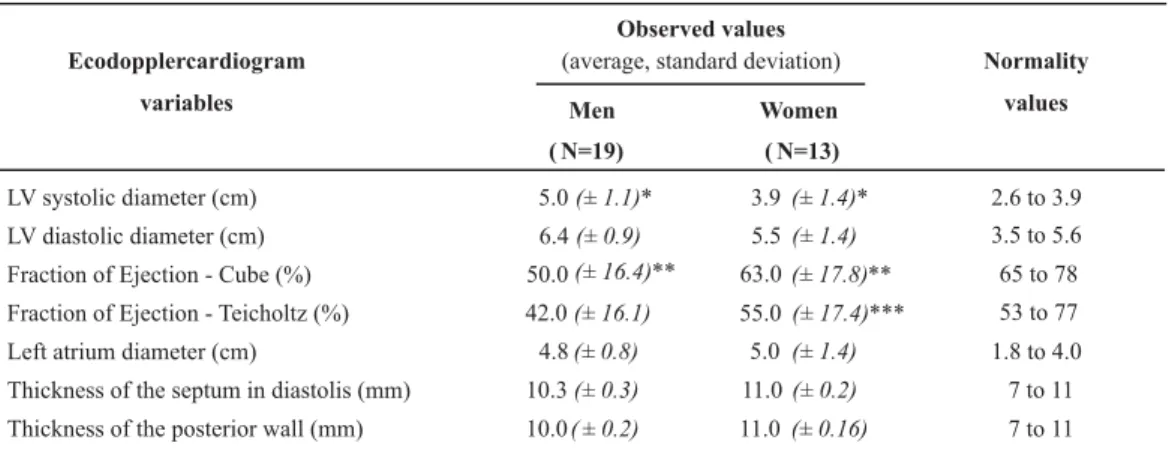
Evidence of structural heart injuries, identified with ecodopplercardiograms, was investigated in 32 patients who performed the exam during hospitalization. The sys-tolic and diassys-tolic diameters of the left ventricle were ob-served, as well as the left atrium diameter, itself an evi-dence of structural heart injury, and still a reduced fraction
of ejection (FE), characterizing a systolic dysfunction. FE was significantly more compromised among men, regardless of the method employed. [Cube: 50.0 (± 16.4) × 63.0 (± 17.8) p=0.041; Teicholtz: 42.0 (± 16.1) × 55.0 (± 17.4) p=0.0420, Mann-Whitney](Table 3).
Table 3 - Ecodopplercardiogram according to gender – Campinas - 2002-2003
Observed values (average, standard deviation) Ecodopplercardiogram
variables Men
( N=19)
Women
( N=13)
LV systolic diameter (cm)
LV diastolic diameter (cm)
Fraction of Ejection - Cube (%)
Fraction of Ejection - Teicholtz (%)
Left atrium diameter (cm)
Thickness of the septum in diastolis (mm)
Thickness of the posterior wall (mm)
5.0(± 1.1)* 3.9(± 1.4)* 2.6 to 3.9
6.4(± 0.9) 5.5(± 1.4) 3.5 to 5.6
50.0(± 16.4)** 63.0(± 17.8)** 65 to 78
42.0(± 16.1) 55.0(± 17.4)*** 53 to 77
4.8(± 0.8) 5.0 (± 1.4) 1.8 to 4.0
10.3(± 0.3) 11.0(± 0.2) 7 to 11
10.0( ± 0.2) 11.0(± 0.16) 7 to 11
Normality
values
*Mann-Whitney, p = 0.0329; **Mann-Whitney, p = 0.041;***Mann-Whitney, p = 0,0420
According to the patient, the reason for HF worsening
and the consequent necessity of hospitalization was attrib-uted to: the presence of symptoms (27.8%), stressing
Regarding the precipitating event of the current
hospi-talization, the high prevalence of symptoms was observed,
noting dyspnea 86.9%, followed by lower limb edemas (55.7%), coughing (24.6%) and abdominal pain (16.4%).
As for the history of hospitalizations due to HF, most sub-jects (60.7%) reported previous hospitalizations, with 64.8%
reporting from 1 to 5 previous hospitalizations. The average number of previous hospitalizations was 2.35 (±0.75), with a high variability in the average time between hospitalizations (Table 4). Although the average time between hospitaliza-tions had been lower among females than among males, this difference was not significant in any period.
Table 4 – Distribution of the subjects who reported previous hospitalizations, according to hospitalization place and the length of time (in days) between the re-hospitalizations– Campinas - 2002-2003.
Place of first hospitalization Male Hospital* 65,0 % (n=20) Average: 287,6
( ± 560,3)
Median: 60 Hospital 71,4 % (n=17) Average 206,3
( ± 228)
Median: 90 Hospital 66,7 % (n=12) Average 425,7
( ± 949,1)
Median: 37 Female Hospital 70,6 % (n=17) Average 151,0
( ± 213,3)
Median: 67,5 Hospital 76,9% (n=13) Average 104,1
( ± 89,6)
Median: 82,5 Hospital 72,7% (n=11) Average 79,1
( ± 47,9)
Median: 82,5 Total (M+F) Hospital 67,6 % (n=37) Average: 227,8
( ± 442,7)
Median: 60 Hospital 70,0 % (n=30) Average 159,8
( ± 182,7)
Median: 82,5 Hospital 69,6 % (n=23) Average 262,2
( ± 695,1)
Median: 60
Average time between the 1 and 2st nd
hospitalization (days)
Place of the second hospitalization
Average time between the 2 and 3nd rd
hospitalization (days)
Place of the third hospitalization
Average time between the 3 and 4rd th
hospitalization (days)
* Studied hospital
Regarding the characterization of the clinical monitoring of HF, most subjects (75.4%) reported periodical monitoring, with 30.4% of 40 patients reporting monthly monitoring, 17.4% bi-monthly monitoring, another 17.4% every six months and 28.2% in periods over six months. As for the monitoring place,
half the patients mentioned the outpatient clinic of the uni-versity hospital, 19.6% healthcare centers, 17.4% other ser-vices and 10.9% hospitals in their hometown. The distribu-tion of the subjects in reladistribu-tion to monitoring and compliance with clinical follow-up are represented in Figure 1.
PERIODICAL CLINICAL MONITORING YES n=46 NO n=15 NON-COMPLIANT N=07 REASONS FOR NOT MONITORING Reasons for non-compliance
- patient does not know that he has a heart condition
- problems at the healthcare center
- family problems Reasons for compliance
- acknowledging the severity of the disease - acknowledging the
importance of the treatment - having easy access - other COMPLIANT n=39 STUDIED SUBJECTS n=61
- difficulty of access to the healthcare service - bad service provided at
the healthcare facility - family problems - forgetfulness
It was observed that, out of the 46 subjects undergoing clinical monitoring, 84.8% reported that they complied with periodical appointments. The reason these 39 patients most often mentioned to comply with the follow-up appointments
was acknowledging the severity of the disease (28.2%),
fol-lowed by the importance of having easy access to the
healthcare service (25.6%), acknowledgment of the
impor-tance of the treatment (20.5%) and, less frequently,
commit-ment with the medical team and the desire for a cure.
The most frequent reason for non-compliance among the seven patients was the difficulty to access the healthcare
service related to transportation (57.1%), followed by
in-adequate service provided at the healthcare facility, family
problems and forgetfulness, in similar proportions (14.3%).
Of the 15 patients who reported not undergoing moni-toring, 73.3% mentioned not knowing about their diagno-sis, 20.0% reported problems with the healthcare center that did not refer them to monitoring, being restricted to
the emergency appointments, and 6.7% reported family
problems.
As for the previous and current therapies used by the patients, diuretics were predominant in 84.9% (45/53) and 93.4% (57/61) of the subjects, respectively. Not all patients use the converting enzyme inhibitor (ACEI). Previous usage is observed in less than half the subjects (60.4%, 32/53), and increasing frequency of use during hospitalization (71.7%; 43/60) (Table 5).
Table 5 – Previous and current drug therapy of the HF patients – Campinas - 2002-2003
Drug Therapy Previous Currents
N % N %
ACEI* 32/53 60.4 43/61 70.5
ARA II** -- -- --
--Diuretics 45/53 84.9 57/61 94.4
Spironolactone 16/53 30.2 29/61 47.5
Beta Blocker 4/53 7.5 8/60 13.3
Digital=
23/53 43.4 20/60 33.3
Hydralazine + nitrate 16/53 30.2 19/60 31.7
Platelet anti-aggregator 13/53 24.5 20/60 33.3
Anticoagulant 9/53 17.0 17/60 28.3
Antiarrhythmic 9/53 1 7.0 12/60 20.0
Diazepinics 5/53 9.4 07/61 11.4
Others<< 23/53 43.5 51/61 83.6
+
++
* angiotensin-converting enzyme inhibitor (captopril); **angiotensin receptor antagonist II; +diuretic (hydrochlorothiazide, chlortalidone,
furosemide); ++Beta blocker (propranolol and carvedilol); •Digital (digoxin, digitoxin and cedilanide); Others: anti-emetics,
hypoglycemiants, antibiotics, analgesics, antipyretic, statins, neuroleptics, nitrates, antidepressants, bronchodilators, mycophenolates, calcium carbonates, electrolytes, sympathomimetics, antacids and anti-inflammatory agents.
DISCUSSION
Literature(13-14) notes the influence of low socioeconomic
levels, more specifically low income(14), on the increased risk
of re-hospitalizations due to HF. In this study, most patients were characterized by low income and low education, which represents evidence of high risks of re-hospitalization. An-other interesting data regards the average age of the pa-tients, which is lower than the average described in inter-national literature, data that was also observed in HF dec-ompensation. In the study comparing results from HF treat-ment among tertiary hospitals in Brazil and the United States(15), Brazilians with HF also had lower average ages.
Although 50% of the patients were younger than 60, only 2.6% of them were professionally active. This shows the strong social impact of HF, which removes individuals from the job market who are still in their productive years.
Regarding social and family support, the studied group seems to have advantages that can be explored in nurses’ educational activity, since most of them were married, liv-ing with a spouse and children and literature has described
As for the clinical characterization, the complexity of the syndrome is demonstrated by the high co-existence of clinical conditions, the presence of structural heart injuries and LV dysfunction, as well as the history of hospitaliza-tions – average 2.35 per patient, with average intervals be-tween five and nine months.
The associated clinical conditions of the studied patients include SH and coronary disease, which has been associ-ated to worse HF prognostics(6).
Regarding the signs and symptoms that led to hospital-ization, those with the congestive form of HF decompensa-tion are noted, with dyspnea and edema as the most preva-lent. At hospitalization, other signs and symptoms were registered, such as rales, hepatomegaly, ascites, noting the prevalence of the congestive form of HF decompensation. According to literature, HF patients who have volume over-loads represent the largest share of patients with decom-pensated HF(6).
tant to note that, even in the case of a substantial amount of body fluid, as a consequence of the increased venous capacity in these patients, a subgroup of these patients may not present the characteristic signs of congestion. There-fore, other evidence of HF decompensation or risk factors for decompensation should also be investigated.
In a study about the length of each HF symptom experi-enced by elderly adults until they decide to turn to a hospi-tal emergency service for evaluation, the following reports were observed: dyspnea for an average period of three days, reduced to a 12-hour period if the symptoms were acute(17).
For edemas, weight gain, coughing and fatigue, the aver-age was seven days. Dyspnea is perceived by the patient as more threatening, being probably the most predominant discomfort reported.
It is worth noting, however, that the signs and symptoms were more frequent in this study according to the researcher’s assessment. Considering a low likelihood of nearly all the participants presenting worsening situations, after hospital-ization, it seems possible that these data were underesti-mated in the registry performed when the patient was ad-mitted, due to the non-existence of a systematized script for the assessment of patients with HF decompensation, which will direct its systematic investigation and registry, recording the most evident or reported signs. Among the symptoms, there is fatigue, reported in 6.5% of the medical records and by 93.4% of the patients at the moment of the interview.
A previous study notes that fatigue, especially in the elderly, tends to be wrongly interpreted as a result of old age, being underestimated. Another fact worth noting is the early start of the HF decompensation signs and symp-toms, which are treated with tolerance by the patients but which, if acknowledged and valorized, could lead to early intervention, avoiding hospitalization.
While literature(17) observes the need to orient the
pa-tients to monitor their HF decompensation signs and symp-toms, the present study also verified the need for orienta-tion, training and establishment of service standards and registry of healthcare professionals who provide care to these patients, since the inadequate recording of the signs and symptoms does not allow for a global evaluation of the subject that could subsidize their future monitoring.
Structural injuries and dysfunctions in the LV were made evident, highlighting the reduction of FE in the group as a whole and significantly lower among men. Studies(2,17) have
noted the importance of early detection and treatment of ventricular dysfunction, a condition associated to heart remodeling, whose prevention and/or early treatment with the use of ACEI and beta-blockers has a strong impact on QL and survival of the patients with HF. As such, the pa-tients in this study with a preserved ventricular function require special attention in the establishment of the thera-peutic strategy, especially in the control of SH and underly-ing ischemia, which was not observed given the low
num-Data showed the lack of regular clinical monitoring when the subject is not hospitalized, considering that, out of 46 patients who reported periodic clinical monitoring, 39 men-tioned having appointments regularly, considering only their attendance to the appointments. Therefore, nearly half of the patients did not present regular monitoring, which is indicated as one of the causes of decompensation and re-hospitalization(4,8).
Moreover, the place for return appointments after the last hospitalization is noted – which, for most patients, was the hospital (outpatient clinic or emergency service). This situation shows that there is a need for a rational follow-up proposal, which, based on the gravity of the patient’s con-dition, could permit different referrals, early detection and intervention, as well as a periodic evaluation according to the demand of the clinical situation, thus avoiding serious decompensations that lead to hospitalization. Similar data related to the difficulty of clinical follow-up were also evi-dent in a previous study involving hypertensive patients(18).
In this study, the individual and environmental factors were identified as responsible for non-compliance with treatment or lack of regular follow-up. Access to the health-care service and the problems that are inherent to the ser-vice itself, which result in inadequate treatment according to the patient’s perception, need to be revisited. The right to access and good service provision should be guaranteed – and the problem should be discussed not only locally, but it should involve broader healthcare policies, aiming for the recognition of HF as a public healthcare problem that requires specific action at all levels of healthcare ser-vices. On an individual basis, educational actions should cover the information given to patients about their condi-tion, gravity, prognosis and the need for regular monitor-ing, as well as the importance of strategies aimed at over-coming individual barriers for treatment.
The frequency of ACEI and beta-blocker use was infe-rior to literature recommendations. National and interna-tional studies(15,4) have evidenced the under-utilization of
ACEI. Therefore, almost ten years after the indication of the use of ACEI, it can be verified that many patients still lack the benefits of using the two only drugs that, until now, are proven to change the course of HF evolution.
FINAL CONSIDERATIONS
low for better follow-up and control of HF patients. Broad-ening the study, with investigation of hospitalizations over the year, as well as the follow-up of patients after hospital
discharge, can provide even more support to guide the design of educational clinical interventions.
REFERENCES
1. Rosamond W, Flegal K, Furie K, Go A, Greenlund K, Haase N, et al. Heart disease and stroke statistics 2008 update: a report from the American Heart Association Statistics Committee and Stroke Statistics Subcommittee. Circulation. 2008;117(4):e 25-146.
2. Hunt SA, Baker DW, Chin MH, Cinquegrani MP, Feldman A, Francis GS, et al. ACC/AHA Guidelines for the evaluation and management of chronic heart failure in the adult: executive summary. A report of the American College of Cardiology/ American Heart Association Task Force on Practice Guidelines Committee to revise the 1995 Guidelines for the evaluation and management of heart failure. Circulation. 2001; 104 (24):2996-3007.
3. Barretto ACP, Drumond Neto C, Mady C, Albuquerque DC, Brindeiro Filho DF, Braile, DM et al. Revisão das II Diretrizes da Sociedade Brasileira de Cardiologia para o Diagnóstico e Trata-mento da Insuficiência Cardíaca. Arq Bras Cardiol. 2002;79 Supl 4:1-30.
4. Munger MA, Carter O. Epidemiology and practice patterns of acute decompensated heart failure. Am J Health Syst Pharm. 2003;60 Suppl 4:S3-6.
5. Cowie MR, Fox KF, Wood DA, Metcalfe C, Thompson SG, Coats AJ, et al. Hospitalization of patients with heart failure: a population-based study. Eur Heart J. 2002;23(11):877-85.
6. Felker GM, Adams KF, Konstam MA, O’Connor CM, Gheorghiade M. The problem of decompensated heart failure: nomenclature, classification, and risk stratification. Am Heart J. 2003;145(2):S18-25.
7. Brasil. Ministério da Saúde. DATASUS. Dados de morbidade de 2000 [texto na Internet]. Brasília; 2000. [citado 2000 out. 28]. Disponível em: http://www.datasus.gov.br/principal.htm
8. Knox D, Mischke L. Implementing a congestive heart failure disease management program to decrease length of stay and cost. J Cardiovasc Nurs. 1999;14(1):55-74.
9. Ekman I, Fagerberg B, Skoog I. The clinical implications of cognitive impairment in elderly patients with chronic heart failure. J Cardiovasc Nurs. 2001;16(1):47-55.
10. Armolla RR, Topp R. Variables that discriminate length of stay and readmission within 30 days among heart failure pa-tients. Lippincotts Case Manag. 2001;6(6):246-55.
11. Mejhert M, Kahan T, Persson H, Edner M. Predicting read-missions and cardiovascular events in heart failure patients. Int J Cardiol. 2006;109(1):108-13.
12. Levy D, Savage DD, Garrison RJ, Anderson KM, Kannel WB, Castelli WP. Echocardiographic criteria for LVH: the Framin-gham Heart Study. Am J Cardiol. 1987; 59(9):956-60.
13. Rathore SS, Masoudi FA, Wang Y, Curtis JP, Foody JM, Havranek EP, et al. Socioeconomic status, treatment and results with heart failure: findings from the national Heart Failure Project. Am Heart J. 2006;152(2):371-8.
14. Phibin EF, William Dec G, Jenkins PL, DiSalvo TG. Socioecono-mic status as an independent risk factor for hospital readmission for heart failure. Am J Cardiol. 2001;87(12):1367-71.
15. Rodhe LE, Clausell N, Ribeiro JP, Goldraich L, Netto R, William DG, et al. Health outcomes in decompensate congestive heart failure: a comparison of tertiary hospitals in Brazil and United States. Int J Cardiol. 2005;102(1):71-7.
16. Luttik ML, Jaarsma T, Veeger N, van Veldhuisen DJ. Marital status, quality of life, and clinical outcome in patients with heart failure. Heart Lung. 2006;35(1):3-8.
17. Friedman MM, Rochester NY. Older adults’symptoms and their duration before hospitalization for heart failure. Heart Lung 1997;26(3):169-76.
18. Sanchez CG, Pierin AMG, Mion Junior D. Comparação dos per-fis dos pacientes hipertensos atendidos em Pronto-Socorro e em tratamento ambulatorial. Rev Esc Enferm USP. 2004; 38(1):90-8.
Funding Institution