O
riginal
a
r
ticle
RESUMO
O objeivo do estudo foi invesigar a pre -valência e os fatores associados à lesão do septo nasal em prematuros sob uso de venilação não invasiva. Estudo transversal, cujos dados foram coletados entre março e julho de 2012 por meio de busca em prontuários, entrevistas às mães e avalia -ção nasal de 47 prematuros, na Unidade Neonatal de um Hospital Universitário da cidade do Recife, Pernambuco, região nordeste do Brasil. Realizou-se análise estaísica descriiva e bivariada por meio do teste qui-quadrado ou Exato de Fisher, uilizando o sotware SPSS. A prevalência de lesão nasal foi de 68,1%, associada ao baixo peso ao nascer e à duração do tratamento. A prevalência de lesão nasal na população estudada é elevada e associa-se ao baixo peso ao nascer e ao tempo de permanên -cia em venilação não invasiva. Infere-se a necessidade de ações prevenivas, como cuidados de Enfermagem contínuos, adequação dos dispositivos e educação permanente em serviço.
DESCRITORES
Prematuro Septo nasal Ferimentos e lesões Enfermagem neonatal Cuidados de enfermagem
ABSTRACT
The aim of this study was to investigate the prevalence and factors associated with nasal septum injury in preterm infants in the use of noninvasive venti -lation. A cross-sectional study with data collection between March and July 2012 and with search for records, interviews with mothers and nasal evaluation of 47 premature in the neonatal unit of a teaching hospital in Recife, Pernambuco, northeastern Brazil. A descriptive biva -riate statistical analysis was performed through the chi-square test or Fisher exact test using the SPSS software. The prevalence of nasal lesions was 68.1%, associated with low birth weight and duration of treatment. The prevalence of nasal injury in this population is high and associated with low birth weight and leng -th of stay in noninvasive ventilation. Due to these facts the necessity for preventive actions was noticed, such as continuous care in nursing, suitability of devices and permanent education in service.
DESCRIPTORS
Infant, premature Nasal septum Wounds and injuries Neonatal nursing Nursing care
RESUMEN
Investigar la prevalencia y factores aso -ciados con la lesión del tabique nasal en bebés prematuros en uso de la venilación no invasiva. Estudio de corte transversal, los datos se obtuvieron de los registros médicos, entrevistas con las madres y 47 de evaluación prematura de nasal entre marzo y julio de 2012, en la unidad neonatal de un hospital universitario de Recife, Pernambu -co, Noreste de Brasil. El análisis se realizó mediante estadísica descripiva y bivariado mediante la prueba de chi-cuadrado o la prueba exacta de Fisher, uilizando el sotware SPSS. La prevalencia de lesiones nasales fue 68,1%, bajo peso al nacer y la duración del tratamiento se asoció con una lesión nasal. La prevalencia de lesión nasal en esta población es alta y se asocia con bajo peso al nacer y la duración de la estancia en la venilación no invasiva. Esto iniere la necesidad de medidas prevenivas, como la atención de enfermería, un ajuste coninuo de los disposiivos de servicio y educación coninua.
DESCRIPTORES
Prematuro Tabique nasal
Heridas y traumaismos Enfermería neonatal Atención de enfermería
Prevalence of nasal septum injury in
premature infants using nasal prongs
PREVALÊNCIA DE LESÃO DO SEPTO NASAL EM PREMATUROS NO USO DE PRONGAS NASAIS
PREVALENCIA DE LESIONES DE SEPTO NASAL EN EL USO DE CÁNULAS NASALES
Nayara Francisca Cabral de Sousa1, Suely de Fátima Santos Freire Bonim2,
Maria Gorete Lucena de Vasconcelos3, Joana Lidyanne de Oliveira Bezerra4,
Daiana Vieira Câmara da Silva5, Luciana Pedrosa Leal6
1 Nurse. Specialist in Child Health, Nurse Residency Program, Department of Nursing, Center for Health Sciences, Hospital das Clínicas, Universidade Federal
de Pernambuco, Recife, PE, Brazil. [email protected] 2 MSc in Nursing. Nurse of the neonatal Unit, Hospital das Clínicas, Universidade Federal de
Pernambuco, Recife, PE, Brazil. 3 Post-Doctorate in Nursing. Associate Professor, Department of Nursing, Center for Health Sciences, Universidade Federal
de Pernambuco, Recife, PE, Brazil. 4 MSc in Nursing. Substitute Professor, Department of Nursing, Center for Health Sciences, Universidade Federal de
Pernambuco, Recife, PE, Brazil. 5 Nurse. Graduate Department of Nursing, Center for Health Sciences, Universidade Federal de Pernambuco, Recife, PE,
INTRODUCTION
Improvements in the quality of antenatal care, from care during labor unil the delivery room and neonatal care have relected in the survival of premature and very low birth weight babies in diferent regions and countries of the world(1). At birth, neonates undergo physiological adaptaions, especially those related to breathing and few minutes of severe oxygen deprivaion can cause irreversible brain damage(2). The preterm infants do not have adequate pulmonary funcion, which increases the chances of respi -ratory problems(3) requiring venilatory assistance.
Among the techniques of administering oxygen to newborn preterm infants (PTI), the method of non-invasive venilaion (NIV) has been successfully used. This type of venilatory support is an efecive alternaive to reduce the ime of transiion from mechanical venilaion to sponta -neous breathing in the treatment of respiratory distress of premature babies(4). Some devices are used
for applicaion of this system, such as face mask, nasal mask, tracheal tube, intubaion, short single nasal prong, nasopharyngeal prong and short binasal prong, which is the most widely used in health services for its easy applicaion in neonatal clientele, espe -cially in Northeastern Brazil(4-6).
However, its therapeuic use can lead to complicaions related to air leakage, fa -voring the reducion of supplied pressure, dryness of mucous membranes, diicult tolerance to devices, occurrence of baro -trauma and abdominal distension(7-8).
Despite technological advances being an important step in caring for PTI, adverse events sill represent a very common reality in neonatal units. Nasal prongs are the most
used devices for administraion of NIV. Its use can lead to the development of columella and nasal septum injuries – the main damages of this type of equipment due to its posiioning and locaion – which are increasingly present adverse events in neonatal units(4,9-12).
A recent study showed that the lesion of the nasal septum was responsible for 6% of adverse events in a neonatal reference unit in Northeastern Brazil(13). The lite -rature suggests that the prevalence is increasing in spite of nursing care with the use of techniques to prevent these injuries. Thus the best form of prevenion is the coninuous monitoring(9,14-15).
Based on the risks associated with the use of prongs for applicaion of NIV, the present study aimed to invesigate the prevalence and factors associated with nasal septum injury in preterm infants in the use of non-invasive venila -ion in a teaching hospital in Recife-PE.
METHOD
Cross-secional study in the Neonatal Intensive Care Unit of the Hospital das Clínicas, linked to the Universidade Federal de Pernambuco, in the city of Recife, Northeast of Brazil.
The study populaion consisted of preterm infants un -dergoing non-invasive venilaion born in the aforemenio -ned hospital in the period between March and July 2012. The sample was a convenience sample and comprised 47 premature in use of NIV.
It were excluded from the study the preterm infants with deformiies or nasal lesions ideniied on physical examinaion at admission, shock, coagulaion disorders, children of mothers with hearing or cogniive impair -ments that prevented the applicaion of the technique of interview, those whose mothers had died in childbirth or post-delivery, and also those whose idenity and socio
-economic data were not available in the respecive medical records.
Data were collected in two stages. The irst was an interview with the preterm infants’ mothers to obtain socioeconomic data which was not available in the admis -sion form neither in the medical records of these paients. The second stage cor -responded to the evaluaion of the nasal area of the neonate at the ime of hospital discharge to identify the presence and stage of nasal injury.
The variables of the instrument for data collecion related to preterm infants were sex, gestaional age (weeks), birth weight (grams) and Apgar scores at one and ive minutes of life. Maternal variables included age, type of delivery and number of live bir -ths (parity). Socioeconomic variables were: marital status, educaion, occupaion, income and housing. Regarding the -rapy, it were invesigated the indicaions for the use of NIV and the stage of the lesion (I – hyperemia; II – disrupion of skin integrity and the onset of bleeding and ulcerated lesion; III - lesion in the subcutaneous issue without involvement of tendons and muscles)(16).
To assess the socioeconomic condiions, it were used as parameters the data on educaion and labor and social indicators provided by the IBGE – Insituto Brasileiro de Geograia e Estaísica (Brazilian Insitute of Geography and Staisics). Income was divided into less, equal or greater than half the Brazilian minimum wage; housing was ranked as owned, rented or given; and educaion in illiterate, pri -mary, secondary and teriary(17).
To assess the gestational age (GA), the classification of the World Health Organization (WHO)(18) was used. It
Nasal prongs are the most used devices for administration of NIV. Its use can lead to the development of
columella and nasal septum injuries – the main damages of this type of equipment due
to its positioning and location – which are increasingly present adverse events in
considers as extremely premature the babies with GA less than 28 weeks, as very premature the ones with GA between 28 and 32.6 weeks and as borderline preterm the babies with GA between 32 and 36.6 weeks. The number of prenatal visits was ranked as lower than six and greater than or equal to six, according to the rec -ommended by the Ministry of Health of Brazil (MS).(19) Birth weight was classified as extremely low birth weight (<1,000g), very low birth weight (<1,500g) and low birth weight (<2,500g)(20).
Sotware SPSS 18.0 was used for data tabulaion and analysis. The Kolmogorov-Sminorv test was used to exam -ine the normality of coninuous variables, and to describe them the median, mean and standard deviaion were used. Absolute and relaive frequencies were calculated for cat -egorical variables. The chi-square test was used to assess the associaion between sex, gestaional age, birth weight and length of stay in the NIV and the presence of nasal injury. The Fisher exact test was used when the expected values were less than ive.
The study complied with the guidelines for research with human beings Resoluion No. 466/2012 of the Na -ional Health Council. The project was approved by the Ethics in Research Commitee of the Center for Health Sciences of the UFPE, under protocol No. 540/11. The term of informed consent (IC) was signed by the mothers paricipaing in the study.
RESULTS
With respect to maternal data, 78.7% of mothers were aged older than or equal to 20 years and 70.0% had a stable relaionship while 27.9% were married. A total of 38.3% worked outside the home and 21.3% of these were domesic jobs. With regard to family income 51.1% of mothers received more than half the Brazilian minimum wage and 23.4% had no source of income. In relaion to housing 57.3% lived in their property and 34% in rented properies and 53.2% of households had sanitaion. Regarding educaion, 42.6% had studied up to 9th grade, 16.0% had atended or were atending college and 2.1% of the sample was illiterate. In respect to the number of prenatal visits, 68.1% of these mothers held more than six visits.
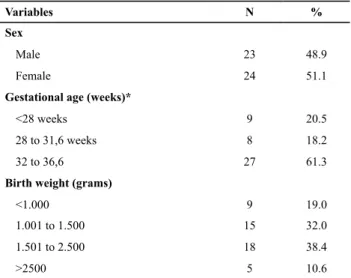
The distribution of preterm infants by sex was similar. In relation to gestational age, the majority were border -line premature (61.3%) with a mean gestational age of 31.4 weeks (SD=8.5). It was found that 89.4% had low birth weight (Table 1) and the median Apgar score was 7 at the first minute of life of preterm infants and 9 at five minutes.
The majority (68.1%) of the sample had lesion of nasal septum (95% CI: 52.7 to 80.5) with stage II (50.0% - 95% CI: 32.2 to 67.8) as the most frequent (Table 2).
With regard to the length of stay in use of the method, 42.5% of the populaion remained over 72 hours under non-invasive venilaion. The most frequent indicaion for NIV was prematurity (91.5%) followed by respiratory dis -tress syndrome, present in 70.2% of the sample.
Table 1 – Sex, gestational age and birth weight of preterm infants in the use of NIV – Recife, PE, 2012.
Variables N %
Sex
Male 23 48.9
Female 24 51.1
Gestational age (weeks)*
<28 weeks 9 20.5
28 to 31,6 weeks 8 18.2
32 to 36,6 27 61.3
Birth weight (grams)
<1.000 9 19.0
1.001 to 1.500 15 32.0
1.501 to 2.500 18 38.4
>2500 5 10.6
* Three cases ignored
Table 2 – Presence and degree of nasal injury in preterm infants in the use of NIV – Recife, PE, 2012.
Variables N %
Lesion
Absent 15 31.9
Present 32 68.1
Degree of injury
I 14 43.7
II 16 50.0
III 2 6.3
Table 3 – Length of time and indication of the use of NIV in pre-term infants – Recife, PE, 2012.
Variables N %
Length of stay in use of the method (hours)
24 17 36.2
48 10 21.3
72 or longer 20 42.5
Indication
Respiratory distress syndrome 33 70.2
Very low birth weight newborn 2 4.3
Preterm newborn 43 91.5
Respiratory distress 26 55.3
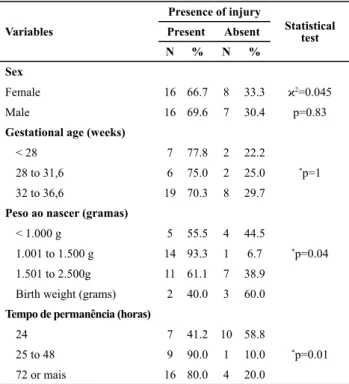
Regarding the assessment of injury to the nasal sep -tum by sex and gestaional age, there was no staisically signiicant diference. Birth weight and length of stay in the NIV showed a staisically signiicant diference in the occurrence of nasal injury. A higher prevalence of injury was observed in children of very low birth weight that remained between 25 and 48 hours in treatment (Table 4).
which 58.8% of the populaion used the prong and 50% of those who used mask showed lesions on stage II(9,22).
Nursing care such as daily inspecion of the nasal colu -mella, sucion probes with small caliber (No. 4), use of nasal protecion (hydrocolloid), comfort massages and coninu -ous monitoring minimize the emergence and aggravaion of injuries(12,14-15).
The immaturity of the gastrointesinal system of preterm infants with low birth weight afects the rates of infant mor -tality(25).In this sample, the low birth weight appeared as an associated factor for the development of nasal lesions, which can be jusiied by the increased predisposiion of neonates to skin lesions due to greater cutaneous fragility and immaturity(26). Research has shown that most of nasal trauma occurs during the irst days in the method, while its frequency and severity are inversely proporional to gestaional age and birth weight (9,21-22). In this study, no associaion was found between GA and the appearance of lesions in preterm infants receiving nasal septum NIV. Such associaion is directly related to the appearance of skin le -sions due to the immaturity of the issues(10,27-30).
In relation to the time spent in therapy, it was identi -fied that the preterm infants who used nasal prongs for longer were more likely to nasal injury, showing statis -tically significant association. In studies with a similar population, neonates showed nasal lesions with 48 hours of using the method(9,22).
In the nursing care to neonates undergoing NIV with the use of nasal prongs it is necessary to direct greater atenion to the very low birth weight preterm infants that remain for more than 72 hours in the NIV because of their greater suscepibility to the appearance of lesions(12,14-15). Scieniic evidence indicates the need for coninuous monitoring of the neonate and staf training in health related to the use of the method, as well as the suitability of the devices used in therapy(14-15).
CONCLUSION
Birth weight and length of use of NIV with short bina -sal prongs were directly associated with the appearance of nasal septum injury. The variables GA and sex showed no relaionship with the onset of lesions although being menioned in the literature.
The results of this study reinforce the fact that nursing care is one of the pillars of prevenion of nasal lesions in preterm infants in the NIV who use nasal prongs. The care in handling, maintenance and siing of equipment that make up the circuit should be prioriized. Studies aimed at evaluaing such care must be carried out with the objecive of minimizing the risks of inappropriate use of NIV. Longi -tudinal studies should be developed with representaive samples to assess the relaion of cause and efect taking into account the exposure ime of preterm infants to NIV.
Table 4 – Evaluation of nasal septum injury by sex, gestational age, birth weight, length of stay in the method and indication in preterm infants – Recife, PE, 2012.
Variables
Presence of injury
Statistical test
Present Absent
N % N %
Sex
Female 16 66.7 8 33.3 ϰ2=0.045
Male 16 69.6 7 30.4 p=0.83
Gestational age (weeks)
< 28 7 77.8 2 22.2
28 to 31,6 6 75.0 2 25.0 *p=1
32 to 36,6 19 70.3 8 29.7
Peso ao nascer (gramas)
< 1.000 g 5 55.5 4 44.5
1.001 to 1.500 g 14 93.3 1 6.7 *p=0.04
1.501 to 2.500g 11 61.1 7 38.9
Birth weight (grams) 2 40.0 3 60.0
Tempo de permanência (horas)
24 7 41.2 10 58.8
25 to 48 9 90.0 1 10.0 *p=0.01
72 or mais 16 80.0 4 20.0
*Fisher exact test
DISCUSSION
Birth weight and length of stay in the NIV show staisical associaion with the presence of nasal septum injury. Such prevalence may be related to vulnerability in appearance of lesions in neonates of low birth weight and that remain longer under NIV(9,15,21-22). The prevalence of lesions was 68.1% which is close to the naional data found in the last decade, ranging from 85 to 100%(4,9). Internaional studies show incidences from 13 to 42.5%(10, 21, 23).
It is noteworthy that the device used for administraion of NIV in this study was the short binasal prong. This de -vice can lead to the early onset of nasal trauma(22) – when comparing it to other types (nasal mask) – although it is sill considered the best one for applicaion of NIV(4,24).
1. Costa R, Padilha MI, Monticelli M. Production of knowledge about the care given to newborns in neonatal IC: contribution of Brazilian nursing. Rev Esc Enferm USP [Internet]. 2010 [cited 2013 Mar 19];44(1):199-204. Available from: http://www.scielo.br/pdf/reeusp/v44n1/ en_a28v44n1.pdf
2. Barbosa AL, Chaves EMC, Campos ACS. Caracterização dos recém-nascidos em venilação mecânica em uma unidade neonatal. Rev RENE. 2007;8(2):35-40.
3. Tamez RN, Silva MJP. Enfermagem na UTI Neonatal: assistência ao recém-nascido de alto risco. Rio de Janeiro: Guanabara Koogan; 2010. Distúrbios respiratórios; p. 101-31.
4. Medeiros SK, Carvalho WB, Soriano CF. Pracices of use of nasal intermitent posiive pressure venilaion (NIPPV) in neonatology in northeastern Brazil. J Pediatr. 2012;88(1): 48-53.
5. De Paoli AG, Davis PG, Faber B, Morley CJ. Devices and pressure for administration of nasal continuous positive airway pressure (NCPAP) in preterm neonates. Cochrane Database Syst Rev. 2008;(1):CD002977.
6. Sola A. Cuidados neonatais: descobrindo a vida de um recém-nascido enfermo. Buenos Ayres: Ediciones Médicas; 2012.
7. Walsh M, Engle W, Laptook A, Kazzi SNJ, Buchter S, Rasmussen M, et al. Oxigen delivery through nasal cannulae to preterm infants: can pracice be improved? Pediatrics. 2005;116(4):857-61.
8. Figueruelo AG, Villaescusa JU, Pietro MB, García ML, Bartolomé SM, Cid JLH. Uilización de cânulas nasales de alto lujo para la venilación no invasiva em niños. An Pediatr (Barc). 2011;75(3):182-87.
9. Nascimento RN, Ferreira ALC, Couinho ACFP, Veríssimo RCSS. The frequency of nasal injury in newborns due to the use of
coninuous posiive airway pressure with prongs.Rev Lat Am
Enferm. 2009;17(4):489-94.
10. O’Brien K, Campbell C, Brown L, Wenger L, Shah V. Infant low biphasic nasal coninuous posiive airway pressure (BP-NCPAP) vs infant low NCPAP for the facilitaion of extubaion in infants’ ≤ 1250 grams: a randomized controlled trial [images]. BMC Pediatr. 2012;12:43.
11. Chan KM, Chan HB. The use of bubble CPAP in premature infants: local experience. J. Paediatr. 2007;12(2):86-92.
12. McCoskey L. Nursing guidelines for prevention of nasal breakdown in neonates receiving nasal CPAP. Adv Neonatal Care. 2008;8(2):116-24.
13. VenturaCMU, Menezes JA, Alves JGB. Eventos adversos em
uma unidade de terapia intensiva neonatal no Brasil. Rev Bras Enferm. 2012;65(1):49-55.
14. Antunes JCP, Nascimento MAL, Gomes AVO, Araujo MC, Christofel MM. Tecnologia secundária el tratamiento del recién nacido prematuro (cuidados de enfermería en el uso del CPAP NASAL. Enferm Global. 2010;(20):1-11.
15. Squires AJ, Hyndman M. Prevention of nasal injuries secondary to NCPAP applicaion in the ELBW infant. Neonatal Netw. 2009;28(1):13-27.
16. European Pressure Ulcer Advisory Panel; Naional Pressure Ulcer Advisory Panel. Prevenion and treatment of pressure ulcers: quick reference guide [Internet]. Washington; 2009 [cited 2013 Mar 19]. Available from: htp://www.npuap.org/ wp-content/uploads/2012/02/Final_Quick_Prevenion_for_ web_2010.pdf
17. Instituto Brasileiro de Geografia e Estatística (IBGE). Indicadores Sociais Municipais: uma análise dos resultados do universo do Censo Demográfico 2010. Rio de Janeiro; 2011.
18. World Health Organizaion. Born too soon: the global acion report on preterm birth. Geneva: WHO; 2012.
19. Brasil. Ministério da Saúde; Secretaria de Atenção à Saúde. Atenção ao pré-natal de baixo risco. Brasília; 2012. (Cadernos de Atenção Básica, 32).
20. Brasil. Ministério da Saúde. DATASUS. Informações de Saúde [Internet]. Brasília; 2012 [citado 2012 nov. 28]. Disponível em: htp://www.datasus.gov.br
21. Fischer C, Bertelle V, Holfeld J, Forcada-Guex M, Stadelmann-Diaw C, Tolsa JF. Nasal trauma due to coninuous posiive airway pressure in neonates. Arch Dis Child Fetal Neonatal. 2010;95(6):F447-51.
22. Yong SC, Chen SJ, Boo NY. Incidence of nasal trauma associaion with nasal prong versus nasal mask during coninuous posiive airway pressure treatment in very low birthweight infants: a randomized control study. Arch Dis Child Fetal Neonatal. 2005;90 (6):F480-3.
23. Robertson NJ, McCarthy LS, Hamilton PA, Moss AL. Nasal deformities resulting from flow driver continuous posiive airway pressure. Arch Dis Child Fetal Neonatal Ed. 1996;75(3):209-88.
24. Sweet DG, Carnielli V, Greisen G, Hallman M, Ozek E, Plavka R, et al. European Consensus Guidelines on the management of neonatal respiratory distress syndrome in preterm infants – 2010 update. Neonatology. 2010;97(4):402-17.
25. Brasil. Ministério da Saúde; Secretaria de Atenção à Saúde. Atenção humanizada ao recém-nascido de baixo peso: Método Canguru. 2ª ed. Brasília; 2011.
26. Marins CP, Tapiá CEV. A pele do recém-nascido prematuro sob avaliação do enfermeiro: cuidado norteando a manutenção da integridade cutânea. Rev Bras Enferm. 2009;62(5): 778-83.
27. Saianda A, Fernandes RM, Saldanha J. Uso do método INSURE versus CPAP nasal isolado em recém-nascidos de muito baixo peso com 30 ou menos semanas de gestação. Rev Port Pneum. 2010;16(5):779-95.
28. Rastolgi S, Rajasekhar H, Gupta A, Bhutada A, Rastogi D, Wung JT. Factors afecing the weaning from nasal CPAP in preterm neonates [images]. Int J Pediatr. 2012;416073.
29. Carneiro JA, Vieira MM, Reis TC, Caldeira AP. Fatores de risco para a mortalidade de recém-nascido de muito baixo peso em Unidade de Terapia Intensiva Neonatal. Rev Paul Pediatr. 2012;30(3):369-76.