www.jped.com.br
REVIEW
ARTICLE
Association
between
gestational
age
and
birth
weight
on
the
language
development
of
Brazilian
children:
a
systematic
review
夽
Amanda
B.
Zerbeto
∗,
Fernando
M.
Cortelo,
Élio
B.C.
Filho
CentrodeInvestigac¸ãoemPediatria(CIPED),Post-GraduatePrograminChildandAdolescentHealth,FaculdadedeCiências Médicas,UniversidadeEstadualdeCampinas(UNICAMP),Campinas,SP,Brazil
Received11November2014;accepted27November2014 Availableonline23April2015
KEYWORDS
Infantprematurity; Lowbirthweight; Child;
Language; Language development disorders; Language development
Abstract
Objective: Toreviewtheliteraturethataddressestherelationshipbetweenprematurity,birth
weight,anddevelopmentoflanguageinBrazilianchildren.
Sources: Asystematicreviewofstudiespublishedbetween2003and2012inEnglishand
Por-tugueseandindexedinPubMed,LILACS,andSciELO. Thefollowing keywords wereusedin
thesearches:Prematuro,Prematuridade,Linguagem,Prematurity,Language,Speech-Language
Pathology. Fifty-sevenarticles wereretrieved, 13ofwhich wereincludedinthesystematic
review.
Summaryofthefindings: The resultsshowedanassociationbetween prematurity,lowbirth
weight,andlanguagedevelopment.Instudiesthatmadecomparisonsbetweenpretermand
terminfants,therewasevidencethatpreterminfantshadpoorerperformanceonindicators
oflanguage. Itwas also observed thatchildren born withlower birthweight hadapoorer
performanceonmeasuresoflanguagewhencomparedtochildrenwithhigherweightandcloser
to37weeksofgestationalage.Regardingthetypeoflanguageassessed,expressionprovedtobe
moreimpairedthanreception.Higherparentaleducationandfamilyincomewereindicatedas
protectivefactorsforthedevelopmentoflanguage.Conversely,lowerbirthweightandhigher
degreeofprematurityemergedasriskfactors.
Conclusions: Pretermbirthandlowbirthweightposesrisksforthelanguagedevelopmentof
children,especiallyinthefirstyearsoflife.Therefore,itisessentialthatpediatriciansare
awareofthelanguagedevelopmentofthesechildrentoensurepropertreatment.
©2015SociedadeBrasileiradePediatria.PublishedbyElsevierEditoraLtda.Allrightsreserved.
夽 Pleasecitethisarticleas:ZerbetoAB,CorteloFM,FilhoÉB.Associationbetweengestationalageandbirthweightonthelanguage
developmentofBrazilianchildren:asystematicreview.JPediatr(RioJ).2015;91:326---32.
∗Correspondingauthor.
E-mail:[email protected](A.B.Zerbeto).
http://dx.doi.org/10.1016/j.jped.2014.11.003
PALAVRAS-CHAVE
Prematuridade; Baixopesoao nascimento; Crianc¸a; Linguagem; Atrasode
desenvolvimentode linguagem;
Desenvolvimentode linguagem
Associac¸ãoentreidadegestacionalepesoaonascimentonodesenvolvimento
linguísticodecrianc¸asbrasileiras:revisãosistemática
Resumo
Objetivo: Revisaraliteraturaqueabordaarelac¸ãoentreprematuridade,pesoaonascimento
edesenvolvimentodelinguagemdecrianc¸asbrasileiras.
Fontesdosdados: Revisãosistemáticadeestudospublicados entre2003e2012,nosidiomas
inglêseportuguês,eindexadosnasbasesdedadosPubMed,LILACSeSciELO.Nasbuscasforam
utilizadasaspalavras-chave:Prematuro,Prematuridade,Linguagem, Prematurity,Language,
Speech-Language Pathology.Foramidentificados57artigos, dosquais 13foramincluídos na
revisãosistemática.
Síntesedosdados: Osresultadosapontaramumaassociac¸ãoentreprematuridade,baixopeso
ao nascere desenvolvimentodelinguagem.Nosestudos querealizaramcomparac¸ões entre
crianc¸asnascidaspré-termoecrianc¸asnascidasatermo,houveevidênciasdequeosprematuros
apresentaram piordesempenhonosindicadoresdelinguagem.Tambémfoiobservadoqueas
crianc¸asnascidascommenor pesoao nascerobtiveram piordesempenho nasavaliac¸õesde
linguagemquandocomparadasàscrianc¸ascommaiorpesoeidadegestacionalmaispróximaà37
semanas.Emrelac¸ãoaotipodelinguagemavaliado,aexpressivamostrou-semaisprejudicada
queareceptiva.Comofatoresdeprotec¸ãoaodesenvolvimentodelinguagemforamapontadas
amaiorescolaridadedospaisemaiorrendafamiliar. Eem contrapartida, omenorpesoao
nascimentoeomaiorgraudeprematuridadesurgiramcomofatoresderisco.
Conclusões: Aprematuridadeeobaixopesoaonascerrepresentamriscosparao
desenvolvi-mentolinguísticodascrianc¸as,especialmentenosprimeirosanosdevida.Sendoassim,torna-se
fundamentalqueospediatrasestejamatentosaodesenvolvimentodalinguagemdestascrianc¸as
paratratamentoadequado.
©2015SociedadeBrasileiradePediatria.PublicadoporElsevierEditoraLtda.Todososdireitos
reservados.
Introduction
InBrazil, in2011,285,592 infants werebornpreterm and 248,217hadlowbirth weight,correspondingto9.80%and 8.52%oftotalbirths(2,913,160),respectively.1Gestational
age (GA) and birth weight (BW) have been identified as
importantbiologicalriskfactorsforalterationsinchildren’s
languagedevelopment.2---4
Theliteratureintheareaofneonatologyindicatesthat
although technological and scientific developments have
contributedsignificantlytothedecreaseinmortalityamong
preterm infants, prematurity and low BW still appear as
causesofneonatalmortalityandmorbidity,showingastrong
clinicalandepidemiologicalimpact.5Therefore,the
follow-upofthisgroupisimportanttohealthpromotion.
Studies haveshown thatthelowertheGAandtheBW,
thegreateristheriskofdevelopmentaldisorders.6Therisks
of developmental alterations in thesechildren are higher
notonlybecausetheyaremoresusceptibletodiseases,but
alsobecausethey areexposedtoiatrogenicfactors, such
timeawayfromthemother,prolongedtimeinthe
incuba-tor,drugeffects,mechanicalventilation,andstressdueto
long-term manipulation.7 Thus,newborns who resist
peri-natalcomplications becomeprone tomanifestalterations
in theirdevelopmentandmay haveneurological, sensory,
andlanguagedeficits.8
Theliteraturehasshownasignificantdelayinlanguage
developmentof children bornpreterm and withlowBW,9
and the early recognition of developmentaldisorders can
helptoincludethesechildreninspecificintervention
pro-grams,thusminimizingtheriskofirreversibledysfunctions
andimprovingtheirqualityoflife.7,10Therefore,thisstudy
aimedtosystematicallyreviewresearchontheassociation
betweenprematurity,lowBW,andlanguagedevelopmentin
Brazilianchildren.
Methods
Researchstrategy
AsystematicreviewwascarriedoutinthePubMed,LILACS, andSciELOdatabases,usingcombinationsofthefollowing keywords:prematurolinguagem,prematuridadelinguagem, prematuritylanguage, speech-language pathology (always includingthe wordAND). The keywords wereselected by researching MeSH (PubMed) and DeCS terms (LILACS and SciELO).
Selectioncriteria
The dependent variables used in this review were the variablesobtainedastheresultofstandardizedtests (recep-tivelanguageand/orexpressivelanguage).Theindependent variableswereGA,BW,gender,ageat timeofevaluation, familyincome,andmaternallevelofeducation.
Forthepurposes ofthepresentstudy,prematuritywas considered at three levels: borderline preterm (GA 35-36 weeks), moderately preterm (GA 31-34 weeks), and extremelypreterm(GA≤30weeks).NewbornswithlowBW
wereclassifiedaslowBW(<2,500g),verylowbirthweight (<1,500g),andextremelylowBW(<1,000g).11
Dataanalysis
Theinitialsearchresultedinatotalof57articles,ofwhich 36wereexcludedafterthetitleandabstractwereread,as theydidnotaddressthesubject,wereliteraturereviews,or werecasereports.Oftheremaining21articles,eightwere excludedduetoduplication.The13selectedarticleswere readandincludedinthereview.Theresultsoftheassessed studieswereanalyzeddescriptively.
Results
and
discussion
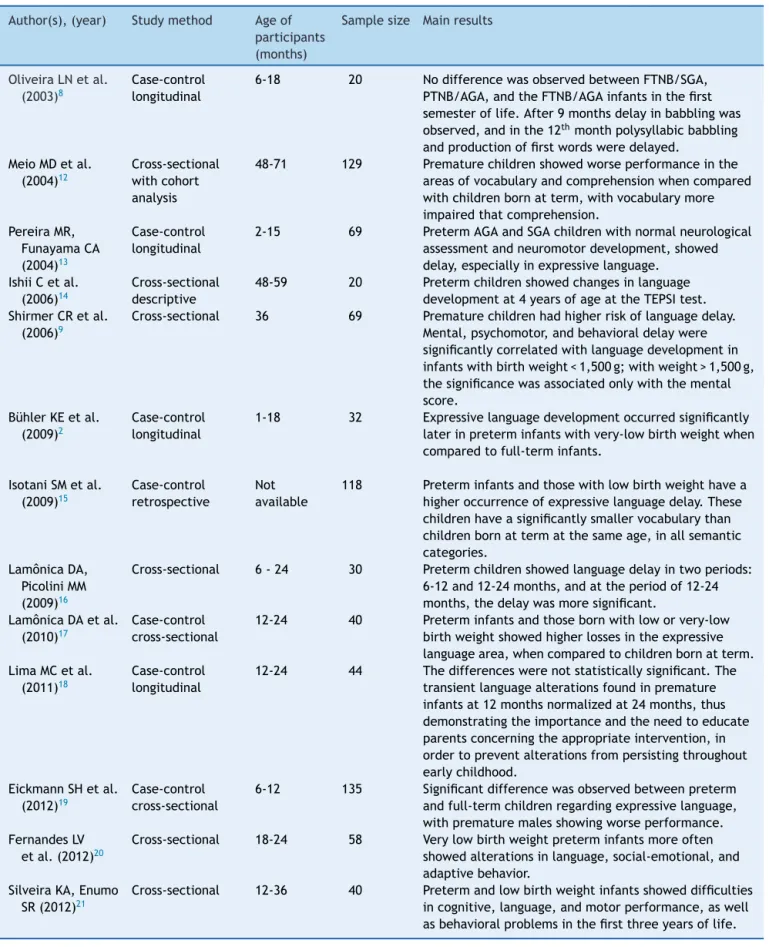
The characteristics of the studies, such asthe methodol-ogyused,ageoftheassessedchildren,andsamplesizeare describedinTable1.Mostofthestudiesassessedchildren
youngerthan2yearsandsamplesizevaried.Theyears2009
and2012featuredthegreatestnumberofarticlespublished
onthesubject.
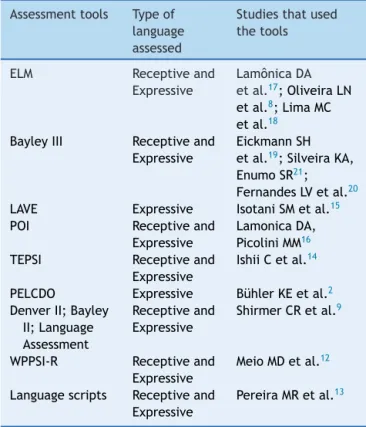
Table2describesthelanguageassessmenttoolsusedin
thestudies, demonstrating a variety of tests, scales,and
lists,amongtechniquesusedbytheauthors.
Regardingthelocationswherestudies wereconducted,
elevenwere performed in the Southeast Region, whereas
theSouthandNortheastRegionswererepresentedbyone
studyeach.2,8,9,12---21Itwasnotpossibletomakecomparisons
betweenthe results obtained in theseregions due tothe
differenceinthenumberofstudies carriedoutby region,
whichisindicativeoftheneedtoperformstudiesinother
Brazilianregions.
Language skillsof prematureinfantswereevaluatedin
twodifferentmanners by the studies: thosethat focused
onexpressive language2,15 and thosethat addressed both
receptive and expressive language.8,9,12---14,16---21 The two
studiesthatevaluatedexpressivelanguageonly2,15founda
delay in language developmentin preterm children when
comparedtochildrenbornatterm,andonefounda
signifi-cantlylowerdifferenceinthevocabularyinallthesemantic
categories.15
Inthe11studiesthatanalyzedthereceptiveand
expres-sive language, four found significant differences in both
typesoflanguage,9,12,13,17threefounddifferencesin
expres-sivelanguageonly,8,14,19twodidnotdifferentiatethetypeof
languagebutdemonstrated significant difference,16,20 and
twofoundnodifferenceinanyofthelanguagetypes.18,21
Among thosethat found significant differences in both
typesoflanguage,thedifferencefound inexpressive
lan-guage was more significant when compared to receptive
language.12,13,17 In one study that showed a significant
difference,8themostdelayedexpressivelanguageitemin
prematureinfantswasfirstwordproduction(p=0.0096).In
astudythatshowednodifferencebetweenthefull-termand
pretermchildren,18 apossibleexplanationreportedbythe
authorswastheassistanceparents receivedin the
follow-upcarriedoutattheservice,whichincludedinformationon
howtostimulatethechild’slanguage.Therefore,thereview
suggeststhatexpressivelanguagewasmoreaffected than
receptivelanguageinprematureinfants.
The language acquisition delay in these children may
be associated with brain injuries related to
neona-tal complications,8,22 with central nervous system
immaturity,8,22,23 and the child’s interaction with the
environmentandwithpeople.24Thematurationalprocesses
andtheindividual’sinteractionswiththeenvironmentare
influencedbyorganic,psychological,social,andeconomic
conditionsthatmayhaveanegativeor positiveimpacton
child development.25 Therefore, the interaction between
parent andchild becomes ofutmost importancefor child
development, especially in preterm infants. Thus, it is
veryimportantthatpediatriciansandspeechtherapistsare
awareofalltheseaspectswhenobservingthelanguageof
prematureinfants,sothat,ifnecessary,earlyreferralsand
interventionscanbeperformed.
Inthesixstudiesthatcomparedlanguagedevelopment
betweengroupsdifferentiatedbyGAorBW,9,13,15---17,21itwas
observedthatchildrenbornwithlowerGAandBWshowed
theworstresultsinlanguageassessments.Moststudiesthat
performed comparisons between groups differentiated by
GAfoundthatsamplesofpretermchildrenhadpoorer
per-formanceonlanguageassessment testswhencomparedto
childrenbornatterm,andthelowerGAwasassociatedwith
children’s lowerphrasalextent (p=0.016),15 losses in the
expressivelanguageareaat4-6monthsand10-12monthsof
age,13andlossesintheexpressivelanguageareainchildren
aged12-36months.21
Inthestudy bySchirmer etal.,9 whichusedDenverII,
Bayley II, and the Developmental Sequences of Language
Behavior by Nicolosi for evaluation, it wasobserved that
the mental, psychomotor, and behavioral development in
newbornswithBW<1,500gshowedastatisticallysignificant
associationwithlanguagedevelopment,whereasininfants
with BW>1,500g, this association remained significant in
thementalaspect.9Thus,thelanguagedevelopmentdelay
may beassociated withdelays in other areas of
develop-ment,especiallyininfantswithlowerBW.
In the three studies that compared language
assess-mentresultswithBW,15,17,21lowerBWwasassociatedwith
the worse performance in expressive language,21 lower
number of words (p=0.045), and lowerphrasal extension
(p=0.019).15 When comparing low BW with very-low BW
preterminfantsatage12-24months,infantswithverylow
BWshowedhigherlossesintheassessedareascomparedto
thosewithlowweight.17
Oliveiraetal.8comparedfull-termnewbornssmallfor
GA (FTNB/SGA) with preterm newborns adequate for GA
(PTNB/AGA)usingtheEarlyLanguageMilestone(ELM)scale.
Bothgroupshadequivalentlinguisticproductionfor
chrono-logical age up to 6 months. This result differs from that
found by Pereira and Funayama,13 whofound differences
inlanguagebetweenthegroupsattheagesof0-3months,
even those withcorrected ages.The items considered in
Table1 Descriptionofstudiesonlanguagedevelopmentinpretermchildren.
Author(s),(year) Studymethod Ageof
participants (months)
Samplesize Mainresults
OliveiraLNetal.
(2003)8
Case-control longitudinal
6-18 20 NodifferencewasobservedbetweenFTNB/SGA, PTNB/AGA,andtheFTNB/AGAinfantsinthefirst semesteroflife.After9monthsdelayinbabblingwas observed,andinthe12thmonthpolysyllabicbabbling
andproductionoffirstwordsweredelayed. MeioMDetal.
(2004)12
Cross-sectional withcohort analysis
48-71 129 Prematurechildrenshowedworseperformanceinthe areasofvocabularyandcomprehensionwhencompared withchildrenbornatterm,withvocabularymore impairedthatcomprehension.
PereiraMR, FunayamaCA (2004)13
Case-control longitudinal
2-15 69 PretermAGAandSGAchildrenwithnormalneurological assessmentandneuromotordevelopment,showed delay,especiallyinexpressivelanguage.
IshiiCetal. (2006)14
Cross-sectional descriptive
48-59 20 Pretermchildrenshowedchangesinlanguage developmentat4yearsofageattheTEPSItest. ShirmerCRetal.
(2006)9
Cross-sectional 36 69 Prematurechildrenhadhigherriskoflanguagedelay. Mental,psychomotor,andbehavioraldelaywere significantlycorrelatedwithlanguagedevelopmentin infantswithbirthweight<1,500g;withweight>1,500g, thesignificancewasassociatedonlywiththemental score.
BühlerKEetal. (2009)2
Case-control longitudinal
1-18 32 Expressivelanguagedevelopmentoccurredsignificantly laterinpreterminfantswithvery-lowbirthweightwhen comparedtofull-terminfants.
IsotaniSMetal. (2009)15
Case-control retrospective
Not available
118 Preterminfantsandthosewithlowbirthweighthavea higheroccurrenceofexpressivelanguagedelay.These childrenhaveasignificantlysmallervocabularythan childrenbornattermatthesameage,inallsemantic categories.
LamônicaDA, PicoliniMM (2009)16
Cross-sectional 6-24 30 Pretermchildrenshowedlanguagedelayintwoperiods: 6-12and12-24months,andattheperiodof12-24 months,thedelaywasmoresignificant.
LamônicaDAetal. (2010)17
Case-control cross-sectional
12-24 40 Preterminfantsandthosebornwithloworvery-low birthweightshowedhigherlossesintheexpressive languagearea,whencomparedtochildrenbornatterm. LimaMCetal.
(2011)18
Case-control longitudinal
12-24 44 Thedifferenceswerenotstatisticallysignificant.The transientlanguagealterationsfoundinpremature infantsat12monthsnormalizedat24months,thus demonstratingtheimportanceandtheneedtoeducate parentsconcerningtheappropriateintervention,in ordertopreventalterationsfrompersistingthroughout earlychildhood.
EickmannSHetal. (2012)19
Case-control cross-sectional
6-12 135 Significantdifferencewasobservedbetweenpreterm andfull-termchildrenregardingexpressivelanguage, withprematuremalesshowingworseperformance. FernandesLV
etal.(2012)20
Cross-sectional 18-24 58 Verylowbirthweightpreterminfantsmoreoften showedalterationsinlanguage,social-emotional,and adaptivebehavior.
SilveiraKA,Enumo SR(2012)21
Cross-sectional 12-36 40 Pretermandlowbirthweightinfantsshoweddifficulties incognitive,language,andmotorperformance,aswell asbehavioralproblemsinthefirstthreeyearsoflife.
Table2 Assessmenttoolsusedinthestudies.
Assessmenttools Typeof
language assessed
Studiesthatused
thetools
ELM Receptiveand
Expressive
LamônicaDA
etal.17;OliveiraLN
etal.8;LimaMC
etal.18
BayleyIII Receptiveand Expressive
EickmannSH etal.19;SilveiraKA,
EnumoSR21;
FernandesLVetal.20
LAVE Expressive IsotaniSMetal.15
POI Receptiveand Expressive
LamonicaDA, PicoliniMM16
TEPSI Receptiveand Expressive
IshiiCetal.14
PELCDO Expressive BühlerKEetal.2
DenverII;Bayley II;Language Assessment
Receptiveand Expressive
ShirmerCRetal.9
WPPSI-R Receptiveand Expressive
MeioMDetal.12
Languagescripts Receptiveand Expressive
PereiraMRetal.13
ELM,EarlyLanguageMilestonescale;LAVE,expressive vocabu-laryevaluationlist;POI,portageoperationalinventory;TEPSI, psychomotordevelopmenttest; PELCDO,protocolfor expres-sivelanguageandcognitiondevelopmentobservation;WPPSI-R, WechslerPreschoolandPrimaryScaleofIntelligence---Revised.
of up to 6 months; while the ELM scale considers smil-ingand lip vibration the firstmanifestations of language, the assessment protocol used by Pereira and Funayama13
onlyconsidersvowelemissions.Inthe9th month,theitems
assessedinbothtoolsaremoresimilarandtheresultsfound
in the two studies indicated a lower production of
bab-bling, although the ELMscale showed that these findings
alsooccurredinfull-termAGAchildren.Therefore,itis
dif-ficulttocompareresultsinlanguagestudiesbecauseofthe
differentinstrumentsusedforassessment.
Regarding the age at which premature infants showed
a more meaningful language delay, three studies
fol-lowedchildrenlongitudinallyandwereabletoanalyzethis
aspect.8,13,16Oliveiraetal.8evaluatedtheexpressive
lan-guageintwogroupsofchildren,FTNB/SGAandPTNB/AGA,
at 6, 9, 12, and 18 months and found that until the 6th
month,theinfantsshowedanormalperformancefortheir
age,andonlyinthe12thmonthwasthereastatistically
sig-nificantdelayintheFTNB/SGAgroup,whichremainedwith
polysyllabic babbling, andin the PTNB/AGAgroup,in the
productionoffirstwords.PereiraandFunayama13reviewed
children’slanguageatfivedifferentlevels:I(0-3months),
II(4-6months),III (7-9months),IV(10-12months),andV
(13-15months).
As for receptive language,preterm children had a
sig-nificantlyworse performanceat level I,and inexpressive
language,performancewasworseinlevelsIIandIV.Based
ontheseresults,childrenupto12monthsofageweremore
likelytohavelanguagedevelopmentdelays.Lamônicaand
Picolini16observedchildren’slanguageintwoperiods,6-12
monthsand12-24months,andalthoughinbothperiodsthe
results weresignificantlyworse for preterminfants, more
children hadlanguagedelay in the periodof6-12 months
thanat 12-24months.Thus,studieshave shownan
evolu-tion of preterm infants during the first twoyears of life,
withlanguagedevelopmentdrawingnearertothe
develop-mentofchildrenbornatterm.Thisdevelopmentisknown
asthe‘‘catch-upphenomenon,’’whichmayoccurwithboth
pretermandlowBWnewborns.24
Anotheraspectdiscussedinthearticleswaswhether
gen-der influenced language development.8,15,19,20 In the four
analyzedstudies,twoofthemfoundnostatistically
signif-icant difference,8,15 whereasthe othertwoindicated that
male gender wasa risk factor for alterations in language
development.19,20
Inasystematicreviewofliteraturecarriedoutinnational
andinternationaldatabasesbetweenJanuary2005andJune
2010,oneoftheaspectsanalyzedinpretermchildrenwas
language.26Atotaloftenarticleswereassociatedwith
lan-guage,andalthoughmanydidnotincludeBrazilianchildren,
acomparisonmightberelevant.VieiraandLinhares26
identi-fiedinsomestudiesthatmalegenderwasariskpredictorfor
languagedelayinprematureinfants.Thereisstillno
consen-susamongtheresults,butthereisanindicationthatmale
childrenareatincreasedriskforthelanguagedevelopment
delay.
Languageacquisitionanddevelopmentinvolvemultiple
aspects,andinadditiontothephysicalandbiological
fac-tors,itisimportanttoconsidersocialandculturalfactors
that involvevariables suchastheenvironment where the
child lives, the qualityof adult-child interaction,27---29 and
the degree of parental education and family income. In
this review, one study assessed maternal education and
per capitaincome21 and twoanalyzed parentaleducation
andfamilyincome.15,26Inonestudy,poorerperformancein
receptivelanguagewascorrelatedwithlowmaternal
edu-cationallevel.21InthereviewbyVieiraandLinhares,26 low
educationallevelwasconsideredariskfactorforlanguage
development,whereashigherfamilyincomewasa
protec-tivefactor.Isotanietal.15 foundnosignificantdifferences
betweenmaternaleducationandthechild’sexpressive
lan-guage, but when correlating income with child’s phrasal
extension,a positiveassociation wasobserved (p=0.008),
sothatthehigherthefamilyincome,thegreaterthechild’s
phrasalextension.
Childdevelopment,especiallythatrelatedtolanguage,
isgreatlyinfluencedbythesocialenvironmentinwhichthe
child lives,30,31 and low incomeand educationallevel are
variables that may be related to fewer opportunities for
interactionsbetweenadultandchild,collapseofthe
fam-ilystructure,andschoolabandonment.Therefore,children
born preterm whose families are in vulnerable situations
maybemorepronetodevelopmentalalterationsand,thus,
it is extremely important for health professionals to be
awareoftheseissues.
Conclusion
riskforlanguagedevelopmentalterations,especiallyduring earlyyears.Inthestudiesthatcomparedpretermchildren andchildrenbornatterm,therewasevidencethatpreterm childrenhadpoorerperformanceindevelopmentindicators related to language. When considering the types of lan-guage,theexpressivelanguagewasmoreimpairedthanthe receptive.
Higherparentaleducationandfamilyincomewere iden-tified as protective factors for language development, whereaslowerBWandhigherdegreeof prematuritywere identifiedasriskfactors.In thestudies thatanalyzed dif-ferentlevelsofprematurityandBW,it wasobserved that childrenbornwithlowerGAandlowerweighthadworse per-formancein languageassessment teststhanchildren with higherweightandGAcloserto37weeks.
As for theproceduresusedfor languageassessment,it wasobservedthatawidevarietyoftoolswereusedinthe studies,whichmakesitdifficulttocomparethem.Thus,the authorsemphasizetheneedforresearcherstostudythe dif-ferenttoolsinordertoselectthebestfortheirobjectives. Hence,preterminfantsandfamiliesinmorevulnerable situationsmaybemorepronetodevelopmentalterations. Considering this issue is of utmost importance, health services have developed actions to follow these children regardinglanguagedevelopment.Thus,itisessential that pediatriciansbeawareofthelanguagedevelopmentinthese childrensothatadequatetreatmentcanbeprovided.
Conflicts
of
interest
Theauthorsdeclarenoconflictsofinterest.
Acknowledgments
ToallgraduatestudentsandprofessorsofthePostgraduate Programin Child andAdolescent Health of UNICAMP, who helpedreviewthismanuscript.
References
1.Brasil.Ministério da Saúde. Secretaria de Atenc¸ão à Saúde. DepartamentodeAc¸õesProgramáticasEstratégicas.Atenc¸ãoà saúdedorecém-nascido: guiaparaosprofissionaisdesaúde. MinistériodaSaúde,SecretariadeAtenc¸ãoàSaúde, Departa-mentode Ac¸õesProgramáticasEstratégicas.2nd ed.Brasília: MinistériodaSaúde,2012.4v.:il-SérieA.NormaseManuais Técnicos.
2.BühlerKE,LimongiSC,DinizEM.Languageandcognitioninvery lowbirthweightpreterminfantswithPELCDOapplication.Arq Neuropsiquiatr.2009;67:242---9.
3.DaSilva ES,NunesML.The influenceofgestational ageand birth weight in the clinical assessment of the muscle tone ofhealthy term and pretermnewborns. Arq Neuropsiquiatr. 2005;63:956---62.
4.Silveira MF, Santos I, Barros AJ, Matijasevich A, Barros FC, Victora CG. Increase in preterm births in Brazil: review of population-basedstudies.RevSaudePublica.2008;42:957---64. 5.RugoloLM.Crescimentoedesenvolvimentoa longoprazodo
prematuroextremo.JPediatr(RioJ).2005;8:S101---10. 6.McCormick MC. The contribution of low birth weight to
infant mortality and childhood morbidity. N Engl J Med. 1985;312:82---90.
7.Vohr BR, Wright LL, Dusick AM, Mele L, Verter J, Steichen JJ, et al. Neurodevelopmental and functional outcomes of extremelylowbirthweightinfantsintheNationalInstituteof ChildHealthandHumanDevelopmentNeonatalResearch Net-work,1993-1994.Pediatrics.2000;105:1216---26.
8.Oliveira LN, Lima MC, Gonc¸alves VM. Follow-up of low birthweightinfants:languageacquisition.ArqNeuropsiquiatr. 2003;61:802---7.
9.SchirmerCR,PortuguezMW,NunesML.Clinicalassessmentof languagedevelopmentinchildrenatage3yearsthatwereborn preterm.ArqNeuropsiquiatr.2006;64:926---31.
10.DoyleLW,RobertsG,AndersonPJ,VictorianInfantCollaborative StudyGroup.Outcomesatage2yearsofinfants<28weeks’ gestationalageborninVictoriain2005. JPediatr. 2010;156: 49---53.
11.LeoneCR,RamosJL.FAVOrecémnascidopré-termo.In: Mar-condesE,VazFA,RamosJL,OkayY,editors.Pediatriabásica. 9thed.SãoPaulo:Savier;2002.
12.MeioMD,LopesCS,MorschDS,MonteiroAP,RochaSB,Borges RA, etal.Desenvolvimentocognitivodecrianc¸asprematuras de muito baixo peso naidade pré-escolar. JPediatr (RioJ). 2004;80:495---502.
13.PereiraMR,FunayamaCA.Evaluationofsomeaspectsofthe acquisitionanddevelopmentoflanguageinpre-termborn chil-dren.ArqNeuropsiquiatr.2004;62(3a):641---8.
14.IshiiC,MirandaCS, IsotaniSM,Perissinoto J.Caracterizac¸ão de comportamentos lingüísticos de crianc¸as nascidas pre-maturas, aos quatro anos de idade. Rev CEFAC. 2006;8: 147---54.
15.IsotaniSM, AzevedoMF, Chiari BM, Perissinoto J.Expressive languageoftwoyear-oldpre-termandfull-termchildren.Pro Fono.2009;21:155---9.
16.LamonicaDA,PicoloniMM.Habilidadesdodesenvolvimentode prematuros.RevCEFAC.2009;11:145---53.
17.LamônicaDA,CarlinoFC,AlvarengaKdeF.Assessmentof recep-tiveandexpressiveauditoryand visualfunctionsinpre-term children.ProFono.2010;22:19---24.
18.LimaMC,RuivoNG,CasaliRL,Franc¸ozoMdeC,Colella-Santos MF,AlvesMC.Comparac¸ãododesenvolvimentodalinguagemde crianc¸asnascidasatermoepré-termocomindicadoresderisco parasurdez.Distúrbcomun.2011;23:297---306.
19.EickmannSH,MalkesNF,LimaMeC.Psychomotordevelopment of preterm infants aged 6 to 12 months. Sao Paulo Med J. 2012;130:299---306.
20.FernandesLV,Goulart AL, SantosAM,BarrosMC, GuerraCC, KopelmanBI.Neurodevelopmentalassessmentofverylowbirth weightpreterminfantsatcorrected ageof18-24months by BayleyIIIscales.JPediatr(RioJ).2012;88:471---8.
21.Silveira KA, EnumoSR. Riscos biopsicossociaispara o desen-volvimentodecrianc¸asprematurasecombaixopeso.Paidéia. 2012;22:335---45.
22.Maria-Mengel MR. Martins Linhares MB. Risk factors for infant developmental problems. Rev Lat Am Enfermagem. 2007;15:837---42.
23.Foster-Cohen S, Edgin JO, Champion PR, Woodward LJ. Earlydelayedlanguagedevelopmentinverypreterminfants: evidence from the MacArthur-Bates CDI. J Child Lang. 2007;34:655---75.
24.PerissinotoJ, IsotaniS. Desenvolvimentodalinguagem: pro-grama de acompanhamento de recém nascidosde risco. In: HernandezAM,editor.Conhecimentosessenciaisparaatender bem o neonato.Pulso: São José dos Campos (SP); 2003. p. 113---21.
25.RutterM,SroufeLA.Developmentalpsychopathology:concepts andchallenges.DevPsychopathol.2000;12:265---96.
27.BrocchiBS,Leme MI.A relac¸ãoentreinterac¸ãomãe-crianc¸a nodesenvolvimentodalinguagemoralderecém-nascidos pre-maturos.ACR.2013;18:321---31.
28.KleinVC,LinharesMB.Prematuridadeeinterac¸ãomãe-crianc¸a: revisãosistemáticadaliteratura.PsicolEstud.2006;11:277---84. 29.Scopel RR, Souza VC, Lemos SM. A influência do ambi-ente familiar e escolar na aquisic¸ão e no desenvolvimento
da linguagem: revisão de literatura. Rev CEFAC. 2012;14: 732---41.
30.Vygotsky LS. Aprendizado e desenvolvimento. Um processo sócio-histórico.4thed.SãoPaulo:Scipione;2003.