Screening of cognitive impairment
by general internists using
two simple instruments
Alessandro Ferrari Jacinto1, Sonia Maria Dozzi Brucki1, Claudia Sellitto Porto2, Milton de Arruda Martins3, Ricardo Nitrini1
ABSTRACT. General internists (GIs) tend to overlook cognitive impairment in the elderly. Lack of time to diagnose and/
or poor knowledge on how to use screening instruments may be the reasons for this shortcoming. Objectives: To verify the efficacy of simple instruments in the screening of cognitive impairment in elders. Methods: In a previous study, 248 patients aged ≥65 that had been assisted by GIs within outpatient services of a public university hospital in São Paulo, Brazil, were evaluated. The Mini-Mental State Examination and/or the Informant Questionnaire on Cognitive Decline in the Elderly (short-IQCODE) were employed to classify patients into probable cognitively impaired cases or otherwise. Other tests and questionnaires were also applied, but were not used to perform this classification. After full assessment and consensus meetings, cases were classified into dementia, cognitively impaired not demented, and without cognitive impairment. In this study, the sensitivity and specificity of the combined use of the category fluency test (CFT) and the Functional Activities Questionnaire (FAQ) was evaluated as if used as screening instruments for the whole sample. Results: The combined use of the CFT and/or FAQ showed sensitivity of 88.3% and specificity of 76.5% in the screening of cognitive impairment for the whole sample. Conclusions: Two simple and easy-to-apply instruments showed high sensitivity and reasonable specificity, and are probably useful for the screening of cognitive impairment in the elderly in outpatient services.
Key words: screening, dementia, cognitive impairment, questionnaire, functional activity, verbal fluency, general internists.
RASTREIO DE COMPROMETIMENTO COGNITIVO POR MÉDICOS GENERALISTAS COM DOIS INSTRUMENTOS SIMPLES RESUMO. Médicos generalistas (MGs) normalmente não detectam comprometimento cognitivo em idosos. Falta de tempo
para realizar a triagem de comprometimento cognitivo e pouco conhecimento sobre a forma de realizá-la podem ser as razões desta falha. Objetivos: Verificar a eficácia de instrumentos simples no rastreio de comprometimento cognitivo em idosos. Métodos: Em um estudo prévio, 248 pacientes com idade ≥65, que tinham sido assistidos por MGs em serviços ambulatoriais de um hospital universitário público em São Paulo, Brasil, foram avaliados. O Mini-Exame do Estado Mental e/ou o Questionário com Informante sobre Declínio Cognitivo em Idosos (Short-IQCODE) foram utilizados para classificar os pacientes em casos prováveis de cognição prejudicada ou não. Outros testes e questionários também foram aplicados, mas não foram usados para esta classificação. Depois de avaliação completa e reuniões de consenso, os casos foram classificados como demência, cognição alterada não demência e sem comprometimento cognitivo. Neste estudo avaliamos a sensibilidade e a especificidade do uso de dois instrumentos, o teste de fluência verbal (TFV) e o Questionário de Atividades Funcionais (QAF), se eles tivessem sido empregados como instrumentos de rastreio para toda a amostra. Resultados: O uso combinado do TFV e/ou do QAF mostrou sensibilidade de 88,3% e especificidade de 76,5% no rastreio de comprometimento cognitivo em toda a amostra. Conclusões: Dois instrumentos simples e de fácil aplicação mostraram alta sensibilidade e razoável especificidade e são provavelmente úteis para o rastreio de comprometimento cognitivo de idosos em ambulatórios.
Palavras-chave: rastreio, demência, comprometimento cognitivo, questionário, atividade funcional, fluência verbal, médico generalista.
1MD, PhD, Behavioral and Cognitive Neurology Unit, Department of Neurology, University of São Paulo School of Medicine (FMUSP), São Paulo SP, Brazil. 2PhD,
Behavioral and Cognitive Neurology Unit, Department of Neurology, FMUSP. 3MD, PhD, Department of Internal Medicine, FMUSP.
INTRODUCTION
G
eneral internists (GIs) follow elderly patients atdif-ferent levels of health care settings and this prac-tice has become increasingly frequent as populations
become older in many countries.1 Cognitive
impair-ment is very common among elders and its early diag-nosis might be important considering the possibility of
potentially reversible conditions2 and also the prospect
of receiving adequate interdisciplinary assessment and treatment when dementia due to neurodegenerative disease is diagnosed. In addition, having patients and caregivers’ futures well-planned regarding legal matters
is an important issue in this context.3,4
Previous studies have shown that GIs overlook
cog-nitive impairment in the elderly.5,6 Lack of time to
prop-erly perform a global assessment in which cognitive impairment screening is one of the most important is-sues, or even poor knowledge about dementia might be obstacles preventing adequate diagnosis of these
condi-tions by GIs.7,8
It would be useful for GIs to apply brief instruments that did not demand complex materials in their work-ing sets. he Category Fluency Test (CFT) seems to be
a useful tool in this situation.9,10 his test entails
ask-ing the patient to cite as many items (animals or fruits are the most used) as possible in one minute, and the instrument has been previously studied in the
Brazil-ian population.11,12 Our aim in this study was to verify
the sensitivity and speciicity of this one-minute test in the detection of cognitive impairment in elders followed by GIs. Also, the hypothesis of whether the use of this instrument in combination with a questionnaire (the
Functional Activities Questionnaire)13 increases the
sensitivity and speciicity of the screening of cognitive impairment in elders followed by GIs was tested.
METHODS
In this study, data was drawn from a previous study as-sessing the accuracy of GIs in the diagnosis of cognitive impairment in the elderly, whose methods have been
reported elsewhere.14 Briely, 248 patients aged 65 or
older that had been assisted by GIs were evaluated. In the assessment, subjective memory complaints, medical antecedents and use of medications were re-corded, and the following tests and questionnaires were employed: the Mini Mental State Examination
(MMSE),15,16 short version of the Informant
Question-naire on Cognitive Decline in the Elderly
(Short-IQ-CODE),17 Brief Screening Cognitive Battery (the
Cat-egory Verbal Fluency is included in this battery),18,19
Functional Activities Questionnaire (FAQ),13 Forward
and Backward Digit Span and the 15-item Geriatric
De-pression Scale (GDS).20 Short-IQCODE and/or MMSE
scores were used to classify patients into probable cog-nitively impaired cases or otherwise using cut-of scores previously suggested for the Brazilian population. For the MMSE, cut-of scores were 18 for illiterates, 22 for those with 1-4 years of education, 24 for 5-8 years, 26 for 9-11 years and 27 for those with 12 or more years of
ed-ucation.16 For the Short-IQCODE, the cut-of score used
was 3.41.21 Probable cases underwent
neuropsychologi-cal evaluation using the Dementia Rating Sneuropsychologi-cale,22,23
lab-oratory tests (blood count, thyroid hormones, syphilis serology, liver function, kidney function, vitamin B12 and folic acid levels), and a brain computed tomography
(CT) scan.23
Final diagnoses were established in a consensus meeting with the presence of two neurologists special-ized in dementia (SMDB, RN) and the geriatrician who had evaluated the patients (AFJ), using all available data. he probable cases and a sample of 53 patients considered as not cognitively impaired based on the MMSE and/or Short-IQCODE scores were evaluated on the basis of clinical data, performances on neuropsycho-logical tests and questionnaires for all subjects, as well as laboratory and CT results for probable cases. Patients were classiied into cases with dementia, cognitively impaired not demented (CIND), and without cognitive
impairment (WCI).23-25 Of the 248 elderly patients, 52
were classiied as cognitively impaired (21 had a inal diagnosis of dementia, 22 CIND while nine cases were considered not cognitively impaired). All 53 individuals classiied as not cognitively impaired by the screening instruments had the inal diagnosis of WCI in the con-sensus meeting. he speciicity of the screening method (MMSE and/or Short-IQCODE) was 100% whereas the sensitivity was 82.7%.
he sensitivities, speciicities and cut-of scores of the category luency test (CFT) and FAQ for the diagno-sis of cognitive impairment were obtained by compar-ing cases with the inal diagnoses of CIND or dementia against the 53 WCI cases. Subsequently, the CFT and FAQ, adopting the cut-of scores deined above, were retrospectively applied to the entire sample of 248 el-ders to evaluate the accuracy of the association of both instruments for the screening of cognitive impairment. he Research Ethics Committee of the Hospital das Clínicas of the University of São Paulo Medical School, Brazil approved this study.
Windows and “R: A Language and Environment for Statistical Computing”. ROC curves were used to obtain sensitivities and speciicities of the CFT and FAQ. Lo-gistic regression was employed to obtain a compounded score for the FAQ and CFT used to determine sensitivity and speciicity of the combined instruments based on the ROC curve. Five comparisons were made in order to attain sensitivities and speciicities of the CFT, FAQ and both instruments combined. hese comparisons were CIND × WCI, dementia × WCI, dementia + CIND × WCI, dementia × CIND + WCI and dementia × CIND. he ac-cepted level of signiicance was set at 0.05.
RESULTS
Demographic data of dementia, CIND and WCI groups are shown in Table 1.
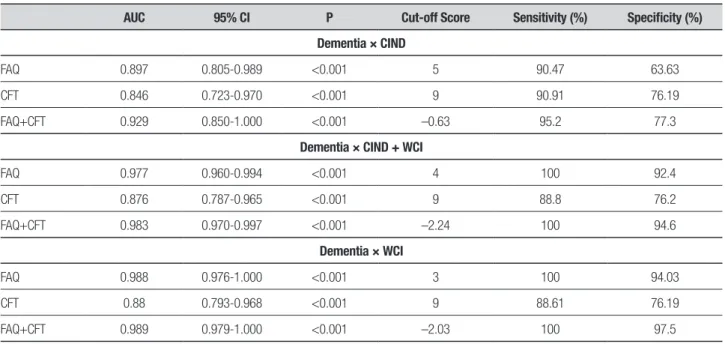
he sensitivities and speciicities of the CFT, FAQ and both instruments combined, are given in Tables 2, 3.
When distinguishing CIND from WCI, the FAQ showed higher sensitivity and speciicity than the CFT, even compared with the combination of both instruments.
For distinguishing all possible types of cognitive impairment (dementia and CIND), the FAQ again had greater eicacy than the CFT, although the combina-tion of both instruments showed higher sensitivity and speciicity.
Regarding dementia and CIND, the CFT showed similar sensitivity and speciicity to the FAQ. he com-bination of both instruments increased the eicacy of distinguishing demented from CIND individuals.
For discriminating dementia from CIND and WCI individuals, the FAQ showed greater eicacy than the CFT but the combination of both showed higher sensi-tivity and speciicity compared to performance of each instrument alone.
For distinguishing only dementia individuals from normal subjects, the FAQ showed greater eicacy than the CFT. Similarly, the combination of both tests yielded higher sensitivity and speciicity compared to perfor-mance of each test used alone.
Applied as screening instruments with the cut-of scores suggested in Table 2, the FAQ and/or CFT would have classiied 38 out of the 43 with cognitive
impair-Table 1. Demographic data of patients with dementia, cognitively impaired not demented (CIND) and individuals without cognitive impairment (WCI).
WCI (N=202) CIND (N=22) Dementia (N=21) P* Multiple comparisons†
Age (median) 70 69.5 72
0.28 D=CIND=WCI
IQI (67-74) (67-73.3) (67-75.5)
Years of schooling (median) 4 4 2
0.02
D=CIND D<WCI CIND=WCI
IQI (2-8) (2-8.3) (2-4)
*Kruskall-Wallis test; †Dunn’s post hoc test; IQI: inter quartile interval; CIND: cognitively impaired not demented; WCI: without cognitive impairment; D: dementia.
Table 2. Sensitivities and specificities of FAQ, CFT, and FAQ combined with CFT.
AUC 95% CI P Cut-off Scores Sensitivity (%) Specificity (%)
CIND × WCI
FAQ 0.909 0.836-0.983 <0.001 1 90.9 89.1
CFT 0.678 0.578-0.778 0.006 11 56.4 77.3
FAQ+CFT 0.926 0.882-0.969 <0.001 –2.54 86.4 80.6
Dementia + CIND × WCI
FAQ 0.945 0.902-0.988 <0.001 2 88.4 90.3
CFT 0.777 0.701-0.853 <0.001 10 71.3 69.8
FAQ+CFT 0.957 0.930-0.983 <0.001 –1.43 90.7 94
Table 3. Sensitivities and specificities of FAQ, CFT, and FAQ combined with CFT.
AUC 95% CI P Cut-off Score Sensitivity (%) Specificity (%)
Dementia × CIND
FAQ 0.897 0.805-0.989 <0.001 5 90.47 63.63
CFT 0.846 0.723-0.970 <0.001 9 90.91 76.19
FAQ+CFT 0.929 0.850-1.000 <0.001 –0.63 95.2 77.3
Dementia × CIND + WCI
FAQ 0.977 0.960-0.994 <0.001 4 100 92.4
CFT 0.876 0.787-0.965 <0.001 9 88.8 76.2
FAQ+CFT 0.983 0.970-0.997 <0.001 –2.24 100 94.6
Dementia × WCI
FAQ 0.988 0.976-1.000 <0.001 3 100 94.03
CFT 0.88 0.793-0.968 <0.001 9 88.61 76.19
FAQ+CFT 0.989 0.979-1.000 <0.001 –2.03 100 97.5
AUC: area under curve; CIND: cognitively impaired not demented; WCI: without cognitive impairment; FAQ: Functional Activities Questionnaire; CFT: Category Fluency Test.
ment as cognitively impaired after consensus (sensitivity of 88.3%). he FAQ and/or CFT would have classiied as cognitively impaired 48 out of the 205 patients without cognitive impairment (speciicity of 76.5%) (Table 4).
Applied as screening instruments with the cut-of scores suggested in Table 2, the FAQ and CFT would have classiied 38 out of the 43 with cognitive impair-ment as cognitively impaired after consensus (sensitiv-ity of 88.3%). he FAQ and CFT would have classiied 48 out of 205 patients without cognitive impairment as cognitively impaired (speciicity of 76.5%).
DISCUSSION
In the present study, the FAQ had greater eicacy than the CFT for distinguishing CIND from WCI individuals. he same was observed for dementia, except when dis-tinguishing dementia from CIND individuals. All sensi-tivities and speciicities improved when FAQ and CFT were used together.
he CFT would likely be the better instrument for use in GIs’ working sets since it is quick and easy to
apply.26
Duf et al.10 studied the eicacy of the CFT for
de-tecting dementia in groups previously classiied for cog-nitive impairment and found that the CFT was useful in the setting of their study; a cut-of score of 15 had a sensitivity of 87% and speciicity of 96%. In comparison to the Duf et al. study, the present study found
over-all similar sensitivities but slightly lower speciicities Figure 1. Area under the curve for dementia + CIND × WCI.
Functional Activities Questionnaire - Pfeffer
Verbal Fluency Test Animal Category
FAQ + VFT
Reference Line 1.0
0.8
0.6
0.4
0.2
0.0
Sensitivity
1 - Specificity
0.0 0.2 0.4 0.6 0.8 1.0
FAQ: functional activities questionnaire; VFT = CFT: category fluency test
Table 4. Functional Activities Questionnaire (FAQ) and category fluency test (CFT) as screening instruments.
FAQ above AND/OR CFT below cut-off scores
Cognitive impairment (final diagnosis after consensus)
Present Absent Total
Yes 38 48 86
No 5 157 162
Total 43 205 248
when CFT was used alone. Compared to the study by Duf et at., our study on the CFT showed lower eicacy in detecting CIND cases. Also, cut-of scores of the CFT difered, probably due to lower education in Brazilian
populations. Brucki et al.11,12 and Caramelli et al.27 also
studied the CFT in a Brazilian populations and proposed cut-of scores according to educational levels.
he FAQ version currently used in Brazil28,29 is a
simple instrument and informants are usually able to complete the questionnaire without help from the phy-sician. In the GIs’ outpatient services, site attendants could hand FAQ sheets to the informant before physi-cian’s consultation and any doubt could be resolved at the end of the appointment in order to save time. In Brazil, it is uncommon for elders to visit an outpatient service without an accompanying person, usually a rela-tive. However, when an informant is not available,
pa-tients themselves may be able to complete the FAQ.30
In Brazil, as in several other countries worldwide, GIs are the health care professionals who routinely follow elderly patients but this group of physicians often over-looks cognitive impairment in this population. Cross-sectional studies of primary care physicians have found that a large number of cognitive impairment cases had
not been detected by GIs.26 here may be several reasons
for cognitive impairment being overlooked by GIs6,8
and one explanation proposed cites insuicient train-ing on dementia issues given to GIs on their medical
graduate programs.8 In Canada and Australia, Lorentz
et al. showed that GIs felt that applying cognitive tests in their work settings (a large number of patients and short period to attend them) was not viable since these instruments are very complex and time-consuming to
apply.31 However, this is not the case for the simple
com-bination of tests proposed in this work.
he most important limitation of this study was the use of cut-of scores of the CFT and FAQ obtained from part of the same sample for which sensitivity and speci-icity of these screening instruments were investigated. Future studies are needed applying these two screening instruments combined to another sample in order to conirm whether this association holds.
In GIs’ working sets, the CFT combined with the FAQ could be useful for cognitive impairment screening in the elderly. his combination showed high sensitiv-ity although only moderate speciicsensitiv-ity. his means that most cases of cognitive impairment would be detected by these instruments, although around one-fourth of suspected cases would be included in excess and require further evaluation.
REFERENCES
1. Rodrigues MA, Facchini LA, Piccini RX, Tomasi E, Thumé E, Silveira DS, et al. Use of outpatient services by the elderly in the South and North-east of Brazil. Cad Saude Publica 2008;24:2267-2278.
2. Takada LT, Caramelli P, Radanovic M, Anghinah R, Hartmann AP, Guari-glia CC, et al. Prevalence of potentially reversible dementias in a demen-tia outpatient clinic of terdemen-tiary university-afiliated hospital in Brazil. Arq Neuropsiquiatr 2003;6:925-929.
3. Wimo A, Winblad B, Jönsson L. The worldwide societal costs of de-mentia: estimates for 2009. Alzheimers Dement 2010;6:98-103. 4. Boustani M, Peterson B, Hanson L. Harris R, Lohr KN. Screening for
dementia in the primary care: a summary of the evidence for the US preventive services task force. Ann Intern Med 2003;138:927-937. 5. Valcour VG, Masaki H, Curb JD, Blanchette PL. The detection of
de-mentia in the primary care setting. Arch Int Med 2000;160:2964-2968. 6. Barret JJ, Haley WE, Harrel LE, Powers RE. Knowledge about Alzheim-er’s disease among primary care physicians, psychologists, nurses and social workers. Alzheimer Dis Assoc Disord 1997;11:99-106. 7. Henriques SG, Fráguas R, Iosifescu DV, Menezes PR, Lucia MC, Gattaz
WF, Martins MA. Recognition of depressive symptoms by physicians. Clinics 2009;64:629-635.
8. Renshaw J, Scurield LC, Cloke L, Orrel M. General practitioner’s views on the early diagnosis of dementia. Br J Gen Pract. 2001;51:37-38. 9. Cummings JL. The one-minute mental status examination. Neurology
2004;62:534-535.
10. Duff Canning SJ, Leach L, Stuss D, Ngo L, Black SE. Diagnostic util-ity of abbreviated luency measures in Alzheimer disease and vascular dementia. Neurology 2004;62:556-562.
11. Brucki SMD, Malheiros SMF, Okamoto IH, Bertolucci PHF. Normative data on the verbal luency test in the animal category in our milieu Arq Neuropsiquiatr 1997;55:56-61.
12. Brucki SMD, Rocha MSG. Category luency test: effects of age, gender and education on total scores, clustering and switching in Brazilian
Por-tuguese-speaking subjects. Brazilian Journal of Medical and Biological Research 2004;37:1771-1777.
13. Pfeffer RI, Kurosaki TT, Harrah Jr CH, Chance JM, Filos S. Measure-ment of functional activities in older adults in the community. J Gerontol 1982;37:323-329.
14. Jacinto AF, Brucki S, Porto CS, Martins MA, Nitrini R. Detection of cog-nitive impairment in the elderly by general internists in Brazil. Clinics 2011;66:1379-1384.
15. Folstein MF, Folstein SE, McHugh PR. “Mini-mental state”: a practi-cal method for grading the cognitive state of patients for the clinician. J Psychiatr Res 1975;12:189-198.
16. Brucki SMD, Nitrini R, Caramelli P, Bertolucci PH, Okamoto IH. Sug-gestions for utilization of the mini-mental state examination in Brazil. Arq Neuropsiquiatr 2003;61:777-781.
17. Jorm AF. A short form of the Informant Questionnaire on Cognitive Decline in the Elderly (IQCODE): development and cross-validation. Psychol Med 1994;24:145-153.
18. Nitrini R, Caramelli P, Herrera Júnior E, Porto CS, Charchat-Fichman H, Carthery MT, et al. Performance of illiterate and literate nondemented elderly subjects in two tests of long-term memory. J Int Neuropsychol Soc 2004;10:634-638
19. Takada LT, Caramelli P, Fichman HC, Porto CS, Bahia VS, Anghinah R, et al. Comparison between two tests of delayed recall for the diagnosis of dementia. Arq Neuropsiquiatr 2006;64:35-40.
20. Sheikh JI, Yesavage JA. Geriatric depression scale (GDS): recent evidence and development of a shorter version. Clin Gerontol. 1986;5: 165-173.
21. Bustamante SEZ, Bottino CMC, Lopes MA, et al. Combined instru-ments on the evaluation of dementia in the elderly: preliminary results. Arq Neuropsiquiatr 2003;61:601-606.
23. Porto CS, Fichman HC, Caramelli P, Bahia VS, Nitrini R. Brazilian version of the Mattis dementia rating scale: diagnosis of mild dementia in Alzheimer’s disease. Arq Neuropsiquiatr 2003;61:339-345. 24. Nitrini R, Caramelli P, Bottino CM, Damasceno BP, Brucki SM,
Ang-hinah R. Diagnosis of Alzheimer’s disease in Brazil: diagnostic criteria and auxiliary tests. Recommendations of the Scientiic Department of Cognitive Neurology and Aging of the Brazilian Academy of Neurology. Arq Neuropsiquiatr 2005;63:713-919.
25. American Psychiatry Association. Diagnostic and Statistical Manual of Mental Disorders. 4th ed. Washington (DC): American Psychiatric Press;
1994.
26. Ebly EM, Hogan DB, Parhad IM. Cognitive impairment in the nonde-mented elderly: results from the Canadian Study of Health and Aging. Arch Neurol 1995;52:612-9.
27. Caramelli P, Carthery-Goulart MT, Porto CS, Charchat-Fichman H, Nitrini R. Category luency as a screening test for Alzheimer disease in illiterate and literate patients. Alzheimer Dis Assoc Disord 2007;21: 65-67.
28. Quiroga P, Albala C, Klaasen G. Validación de un test de tamizaje para el diagnóstico de demencia asociada a edad, en Chile. Rev Med Chile 2004;132:467-478.
29. Nitrini R. Editorial. Dement Neuropsychol 2007;3:225.
30. Bressan LA, Vale FAC, Speciali JG. The daily life of patients with de-mentia: a comparative study between the information provided by the caregiver and direct patient assessment. Dement Neuropsychol 2007; 1:288-295.