Short IQCODE as a screening tool
for MCI and dementia
Preliminary results
Tíbor Rilho Perroco, Antonio Eduardo Damin, Norberto A. Frota,
Mari-Nilva M. Silva, Viviane Rossi, Ricardo Nitrini, Cássio M.C. Bottino
Abstract – Reaching a diagnosis may be difficult in the initial stages of dementia, especially in low educated individuals, when informant reports may be useful. Objectives: To compare the sensitivity and specificity of the IQCODE against cognitive tests applied in clinical practice and to evaluate the possible cut-off points in Brazil.
Methods: Individuals without dementia (CDR=0; N=5), with Mild Cognitive Impairment (MCI) (CDR=0.5; N=15) and demented (CDR≥1; N=29) were evaluated using the Short IQCODE, a 16-item questionnaire applied to an informant, and on standard cognitive and functional scales. Diagnosis was reached by a consensus team with expertise in dementia, according to DSM-IV criteria, which was blind to the IQCODE results. Results:
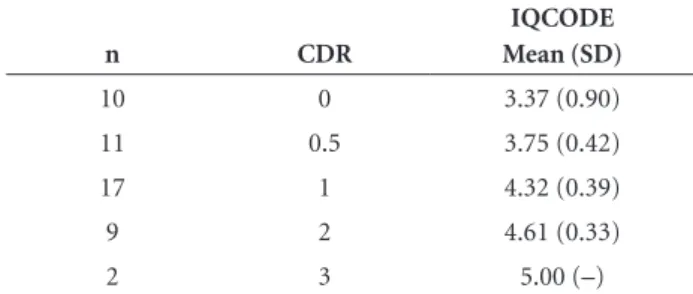
IQCODE scores were positively correlated to the CDR (r=0.65, p<0.001) and negatively correlated with years of schooling (r= –0.33, p=0.021). IQCODE scores were positively correlated with CDR controlled by age and education (r=0.61, p<0.001). Linear regression showed that age was associated with the IQCODE (p=0.016) whereas education was not associated (p=0.078). IQCODE means according to the CDR classification were: CDR 0–3.37; CDR 0.5–3.75; CDR 1–4.32; CDR 2–4.61; CDR 3–5.00. The area under the ROC curve for dementia vs. controls was 0.869 (p<0.001), MCI vs. controls, 0.821 (p<0.001); and according to the groups classified by the CDR was: CDR 0.5 vs. CDR 1=0.649 (p=0.089), CDR 1 vs. CDR 2=0.779 (p=0.009), and CDR 2 vs. CDR 3=0.979 (p=0.023). Conclusions: These preliminary findings suggest that the short IQCODE can be used for the screening of MCI and dementia in Brazil.
Key words: dementia, diagnosis, cognitive test, functional scales, screening tests, informant report.
IQCODE reduzido no screening de MCI e demencia: resultados preliminares
Resumo – O diagnóstico pode ser difícil em estágios iniciais de demência, especialmente em população de baixa escolaridade, quando os relatos de informantes podem ser úteis. Objetivo: Comparar a sensibilidade e especificidade do IQCODE com outros testes e diagnóstico clinico, assim como identificar os possíveis pontos de corte no Brasil.
Métodos: Indivíduos sem demência (CDR=0; N=5), com comprometimento cognitivo leve (MCI) (CDR=0,5; N=15) e dementados (CDR≥1; N=29) foram avaliados usando o IQCODE reduzido, um questionário de 16 itens aplicado ao informante, e escalas cognitivas e funcionais padrões. Diagnóstico final foi fornecido por consenso de especialistas, com experiência em demência, de acordo com os critérios do DSM-IV, e cegos quanto ao resultado do IQCODE. Resultados: IQCODE tem uma correlação positiva com o CDR (r=0.65, p<0.001) e negativa com anos de escolaridade (r= –0.33, p=0.021). IQCODE mantêm correlação positiva com o CDR quando controlado por idade e escolaridade (r=0.61, p<0.001). Na regressão linear a idade continuou a afetar o resultado do IQCODE (p=0.016) enquanto a escolaridade não (p=0.078). Médias do IQCODE de acordo com a classificação do CDR: CDR 0–3.37; CDR 0.5–3.75; CDR 1–4.32; CDR 2–4.61; CDR 3–5.00. A área sob a curva ROC para demência vs. controles foi 0.869 (p<0.001), MCI vs. controles, 0.821 (p<0.001) e de acordo com os CDR foi: CDR 0.5 vs. CDR 1=0.649 (p=0.089), CDR 1 vs. CDR 2=0.779 (p=0.009) e CDR 2 vs. CDR 3 =0.979 (p=0.023). Conclusão: Esses achados preliminares sugerem que o IQCODE Curto pode ser usado como instrumento de triagem para MCI e demência no Brasil.
Key words: demência, diagnóstico, teste cognitivo, escalas funcionais, testes de rastreio, relatos de informante.
CEREDIC and Old Age Research Group (PROTER), Department of Neurology and Institute and Department of Psychiatry, Faculty of Medicine, Uni-versity of São Paulo.
Tíbor Rilho Perroco – Old Age Research Group (Proter) / Institute of Psychiatry / University of São Paulo Medical School / CEAPESQ / sala 14 - R. Dr. Ovídio Pires de Campos 785 / 3º andar - 05403-010 São Paulo SP - Brazil. E-mail: [email protected] and [email protected]
Screening tests are essential in the investigation of
pa-tients with suspected dementia. As the population ages and
dementia prevalence and incidence rates increase,
1such
tests have become even more important.
Some screening tests entail cognitive assessments
per-formed directly with the patient while others are based on
information provided by the proxy (or family member).
2Studies have shown that the association of both
cogni-tive test and informant report is an effeccogni-tive dementia
screening method,
3,4yielding increased sensitivity and
specificity of the instruments than when used
indepen-dently. However, in some cases the patient is unable to
provide information properly, due to severe disease,
re-fusal to cooperate, or because the patient has a very low
educational level.
5,6In such cases, indirect assessments,
performed only with the informant, play a major role in
clinical practice, especially in developing countries where
the mean educational level is often lower than that found
in developed countries.
6Ideally, screening tests must be brief, easily adapted,
with a high reproducibility level between different raters
and cultures, and show little influence from educational
level. Unfortunately, many of the current tests do not meet
these premises, or are long and often require training prior
to their application.
7In this context, a brief screening test
applied to the informant, the IQCODE,
8was evaluated to
verify the efficacy of its long and short versions adapted
for use in Brazil.
The IQCODE was originally developed as an interview
with informant.
9A total of 39 initial items were reduced to
26, making the test faster and more suited for application.
The informant is asked about issues regarding changes in
the subject’s memory, cognition and language ability over
the last ten years. The items on the IQCODE are rated on
a five-point scale, where 1 indicates “much better” and 5
indicates “much worse”. The final score is the average of
the rated item scores.
There are versions in numerous languages,
includ-ing Chinese, German, Finnish, French, Canadian French,
Dutch, Italian,
10Japanese, Korean, Norwegian, Polish,
Spanish, and Thai.
11Many short versions have been
evalu-ated, with differences in number of items. Sixteen-item
versions in English
12and German
13and a 17-item version
in Spanish
14have been validated.
This aim of this preliminary report was to evaluate the
performance of a 16-item, short (S) Brazilian version of
the Informant Questionnaire on Cognitive Decline in the
Elderly (IQCODE), to compare against cognitive tests and
functional scales, and to investigate the possible cut-off
points that can be applied in clinical practice for the
Bra-zilian population.
Methods
A cross-sectional, case-control study was performed in
patients diagnosed with dementia, MCI
15along with
con-trols, at the CEREDIC, Clinicas Hospital, School of
Medi-cine, University of São Paulo.
Informants of individuals without dementia (CDR=0;
N=5), with Mild Cognitive Impairment (MCI) (CDR=0.5;
N=15) and patients with dementia (CDR
≥
1; N=29) were
evaluated using the Short version of the IQCODE
(IQ-CODE-S), which consists of a reduced 16-item version
of the original questionnaire. Besides the IQCODE-S, all
participants were evaluated with the Brazilian versions of
the Mini-Mental State Examination (MMSE),
16cognitive
test of the CAMDEX interview (CAMCOG),
17Clinical
Dementia Rating (CDR), Brief Cognitive Battery, while
their informants were evaluated with the
Pfeffer-Func-tional Activities Questionnaire and the Neuropsychiatric
Inventory (NPI).
18Participants with suspected dementia
were submitted to a work up for dementia (blood tests
and neuroimaging scan) according to the
recommenda-tions suggested by the Brazilian Academy of Neurology.
19Final consensus diagnosis was performed by at least one
neurologist, one psychiatrist and one geriatrician with
ex-pertise in dementia, according to DSM-IV (APA, 1994)
20and NINCDS/ADRDA criteria. The Petersen criteria
(1999)
15was applied to classify subjects with MCI in our
sample who were all classified as CDR=0.5. The consensus
team was blind to the IQCODE results obtained through
the informants.
The Hospital Ethics Committee approved this study
and all the patients and informants agreed to participate
in the study after signing an informed consent term.
Data analysis was performed using the statistical
pack-age SPSS for Windows version 14.0. We presented
descrip-tive analysis, analysis of receiver operating characteristic
(ROC) curves and logistic regression.
21,22Diagnosis of
de-mentia was the dependent variable, and the MMSE and
IQCODE versions were the independent variables for the
regression analysis.
Table 1. Mean scores on the short version of the Brazilian IQCODE according to CDR classification.
n CDR
IQCODE Mean (SD)
10 0 3.37 (0.90)
11 0.5 3.75 (0.42)
17 1 4.32 (0.39)
9 2 4.61 (0.33)
Results
The sample evaluated comprised 49 subjects (male=25;
female=24), 9 of whom were classified as CDR=0, 11 as
CDR=0.5, and 29 as CDR
≥
1, with mean age=70.5 years,
and mean schooling=5.7 years.
Means on the IQCODE-S by CDR groups are shown
in Table 1.
Our results showed that IQCODE-S scores were
posi-tively correlated to CDR (r=0.65, p<0.001) and negaposi-tively
correlated with years of schooling (r= –0.33, p=0.021).
Also, IQCODE scores were positively correlated with
CDR controlled by age and education (r=0.61, p<0.001).
Linear regression showed that age was associated with the
IQCODE scores (
β
=0.26, p=0.016) while education was
not (
β
= –0.19, p=0.078). The area under the ROC curve
comparing demented subjects to the control group was
0.869 (p<0.001), comparing MCI to controls was 0.821
(p<0.001) and according to the groups classified by the
CDR was: CDR 0.5 vs. CDR 1=0.649 (p=0.089), CDR 1 vs.
CDR 2=0.779 (p=0.009), and CDR 2 vs. CDR 3, p=0.023.
The IQCODE-S area under the ROC curve, including
subjects CDR=0 and 0.5 compared to those with CDR
≥
1
was 0.898 (p
≤
0.001). Comparing those subjects classified as
CDR=0.5 to those considered CDR
≥
1, the area under the curve
was 0.921 (p
≤
0.001) as presented in Graphs 1 and 2 below.
Discussion
In the present report, the IQCODE-S applied to
in-formants of low educated elderly subjects showed high
sensitivity and specificity values in differentiating subjects
with MCI and mild to moderate dementia from normal
controls. Educational level was found not to influence the
IQCODE-S version.
Using the Spanish version of the short IQCODE,
Mo-rales et al. (1997) compared the instrument in two
differ-ent samples, one urban and the other rural.
23The authors
did not report the educational level of the rural sample,
but 78.2% of these individuals had no formal education.
Mean educational level was 4.9 years for the urban sample.
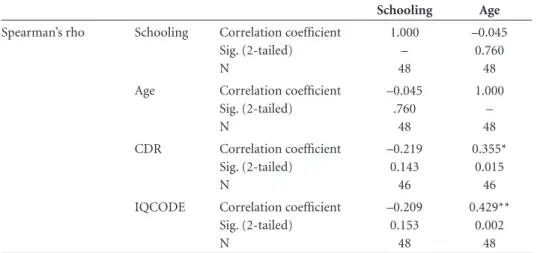
Table 2. Correlation between the IQCODE, sociodemographic and clinical variables.
Schooling Age
Spearman’s rho Schooling Correlation coefficient Sig. (2-tailed) N
1.000 – 48
–0.045 0.760
48 Age Correlation coefficient
Sig. (2-tailed) N
–0.045 .760
48
1.000 – 48 CDR Correlation coefficient
Sig. (2-tailed) N
–0.219 0.143
46
0.355* 0.015
46 IQCODE Correlation coefficient
Sig. (2-tailed) N
–0.209 0.153
48
0.429** 0.002
48
*Correlation is significant at the 0.05 level (2-tailed); **Correlation is significant at the 0.01 level (2-tailed); CDR, Clinical De-mentia Rating; IQCODE, Informant Questionnaire on Cognitive Decline in the Elderly
IQCODE Sens.% Spec.%
3.780 3.870 3.965
4.005
4.035 4.080 4.112
61.9 61.9 71.4
81.0
81.0 81.0 85.7
96.2 92.3 92.3
88.5
84.6 80.8 80.8
1.0 0.8 0.6 0.4 0.2 0.0 1.0
0.8
0.6
0.4
0.2
0.0
Se
n
s
iti
v
ity
The IQCODE was better than the MMSE in both samples
and unlike the MMSE, demonstrated no influence of age,
educational or cultural level.
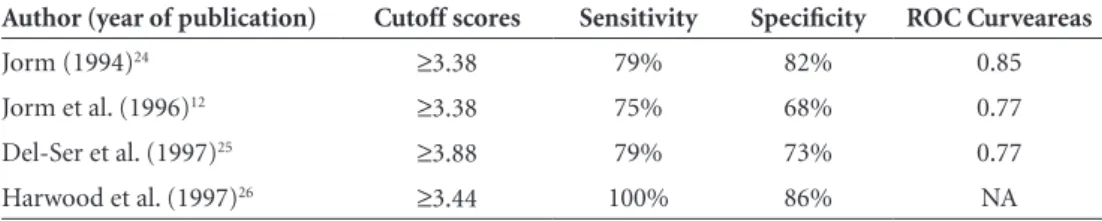
23The IQCODE-S cut-off points found in the present study
ranged from 4.0 to 4.1, which are slightly higher than those
suggested in the literature,
12,24-26as can be seen in Table 3.
However, we included patients with MCI and very mild
de-mentia in our sample which probably explains these results.
Isella et al. (2006) followed up subjects with MCI for at
least 2 years or until they converted to dementia.
27The
abil-ity to differentiate patients with MCI from healthy controls
proved similar for the IQCODE (area under the curve –
AUC=0.86) and the MMSE (AUC=0.84). These areas were
also very similar to the ones found in the present study
(AUC=0.821, p=0.001). Isella et al. evaluated the
indepen-dent predictive ability of IQCODE and memory scores
us-ing logistic regression, demonstratus-ing that the IQCODE
alone achieved the best correct classification of 81%.
27In Brazil, Areza-Fegyveres et al. (2008) described the
ap-plicability of the IQCODE in a population with low
school-ing, reporting that the proxy-reports were similar to the
el-derly reports.
28This finding lends support to the efficacy of
the test and suggests another possible use for the IQCODE.
Bustamante et al. (2003) showed that the combination
of a cognitive test with a functional scale can improve the
detection of mild to moderate cases of dementia, even in
samples of very heterogeneous populations with regard to
socioeconomic status and educational level.
29These results
suggested that a functional scale combined with a cognitive
test can improve the diagnostic accuracy of dementia.
Limitations of the study include a relatively small
sam-ple, with low mean educational level, although containing
few elderly individuals with no formal education. Data on
the educational level of relatives or proxies were not
col-lected, and this point should be addressed in further
stud-ies since it may have influenced the IQCODE results.
In summary, the results suggest that the short Brazilian
version of the IQCODE can be used for the screening of
MCI and mild cases of dementia. The IQCODE is not
in-fluenced by educational level, which makes it an adequate
instrument for use in our country and useful for other
samples with a similar educational profile.
Conflict of interest –
None.
References
1. Bottino CMC, Azevedo D, Tatsch M, et al. Estimate of De-mentia prevalence in a community sample from São Paulo, Brazil. Dement Geriatr Cogn Disord 2008; 26:291-299. 2. Carr DB, Gray S, Baty J, Morris JC. The value of informant
versus individual´s complaints of memory impairment in early dementia. Neurology 2000;55:1724-1726.
3. Mackinnon A, Mulligan R. Combining cognitive testing and
1.0 0.8 0.6 0.4 0.2 0.0
1 - Specificity
1.0
0.8
0.6
0.4
0.2
0.0
S
e
n
s
it
iv
it
y
IQCODE Sens.% Spec.%
4.005 4.035 4.080 4.112 4.187 4.312 4.402
81.8 81.8 81.8 90.9 90.9 90.9 100
88.5 84.6 80.8 80.8 76.9 73.1 69.2
Graph 2. ROC Curve comparing CDR=0.5 to CDR≥1.
Table 4. Results using short versions of the IQCODE.
Author (year of publication) Cutoff scores Sensitivity Specificity ROC Curveareas
Jorm (1994)24 ≥3.38 79% 82% 0.85
Jorm et al. (1996)12 ≥3.38 75% 68% 0.77
Del-Ser et al. (1997)25 ≥3.88 79% 73% 0.77
informant report to increase accuracy in screening for de-mentia. Am J Psychiatry 1998;155:1529-1535.
4. Bustamante, Sonia E, Zevallos, et al. Instrumentos combina-dos na avaliação de demência em icombina-dosos: resultacombina-dos prelim-inares. Arq Neuropsiquiatr 2003;61:601-606.
5. Jorm AF. The Informant questionnaire on cognitive decline in the elderly (IQCODE): a review. Int Psychogeriatr 2004;16: 275-293.
6. Teng EL, Cultural and educational factors in the diagnosis of de-mentia. Alzheimer Dis Assoc Disord 2002;16(suppl. 2):S77-S79. 7. Galvin JE, Roe CM, Xiong C, Morris JC. Validity and reliabil-ity of the AD8 informant interview in dementia. Neurology 2006;67:1942-1948.
8. Jorm AF, Jacomb PA. The informant questionnaire on cog-nitive decline in the elderly (IQCODE): Socio-demographic correlates, reliability, validity and some Norms. Psychol Med 1989;19:1015-1022.
9. Jorm AF, Korten AE. Assessment of cognitive decline in the el-derly by informant interview. Br J Psychiatry 1988;152:209-213. 10. Isella V, Villa ML. Frattola L, Appollonio I. Screening cogni-tive decline in dementia: preliminary data on Italian version of the IQCODE. Neurol Sci 2002;23:S79-S80.
11. Senanarong V, Assavisaraporn S, Sivasiriyanonds N, et al. The IQCODE: an alternative screening test for dementia for low educated Thai. J Med Assoc Thai 2001;84:648-655.
12. Jorm AF, Christensen H, Henderson AS, Jacomb PA, Korten AE, Mackinnon A. Informant ratings of cognitive decline of elderly people: relationship to longitudinal change on cogni-tive tests. Age Ageing 1996;25:125-129.
13. de Jonghe JF, Schmand B, Ooms ME, Ribbe MW. Abbreviated form of the Informant Questionnaire on cognitive decline in the elderly. Tijdschr Gerontol Geriatr 1997;28:224-229. 14. Morales JM, Gonzalez-Montalvo JL, Bermejo F, Del Ser T. The
screening of mild dementia with a shortened Spanish version of the “Informant Questionnaire on Cognitive Decline in the Elderly”. Alzheimer Dis Assoc Disord 1995;9:105-111. 15. Petersen RC, Smith E, Warring SC, Ivnik RJ, Tangalos E,
Kok-men E. Mild cognitive impairKok-ment: clinical characterization and outcome. Arch Neurol 1999;56:303-308.
16. Brucki SMD, Nitrini R, Caramelli P, Bertolucci PHF, Okamoto IH. Sugestões para o uso do mini-exame do estado mental no Brasil. Arq Neuropsiquiatr 2003;61:777-781.
17. Bottino CMC, Almeida OP, Tamai S, Forlenza OV, Scalco MZ, Carvalho IAM. Entrevista estruturada para diagnóstico de transtornos mentais em idosos-CAMDEX The Cambridge
ex-amination for mental disorders of the elderly. Versão brasile-ira, traduzida e adaptada com autorização dos editores, Cam-bridge University Press, São Paulo, 1999.
18. Cummings JL, Mega M, Gray K, Rosenberg-Thompson S, Carusi DA, Gornbein J. The Neuropsychiatric Inventory: comprehensive assessment of psychopathology in dementia. Neurology 1994;44:2308-2314.
19. Nitrini R, Caramelli P, Bottino CM, Damasceno BP, Brucki SM, Anghinah R; Academia Brasileira de Neurologia. [Diag-nosis of Alzheimer’s disease in Brazil: cognitive and functional evaluation. Recommendations of the Scientific Department of Cognitive Neurology and Aging of the Brazilian Academy of Neurology]. Arq Neuropsiquiatr 2005;63:720-727. 20. American Psychiatric Association. Diagnostic and statistical
manual of mental disorders: DSM-IV, 4th edition,1994.
21. Altmann D. ROC Curves, (editors). Practical statistics for medical research. London: Chapman & Hall; 1992.
22. Altmann D, (editor). Logistic Regression. Practical statistics for medical research. London: Chapman & Hall; 1992. 23. Morales JM, Gonzalez-Montalvo JL, Bermejo F, Del Ser
T. Screening of dementia in community-dwelling elderly through informant report. Int J Geriatr Psychiatry 1997;12: 808-816.
24. Jorm AF. A short form of the Informant questionnaire on cognitive decline in the elderly (IQCODE): development and cross-validation. Psychol Med 1994;24: 145-153.
25. Del-Ser T, Morales JM, Barquero MS, Canton R, Bermejo F. Application of a spanish version of the “Informant Ques-tionnaire on Cognitive Decline in the Elderly” in the clinical assessment of dementia. Alzheimer Dis Assoc Disord 1998; 11:3-8.
26. Harwood DM, Hope T, Jacoby R. Cognitive impairment in medical inpatients. I: Screening for dementia--is history bet-ter than mental state? Age Ageing. 1997 ;26:31-35.
27. Isella V, Villa L, Russo A, Regazzoni R, Ferrarese C, Appollonio IM. Discriminative and predictive power of an informant re-port in mild cognitive impairment. J Neurol Neurosurg Psy-chiatry 2006;77:166-171.
28. Fegyveres RA, Formigoni AP, Porto CS, et al.Applicability of cognitive questionnaire in the elderly and proxy. Dement Neuropsychol 2008;2:228-232.