Original Article
Artigo Original
Ana Cláudia Fernandes Amaral1 Lívia Azevedo Rodrigues2 Renata Maria Moreira Moraes Furlan3 Laélia Cristina Caseiro Vicente4 Andréa Rodrigues Motta4
Descritores
Alimentos Dieta Fonoaudiologia Serviço Hospitalar de Nutrição Transtornos de Deglutição
Keywords
Food Diet Speech Language Pathology Food Service Hospital Deglutition Disorders
Correspondence address: Andréa Rodrigues Motta
Avenida Professor Alfredo Balena, 190, sala 69, Belo Horizonte (MG), Brasil, CEP 30130-100.
E-mail: [email protected] Received: 03/04/2015
Accepted: 05/06/2015
Study carried out at the Department of Speech-Language Pathology and Audiology at Universidade Federal de Minas Gerais – UFMG – Belo Horizonte (MG), Brazil.
(1) Clínica Medicina Empresarial – Belo Horizonte (MG), Brazil.
(2) Universidade Federal de Minas Gerais – UFMG – Belo Horizonte (MG), Brazil.
(3) Hospital das Clínicas at Universidade Federal de Minas Gerais – UFMG – Belo Horizonte (MG), Brazil. (4) Department of Speech-Language Pathology and Audiology at Universidade Federal de Minas Gerais – UFMG – Belo Horizonte (MG), Brazil.
Financial support: Fundação de Amparo à Pesquisa do Estado de Minas Gerais – FAPEMIG. Conlict of interests: nothing to declare.
Speech-Language and Nutritional Sciences in
hospital environment: analysis of terminology of
food consistencies classiication
Fonoaudiologia e nutrição em ambiente hospitalar:
análise de terminologia de classiicação
das consistências alimentares
ABSTRACT
Purpose: To verify if there is an agreement between speech-language pathologists and nutritionists about the classiication of food textures used in hospitals and their opinions about the possible consequences of differences in this classiication. Methods: This is a descriptive, cross-sectional study with 30 speech-language pathologists and 30 nutritionists who worked in 14 hospitals of public and/or private network in Belo Horizonte, Brazil. The professionals answered a questionnaire, prepared by the researchers, and classiied ive different foods, with and without theoretical direction. The data were analyzed using Fisher’s exact and Z-tests to compare ratios with a 5% signiicance level. Results: Both speech-language therapists (100%) and nutritionists (90%) perceive divergence in the classiication and, 86.2% and 100% of them, respectively, believe that this difference may affect the patients’ recovery. Aspiration risk was the most mentioned problem. For the general classiication of food textures, most of the professionals (88.5%) suggested four to six terms. As to the terminology used in the classiication of food presented without theoretical direction, the professionals cited 49 terms and agreed only in the solid and liquid classiications. With theoretical direction, the professionals also agreed in the classiication of thick and thin paste. Conclusion: Both the professionals recognized divergences in the classiication of food textures and the consequent risk of damage to patient’s recovery. The use of theoretical direction increased the agreement between these professionals.
RESUMO
INTRODUCTION
Modiication in food texture is a common strategy used to treat swallowing disorders(1). It is known that liquid food,
such as water, can cause a premature escape to the pharynx in patients with dysphagia, owing to the fast low, compromising swallowing safety(2). On the other hand, viscous liquid food
and solid food require higher propulsion strength of the tongue. If the strength in the tongue or in the pharyngeal muscles is not enough, there might remain some food residues in the pharyngeal recesses after swallowing(2). In order to ensure a safe diet, the
speech-language pathologist advises patients with swallowing dificulties to ingest food in the most appropriate textures for each case. Some industrialized products such as food thicken-ers are available in the market to facilitate the modiication in food textures. Premade diets are also commercially available(3).
Several food textures are used in the hospital clinical practice. Despite the different characteristics among the food textures, there is no standard terminology to classify them(3). The lack
of clear terminologies and deinitions that are able to guide the clinical production, preparation, and use of different food textures may compromise the clinical chart of the patient and evolution of the swallowing therapy, because it is not possible to ensure that the patients with dysphagia received the diet in the texture established by the speech-language pathologist. In addition, standardization of texture names is important so that communication among professionals of health and of indus-try, caregivers, and investigators is consistent. Comparisons of different investigations are dificult owing to the heterogeneity of used terms and absence of common terms(4).
Several classiications were suggested in different countries. In most of the cases, diets were classiied based on texture, from two to ive categories(3). The recommendation of Penman and
Thomson in 1998 is a pretty used classiication(5). The authors
established four textures:
1. liquidized/thin purée – homogenous consistency that does not hold its shape after serving;
2. thick purée – homogeneous consistency that holds its shape after serving and does not separate into solid and liquid components during swallowing;
3. inely minced – soft consistency with small pieces sized around 0.5 to 0.5 cm;
4. modiied normal – consistency with varied textures that require chewing with pieces sized around 1.5 x 1.5 cm.
In some countries such as Australia, the United Kingdom, Japan, and the United States, standard classiications were estab-lished with different characteristics among them(4-9). In the last
decade, a global movement was created to standardize the ter-minology applied to describe food consistencies and to indicate food with modiied texture that will be employed in dysphagia treatment(3). An organization including members from different
countries, The International Dysphagia Diet Standardization Initiative (IDDSI) has been working to create an international nomenclature of food consistencies to dysphagic subjects(1).
One of the irst actions of such organization was to carry out a survey in the medical literature about the terminology used in
several countries(1). The use of four categories for liquid food
(normal/thin, thicker liquid, nectar/honey, and paste/creamy) and two categories for solid food (solid and soft solid or purée) was found in Brazil(1). In practice, there is still a lack of
agree-ment, and each health service uses its own deinitions(10).
Given the importance of food texture adequacy provided to patients cared at hospitals, especially those with dificul-ties to perform a proper swallowing, there must be a harmoni-ous communication among professionals in charge of providing patients with an appropriate diet, mainly between speech-lan-guage pathologists and nutritionists.
It is highly important that speech language-pathologists work in the treatment of patients with dysphagia in synchronization with the nutritionist, who is in charge of adjusting the patient’s diet to the food consistency provided by the speech-language pathologist. Thus, the nutritional status and pleasure must be preserved, because they are culturally associated with food.
This study aimed at analyzing the agreement between speech-language pathologists and nutritionists with regard to the terminology used in the classiication of food textures in Belo Horizonte hospitals and with regard to the perception of possible divergence consequences in how professionals involved in food texture management classify them.
METHODS
The project was approved by the Research Ethics Committee from Universidade Federal de Minas Gerais (number 601/07), so that the study could be carried out.
This cross-sectional, descriptive study included 60 pro-fessionals, 30 speech-language pathologists and 30 nutri-tionists, who worked in 14 hospitals from the public and/or private network in the city of Belo Horizonte, Minas Gerais, Brazil, in occupations associated with the classiication of food diet texture.
The inclusion criteria for this study considered were having an undergraduation degree in the courses of Speech-Language Pathology and Audiology or Nutrition and working in the area of dysphagia in public and/or private hospitals in the city of Belo Horizonte for at least 2 months; they signed the informed consent. Professionals who did not participate in all the study phases were excluded.
Initially, a hospital survey was conducted through veriica-tion in phonebooks, research websites, and lists of insurance companies. All professionals who took part in the investigation were invited to be part of the study in person, through visits of the investigators to hospitals, or by e-mail or telephone if another professional recommended them. After the irst con-tact, investigators would schedule a date and a place chosen by the interviewer to conduct the research. In such a meeting, the professional would read and sign the informed consent and only then, he/she would answer all the study items.
how professionals involved in food texture management clas-siied them and if they believed that such divergences could cause damages to the patients.
In order to complete items ive to seven from the question-naire, the investigators presented ive foods to the profession-als, divided into equal recipients that were identiied only by numbers from one to ive. Participants did not have access to their packaging and could not taste them, but ive spatulas were given them to handle the following foods:
• Food 1 – Aymoré® cornstarch cookies, 200 grams;
• Food 2 – Fugini® raspberry jelly, 230 grams;
• Food 3 – Itambé® yogurt, 180 grams with fruit pulp, berries
lavor;
• Food 4 – Santa Bárbara® honey, 280 grams, ‘marmeleiro’
(Croton sonderianus);
• Food 5 – Vilma® artiicial refreshment, 240-gram-solid
pre-paration, mango lavor mixed with water.
As this investigation aimed at studying food textures, the authors were concerned about choosing and presenting the professionals with the following kinds of foods: hard food that required chewing effort for consumption (cookie); diluted food that could be sipped directly from a glass (refreshment);
food of intermediate consistency, but with pieces (jelly); and two homogeneous foods with a distinct difference of viscos-ity (yogurt and honey). Liquid and solid foods were chosen, because they are considered as the two extreme ends of food consistencies in the clinical practice. Food of intermediate con-sistence with pieces was presented owing to the possibility of the residues that interfere in how professionals classify them. Both homogenous foods with a distinct difference of viscos-ity were included to allow the observation of the importance given by professionals to the food viscosity in the deinition of its consistency and, consequently, its adaptation to patients’ consumption.
After food presentation, professionals were at irst instructed to classify them, in item ive of the questionnaire, according to the nomenclature used in each service. In item six of the ques-tionnaire, the participant would write what terms he/she con-sidered more appropriate to classify the food consistencies in general. Then, the professional received a separate sheet with the following nomenclatures: solid, thick pasty, thin pasty, and liquid(11,12),so that he/she could be directed to classify the foods.
Professionals classiied, in item seven of the questionnaire, the same foods, however, at this time, based on the direction pre-sented by the investigators.
QUESTIONÁRIO
1 – ( ) Fonoaudiólogo ( ) Nutricionista
2 – Há quanto tempo a sua atuação profissional está relacionada à classificação das consistências alimentares? __________ Por quantas horas diárias? ____________________________________________________________________________________________________
3 – Você percebe divergências no modo como os profissionais envolvidos no manejo das consistências alimentares as classificam? ( )SIM ( )NÃO
4 – Se sim, você acha que essas divergências podem trazer prejuízos ao paciente?
( )SIM ( )NÃO Quais? __________________________________________________________________________________________ ________________________________________________________________________________________________________________ 5 – CLASSIFIQUE A CONSISTÊNCIA DOS SEGUINTES ALIMENTOS:
Hospital: ________________________________________________________________________________________________________ Alimento 1: ______________________________________________________________________________________________________ Alimento 2: ______________________________________________________________________________________________________ Alimento 3: ______________________________________________________________________________________________________ Alimento 4: ______________________________________________________________________________________________________ Alimento 5: ______________________________________________________________________________________________________
6 – Na sua opinião, quais termos seriam os mais adequados para classificar as diferentes consistências alimentares? Exemplifique.
________________________________________________________________________________________________________________ ________________________________________________________________________________________________________________
7 – CLASSIFIQUE A CONSISTÊNCIA DOS SEGUINTES ALIMENTOS DE ACORDO COM O DIRECIONAMENTO TEÓRICO APRESENTADO: Alimento 1: ______________________________________________________________________________________________________ Alimento 2: ______________________________________________________________________________________________________ Alimento 3: ______________________________________________________________________________________________________ Alimento 4: ______________________________________________________________________________________________________ Alimento 5: ______________________________________________________________________________________________________
The statistical data was analyzed through PASW Statistics 18 program, using Fisher’s exact test and Z-test to compare the ratios with a 5% signiicance level.
RESULTS
The interviewed professionals included 13 (43%) speech-lan-guage pathologists and 17 (57%) nutritionists, who possessed 5 years at maximum of experience in the area associated with food texture classiication; 15 (51%) speech-language pathologists and nine (30%) nutritionists presented experience that ranged from 6 to 10 years; and 2 (6%) speech-language pathologists and 4 (13%) nutritionists presented more than 10 years of experience. With regard to speech-language pathologists, three (10%) worked 4 hours daily, 26 (86.7%) worked from 4 to 8 hours daily, and 1 (3.3%) worked for more than 8 hours daily. With regard to nutritionists, 1 (3.3%) worked 4 hours daily, 21 (70%) worked from 4 to 8 hours daily, and 8 (26.7%) worked for more than 8 hours daily. Most of the professionals (i.e., speech-language
pathologists and nutritionists), worked in a weekly period from 20 to 40 hours.
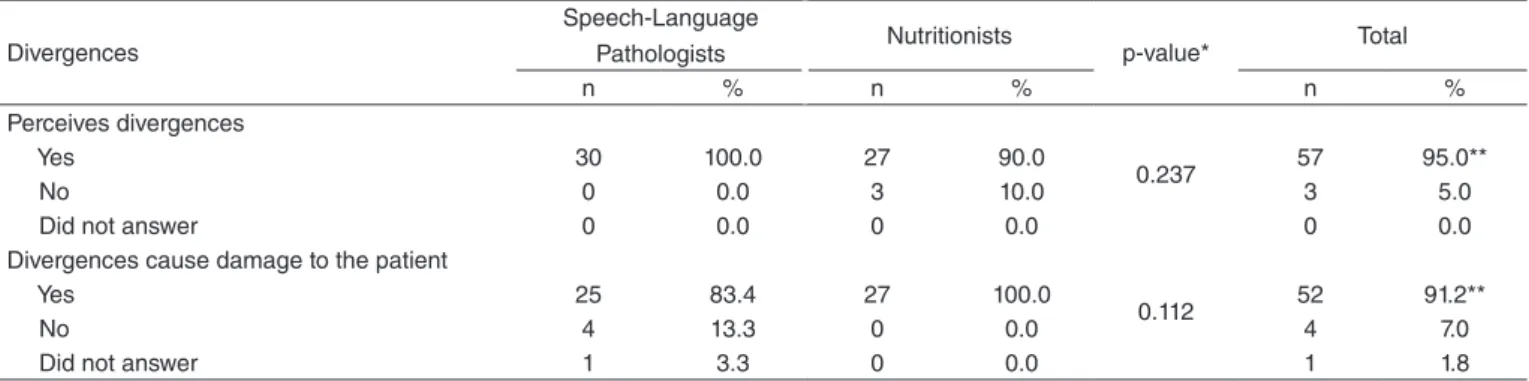
Table 1 presents the interviewed professionals’ perception of divergences in the classiication of food textures and their possible impacts on the patients’ quality of life. No differences were seen between the groups, and all speech-language pathologists and most of the nutritionists who perceived a divergence in the classi-ications. For the majority of professionals, this difference might cause damage to patients’ recovery. Fisher’s exact test showed no signiicant difference between the number of speech-language pathologists and nutritionists that perceived divergences in how food consistencies were classiied (p=0.237) and between the amount of professionals from different groups who believe the existence of such divergences might cause damage to patients (p=0.112).
It is possible to verify in Table 2 the opinion of interviewed pro-fessionals about the main damages caused to the patient owing to divergences in food consistency classiication. Among the reported problems, “aspiration risk” was the most important; according to the Z-test for ratio comparison, it presented a higher frequency of
Table 1. Perception of divergences in the classification of food textures and their impacts on patients’ quality of life
Divergences
Speech-Language
Pathologists Nutritionists p-value* Total
n % n % n %
Perceives divergences
Yes 30 100.0 27 90.0
0.237 57 95.0**
No 0 0.0 3 10.0 3 5.0
Did not answer 0 0.0 0 0.0 0 0.0
Divergences cause damage to the patient
Yes 25 83.4 27 100.0
0.112 52 91.2**
No 4 13.3 0 0.0 4 7.0
Did not answer 1 3.3 0 0.0 1 1.8
*Fisher’s exact test. **p≤0.05.
Table 2. Perception of the main damages caused to the patient due to divergences in food texture classification
Damages
Speech-Language Pathologists
(n=25)
Nutritionists
(n=26) p-value
Total (n=51)
n % n % n %
Aspiration risk 15 60.0* 18 69.2* 0.489# 33 64.7*
Diet incompatible with clinical condition 11 44.0 3 11.5 0.013## 14 27.5
Dysphagia 2 8.0 7 26.9 0.140## 9 17.6
Malnutrition risk 1 4.0 6 23.1 0.037## 7 13.7
Prescription confusion 4 16.0 2 7.7 0.419## 6 11.8
Delay in rehabilitation/hospital discharge 1 4.0 3 11.5 0.610## 4 7.8
Pulmonary complications /pneumonia 0 0.0 4 15.4 0.110## 4 7.8
Lower caloric offer 0 0.0 4 15.4 0.110## 4 7.8
Clinical condition complication 1 4.0 2 7.7 0.572## 3 5.9
Loss weight 0 0.0 3 11.5 0.235## 3 5.9
Food refusal 0 0.0 3 11.5 0.235## 3 5.9
Anorexia 0 0.0 2 7.7 0.490## 2 3.9
Death 1 4.0 1 3.8 1.000## 2 3.9
Delay in probe removal 1 4.0 0 0.0 0.490## 1 2.0
Commitment of postdischarge home care 1 4.0 0 0.0 0.490## 1 2.0
Odynophagia 0 0.0 1 3.8 0.977## 1 2.0
Cardiac arrest 0 0.0 1 3.8 0.977## 1 2.0
Gastrointestinal issues 0 0.0 1 3.8 0.977## 1 2.0
answers considering general professionals. In addition, there was a difference of opinions among speech-language pathologists and nutritionists when mentioning the damages of “incompatible diet with the clinical condition” and “malnutrition risk.”
When the participants were questioned about the ideal ter-minology to classify food consistencies, 20 (33.3%) profes-sionals suggested four terms for the classiication, 19 (31.7%) indicated ive terms, 14 (23.3%) pointed out six terms, 4 (6.7%) suggested seven terms, 1 (1.7%) indicated three terms, 1 (1.7%) referred thirteen terms, and 1 (1.7%) did not answer the question.
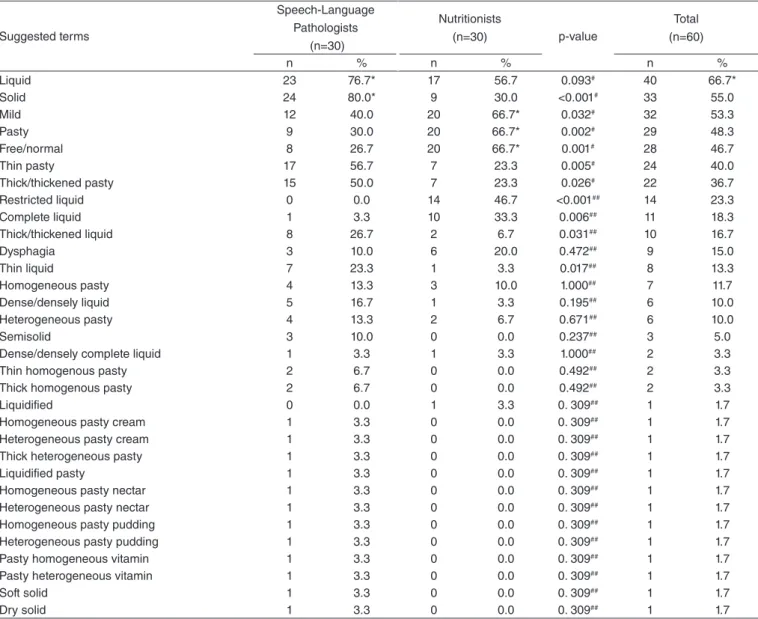
Table 3 presents terms suggested by the interviewed profession-als for the classiication of different food textures. Among speech-language pathologists, only the terms “liquid” and “solid” were mentioned with statistical signiicance compared with the others, whereas, among nutritionists, the same happened with the terms “mild,” “pasty,” and “free/normal.” When both occupations were considered together, only the term “liquid” was mentioned with statistical signiicance compared with the other options. There was a signiicant difference between the number of speech-language
pathologists and the number of nutritionists who suggested the terms solid,” “thin pasty,” “thick/thickened pasty,” “thick/thickened liquid,” and “thin liquid – more mentioned by speech-language pathologists and the terms “mild,” “pasty,” “free/normal,” “restricted liquid,” and “complete liquid” – more mentioned by nutritionists.
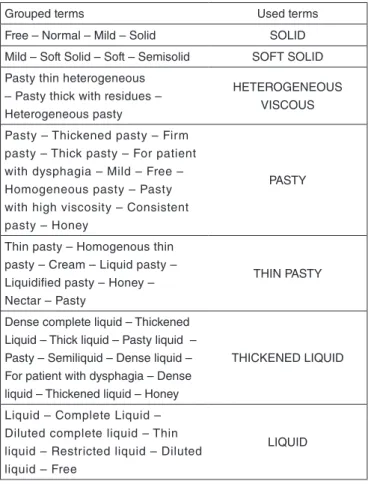
For statistical analysis purposes, terms used by professionals in the classiication of foods without theoretical direction were decreased to seven groups. To do so, generic denominations of food textures that best approached the mentioned terms, accord-ing to the authors’ opinion, were chosen (Chart 1). The term “free” was used for three foods: cookie, yogurt, and refreshment. The investigators understood that free referred to a diet in which food could be offered to the patient without consistency restric-tion. Thus, they included the term in three categories with more generic denominations: solid, pasty, and liquid, respectively.
Finally, answers of professionals who were interviewed regarding classiication of foods, without theoretical direc-tion and based on the classiicadirec-tion presented by the authors, are presented in Tables 4 and 5. It has been seen that, with no
Table 3. Terms suggested by interviewed professionals to classify different food textures
Suggested terms
Speech-Language Pathologists
(n=30)
Nutritionists
(n=30) p-value
Total (n=60)
n % n % n %
Liquid 23 76.7* 17 56.7 0.093# 40 66.7*
Solid 24 80.0* 9 30.0 <0.001# 33 55.0
Mild 12 40.0 20 66.7* 0.032# 32 53.3
Pasty 9 30.0 20 66.7* 0.002# 29 48.3
Free/normal 8 26.7 20 66.7* 0.001# 28 46.7
Thin pasty 17 56.7 7 23.3 0.005# 24 40.0
Thick/thickened pasty 15 50.0 7 23.3 0.026# 22 36.7
Restricted liquid 0 0.0 14 46.7 <0.001## 14 23.3
Complete liquid 1 3.3 10 33.3 0.006## 11 18.3
Thick/thickened liquid 8 26.7 2 6.7 0.031## 10 16.7
Dysphagia 3 10.0 6 20.0 0.472## 9 15.0
Thin liquid 7 23.3 1 3.3 0.017## 8 13.3
Homogeneous pasty 4 13.3 3 10.0 1.000## 7 11.7
Dense/densely liquid 5 16.7 1 3.3 0.195## 6 10.0
Heterogeneous pasty 4 13.3 2 6.7 0.671## 6 10.0
Semisolid 3 10.0 0 0.0 0.237## 3 5.0
Dense/densely complete liquid 1 3.3 1 3.3 1.000## 2 3.3
Thin homogenous pasty 2 6.7 0 0.0 0.492## 2 3.3
Thick homogenous pasty 2 6.7 0 0.0 0.492## 2 3.3
Liquidified 0 0.0 1 3.3 0. 309## 1 1.7
Homogeneous pasty cream 1 3.3 0 0.0 0. 309## 1 1.7
Heterogeneous pasty cream 1 3.3 0 0.0 0. 309## 1 1.7
Thick heterogeneous pasty 1 3.3 0 0.0 0. 309## 1 1.7
Liquidified pasty 1 3.3 0 0.0 0. 309## 1 1.7
Homogeneous pasty nectar 1 3.3 0 0.0 0. 309## 1 1.7
Heterogeneous pasty nectar 1 3.3 0 0.0 0. 309## 1 1.7
Homogeneous pasty pudding 1 3.3 0 0.0 0. 309## 1 1.7
Heterogeneous pasty pudding 1 3.3 0 0.0 0. 309## 1 1.7
Pasty homogeneous vitamin 1 3.3 0 0.0 0. 309## 1 1.7
Pasty heterogeneous vitamin 1 3.3 0 0.0 0. 309## 1 1.7
Soft solid 1 3.3 0 0.0 0. 309## 1 1.7
Dry solid 1 3.3 0 0.0 0. 309## 1 1.7
theoretical direction, there was a signiicant difference between both groups in yogurt and honey classiication. Yogurt was more classiied as liquid by nutritionists and thin pasty by speech-language pathologists; on the other hand, honey was consid-ered thin viscous by speech-language pathologists. When the data were analyzed using the presented theoretical direction, there was no difference between speech-language pathologists and nutritionists in the presented food classiication (p>0.05).
DISCUSSION
Initial analysis of data obtained from the questionnaire showed that, between speech-language pathologists and nutritionists, most of the interviewed professionals perform activities asso-ciated with food texture classiication from 1 to 10 years, for a period of 20 to 40 weekly hours. Data have shown the work market has a large amount of professionals with little under-graduation time; however, it is believed such aspect was not characterized as a factor that inluenced the results of the pres-ent investigation, because the weekly workload and experience time in the area indicate that the investigated professionals deal a lot with this activity.
Speech-language pathologists and nutritionists agreed on some divergences regarding in how consistencies were classi-ied. They perceived the possibility of damage to patients’ health and recovery owing to these divergences. In total, 18 possible damages to the patients were mentioned, in which aspiration risk was the most relevant.
Literature points out that the lack of a standardized termi-nology can result in a wrong interpretation of medical reports and prescriptions of food consistencies that, in turn, may put at risk not only the patients’ habilitation/rehabilitation process but also their lives(10). Aspiration risk and death were mentioned by
other authors as a consequence of incidents caused by confusion in the consistency of the provided diet(3). A strategy adopted by
Table 4. Classification of food textures presented without recommended theoretical direction
Classification without direction
Speech-Language Pathologist
Nutritionist
p-value*
n % n %
Cookie
Solid 28 93.3** 29 96.7** 0.554
Soft solid 2 6.7 1 3.3 –
Jelly
Thickened liquid 2 6.7 0 0.0 0.492 Pasty 18 60.0 24 80.0** 0.083 Thin pasty 0 0.0 2 6.7 0.492 Heterogeneous pasty 6 20.0 2 6.7 0.254 Soft solid 4 13.3 2 6.7 0.671 Yogurt
Liquid 4 13.3 16 53.3 0.002 Thickened Liquid 4 13.3 3 10.0 1.000 Pasty 10 33.3 6 20.0 0.238 Thin pasty 12 40.0 5 16.7 0.038 Honey
Liquid 0 0.0 4 13.3 0.112
Thickened Liquid 5 16.7 6 20.0 0.738 Pasty 15 50.0 18 60.0 0.434 Thin pasty 10 33.3 2 6.7 0.021 Artificial refreshment
Liquid 30 100.0 30 100.0 –
*Z-test for ratio comparison. **p≤0.05.
Chart 1. Division of terms used in the classification of foods without theoretical direction
Grouped terms Used terms
Free – Normal – Mild – Solid SOLID Mild – Soft Solid – Soft – Semisolid SOFT SOLID Pasty thin heterogeneous
– Pasty thick with residues – Heterogeneous pasty
HETEROGENEOUS VISCOUS
Pasty – Thickened pasty – Firm pasty – Thick pasty – For patient with dysphagia – Mild – Free – Homogeneous pasty – Pasty with high viscosity – Consistent pasty – Honey
PASTY
Thin pasty – Homogenous thin pasty – Cream – Liquid pasty – Liquidified pasty – Honey – Nectar – Pasty
THIN PASTY
Dense complete liquid – Thickened Liquid – Thick liquid – Pasty liquid – Pasty – Semiliquid – Dense liquid – For patient with dysphagia – Dense liquid – Thickened liquid – Honey
THICKENED LIQUID
Liquid – Complete Liquid – Diluted complete liquid – Thin liquid – Restricted liquid – Diluted liquid – Free
LIQUID
Table 5. Classification of presented food textures based on the suggested theoretical direction
With direction
Speech-Language Pathologist
Nutritionist
p-value*
n % n %
Cookie
Solid 30 100.0 29 100.0 –
Jelly
Thin pasty 1 3.3 2 6.9 0.612 Thick pasty 29 96.7** 27 93.1** Yogurt
Liquid 1 3.3 2 6.9 0.612 Thin pasty 15 50.0 11 37.9 0.347 Thick pasty 14 46.7 16 55.2 0.512 Honey
Liquid 5 16.7 8 27.6 0.309 Thin pasty 24 80.0** 21 72.4** 0.493 Thick pasty 1 3.3 0 0.0 1.000 Artificial refreshment
Liquid 30 100.0 29 100.0 –
some speech-language pathologists to avoid misunderstandings in diet prescriptions is describing not only the indicated con-sistency but also the appropriate food for patients(10).
It is worth emphasizing that speech-language pathologists mentioned less complications (n=10) than nutritionists (n=16) — out of the 18 possible complications, more than half of them (n=10) was not mentioned in both the categories, eight were only by nutritionists, and two only by speech-language pathol-ogists. In addition, professionals did not get into an agreement with regard to damages, that is “incompatible diet with patient’s clinical condition” and “malnutrition risk,” which were men-tioned in detail, according to the statistical analysis, by speech-language pathologists and nutritionists, respectively.
These indings call the attention to different points of view on which the speech-language pathologists and nutritionists analyze patient’s health condition. In the speech-language pathologist’s intervention, the priority is given to adequacy of the consistency of swallowing physiological conditions and pulmonary conditions of the patient. Although such a profes-sional considers nutritional condition, the nutritionist has better technical skills to identify this malnutrition. Thus, the establish-ment of treatestablish-ment that will be given to the patient should take into consideration several factors, which should be approached with the entire multiprofessional team.
When the professionals were asked to suggest the most appro-priate terms to classify food texture in general, most profession-als (88.5%) suggested four to six terms as the ideal amount. In the international literature, the Australian classiication uses eight terms: four for solids and semisolids (Australian Food Texture Scale) and four for liquids (Australian Fluid Viscosity Scale)(4). In the United States, the National Dysphagia Diet (US)
also uses eight terms: four for solids and semisolids and four for liquids(6). Eleven terms are used in the United Kingdom:
six for solids and semisolids and ive for liquids(7). It has been
seen that there is a difference between liquid and solid/semi-solid foods. Each category comprised a different table. A bib-liographic review about the different diet classiications found the existence of variations from two to ive categories for solid and semisolid food and from one to six liquid categories(5).
Sordi et al.(10) emphasized that professionals have the
ten-dency of using two designation strategies. One of them pres-ents a main term, such as liquid, followed by graduations such as thin and thick, among others. Another strategy compares the foods under analysis with others of general knowledge, such as honey and pudding. According to the authors, designation based on the comparison of food with others of general knowledge is presented as a strategy of easy understanding in the moment of diet guidance and facilitates the visualization of possible simi-lar foods, which helps the process of caregivers’ orientation, insofar the professional may refer to routine foods(10).
In the phases regarding the suggestion of terminology to classify the food textures and foods with no theoretical direc-tion, it was seen the mention to a huge variety of terms, which, in the last case, required the authors to divide the terms into groups so that the statistical analysis could be carried out. Many of the suggested and/or used terms by the professionals were of dificult comprehension, because the aim of the study
was inappropriately used, because the terms refer to food diet classiication, not to the textures that composes them. Even after the investigators’ explanation, the nutritionists were still having trouble to differentiate texture and diet. The authors believe this happens owing to the different roles performed by the professionals in the hospital environment. It is known that speech-language pathologists evaluate the patient’s swal-lowing capacity to several food textures and, on the basis of such observation, they recommend the release of a standard-ized diet from the hospital, which includes the appropriate tex-tures to the patient’s clinical conditions. Once the suggestion is done, the physician must prescribe the diet and the nutritionist must adjust it to the patient’s nutritional needs. Therefore, in practice, the nutritionist deals more directly with diets rather than with textures.
In the classiication of foods without theoretical direc-tion, professionals used 39 terms for ive foods. Even after the authors’ division of terms, speech-language pathologists and nutritionists agreed only in the classiication of two to ive foods: cookie and refreshment—solid and liquid, respec-tively. An investigation carried out in Australia found 39 dif-ferent terms used for thickened liquid foods and 95 terms to describe foods with modiied texture(4).
In North America, a research identiied 40 different terms used for solid foods and 18 for describing thickened liquids(4).
A similar study with the aim of verifying the terminology of the main preparations used in interventions with patients with dysphagia, which was carried out by speech-language pathol-ogists in the state of São Paulo, Brazil, found 33 terms used by 30 speech-language pathologists to classify seven foods. Similarly to this study, the nomenclature used by speech-lan-guage pathologists was common only in the two ends of the scale (liquid and solid)(10).
With regard to jelly, no concordance was found between speech-language pathologists and nutritionists, but the latter agreed among themselves in the classiication of the food as pasty. For yogurt and honey, however, there was not an agree-ment between the groups, not even between professionals from the same category. Yogurt received from both catego-ries of occupation the classiications liquid, thickened liquid, pasty, and thin pasty, but none of the terms was more frequent among the groups. Many speech-language pathologists called yogurt thin pasty, whereas most of the nutritionists called it liq-uid. Honey was named pasty by most of the nutritionists and half of the speech-language pathologists, but there was no statisti-cally signiicant difference. No references were found in the lit-erature with regard to honey classiication. Yogurt, on the other hand, was considered in the investigations as pasty(13-18), thin
pasty(10,11), thick/thickened liquid(10,19,20), pasty liquid(10), and
thick pasty liquid(21).
Some professionals emphasized, in the food classiication, that the ive foods presented are not usually offered to patients in hospital diets. Authors believe, mainly with regard to jelly and honey, this may have collaborated to a lower agreement between professionals.
the analyzed literature, where the terminology used by hospital institutions to identify different diets is incorporated through its current use in the hospital routine(22). This shows the need of a
standardization in the classiication of textures among hospital services, thus, avoiding misunderstandings in the event that the patient has to be followed up to another service.
It is important to emphasize the need of clariication, by the team, to the patient or caregiver about the texture and dif-ference of diets given at hospital discharge. In this study, it is clear the variation of terms used among health professionals; therefore, confusions might surely happen in the patient or family’s interpretation.
Analysis of data from the classiication of foods with the-oretical directions showed an increase of agreement among professionals, because the same classiication was given in four of ive foods: cookie (solid), jelly (thick pasty), honey (thin pasty), and refreshment (liquid). Yogurt was called thin pasty by most of the speech-language pathologists and thick pasty by most nutritionists. In the investigated national lit-erature, three references(11,12,23) applied the term thin pasty,
but only one of them(11) exempliied the food used for this
texture, Bliss® yogurt. The same happened with the term
thick pasty, exempliied with Danete® food, in only one of
the references(11).
Pasty may have variations in texture, varying from stiff, such as pudding, to those lowing easily from the spoon, such as honey; and yogurt is a food that presents a variation of tex-tures, depending on product brand. Since small variations in food texture might cause a great impact on patients’ health, each food texture should be identiied more rigorously and reproducible(3).
TheAmerican Dietetic Association established textures for liquid foods, based on viscosity, in four levels: thin liquid, nectar, honey, and spoon-thick, corresponding to viscosities of 1–50, 51–350, 351–1,750, and higher than 1,751 mPa.s, respec-tively. Such measures had a shear rate of 50/s(6), and solids
were divided into categories according to the size of particles. The scale used in Japan for liquids has a higher number of cat-egories: 1–50, 51–150, 151–300, 301–500, and >500 mPa.s, which were measured using a shear rate of 50/s(3).
These classiications, based on the measured value of food rheological characteristics, would be convenient to exclude any confusion in food prescriptions. Hence, it is important that such pieces of information be present in packages and labels of commercially available products(24). The classiication used in
Japan adds not only texture but also energy and protein content, hardness, and cohesion for each consistency and temperature (15 or 45°C)(3). The use of different colors to differentiate
tex-tures is another available resource in some classiications(3,7,8).
A study investigated the amount of textures in which com-mon subjects may notice differences. Authors observed that the number of consistencies differentiated by subjects was higher than what the classiications recommend. Nevertheless, inso-far, as viscosity increases, only great variations are found(24).
Before suggesting any classiications, it would be interesting to conduct studies that discussed what viscosity differences are
clinically relevant to cause physiological or functional changes in swallowing.
Results of this investigation reinforce the importance of standardizing the terminology regarding food texture classi-ication, taking into consideration the increase of agreement between professionals using theoretical direction and the fact that they recognize the increase of aspiration risks and other complications when there is a disagreement in diet classiica-tion. We recommend that such standardization include values of liquid food rheological characteristics and size of particles in the case of solid foods in order to avoid at most possible confusions between institutions or professionals.
CONCLUSIONS
This study showed that both speech-language pathologists and nutritionists recognize divergences in the classiication of food consistencies in hospital diets and that such divergences may cause damage to the patients’ health, where the aspiration risk was the most mentioned by the participants.
In the classiication of food without theoretical direction, the professionals used 49 terms to deine ive foods. However, it was seen that, in the presence of a theoretical direction, dis-agreement between speech-language pathologists and nutri-tionists was considerably decreased.
Results of this investigation reinforce the importance of standardizing the terminology of food texture classiication in order to ensure a good evolution of the dysphagia treatment.
ACKNOWLEDGMENTS
We thank FAPEMIG for the granted scholarship.
*ACFA and LAR were in charge of the study creation and outline, data collection and analysis, and manuscript preparation. RMMMF was in charge of data analysis and manuscript preparation. LCCV and ARM were in charge of the creation, outline, and orientation of all study phases and manuscript review.
REFERENCES
1. Steele CM, Alsanei WA, Ayanikalath S, Barbon CEA, Chen J, Cichero JAY, et al. The inluence of food texture and function: a systematic review. Dysphagia. 2015;30(1):2-26.
2. Clavé P, de Kraa M, Arreola V, Girvent M, Farré R, Palomera E, Serra-PratM. The effect of bolus viscosity on swallowing function in neurogenic dysphagia. Aliment Pharmacol Ther. 2006;24:1385-94.
3. Cichero JA, Steele C, Duivestein J, Clavé P, Chen J, Kayashita J, et al. The need for international terminology and deinitions for texture-modiied foods and thickened liquids used in dysphagia management: foundations of a global initiative. Curr Phys Med Rehabil Rep. 2013;1:280-291. 4. Atherton M, Bellis-Smith N, Cichero JAY, Suter M. Texture modiied foods
and thickened luids as used for individuals with dysphagia: Australian standardised labels and deinitions. Nutr Diet. 2007;64:53-76.
5. Penman JP, Thomson M. A review of the textured diets developed for the management of dysphagia. J Hum Nutr Diet. 1998;11:51-60
7. United Kingdom National Patient Safety Agency, Dysphagia Diet Food Texture Descriptors; 2011.
8. Irish Association of Speech-Language Therapists and Irish Nutrition and Dietetic Institute, Irish consistency descriptors for modiied luids and food; 2009.
9. Fujitani J, Uyama R, Okoshi H, Kayashita J, Koshiro A, Takahashi K, Maeda H, Fujishima I, Ueda K. Japanese Society of Dysphagia Rehabilitation: classiication of dysphagia modiied food. Jpn J Dysphagia Rehabil. 2013;17:255-67.
10. Sordi M, Mourão LF, Silva LBC. Comportamento reológico e nomenclatura dos alimentos utilizados por fonoaudiólogos de serviços de disfagia. Rev CEFAC. 2012;14(5):925-32.
11. Oliveira LCS, Vieira CA, Mota MHM, Salles PV, Salles JMP, Di Ninno CQMS, et al. Identiicação das mudanças na mastigação e deglutição de indivíduos submetidos à glossectomia parcial. Rev Soc Bras Fonoaudiol. 2008;13(4):338-43.
12. Queiroz MAS, Haguette RCB, Haguette EF. Achados da videoendoscopia da deglutição em adultos com disfagia orofaríngea neurogênica. Rev Soc Bras Fonoaudiol. 2009;14(3):454-62.
13. Lustre NS, Freire TRB, Silvério CC. Medidas de tempo de trânsito oral em crianças com paralisia cerebral de diferentes níveis motores e sua relação com o grau de severidade para disfagia. Audiol. Commun. Res. 2013;18(3):155-61. 14. Lynch CS, Chammas MC, Mansur LL, Cerri GG. Biomecânica ultra-sonográica da deglutição: estudo preliminar. Radiol Bras. 2008;41(4):241-4. 15. Sakate M, Teixeira AS, Yamashita S, Medeiros TR, Silva PG, Henry
MACA. Um novo método de avaliação do “tempo esofágico” com ultra-sonograia por abordagem externa. Radiol Bras. 2008;41(5):309-12.
16. Belo LR, Lins SC, Cunha DA, Lins O, Amorim CF. Eletromiograia de superfície da musculatura supra-hióidea durante a deglutição de idosos sem doenças neurológicas e idosos com Parkinson. Rev CEFAC. 2009;11(2):268-80.
17. Saconato M, Guedes ZCF. Estudo da mastigação e da deglutição em crianças e adolescentes com Sequência de Möbius. Rev Soc Bras Fonoaudiol. 2009;14(2):165-71.
18. Vivone GP, Tavares MMM, Bartolomeu RS, Nemr K, Chiapetta ALML. Análise da consistência alimentar e tempo de deglutição em crianças com paralisia cerebral tetraplégica espástica. Rev CEFAC. 2007;9(2):504-11. 19. Neto GS, Souza PEL, Boehm K, Fortinguerra M, Paula A, Rezende JMM. Avaliação da disfagia no pós-operatório de amigdalectomia através de videoendoscopia da deglutição. Rev Bras Otorrinolaringol. 2003;69(1):19-22.
20. Gazzoni J, Pedroso KCD, Grolli EB. Avaliação fonoaudiológica funcional em pacientes portadores de doença de Parkinson. Rev CEFAC. 2003;5(3):223-6.
21. Padovani AR, Moraes DP, Sassi FC, Andrade CF. Avaliação clínica da deglutição em unidade de terapia intensiva. CoDas. 2013;23(1):1-7. 22. Garcia RWD. A dieta hospitalar na perspectiva dos sujeitos envolvidos
em sua produção e planejamento. Rev Nutr. 2006;19(2):129-44. 23. Silvério CC, Henrique CS. Indicadores da evolução do paciente com
paralisia cerebral e disfagia orofaríngea após intervenção terapêutica. Rev Soc Bras Fonoaudiol. 2009;14(3):381-6.