Pontifical Catholic University of Campinas – Campinas/SP, Brazil. Interdisciplinary Medicine in Cardiology Unit, Heart Institute, University of São Paulo - São Paulo/SP, Brazil.
Email: [email protected]
Received for publication on August 08, 2006. Accepted for publication on October 16, 2006.
CLINICAL SCIENCES
MULTICENTER STUDY OF PERIOPERATIVE
EVALUATION FOR NONCARDIAC SURGERIES IN
BRAZIL (EMAPO)
Claudio Pinho, Paulo C Grandini, Danielle M Gualandro, Daniela Calderaro, Maristela Monachini, Bruno Caramelli
Pinho C, Grandini PC, Gualandro DM, Calderaro D, Monachini M, Caramelli B. Multicenterric study of perioperative evaluation for noncardiac surgeries in Brazil (EMAPO). Clinics. 2007;62(1):17-22.
INTRODUCTION: The accuracy of perioperative evaluation methods available is better than chance, but their performance is not ideal.
OBJECTIVES: To compare a new evaluation method (EMAPO) to the American College of Physicians method for determining the risk of cardiovascular complications in noncardiac surgeries and to look for new influencing variables.
METHODS: Evaluations through EMAPO and the American College of Physicians method were employed for 700 patients. Cardiac events and deaths were recorded, the risk variables related to the occurrence of complications were verified, and the models were compared by analyzing the areas under the receiver operating characteristic curves.
RESULTS: Mortality rate was 3.4%, and the incidence of cardiovascular complications was 5.3%. Renal failure (P = 0.01), major surgery (P = 0.004), and emergency surgery (P = 0.003) were independently related to the occurrence of cardiovascular complications. The two methods produced similar results.
CONCLUSION: EMAPO is as good as the American College of Physicians method in determining the risk of cardiovascular complications in noncardiac surgeries. New variables related to surgical risk were identified.
KEYWORDS: Cardiac risk. Noncardiac surgery. Algorithms. Cardiovascular complications. Risk factors.
There were 2,747,254 hospitalizations for surgical in-terventions in Brazil in 2000. The mortality rate associated with these hospitalizations was 2.1%, and the average pe-riod of hospitalization was 4.6 days, generating a cost of roughly 750 million dollars.1 In the United States, 3% to 10% of the patients undergoing surgical intervention have some sort of complication, and of the deaths that occur in the postoperative period, 40% have a cardiovascular cause.2 Perioperative evaluation consists of a set of medical pro-cedures performed before, during, and after the surgery to establish the degree of risk and to propose strategies for
reducing the incidence of cardiovascular complications. 3-26 The existing evaluation methods are based on studies that
consider the impact of clinical and surgical characteristics on the postoperative evolution. The currently available evaluation methods have limitations because they leave out certain diseases, do not adopt modern diagnostic criteria and treatment options for others, and do not consider the extent of the surgery or the functional capacity. The accu-racy of these methods is better than chance, but their per-formance is not ideal. The American College of Physicians (ACP) method is the most widely used method internation-ally, but it also has problems,6 eg, the wide range of dif-ferent risk levels—particularly that of the intermediate level—in which different patients with clearly different risk profiles are classified in the same category.
a Brazilian population and to compare an international evaluation method (ACP) with a new one called EMAPO (Multicenter Study of Perioperative Evaluation), which con-siders diseases that were not mentioned in the previous guidelines and modern treatment options in order to deter-mine new clinical variables associated with cardiovascu-lar complications.
Population
After approval by the local ethics committee, all con-secutive patients older than 15 years referred for noncardiac surgeries, for whom perioperative evaluation was requested in the period between February 2001 and May 2002 in 3 centers (1 university hospital and 2 private clinics: Hospi-tal das Clínicas, São Paulo University Medical School, Clinicor Clinic of Ribeirão Preto, and Ritmocordis Clinics of Valinhos) were studied. Patients who did not undergo surgery for any reason were excluded.
METHODS
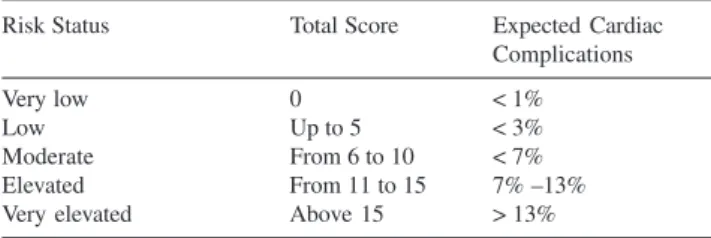
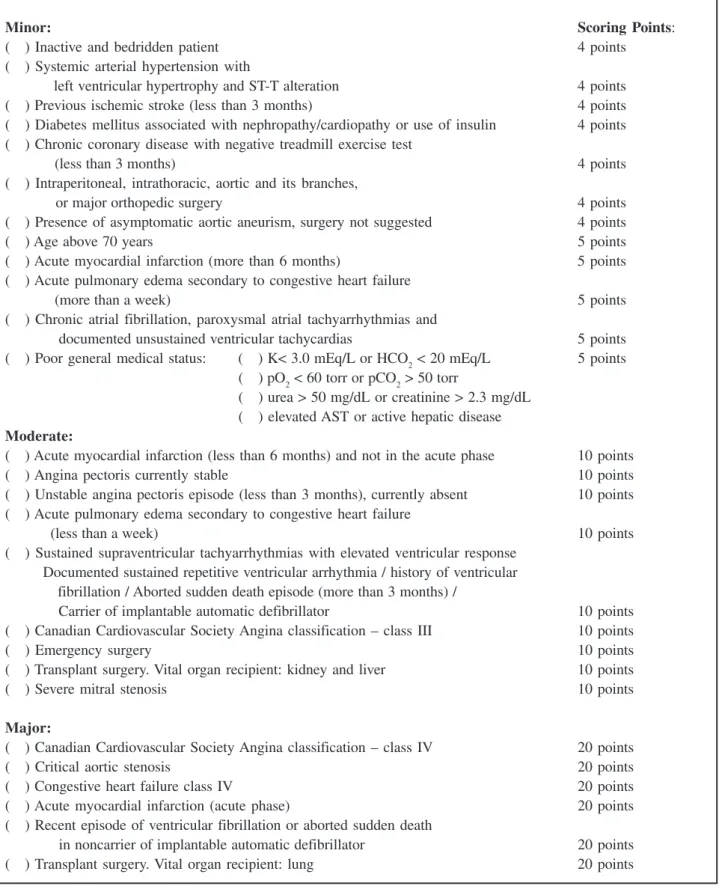
The patients were evaluated through the method pro-posed by the EMAPO Project (Multicenter Study of Perioperative Evaluation of SOCESP – Society of Cardi-ology of the State of São Paulo). This method proposes cal-culating the cardiovascular risk index by adding the accu-mulated points that correspond to the presence of risk fac-tors described previously and new variables that were added based on the clinical experience of the authors (Appen-dix).5,6,27 Additionally, EMAPO proposes a new classifica-tion, stratifying the perioperative risk into 5 levels accord-ing to the expected complication rate (Table 1).
The same population was also evaluated using the American College of Physicians (ACP) criteria, which stratifies the perioperative risk into 3 levels according to the expected complication rate.6
The patients were monitored until discharge, and car-diac events and deaths were recorded. The carcar-diac events considered were ischemic events (unstable angina and
myo-cardial infarction), embolic events, cardiac arrhythmias, and others. Cardiac events were defined as previous reported.8
Statistical Analysis
We estimated that the sample to be studied should have roughly 700 individuals. The risk variables were descrip-tively analyzed, and their relationship to the occurrence of perioperative cardiac complications was subsequently veri-fied. Although some patients presented more than 1 com-plication, such patients were reckoned in the same man-ner as patients with a single complication. The chi-square method was used for this first analysis. Multivariate analysis was performed based on the variables identified in the univariate model. A P value lower than or equal to 0.05 was considered statistically significant.
Both methods were then compared according to crite-ria of sensitivity and specificity using the areas under the receiver operating characteristic (ROC) curve.28-30
RESULTS
Seven hundred patients with a mean age of 56 years (18 to 96 years) were evaluated. The majority of these patients were women (59.1%), and the presence of clinically de-tectable cardiac disease was described in 52%. Regarding the type of surgery, 95% were elective, 4% urgent, and 0.4% emergency surgery. The average hospitalization pe-riod was 3.6 days (1 to 72 days).
The evaluation with the EMAPO method yielded a mean score of 3.5 points (within a range of 0 to 33), and patients with low and very low risk prevailed (83%). The evaluation of the same sample by the ACP method resulted in a mean score of 2.0 points (0 to 20) and the patients with low risk (94.4%) also prevailed.
The mortality rate was 3.4%. Perioperative complica-tions were observed in 64 patients (9.1%). There were 42 cardiovascular events in 37 patients (5.3%) as follows: 16
Table 1 - Complication risk index according to the EMAPO
Risk Status Total Score Expected Cardiac
Complications
Very low 0 < 1%
Low Up to 5 < 3%
Moderate From 6 to 10 < 7%
Elevated From 11 to 15 7% –13%
Very elevated Above 15 > 13%
EMAPO = Multicenter Study of Perioperative Evaluation
Table 2 - Risk level classification and cardiovascular complications (CC)
EMAPO ACP
Risk Patients (%) CC (%) Patients (%) CC (%)
Very Low 370 (52.9) 11/370 (3.0) —— ——
Low 211 (30.1) 12/211 (5.7) 661 (94.4) 34/661 (5.1) Moderate / 64 (9.1) 10/64 (15.6) 35 (5.0) 2/35 (5.7) Intermediate
RISK FACTORS - VARIABLES:
Minor: ScoringPoints:
( ) Inactive and bedridden patient 4 points
( ) Systemic arterial hypertension with
left ventricular hypertrophy and ST-T alteration 4 points
( ) Previous ischemic stroke (less than 3 months) 4 points
( ) Diabetes mellitus associated with nephropathy/cardiopathy or use of insulin 4 points ( ) Chronic coronary disease with negative treadmill exercise test
(less than 3 months) 4 points
( ) Intraperitoneal, intrathoracic, aortic and its branches,
or major orthopedic surgery 4 points
( ) Presence of asymptomatic aortic aneurism, surgery not suggested 4 points
( ) Age above 70 years 5 points
( ) Acute myocardial infarction (more than 6 months) 5 points
( ) Acute pulmonary edema secondary to congestive heart failure
(more than a week) 5 points
( ) Chronic atrial fibrillation, paroxysmal atrial tachyarrhythmias and
documented unsustained ventricular tachycardias 5 points ( ) Poor general medical status: ( ) K< 3.0 mEq/L or HCO2 < 20 mEq/L 5 points
( ) pO2 < 60 torr or pCO2 > 50 torr
( ) urea > 50 mg/dL or creatinine > 2.3 mg/dL ( ) elevated AST or active hepatic disease
Moderate:
( ) Acute myocardial infarction (less than 6 months) and not in the acute phase 10 points
( ) Angina pectoris currently stable 10 points
( ) Unstable angina pectoris episode (less than 3 months), currently absent 10 points ( ) Acute pulmonary edema secondary to congestive heart failure
(less than a week) 10 points
( ) Sustained supraventricular tachyarrhythmias with elevated ventricular response Documented sustained repetitive ventricular arrhythmia / history of ventricular fibrillation / Aborted sudden death episode (more than 3 months) /
Carrier of implantable automatic defibrillator 10 points ( ) Canadian Cardiovascular Society Angina classification – class III 10 points
( ) Emergency surgery 10 points
( ) Transplant surgery. Vital organ recipient: kidney and liver 10 points
( ) Severe mitral stenosis 10 points
Major:
( ) Canadian Cardiovascular Society Angina classification – class IV 20 points
( ) Critical aortic stenosis 20 points
( ) Congestive heart failure class IV 20 points
( ) Acute myocardial infarction (acute phase) 20 points
( ) Recent episode of ventricular fibrillation or aborted sudden death
in noncarrier of implantable automatic defibrillator 20 points
( ) Transplant surgery. Vital organ recipient: lung 20 points
EMAPO = Multicenter Study of Perioperative Evaluation
ischemic, 10 arrhythmic, 6 embolic, 2 congestive, and 8 nonspecified cardiovascular etiologies. Among the patients that presented complications, 37.5% died (Table 2).
The significance of the variables used in the EMAPO questionnaire regarding the existence of cardiac complica-tions during the perioperative period was determined. In the univariate analysis, the statistically significant variables were detectable cardiopathy, poor general medical status (Figure 1), urea > 50 mg/dL or creatinine > 2.3 mg/dL, emergency surgery, major surgery, surgery duration > 4 hours, blood loss > 1000 mL, hospitalization > 3 days, chronic coronary dis-ease with negative noninvasive stress testing (less than 3 months), male gender, general anesthesia, myocardial inf-arction < 6 months, aortic aneurism, and age > 70 years. In the multivariate analysis, the variables related to renal fail-ure (P = 0.016), major surgery (P = 0.004), and emergency surgery (P = 0.03) remained significant.
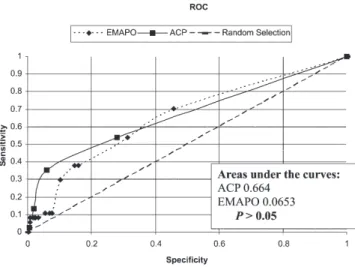
The ROC curves derived from patient data according to EMAPO and ACP methods were analyzed. In order for the two methods to be compared, the 5 levels of the EMAPO method were grouped in 3 categories: very low and low risks were compared with the ACP low risk; mod-erate was compared with the ACP intermediate risk; el-evated and very elel-evated were compared with the ACP high risk. The ROC curves are represented in Figure 2.
The comparison of the two methods showed that the ar-eas did not differ and there was no significant difference between them in predicting the occurrence of cardiovas-cular complications. Besides that, new variables related to surgical risk were identified, such as male gender, aortic aneurysm and major surgery.
DISCUSSION
The majority of patients in our study was classified within the low risk group for perioperative cardiovascular complications. Nevertheless, we observed a high overall incidence of perioperative cardiovascular complications (5.3%). The accuracy of perioperative evaluation methods available today is low, limiting our ability to take meas-ures that would reduce cardiovascular complications. Gilbert et al compared the perioperative evaluation ods used in clinical practice in 2035 patients. These meth-ods were the ACP, the American Society of Anesthesiologists Index (ASA), the Canadian Cardiovas-cular Society Index, and the Goldman Index. In this popu-lation, 30% of the patients underwent low risk surgeries (ophthalmologic, superficial, and endoscopic), and cardiac complications occurred in 6.4% of patients. By comparing the accuracy of the methods using the ROC curve analy-sis, the authors concluded that all of them have limited ac-curacy and no method was better than the others. The au-thors suggest that more efficient methods are needed to pre-vent the occurrence of perioperative cardiovascular com-plications and that other clinical variables should be con-sidered during the evaluation of risk.31 Consequently, we tried to create a new score to predict cardiac complications. Existing methods of perioperative evaluation were de-veloped by choosing variables previously described in the literature as predictors of perioperative events and giving points in order to create a score. The EMAPO was designed by updating variable definitions and adding new ones based on clinical experience, and it was as good as the ACP method in predicting cardiac events. Additionally, in the EMAPO model, major surgery was significant as a predic-tor of cardiac complications; this variable is not consid-ered in the ACP model.
The intermediate risk of the ACP model includes pa-tients with a wide risk range (chance of cardiac complica-tions between 3% and 15%). By proposing an extra 2 risk levels for cardiovascular complications, the EMAPO method intended to split the two most important strata, low risk and high risk, into 2 groups to disclose the differences in these very heterogeneous groups. However, this strategy failed, since no increased risk levels were identified, prob-ably because of the relatively small number of patients in each group. Although the efficacy of EMAPO is similar to that of ACP, the execution of the former is more complex because of the number of items and consequently the amount of information needed. Besides that, as this is a new score, there are no guidelines regarding the strategy to be taken in order to minimize the cardiac risk for each category of patients.
As the cost of hospital expenditures increases, the re-duction of perioperative complication incidence becomes mandatory, because complications often result in a longer hospitalization period and in subsidiary exams and other medical interventions.3,7,8,32
More studies are needed to improve our ability to de-termine which patient has more cardiac risk after noncardiac surgery. The division of the intermediate risk
into a more narrow risk range may be the first stage in this direction.
ACKNOWLEDGEMENTS
To SOCESP – Sociedade de Cardiologia do Estado de São Paulo (Society of Cardiology of the State of São Paulo), for the support given for the execution of this clinical study.
RESUMO
Pinho C, Grandini PC, Gualandro DM, Calderaro D, Monachini M, Caramelli B. Estudo multicêntrico de ava-liação perioperatória para operações não cardíacas (EMAPO). Clinics. 2007;62(1):17-22.
INTRODUÇÃO: A precisão dos métodos de avaliação perioperatória disponíveis é melhor que o acaso, porém está longe do ideal.
OBJETIVOS: Comparar um novo método de avaliação perioperatória (EMAPO) ao método do American College of Physicians para determinar o risco cardíaco em cirurgi-as não cardíaccirurgi-as e buscar novcirurgi-as variáveis envolvidcirurgi-as na de-terminação deste risco.
MÉTODOS: O EMAPO e o método do American College of Physicians foram aplicados em 700 pacientes. A ocor-rência de eventos cardíacos e de mortes foi documentada, a relação entre as variáveis de risco e as complicações foi
estabelecida e os métodos foram comparados analisando as áreas sob a curva ROC.
RESULTADOS: A mortalidade foi 3.4% e a incidência de complicações cardiovasculares 5.3%. A presença de insu-ficiência renal (p=0.01), cirurgia de grande porte (p=0.004) e cirurgia de emergência (p=0.003) se correlacionaram com a ocorrência de complicações cardiovasculares na análise multivariada. Não houve diferença entre os dois métodos.
CONCLUSÕES: O EMAPO é tão eficaz quanto o méto-do méto-do American College of Physicians para determinar o risco de complicações cardiovasculares em cirurgias não cardíacas. Novas variáveis relacionadas com o risco perioperatório foram encontradas.
UNITERMOS: Avaliação perioperatória. Risco cardíaco. Algorítimos. Fatores de risco. Complicações cardio-vasculares.
REFERENCES
1. Ministério da Saúde;SUS – DATASUS – Morbidade. www.datasus.gov.br (Accessed 20/08/2002).
2. Simon HU, Blaustein AS, Wexler LF. Evaluation and treatment of the perioperative patient. In: Crawford MH, editor. Current diagnosis & treatment in cardiology, 2nd ed. United States of America:
McGraw-Hill; 2003. p. 595-609.
3. Mangano DT, Layug EL, Wallace A, Tateo I. Effect of atenolol on mortality and cardiovascular morbidity after noncardiac surgery. N Engl J Med. 1996;335:1713-20.
4. Rao TL, Jacobs KH, El-Etr AA. Reinfarction following anesthesia in patients with myocardial infarction. Anesthesiology.1983;59:499-505. 5. Eagle KA, Berger PB, Calkins H, Chaitman BR, Ewy GA, Fleishmann KE, et al. ACC/AHA Guideline update for perioperative cardiovascular evaluation for noncardiac surgery. Report of the American College of Cardiology/American Heart Association Task Force on Practice Guidelines (Committee to Update the 1996 Guideline on Perioperative Cardiovascular Evaluation for Noncardiac Surgery). Circulation. 2002;105:1257-67.
6. Guidelines for assessing and managing the perioperative risk from coronary artery disease associates with major noncardiac surgery. Report of the American College of Physicians. Ann Intern Med. 1997;127:309-12.
7. Poldermans D, Boersma E, Bax JJ, Thamson IR, Paelenck B, Vandeven LL, et al; Dutch Echocardiographic Cardiac Risk Evaluation Applying Stress Echocardiography Study Group. Bisoprolol reduces cardiac death and myocardial infarction high-risk patients as long as 2 years after successful major vascular surgery. Eur Heart J. 2001;22:1253-8. 8. Durazzo AE, Machado FS, Ikeoka DT, De Bernoche C, Monachini MC,
Puech-Leão P, et al. Reduction in cardiovascular events after vascular surgery with atorvastatin: a randomized trial. J Vasc Surg. 2004;39:967-76.
10. Eagle KA, Coley CM, Newell JB, Brewster DC, Darling RC, Strauss HW, et al Combining clinical and thallium data optimizes preoperative assessment of cardiac risk before major vascular surgery. Ann Intern Med.1989;110:859-66.
11. Goldman L, Caldera DL, Nussbaum SR, Southwick FS, Krogstod D, Murray B, et al. Multifactorial index of cardiac risk in noncardiac surgical procedures. N Engl J Med.1977;297:845-50.
12. Detsky AS, Abrams HB, Mclaughlin JR, Druker DJ, Sanon G, Johnston N, et al. Predicting cardiac complications in patients undergoing non-cardiac surgery. J Gen Intern Med.1986;1:211-9.
13. Hollenberg M, Mangano DT, Browner WS, London MJ, Tubau JF, Tateo IM. Predictors of postoperative myocardial ischemia in patients undergoing noncardiac surgery. JAMA. 1992;268:205-9.
14. Shaw LJ, Eagel KA, Gerrsh BJ, Miller DD. Meta-analysis of intravenous dipyridamole-thallium-201 imaging (1985-1994) and dobutamine echocardiography (1991-1994) for risk stratification before vascular surgery. J Am Coll Cardiol.1996;27:787-98.
15. Mangano DT, Goldman L. Preoperative assessment of patients with known or suspected coronary disease. N Engl J Med. 1995;33:1750-6. 16. Fleisher LA, Eagle KA. Screening for cardiac disease in patients having
noncardiac surgery. Ann Intern Med.1996;124:767-72.
17. Wirthlin DJ, Cambria RP. Surgery-specific considerations in the cardiac patient undergoing noncardiac surgery. Prog Cardiovasc Dis. 1998;40:453-68.
18. Bondenheimer MM. Noncardiac surgery in the cardiac patient: what is the question? Ann Intern Med.1996;124:763-6.
19. Younis LT, Miller D, Chaitman BR. Preoperative strategies to assess cardiac risk before noncardiac surgery. Clin. Cardiol. 1995;18:447-54. 20. Leppo JA. Preoperative cardiac risk assessment for noncardiac surgery.
Am J Cardiol. 1995;75:42D-51D.
21. Abraham as, Eagle KA. Preoperative cardiac risk assessment for noncardiac surgery. J Nucl Cardiol.1994;1:389-98.
22. Bartels C, Bechtel JF, Hossmann V, Horsch S. Cardiac risk stratification for high-risk vascular surgery. Circulation. 1997;95:2473-5. 23. Potyk D, Raudaskoski P. Preoperative cardiac evaluation for elective
noncardiac surgery. Arch Fam Med. 1998;7:164-73.
24. Chaitman BR, Miller DD. Perioperative cardiac evaluation for noncardiac surgery noninvasive cardiac testing. Prog Cardiovasc Dis. 1998;40:405-18.
25. Roizen MF. More preoperative assessment by physicians and less by laboratory tests. N Engl J Med. 2000;342:204-5.
26. Schein OD, Katz J, Bass EB, Tielsch JM, Lubomski LH, Feldman MA, et al. The value of routine preoperative medical testing before cataract surgery. N Engl J Med. 2000;342:168-75.
27. ACC/AHA Guidelines for the management of patients with valvular heart disease. J Am Coll Cardiol. 1998;32:1486-588.
28. Hanley JA, McNeil BJ. The meaning and use of the area under a receiver operating characteristic (ROC) curve. Radiology. 1982;143:29-36. 29. Hanley JA, McNeil BJ. A method of comparing the areas under receiver
operating characteristic curves derived from the same cases. Radiology. 1983;148:839-43.
30. Metodologia Estatística. www.analyse-it.com (Accessed 30/07/2002). 31. Gilbert K, Larocque BJ, Patrick LT. Prospective evaluation of cardiac risk indices for patients undergoing noncardiac surgery. Ann Intern Med. 2000;133:356-9.