Submitted6 May 2013
Accepted 18 July 2013
Published13 August 2013
Corresponding author Karen L. Celedonia,
Academic editor Josep Tur
Additional Information and Declarations can be found on page 11
DOI10.7717/peerj.125
Copyright 2013 Celedonia et al.
Distributed under
Creative Commons CC-BY 3.0
OPEN ACCESS
Physical fighting among Egyptian
adolescents: social and demographic
correlates among a nationally
representative sample
Karen L. Celedonia1, Michael L. Wilson1, Hanan A. El Gammal2and Abeer M. Hagras3
1Centre for Injury Prevention and Community Safety, PeerCorps Trust Fund, Dar es Salaam,
Tanzania
2Family Medicine Department, Faculty of Medicine, Suez Canal University, Ismailia, Egypt 3Department of Forensic Medicine and Clinical Toxicology, Faculty of Medicine, Suez Canal
University, Ismailia, Egypt
ABSTRACT
Introduction.Adolescent interpersonal violence is a global public health problem, yet gaps remain in the epidemiologic literature on adolescent violence in low- and middle-income countries (LMIC). Prevalence rates and risk and protective factors reported in high-income countries may be different from those reported in LMICs. Culturally-relevant epidemiologic data is important in efforts aimed at addressing adolescent interpersonal violence in these countries.
Methods.A cross-sectional study of Egyptian adolescent involvement in violent behavior was conducted. Data collected from a 2006 school-based survey initiative were used; participants were adolescents aged 11–17 (N=5,249). Some participants
were excluded from the dataset due to incomplete data(N=111)resulting in a final
sample of 5,138. Bivariate and logistic regression analyses were run to determine demographic and social variables associated with participation in physical fighting.
Results.Thirty-one percent of adolescents reported being involved in a physical fight. Previously reported risk factors for violent behavior among adolescents such as depressive symptoms (OR=1.29; CI=1.11–1.50) and bullying victimization
(OR=2.44; CI=2.12–2.83) were positively associated with violent behavior in the
present study, while the more novel factor of sedentary behavior was also observed as having a positive association with violent behavior (OR=1.43; CI=1.21–1.69).
Known protective factors such as helpful peers (OR=0.75; CI=0.62–0.90) and
understanding parents (OR=0.67; CI=0.56–0.81) were found to have negative
associations with violent behavior in the present study, in addition to the counterin-tuitive protective effect of having fewer friends (OR=0.75; CI=0.60–0.92).
Subjects Epidemiology, Global Health, Pediatrics, Psychiatry and Psychology, Public Health
Keywords Violence, Adolescent behavior, Adolescents, School health
INTRODUCTION
Interpersonal violence among adolescents has become an increasingly important global public health concern in recent years (Sugimoto-Matsuda & Braun, 2013). Nearly one third of adolescents from North America and Europe reported being in a physical fight within a year to a year and a half prior to being surveyed (Eaton et al., 2012;Walsh et al., 2013), and in the Middle East and Sub-Saharan Africa, more than half of adolescents report involvement in physical fighting (Gofin, Palti & Mandel, 2000;Rudatsikira et al., 2007). Prevalence rates of physical fighting and other forms of interpersonal violence in low- and middle-income countries–particularly those experiencing social and political unrest–remain elevated and, in some instances, are increasing (Krug et al., 2002). In response to this concerning trend, there has been a call for concerted public health efforts to reduce violence among adolescents worldwide (Krug et al., 2002;OECD, 2011).
One component of these efforts has included research aimed at discerning individual and social factors associated with adolescent involvement in violent behavior. From this research, several common risk factors have been determined, among them including drug, alcohol or tobacco use; poor behavior control; emotional distress; and poor parental supervision/involvement (DHHS, 2001). The majority of this research, however, has been conducted with adolescent samples from high-income countries leaving important knowledge gaps in low- and middle-income country settings (LMIC).
Additionally, not all adolescents exhibit violent behavior, indicating that there may be other, micro-level factors that are exerting influence either as risk or protective factors. A better understanding of individual and social correlates of violence among adolescents in LMICs is important to violence prevention in these countries. With rates of non-fatal injuries resulting from violent behavior starting to increase during mid-adolescence (age 14 years) and violence peaking during late adolescence (Odero & Kibosia, 1995; Butchart, Kruger & Nell, 1997;DHHS, 2001), violence prevention programs geared towards adolescents are critical to protecting the well-being of this demographic.
METHODS
Sample
The data for this study were derived from the 2006 Egypt contribution to the Global School-based Health Survey (GSHS). The GSHS was developed by the World Health Orga-nization in collaboration with the U.S. Centers for Disease Control. It collects relevant in-formation for the discernment of behavioral and health risks among adolescents of school age in more than 40 mainly LMICs. Detailed information on the data collection methods, questionnaire and procedures may be found elsewhere (http://www.cdc.gov/gshs/). Briefly, a two-stage cluster sampling design was used to facilitate the collection of data representing all students in Preparatory first, second, and third grade in Egypt. At stage one, schools were selected with a probability proportional to their enrollment size. At stage two, classrooms within the selected schools were randomly selected and all students in selected classes were eligible to participate. A total of 5,249 students aged 11–17 years participated in the Egyptian GSHS.
The school response rate was 100% and the student response rate was 87%. The re-sponse rate of 87% was high due to being carried out in a controlled environment (schools) among a captive audience (school-attending adolescents). In a global comparison of 34 countries using the same methodology and questionnaire, the average response rate we calculated at 84.14 (SD 8.39) based on the rates presented in the study. All students were informed of the anonymous nature of the questionnaire and were free to participate. Answers to each of the completed questionnaires were self-reported on a computer scannable answer sheet. Other than verifying heights and weights, there were no validation measures used for the other responses in the survey, including the responses to items used for the present study. At the time of data collection, the research committee of the Ministry of Education approved the study including the questionnaire.
In the present study, we excluded 111 participants that did not have complete information on age and sex which resulted in a final sample of 5,138 (48% female).
Measurements
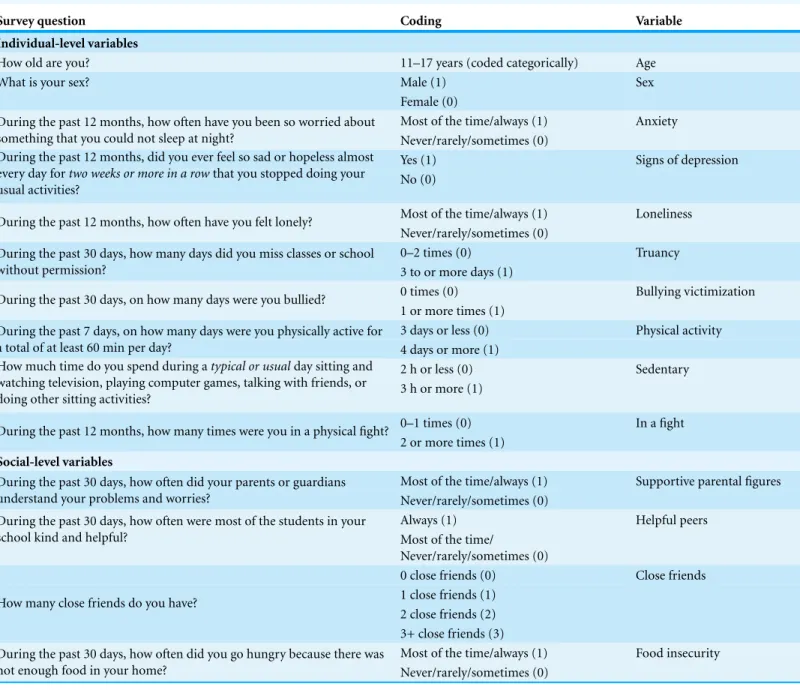
We derived the dependent variable, physical fighting, from one question in the GSHS: “During the past 12 months, how many times were you in a physical fight?” Response options ranged from “0 times”, “1 time”, “2 or 3 times”, “4 or 5 times”, “6 or 7 times”, “8 or 9 times”, “10 or 11 times” or “12 or more times”. A physical fight was defined as “when two or more students of about the same strength and power choose to fight each other”. For the purpose of our analyses, participants were classified as having participated in a physical fight if they reported being in two or more fights(N=1,593). If one or fewer fights were
reported, participants were classified as not participating in a physical fight(N=3,545).
Table 1 Independent variable derivation from GSHS survey data (2006).
Survey question Coding Variable
Individual-level variables
How old are you? 11–17 years (coded categorically) Age
What is your sex? Male (1) Sex
Female (0)
Most of the time/always (1) Anxiety During the past 12 months, how often have you been so worried about
something that you could not sleep at night? Never/rarely/sometimes (0)
Yes (1) Signs of depression
During the past 12 months, did you ever feel so sad or hopeless almost every day fortwo weeks or more in a rowthat you stopped doing your
usual activities? No (0)
Most of the time/always (1) Loneliness During the past 12 months, how often have you felt lonely?
Never/rarely/sometimes (0)
0–2 times (0) Truancy
During the past 30 days, how many days did you miss classes or school
without permission? 3 to or more days (1)
0 times (0) Bullying victimization
During the past 30 days, on how many days were you bullied?
1 or more times (1)
3 days or less (0) Physical activity During the past 7 days, on how many days were you physically active for
a total of at least 60 min per day? 4 days or more (1)
2 h or less (0) Sedentary
How much time do you spend during atypical or usualday sitting and watching television, playing computer games, talking with friends, or
doing other sitting activities? 3 h or more (1)
0–1 times (0) In a fight
During the past 12 months, how many times were you in a physical fight?
2 or more times (1) Social-level variables
Most of the time/always (1) Supportive parental figures During the past 30 days, how often did your parents or guardians
understand your problems and worries? Never/rarely/sometimes (0)
Always (1) Helpful peers
During the past 30 days, how often were most of the students in your
school kind and helpful? Most of the time/
Never/rarely/sometimes (0)
0 close friends (0) Close friends 1 close friends (1)
2 close friends (2) How many close friends do you have?
3+ close friends (3)
Most of the time/always (1) Food insecurity During the past 30 days, how often did you go hungry because there was
not enough food in your home? Never/rarely/sometimes (0)
Statistical analysis
Table 2 Distribution of selected factors according to categories of physical fighting among school-attending adolescents in Egypt (2006).
Variable Not involved in physical fights
(n=3,545)
Involved in physical fights
(n=1,593)
p-value Chi-square or t-value
Age (mean) 13.2 (0.93) 13.2 (0.99) 0.410 −0.825
Sex (female) 55.0 33.1 <0.001 211.606
Food insecurity 5.0 6.2 0.066 3.400
Bullied 45.6 70.3 <0.001 269.243
Loneliness 8.4 13.1 <0.001 27.529
Anxiety 8.0 14.1 <0.001 44.659
Signs of depression 30.6 34.2 <0.011 6.492
Truancy 14.0 21.9 <0.001 49.386
Social network
No close friends 7.3 6.2 <0.001 21.134
One close friend 17.8 13.1 — —
Two close friends 30.3 31.2 — —
Three or more close friends 44.6 50.0 — —
Helpful peers 27.1 16.8 <0.001 64.074
Sedentary 21.1 31.5 <0.001 63.605
Physically active 18.0 20.4 0.044 4.072
Understanding parents 19.0 11.7 <0.001 41.973
Notes.
All variables are expressed as proportions (in %) except for age (mean and standard deviation).
adjusted only for age and sex. We reported the measures of association as odds ratios (OR) accompanied by 95% confidence intervals (CI). All analyses were carried out using Stata 12 (StataCorp, 2011).
RESULTS
Within the recall period, 31%(n=1,593)of participants reported being involved in
two or more physical fights, a majority of which were males (67%). The mean age of the sample was 13.2 years old (SD=0.95). Thirty-two percent of respondents reported signs of
depression, with 10% indicating loneliness and 10% percent anxiety. Food insecurity was found in 5.4% of the sample and more than half (53%) of all participants reported being bullied during three or more days during the recent 30-day period.
Table 2shows the crude distribution of selected factors according to physical fighting category. The bivariate analyses revealed that within all but three of the selected variables, significant differences existed between participants who had been involved in physical fights and those who were not. No significant differences existed with regard to food insecurity among the physical fighting categories or physical activity.
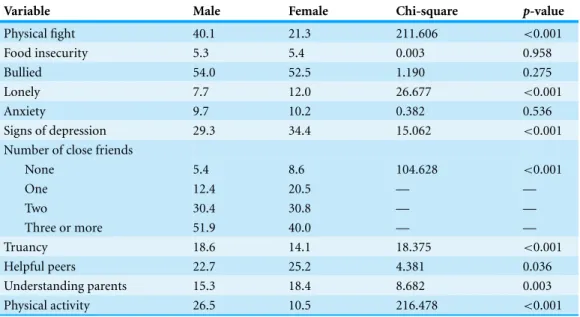
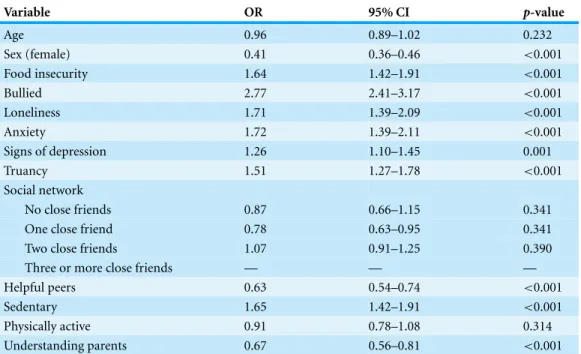
Table 3shows the distribution of variables by sex. The age and sex adjusted analysis (Table 4) revealed significant associations for all selected variables with the exception of age, social network variables and physical activity. As in the model which adjusted for all covariates, female sex (OR=0.41; CI=0.36–0.46) and having helpful peers
Table 3 Distribution of selected variable categories by sex among a nationally representative sample of Egyptian adolescents (2006).
Variable Male Female Chi-square p-value
Physical fight 40.1 21.3 211.606 <0.001
Food insecurity 5.3 5.4 0.003 0.958
Bullied 54.0 52.5 1.190 0.275
Lonely 7.7 12.0 26.677 <0.001
Anxiety 9.7 10.2 0.382 0.536
Signs of depression 29.3 34.4 15.062 <0.001
Number of close friends
None 5.4 8.6 104.628 <0.001
One 12.4 20.5 — —
Two 30.4 30.8 — —
Three or more 51.9 40.0 — —
Truancy 18.6 14.1 18.375 <0.001
Helpful peers 22.7 25.2 4.381 0.036
Understanding parents 15.3 18.4 8.682 0.003
Physical activity 26.5 10.5 216.478 <0.001
Notes.
Percentages of the total within each category are listed.
Having understanding parents (OR=0.67; CI=0.56–0.81) was found to be significantly
protective. None of the social network variables were found to be associated with fighting behavior. As in the previous model being bullied, loneliness, anxiety, signs of depression, truancy and sedentary behavior were associated with higher rates of fighting.
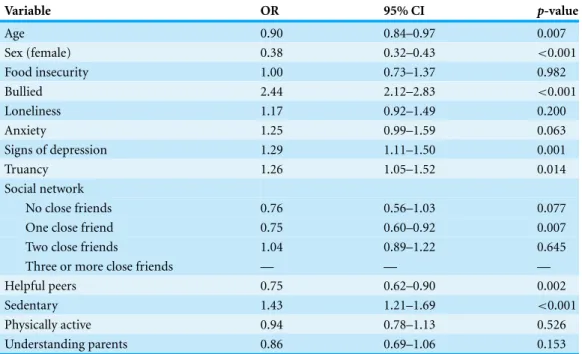
After adjusting for all associated covariates in the first model (Table 5), and compared to those who did not report being involved in physical fighting, those who had been involved in physical fights were younger (OR=0.90; CI=0.84–0.97) and less likely
to be male (OR=0.38; 0.32–0.43). Being bullied was significantly associated with an
increase in fighting involvement (OR=2.44; CI=2.12–2.83) as was missing days of school
(OR=1.26; CI=1.05–1.52). Those who reported signs of depression were also more likely
to have reported being involved in fighting behavior (OR=1.29; CI=1.11–1.50). Having
fewer close friends appeared to indicate an effect which was protective, but the result was only statistically significant for those who reported having only one friend (OR=0.75;
CI=0.60–0.92). Having helpful peers in school (OR=0.75; CI=0.62–0.90) had a
protective effect while sedentary behaviors (OR=1.43; CI=1.21–1.69) were positively
associated with being involved in fighting behavior.
DISCUSSION
Table 4 Multivariate analysis of physical fighting among school-attending adolescents in Egypt (2006).
Variable OR 95% CI p-value
Age 0.96 0.89–1.02 0.232
Sex (female) 0.41 0.36–0.46 <0.001
Food insecurity 1.64 1.42–1.91 <0.001
Bullied 2.77 2.41–3.17 <0.001
Loneliness 1.71 1.39–2.09 <0.001
Anxiety 1.72 1.39–2.11 <0.001
Signs of depression 1.26 1.10–1.45 0.001
Truancy 1.51 1.27–1.78 <0.001
Social network
No close friends 0.87 0.66–1.15 0.341
One close friend 0.78 0.63–0.95 0.341
Two close friends 1.07 0.91–1.25 0.390
Three or more close friends — — —
Helpful peers 0.63 0.54–0.74 <0.001
Sedentary 1.65 1.42–1.91 <0.001
Physically active 0.91 0.78–1.08 0.314
Understanding parents 0.67 0.56–0.81 <0.001
Notes.
OR, Odds Ratio; 95% CI, 95% Confidence Interval. All estimates are adjusted for age and sex; age; or sex.
political revolutions and lack of safety measures in schools may exacerbate existing youth violence, likely making it an emergent public health issue in the region.
Overall our analyses yielded results that coincide with previously known risk and pro-tective factors for youth involvement in interpersonal violence. Additionally, the reported prevalence rate of physical fighting among our sample of Egyptian adolescents (31%) was similar to reported rates in high-income (Eaton et al., 2012;Fraga et al., 2011) and other low- and middle-income countries globally (Alikasifoglu et al., 2004;Rudatsikira, Muula & Siziya, 2008). Well-studied risk factors such as signs of depression, truancy, and bullying victimization were associated with involvement in physical fighting in our sample of Egyp-tian adolescents. The commonly and globally observed trend of males being more involved in physical fighting was also found in our study (Sousa et al., 2010;Walsh et al., 2013). Protective factors such as understanding parents and helpful peers were also found to be significant for Egyptian adolescents. Two of our findings were notable for their novelty within the context of the more researched risk and protective factors for youth violence.
Table 5 Multivariate analysis of physical fighting among school-attending adolescents in Egypt (2006).
Variable OR 95% CI p-value
Age 0.90 0.84–0.97 0.007
Sex (female) 0.38 0.32–0.43 <0.001
Food insecurity 1.00 0.73–1.37 0.982
Bullied 2.44 2.12–2.83 <0.001
Loneliness 1.17 0.92–1.49 0.200
Anxiety 1.25 0.99–1.59 0.063
Signs of depression 1.29 1.11–1.50 0.001
Truancy 1.26 1.05–1.52 0.014
Social network
No close friends 0.76 0.56–1.03 0.077
One close friend 0.75 0.60–0.92 0.007
Two close friends 1.04 0.89–1.22 0.645
Three or more close friends — — —
Helpful peers 0.75 0.62–0.90 0.002
Sedentary 1.43 1.21–1.69 <0.001
Physically active 0.94 0.78–1.13 0.526
Understanding parents 0.86 0.69–1.06 0.153
Notes.
OR, Odds Ratio; 95% CI, 95% Confidence Interval. All estimates are adjusted for all variables listed in the table.
studies suggest this potential risk factor may deserve more attention from public health researchers.
Of particular importance is determining what about sedentary behavior contributes to violent behavior. Current hypotheses center on the type of sedentary activities youth are engaging in, with emphasis on video and computer gaming. Exposure to video or computer games with violent content has been linked to aggression (Anderson, 2004). Gaming, however, is not as ubiquitous in Egypt as it is in high-income countries; the high prices of gaming consoles and games make them unattainable to the majority of the population: access is often limited to public gaming centers (Garratt, 2012). Therefore, the gaming hypothesis is likely irrelevant to Egyptian youth. A more likely explanation for this correlation in Egyptian adolescents lies in the current political situation in Egypt. The contentious and highly-charged political atmosphere could be forcing sedentary behavior upon this age group: studies show that adolescents living in areas characterized by turmoil are more likely to engage in sedentary behavior (Kim et al., 2010;Carson & Janssen, 2012). While this does not explain the nature of the interaction between sedentary behavior and physical fighting, it does provide a potential starting point for addressing this behavior in Egyptian adolescents in a culturally-sensitive manner, most notably creating opportunities for adolescents to engage in appropriate physical activities in a safe environment.
of depression) was found to be associated with increased likelihood of participating in physical fighting in our sample. However, perhaps having fewer friends, and thus, a smaller social circle, reduces the likelihood of youth becoming exposed to other youth who may be involved in risky and delinquent behaviors; associating with delinquent peers is a known risk factor for youth violence (Haynie, 2001;Haynie, 2002). Another explanation for this finding could be the quality of the youths’ friendships: fewer, but more supportive and exemplary friends could have a more positive effect on youth than a wider yet less meaningful social network.
While not a specific aim of the present study, the high rates of reported signs of depression and bullying victimization give cause for considerable concern, particularly since both were found to be strongly associated in our sample–at all levels of analysis–for involvement in physical fighting. An explanation for the high rates of reported signs of depression could be that most Egyptian adolescents are without hope for a bright future with appropriate education, descent work and marriage opportunities. Our findings would suggest that culturally-appropriate tertiary interventions designed to alleviate depressive symptoms and help adolescents cope with bullying victimization may help reduce the likelihood of involvement in physical fighting. In conjunction with these efforts, primary and secondary prevention programs designed to prevent and reduce bullying would be advantageous as well and most likely create supportive school environments; this may increase the likelihood of having helpful peers, which was an observed protective factor for involvement in physical fighting.
Strengths and limitations
Demographic, socioeconomic and political factors singular to LMICs create a contextual backdrop unlike that in high-income countries. In particular, the “youth bulge” phenomenon observed in LMICs has been cited as a possible explanation for escalating violence in this demographic region (Hilker & Fraser, 2009). This disproportionate age distribution puts additional strains on underfunded infrastructures that may already struggle to provide employment and adequate education to the younger generation. Com-bined with political unrest, a precarious national ethos materializes that often translates to increased interpersonal conflicts and violence (Peden et al., 2008). Additionally, the effects of urbanization have led to increased migration from urban areas to surrounding rural areas, creating pockets of impoverished, suburban populations – situations which have been shown to increase aggressive and violent behavior among adolescents (Schneiders et al., 2003;Carlson, 2006).
Our findings, however, should be considered within the context of the study’s limitations. Given the nature of self-report surveys, responses could be biased towards socially accepted norms. Some questions required participants to recall information within a rather generous time frame (30 days or 12 months), and the effects of the passage of time on memory might have affected participants’ recall ability and accuracy. Furthermore, while designed to be culturally-sensitive and given to participants in their native language (Arabic), participant interpretation of the questions might have differed from what the survey designers intended to capture with the questions. Additionally, causality cannot be inferred due to the cross-sectional data.
Future research
As mentioned earlier, more research is needed to understand why participation in sedentary behaviors seems to increase the likelihood of involvement in physical fighting, particularly in youth from low- and middle-income countries. Some professionals theorize that sedentary behavior often coincides with unstructured socializing, of which there has been an observed association with delinquent behaviors such as violence (Haynie & Osgood, 2005). This might be a more plausible explanation for the association between sedentary behavior and physical fighting in our sample of Egyptian youth, rather than gaming-centered hypotheses.
Or does sedentary behavior interact with other present risk factors such as depression? Depressive symptoms and a sedentary lifestyle are closely related; a standing chicken-and-the-egg debate over the nature of the association exists, but a growing body of literature indicates that targeted physical activity interventions may ameliorate depressive symptoms in adolescents (Brown et al., 2013). Involving Egyptian adolescents with a high risk for physical fighting in physical activities as part of a well-designed intervention program–and determining this program’s effects–may be a likely next step for public health professionals working to address adolescent interpersonal violence in Egypt.
Studies designed to repeat the significant finding of fewer friends as a protective factor should also be conducted. Quantitative and qualitative studies could probe deeper into the nature of the friendships to learn which specific qualities of the relationship impart protective effects. Once more is known about this potential protective factor, public health professionals will have a better understanding of how to include it in intervention efforts, if the research does indeed suggest it should be taken into consideration.
CONCLUSIONS
environments, as well as providing access to physical activities in a safe environment, may help reduce the prevalence of violent behavior in Egyptian adolescents.
ACKNOWLEDGEMENTS
The authors thank the Ministry of Education, Arab Republic of Egypt; the Centers for Disease Control and Prevention (Atlanta, GA, USA); and the World Health Organization (Geneva, Switzerland). The authors also thank all of the survey officers and students who took part in the survey.
ADDITIONAL INFORMATION AND DECLARATIONS
Funding
The authors declare that they have no funding for this work.
Competing Interests
The authors declare that they have no conflict of interest, whether financial or otherwise, which arise from the analysis and reporting of the data contained in this manuscript.
Author Contributions
• Karen L. Celedonia conceived and designed the experiments, wrote the paper. • Michael L. Wilson performed the experiments, analyzed the data, wrote the paper. • Hanan A. El Gammal reviewed and made critical revisions to the manuscript. • Abeer M. Hagras contributed reagents/materials/analysis tools.
Ethics
The following information was supplied relating to ethical approvals (i.e., approving body and any reference numbers):
Egypt Ministry of Education research committee
The study was based on freely available secondary data. Detailed information on ethical procedures and policies concerning the data collection can be found athttp://www.cdc. gov/gshs/.
REFERENCES
Alikasifoglu M, Erginoz E, Ercan O, Uysal O, Kaymak DA, Iiter O. 2004.Violent behaviour among Turkish high school students and correlates of physical fighting.European Journal of Public Health14:173–177DOI 10.1093/eurpub/14.2.173.
Anderson CA. 2004.An update on the effects of playing violent video games.Journal of Adolescence
27:113–122DOI 10.1016/j.adolescence.2003.10.009.
Brown H, Pearson N, Braithwaite R, Brown W, Biddle S. 2013.Physical activity interventions and depression in children and adolescents: a systematic review and meta-analysis.Sports Medicine
43:195–206DOI 10.1007/s40279-012-0015-8.
Butchart A, Kruger J, Nell V. 1997.Neighbourhood safety: a township violence and injury profile.
Carlson KT. 2006.Poverty and youth violence exposure: experiences in rural communities.
Children and Schools28:87–96DOI 10.1093/cs/28.2.87.
Carson V, Janssen I. 2012.Neighborhood disorder and screen time among 10–16 year old Canadian youth: a cross-sectional study.International Journal of Behavioral Nutrition and Physical Activity9:1–11DOI 10.1186/1479-5868-9-66.
DHHS. 2001.Youth violence: a report of the surgeon general. Rockville: Office of the Surgeon General.
Eaton DK, Kann L, Kinchen S, Shanklin S, Flint KH, Hawkins J, Harris WA, Lowry R, McManus T, Chyen D, Whittle L, Lim C, Wechsler H, Centers for Disease Control and Prevention (CDC). 2012.Youth Risk Behavior Surveillance–United States 2011.Morbidity and Mortality Weekly Report. Surveillance Summaries (Washington, D.C.: 2002)61(4):1–162.
Ez-Elarab HS, Sabbour SM, Gadallah MA, Asaad TA. 2007.Prevalence and risk factors of violence among elementary school children in Cairo.Journal of the Egypt Public Health Association
82:127–146.
Fraga S, Ramos E, Dias S, Barros H. 2011.Physical fighting among school-going Portuguese adolescents: social and behavioural correlates. Prevention Medicine 52:401–404
DOI 10.1016/j.ypmed.2011.02.015.
Garratt P. 2012.Disconnected? Gaming and the Egyptian revolution.Available at
http://www.vg247.com/2012/01/25/disconnected-gaming-and-the-egyptian-revolution/
(accessed 5 March 2013).
Gofin R, Palti H, Mandel M. 2000.Fighting among Jerusalem adolescents: personal and school-related factors.Journal of Adolescent Health27:218–223DOI 10.1016/S1054-139X(00)00095-1.
Haynie DL. 2001.Delinquent peers revisited: does network structure matter?American Journal of Sociology106:1013–1057DOI 10.1086/320298.
Haynie DL. 2002.Friendship networks and delinquency: the relative nature of peer delinquency.
Journal of Quantitative Criminology18:99–134DOI 10.1023/A:1015227414929.
Haynie DL, Osgood DW. 2005.Reconsidering peers and delinquency: How do peers matter?Social Forces84:1109–1130DOI 10.1353/sof.2006.0018.
Hilker LM, Fraser E. 2009. Youth exclusion, violence, conflict and fragile states. Social Development Direct.
Iannotti RJ, Janssen I, Haug E, Kololo H, Annaheim B, Borraccino A. 2009.Interrelationships of adolescent physical activity, screen-based sedentary behaviour, and social and psychological health.International Journal of Public Health54:191–198DOI 10.1007/s00038-009-5410-z.
Kim J, Liu J, Colabianchi N, Pate RR. 2010.The effect of perceived and structural neighborhood conditions on adolescents’ physical activity and sedentary behaviors.Archives of Pediatrics and Adolescent Medicine164:935–942DOI 10.1001/archpediatrics.2010.167.
Krug EG, Dahlberg LL, Mercy JA, Zwi AB, Lozano R. 2002.World report on violence and health. Geneva: World Health Organization.
Morris RG, Johnson MC. 2010.Sedentary activities, peer behavior, and delinquency among American youth.Crime & Delinquency1–30DOI 10.1177/0011128710386205.
Nelson MC, Gordon-Larsen P. 2006.Physical activity and sedentary behavior patterns are associated with selected adolescent health risk behaviors.Pediatrics117:1281–1290
DOI 10.1542/peds.2005-1692.
OECD. 2011.Reducing the involvement of youth in armed violence: programming note. Conflict and Fragility: OECD Publishing.
Peden M, Oyegbite K, Ozanne-Smith J, Hyder AA, Branche C, Rahman AF, Rivara F, Bartolomeos K. 2008.World report on child injury prevention. Geneva: World Health Organization.
Rudatsikira E, Muula AS, Siziya S. 2008.Prevalence and correlates of physical fighting among school-going adolescents in Santiago, Chile.Revista Brasileira de Psiquiatria30:197–202
DOI 10.1590/S1516-44462008000300004.
Rudatsikira E, Siziya S, Kazembe LN, Muula AS. 2007.Prevalence and associated factors of physical fighting among school-going adolescents in Namibia.Annals of General Psychiatry
6:1–5DOI 10.1186/1744-859X-6-18.
Schneiders J, Drukker M, Ende Jvd, Verhulst FC, Os Jv, Nicolson NA. 2003.Neighbourhood socioeconomic disadvantage and behavioural problems from late childhood into early adolescence.Journal of Epidemiology and Community Health57:699–703
DOI 10.1136/jech.57.9.699.
Sousa S, Correia T, Ramos E, Fraga S, Barros H. 2010.Violence in adolescents: social and behavioural factors.Gaceta Sanitaria24:47–52DOI 10.1016/j.gaceta.2009.08.002.
StataCorp. 2011.Stata Statistical Software: Release 12. College Station: StataCorp LP.
Sugimoto-Matsuda JJ, Braun KL. 2013.The role of collaboration in facilitating policy change in youth violence prevention: a review of the literature.Prevention ScienceEpub ahead of print Feb 21 2013.
Walsh SD, Molcho M, Craig W, Harel-Fisch Y, Huynh Q, Kukaswadia A, Aasvee K, Varnai D, Ottova V, Ravens-Sieberer U, Pickett W. 2013.Physical and emotional health problems experienced by youth engaged in physical fighting and weapon carrying.PLoS ONE8(2):e56403
DOI 10.1371/journal.pone.0056403.