ISSN 0100-879X
BIOMEDICAL SCIENCES
AND
CLINICAL INVESTIGATION
www.bjournal.com.br
www.bjournal.com.br
Volume 44 (12) 1194-1298 December 2011
Institutional Sponsors
The Brazilian Journal of Medical and Biological Research is partially financed by
Faculdade de Medicina de Ribeirão Preto Campus
Ribeirão Preto
Ex plor e H igh - Pe r for m a n ce M S Or bit r a p Te ch n ology I n Pr ot e om ics & M e t a bolom ics
analit icaw eb.com .br S C I E N T I F I C
Braz J Med Biol Res, December 2011, Volume 44(12) 1285-1290
doi: 10.1590/S0100-879X2011007500139
Markers of insulin resistance and sedentary lifestyle are predictors
of preeclampsia in women with adverse obstetric results
Markers of insulin resistance and sedentary
lifestyle are predictors of preeclampsia in
women with adverse obstetric results
S. Hoirisch-Clapauch
1and P.R. Benchimol-Barbosa
21Unidade Materno Fetal de Alto Risco, Hospital Federal dos Servidores do Estado, Rio de Janeiro, RJ, Brasil 2Departamento de Cardiologia, Universidade do Estado do Rio de Janeiro, Universidade Gama Filho, Rio de Janeiro, RJ, Brasil
Abstract
Some thrombophilias and severe preeclampsia may increase the risk for preterm deliveries and fetal death due to placental
insufficiency. Our objective was to evaluate clinical and laboratory data as predictors of preeclampsia in a population of mothers
with 3rd trimester fetal losses or preterm deliveries. In a longitudinal retrospective study, 54 consecutive women (age range: 16 to 39 years) with normotensive pregnancies were compared to 79 consecutive women with preeclampsia (age range: 16 to
43 years). Weight accrual rate (WAR) was arbitrarily defined as weight gain from age 18 years to the beginning of pregnancy
divided by elapsed years. Independent predictors of preeclampsia were past history of oligomenorrhea, WAR >0.8 kg/year, pre-pregnancy or 1st trimester triglyceridemia >150 mg/dL, and elevated acanthosis nigricans in the neck. In a multivariate logistic regression model, two or more predictors conferred an odds ratio of 15 (95%CI [5.9-37]; P < 0.001) to develop preeclampsia
(85% specificity, 73% sensitivity, c-statistic of 81 ± 4%; P < 0.0001). Clinical markers related to insulin resistance and sedentary
lifestyle are strong independent predictors of preeclampsia in mothers with 3rd trimester fetal losses or preterm deliveries due
to placental insufficiency. Women at risk for preeclampsia in this particular population might benefit from measures focused on
overcoming insulin resistance.
Key words: Preeclampsia; Acanthosis nigricans; Weight accrual rate; Triglycerides; Oligoamenorrhea
Introduction
Correspondence: S. Hoirisch-Clapauch, Praça Demétrio Ribeiro, 17/1201, 22011-020 Rio de Janeiro, RJ, Brasil. E-mail: [email protected]
Received April 12, 2011. Accepted September 30, 2011. Available online October 21, 2011. Published November 28, 2011.
Placentas from thrombophilic women whose normotensive
pregnancies are complicated by placental insufficiency share histopathological findings with pregnancies complicated by
preeclampsia, such as infarcts and thrombosis (1). This
pro-thrombotic metabolic profile in preeclampsia has been com -monly associated with a sedentary lifestyle and pre-pregnancy complaints of irregular menses (2). Furthermore, mothers with preeclampsia may remain hypertensive after delivery, with a potential increase in lifelong risk for adverse cardiovascular outcomes (3). The aim of the present study was to analyze clinical and laboratory data regarding pregnancies that ended with fetal losses or preterm deliveries related to placental
insuf-ficiency as predictors of preeclampsia.
Patients and Methods
Study design
From January 2008 to December 2010, a cohort of 133
consecutive women referred to Unidade Materno-Fetal de Alto Risco, Hospital Federal dos Servidores do Estado, Rio de Janeiro, with either a preterm delivery or a 3rd trimester
fetal loss as a consequence of placental insufficiency were
enrolled in a longitudinal, retrospective and observational study. Subjects comprised 54 normotensive mothers with a diagnosis of thrombophilia or with a systemic thrombotic event before pregnancy or during the puerperium (NM, 175 pregnancies, 179 offspring) and 79 mothers with preec-lampsia (PM, 238 pregnancies, 243 offspring). The study protocol was approved by the Ethics Committee of Hospital Federal dos Servidores do Estado (registration #000377) on September 14, 2009.
1286 S. Hoirisch-Clapauch and P.R. Benchimol-Barbosa
of systemic thrombosis before pregnancy. Thrombophilia screening included factor V Leiden, prothrombin G20210A polymorphism, antithrombin III, functional protein C, free pro-tein S assessed far from pregnancy, puerperium or infectious episodes, lupus anticoagulant, and anticardiolipin antibodies IgM and IgG. Whenever positive, antiphospholipid antibod-ies were repeated after a 12-week interval. Anticardiolipin
antibody cut-off was ≥40 GPL or MPL. Homozygosis or
double heterozygosis of methylene tetrahydrofolate re-ductase was not considered to be relevant because folate supplementation is part of obstetrical routine.
The PM group was selected on the basis of the pres-ence of all of the following criteria: i) women with severe
preeclampsia (see definition below); ii) death of a morpho -logically normal fetus beyond 28 weeks of gestation or a premature delivery.
Exclusion criteria for NM and PM were any of the follow-ing: i) diabetes; ii) untreated anatomical causes responsible for either fetal loss or preterm delivery; iii) illicit drug addic-tion; iv) medications that could alter metabolic parameters
or induce fibrinolysis such as metformin or full-dose heparin
use during pregnancy. Cut-off at 28 gestational weeks was
arbitrarily defined to exclude patients with notches in uterine
artery Doppler scan in the NM group.
Maternal information was retrieved from patient interview and review of medical records. Data were obtained from
last pregnancy that ended at ≥28 weeks of gestation either
with preterm delivery or fetal death as a consequence of
placental insufficiency.
Placental insufficiency was characterized by the pres -ence of either an excess placental thrombosis/infarction at postpartum histopathological assessment or intrauterine growth restriction combined to oligohydramnios (fetal urinary tract abnormalities were excluded).
Definitions
Some pregnant women are young and, as a conse-quence, sedentary lifestyle might not yet have been nec-essarily translated into increased body mass index (BMI). Furthermore, we know from experience that women who gain weight over time tend to be more sedentary. Thus, we have created an index to express this weight accrual
rate (WAR) as an alternative. WAR is defined as weight
at the beginning of pregnancy minus weight at the age of 18, divided by the number of elapsed years. For example, a 23-year-old mother weighing 60 kg at the beginning of pregnancy and 50 kg when she was 18, gained 10 kg in 5 years and her WAR is 10:5 = 2.
Preeclampsia was considered to be severe if one or more of the following criteria were present: i) sustained systolic
blood pressure ≥160 mmHg or diastolic blood pressure ≥110 mmHg after the 20th week of gestation and proteinuria ≥300 mg/24 h; ii) sustained systolic blood pressure ≥140 mmHg or diastolic blood pressure ≥90 mmHg after the 20th week of gestation and proteinuria ≥5 g/24 h; iii) sustained systolic
blood pressure ≥140 mmHg or diastolic blood pressure ≥90 mmHg after the 20th week of gestation, proteinuria ≥300 mg/24 h and multisystemic involvement, such as:
pulmonary edema, oliguria, abnormal liver enzymes with persistent epigastric or right upper-quadrant pain, platelet
count <100,000/mm3, or persistent and severe central
ner-vous system symptoms, such as seizures, altered mental status, headaches, blurred vision, or blindness. Eclampsia
was defined as preeclampsia with seizures and HELLP
syndrome as microangiopathic hemolysis, elevated liver
enzymes and platelet count <100,000/mm3 (4).
Statistical analysis
Continuous variables are reported as means ± SD and
discrete variables as ratio or percent, and were compared by
the two-tailed Student t-test or chi-square (Fisher exact) test in
univariate analysis, as appropriate. Continuous variables had their optimal cut-off values calculated by receiver operating
characteristic (ROC) curve analysis. Significant variables in
univariate analysis were entered into a stepwise multivariate logistic regression model to identify independent predictors of
preeclampsia. In the model, covariant variables were identified
by regression analysis and were retained according to the Wald
test significance. Significant variables in the logistic model were
equally weighed to 1 and were entered into a predictive model, which accounted for the sum of the weight of each variable. A bootstrap re-sampling procedure using multivariate logistic regression modeling was employed to validate the present score. The alpha error level was set to 0.05.
Results
Placental insufficiency was confirmed by histopathology
for 120 mothers, whereas the remaining 13 mothers had fetal demise associated with intrauterine growth restric-tion and oligohydramnios, without ultrasound evidence of fetal urinary tract malformation. Mean maternal age did
not differ between groups: 29 ± 5 years for NM (range: 16-39 years), and 31 ± 7 years for PM (range: 16-43 years) (P = 0.3). Three NM and 1 PM were smokers (≥1
pack/day) and smoked throughout pregnancy (P = 0.64). Thrombotic tendency was higher in the NM group than in the PM group. While 25 NM had deep venous thrombosis (DVT) pre-pregnancy or during the puerperium and 1 had a stroke (48%), 13 PM had a DVT pre-pregnancy or during the puerperium, 7 had a stroke and 1 had both a DVT and a stroke pre-pregnancy (27%; P = 0.02). The prevalence of antiphospholipid syndrome was similar in NM and PM (9 and 8%, respectively; P = 0.98). In NM, 9 had protein S
deficiency, 6 had protein C deficiency, 5 had antithrombin III deficiency, 2 were heterozygous for factor V Leiden, 2
were heterozygous for factor II G20210A, and 1 had es-sential thrombocythemia.
not: 45 of 79 PM (57%) had had only one episode of preec-lampsia, and 53% of them were nulliparous; 34 of 79 PM (43%) had had recurrent preeclampsia or eclampsia, 85% of them with the same partner, 9% with a different partner, 6% with either a different or the same partner. In the PM group, 63 of 79 women (80%) were resting and avoiding any kind of exercise when preeclampsia was eventually detected. Table 1 summarizes the obstetric outcomes.
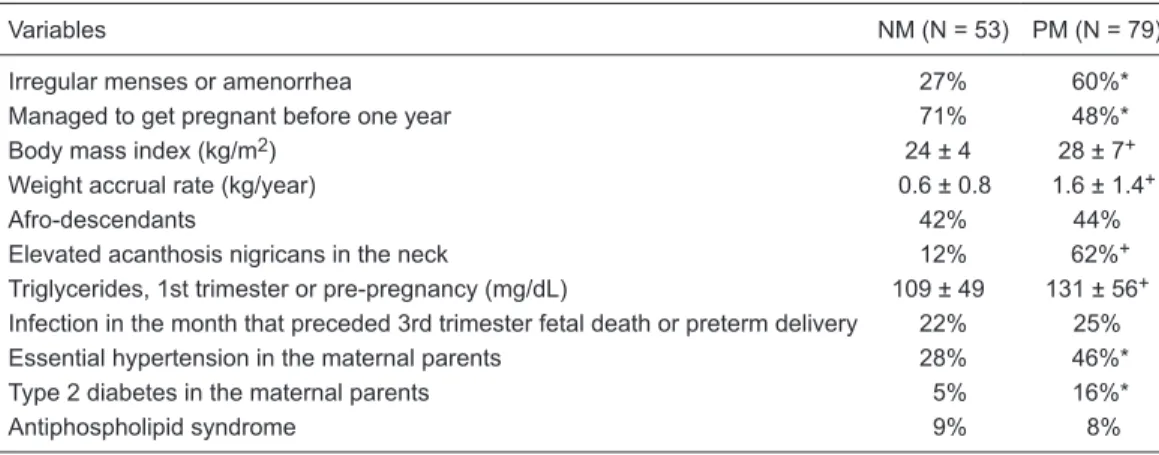
PM women showed a higher prevalence of clinical and laboratory markers related to insulin resistance than NM, such as oligomenorrhea (60 and 27%, respectively; P <
0.001), higher BMI at the beginning of pregnancy (28 ± 7 and 24 ± 4 kg/m2, respectively; P < 0.001), higher WAR (1.6 ± 1.4 and 0.6 ± 0.8 kg/year, respectively; P < 0.001), higher pre-pregnancy or 1st trimester triglyceridemia (131 ± 56 and 109 ± 49 mg/dL, respectively; P = 0.02), and elevated
acanthosis nigricans in the neck (62 and 12%, respectively; P < 0.001). No difference was found in pre-pregnancy or 1st trimester plasma LDL or HDL levels between NM (103
± 33 and 60 ± 13 mg/dL) and PM (97 ± 32 and 60 ± 18 mg/dL, respectively; P = 0.31
and P = 0.99). At least one episode of acute bacterial, viral or fungal infection during the month that preceded 3rd trimester fetal de-mise or premature delivery was observed in 17 NM (17/77, 22%) and in 32 PM (32/128, 25%; P = 0.89). While hypertension was not a characteristic in the NM group, in PM, 11 of 79 were hypertensive prior to the pregnancy under study (0 and 14%, respectively; P = 0.003). After a pregnancy complicated by severe preeclampsia, 28 of the 79 PM women remained hypertensive at least 3 months after delivery, as opposed to
none in the NM group (35 and 0%, respectively; P < 0.001). Essential hypertension and type 2 diabetes were more frequent in parents of PM (46 and 16%) than in parents of NM (28 and 5%, respectively; P = 0.002 and P = 0.001). Table 2 summarizes the maternal characteristics.
In univariate analysis, ROC curve analysis of WAR
showed an optimal cut-off value at >0.8 kg/year, with 70%
sensitivity and 74% specificity (OR = 7; 95%CI [3-15]; P < 0.001; c-statistic = 0.74 ± 0.05; P < 0.001).
We carried out a stepwise logistic regression analysis to identify independent predictive variables for preeclampsia in this population of mothers with pregnancies that ended with fetal losses or preterm deliveries related to placental
insufficiency. The model was appropriately adjusted to regression data (model significance test: P < 0.001; re
-sidual significance test: P = 0.9). Independent variables
for preeclampsia were: i) oligomenorrhea (Wald test: χ2 =
6.7; P = 0.006); ii) WAR >0.8 kg/year (Wald test: χ2 = 15; P
= 0.001); iii) pre-pregnancy or 1st trimester triglyceridemia
Table 1. Obstetric outcomes of the patients studied.
Variables NM (N = 53) PM (N = 79)
Offspring 176 (100%) 243 (100%)
Spontaneous embryonic/fetal death, 1st trimester 37 (21%) 42 (17%) Spontaneous fetal death, 2nd trimester 35 (20%) 42 (17%) Spontaneous fetal death, 3rd trimester 27 (15%) 36 (15%)
Preterm deliveries 50 (29%) 92 (38%)*
Full-term deliveries 27 (15%) 31 (13%)
Data are reported as number with percent in parentheses. NM = normotensive mothers; PM = mothers with preeclampsia. *P < 0.05 compared to NM (chi-square or Fisher exact tests when appropriate).
Table 2. Maternal characteristics.
Variables NM (N = 53) PM (N = 79)
Irregular menses or amenorrhea 27% 60%*
Managed to get pregnant before one year 71% 48%*
Body mass index (kg/m2) 24 ± 4 28 ± 7+
Weight accrual rate (kg/year) 0.6 ± 0.8 1.6 ± 1.4+
Afro-descendants 42% 44%
Elevated acanthosis nigricans in the neck 12% 62%+
Triglycerides, 1st trimester or pre-pregnancy (mg/dL) 109 ± 49 131 ± 56+ Infection in the month that preceded 3rd trimester fetal death or preterm delivery 22% 25%
Essential hypertension in the maternal parents 28% 46%*
Type 2 diabetes in the maternal parents 5% 16%*
Antiphospholipid syndrome 9% 8%
1288 S. Hoirisch-Clapauch and P.R. Benchimol-Barbosa
>150 mg/dL (Wald test: χ2 = 4.8; P = 0.04); iv) elevated
acanthosis nigricans in the neck (Wald test: χ2 = 5.7; P =
0.001).
Each significant variable was arbitrarily assigned a
unit weight. A score was built by summing up individual weights, ranging from 0 to 4. The optimal cut-off value of
preeclampsia score, assessed by the ROC curve, was ≥2, with 73% sensitivity and 85% specificity (c-statistic = 0.81 ± 0.04; P < 0.001), OR = 15 (95%CI [5.9-37]; P < 0.001;
Figure 1).
We carried out 1000 bootstrap uniform re-sampling
procedures to validate the final logistic model. The aver
-age model coefficient for each independent predictor was oligomenorrhea = 2.7 ± 1.5 (P < 0.001); WAR >0.8 kg/year = 1.7 ± 1.6 (P < 0.001); pre-pregnancy or 1st trimester triglyceridemia >150 mg/dL = 1.8 ± 1.9 (P < 0.001), and elevated acanthosis nigricans in the neck = 2.0 ± 1.8 (P <
0.001). In bootstrap frequency distribution analysis of the
final logistic model, oligomenorrhea, WAR >0.8 kg/year,
pre-pregnancy or 1st trimester triglyceridemia >150 mg/dL and elevated acanthosis nigricans in the neck independently predicted preeclampsia in 99.4, 99.9, 99.4, and 99.2% of cases, respectively.
Discussion
In this retrospective observational study, we analyzed clinical, anthropometric and metabolic markers in a popula-tion of women with fetal losses and preterm delivery due
to placental insufficiency divided into two groups in order to assess independent predictors for preeclampsia.
Oligo-menorrhea, WAR >0.8 kg/year (from 18 years of age to the beginning of pregnancy), pre-pregnancy or 1st trimester trig-lyceridemia >150 mg/dL and elevated acanthosis nigricans in the neck were independent predictors of preeclampsia. The presence of at least two of four makers showed 81% total predictive accuracy.
In another cohort study of 295 thrombophilic patients regularly assisted by one of the authors at Hospital Fed-eral dos Servidores do Estado, Rio de Janeiro, it was found that the prevalence of both factor V Leiden and prothrombin G20210A polymorphisms was less than 5% (Hoirisch-Clapauch S, unpublished data). In the present study, the prevalence of factor V Leiden and prothrombin G20210A polymorphism in NM was similar to this previous observation. In PM, thrombophilia screening was limited to anticardiolipin and lupus anticoagulant antibodies.
Lack of exercise favors weight accumulation and impair-ment of glucose metabolism. A sedentary lifestyle by itself favors insulin resistance (5). Elevated acanthosis nigricans in the neck and hypertriglyceridemia are clinical manifesta-tions related to insulin resistance (6). Furthermore, basic and clinical evidence has linked insulin resistance to
im-paired fibrinolysis through increased plasminogen activator
inhibitor-I (PAI-I) production (7,8). During normal pregnancy,
elastic fibers in the walls of the placental spiral arteries are
progressively destroyed by matrix metalloproteinases in order to provide a low resistance placental circulation that ensures appropriate fetal growth. Since plasmin is required
to activate metalloproteinases (9,10), PAI-I-related hypofi -brinolysis prevents elastin destruction.
Physiological insulin resistance of pregnancy may be
intensified by lack of exercise, stimulating pancreatic β-cells
to increase insulin and proinsulin production (11). Proinsulin stimulates PAI-I production in both hepatocytes and stromal cells of adipose tissue (12). Therefore, one could expect that a sedentary lifestyle would favor preeclampsia through
a hypofibrinolysis-related mechanism that increases the
resistance of placental vessels. It is noteworthy that 80% of PM women in this population were resting and avoiding any kind of exercise when preeclampsia occurred.
A higher recurrence rate of severe preeclampsia than previously reported was observed in the present study (13). The reason for this is not apparent. It was our observation that, after a preeclampsia-related fetal demise, patients were often advised to rest as much as possible, a condition that was associated with 80% of preeclampsia recurrence
versus 42% when the mother was not resting in bed (OR
= 5.5; 95%CI [1-30]; P = 0.04). Therefore, we speculate that bed rest might have contributed to the recurrence of preeclampsia. Although overall neonatal weight was similar
in the NM and PM groups (1533 ± 735 and 1564 ± 742 g,
respectively; P = 0.8), intrauterine growth restriction was
Figure 1. Receiver operating characteristics (ROC) curve analy -sis of preeclampsia score as a predictor of preeclampsia. The
optimal cut-off value of the score was ≥2, yielding 73% sensitivity and 85% specificity (c-statistic = 0.81 ± 0.04; P < 0.001). Hazard
more frequent in NM (42%) than PM (34%; P < 0.01). Irregular menses or amenorrhea may also be a result
of hypofibrinolysis particularly related to sedentary lifestyle
(2). Metalloproteinases mediate tissue remodeling in the ovary during follicular development, ovulation, formation and regression of corpus luteum, and follicular atresia (14). As
these metalloproteinases are activated by plasmin, hypofi -brinolysis prevents adequate remodeling. In addition, it has been shown that ovulation damages the ovarian surface and a blood clot is formed. If one of the components of the
blood clot (the fibrin net) is not destroyed by fibrinolysis it
will contribute to the abnormal anatomy of the ovary. The resulting polycystic ovaries prevent ovulation and are related
to oligoamenorrhea (15). Oligomenorrhea was quite com -mon in PM, and it is interesting to note that exercises can cure polycystic ovaries (16). It should be stressed that 48% of PM compared to 71% of NM (women P = 0.01) managed to get pregnant before 1 year of having sexual intercourse on a regular basis without contraception (Table 2).
Preeclampsia has been shown to have a seasonal pattern worldwide. In countries with marked seasonal variations, either extremely cold winters or unbearably hot summers, pregnant women are less likely to walk around (17-20). The hypothesis that exercise could prevent
preec-lampsia has been confirmed in animal models (21).
Some limitations of the present study should be ad-dressed. In this retrospective longitudinal study, we focused on investigating preeclampsia predictors in a population of mothers with fetal losses and preterm delivery due to
placental insufficiency. Therefore, extrapolation of the present data to a general population awaits confirmation. At
Hospital Federal dos Servidores do Estado, Rio de Janeiro, plasma insulin and C-peptide assessments are not part of
obstetric routine and, thus, homeostatic model assessment and other indexes were not readily available to characterize insulin resistance. As an alternative, we employed avail-able laboratory data on serum triglyceride as a surrogate marker of insulin resistance. The newly created variable
defined as WAR intended to provide a measurement of
weight gain rate from 18 years of age up to the beginning of the current pregnancy. According to the rationale of this variable, it was postulated that the shorter the time spent in activities requiring energy expenditure the greater the weight gain. Thus, the WAR variable was employed as an alternative index linked to sedentary lifestyle before preg-nancy. Although WAR was validated by bootstrap as an independent predictor of preeclampsia in this population,
the present postulate needs to be confirmed.
Oligomenorrhea, WAR >0.8 kg/year, pre-pregnancy
or 1st trimester triglyceridemia >150 mg/dL, and elevated acanthosis nigricans in the neck are independent predic-tors of preeclampsia in a population of mothers with fetal
losses and preterm delivery due to placental insufficiency.
Insulin resistance mechanisms seem to play a key role in the development of preeclampsia.
We suggest that the current preeclampsia index might
identify women at risk for preeclampsia who might benefit
from exercises and other therapeutic approaches particu-larly directed at overcoming insulin resistance.
Acknowledgments
The authors thank Dr. Daniel M. Cooper, from Sarasota Heart Clinic, Sarasota, FL, USA, for a critical review of the manuscript.
1. Many A, Schreiber L, Rosner S, Lessing JB, Eldor A, Kupfer-minc MJ. Pathologic features of the placenta in women with severe pregnancy complications and thrombophilia. Obstet Gynecol 2001; 98: 1041-1044.
2. Fruscalzo A, Bertozzi S, Londero AP, Biasioli A, Driul L, Kiesel L, et al. Menstrual abnormalities and predisposition to pregnancy-related hypertensive disorders: a retrospective study. Gynecol Endocrinol 2010; 26: 445-450.
3. Freibert SM, Mannino DM, Bush H, Crofford LJ. The as-sociation of adverse pregnancy events and cardiovascular disease in women 50 years of age and older. J Women’s Health 2011; 20: 287-293.
4. Sibai B, Dekker G, Kupferminc M. Pre-eclampsia. Lancet 2005; 365: 785-799.
5. Carvalho-Filho MA, Ueno M, Hirabara SM, Seabra AB,
Car-valheira JB, de Oliveira MG, et al. S-nitrosation of the insulin
receptor, insulin receptor substrate 1, and protein kinase B/Akt: a novel mechanism of insulin resistance. Diabetes 2005; 54: 959-967.
6. Grundy SM. Hypertriglyceridemia, insulin resistance, and
the metabolic syndrome. Am J Cardiol 1999; 83: 25F-29F.
7. Robb AO, Mills NL, Din JN, Cameron S, Ludlam CA, Newby
DE, et al. Acute endothelial tissue plasminogen activator re-lease in pregnancy. J Thromb Haemost 2009; 7: 138-142.
8. Pandolfi A, Solini A, Pellegrini G, Mincione G, Di Silvestri
S, Chiozzi P, et al. Selective insulin resistance affecting nitric oxide release but not plasminogen activator inhibitor-1
synthesis in fibroblasts from insulin-resistant individuals.
Arterioscler Thromb Vasc Biol 2005; 25: 2392-2397. 9. Salamonsen LA. Role of proteases in implantation. Rev
Reprod 1999; 4: 11-22.
10. Pijnenborg R, Vercruyssse L, Verbist L, Van Assche FA. Relative contribution of interstitial and endovascular tropho-blast to elastic breakdown in placental bed spiral arteries. Am J Obstet Gynecol 1999; 180: 43-57.
11. Alessi MC, Anfosso F, Henry M, Peiretti F, Nalbone G, Juhan-Vague I. Up-regulation of PAI-1 synthesis by insulin and proinsulin in HEP G2 cells but not in endothelial cells. Circulation 1995; 91: 764-770.
12. Bastelica D, Morange P, Berthet B, Borghi H, Lacroix O,
1290 S. Hoirisch-Clapauch and P.R. Benchimol-Barbosa
Grino M, et al. Stromal cells are the main plasminogen activator inhibitor-1-producing cells in human fat: evidence of differences between visceral and subcutaneous deposits. Arterioscler Thromb Vasc Biol 2002; 22: 173-178.
13. Sibai BM. Magnesium sulfate prophylaxis in preeclampsia: Lessons learned from recent trials. Am J Obstet Gynecol 2004; 190: 1520-1526.
14. Ny T, Wahlberg P, Brändström IJ. Matrix remodeling in the ovary: regulation and functional role of the plasminogen activator and matrix metalloproteinase systems. Mol Cell Endocrinol 2002; 187: 29-38.
15. Bjercke S, Dale PO, Tanbo T, Storeng R, Ertzeid G, Abyholm
T. Impact of insulin resistance on pregnancy complications and outcome in women with polycystic ovary syndrome. Gynecol Obstet Invest 2002; 54: 94-98.
16. Palomba S, Giallauria F, Falbo A, Russo T, Oppedisano R,
Tolino A, et al. Structured exercise training programme ver-sus hypocaloric hyperproteic diet in obese polycystic ovary syndrome patients with anovulatory infertility: a 24-week pilot study. Hum Reprod 2008; 23: 642-650.
17. Immink A, Scherjon S, Wolterbeek R, Steyn DW. Seasonal
influence on the admittance of pre-eclampsia patients in
Tygerberg Hospital. Acta Obstet Gynecol Scand 2008; 87: 36-42.
18. Metoki H, Ohkubo T, Watanabe Y, Nishimura M, Sato Y,
Kawaguchi M, et al. Seasonal trends of blood pressure during pregnancy in Japan: the babies and their parents’ longitudinal observation in Suzuki Memorial Hospital in In-trauterine Period Study. J Hypertens 2008; 26: 2406-2413. 19. Magnu P, Eskild A. Seasonal variation in the occurrence of
pre-eclampsia. BJOG 2001; 108: 1116-1119.
20. Makhseed M, Musini VM, Ahmed MA, Monem RA. Influence
of seasonal variation on pregnancy-induced hypertension and/or preeclampsia. Aust N Z J Obstet Gynaecol 1999; 39: 196-199.