ORIGIN
AL RESEAR
CH
Corresponding address: Lisiane Piazza – Avenida Engenheiro Max de Souza, 1327, Coqueiros – Florianópolis (SC), Brazil – Zip Code: 88080-000 – Email: [email protected] – Finance source: None – Conlict of interests: Nothing to declare – Presentation: Dec. 2016 – Accepted for publication: Apr. 2017– Approved by the Research Ethics Committee of the Universidade Paulista (Unip) under the opinion number 1.063.917.
Study developed at the Instituto de Ensino Superior da Grande Florianópolis, Physical Therapy course – São José (SC), Brazil.
1Student of the Physical Therapy course of the Instituto de Ensino Superior da Grande Florianópolis (IESGF) – São José (SC), Brazil. 2Graduate physical therapist by the Instituto de Ensino Superior da Grande Florianópolis (IESGF) – São José (SC), Brazil.
3Physical therapist, PhD student in Human Movement Sciences at the Universidade do Estado de Santa Catarina (Udesc), Physical
Therapy professor of the Instituto de Ensino Superior da Grande Florianópolis (IESGF) – Florianópolis (SC), Brazil.
ABSTRACT | Was compared the performance in simple and dual task in institutionalized older adults who perform and do not perform Physical Therapy. The study involved 60 institutionalized older adults, 30 that performed Physical Therapy (PTG) and 30 that did not perform (NPTG). To assess the performance in simple and dual tasks activities, all participants performed the subsequent activities: one-foot stance test, walking in a corridor for 30 seconds, stepping up and down for 30 seconds, stand up and sit down on a chair for 30 seconds (simple task). After that, the older adults performed the same activities while holding a plastic cup with water (motor dual task), speaking the days of the week in opposite way (cognitive dual task), and holding a plastic cup with water while speaking the days of the week in opposite way (motor and cognitive dual task). The data were analyzed using descriptive and inferential statistics with signiicance value p≤0,05. We observed diferences between the walking tests and in the get up and sit down tests and, the greater the complexity of the task, the lower was the performance of the participants. In the stepping up and down activity, there was diference between groups where the PTG had a better performance compared with the NPTG group. We observed no diferences between groups in the one-foot stance test. The dual task led to a reduction in functional performance in both groups: 149
the institutionalized older adults that performed Physical Therapy and that did not perform.
Keywords | Motor Activity; Aged; Institutionalization; Physical Therapy Modalities.
RESUMO | Comparou-se o desempenho nas atividades de simples e dupla tarefas em idosos institucionalizados que realizam e não realizam isioterapia. Participaram 60 idosos institucionalizados, 30 que realizavam isioterapia (GF) e 30 que não realizavam (GNF). Para a avaliação do desempenho nas atividades de simples e dupla tarefa, foram realizadas as seguintes atividades: icar em apoio unipodal, caminhar ao longo de um corredor por 30 segundos, subir e descer de um step por 30 segundos, sentar e levantar de uma cadeira por 30 segundos (tarefa simples). Depois, os idosos realizaram as mesmas atividades segurando um copo de plástico com água (dupla tarefa motora), dizendo os dias da semana ao contrário (dupla tarefa cognitiva) e segurando um copo de água e dizendo os dias da semana ao contrário (dupla tarefa motora e cognitiva). Os dados foram analisados através de estatística descritiva e inferencial com valor de signiicância de p≤0,05. Foi observada diferença entre as tarefas na caminhada e também no sentar e levantar, sendo que quanto maior a complexidade da tarefa, menor foi o desempenho dos idosos. Já na atividade de subir e descer
Performance in simple and dual task activities of
institutionalized older adults who perform and do
not perform physical therapy
Desempenho em atividades de simples e dupla tarefas de idosos institucionalizados que
realizam e não realizam isioterapia
Rendimiento en actividades de tarea simple y doble de ancianos institucionalizados que
realizan y no realizan isioterapia
de um step, ocorreu diferença entre os grupos, onde o GF teve melhor desempenho que o GNF. Em relação ao apoio unipodal, não foi observada diferença entre os grupos e tarefas. A dupla tarefa conduziu a uma redução no desempenho funcional tanto de idosos institucionalizados que realizam isioterapia quanto dos que não realizam.
Descritores | Atividade Motora; Idoso; Institucionalização; Modalidades de Fisioterapia.
RESUMEN | Se comparó el rendimiento en las actividades de simple y doble tarea en ancianos institucionalizados que realizan e no realizan isioterapia. Participaron 60 ancianos institucionalizados, 30 que realizaban isioterapia (GF) y 30 que no realizaban (GNF). Para evaluación del rendimiento en actividades de simple y doble tarea, fueron realizadas las seguientes actividades: quedar en apoyo unipodal, caminar a lo largo de un corredor por 30 segundos, subir y bajar un step por 30 segundos, sentarse y levantarse de una silla por 30 segundos
(tarea simple). Después que los ancianos realizaron las mismas actividades sosteniendo un vaso de plástico con agua (doble tarea motora), diciendo los días de la semana al revés (doble tarea cognitiva) y sosteniendo un vaso de agua y diciendo los días de la semana al revés (doble tarea motora-cognitiva). Los datos fueron analizados por medio de estadística descriptiva y inferencial con valor de signiicación p≤0,05. Fue observada diferencia entre las tareas al caminar y también al sentarse y levantarse, considerándose que cuanto mayor la complejidad de la tarea, menor fue el rendimiento de los ancianos. Mientras en la actividad de subir y bajar un step, ocurrió diferencia entre los grupos, en que el GF tuvo mejor rendimiento que el GNF. En relación al apoyo unipodal, no fue observada diferencia entre grupos y tarefas. La doble tarea condujo a una reducción en el rendimiento funcional tanto de ancianos institucionalizados que realizan isioterapia cuanto de los que no realizan.
Palabras clave | Actividade Motora; Anciano; Institucionalización; Modalidades de Fisioterapia.
INTRODUCTION
he elderly population has been increasing in Brazil. In 1960, the country occupied the 16th place in the ranking of the world’s oldest population, and it is estimated that by 2025, it will reach the 6th place1.
he aging process can lead to many functional changes. Among these, deicit balance stands out, which is linked to inadequate functioning of vestibular, visual, somatosensory and musculoskeletal systems².
Poor performance of balance generates functional damages for the aged, causing falls and higher levels of morbidity and mortality in this population2. Injuries
caused by falls are worldwide complications, and estimation is 28% to 35% people aged 65 or older have previously sufered at least one fall over a year3.
Studies conducted by Yang et al.4 and Laessoe et al.5
show that another factor that leads to a higher risk of falls is the poor performance in dual task activity. Dual task execution involves carrying out a main task – the simple task, which is the main center of attention – and a secondary task developed simultaneously, thus becoming a dual task activity6. As age advances, there is
a decline in the dual task performance, which can lead to loss in the number of moves in a speciic period of time, an increase in the quantity of execution errors, and may not complete the task7.
Diiculty or impossibility of performing dual tasks, due to gradual loss of motor skills caused by aging, makes elders dependent on the daily tasks execution, since most activities of daily living (ADL) involve dual tasks, such as walking holding an object or talking, and this bigger dependence often ends up leading them to search for long-stay institutions. A study conducted in a long-stay institution from southern Brazil revealed that 79.4% of elders presented a performance decrease of at least one activity of daily living7,8. Besides, it is
estimated that 40% of the institutionalized elders fall at least once a year9.
Number of research to improve balance in order to prevent falls of the aged is growing, especially of the institutionalized ones, as this fact entails an autonomy damage for this population, making it more fragile9,10.
Studies have been inding that using dual-task training results in a balance improvement in the older women of the community11. However, studies verifying efects of
dual-task training in institutionalized elders have not been found so far.
due to aging. Preventing falls reduces mortality, and fall rate is high among elders of this group12,13.
Despite the existence of studies aimed at assessing the performance of dual and simple tasks in older people, studies that investigated and discussed the topic in the institutional context are scarce. So far, studies that assess dual task performance of institutionalized elders who perform and do not perform physical therapy have not been found. herefore, the objective of this study was to compare performance in simple and dual task activities of institutionalized elders who perform and do not perform physical therapy.
METHODOLOGY
Cross-sectional, descriptive and comparative study, in which ethical principles were respected through approval of the Research Ethics Committee of the Universidade Paulista (UNIP) under the opinion number 1,063,917. he data were collected in twelve long-stay institutions, located in Greater Florianópolis, being eight private and four philanthropic and selected by convenience. he collection occurred from July 2015 to January 2016.
In this study, 60 individuals of both sexes took part and were divided into two groups: 30 institutionalized elders who were attended physical therapy (PTG) and 30 institutionalized elders who were not (NPTG). All of them were chosen in a non-probabilistic intentional way. he sample calculation was carried out through the G*Power (v. 3.1), considering a 95% test power and 0.5 efect size.
he inclusion criteria for both groups were: aged 60 or older, independent locomotion ability, no cognitive dysfunction diagnosis, and living in an long-stay institution in the Greater Florianópolis region. Additionally, the inclusion criteria for the PTG were: elders attending physical therapy at least twice a week. For the NPTG: elders not attending physical therapy.
Exclusion criteria for both groups were: individuals who used a gait auxiliary device, with neurological disorders that afect gait and balance such as Alzheimer’s, Parkinson’s, Stroke and those unable to understand general commands essential for the tests.
he irst step was to contact the heads of the institutions and request approval to carry out the study. After authorization of those heads, we selected the elders who it in the research inclusion criteria and
then, they were invited to participate in the study. hose who accepted were instructed about the objectives of the study, how tests would be performed and they were requested to sign the informed consent form. After this stage, an assessment form was applied for characterization of the subjects, and the International Physical Activity Questionnaire (IPAQ) was applied as well.
To perform the study, the following materials were used: a timer, a measuring tape, a step, a chair and a plastic cup with water. For characterization of the subjects, an assessment form elaborated previously by the researchers was applied, containing the following questions: name; age; marital status; time and reason for institutionalization; time, reason and objectives of physical therapy; exercises performed during physical therapy; history of falls; medications; associated diseases and physical activity level. he form was composed by open questions.
For characterization of the physical activity level of the elderly, the short version of the International Physical Activity Questionnaire (IPAQ) was applied. he IPAQ is a questionnaire that allows calculating weekly time spent in physical activity of moderate and vigorous intensity, in many situations of daily life. he IPAQ short version is composed by seven open questions and its information make it possible to estimate time spent per week in various physical activity aspects (walking and physical activity of moderate and vigorous intensity) and physical inactivity (seated position). his questionnaire was validated for Brazilian people by Matsudo et al.14.
hen, the elderly were submitted to performance assessment by carrying out simple task (ST) and dual task (DT) activities. he activities requested were: unipedal stance, while we timed how long the elder remained in this position without touching the loor with the opposite foot, with maximum 60 seconds to carry out this test; walking along a corridor for 30 seconds, so the distance covered over this time was measured; going up and down on a step for 30 seconds, so quantity of times performing it over the time delimited was measured; sitting down and standing up from a chair for 30 seconds, so the number of times they performed this task over the time delimited was calculated. hese activities correspond to the simple task, being the order of performance chosen at random.
Task – MDT), saying the days of the week backwards (Cognitive Dual Task – CDT) and holding a glass of water and saying the days of the week backwards (Motor Cognitive Dual Task – MCDT) and the order was also chosen at random. Activities were prepared and organized based on the studies by Barbosa et al.15 and Pompeu16.
Statistical analysis was performed with the Statistical Package for the Social Sciences software (SPSS v.20.0). Descriptive statistics was used for characterization of the subjects and the Shapiro-Wilk test was used to check data normality of the study. Independent t-test to compare age and institutionalization time between the groups. To check efect of dual task and physical therapy over unipedal stance, walking, going up and down a step, sitting down and standing up from a chair activities, the 2x4 Factorial ANOVA along with Bonferroni correction were used. To
do it so, two variables were considered: an intra-group independent variable with four levels (types of tasks) and an independent variable between groups with two levels (group of individuals divided according to going or not going to physical therapy sessions), in relation to the dependent variable (unipedal stance; walking; going up and down on a step; sitting down and getting up from a chair). Signiicance level adopted was 0.05%.
RESULTS
Table 1 presents the following characteristics of participants: age, sex, institutionalization time, physical activity level classiication, history of falls, associated diseases and main medications used.
Table 1. Characteristics of participants
PTG (n=30) NPTG (n=30) p*
Age (M±SD) 78.9±10.8 79.8±8.3 0.12
Sex – n (%) Male – 7 (23.3%)
Female – 23 (76.6%)
Male – 11 (36.7%) Female – 19 (63.3%)
Institutionalization time (M±SD) 49.6±84.2 months 109.1±161.9 months 0.001
PA activity classiication – n (%)
Inactive – 15 (50.0%) Irregularly active – 11 (36.6%)
Active – 4 (13.4%)
Inactive – 4 (13.4%) Irregularly active – 13 (43.3%) Active – 13 (43.3%)
History of falls (in the past 12 months) – n (%) Yes – 12 (40.0%) No – 18 (60.0%)
Yes – 6 (20.0%) No – 24 (80.0%)
Associated diseases – n (%)
SAH 13 (43.3%) Diabetes – 9 (30.0%) Cardiopathies – 4 (13.3%) Depression – 7 (23.3%) Vascular Alt. – 3 (10%) Others – 10 (33.3%)
SAH – 19 (63.3%) Diabetes – 16 (53.3%) Cardiopathies – 4 (13.3%) Depression – 9 (30%) Vascular Alt. – 5 (16.6%) Other – 18 (60.0%)
Main medicines – n (%)
Antihypertensives – 15 (50%) Hypoglycemic Agents – 9 (30%) Anxiolytics – 12 (40%)
Antihypertensives – 21 (70%) Hypoglycemic Agents -16 (53.3%) Anxiolytics – 15 (50%)
*Independent t test; PTG: group that attend physical therapy; NPTG: group that does not attend physical therapy; PA: physical activity; SAH: systemic arterial hypertension. Vascular Alt.: vascular alterations; M: mean; SD: standard deviation; n: absolute frequency; %: relative frequency
Table 2 shows the main reasons that led to institutionalization of elders who participated in the study.
Table 2. Reasons why institutionalization of the participants happened
GROUP INSTITUTIONALIZATION REASONS
PTG – n (%)
Loneliness – 10 (33.3%) Family issues – 4 (13.3%) Self-care reduction – 8 (26.6%) Will – 5 (16.6%)
No family record – 1 (3.3%) Risk of falls – 2 (6.6%)
NPTG – n (%)
Loneliness – 13 (43.3%) Family issues – 1 (3.3%) Self-care reduction – 13 (43.3%) Homeless – 2 (6.6%)
History of falls – 1 (3.3%)
PTG: group that attend physical therapy; NPTG: group that does not attend physical therapy; n: absolute frequency; %: relative frequency
Table 3 shows the data on the physical therapy group (PTG): how long they have been attending it, weekly frequency, reasons why they attend physical therapy and activities carried out during the sessions.
Table 3. Data referring to physical therapy of the PTG (time, weekly frequency, reason and activities performed)
PHYSICAL THERAPY
How long – (M±SD) 15.4±12.0 months
Weekly
frequency – (M±SD) 2.5±1.1 times/week
Reasons to attend physical therapy – n (%)
Prevention of falls – 23 (76.7%)
Maintenance of physical mobility – 8 (26.6%) Other – 7 (23.3%)
PHYSICAL THERAPY
Activities performed – n (%)
Strengthening exercises for UL and LL – 29 (96.6%)
Stretching for UL and LL – 19 (63.3%) Balance exercises – 15 (50.0%) Walks – 9 (30.0%)
Circuit exercises – 7 (23.3%) Bicycle – 2 (6.6%)
Active-assisted mobilization of UP and LL – 2 (6.6%)
Electrotherapy resources – 2 (6.6%) Manual therapy – 3 (10%)
M: mean; SD: standard deviation; n: absolute frequency; %: relative frequency; UL: upper limbs; LL: lower limbs
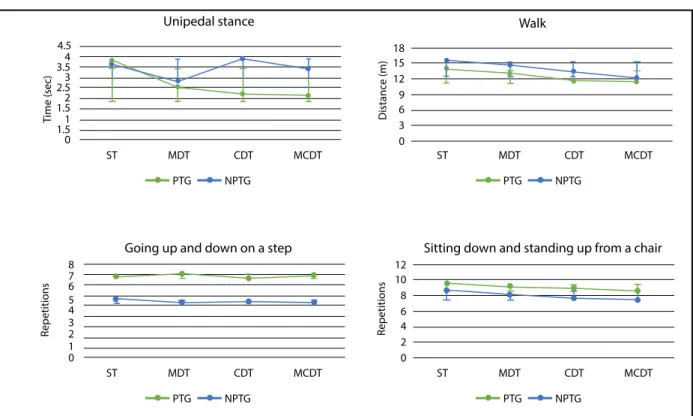
Figure 1 shows performance results of the institutionalized elders who attend and do not attend physical therapy in dual task situations. Regarding the unipedal stance, no diference was observed among the tasks (F=2.45; p=0.06) nor between the groups (F=0.309; p=0.581).
Regarding walking, diference was observed between the tasks (F=28.69; p=0.001), being the diference between ST and MDT (p=0.019), ST and CDT (p=0.001), ST and MCDT (p=0.001), MDT and CDT (p=0.001) and MDT and MCDT (p=0.001). No diference was observed between the groups (F=1.91; p=0.172).
In the going up and down on a step activity, a diference was noticed between the groups (F=7.12; p=0.01). However, no diference was observed between the tasks (F=0.331; p=0.803).
In the sitting down and getting up from a chair activity, a diference between tasks was revealed (F=8.04; p=0.001), being the diference between ST and CDT (p=0.029) and between ST and MCDT (p=0.001). However, there was no diference between groups (F=2.11; p=0.151).
Table 3. Continuation
18 15 12 9 6 3 0
ST MDT CDT MCDT
PTG NPTG
ST MDT CDT MCDT
PTG NPTG
ST MDT CDT MCDT
PTG NPTG
ST MDT CDT MCDT
PTG NPTG
Unipedal stance
4.5 4 3.5
2.5
1.5
1.5 3
2
1
0
Walk
12 10 8 6 4 2 0
Sitting down and standing up from a chair Going up and down on a step
8 7 6 5 4 3 2 1 0
Figure 1. Performance of the institutionalized elders who attend and do not attend physical therapy in dual task situations
PTG: group that attend physical therapy; NPTG: group that does not attend physical therapy; ST: simple task; MDT: motor dual task; CDT: cognitive dual task; MCDT: motor cognitive dual task
DISCUSSION
Considering the constant increase of the elderly population and knowing that dual task is essential to carry out basic and instrumental activities1,7 of daily
living, this study aimed to compare simple and dual task performances in institutionalized elders who attend and do not attend physical therapy.
Regarding the unipedal stance, there was no signiicant diference between the two groups assessed. Both groups had diiculties to perform this activity, since the maximum time was 4 seconds. Although studies demonstrate the importance of balance training for institutionalized elders, in this study, only 50% of the PTG carried out balance training, and such fact can justify the bad performance in this activity17. Gusi
to improve balance in institutionalized elders, in which elders of the experimental group had 95% improvement in balance performance compared to the control group which did not participate in the training.
In the walk task performance, there was no diference between the groups. However, there was a diference between tasks. In the simple task, individuals walked a bigger distance compared to the motor dual task, cognitive dual task and motor cognitive dual task. hus, it was possible to verify that as task complexity increased, the distance walked decreased. his result is consistent with previous indings, since Iersel et al.19 observed in
their study with elders of the community that, by adding motor and cognitive activities, it caused increased step and decreased gait speed. Corroborating results found, the study by Fatori et al.20 shows that individuals who
performed the Timed up and Go, which is a standing and walking test associated with a dual task, took more time to perform it compared to the simple test. Speed reduction during dual task performance is an automatic adaptation efect of the body to reduce risk of falls in more complex situations19.
In addition, it was possible to verify decrease in the walked distance among the motor dual task, cognitive dual task and motor cognitive dual task. We noticed that individuals had a better performance in the motor activity only, and when the cognitive activity was added, the performance was worse. A research developed by Hall et al.21 demonstrated that, during a walking test
in which the elders had to speak numbers backwards, their performance reduced up to 18% compared with the motor activity walk only. Another fact that may have occasioned this result, is that the aging process naturally leads to a cognitive decline, which generates functional capacity compromising of elders, causing a decrease in the independence level and autonomy, that is, inluence on the gait performance. In this sense, by assessing cognition of healthy elders, Machado et al.22
noticed that 40% of them presented cognitive decline. In the going up and down on a step activity, tasks did not inluence the outcome, nevertheless, a diference occurred between the groups: the PTG managed to perform the task more times during the time given than the NPTG. his result can be explained by the fact that 96.6% of the PTG performs muscle strengthening of lower limbs during the physical therapy sessions. he main muscles used to going up and down on a step are the quadriceps and triceps surae, which are widely trained in physical therapy for being important muscles for individuals’
functionality. In this sense, Lustosa et al.23 proposed a
ten-week physical therapy program to strengthen the lower limbs in elders of the community. By the end of the program, they noticed improvement in muscle power and functional performance due to the proposed exercises.
For the sitting down and getting up from a chair activity, a diference was identiied between the tasks, so that elders executed the activity more times when it was simple. However, when the cognitive dual task and the motor cognitive dual task were added, there was a reduction of repetitions. No signiicant diference was observed between the two groups assessed, although the PTG have performed the activity proposed more times. Again, verifying decreased performance is possible by adding the cognitive dual task. hese results corroborate the indings by Carmelo and Garcia24. In their study on
the efect of dual task in sedentary and non-sedentary older women, they found performance reduction and need of more time to complete the task proposed when the countdown from 100 to 0 task was added to the motor task, which suggests a negative impact of the cognitive task in both groups.
A study by Pompeu16 assessed inluence of motor
cognitive dual task in elders when carrying out postural exchange activity, in which number of times elders changed from sitting to standing in a 30-second period was analyzed. he authors found that elders performed 22 times the activity in a simple way, 14 times when they performed the motor dual task, which consisted in pressing a mechanical counter, and decreased to 10 when cognitive task was added, which was based on speaking proper names. Such inding corroborates the results found in this study, emphasizing that when cognitive task is applied, a decrease in motor performance occurs.
Knowing that poor performance in dual tasks leads to a higher number of falls4,5, one inding of our study calls
attention: 40% of the PTG elders fell in the past year. his inding is compatible with the study by Gonçalves et al.25 and Pi et al.26, in which prevalence of falls over
the past twelve months among the institutionalized elders assessed was 38.3% and 38% respectively. Only 20% of the NPTG fell in the past year. his diference can be explained by the physical activity level of the groups, as 43.3% of the NPTG was considered active by the IPAQ against 13.3% of the PTG. Pagliosa and Renosto27 proposed a physical activity protocol for
Physical activity level of the NPTG may also have inluenced the fact that there were no major diferences between groups in the dual task assessment, although the NPTG was institutionalized for much longer than the PTG. A study by Ribeiro et al.28 revealed that the
most active elders of an institution presented better balance and functional performance when compared with the little active elders.
Although studies show efectiveness of dual task training in balance and functional mobility improvement, in this study, such activity was not performed with the elderly in physical therapy sessions. Gregory et al.29 held
a 26-week group training with elders involving dual task activities, and at the end, they concluded that exercises combined with a dual task can improve gait performance. Targino et al.11 proposed an activity in which during
four weeks, elders carried out a training that consisted of walking on the treadmill (simple task) and walking on the treadmill with visual stimuli (dual task), which showed improvement in static balance at the end.
Reairming the importance of the dual task training, Voos et al.30 assessed two groups: one of them participated
in the training with associated motor and cognitive tasks, and the other one performed only the motor activity, so they veriied a better performance after the dual task training, thus concluding that for a better dual task performance, cognitive and motor components must be exercised together. hey also concluded that dual task is performed in a fragmentary way during the physical therapeutic treatment, although such division can result in a future inability to carry out dual task activities.
Considering the importance of a good performance in dual task situations in order to maintain a good functional mobility and reduce risk of falls during execution of daily activities, it is suggested that professional physical therapists add activities involving dual task situations to their treatment program, especially regarding elders who live in long-stay institutions.
Non-assessment of the cognitive level of the elders who participated was considered a limitation of this study. hus, future studies are suggested to assess participants’ cognitive state and studies that conduct a physical therapeutic treatment protocol with dual task activities.
CONCLUSION
his study observed a reduction in functional performance of institutionalized elders who attended
and did not attend physical therapy when a dual task was added in activities such as walking and sitting and standing up from a chair, showing that when a dual task is added, there is a negative impact that impairs the execution of the activities. herefore, we suggest professional physical therapists to add activities involving dual task situations to their treatment program, especially regarding elders who live in long-stay institutions, in order to improve or maintain their functional mobility and reduce risk of falls in daily activities.
REFERENCES
1. Instituto Brasileiro de Geograia e Estatística. Síntese de Indicadores Sociais: Uma análise das condições de vida da população Brasileira. [Internet]. 2010 [cited 2015 Mar 17]. Available from: http://bit.ly/2rJoj8m.
2. Horak FB. Postural orientation and equilibrium: what do we need to know about neural control of balance to prevent falls. J Age Ageing. 2006;35(2):7-11. doi: 10.1093/ageing/al077. 3. Khawandi S, Daya B, Chauvet P. Implementation of a monitoring
system for fall detection in elderly healthcare. J Procedia Comput Sci. 2011;3(1):216-20. doi: 10.1016/j.procs.2010.12.036. 4. Yang L, Liao LR, Lam FMH, He CQ, Pang MYC. Psychometric
properties of dual-task balance assessments for older adults: systematic review. J Maturitas. 2015;80(4):359-69. doi: 10.1016/j.maturitas.2015.01.001.
5. Laessoe U, Hoeck HC, Simonsen O, Voigt M. Residual attentional capacity amongst young and elderly during dual and triple task walking. J Hum Mov Sci. 2008;27(3):496-512. doi: 10.1016/j.humov.2007.12.001.
6. O’she S, Morris ME, Iansek R. Dual task interference during gait in people with Parkinson disease: efects of motor versus cognitive secondary tasks. Phys Ther. 2002;82(9):888-97. 7. Mccullochh KL. Attention and dual-task conditions: physical
therapy implications for individuals with acquired brain injury. J Neurol Phys Ther. 2007;31(3):104-18. doi: 10.1097/ NPT.0b013e31814a6493.
8. Del Duca GF, Silva SG, Thumé E, Santos IS, Hallal PC. Indicadores da institucionalização de idosos: estudo de casos e controles. Rev Saúde Pública. 2012;46(1):147-53. doi: 10.1590/S0034-89102012000100018.
9. Ferreira DCO, Yoshitome AY. Prevalência e características das quedas de idosos institucionalizados. Rev Bras Enferm. 2010;63(6):991-7. doi: 10.1590/S0034-71672010000600019. 10. Cândido DP, Cillo BAL, Fernandes AS, Nalesso RP, Jakaitis F,
Santos DG. Analise dos efeitos da dupla tarefa na marcha de pacientes com doença de parkinson: relato de três casos. Rev Neurocienc. 2012;20(2):240-5.
12. Araujo MMA, Fló CM, Michels S. Efeitos dos exercícios resistidos sobre o equilíbrio e a funcionalidade de idosos saudáveis: artigo de atualização. Fisioter Pesqui. 2010;17(3):277-83. doi: 10.1590/S1809-29502010000300016. 13. Lopes MNSS, Passerini CL, Travensolo CF. Eicácia de
um protocolo isioterapêutico para equilíbrio em idosos institucionalizados. Semina Cienc Biol Saúde. 2012;31(2):143-52. doi: 10.5433/1679-0367.2010v31n2p143.
14. Matsudo S, Araujo T, Matsudo V, Andrade D, Andrade E, Oliveira LC et al. Questionário Internacional de Atividade Física (IPAQ): estudo de validade e reprodutibilidade no Brasil. Rev Bras Ativ Fís Saúde. 2001;6(2):5-18. doi: 10.12820/ rbafs.v.6n2p5-18.
15. Barbosa JMM, Prates B SS, Gonçalves CF, Aquino AR, Parentoni AN. Efeito da realização simultânea de tarefas cognitivas e motoras no desempenho funcional de idosos da comunidade. Fisioter Pesqui. 2008;15(4):374-9. doi: 10.1590/ S1809-29502008000400010.
16. Pompeu SMAA. Elaboração e aplicação do teste de divisão de atenção em tarefas funcionais [dissertação de mestrado]. [São Paulo]: Universidade de São Paulo; 2013.
17. Pantoja MC, Mendoza ML, Percy MT. Efecto de un programa de ejercicios isioterapéuticos sobre el desempeño físico en adultos mayores institucionalizados. Rev Esp Geriatr Gerontol. 2014;49(6):260-5. doi: 10.1016/j.regg.2014.05.010. 18. Gusi N, Adsuar JC, Corzo H, Cruz BP, Olivares PR, Parraca JA.
Balance training reduces fear of falling and improves dynamic balance and isometric strength in institutionalised older people: a randomised trial. J Physiother. 2012;58(2):97-104. doi: https://doi.org/10.1016/S1836-9553(12)70089-9.
19. Iersel VMB, Ribbers H, Munneke M, Borm GF, Rikkert MGO. The Efect of cognitive dual tasks on balance during walking in physically it elderly people. Arch Phys Med Rehabil. 2010;88(1):18-91. doi: doi.org/10.1016/j.apmr.2006.10.031.
20. Fatori CO, Leite CF, Souza LAPS, Patrizzi LJ. Dupla tarefa e mobilidade funcional de idosos ativos. Rev Bras Geriatr Gerontol. 2015;18(1):29-37. doi: http://dx.doi. org/10.1590/1809-9823.2015.13180.
21. Hall CD, Echt KV, Wolf SL, Rogers WA. Cognitive and motor mechanisms underlying older adults’ ability to divide
attention while walking. J Phys Ther. 2011;91(7):1039-50. doi: 10.2522/ptj.20100114.
22. Machado JC, Ribeiro RCL, Cotta RMM, Leal PFG. Declínio cognitivo de idosos e sua associação com fatores epidemiológicos em Viçosa, Minas Gerais. Rev Bras Geriatr Gerontol. 2011;14(1):109-21. doi: 10.1590/ S1809-98232011000100012.
23. Lustosa LP, Silva JP, Coelho FM, Pereira DS, Parentoni NA, Pereira LSM. Impact of resistance exercise program on functional capacity and muscular strength of knee extensor in pre-frail community-dwelling older women: a randomized crossover Trial. Rev Bras Fisioter. 2011;15(4):318-24. doi: 10.1590/S1413-35552011000400010.
24. Carmelo VVB, Garcia PA. Avaliação do equilíbrio postural sob condição de tarefa única e tarefa dupla em idosas sedentárias e não sedentárias. Rev Acta Fisiátr. 2011;18(3):136-40. 25. Goncalves LG, Vieira ST, Siqueira FV, Hallal PC. Prevalência
de quedas em idosos asilados do município de Rio Grande, RS. Rev Saúde Pública. 2008;42(5):938-45. doi: 10.1590/S0034-89102008000500021.
26. Pi HY, Hu MM, Zhang J, Peng PP, Nie Dan. Circunstances of falls and fall-related injuries among frail elderly under home care in China. Jpn J Nurs Sci. 2015;2(3):237-42. doi: https:// doi.org/10.1016/j.ijnss.2015.07.002.
27. Pagliosa LC, Renosto A. Efects of a health promotion and fall prevention program in elderly individuals participating in interaction groups Fisioter Mov. 2014;27(1):101-09. doi: 10.1590/0103-5150.027.001.AO11.
28. Ribeiro F, Gomes S, Teixeira F, Brochado G, Oliveira J. Impacto da prática regular de exercício físico no equilíbrio, mobilidade funcional e risco de queda em idosos institucionalizados. Rev Port Ciên Desp. 2009;9(1):36-42.
29. Gregory MA, Gill DP, Zou G, Liu-Ambrose T, Shiguematsu R, Fritzgerald C, et al. Group-based exercise combined with dual-task training improves gait but not vascular health in active older adults without dementia. Arch Gerontol Geriatr. 2016;63(1):18-27. doi: 10.1016/j.archger.2015.11.008.