Tracheostomy in the Intensive Care Unit: a
University Hospital in a Developing Country
Study
Mohammad Waheed El-Anwar
1Ahmad Abdel-Fattah Nofal
1Mohammad A. El Shawadfy
1Ahmed Maaty
2Alaa Omar Khazbak
11Department of Otorhinolaryngology, Head and Neck Surgery, School
of Medicine, Zagazig University, Zagazig, Egypt
2Department of Anesthesia and Intensive Care Units, School of
Medicine, Zagazig University, Zagazig, Egypt
Int Arch Otorhinolaryngol 2017;21:33–37.
Address for correspondence Ahmad Abdel-Fattah Nofal, MD, Department of Otorhinolaryngology, Head and Neck Surgery, School of Medicine, Zagazig University, Zagazig 46166, Egypt
(e-mail: [email protected]).
Keywords
►
tracheostomy
►
endotracheal
intubation
►
ICU
►
mechanical
ventilation
Abstract
Introduction
Tracheostomy is the commonest surgical procedure in intensive care
units (ICUs). It not only provides stable airway and facilitates pulmonary toilet and
ventilator weaning, but also decreases the direct laryngeal injury of endotracheal
intubation, and improves patient comfort and daily living activity.
Objective
The objective of this study is to assess the incidence, indications, timing,
complications (early and late), and the outcome of tracheostomy on patients in the
intensive care units (ICU) at a university hospital in a developing country.
Methods
This study is an observational prospective study. It was performed at the
otolaryngology department and ICU new surgery hospital on 124 ICU admitted
patients. We collected patients
’
demographic records, cause of admission, indications
of tracheostomy, mechanical ventilation, and duration of ICU stay. We also gathered
patients
́
tracheostomy records including the incidence, timing, technique, type, early
and late complications, and outcome. All tracheostomized patients received follow-up
for 12 months.
Results
The indication for tracheostomy in ICU patients was mostly prolonged
intubation (80.5%), followed by diaphragmatic paralysis (19.5%). All tracheostomies
were done by the open approach technique. Tracheostomy for prolonged intubation
was done within 17 to 26 days after intubation with a mean of 19.4
2.07 days.
Complications after tracheostomy were 13.9% tracheal stenosis and 25% subglottic
stenosis.
Conclusion
Prolonged endotracheal intubation is the man indication of tracheostomy,
performed after two weeks of intubation. Although there were no major early
complications, laryngotracheal stenosis is still a challenging sequel for tracheostomy
that needs to be investigated to be prevented.
received
February 19, 2016
accepted
April 12, 2016
published online
July 26, 2016
DOI http://dx.doi.org/ 10.1055/s-0036-1584227.
ISSN 1809-9777.
Copyright © 2017 by Thieme-Revinter Publicações Ltda, Rio de Janeiro, Brazil
Introduction
Tracheostomy is the commonest surgical procedure in inten-sive care units (ICUs).1,2There are four main general indica-tions for tracheostomy: long term mechanical ventilation, weaning failure, upper airway obstruction, and airway protection.3Tracheostomy in ICU is usually performed for patients with prolonged mechanical ventilation.4
Tracheostomy does not only provide stable airway and facilitate pulmonary toilet and ventilator weaning, it also decreases the direct laryngeal injury of endotracheal intuba-tion, and improves patient comfort and daily living activity such as mobility, speech, and eating.5,6
Furthermore, early tracheostomy decreases the ventilator time, the incidence of ventilator-associated pneumonia (VAP), length of ICU stay, and overall length of hospital stay.7
There are two main tracheostomy techniques: surgical tracheostomy (ST),first described in 19098and performed by surgeons, and percutaneous dilatational tracheotomy (PDT), described in 19859 and performed by surgeons, internists, or anesthetists.
So far, the choice of tracheostomy techniques has been a matter of debate, and it is primarily made in accordance with the surgeońs preference rather than by evidence.7,10,11
The aim of this study was to assess the incidence, indica-tions, timing, early and late complicaindica-tions, and outcome of tracheostomy in ICU patients of a university hospital in a developing country.
Patients and Methods
Study Design
This prospective study took place at the otorhinolaryngology department and ICU of the new surgery hospital, Zagazig University Hospitals, Egypt, from June 2013 to June 2014. All enrolled subjects or their relative signed an informed consent after explanation of the research purpose.
Methods
All the patients who needed surgical tracheostomy (ST) were transferred to the neighboring operation theater in the same floor within the same hospital (Zagazig new surgery hospital). During the transfer, all patients were assisted by a portable mechanical ventilator. Upon arrival to the operating room, the patient underwent a noninvasive blood pressure monitoring, 5 ECG leads, pulse oximetry, and capnogram for end tidal CO2 monitoring. Anesthesia was induced with propofol 1–2 mg/kg, fentanyl 1–2 mcg/kg, and cis-atracurium 0.1 mg/kg. Then, the lungs were mechanically ventilated to maintain end tidal CO2 tension between 30 to 35 mm Hg. Anesthesia was maintained with isoflurane 1–1.5% in 50% oxygen air. Otolaryngology surgeons performed all the tracheostomies. At the end of the procedure, the surgeon introduced the tracheostomy tube with gradual withdrawal of the endotracheal tube. Then, the patients returned to the ICU, assisted by the portable mechan-ical ventilator.
In the ICU, the immediate postoperative priorities of care for a patient with a new tracheostomy include ensuring that
the tracheostomy tube is secured in place and is patent. Routine care, as well as prompt management of postoperative complication, can be facilitated by ensuring that proper equipment and supplies are quickly available (tracheostomy tube of the same size and 1size smaller, endotracheal tubes of appropriate sizes with intubation equipment, and physiolog-ical saline).
No percutaneous dilatational tracheostomy (PDT) was operated in the current study.
We collected data as regarded to demographic patients’ record, cause of admission, indications of tracheostomy, mechanical ventilation and duration of ICU stay. Tracheos-tomy records were also gathered including the incidence of tracheostomy, timing, technique, type, early and late compli-cations, and the patients’outcome had been reported.
All tracheostomized patients received follow-up for 12 months post hospital discharge.
Statistical Analysis
We performed a statistical analysis using SPSS 14.0 statistical software for Windows (SPSS Inc., Chicago, USA). The signifi -cance level was set at p<0.05. We used the t-test for quantitative data and chi-square test for qualitative data.
Results
This study includes 124 ICU patients; 108 male (87.1%) and 16 female (12.9%) with ages ranging from 12 to 67 years. The mean age was 40.713.4 years. Tracheostomy was per-formed for 36 patients (29%).
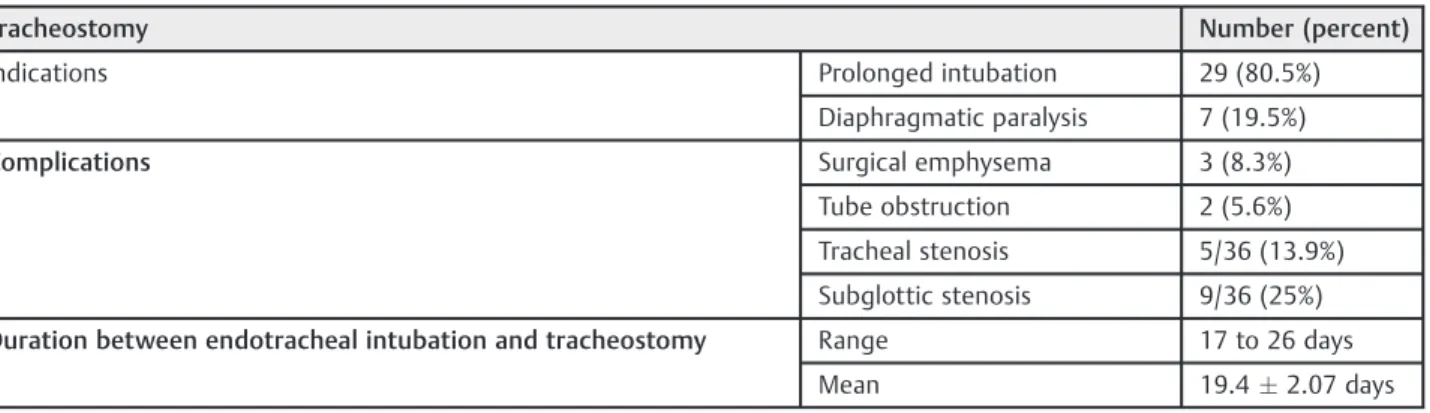
All the patients had surgical tracheostomy (ST); 3 (8.3%) female and 33 (91.7%) male. The indication for tracheostomy was prolonged intubation in 29 (80.5%) patients and dia-phragmatic paralysis in 7 (19.5%) patients.
All the tracheostomies were surgical tracheostomy (ST) and done in the operative theater with otolaryngology sur-geons. So no percutaneous dilatational tracheostomy (PDT) was recorded or tracheostomy done by anesthetists. Hori-zontal collar incision with mid tracheostomy and removal of part of the tracheal cartilage was used in all cases except in children, with no trachealflap.
Surgical emphysema, attributed to small tracheostomy tube size, was reported in three cases (8.3%) and resolved spontaneously. There were no other intraoperative or early post-operative complications and all the patients left the ICU with the tracheostomy tube. Out of the three most common tracheostomy emergencies (hemorrhage, tube dislodgement, and tube obstruction),1we encountered two cases of tubal obstruction in the current study and treated it by changing the tube (►Table 1).
Tracheostomy for prolonged intubation was done within 17 to 26 days after intubation with a mean of 19.42.07 days. No tracheostomy was performed withinfirst two weeks of intubation.
ICU stay duration ranged between 2 and 100 days with a mean (SD) of 15.87 (21.4). This duration ranged between 3 to 100 days (mean; 33.530.9) for tracheostomized patients and ranged between 2 to 60 days (mean; 8.610.1) for intubated patients. Thus, there were significantly longer durations of ICU stay in tracheostomized patients (t¼3.4253 andp¼0.0019) (►Table 2).
Mechanical ventilation was required in 96/124 (77.4%) of studied patients and 32/36 of the tracheostomized patients with near significance difference (Chi-square test: 3.817 and p¼0.05) (►Table 2).
Discussion
Patients require long-term mechanical ventilation because of chronic respiratory failure, inability to maintain unassisted respiratory function, or failed weaning from ventilatory support.12 We estimated that between 2% and 11% of ICU patients who required mechanical ventilation would receive a tracheostomy.13
Numerous studies aimed to determine the optimal interval between orotracheal intubation and placement of a
trache-ostomy tube, without definitive recommendations due to the varied results in different populations and in patients with distinctive comorbid conditions.12,14The American College of Chest Physicians recommends consideration of tracheostomy for patients who require an endotracheal tube for more than 21 days.15Benefits of establishing a tracheostomy rather than using an endotracheal tube include a decrease in direct laryngeal injury as well as improved comfort and daily activities of living such as mobility, speech, and eating.6
The tracheostomy tube may be placed surgically or percu-taneously. Percutaneous tracheotomy is generally performed solely on intubated patients and, unlike surgical tracheotomy, it can be performed without direct visualization of the trachea. Bronchoscopy is used to guide and confirm place-ment of the tracheostomy tube within the trachea.16
Surgical placement is done in the operating room or at the bedside, generally under general anesthesia. A common technique is to create a“trap door”(Bjӧrkflap), by which a small part of the tracheal cartilage is pulled down and sutured to the skin.16We did not utilize this technique in the current study and conducted all the cases in the operating theater.
Percutaneous dilational tracheotomy (PDT) is the most common technique in most centers, especially in the devel-oped countries. In study of ICU tracheostomy in the United Kingdom, PDT is preferred over the surgical technique; in 43% of units, PDT is performed in 95% of cases, in 32.4% of units it is Table 1 Indications, complications of tracheostomy and duration between endotracheal intubation and tracheostomy
Tracheostomy Number (percent)
Indications Prolonged intubation 29 (80.5%)
Diaphragmatic paralysis 7 (19.5%)
Complications Surgical emphysema 3 (8.3%)
Tube obstruction 2 (5.6%)
Tracheal stenosis 5/36 (13.9%)
Subglottic stenosis 9/36 (25%)
Duration between endotracheal intubation and tracheostomy Range 17 to 26 days
Mean 19.42.07 days
Table 2 Differences between tracheostomized and non tracheostomized ICU patients
Tracheostomized ICU patients Other ICU patients Pvalue
Cases 0.33 NS
(x2
¼0.943)
Total 36 88
Male 33 (91.7%) 75 (88.2%)
Female 3 (8.3%) 13 (14.8%)
Mechanical ventilation 32/36 (88.9%) 64/88 (72.7%) 0.05 near S
(X2
¼3.817)
Mean ICU stay 33.530.9 All ICU patients,
15.87 (21.4)
For intubated ICU patients 8.610.1
0.0004 S (t¼3.6365) 0.0019 S (t¼3.4253)
done in 75–95% of cases, in 16.6% of units it is done in 50 to 75% of cases, while in only 8% of units, ST is preferred with PDT accounting for less than 50% of cases.17In many studies about tracheostomy in ICU in many of European countries, PDT was usually the preferred technique; in Italy, it accounted for 89% of cases,18in Germany, 86% of cases,11in Spain, 72% of cases,19 and in the Netherlands, 62% of cases.20
Surgical tracheotomy (ST) is the only technique used in our center; this is mainly due to the cost effectiveness, which is in the favor of ST because of the cost of the PDT insertion set as well as the otolaryngology surgeońs easy 24-hour accessibil-ity to the hospital. Furthermore, insufficient expertise in performing PDT can be added to the cause of preference of ST. This agrees with the result of other studies21,22 about tracheostomy in ICU in Nigeria’s teaching hospital in which all the tracheostomies were surgical tracheostomy. In one of the international survey about tracheostomy in ICU; they found that ST was the most popular tracheotomy technique outside Europe, and was mainly performed by ENT special-ists.23Even in some developed countries, such as France, the ST technique is still preferred over PDT.24
The importance of this study is while it was done in the ICU of a surgery hospital, so it was dealing mostly with surgical cases, which differ from other studies, which may include non-surgical cases, and even data of the met analysis studies involve non-surgical ICUs. At the same time, since study took place in a developing country, the cost effectiveness favors ST over PDT, because of ST́s low-cost versus the cost of the single-use PDT tracheostomy set, as well as the availability of the surgical team. In the study by Kluge et al,1186.1% of ICUs routinely perform PDT and only 13.9% of ICUs perform ST; however, in answering a question of“which method is according to your opinion is safer,”50% answered there was no difference between the two methods, 27% answered PTD, and 19% answered ST.
Some review studies prefer PTD over ST because there is no need for the operating room (OR), it is less expensive, the reduced time between decision and performance of tracheos-tomy, and lower mortality rate.3In our study, however, the ICU is located in the samefloor neighbor as the OR, and otolaryn-gology doctors are freely available 24/7 in the university hospital. This overrides the problems from transferring the patients from the ICU to the OR, as well as reduces the time between the decision and the performance of the tracheos-tomy. In fact, the ST turns out to be cheaper than PDT (no need for the costly disposable PDT set). As for mortality rate, there are many studies that found no difference between ST and PDT in this regard.7,10,11Because of the significant effect of trache-ostomy on the patient́s life, it must be included in any learning process undergone by the otolaryngologist.
The results of current study showed that prolonged endotra-cheal intubation is the main indication of tracheostomy, and surgical open tracheostomy remains the most used technique in our institutional hospitals. We found no significant early com-plications, but still laryngeotracheal stenosis is an important reported late complication that needs to be studied to manage factors related to occurrence of such a complication.
Although the incidence of laryngotracheal stenosis in this study was 14/36 cases (39%), only two cases (5.5%) were
significantly affected and needed intervention, either with surgery or permanent tracheostomy. In our concept, we did not attribute this to the tracheostomy technique per se, but mostly due to the long intubation period preceding it (more than 21 days), particularly since tracheostomy in ICU is elective.
International and national surveys report as the prevailing timing of tracheostomy between 7 to15 days.11,17–20,23Some studies consider early tracheostomy to happen within 4 days of intubation and late tracheostomy after 10 days.25Thus, we hope to introduce the concept of earlier tracheostomy to a greater extent that the current protocol in our center, to avoid most of tracheostomy complications.
Conclusion
Prolonged endotracheal intubation is the main indication for patients that have undergone tracheostomy performed after two weeks of intubation, in all cases. Although it does not present major early complications, laryngeotracheal stenosis is still an unresolved sequel for tracheostomy that needs to be further investigated so it can be prevented.
References
1 Garner JM, Shoemaker-Moyle M, Franzese CB. Adult outpatient tracheostomy care: practices and perspectives. Otolaryngol Head Neck Surg 2007;136(2):301–306
2 Freeman BD, Isabella K, Cobb JP, et al. A prospective, randomized study comparing percutaneous with surgical tracheostomy in critically ill patients. Crit Care Med 2001;29(5):926–930 3 De Leyn P, Bedert L, Delcroix M, et al; Belgian Association of
Pneumology and Belgian Association of Cardiothoracic Surgery. Tracheotomy: clinical review and guidelines. Eur J Cardiothorac Surg 2007;32(3):412–421
4 MacIntyre NR, Epstein SK, Carson S, Scheinhorn D, Christopher K, Muldoon S; National Association for Medical Direction of Respira-tory Care. Management of patients requiring prolonged mechani-cal ventilation: report of a NAMDRC consensus conference. Chest 2005;128(6):3937–3954
5 Koh WY, Lew TW, Chin NM, Wong MF. Tracheostomy in a neuro-intensive care setting: indications and timing. Anaesth Intensive Care 1997;25(4):365–368
6 Bittner EA, Schmidt UH. The ventilator liberation process: update on technique, timing, and termination of tracheostomy. Respir Care 2012;57(10):1626–1634
7 Möller MG, Slaikeu JD, Bonelli P, Davis AT, Hoogeboom JE, Bonnell BW. Early tracheostomy versus late tracheostomy in the surgical intensive care unit. Am J Surg 2005;189(3):293–296
8 Jackson C. Tracheostomy. Laryngoscope 1909;19(4):285–290 9 Ciaglia P, Firsching R, Syniec C. Elective percutaneous dilatational
tracheostomy. A new simple bedside procedure; preliminary report. Chest 1985;87(6):715–719
10 Klotz R, Klaiber U, Grummich K, et al. Percutaneous versus surgical strategy for tracheostomy: protocol for a systematic review and meta-analysis of perioperative and postoperative complications. Syst Rev 2015;4(1):105
11 Kluge S, Baumann HJ, Maier C, et al. Tracheostomy in the intensive care unit: a nationwide survey. Anesth Analg 2008;107(5): 1639–1643
13 Diaz-Prieto A, Mateu A, Gorriz M, et al. A randomized clinical trial for the timing of tracheotomy in critically ill patients: factors precluding inclusion in a single center study. Crit Care 2014;18; (5):585
14 Brook AD, Sherman G, Malen J, Kollef MH. Early versus late tracheostomy in patients who require prolonged mechanical ventilation. Am J Crit Care 2000;9(5):352–359
15 Plummer AL, Gracey DR. Consensus conference on artificial air-ways in patients receiving mechanical ventilation. Chest 1989; 96(1):178–180
16 Bove MJ, AfifiMS. Tracheotomy procedure. In: Morris LL, AfifiMS, eds. Tracheostomies: The Complete Guide. New York, NY: Springer Publishing Co LLC; 2010:17–40
17 Veenith T, Ganeshamoorthy S, Standley T, Carter J, Young P. Intensive care unit tracheostomy: a snapshot of UK practice. Int Arch Med 2008;1(1):21
18 Vargas M, Servillo G, Arditi E, et al. Tracheostomy in Intensive Care Unit: a national survey in Italy. Minerva Anestesiol 2013;79; (2):156–164
19 Añón JM, Escuela MP, Gómez V, García de Lorenzo A, Montejo JC, López J. Use of percutaneous tracheostomy in intensive care units
in Spain. Results of a national survey. Intensive Care Med 2004; 30(6):1212–1215
20 Fikkers BG, Fransen GA, van der Hoeven JG, Briedé IS, van den Hoogen FJ. Tracheostomy for long-term ventilated patients: a postal survey of ICU practice in The Netherlands. Intensive Care Med 2003;29(8):1390–1393
21 Okafor U, Nwosu J. Tracheostomy in the Intensive Care Unit: A Developing Country Experience. Internet Journal of Otorhinolar-yngology 2008;9(2):17
22 Amusa YB, Akinpelu VO, Fadiora SO, Agbakwuru EA. Tracheostomy in surgical practice: experience in a Nigerian tertiary hospital. West Afr J Med 2004;23(1):32–34
23 Vargas M, Sutherasan Y, Antonelli M, et al. Tracheostomy proce-dures in the intensive care unit: an international survey. Crit Care 2015;19(1):291
24 Blot F, Melot C; Commission d’Epidémiologie et de Recherche Clinique. Indications, timing, and techniques of tracheostomy in 152 French ICUs. Chest 2005;127(4):1347–1352