J Educ Eval Health Prof 2014, 11: 7 • http://dx.doi.org/10.3352/jeehp.2014.11.7
RESEARCH ARTICLE
Open Access
Does curricular change improve faculty perceptions of student
experiences with the educational environment? A preliminary
study in an institution undergoing curricular change
Syed Ilyas Shehnaz
1*, Jayadevan Sreedharan
2, Kadayam Guruswami Gomathi
3 1Department of Pharmacology; 2Statistical Support Facility, Center for Advanced Biomedical Research and Innovation;3Department of Biochemistry, Gulf Medical University, Ajman, United Arab Emirates
Abstract
Purpose: College of Medicine, Gulf Medical University, United Arab Emirates, underwent a major curriculum change from a discipline-based to an organ system-based integrated curriculum. However, it was not known how the faculty perceived the changes in the educational environment as experienced by the students. In this context, we aimed to compare the faculty perceptions of the student experiences in the discipline-based curriculum with those in the organ system-based integrated curriculum. Methods: The Dundee Ready Education Environment Measure (DREEM) questionnaire was modi-ied to assess faculty perceptions of the student experiences, pilot-tested, and administered to all faculty members (n= 28) involved in the discipline-based curriculum (FDC) in January 2009. In the subsequent year, data were collected from the same faculty involved in the new integrated curriculum (FIC). Collected data were transferred to Predictive Analytics Soft-ware version 18. Total, domain, and individual statement scores were assessed with the Wilcoxon signed rank test. Per-centage agreement, disagreement, and uncertainty were assessed by the McNemar’s test for proportion. Results: The mean total DREEM score was signiicantly higher (P < 0.001) for FIC (139/200) as compared to FDC (119/200). The FIC perceived signiicantly more positive student experiences with the educational environment as indicated by the domain scores and statement scores. The diferences in proportions of agreement between FIC and FDC also reinforced that the FIC perceived more positive student experiences with the educational environment. Conclusion: The study showed that the faculty perceived the organ system-based integrated curriculum as providing a better educational environment for the students than the discipline based curriculum.
Key Words: Curriculum; Educational environment; Medical faculty; Perceptions; Undergraduate medical education
INTRODUCTION
he importance of gauging the educational environment of a medical school has been well recognized. Positive environ ment and student achievement, satisfaction and success are intimately linked. Learning environment and curriculum are also closely associated [1]. he College of Medicine, Gulf Me
dical University, United Arab Emirates, had a traditional dis ciplinebased undergraduate curriculum for over 10 years. However, reviews of the traditional curriculum, guidelines from Ministry of Higher Education (accreditation body in United Arab Emirates) and a desire to keep up with the global changes in medical education resulted in a major curricular change from the traditional curriculum to an organsystem based integrated curriculum with elements of problem based learning. A more studentcentered approach using less didac tics and more interactive sessions (small group learning, com puter aided learning, case based learning, problem based learn ing) was the focus of the new curriculum. he new curricu
*Corresponding email: [email protected]
Received: January 22, 2014; Accepted: April 16, 2014;
Published: April 26, 2014
his article is available from: http://jeehp.org/
lum, in place from 2008, is imparted in three phases. he irst phase (of one year duration) involves an introduction to med ical sciences with courses like Cells, Molecules and Genes, Tis-sues and Organs, Embryogenesis and Life Cycle, Metabolism and Nutrition, Internal and External Environment, Language and Communication Skills, and Psychosocial Sciences. he next two years of Phase II are devoted to the integrated study of all organ systems and the inal Phase III (of two years duration) includes the clinical clerkships. Subsequently, the students un dergo one year of compulsory rotating internship.
While a lot of attention has been given to the students’ per spective about the educational environment [25], very few studies have looked into perspective of the other stakeholders such as the teaching staf. Previous studies comparing the fac ulty perceptions with those of the students revealed that the faculty and students had similar perceptions about the student experiences in an integrated curriculum [6,7]. he perceptions of the educational environment by medical teachers are sig niicant not only for themselves but also for the students. he environment of any medical school will be a determinant of the behavior of the students and teachers of the medical school [1]. Hence, the quality of the educational environment in any institution can be improved by studying the teaching faculty’s perceptions. he faculty viewpoints about the student experi ences in the educational environment prior to and after the curricular change at College of Medicine were not explored in depth. Hence, the objectives of our study were to measure and compare the faculty perceptions of the student experiences with the educational environment in the disciplinebased cur riculum with that in the newly introduced integrated curricu lum at College of Medicine.
METHODS
Instrument
he validated and highly reliable Dundee Ready Education Environment Measure (DREEM) has been used by a number of medical colleges to assess the learning environment as per ceived by the students. DREEM has been used to diagnose the positive or negative aspects of individual institutions; to iden tify the perceived weaknesses of a new curriculum and to com pare perceptions of medical students in disciplinebased cur riculum with those in innovative curriculum [25]. A modi ied version of the DREEM inventory also assessed the per ception of teachers and compared it with the students’ percep tions [6,7].
he DREEM inventory involves 50 statements divided into 5 domains which are:
1. Students’ perceptions of learning (SPL): 12 statements, max i mum score is 48;
2. Students’ perceptions of teachers (SPT): 11 statements, maximum score is 44;
3. Students’ academic selfperceptions (SAP): 8 statements, maximum score is 32;
4. Students’ perceptions of atmosphere (SPA): 12 statements, maximum score is 48;
5. Students’ social selfperceptions (SSP): 7 statements, max imum score is 28.
he total score for all domains is 200. Each statement is scor ed from 04 with 4, strongly agree; 3, agree; 2, unsure; 1, dis agree; 0, strongly disagree. Nine negative statements are scored in reverse for analysis.
he main aim of this paper was to assess the faculty percep tions of students’ experiences with the educational environ ment in a curriculum. However, to the best of our knowledge there is no appropriate instrument available to assess the views of the faculty. As the DREEM questionnaire was originally developed to give only the students’ perceptions of the educa tional environment, hence, in our study it was modified so that certain statements in the irst person (e.g., I am encour-aged to participate in class.) were rephrased to allow the faculty to give their opinions about the student experiences in our in stitution. (e.g., The students are encouraged to participate in class.) Permission to modify the instrument was obtained from the authors of the original DREEM. The content validity of the modiied DREEM questionnaire was obtained through a review process with a medical education expert and a socio psychologist. he questionnaire was pretested on a group of faculty members, to ensure face validity and this data was ex cluded from inal analysis. Following the pilot study, descrip tive phrases were added to some statements of the question naire for better understanding. In addition, openended re sponses about the students’ experiences were also encouraged.
Sample
he 30 faculty members of College of Medicine were con tacted personally by the authors. Explanations of the objec tives and the method of illing out the questionnaire were giv en. he faculty was speciically instructed that their percep tions should be about the students’ experiences in the previ ous academic year. Any statements dealing with students’ per sonal aspects of the environment (e.g., Students have good friends in this school.) or outside of the context in which some of the staf encountered the students (e.g., Teachers are patient with the hospital patients.) were encouraged to be responded as un-sure. Voluntary participation was stressed upon with informed consent obtained from the faculty.
and in the subsequent year (January 2010), by the same faculty who were now teaching students of the 2008 batch (irst batch of integrated curriculum; n = 28; FIC). Data from those staf involved in teaching in both the consecutive academic years (2009 and 2010) were selected for inal analysis.
he study was approved by the Ethics Review Committee of the institution.
Statistical analysis
Data was analyzed using the PASW ver. 18.0 (SPSS Inc., Chi cago, IL, USA). he mean total, domain and individual state ment scores were expressed as mean± SD. Comparison of scores was done using Wilcoxon signed rank test. Pvalue less than 0.05 was considered as statistically signiicant.
Due to the anticipated large number of unsure responses, the faculty responses to individual statements were also classi ied into three categories: agreement (strongly agree or agree), disagreement (strongly disagree or disagree), and unsure. he McNemar’s test for proportion was used to compare the per centage agreement of staf giving responses in each category using a signiicance level of 0.05.
RESULTS
A total of 28 questionnaires were returned out of 30 subjects. Majority of the faculty were female (64%), senior faculty (61%), those with teaching experience of more than 10 years (68%), and from preclinical/paraclinical departments (82%). The faculty had multiple teaching roles as lecturers/seminar lead ers and as tutors for tutorials, casebased learning (CBL)/prob lembased learning (PBL) groups.
he mean total DREEM score for FDC and FIC was 119/200 and 139/200, respectively (P< 0.001). he mean domain scores obtained by FDC and FIC are shown in Table 1. Interpreta tion of domain scores revealed that both groups perceived
moving in the right direction for the teachers as the scores for
the domain Students’ Perceptions of Teachers ranged from 23 to 33; feeling more on the positive side for the academic self perception as the domain scores for Students’ Academic Self-Perceptions were between 1724; a more positive atmosphere
for the atmosphere as scores for domain Students’ Perceptions of Atmosphere were between 2536 and not too bad for the so cial selfperceptions with scores of Students’ Social Self-Percep-tions ranging from 15 to 21. FDC perceived a more positive approach whereas FIC perceived teaching highly thought of for the learning as the scores for domain Students’ Perceptions of Learning were 28.3 and 36.9, respectively. However, all mean domain scores for FIC were signiicantly higher as compared to FDC.
FDC identiied Students’ Perceptions of Teachers as the do main with highest mean score, whereas FIC gave highest scores to the domain Students’ Perceptions of Learning. Both groups gave lowest mean scores to the domain Students’ Social Self-Perceptions. On analysis of the mean scores of individual state ments, mean scores 3 and above were considered as areas of strength; mean scores greater than 2 and less than 3 were con sidered as areas that could be improved and mean scores equal to or less than 2 were areas of weaknesses. FDC and FIC gave the highest score for the statement the teachers are knowledge-able. FDC did not feel that the teaching is student centered and so this statement had the lowest score. FIC gave the lowest scores to the statement stating the students’ accommodation is pleasant (Tables 2, 3).
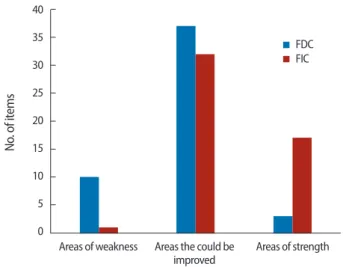
For FDC, there were 10 statements (20%) indicating the ar eas of weaknesses; three statements in the positive area (6%), and the remaining statements were in the areas that could be improved (74%). However, FIC showed a more positive per ception as only 1 statement had a mean score of 2 or less (2%); 17 statements had a mean score above 3 (34%), and the rest were in the areas that could be improved (64%) (Fig. 1). On comparison of percentage agreement, FIC tended to agree signiicantly more than FDC for 4 statements (Table 4). Anal
Table 1. Diference of scores on ive domains of the modiied Dundee Ready Education Environment Measure questionnaire by faculties who partici-pated not only in faculty teaching in discipline-based curriculum in 2009 but also faculty teaching in integrated curriculum in 2010 in College of Medi-cine, Gulf Medical University, United Arab Emirates
Domain FDC (%) FIC (%)
Students’ perception of learning 28.29 ± 5.54 (58.9) 36.89 ± 4.34 (76.9)***
Students’ perception of teachers 28.43 ± 5.37 (64.6) 31.68 ± 4.60 (72.0)***
Students’ academic self-perception 18.29 ± 3.39 (57.2) 21.25 ± 3.34 (66.4)***
Students’ perceptions of atmosphere 29.00 ± 5.37 (60.4) 32.57 ± 4.80 (67.9)***
Students’ social self-perceptions 15.18 ± 2.70 (54.2) 16.57 ± 2.86 (59.2)**
Total DREEM score for the group 119.18 ± 18.76 (59.6) 138.96 ± 15.51 (69.5)***
Values are presented as mean ± SD domain scores (% of maximum score).
Table 2. Each statements of the modified Dundee Ready Education Environment Measure questionnaire by faculties, with significantly different scores, who participated not only in faculty teaching in discipline-based curriculum in 2009 but also in faculty teaching in integrated curriculum in 2010, in College of Medicine, Gulf Medical University, United Arab Emirates
No. Statement FDC FIC
Students’ perception of learning
1 The students are encouraged to participate in class. 2.68 ± 0.905 3.39 ± 0.786**
7 The teaching is often stimulating. 2.62 ± 0.832 3.11 ± 0.629*
3 The teaching is student centered. 1.25 ± 0.752 2.96 ± 0.881***
16 The teaching is suiciently concerned to develop the student’s competence. 2.68 ± 0.819 3.11 ± 0.629* 22 The teaching is suiciently concerned to develop the students’ conidence. 2.68 ± 0.772 3.21 ± 0.630***
25 The teaching gives too much of importance to factual learning. 1.82 ± 1.020 2.54 ± 1.071**
38 The students are clear about the learning objectives of the course. 2.36 ± 1.096 3.25 ± 0.752*** 44 The teaching encourages the students to be active learners. 2.21 ± 0.876 3.18 ± 0.476*** 47 Long term learning is given importance over short term learning. 2.54 ± 0.881 3.21 ± 0.568***
48 The teaching is too teacher-centered. 1.54 ± 1.036 2.75 ± 1.005***
Students’ perception of teachers
8 The teachers ridicule the students. 3.11 ± 0.875 3.39 ± 0.685*
9 The teachers are authoritarian. 2.00 ± 0.943 2.46 ± 0.744*
32 The teachers provide constructive criticism. 2.54 ± 0.744 3.07 ± 0.716**
39 The teachers get angry in class. 2.00 ± 0.816 2.57 ± 0.790**
50 The students irritate the teachers. 2.04 ± 0.881 2.54 ± 0.962*
Students’ academic self- perception
21 The students feel they are being well prepared for their profession. 2.61 ± 0.786 2.96 ± 0.838*
27 The students are able to memorize all they need. 1.79 ± 0.738 2.07 ± 0.766*
31 The students have learned a lot about empathy in their profession. 2.21 ± 0.568 2.71 ± 0.763** 41 Students’ problem solving skills are being well developed here. 1.89 ± 0.786 3.11 ± 0.416*** 45 Much of what students have to learn seems relevant for a career medicine. 2.79 ± 0.738 3.32 ± 0.612*** Students’ perceptions of atmosphere
11 The atmosphere is relaxed during the hospital ward teaching. 2.11 ± 0.567 2.25 ± 0.645*
23 The atmosphere is relaxed during lectures. 2.61 ± 0.832 2.93 ± 0.539*
30 There are opportunities for the students to develop interpersonal skills. 2.46 ± 0.744 3.11 ± 0.786***
33 The students feel comfortable in class socially. 2.57 ± 0.634 2.86 ± 0.591**
36 The students are able to concentrate well. 2.32 ± 0.723 2.79 ± 0.787**
43 The atmosphere motivates the students as learners. 2.29 ± 0.763 2.86 ± 0.651**
49 The students’ feel able to ask the questions they want. 2.75 ± 0.799 3.29 ± 0.600*** Students’ social self-perceptions
14 The students are rarely bored in this course. 1.75 ± 0.752 2.39 ± 0.875**
15 The students have good friends in this school. 2.50 ± 0.694 2.86 ± 0.756*
19 The students’ social life is good. 2.25 ± 0.752 2.39 ± 0.786*
Values are presented as mean ± SD scores of statements with signiicant diferences. Negative statements are in italics with the reversed scores inserted into the Ta-ble. Higher a score for these statements, the more the faculty members disagreed to the statement.
FDC, faculty teaching in discipline-based curriculum; FIC, faculty teaching in integrated curriculum. *P < 0.05, **P < 0.01, ***P < 0.001.
ysis of percentage disagreement identiied one statement with which FIC signiicantly disagreed. (he teaching is too teacher-centered.)
he unstructured qualitative data from the openended re sponses also provided insight into the respondents’ views. Most of the faculty supported the curricular change. However, one of them felt that there was less emphasis on basic sciences knowl edge in the new curriculum.
DISCUSSION
Table 3. Each statements of the modiied Dundee Ready Education Environment Measure questionnaire by faculties, without signiicantly diferent scores, who participated not only in faculty teaching in discipline-based curriculum in 2009 but also in faculty teaching in integrated curriculum in 2010, in College of Medicine, Gulf Medical University, United Arab Emirates
No. Statement FDC FIC
Students’ perception of learning
20 The teaching is well focused. 3.00 ± 0.816 3.18 ± 0.723
24 The teaching time is put to good use. 2.93 ± 0.663 3.00 ± 0.667
Students’ perception of teachers
2 The teachers are knowledgeable. 3.36 ± 0.826 3.43 ± 0.690
6 The teachers are patient with the hospital patients. 2.61 ± 0.832 2.71 ± 0.854
18 The teachers have good communication skills with hospital patients. 2.54 ± 0.838 2.71 ± 0.763 29 The teachers are good at providing feedback to students. 2.50 ± 0.839 2.79 ± 0.917
37 The teachers give clear examples. 2.79 ± 0.787 2.96 ± 0.637
40 The teachers are well prepared for their classes. 2.96 ± 0.744 3.04 ± 0.881
Students’ academic self-perception
5 Learning strategies which worked for the students before continue to work for them now. 2.46 ± 0.793 2.21 ± 1.067
10 The students are conident about passing this year. 2.14 ± 0.591 2.29 ± 0.854
26 The students’ work last year has been a good preparation for this year’s work. 2.39 ± 0.737 2.57 ± 0.742 Students’ perceptions of atmosphere
12 The timetable of this school is appropriate. 2.64 ± 0.870 2.64 ± 0.911
17 Cheating is a problem in this school. 2.07 ± 0.940 2.21 ± 1.031
34 The atmosphere is relaxed during seminars/tutorials. 2.75 ± 0.645 2.86 ± 0.891
35 The students ind the experience (of studying here) disappointing. 2.36 ± 0.780 2.54 ± 0.962
42 The enjoyment outweighs the stress of studying medicine. 2.07 ± 0.858 2.25 ± 1.041 Students’ social self-perceptions
3 There is a good support system (help) for students who get stressed. 2.50 ± 0.839 2.6 ± 0.956
4 The students are too tired to enjoy this course. 1.96 ± 1.105 2.04 ± 1.036
28 The students seldom feel lonely. 2.32 ± 0.723 2.43 ± 0.742
46 The students’ accommodation is pleasant. 1.89 ± 0.629 1.86 ± 0.651
Values are presented as mean ± SD scores of statements without signiicant diferences. Negative statements are in italics with the reversed scores inserted into the Table. Higher a score for these statements, the more the faculty members disagreed to the statement.
FDC, faculty teaching in discipline-based curriculum; FIC, faculty teaching in integrated curriculum.
Fig. 1. Mean statement scores for faculty teaching in discipline-based curriculum (FDC) and faculty teaching in integrated curriculum (FIC).
40 35 30 25 20 15 10 5 0
No
. of it
ems
Areas of weakness Areas the could be improved
Areas of strength FDC FIC
Since we could not ind an appropriate instrument to gauge the faculty perceptions of the changed educational environ ment, we had modiied the DREEM questionnaire and used it to assess the perceptions of the faculty about the student expe riences in our school. his would indirectly allow us insights into the faculty perceptions of our curricular change. he ind ings from this study will also help in ascertaining the weak nesses and strengths of our curriculum and in turn in improv ing our newly introduced curriculum.
Table 4. Number of faculties with agreement of statements out of 28 respondents
No. Statement FDC (%) FIC (%) P-value
Students’ perception of learning
13 The teaching is student centered. 2 (7.1) 24 (85.7) 0.0001
38 The students are clear about the learning objectives (goals) of the course 11 (39.3) 25 (89.3) 0.0303 44 The teaching encourages the students to be active learners. 10 (35.7) 27 (96.4) 0.0085 Students’ academic self-perception
41 The students’ problem solving skills are being well developed here. 6 (21.4) 27 (96.4) 0.0005
FDC, faculty teaching in discipline-based curriculum; FIC, faculty teaching in integrated curriculum.
Students’ Academic Self-Perceptions. Low scores in domains
Students’ Social Self-Perceptions may not reveal perceptions of weaknesses, instead could be due to staff unfamiliarity with certain aspects of the students’ experience since faculty were asked to select unsure when the statements dealt with aspects with which they were unfamiliar.
The individual statement analyses identified the teachers’ medical knowledge and competence as the strength of our college. he FIC perceive that signiicant endeavors have been made to encourage student participation in class, make teach ing stimulating, develop the students’ competence, conidence and interpersonal skills; clarify learning objectives to students, encourage active and long term learning and encourage the students to ask questions they want. he relevance of learning to a career in medicine (No. 45) has also been perceived to be enhanced which may lead to enhanced motivation and reten tion of learning. he signiicant positive responses to the stu dentcenteredness of teaching and the development of prob lem solving skills in the students reassure the curriculum plan ners that the curricular change has been well discerned by the faculty. his is vitally important as faculty contributions and positive views of planned curricular changes lead to successful curricular renewals [9].
he highlighting of the teachers strengths such as well fo cused teaching, teaching time put to good use and teachers being well prepared for their classes are common to both the groups and this reflects the selfconfidence of the teachers. he FIC perceived positive changes with regard to construc tive criticism and teachers’ behavior towards the students as signiicant. However, scores of statements teachers are authori-tarian (No. 9); teachers get angry in class (No. 39), teaching is too teacher-centered (No. 48), and students irritate the teachers
(No. 50) reveal FIC’s perception of being unsuccessful in re linquishing their conventional roles. FIC also perceive that there is room for improvement with regard to feedback by the teachers and teachers giving clear examples. hough literature reviews have revealed that there are substantial diferences be tween the students’ perceptions about their lecturers when compared with the perceptions of the faculty about their col
leagues [10], a previous study comparing faculty perceptions with those of the students showed similar perceptions of the teachers by both the groups [6].
he traditional medical curriculum has been deemed to be overloaded with information and previous studies and meta analytical reviews have shown PBL based curriculum associ ated with less factual knowledge [8]. However in our study, scores of statements associated with importance to factual learning, inability to memorize, appropriateness of the timeta ble of the school, stress of studying medicine and weariness of students may indicate that the teachers still perceive a curricu lum overload. hough signiicant endeavors have been made to prepare the students for the next level, there is still room for improvement as indicated by the scores being less than 3 for all above statements. Cheating has also been identiied as an area requiring intervention. hese common issues of concern have also been identiied by studies conducted in other insti tutions [2,5,11] as the areas warranting remediation. he rest of the statements for which the faculty were probably unsure have garnered scores below three.
As the DREEM was not created to acquire other stakehold ers’ opinions of how the students experience their educational climate, it was expected that the faculty would not be able to respond to certain statements. The respondents, therefore, were encouraged to mark these statements as unsure. Conse quently, the comparison of percentage agreement (faculty who agreed/strongly agreed), identiied signiicant diferences be tween FIC and FDC which reinforced the positive perceptions of FIC about the studentcentered curricular change. he fact that FIC tended to disagree that the teaching is too teacher-cen-tered (No. 48) signiicantly more than FDC, has also support ed the previous indings of this study. We were unable to iden tify any major problem areas with the new curriculum based on the percentage analysis.
faculty teaching in the integrated curriculum were not involved in the developmental stages, they have been actively involved in the implementation of the curriculum. These may have contributed to most FIC teachers inding the experiences of the students in the new curriculum more favorable. Faculty perceptions reveal the need for undertaking certain interven tions to improve our curriculum. Substantial reduction of core curriculum, introduction of study guides, curriculum maps and providing conceptual frameworks for learning [12] may circumvent curriculum overload. An institutional culture of integrity can be established with clearcut institutional poli cies: introduction of medical ethics, formative selfassessment, and newer strategies in assessment like portfolio assessment. hese may help in thwarting the problem of cheating encoun tered. A collegiate, cooperative staf student relationship will reduce the authoritarian leaning of the faculty [1]. Construc tive and effective feedback techniques should be reinforced through our faculty development programs [13].
We are aware that our sample size is too small to generalize the results of this study to other schools, and that a modiica tion of the instrument may have had an efect on its reliability. Moreover, the method we have used is indirect, subjective and dependent on teachers’ recollection of students’ experiences from the previous year. However, faculty members’ perceptions are frequently dependent on these subjective factors and may inluence the faculty’s resultant behavior. More structured qual itative analysis conducted in focus groups and using openend ed questions can supplement our indings [14] and deal with the limitations of this questionnaire based data [15].
In conclusion, our study provides preliminary data about the faculty perceptions’ of the student experiences in the new curriculum in the College of Medicine. he modiied DREEM questionnaire has helped in identifying the strengths and weak nesses of the new curriculum from the faculty’s point of view. The faculty teaching in the integrated curriculum perceived the organ systembased integrated curriculum as providing a better educational environment for the students than the dis cipline based curriculum. However, authoritarian leaning of the faculty, lack of effective feedback, curriculum overload and cheating have been identiied as areas of concern. Conse quently, a need to ine tune the new curriculum in these areas surfaces as a means of improving the new curriculum and the learning environment in our institution.
ORCID:
Syed Ilyas Shehnaz: http://orcid.org/00000003 28307728; Jayadevan Sreedharan: http://orcid.org/00000001 53502408; Kadayam Guruswami Gomathi: http://orcid.org/ 0000000169092511CONFLICT OF INTEREST
No potential conlict of interest relevant to this article was reported.
SUPPLEMENTARY MATERIAL
Audio recording of the abstract.
ACKNOWLEDGMENTS
he authors would like to thank Dr. Gamini Premadasa for his suggestions in editing this article.
REFERENCES
1. Genn JM. AMEE Medical Education Guide No. 23 (Part 1): Cur-riculum, environment, climate, quality and change in medical education-a unifying perspective. Med Teach. 2001;23:337-344. http://dx.doi.org/10.1080/01421590120063330
2. Jifry MT, McAleer S, Fernandoo S, Marasinghe RB. Using the DREEM questionnaire to gather baseline information on an evolv-ing medical school in Sri Lanka. Med Teach. 2005;27:348-352. http://dx.doi.org/10.1080/01421590500151005
3. Mayya S, Rof S. Students’ perceptions of educational environ-ment: a comparison of academic achievers and under-achievers at Kasturba Medical College, India. Educ Health (Abingdon). 2004;17:280-291.
4. Al-Hazimi A, Zaini R, Al-Hyiani A, Hassan N, Gunaid A, Pon-namperuma G, Karunathilake I, Roff S, McAleer S, Davis M. Educational environment in traditional and innovative medical schools: a study in four undergraduate medical schools. Educ Health (Abingdon). 2004;17:192-203.
5. Shehnaz SI, Sreedharan J. Students’ perceptions of educational environment in a medical school experiencing curricular transi-tion in United Arab Emirates. Med Teach. 2011;33:e37-e42. http: //dx.doi.org/10.3109/0142159X.2011.530312
6. Shehnaz SI, Sreedharan J, Gomathi KG. Faculty and students’ perceptions of student experiences in a medical school undergo-ing curricular transition in the United Arab Emirates. Sultan Qa-boos Univ Med J. 2012;12:77-85. http://web.squ.edu.om/squmj/ archive.asp?year=2012&panelno=0
7. Miles S, Leinster SJ. Comparing staf and student perceptions of the student experience at a new medical school. Med Teach. 2009; 31:539-546. http://dx.doi.org/10.1080/01421590802139732 8. Lam TP, Khoo US, Chan YS, Cheng YH, Lam KF. he irst batch
of graduates of a new medical curriculum in Asia: how their teach-ers see them. Med Educ. 2004;38:980-986. http://dx.doi.org 10. 1111/j.1365-2929.2004.01910.x
AH. Moving a graveyard: how one school prepared the way for continuous curriculum renewal. Acad Med. 1998;73:948-955. 10. Haghdoost AA, Shakibi MR. Medical student and academic staf
perceptions of role models: an analytical cross-sectional study. BMC Med Educ. 2006;6:9. http://dx.doi.org/10.1186/1472-6920-6-9
11. Riquelme A, Oporto M, Oporto J, Mendez J, Viviani P, Salech F, Chianale J, Moreno R, Sanchez I. Measuring students’ perceptions of the educational climate of the new curriculum at the Pontii-cia Universidad Católica de Chile: performance of the Spanish translation of the Dundee Ready Education Environment Mea-sure (DREEM). Educ Health (Abingdon). 2009;22:112.
12. Muller JH, Jain S, Loeser H, Irby DM. Lessons learned about in-tegrating a medical school curriculum: perceptions of students, faculty and curriculum leaders. Med Educ. 2008;42:778-785. http://dx.doi.org/10.1111/j.1365-2923.2008.03110.x.
13. Norcini J. he power of feedback. Med Educ. 2010;44:16-17. http: //dx.doi.org/10.1111/j.1365-2923.2009.03542.x
14. Whittle SR, Whelan B, Murdoch-Eaton DG. DREEM and be-yond; studies of the educational environment as a means for its enhancement. Educ Health (Abingdon). 2007;20:7.