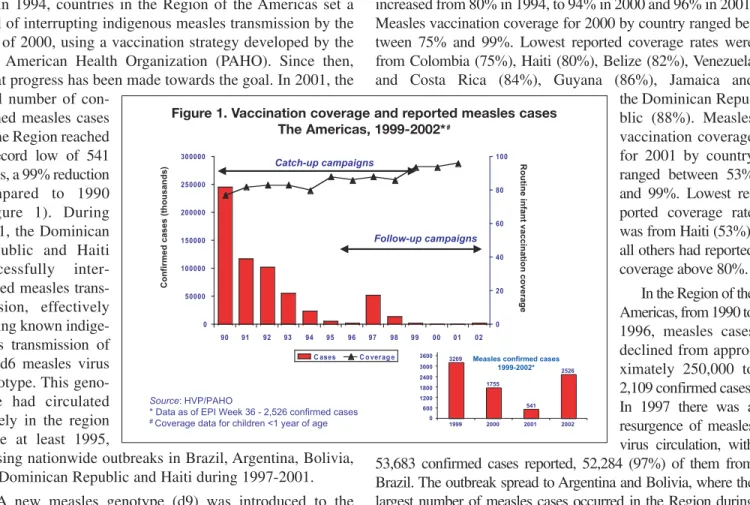
In 1994, countries in the Region of the Americas set a goal of interrupting indigenous measles transmission by the end of 2000, using a vaccination strategy developed by the Pan American Health Organization (PAHO). Since then, great progress has been made towards the goal. In 2001, the total number of
con-firmed measles cases in the Region reached a record low of 541 cases, a 99% reduction compared to 1990 (Figure 1). During 2001, the Dominican Republic and Haiti successfully inter-rupted measles trans-mission, effectively ending known indige-nous transmission of the d6 measles virus genotype. This geno-type had circulated widely in the region since at least 1995,
causing nationwide outbreaks in Brazil, Argentina, Bolivia, the Dominican Republic and Haiti during 1997-2001.
A new measles genotype (d9) was introduced to the Region in August, 2001, by a Venezuelan tourist returning from Europe. Since then, until September 7, 2002, a total of 2,491 cases have been confirmed in Venezuela and 125 in neighboring Colombia.
Measles in the Region
Routine (keep-up) vaccination coverage in the Region has
increased from 80% in 1994, to 94% in 2000 and 96% in 2001. Measles vaccination coverage for 2000 by country ranged be-tween 75% and 99%. Lowest reported coverage rates were from Colombia (75%), Haiti (80%), Belize (82%), Venezuela and Costa Rica (84%), Guyana (86%), Jamaica and
the Dominican Repu-blic (88%). Measles vaccination coverage for 2001 by country ranged between 53% and 99%. Lowest re-ported coverage rate was from Haiti (53%), all others had reported coverage above 80%. In the Region of the Americas, from 1990 to 1996, measles cases declined from appro-ximately 250,000 to 2,109 confirmed cases. In 1997 there was a resurgence of measles virus circulation, with 53,683 confirmed cases reported, 52,284 (97%) of them from Brazil. The outbreak spread to Argentina and Bolivia, where the largest number of measles cases occurred in the Region during 1998 and 1999, respectively. In 1998, there were 14,332 con-firmed cases reported from 17 (41%) of the 41 countries that re-port to PAHO. Argentina (10,229 cases), followed by Brazil (2,781 cases) had the highest number of cases. During 1999 through 2000, 28 (68%) of 41 countries that report to PAHO, in-cluding Cuba, the English-speaking Caribbean countries, and most of Central and South America, reported no measles cases. In
In this issue:
Towards measles eradication in the Americas:
The last inch? . . . 1 Lessons learned: First two years of regional rubella surveillance . . . 3
Immunization programs of the southern cone and
Brazil reviewed . . . 6 Immunization goals in the global sustainable
development and poverty reduction agenda . . . 8
EPI Newsletter
Expanded Program on Immunization
in the Americas
Volume XXIV, Number 4
IMMUNIZE AND PROTECT YOUR CHILDREN
August 2002
Towards measles eradication in the Americas: The last inch?
Source: HVP/PAHO
* Data as of EPI Week 36 - 2,526 confirmed cases
# Coverage data for children <1 year of age
0 50000 100000 150000 200000 250000 300000
90 91 92 93 94 95 96 97 98 99 00 01 02 0 20 40 60 80 100
C ases C o ver ag e
Catch-up campaigns
Follow-up campaigns
Measles confirmed cases 1999-2002*
3600 3000 2400 1800 1200
1999 2000 2001 2002 3209
1755 541
2526
600 0
Confirmed cases (thousands)
Routine infant vaccination coverage
Figure 1. Vaccination coverage and reported measles cases
1999, 3,209 confirmed cases were reported from 11 countries, 78% fewer cases than in 1998 and 94% fewer than in 1997 (Figure 1). In 1999, indigenous transmission occurred in four countries: Bolivia (1,441 cases), Brazil (908), Argentina (313), and Dominican Republic (274). Also in 1999, Canada, Chile, Costa Rica, Mexico, Peru, Uruguay and the United States report-ed measles importations, but secondary transmission was limitreport-ed as a result of high measles vaccination coverage. The largest out-break linked to measles importation occurred in Canada, where 165 confirmed cases were linked to an importation from Bolivia.
In 2000, the number of measles confirmed cases in the Americas decreased to 1,755 (Figure 1). Indigenous trans-mission still occurred in Argentina, Brazil, Bolivia, the Dominican Republic, and Haiti. Only 16 (<1%) of the 12,010 reporting municipalities in the Region reported con-firmed measles cases during this period.
During 2001, a total of 541 confirmed measles cases were reported in the Americas. Indigenous transmission was report-ed only in three countries, Haiti and the Dominican Republic, in the Hispaniola island, and Venezuela. Dominican Republic’s last confirmed case occurred in June, 2001, and Haiti’s last case was reported in September, 2001. In August, 2001, a measles outbreak began in Venezuela, a measles virus from a new genotype (d9) that was introduced by a traveler returning from Europe. During August-December, 2001, 109 measles cases have been reported in Venezuela following this importa-tion. The outbreak spread to Colombia during January, 2002. Since then, Venezuela and Colombia have become the only countries with known indigenous transmission in the Region.
Venezuela
During 1997-2000, routine measles vaccination coverage ranged from 65% to 93%. In September 2001, estimated cov-erage decreased to 58%, and was lower in states near the bor-der with Colombia (e.g., Falcón, 44%; Zulia, 34%). The source case of the outbreak, a 39-year-old male, had rash onset on August 29, 2001, a day before returning to the State of Falcón from a trip to Switzerland, Germany, and Spain during August 4-30. The first case reported, notified on September 28, was his 35-year-old brother who had rash onset on September 23. Since the beginning of the outbreak until September 7, 2002, Venezuela reported 7,007 suspected measles cases, of which 2,491 were laboratory or epidemiologically confirmed. The outbreak peaked in week 11 of 2002 and has affected 17 (70%) of the 24 States in Venezuela. A total of 2,098 (84%) cases were from Zulia, 202 (8%) from Falcón, and 191 (8%) from the other 14 states. Nationally, the age groups most affected were children aged <1 year (120 cases per 100,000 popula-tion), followed by children aged 1-4 years (26 per 100,000), and young adults aged 20-29 years (12 per 100,000).
Measles virus samples were collected from cases in Zulia from November 2001 through January 2002. Genetic sequenc-ing indicated that the virus was not similar to viruses encoun-tered previously in the region or to the reference genotype
strains available on the measles sequence database. A close match was identified from virus samples taken from cases im-ported into Australia from Indonesia as early as 1999 and which have been given the proposed designation of genotype d9.
During November, 2001-January, 2002, a follow-up measles vaccination campaign was implemented targeting 2,216,001 children aged 1 to 4 years, 16 of 24 states reported coverage of 100%. Even so, the outbreak continued with cases occurring in all age groups. House-to-house monitoring of vaccination cov-erage revealed pockets of unvaccinated children. Since March 2002, a nationwide vaccination campaign targeting 5,865,687 children ages 6 months to 14 years and an estimated 5,511,153 high-risk adults in urban, peri-urban and rural areas (including health care workers, tourists, factory workers, soldiers, universi-ty students, displaced populations and migrants) was imple-mented. Since then, measles circulation has decreased significantly. The states most affected, Zulia and Falcón, report no cases since weeks 31 and 20, respectively, and the average number of cases by week during the last 4 weeks decreased to 2.
Colombia
After achieving high vaccination coverage (93%) in 1996, measles coverage declined to around 75% during 1997-2000. Coverage increased to 92% during 2001. The first confirmed case, a 7-year-old from the Atlantic coastal area, had rash onset on January 20, 2002, and reported prior contact with a confirmed measles case in Zulia, Venezuela. As of September 7 (week 36), 3,122 suspected measles cas-es have been reported in Colombia; of them, 125 had been confirmed as measles. Confirmed cases have occurred in 24 municipalities (14 of them on the Atlantic Coast or bordering Venezuela) from 11 (33%) of the 33 national departments. As of September 7, 2002, the average number of confirmed cas-es by week for the last 4 weeks is 6.5. The age groups most affected were children age <5 years (1.37 cases per 100,000), followed by children 5 to 9 years of age (0.36 per 100,000), and those aged 25 to 29 years (0.34 per 100,000).
Control activities being implemented include: (a) a door-to-door measles vaccination campaign in high-risk municipalities as part of a national vaccination campaign for approximately 4.2 million children ages 6 months-5 years and other high-risk groups (health workers and travelers), (b) house-to-house vac-cination and coverage monitoring in high-risk areas, (c) strengthening of epidemiological surveillance nationwide, and (d) increased training on case investigation and outbreak con-trol all over the country. As of September 15, 2002, 3,362,281 children (80%) in the target group had been vaccinated.
During the last two years, national immunization programs began expanding their measles surveillance systems to include cases suspected of being rubella and, in many instances, began to include all febrile rash illnesses into their systems. The re-gional measles database (MESS) developed by PAHO for measles eradication, was also expanded to reflect the changes in surveillance activities. Variables were added for important aspects of rubella infection, e.g., pregnancy status, and classifi-cation codes were modified to allow a suspected case to be con-firmed as rubella. An analysis is presented of the first two years of regional rubella surveillance data that were sent to Washington via weekly transmissions of surveillance data from national MESS databases. For the purposes of this analysis, on-ly laboratory-confirmed cases were included.
During the last two years, 7,696 laboratory-confirmed cases of rubella were reported in the Region from national MESS databases, 5,122 cases were reported in 2000 and 2,574 cases in 2001. During both years, notification peaks for confirmed cas-es were observed in October (Figure 1). During year 2000, 75% of all laboratory-confirmed cases were reported from four coun-tries. Peru reported 2,126 cases (42% of all cases) for an annual notification rate of 8.3 per 100,000. The Dominican Republic re-ported 799 cases (16% of all cases) for an annual notification rate of 9.4 per 100,000. Ecuador reported 486 cases (9% of all cases and a notification rate of 3.8 per 100,000) and Bolivia re-ported 420 cases (8% of all cases) for a rate of 5.0 per 100,000.
It should be noted, that these countries are those that have inte-grated measles and rubella surveillance. In year 2001, 87% of all confirmed cases were reported from three of these same coun-tries (i.e., Peru with 1,319 cases, Bolivia with 558 cases, and Ecuador with 372 cases). The regional notification rate per 100,000 persons was 1.6 in year 2000 and 0.8 in 2001.
Fifty-four percent of all cases during both years were fe-males and cases in all age groups were reported. The majority of cases during both years of surveillance were 1 to 14 years of age, i.e., 73% in 2000 and 83% in 2001. However, persons 5 to 9 years of age accounted for the greatest proportion of cas-es in any age group studied, or 39% in 2000 and 47% in 2001. Persons 1 to 4 years of age accounted for 16% of cases in 2000 and 18% of cases in 2001 while persons 20 to 39 years of age accounted from 15% of cases in 2000 and 9% in 2001.
Persons 5 to 9 years of age had the highest notification rate per 100,000 for laboratory-confirmed rubella, i.e., 6.7 in year 2000 and 4.1 in year 2001. Persons 1 to 4 years of age and 10 to 14 years of age had similar notification rates for both years, i.e., approximately 2.6 in 2000 and 1.5 in year 2001.
According to information provided by national MESS databases, 72% of laboratory-confirmed cases in 2000 and 78% of cases in 2001 were not vaccinated. In addition, 26% of cases in 2000 and 19% of cases in 2001 had no informa-tion on their vaccinainforma-tion status.
Lessons learned: First two years of regional rubella surveillance
An analysis of national rubella data
Editorial Note: The Region’s success in interrupting
transmission of the d6 measles virus genotype is evidence that with the commitment of a whole Region to measles eradica-tion the goal can be achieved. The reintroduceradica-tion of measles and its subsequent transmission in Venezuela and exportation to Colombia are reminders that, until global measles eradica-tion is achieved, countries in the Americas are vulnerable to importations. However, these importations should not result in sustained measles transmission if vaccination coverage is maintained at high levels (>95%) in all municipalities, and measles follow upcampaigns are conducted on time.
The current outbreak in Venezuela and Colombia illus-trates, however, the dangers of failing to maintain high routine vaccination coverage, to effectively implement PAHO’s rec-ommended follow-up measles vaccination campaigns every four years, and to maintain timely surveillance. Also, experi-ence gained in the Americas throughout the past four years has pointed towards the need of validating the measles vaccination effort at the lowest geographical level through house-to-house monitoring, and to identify localities with persistent low vac-cination coverage within countries that report adequate aggre-gate coverage level. Based on the results of outbreak investigations in the Americas, PAHO has targeted, during
outbreaks, the vaccination of population groups considered at high-risk for sustaining measles transmission and for transmit-ting measles to susceptible persons of other groups.
Analysis of the MESS database shows that important numbers of women in child-bearing age (WCBA) in numer-ous countries had laboratory-confirmed infections with rubella. Unfortunately, information on their pregnancy sta-tus was not uniformly collected, or at least was not uniform-ly reported. In year 2000, of 703 women 15 to 39 years of age with confirmed rubella infections, information on their pregnancy status was not reported for 249 (35%). Thirty-nine (6%) of the 703 women were reported to be pregnant while the remaining 415 (59%) were reported as not being pregnant. Of the 1,394 women in 2001 with rubella infec-tion, 223 were 15 to 39 years of age. Of these 223 women, 19 (9%) did not have information on their pregnancy status, 11 (5%) were reportedly pregnant and 193 (87%) were re-portedly not pregnant. Thus, during the two years of study, 268 WCBAs had laboratory-confirmed rubella without any information on their pregnancy status. These women were reported from 10 countries in 2000 (Argentina, Bolivia, Colombia, Dominican Republic, Ecuador, El Salvador, Guatemala, Mexico, Nicaragua and Peru) and from 5 coun-tries in 2001 (Argentina, Colombia, Ecuador, El Salvador and Guatemala). Thus, 5 countries reported cases of labora-tory-confirmed rubella in WCBA with no information on their pregnancy status during both years of study.
A total of 50 women were reportedly pregnant during a rubella infection. These women were reported from 9 coun-tries (Bolivia –1, CAREC – 2, Colombia - 6, Dominican Republic – 4, Ecuador – 9, Honduras –1, Mexico – 10, Nicaragua – 3, and Peru – 14 women). Of these 50 pregnant women with rubella, 36 (72%) were reported to be 1 to 20 weeks pregnant at the time of infection (Figure 2). Information on the number of weeks that they were pregnant was not available for 6 of the 50 women. The 36 women
re-portedly with rubella during weeks 1 to 20 of their pregnan-cy were reported from Colombia (3), the Dominican Republic and Honduras (1 each), Ecuador (9), Mexico (8), Peru (10), and Nicaragua and the Caribbean (2 each).
Finally, the number of both laboratory-confirmed cases of rubella and the number of all confirmed cases of rubella (by either laboratory diagnosis or by epidemiologic link-age) was compared to the number of cases reported to PA-HO/Washington in the national EPI Tables (EPI Tables indicators developed by PAHO collect data on immuniza-tion twice a year). Differences were noted for many coun-tries. In some instances, the EPI Tables had greater numbers of cases reported than those entered in MESS. In other in-stances, MESS had more cases than those reported by the EPI Tables.
Editorial Note:This analysis looked only at rubella
in-formation sent to PAHO/WDC via the weekly transmission of national MESS databases. Data from countries that send PAHO only aggregate numbers of cases by means other than MESS were not included in this analysis (e.g., Brazil). In in-terpreting this data one should keep in mind that countries began including rubella in MESS at different points in time. In fact, in some countries, cases notified as "suspected cas-es" may actually be suspected of only measles, i.e., their ini-tial diagnosis is always measles. Furthermore, it is possible that as countries expand surveillance, only a sample and not all rubella cases are entered into MESS. Thus, rather than consider these data as final summary data for the Region, they should be viewed as start-up data for baseline compar-isons. However, even with these limitations, important les-sons can be learned, particularly about the management and case investigation of rubella cases in the Region.
1 8 15 22 29 36 43 50 5 12 19 26 33 40 47
180
160
140
120
100
80
60
40
20
0
N=5,122 N=2,574
Number of cases
Weeks * Source: National MESS reports
First, in the Americas, rubella is common, affects both genders and all ages and is widespread. This confirms what was known or what has been suspected for many years. Although infections occur in all age groups, the age most af-fected include individuals 5 to 9 years of age. Persons 10 to 14 years of age were found to contribute as many cases as per-sons 1 to 4 years of age. This should be taken into considera-tion when managers plan follow-up vaccinaconsidera-tion campaigns with MR or MMR. Activities aimed at decreasing viral circu-lation to reduce the risk of the occurrence of cases of congen-ital rubella syndrome (CRS) should consider expanding the age group to be vaccinated beyond 4 years of age.
An important finding of these analyses is that not all women of child-bearing age with rubella infection have in-formation on their pregnancy status. This alarming finding (which represents a programmatic error that appears to be occurring in various countries) needs correction. The fact that the proportion with unknown pregnancy status has de-creased from 35% in 2000 to 9% in year 2001 suggests that case investigations are improving. Even so, managers must keep in mind that the goal of vaccination against rubella is to prevent CRS and not necessarily rubella infections. The presence of a single WCBA with rubella who is not ade-quately investigated represents a significant failure of the program. It should be remembered that not only must all
countries accelerate the integration of measles and rubella surveillance, but all women with rubella must be followed closely by health care workers.
It could be argued that women without information on their pregnancy status represent women who were initially diagnosed as measles or with another non-rubella diagnosis and were later confirmed to be rubella. Nevertheless, once diagnosed as rubella, a follow-up investigation needs to be conducted to determine their pregnancy status. If found to be pregnant, these women deserve even more thorough follow up to determine if they eventually give birth to a child with CRS. The data presented here suggest that numerous cases of CRS, from various countries, may have occurred during the two year period studied. Data from MESS do not shed light onto whether infants born to mothers with rubella in-fection during their pregnancy were adequately followed and investigated.
Finally, when comparing MESS data to the national in-formation sent to PAHO in the EPI Tables, many discrepan-cies exist. National authorities should ensure that all cases of rubella notified in national surveillance systems are also re-ported to the national immunization offices and that such cases are investigated. All cases must also be entered as sus-pected cases in national MESS data bases.
0 1 2 3 4 5
2000 2001
* There is no information for 6 (12%) of 50 pregnant women in 2000 36 of the 50 were 1-20 wks pregnant
** Source: National MESS reports
1 4 7
10 13 16 19 22 25 28 31 34 37 40
Number
Week of pregnancy
Danger Period
On the 29thand 30thof August of 2002, the 16th Regional Meeting for Vaccine Preventable Diseases for the countries of the Southern Cone and Brazil was held in Buenos Aires, Argentina. Managers of National Immunization Programs (NIPs) from six
coun-tries met and discussed advances, problems and future plans for their countries. Present dur-ing the meetdur-ing were del-egations from Argentina, Chile, Paraguay, Uruguay, Brazil and Bolivia, as well as staff from the Division of Vaccines and Immunization in Wash-ington, D.C. and a
repre-sentative from UNICEF’s program in the Americas. In addition, 24 provincial chiefs of NIPs in Argentina participated.
The objective of the meeting was to critically analyze the current epidemiological situation in each country for the eradication and/or
con-trol of measles, rubella, and polio, as well as neonatal tetanus. Fur-thermore, detailed dis-cussions were held on vaccine safety, calcula-tions of national cover-age levels, development of National Plans of
Action, and the current status of the diphtheria outbreak in Paraguay. As in previous meetings, national directors of each measles/rubella diagnostic laboratory participated and held a concurrent laboratory meeting.
Countries reported advances in their programs with the majority reaching national coverage levels for DPT3, OPV3 and measles vaccine of at least 90% with the exception of Argentina where coverage is between 85% and 90%. Only Brazil reported a confirmed measles case in 2001/2002 and this sole case was an importation from Japan. Three coun-tries (i.e., Argentina, Brazil and Bolivia) reported confirmed measles cases in 2000.
The countries present confirmed 733 rubella cases in 2002 and all reported the incorporation of rubella vaccines into the national programs. Paraguay is in the process of ini-tiating rubella control strategies and recently adding measles/mumps/rubella to their routine immunization schedule. Argentina is also initiating a plan for rubella con-trol activities. Chile and Brazil have implemented large-scale accelerated rubella control activities.
For polio, only Bolivia, Chile and Uruguay reported AFP rates of >1.0 per 100,000 persons under 15 years of age. Paraguay, where coverage with DTP3 has been approxi-mately 80% during the last decade, reported 41 confirmed diphtheria cases in 2002 (see EPI News-letter, June 2002).
Key recommenda-tions of the meeting
• Maintain intensive fever/rash surveillance activities and high vaccination coverage levels using the PAHO recommended vacci-nation strategies for measles eradication, especially rap-id monitoring of coverage at the local level.
• Vaccinate adults in high-risk groups such as health care workers.
• Each country should identify municipalities with coverage <95% and develop local Plans of Action to im-prove local coverage. • Accelerate the inte-gration of rubella sur-veillance with that of measles and imple-ment surveillance for congenital rubella syndrome. • A rubella-containing vaccine should be used in all
measles campaigns. The use of single antigen measles vaccine represents a missed opportunity for rubella. • Maintain and strengthen, as needed, surveillance for AFP
and ensure high coverage with OPV.
• Each country should create a National Committee for the Containment of Wild Poliovirus.
• Each country reporting cases of neonatal tetanus should develop Plans of Action to confront the problem. • Vaccine safety must become a priority in each country • Each national program should develop and distribute
ma-terial on vaccine safety and include activities for vaccine safety in national Plans of Action.
• Countries should maintain, or revitalize as indicated, Interagency Coordination Committees (ICC), to improve the coordination between agencies, and to take advantage of the each agency’s experiences and expertise.
Immunization programs of the southern cone and
Brazil reviewed
Measles Surveillance Indicators – 2002
Indicators ARG BOL BRA CHI PAR URU
% of units that report weekly 99 0 89 90 84 57
% of suspected cases
investigated <48 hours 70 100 60 67 81 100
% of cases with an adequate
sample 96 97 63 90 100 100
% of cases with a sample that
arrives in lab < 5 days 76 78 53 76 57 100
% of samples with results
< 4 days 76 83 81 94 100 100
Acute Flaccid Paralysis Surveillance Indicators 2001-2002*
Indicators ARG BOL BRA CHI PAR URU
% of units that report weekly 99 0 91 90 86 55
% of cases investigated <48 hours 97 95 98 90 67 100
% of cases with an adequate
stool sample 66 74 74 77 62 100
AFP rate in persons < 15 years 0.99 1.27 0.72 1.3 0.90 1.38
Reported Cases of Selected Diseases
Number of reported cases of measles, poliomyelitis, tetanus, diphteria and whooping cough, from 1 January 2002, to date of last report, and the same epidemiological period in 2001, by country
Measles Polio
Confirmed 2002
Laboratory Clinically Total
Confir-med 2001*
2002 2001
Diphteria
2002 2001
Whooping Cough
2002 2001 2002 2001 2002 2001
Tetanus
Non Neonatal Neonatal Date of
Last Region Country/Territory Report
AND Bolivia 29-Jun 0 0 0 0 0 0 17 12 1 3 4 2 48 27
AND Colombia 29-Jun 72 4 76*** 1 0 0 … … … 0 … …
AND Ecuador 29-Jun 0 0 0 2 0 0 0 1 6 5 2 1 237 211
AND Peru 29-Jun 0 0 0 0 0 0 3 19 0 5 0 0 0 4
AND Venezuela 29-Jun 2306 0 2306 8 0 0 1 1 0 0 0 0 5 4
BRA Brazil 29-Jun 0 0 0 1*** 0 0 … 129 … 17 … 10 … 657
CAP Costa Rica 29-Jun 0 0 0 0 0 0 … … … 0 … 0 … …
CAP El Salvador 29-Jun 0 0 0 2*** 0 0 … … … 0 … …
CAP Guatemala 29-Jun 0 0 0 0 0 0 3 7 2 5 0 0 26 154
CAP Honduras 29-Jun 0 0 0 0 0 0 … … … 0 … 0 … …
CAP Nicaragua 29-Jun 0 0 0 0 0 0 2 9 1 1 0 0 46 35
CAP Panama 29-Jun 0 0 0 0 0 0 2 1 0 1 0 0 49 0
CAR Anguilla 29-Jun 0 0 0 0 0 0 0 0 0 0 0 0 0 0
CAR Antigua & Barbuda 29-Jun 0 0 0 0 0 0 0 0 0 0 0 0 0 0
CAR Bahamas 29-Jun 0 0 0 0 0 0 0 0 0 0 0 0 0 0
CAR Barbados 29-Jun 0 0 0 0 0 0 0 0 0 0 0 0 0 0
CAR Belize 29-Jun 0 0 0 0 0 0 0 0 0 0 0 0 0 0
CAR Bermuda 29-Jun 0 0 0 0 0 0 0 0 0 0 0 0 0 0
CAR British Virgin Islands 29-Jun 0 0 0 0 0 0 0 0 0 0 0 0 0 0
CAR Cayman Islands 29-Jun 0 0 0 0 0 0 0 0 0 0 0 0 0 0
CAR Dominica 29-Jun 0 0 0 0 0 0 0 0 0 0 0 0 0 0
CAR French Guiana 29-Jun 0 0 0 0 0 0 … … … …
CAR Grenada 29-Jun 0 0 0 0 0 0 0 0 0 0 0 0 0 0
CAR Guadeloupe 29-Jun 0 0 0 0 0 0 … … … …
CAR Guyana 29-Jun 0 0 0 0 0 0 0 0 0 0 0 0 2 0
CAR Jamaica 29-Jun 0 0 0 0 0 0 1 2 0 0 0 0 1 0
CAR Martinique 29-Jun 0 0 0 0 0 0 … … … …
CAR Montserrat 29-Jun 0 0 0 0 0 0 … … … …
CAR Netherlands Antilles 29-Jun 0 0 0 0 0 0 … … … …
CAR St Vincent/Grenadines 29-Jun 0 0 0 0 0 0 0 0 0 0 0 0 0 0
CAR St. Kitts/Nevis 29-Jun 0 0 0 0 0 0 0 0 0 0 0 0 0 0
CAR St. Lucia 29-Jun 0 0 0 0 0 0 0 1 0 0 0 0 0 0
CAR Suriname 29-Jun 0 0 0 0 0 0 0 1 3 0 0 0 0 1
CAR Trinidad & Tobago 29-Jun 0 0 0 0 0 0 0 0 0 0 0 0 0 0 CAR Turks & Caicos 29-Jun 0 0 0 0 0 0 0 0 0 0 0 0 0 0
LAC Cuba 29-Jun 0 0 0 0 0 0 0 1 0 0 0 0 0 0
LAC Dominican Republic 29-Jun 0 0 0 113 0 0 28 14 0 0 8 28 3 18
LAC Haiti 29-Jun 0 0 0 102 0 0 … … 32 33 6 4 15 14
MEX Mexico 29-Jun 0 0 0 3*** 0 0 … … … 0 … …
NOA Canada 29-Jun 5 0 5*** 24*** 0 0 … 3 … 0 … 1 … 1056
NOA Puerto Rico 29-Jun 9 0 9*** 0 0 0 … … … …
NOA United States 29-Jun 0 0 0 79*** 0 0 6 22 … … 0 1 2,884 2506
SOC Argentina 29-Jun 0 0 0 0 0 0 … 5 … 0 … 0 … 73
SOC Chile 29-Jun 0 0 0 0 0 0 … 5 … 0 … 0 … 709
SOC Paraguay 29-Jun 0 0 0 0 0 0 7 11 4 6 28 0 10 21
SOC Uruguay 29-Jun 0 0 0 0 0 0 … 1 … 0 … 0 … 6
TOTAL 2,392 4 2396 335 0 0 70 245 49 76 48 47 3,326 5,496
… Data not available
Pan American Health Organization
Pan American Sanitary Bureau Regional Office of the World Health Organization
Division of Vaccines and Immunization 525 Twenty-third Street, N.W.
Washington, D.C. 20037 U.S.A.
http://www.paho.org (Search: EPI Newsletter) The EPI Newsletter is published every two months, in Spanish,
English and French by the Division of Vaccines and Immunization (HVP) of the Pan American Health Organization (PAHO), Regional Office for the Americas of the World Health Organization (WHO). Its purpose is to facilitate the exchange of ideas and information concerning immunization programs in the Region, in order to promote greater knowledge of the problems faced and their possible solutions.
References to commercial products and the publication of signed articles in this Newsletter do not constitute endorsement by PAHO/WHO, nor do they necessarily represent the policy of the Organization.
Editor: Ciro de Quadros
Associate Editor: Mónica Brana ISSN 0251-4729
Immunization goals in the global sustainable development
and poverty reduction agenda
During the 2000-Millennium Summit, states of the United Nations reaffirmed their commitment to sustain-able development and poverty reduction by developing eight measurable goals and targets. Goal number 4 ad-dressing child mortality reduction by two thirds between 1990 and 2015, has three indicators one of which is the proportion of one-year olds immunized against measles. The Department of the Treasury of the United States an-nounced July 25, 2002, during a testimony before the Subcommittee on International Monetary Policy and Trade of the House Committee on Financial Services, that it would assess international aid effectiveness by means of progress being made in school completion, measles im-munization rates, and business start-up expenses. The goal on health seeks an increase in measles immunization cov-erage across countries that are eligible for assistance through the International Development Association (IDA), as well as increase in the number of countries with 80% vaccination coverage (http://www.who.int/mdg/goals/en and http://www.ustreas.gov/press/releases/p03288.htm.
The consensus of the key role played by immunization offers a unique opportunity to maintain and expand the reach of immunization programs in the Americas, and as such for immunization to remain a critical component of child sur-vival initiatives. It requires, however, the maintenance and/or strengthening of the institutions that have supported the delivery of effective immunization and surveillance pro-grams, as well as the effective stewardship of national health authorities to ensure optimum performance of immunization programs at all levels of a country’s health system.
In the context of the critical role now played by health to
reach poverty reduction and sustainable growth goals, equi-ty in immunization has become an overriding theme for PAHO’s technical cooperation program in this area. Equity is defined as attaining uniform quality immunization cover-age in all municipalities of the countries, as well as provid-ing an enablprovid-ing political and technical environment for the Americas to benefit from additional new or under-used vac-cines of public health importance. As such, PAHO’s goal is to support countries in translating the concept of equity into doable and measurable interventions that will effectively re-duce disparities in a changed political environment, and ensure that children and women of child bearing age are pro-tected against other diseases prevented by quality vaccina-tion.
Millennium Development Goals
Goal 1 Eradicate extreme poverty and hunger.
Goal 2 Achieve universal primary education.
Goal 3 Promote gender equality and empower women.
Goal 4 Reduce child mortality.
Goal 5 Improve maternal health.
Goal 6 Combat HIV/AIDS, malaria, and other diseases.
Goal 7 Ensure environmental sustainability.