executivecommitteeof workingpartyof
thedirectingcouncil theregionalcommittee
PAN AMERICAN WORLD '_j__'/_
HEALTH HEALTH
ORGANIZATION ORGANIZATION
116th Meeting Washington, D.C.
June 1995
Provisional Agenda Item 4.8 CEil6/15 (Eng.)
27 March 1995 ORIGINAL: ENGII.qH
M_ASLFS _:L_IINATION IN _ AMERICAS
This progress report by the Director is presented to the 116th Meeting of the Executive Committee in response to Resolution CSP24 R16 of the XXIV Pan t American Sanitary Conference, held in Washington, D.C., in September 1994.
The report summarizes the progress achieved by national immunization programs in increasing immunization coverage and in controlling vaccine preventable diseases. The successes include the eradication of poliomyelitis from the Americas, an accomplishment certified by the International Commission in August 1994, after the last case of paralytic poliomyelitis was detected in Junfn, Peru, on 23 August 1991; the nearly complete control of neonatal tetanus in several countries; and the 99% reduction in measles transmission between 1984 and 1994. The last resulted in the decision of the XXIV Pan American Sanitary Conference to target the elimination of measles from the Western Hemisphere by the year 2000.
A summary of the strategies and technical components of the Plan of Action for measles elimination in the Americas by the Year 2000 is presented and discussed, with analysis of the cost components and implications.
The Executive Committee is requested to review the report and approve the strategies and plan of action as presented or with any modifications that it may deem appropriate.
CBl16/15 (Eng.) Page 2
CONTENTS
Page
Executive Summary ... 3
1. Background ... 4
2. Objectives ... 5
3. Strategies ... 5
4. Technical Components ... 6
4.1 Mob'fiization of Country Resources ... 6
4.2 Immunization Activities ... 6
4.3 Training... 7
4.4 Social Mobilization ... 7
4.5 Epidemiological Surveillance and Outbreak Control ... 7
4.6 Laboratory Support ... 8
4.7 Information Dissemination ... 9
4.8 Identification of Research Needs ... 9
4.9 Evaluation and Certification Procedures ... 9
5. Organization and Administration ... 10 5.1 Country Level ... 10
5.2 International Participation ... 10
CE116/15 (Eng.)
Page 3
EXECUTIVE SUMMARY
On 29 September 1994 the International Commission for the Certification of Poliomyelitis Eradication certified the Region of the Americas polio-free.
For neonatal tetanus, the Region has already met the goal established by WHO
of less than 1case per 1,000 live births.
As a result of the measles initiatives undertaken by severalcountries in the Region and the dramatic impact that the strategy has had on the incidence of measles, the XXlV Pan American Sanitary Conference adopted a resolution calling for the elimination of measles transmission from the Western Hemisphere by the year 2000.
The measles elimination strategy calls for the achievement and maintenance of
95 %measles vaccine coverage in all counties or districts inevery country; careful fever
and rash surveillance for the detection of possible measles cases; aggressive outbreak
response; and intensive social mobilization of nongovernmental organizations (NGOs) and community groups to support the effort and to enhance the community's role inthe prevention of disease. Drawing on the experience ofpolio eradication, it is expected that the measles elimination effort will further reinforce the value of preventing diseases through immunization.
The regional measles elimination initiative will have a duration of five years
(1996-2000) and will cost an estimated U55S3.0 million, including the provision of approximately $7.0 million from PAl-lO and WHO regular budgets and voluntary funds.
These resources are a complement to an estimated USS 650,000,000 which is invested by the countries themselves in their national immunization services and will be critical to address issues related to surveillance, labOratory diagnosis, supervision, social
CBl16/15 (F__g.)
Page 4
1. BaclqKround
Since the Expanded Program on Immunization (]_PI)was launched inthe Region
of the Americas in 1977, immunization cov6rage has improved considerably. In 1978,
less than 10% of children under one year of age lived in countries where coverage with the EPI vaccines was at least 50%. By 1993, nearly 80 % of the children in this age group lived in countries with coverage of at least 75 % for DPT and BCG vaccines and over 80 % for polio and measles vaccines.
Poliomyelitis was certified as eradicated in 1994, neonatal tetanus has been brought under control, and aconsiderable decline has been observed in diphtheria and
pertussis.
The impact of the high coverage with measles vaccine and the national measles elimination campaigns can be seen in Figure 1, which shows the absolute number of cases reported each year during the period 1960-1994 and areduction of 99% between
1984 and 1994. This reduction can only be maintained if additional efforts are initiated which aim at elimination of transmission.
Figure 1. Annual Number of Reported Cases of Measles,
Region of the Americas, 1960-1994'
R.ported caae. ('i'houaand.)
moo-_ V._6iSIk',_...
/ _IA EP, VACCINATION
._..._.._, I)i-, 4YEARS
00 ---*---.---*---.-o---.- o--- ... oo-* ... .
200 ...
"'i I { t I i I { I' 1' I { i ! ! I "1 { ! { { { { { { { { {"" { { { { { {
Il I1 11 131 14 {MI 441 l{ 41ll Il 70 71 TitY$74 111?l _ 711Yl lO I1 13{{ 14 lie 14117 Il It H 11 l{ I_ H Yur
Imlm.= IIAi,IO
Cml
6
/
lS
'
P
age
5
By November 1994, three years had elapsed without measles cases in Cuba and the English-speaking Caribbean, and two years with no confirmed cases in Chile. This impressive and rapid reduction in disease burden, resulting from increased coverage with the measles vaccine and its application in mass campaigns, paved the way for the decision on 29 September 1994 of the XXIV Pan American Sanitary Conference to establish the goal to eliminate indigenous transmission of measles from the Western Hemisphere by the year 2000.
2. Objectives
The following are the proposed objectives of the Plan of Action:
(a) to eliminate indigenous transmission of measles in the American Region by the
year 2000;
Co) to sustain surveillance for vaccine-preventable diseases already in place and
strengthen surveillance for other communicable diseases of public health importance;
(c) to promote the overall development of the Expanded Program on Immunization in the Region and to speed up the attainment of its objectives.
3. Strategies
In order to achieve the goal of elimination of indigenous transmission of measles
in the Americas by the year 2000, it will be necessary to intensify the use of all components of the F,PI strategies currently being implemented, and to modify them as required on the basis of practical experience. Other essential elements are coordination of international agencies at the Regional and country levels and assuring the availability of sufficient funds from both national and international sources to fund all activities related to this goal.
The key strategies which will enable the Region to reach the measles elimination objectives listed above include:
- mobilizing national resources supported by international resources, where
necessary;
CEl16/15 (Eng.)
Page 6
- conducting periodic "catch-up'' campaigns in countries which have accumulated a large number of unprotected children capable of sustaining measles transmission;
- expanding the Regional surveillance system that was put in place for polio
eradication to include surveillance of fever and rash illnesses (suspected measles cases) at Regional and national levels, so that they are immediately investigated and appropriate control measures to stop transmission are rapidly implemented;
- making laboratory diagnostic services available to all countries, permitting laboratory studies of all reported cases of febrile rash illness that are suspected
of being measles;
- disseminating information within countries and throughout the Region;
- identifying research needs and resources to support essential research needs;
- developing a certification protocol to declare the countries and the Region free of indigenous transmission of measles;
- evaluating all ongoing program activities.
4. Technical Components
4.1 Mobilization of Country Resources
Recognizing the limited resources available within the ministries of health in many of the countries, it will be crucial to concentrate efforts on the mobilization of all country resources to complement those available.
To this end, intersectoral coordination and nongovernmental organization (NGO) collaboration will be essential to estimate the potential of existing resources and to mobilize the necessary additional resources. The mob'fiization of the social and economic sectors, social security, and other organizations will be essential elements in this endeavor.
4.2 Immunization Activities
The foremost requirement of the strategy will be achieving and maintaining an
immunization coverage among children of at least 95 % with potent measles vaccine in every district of every country. Given that most countries in the Region have already
_116/15 (Eng.)
P
a
ge7
years of age, it is recommended that the age for primary vaccination be 12 months of age. Therefore, the primary target age group will be children 12-15 months of age.
Since the measles vaccine is not 100% effective, even with very high levels of coverage, there will be an accumulation of susceptible children, which could fuel an outbreak should the measles virus be introduced. Therefore, it will be necessary to implement periodic mass campaigns targeted at reducing or eliminating this pool of suscepfibles. The frequency and target age group for these periodic "catch-up"
campaigns will be determined from epidemiological investigations and coverage data.
Advantage should be taken of the national immunization days to administer DPT and polio vaccines, as well as tetanus toxoid for women of childbeamg age in areas at risk for neonatal tetanus.
All countries should ensure that the vaccines used in the program meet WHO
requirements. Vaccine distribution will be a key component of immunization activities.
4
.
3
r
ramn
s
There will be a major emphasis on training personnel in the components of program operations critical for success. To assist in this endeavor, PAHO will ensure that the field guide on the technical basis of measles elimination is broadly available in
all Member States. This field guide will serve as a prototype for countries to produce country-specific field guides adapted to local circumstances.
4.4 Social Mobilization
In order to stimulate reporting of the disease, a primary goal will be education of the population with respect to the importance of the health sector detecting and reporting the existence of measles cases as soon as possible. The mass media will be
used for this purpose. Families, neighbors, and schoolteachers will be encouraged to
report suspected cases to health facilities as early aspossible.
4.5 Epidemiological Surveillance and Outbreak Control
The foundation of a proper surveillance system is the immediate investigation of suspected measles cases. This is one of the most critical components of the elimination effort. For operational purposes, the definition of an outbreak is the occurrence of three or more probable cases of measles in a defined geographical area within a one-month
CB116/15 (Eng.) Page 8
incorporated into surveillance activities. Weekly calls toalloutpatient facilities thatmight
see measles cases should be considered as a routine part of the surveillance mechanism.
Proper containment actions should be taken to prevent spread of measles in the
event of a probable case or cases occurring. This will require the immunization of
contacts at risk within the population. In addition, a geographical area around the case
or cases should be demarcated and containment vaccination performed among the
identified target age group.
Another key element in the reinforcement of measles surveillance will be the inclusion of providers in the private sector. They are often the fu-st health-related authorities to see cases of measles. This is important, as the private sector is a significant provider of health care in many countries of the Region.
Reports on all outbreaks and case importations will be published and disseminated. When intraregional importation has occurred, the country of origin of the
case will be notified and an investigation team will be available to assist in the
investigation of the origin of that infection.
4.6 Laboratory Support
A major component of surveillance activities will be laboratory confirmation of
probable cases of measles. All probable cases will have specimens collected for serological confirmation. A Regional network of 8 to 10 laboratories will be created to work in close collaboration and participation with the national laboratories in the
serological study and testing of suspected measles cases. The Regional network of
laboratories will monitor the quality of the work performed by the national laboratory in each country through proficiency testing.
A simplified serological test which is now under development and which can be
used in the field will facilitate surveillance activities.
To the extent possible, the regional laboratory network created for the polio eradication effort and the laboratories involved with dengue surveillance will participate
in this activity. For countries without adequate laboratory capacity, reference
laboratories will be identified to assist in the confirmation of cases. These reference laboratories will assist countries to develop in-country virological capacity.
In addition to the laboratory studies related to surveillance, there is a need to develop further laboratory support for potency testing of vaccines. This activity will be assigned to the Vaccine Quality Control network laboratories, which will be used as
CB116/15 (]3ng.)
P
ag
e 9
4.7 Information Dissemination
In addition to the reports on measles activity contained inthe EPI Newsletter and
CAREC Surveillance Report, the weekly measles bulletin prepared by PAHO Headquarters will be distributed widely to all countries in the Region.
Countries will be encouraged to include a section on measles in their national epidemiological bulletins, with distribution to all health care workers in the network.
PAHO will implement a Regional computerized information system to track rash and fever cases in each country and will assist the countries in implementing the system nationally.
An essential ingredient in polio eradication from the Western Hemisphere was the meetings of the EPI program managers. These meetings, sub-Regional and Regional,
served as a forum for mutual assistance and information dissemination. As in the polio eradication effort, these meetings will be decisive in maintaining momentum and facilitating communication inthe Region, as well as in serving as a forum for interagency coordination within the Region.
4.8 Identification of Research Needs
Recognizing that questions remain to be addressed in the field of measles elimination, both in technical and operational areas, support for research will be provided. Research needs identified by the EPI Technical Advisory Group will be implemented within the f'nrst two years of the project. It is also recognized that questions will continue to arise as some problems are solved and others a_ in their place. Participation in addressing research needs will be encouraged by all Member States. Some ofthe issues to be addressed immediately include identification of additional target populations for catch-up vaccination after the measles mass elimination campaigns, reasons for non-reporting among private-sector physicians, simpler diagnostic methods
(such as the IglVl Elisa allowing confirmation from a single rather than paired specimens), improved inoculation procedures, and better equipment for injectable vaccine.
4.9 Evaluation and Certification Procedures
Reco_ing the critical nature ofevaluation for monitoring success and detecting and resolving problems, there will be continued emphasis on evaluation. Knowledge,
attitude, and practice (KAP) studies related to measles and its prevention will be part of
CE116/15 (]Eng.) Page 10
The laboratory network wm be evaluated at regular intervals to guarantee the high level of support needed. Part of the laboratory evaluation process will include a retesting of original specimens by the reference laboratories, as well as specimens sent by the reference laboratories to the country laboratories for testing.
An international certification commission will be established to determine the criteria and timing for certification procedures to be initiated, based on the findings of studies conducted and the need to include other criteria to detect the measles virus.
5. Organization and Administration
5.1 Country Level
Each country should include activities related to measles elimination in their
overall national work plan for EPI and should sign a letter of agreement with ?AHO and
other collaborating agencies for their implementation. As part of this process, all countries will continue to use the EPI Interagency Coordinating Committee as the mechanism for coordination of inputs and program activities.
The national work plan will identify the roles of all of the participating agencies in the country's effort and should identify additional cooperation needed from PAHO and other participating agencies. These needs should be reflected in the agreements.
It is critical that "seed" funding be available at the time of design of the plans of action and signing of agreements.
5.2 International Participation
To assist in guiding the elimination effort, the EPI Technical Advisory Group (TAG) will cooperate in the identification of research needs, oversee the progress of studies underway, and review protocols and results. At its regular meetings, the TAG will review progress and problems encountered in the measles elimination effort.
The EPI Interagency Coordinating Committee (ICC), with representation from all of the international agencies collaborating in the effort (e.g., the Governments of Spain and France, CARICOM, UNICEF, Rotary International, USAID, IDB, World Bank,
C
E
ll
6
/
S
(Eng.)
' Page11
The Regional ICC will meet asfrequently as necessary (quarterly, semiannually, or annually) to review progress and needs for additional assistance. The PAHO EPI
program office will serve as secretariat to both the TAG and the ICC.
6. Funding and Financial Components
It is important to note that investments in immunization programs in the Region of the Americas between 1987-1991 were in the order of $543 million, with
approximately $430 million (80%) from national sources and $113 million (20%) from international agencies and organizations. For the period 1992-1996, an estimated $715 million is being invested in immunization programs, with $654 million (91%) from national sources and $61 million (9%) from international sources. The increase in national investments and the decrease in international funding reflect the maturity of the immunization programs and their sustainability.
It is estimated that, between 1996 and 2000, approximately $700 million will be
invested in immunization programs inthe Region of the Americas. This amount includes salaries and operational costs at country level, vaccines for routine immunization programs, and other supplies such as syringes and cold chain.
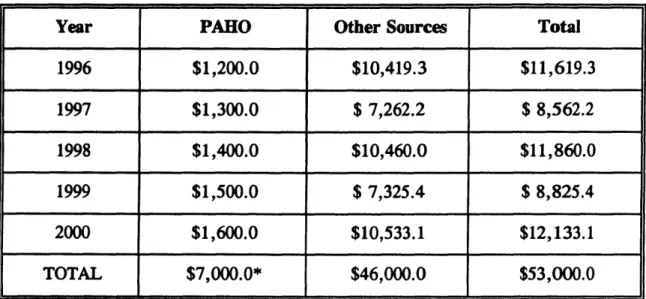
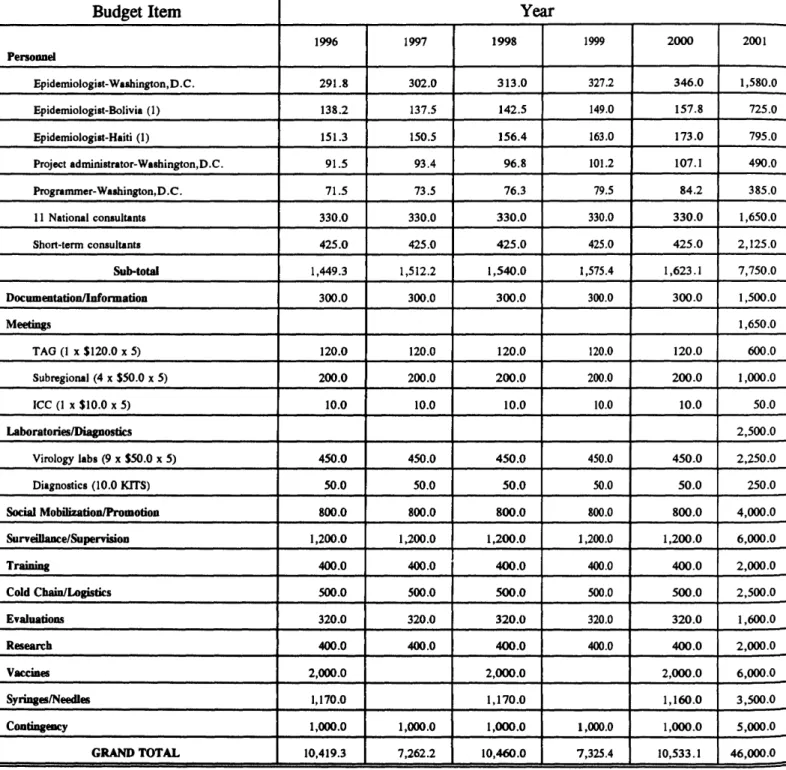
To ensure that the objective of measles elimination by the year 2000 is achieved, it is estimated that 7.5 % of this amount, $53 million, will have to be made available from international sources. Of this, $7 million will be made available from PAHO and V/IlO regular and voluntary funds covering financing of permanent personnel and other operational expenses. Another $46 million will have to come from other international
sources in support of national programs (see Table 1). Of this, approximately $25 million should bemanaged as extrabudgetary resources by PAHO to ensure the necessary regional coordination of the 'initiative. The cost of extra vaccine, syringes, and needles neeAed for implementation of catch-up vaccination campaigns may bemade available by other donors, such as UNICEF, NGOs, or other national sources.
The projected plan of action requirements to be fulfdled through international
cooperation from 1996 to2000, not including $7 million from PAHO, total $46 million,
C
E
l16
/
1
5 (En
g
.
)
Page
1
2
Table 1. Total Contributions
which would be Needed
to Implement the PLanof Action,
1
996-200
0
(in thousands of US dollars)
i i
Year
PAHO
Other Sources
To
ta
l
i
1
996
$1
,
200.0
$
1
0,4
19
.3
$
11
,6
19
.3
1
997
$1,300.0
$ 7,262.2
$ 8,562.2
1
998
$
1
,400.
0
$
1
0,460.0
$
11
,
8
60.0
1999
$1,
5
00.0
$ 7,32
5
.4
$ 8,82
5
.4
2000
$1,600.0
$10,
5
33.1
$12,133.1
TOTAL
$7,000.0*
$46,000.0
$
5
3,000.0
* Includ
e
s funding of p
e
rman
e
nt posts and ot
h
er operational costs
A mor
e
d
e
tail
e
d co
s
t br
e
akdown is pr
ese
nted in Tabl
e
s 2 and 3. W
h
en individual
c
ountry plans ar
e
d
es
ign
e
d, an
e
conomist s
h
ouldparticipate in costing t
he
program.
C
ost
figures wi
ll
b
e
id
e
ntifi
e
d and wi
ll
in
c
lud
e
salari
e
s for additional p
e
rsonn
e
l, transportation
costs (in
c
luding
b
ut not limit
e
d to airfar
e
s), per di
e
m costs,
e
xpect
e
d expenditures for
inv
e
stigation of id
e
ntified
s
u
s
p
ec
ted cas
e
s, ve
h
i
c
les, gasoline, va
c
cine, cold c
h
ain
eq
u
ipm
e
nt, and
laboratory
dev
e
lopment
c
osts
(including
c
osts
for
reagents,
transportation, and shipping of sp
e
cimens). A
H
r
e
curr
e
nt and capital expenditures s
h
o
uld
be taken into account in t
h
e program design. Budgets wi
ll
also include t
h
e
c
ost of m
e
dia
time and production of educational mat
e
rials.
P
A
H
O wi
ll c
oordinat
e
with a
ll
participating agenci
e
s in o
b
taining t
h
e necessary
funding to guarant
ee
th
e
a
ch
i
e
v
e
m
e
nt of this goal, and could serv
e
as th
e c
oordinating
agency for th
e
finan
c
ial as
s
i
s
ta
nce
provid
e
d to th
e
effor
t
. It is
e
xp
e
ct
e
d t
h
at, by the time
of th
e
D
irecting
C
ouncil m
ee
ting in Sept
e
mb
e
r 199
5
, commitm
e
nts to cov
e
r
e
stimated
n
ee
ds for at l
e
ast th
e fi
r
s
t t
h
r
ee
y
e
ars of the progr
a
m will already b
e
identified.
CEl16/15 O_g.)
' Page 13
Table 2. Cost Components, 1996-2000 (not including $7 million from PAHO)
Additional Personnel to be Hired by PAHO $7,750,000
11 Nationalconsultants, localcontracts ($30,000/year x5years) 1,650,000 4 Intercountry epidemiologists x 5years 3,100,000 1 Project administrator and 1 programmer 875,000
Short-term consultants ($8,500/month x 250 months) 2,125,000
Documentation and Information 1,500,000
Vaccine and Syringes 9,500,000
Meetings 1,650,000
Subregional --4/year x 5years 1,000,000 TAG-- 1 meeting/year x 5 years 600,000 ICC--Interagency Coordinating Committee 50,000
Lnberntories 2,500,000
Viral diagnostic labs (9 x $50,000 x 5) 2,250,000 Diagnostic kits (10,000 kits x $5 x 5) 250,000
Surveillance/Supervision 6,000,000
(traveland per diem)
Social Mobilization/Promotion 4,000,000
(media time. radio, TV, press)
Training 2,000,000
Cold Chain/Logistics 2,500,000
Evaluations 1,600,000
Research 2,000,000
Contingency Funds 5.000.000
Cg116/15
(
E
n
g
.
)
Page 14
TABLE 3. External Costs by Component and by Year, 1996-2000 (in thousands)
Budget Item Year
1996 1997 1998 1999 2000 2001
Personnel
F,pidemiologist-Washington, D.C. 291.8 302.0 313.0 327.2 3 46.0 1,580.0
£pidemiologist-Bolivia (1) 138.2 137.5 142.5 149.0 157.8 725.0
Epidemiologist-Haiti (1) 151.3 150.5 156.4 163.0 173.0 795.0
Project administrator-Washington,D.C. 91.5 93.4 96.8 101.2 107.1 490.0
Progmmmer-W,hington,D.C. 71.5 73.5 76.3 79.5 84.2 385.0
11 National consultants 330.0 330.0 330.0 330.0 330.0 1,650.0
Short-term consultants 425.0 425.0 425.0 425.0 425.0 2,125.0
Sub-total 1,449.3 1,512.2 1,540.0 1,575.4 1,623.1 7,750.0
Documentation/Information 300.0 300.0 300.0 300.0 300.0 1,500.0
Meetings 1,650.0
TAG (1 x $120.0 x 5) 120.0 120.0 120.0 120.0 120.0 600.0
Subregional (4 x $50.0 x 5) 200.0 200.0 200.0 200.0 200.0 1,000.0
ICC (1x $I0.0 x 5) 10.0 10.0 10.0 10.0 10.0 50.0
,
Laboratories_ostics 2,500.0
Virology labs (9 x $50.0 x5) 450.0 450.0 450.0 450.0 450.0 2,250.0
,,,
Diagnostics (10.0 KITS) 50.0 50.0 50.0 50.0 50.0 250.0
,, ,,
Social Mob'dization/Promotion 800.0 800.0 800.0 800.0 800.0 4,000.0
Surveillance/supervision 1,200.0 1,200.0 1,200.0 1,200.0 1,200.0 6,000.0
Traininoo 400.0 400.0 400.0 400.0 400.0 2,000.0
Cold Chain/Logistics 500.0 500.0 500.0 500.0 500.0 2,500.0
Evaluations 320.0 320.0 320.0 320.0 320.0 1,600.0
Research 400.0 400.0 400.0 400.0 400.0 2,000.0
Vaccines 2,000.0 2,000.0 2,000.0 6,000.0
SyringesfNeedles 1,170.0 1,170.0 1,160.0 3,500.0
Contingency 1,000.0 1,000.0 1,000.0 1,000.0 1,000.0 5,000.0
GRAND TOTAL 10,419.3 7,262.2 10,460.0 7,325.4 10,533.1 46,000.0