v.3, n.2, p. 108-134, ago. 1996
ANALYSIS IN THE DESIGN OF
MANUFACTURING SYSTEMS
Gabriel R. Bitran
Sloan School of Management Massachusetts Institute of Technology Cambridge, MA, 02139, EUA
Reinaldo Morábito
Departamento de Engenharia de Produção Universidade Federal de São Carlos São Carlos, SP, 13565-905 ([email protected])
Abstract
Uncertainty in manufacturing systems has long been the source of managerial complexity. In this paper we discuss the impact of different sources of uncertainty and present a method-ology to assess their impact on system behavior. We introduce the concept of tradeoff curves as a characteristic of a manufacturing system and illustrate their use to make decisions concerning the amount and type of capacity necessary to manage the system efficiently, to assess the impact of products arrival and processing uncertainties, as well as the conse-quences of changes in throughput and product mix. The methodology is illustrated with an example derived from an actual application in the semiconductor industry.
Key-words: tradeoff curve analysis, manufacturing system design, open queueing networks, optimization and performance evaluation
1. Introduction
uthors have pointed out that modern manufacturing systems are becom-ing very complex to manage due to the wide variety of products competing for common resources, uncer-tainty in demand, and reduction of product leadtimes. One of the current paradigm in the manufacturing environment is to reduce
complexity, that is, to “simplify life”.
Several alternatives have been proposed to simplify a manufacturing system and hence, reduce its complexity. They include: (i)
product classification, (ii) uncertainty reduction, and (iii) knowledge of system relationships. The first defines more
homogeneous product classes in order to
treat them in a more specific way. The second tries to reduce uncertainty and thus, improve the capacity of predicting system behavior (more predictable systems tend to be less complex). Finally, the third empha-sizes the importance of deeply understand-ing relationships in the system in order to simplify it.
In the next section we analyze these three alternatives with special focus on the last two (sections 2.1 and 2.2, respectively). We emphasize the connections among complex-ity, predictability and uncertainty of a system, and discuss endogenous and exogenous factors that contribute to uncertainty. We are particularly concerned with the effects of uncertainty reduction on the performance of the system. In general manufacturing systems can be seen as dynamic systems. As we reduce uncertainty, we also reduce the system variability and hence, we expect to obtain better perform-ance measures (e.g., shorter product leadtimes, lower work-in-process). The effect of uncertainty reduction can then be evaluated considering the variation of those performance measures. In this context we can also visualize the just-in-time (JIT)
strategy as the limit state of a dynamic system from which all uncertainty has been eliminated.
We assume that the manufacturing sys-tem is modeled as an open queueing network
where the nodes correspond to the stations and the arcs connecting nodes correspond to the product flows between stations. Queue-ing network models have been applied to the design of manufacturing systems by several authors in this last decade; see e.g. the references cited in the recent surveys of SURI et al (1993), BUZACOTT &
SHANTHIKUMAR (1993), HSU et al (1993), and BITRAN & DASU (1992); see also the discussion in SURI & DE TREVILLE (1991). Design decisions should consider the tradeoff among performance measures for different system configura-tions. One way to describe this tradeoff is with the so called tradeoff curves; we say
that these curves are the signature of the
system.
In this paper we emphasize the impor-tance of tradeoff curves to the analysis of manufacturing systems such as job shops. In
section 3 we discuss how to generate these curves: In section 3.1 we review perform-ance measure evaluation, in sections 3.2 and 3.3 we present, respectively, the problem of minimizing WIP without adding resources to the system and the problem of minimizing resources without increasing system WIP, and in section 3.4 we discuss how to utilize the solutions of these problems to generate tradeoff curves. In section 4 we use tradeoff curves to analyze the effects of reducing network uncertainty (section 4.1), changing the throughput (section 4.2), and the product mix (section 4.3) of the network. In sections 5 and 6 we extend this analysis to the cases where we have a finite set of discrete alternatives for capacity change and where we can not approximate each station as a single machine. Finally, in section 7 we present the conclusions of this paper.
In order to illustrate the presentation of this topic, we chose an example derived from a real situation of a job-shop system with 10 product classes and 13 stations. We generated different tradeoff curves to analyze this network as presented in sections 3, 4 and 5.
2. Complexity Reduction
ne of the procedures that contributes toward reducing the complexity of manufacturing systems is the
classification of products. As we
define more homogeneous classes, we may
treat them in a more specific way. In marketing this procedure is known as market segmentation. Another well-known example is the classification of animals in zoology. Without classifying them into
species we may say that they are living creatures, which is not very helpful for operational purposes. However, as we classify them into species we may be more specific about each one.
The concept of product classification plays an important role in the group technology approach in manufacturing; see
e.g. KRAJEWSKI & RITZMAN (1990) and KUSIAK (1990). Parts and products with similar characteristics are grouped into
families (or product classes) and processed
by dedicated groups of machines. These
similarities may be in size, shape, raw materials, operations, sequence of opera-tions, and other characteristics. The goal is to define product classes with similar processing requirements to minimize machine changeover and setup time.
Besides product classification, other alternatives to simplifying a manufacturing system include: (i) uncertainty reduction
and (ii) knowledge of system relationships.
In what follows we discuss in more depth these two alternatives.
2.1 Uncertainty Reduction
The complexity of a manufacturing sys-tem can be measured in different ways. In a job-shop system, for example, we may measure complexity as the diversity of product routings in the network, or the diversity of processing times at the stations. BITRAN & SARKAR (1994a) proposed the
predictability of some characteristic of the
system as a more powerful measure of complexity: Less complex systems tend to be more predictable. The authors observed
that: (i) predictability reflects the impact of specific features of the system (e.g., the more similar the processing times, the more predictable is the system), (ii) predictability is a useful measure for managers who need to predict, for example, when a product will be completed at the shop, and (iii) predict-ability helps organizational learning. As we reduce uncertainty, we expect our ability of predicting the behavior of the system to increase.
There are many factors that contribute to uncertainty. One possible classification is: (i) endogenous factors and (ii) exogenous factors. Examples of endogenous factors are
poorly trained operators, machine break-downs, maintenance failures, shortages, etc. These sources of uncertainty may be controlled, for example, by investing in labor training and process improvement. In general we have more control over endoge-nous factors than exogeendoge-nous factors. But it
is also often possible to manage the uncertainty of exogenous factors, as illustrated in the following example: Consider a product with total cycle time of 6 months (including design and production). The planning horizon for its demand forecast must be larger than its cycle time, let us say 12 months. Hence, its forecast uncertainty depends on a 12 month period. If we reduce the product cycle time to 3 months, we may also reduce the planning horizon, say to 6 months. Note that now the forecast uncertainty should be smaller, since it depends on a shorter period.
There are several creative ways to reduce uncertainty and therefore, simplify the manufacturing environment. An alternative explored in BITRAN & SARKAR (1994a) is products partitioning, which relates to the
concept of focused factory (SKINNER,
1974). Consider a manufacturing system with a large number of product classes. If we allocate all classes to a single production line, we may reduce system predictability due to the effects of class interference at stations. Bitran and Sarkar showed that, for a given system capacity, we may obtain better performance measures by appropri-ately allocating classes to different produc-tion lines (or focused factories) instead of allocating all classes to a single line.
situations where the system has a purely deterministic behavior. Consider a manufac-turing system with a large number of product classes arriving at a particular station, and assume that their interarrival times are deterministic. The repetition cycle of class arrivals at that station can be fully determined since the arrival process is deterministic; however, if the cycle length is large, an observer at the station may have the illusion of a random arrival process.
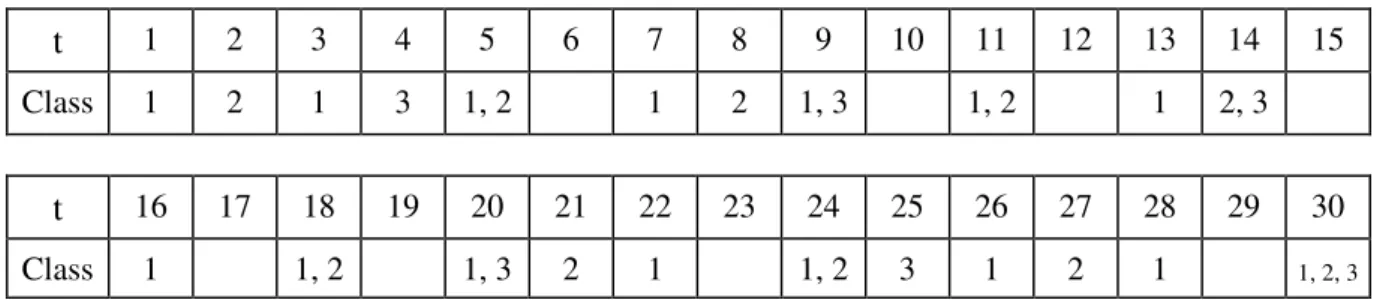
For illustration, consider a small example with only three product classes, named 1, 2 and 3, with interarrival times of 2, 3 and 5 time units at a certain station. The repetition cycle of class arrivals has a length of 30 time
units (i.e., the minimum-common-multiple between 2, 3 and 5), presented in table 1. The first row indicates the time unit t, t=1,...,30, and the second row lists the classes arriving at t. Observe that, despite of the simplicity of this example, it is not a trivial task to identify and memorize the repetition cycle of table 1. This phenomenon generates a perception of uncertainty at the station even if the sequence of class arrivals is perfectly predictable. A similar phenome-non occurs with random generators of
computers, which generate deterministic
sequences of numbers with long repetition cycles giving us the illusion of a pure random generation.
Table 1: Repetition cycle of class arrivals
t 1 2 3 4 5 6 7 8 9 10 11 12 13 14 15
Class 1 2 1 3 1, 2 1 2 1, 3 1, 2 1 2, 3
t 16 17 18 19 20 21 22 23 24 25 26 27 28 29 30
Class 1 1, 2 1, 3 2 1 1, 2 3 1 2 1 1, 2, 3
The Manufacturing System as a Queueing System
So far we have discussed the concepts of complexity, predictability and uncertainty of a manufacturing system, and remarked that uncertainty can be reduced in different ways. In order to assess the impact of reducing uncertainty we consider manufacturing systems that can be modeled as a queueing network. Consider the simple example of
one product class and one station depicted in figure 1 as a single-stage queueing system (the queue corresponds to the waiting line of products at the station). We want to analyze the effects of reducing uncertainty associ-ated with the product leadtime (queue time plus processing time).
product
arrivals station
queue
product departures
λ λ
Let A and S be two random variables representing, respectively, the product interarrival times and the service (or processing) times at the station. Denote by E(A) and E(S), and V(A) and V(S), their expected values and variances, respectively, and let λ=1/E(A) be the mean product arrival rate and µ=1/E(S) be the mean service rate at the station. We assume that the system is stable (i.e., λ<µ) and is in steady-state.
Consider initially that λ=0.5 and µ=1.0 products per hour; therefore the mean utilization at the station, defined as ρ=λ/µ, is equal to 0.5. If product interarrival times and processing times were deterministic and uniform (e.g., products arrive every 2 hours and are processed in 1 hour), we would never have waiting lines at the station. But
as the variances V(A) and V(S) increase, we expect longer and more frequent queues. Furthermore, as the mean product arrival rate increases, the mean utilization also increases and the queues become even longer and more frequent. For instance, if instead of λ=0.5 we have λ=0.95 products per hour, the mean utilization jumps to 0.95. Figure 2 illustrates the tradeoff curve
between the mean product leadtime and the mean utilization at the station. For simplic-ity, this curve was generated assuming that both the arrival and service processes are Poisson; therefore, the leadtime is defined as 1/[µ(1-ρ)] and is asymptotic in the limit as ρ tends to 1 (notice in the figure the leadtime jump from 2 to 20 hours as we increase the mean utilization from 0.5 to 0.95).
1 6 11 16 21 26
0 0,1 0,2 0,3 0,4 0,5 0,6 0,7 0,8 0,9 1
utilization
le
ad
ti
m
e
(0.50, 2) (0.51, 2.041)
(0.96, 25)
(0.95, 20)
Figure 2: Tradeoff curve between mean product leadtime and mean utilization, and impact of small perturbations
Impact of Small Perturbations
What is the sensitivity of the system to small perturbations? Perturbations may arise from unexpected tool failures, energy shortages, supply delays, etc., contributing to a small reduction in the mean processing
rate (capacity) of the system. Note that as the capacity is reduced, the mean utilization increases for the same arrival rate λ.
Consider the two mean utilization levels
ρ=0.95 (with leadtime equal to 20 hours) depicted in figure 2. Let ∆ be a small increment of utilization due to unexpected loss of capacity. What are the new leadtimes if these two utilization levels are incre-mented by, let’s say, ∆=0.01? The leadtime variation in the first case increases just 0.041 hours, but in the second case it increases 5 hours! Therefore, at high
utilization, a small perturbation caused by unexpected events can trigger a great crisis in the system. The physics of manufacturing systems is not different from the physics of a dynamic system: A broken car at 3:00 am and a broken car at 5:00 pm may cause much different traffic jams in the same tunnel.
1 6 11 16 21 26
0 0,1 0,2 0,3 0,4 0,5 0,6 0,7 0,8 0,9 1
utilization
le
ad
ti
m
e
curve 1
2
3
20
10.42
2.65
0.95
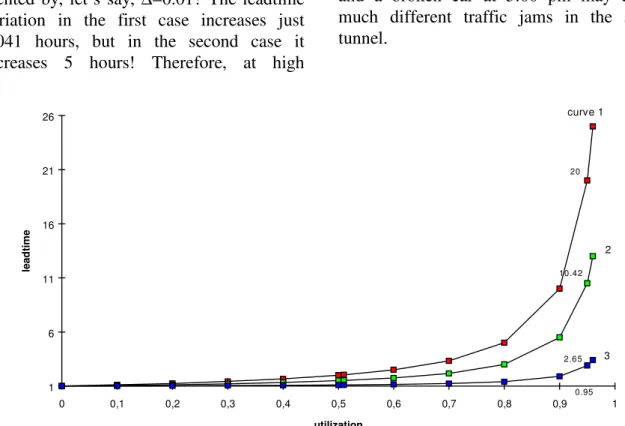
Figure 3: Impact of uncertainty reduction: Curve 1 (ca=1,cs=1), curve 2 (ca=0.5,cs=0.5) and curve 3 (ca=0.1,cs=0.1)
Impact of Uncertainty Reduction
Several manufacturing systems operate at high utilization levels due to high capacity acquisition costs. To illustrate, the break-even point of some semi-conductor factories
corresponds to a utilization higher than 0.7. Under the same utilization, one may reduce product leadtime without adding capacity by reducing the variability of the system.
Let’s consider again the example of figures 1 and 2. In order to manipulate a
dimensionless measure of variability, let us
denote by ca=V(A)/E(A)2 and cs=V(S)/E(S)2 the squared coefficient of variation, or simply the variability parame-ters, of A and S. Observe that ca and cs
correspond respectively to the external
(interarrival time) and internal (service time) variability at the station. The system in figure 1 can be approximately described with the 4 parameters: {λ, ca, µ, cs}, which are then used as input data to generate the curve of figure 2. Authors have shown that performance measure estimates based on these 4 parameters lead to good approxima-tions; see e.g. WHITT (1993) and BUZACOTT & SHANTHIKUMAR (1993).
figure 2. Figure 3 depicts three curves for different values of ca and cs and µ=1; these curves were generated based on Kraemer & Lagenbach-Belz’s formulae (WHITT, 1983). Curve 1 is the same curve of figure 2 with ca=1 and cs=1 (Poisson process), and curves 2 and 3 were generated with ca=0.5 and cs=0.5, and ca=0.1 and cs=0.1, respectively. Note that, for the same mean utilization
ρ=0.95, we obtain very different leadtimes as a function of system variability (leadtimes
of 20, 10.42 and 2.65 hours for curves 1, 2 and 3, respectively). In the limit as ca and cs tend to 0, the curve coincides with the horizontal axis, corresponding to a purely deterministic system with leadtime equal to the mean service rate E(S)=1 hour for all ρ, 0≤ρ<1. In this case we say that all system uncertainty was eliminated; note that this can be seen as a “perfect” JIT (just-in-time):
the limit state of a dynamic system when all variability is removed.
2.2 Knowledge of System Relationships
It is much easier to complicate a system than to simplify it. To simplify a system requires a profound understanding of its structure and relationships among its
components. The more we simplify a system the easier it is to understand it, hence creating a cycle that stimulates learning.
Queueing Network Systems
A manufacturing system is called discrete
if products are processed individually or in batches. A large portion of products are processed in discrete systems. These systems can often be modeled as open queueing networks, where nodes represent
the stations and arcs represent the product flows between stations (figure 4). If the
product arrival process and/or the service process at the stations are stochastic, we may have waiting lines of products in front of the stations. In general queueing network systems are complex (i.e., poorly predict-able) and the ideal is to simplify them, or if possible avoid them.
Figure 4: Open queueing network system
In many cases, however, queueing net-work systems can not be avoided, and several performance measures should be evaluated in order to analyze them. Exam-ples of these measures are work-in-process
(WIP), product leadtimes, number of finished products on time, capacity
parameters, we can utilize tradeoff curves
similar to those of figures 2 and 3. These curves (to be discussed in the following
sections) can be used to analyze strategic objectives as a function of the investment required.
3. Tradeoff Curve Generation
very manufacturing system has a
signature describing the most
effec-tive way of allocating or removing its resources. As we mentioned earlier, we say that tradeoff curves are the signature of the system. They depict the relationship
among performance measures at each station and for the whole network. For example, the curves presented in figures 2 and 3 relate to only one station and describe the tradeoff between the mean product leadtime and the mean capacity utilization at the station.
In this section we discuss how to generate tradeoff curves among performance measures, in particular, between the resources and the WIP of the network (this
methodology can be easily extended to other performance measures, such as product leadtimes). For convenience, the resources are measured by a cost function of capacity defined below. In section 3.1 we discuss how to evaluate network performance measures; our focus is on WIP. In sections 3.2 and 3.3 we discuss respectively how to minimize network WIP without adding resources to the system and how to mini-mize the resources without changing network WIP. As we will see, the solutions to these problems correspond to points on the tradeoff curve. Finally in section 3.4 we discuss how to use these results to generate the remaining points on the curve.
3.1 Performance Measures Evaluation
Performance measures for open queueing networks can be evaluated by applying the so called decomposition method described below. This method computes performance measures assuming that the network is in equilibrium or steady-state. Consider that
the following input data are given:
λ’k mean external arrival rate of product class k
ca’k squared coefficient of variation of external interarrival times of product class k
nkl station that produces the l-th opera-tion in the routing of class k
r number of product classes
nk number of operations in the routing of class k
µj mean processing rate (or capacity) at station j
csj squared coefficient of variation of the processing times at station j n number of stations in the network.
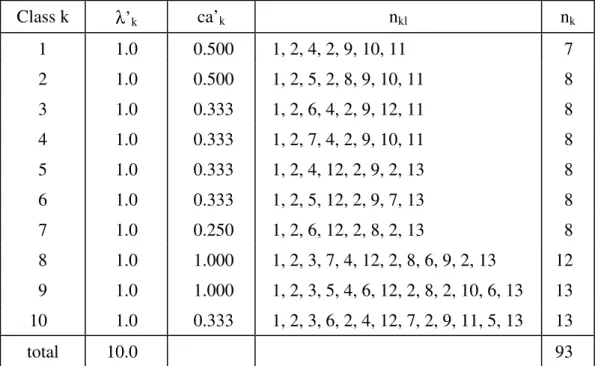
Tables 2 and 3 present these parameters for a manufacturing network example with 10 product classes and 13 stations. They are derived from a real example of a semi-conductor factory and was analyzed in BITRAN & TIRUPATI (1989b). For simplicity, we consider each station j as a single machine with mean processing rate µj. In section 6 we make some comments of how to extend this discussion and consider each station as a set of machines. In addition to the parameters above, table 3 also presents the parameters vj, aj and bj to be defined below. Note that the network
throughput (or mean production rate),
defined as the sum of all class arrival rates, is equal to 10 products per time unit (see table 2) (recall that all measures are evaluated assuming that the system is in steady-state).
Table 2: Input data for the product classes of the network example
Class k λ’k ca’k nkl nk
1 1.0 0.500 1, 2, 4, 2, 9, 10, 11 7
2 1.0 0.500 1, 2, 5, 2, 8, 9, 10, 11 8
3 1.0 0.333 1, 2, 6, 4, 2, 9, 12, 11 8
4 1.0 0.333 1, 2, 7, 4, 2, 9, 10, 11 8
5 1.0 0.333 1, 2, 4, 12, 2, 9, 2, 13 8
6 1.0 0.333 1, 2, 5, 12, 2, 9, 7, 13 8
7 1.0 0.250 1, 2, 6, 12, 2, 8, 2, 13 8
8 1.0 1.000 1, 2, 3, 7, 4, 12, 2, 8, 6, 9, 2, 13 12 9 1.0 1.000 1, 2, 3, 5, 4, 6, 12, 2, 8, 2, 10, 6, 13 13 10 1.0 0.333 1, 2, 3, 6, 2, 4, 12, 7, 2, 9, 11, 5, 13 13
total 10.0 93
Table 3: Input data for the stations of the network example
Station j µj csj vj aj bj
1 13.004 0.500 100 5.68 -51.69
2 27.778 0.250 1612 2.59 -50.40
3 3.160 0.333 733 74.77 -165.40
4 10.000 0.500 1052 6.93 -48.53
5 5.631 0.333 912 12.62 -49.73
6 9.225 0.250 1683 7.51 -48.54
7 5.999 1.000 1662 11.11 -46.67
8 4.500 0.333 1812 27.66 -87.11
9 10.000 0.333 1730 7.47 -52.27
10 5.711 0.333 1600 15.34 -61.30
11 5.441 0.333 1882 27.03 -102.94
12 7.440 0.500 1486 13.01 -67.74
13 7.502 0.500 3250 14.22 -74.67
total 115.391
The decomposition method involves basically three steps. In the first step all products are aggregated into a single class,
called the aggregate class, and its flow is
station j from the initial parameters, where
λj and caj denote respectively the mean product arrival rate and the squared coeffi-cient of variation of product interarrival times at station j. These parameters are estimated considering the interference among product classes at the stations. In the second step performance measures of the aggregate class are evaluated for each station, analyzed as a single queueing system. Finally in the third step performance measures are evaluated for the network and
for each product class by decomposing the aggregate class. For more details of the decomposition method, the readers are referred to BUZACOTT & SHANTHIKUMAR (1981), WHITT (1983, 1994), BITRAN & TIRUPATI (1988), and BITRAN & MORÁBITO (1994, 1995b). Table 4 presents the parameters λj and caj computed for the network example of tables 2 and 3 (the remaining columns of table 4 are defined below).
Table 4: Parameters and performance measures of the network example
Station j λj caj ρj Lj Wj Fj
1 10.0 0.492 0.769 1.974 197.377 288.325
2 25.0 0.601 0.900 4.298 6929.058 598.457
3 3.0 0.760 0.949 10.694 7838.522 223.823
4 7.0 0.608 0.700 1.569 1650.825 207.700
5 4.0 0.613 0.710 1.500 1367.930 120.093
6 6.0 0.583 0.650 1.118 1881.392 191.332
7 4.0 0.619 0.667 1.715 2850.717 119.836
8 4.0 0.665 0.889 4.403 7979.090 168.193
9 8.0 0.642 0.800 2.327 4025.622 224.300
10 4.0 0.662 0.700 1.489 2382.308 150.240
11 5.0 0.684 0.919 6.194 11656.346 240.055
12 7.0 0.614 0.941 9.226 13709.098 216.225
13 6.0 0.677 0.800 2.653 8620.970 240.110
total 49.160 71089.253 2988.689
We estimate performance measures for each station j by substituting the 4 parame-ters {λj, caj, µj, csj} into the formulas of queueing theory. For example, the mean utilization at station j, defined as ρj=λj/µj, can be easily calculated substituting λj and
µj. We can also calculate the WIP (in monetary value) at station j, defined as:
Wj = vj Lj(λj, caj, µj, csj) (1)
where vj is a unit monetary value of an arbitrary product at station j, and Lj(λj, caj,
ALBIN (1986)). Obviously, if vj=1 then Wj corresponds to the mean number of products at station j. Each value Lj(λj, caj, µj, csj) can be estimated by the Kraemer & Lagenbach-Belz’s formulae (WHITT, 1983).
Table 3 presents the values of vj and table 4, the computed values of the mean number of products, the WIP, and the mean utiliza-tion at each stautiliza-tion j of the network exam-ple. Adding the WIP of all stations, we obtain the network WIP, equal to 71089 (see table 4).
Another useful performance measure is the value of the resources utilized in the system, which can be measured by the cost of capacity acquisition (or capacity invest-ment). This cost is a function of the capacity at each station j, µj. An example of such a cost function is:
Fj(µj) = aj µj2 + bj µj + cj (2) where aj, bj and cj are known coefficients. We are assuming that it is possible to add capacity to station j with amounts small enough to consider µj as a continuous variable. In section 5 we analyze the more general case where capacity changes are limited to a finite set of discrete alternatives.
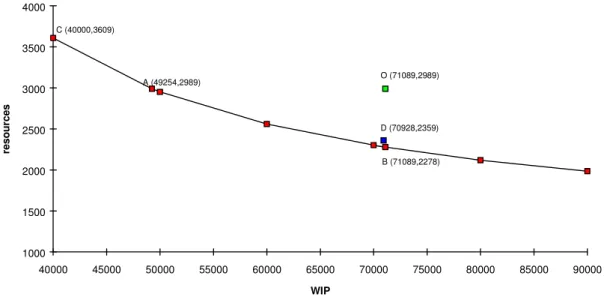
Table 3 presents the values of aj and bj for each station of the network example (for simplicity, we assume that cj=0). Adding the capacity cost of all stations, we obtain the network resources. Table 4 presents these values utilizing the data of table 3. Note that the WIP value 71089 and the resource value 2989 define the point O depicted in figure 5.
1000 1500 2000 2500 3000 3500 4000
40000 45000 50000 55000 60000 65000 70000 75000 80000 85000 90000
WIP
re
so
u
rc
es
O (71089,2989) A (49254,2989)
B (71089,2278) C (40000,3609)
D (70928,2359)
Figure 5: Points O, A, B, C, D and efficient frontier
For convenience, we assume that the network capacity is homogeneous and interchangeable among stations. An
example is a trained labor-force that can be transferred from one station to another. The
algorithms discussed below can also be applied when the capacity of a station is not transferable to all other stations. At the end of this section we discuss this more general case.
3.2 Efficient Redistribution of Resources
Let us assume that the system is at point O (71089, 2989). Considering the data of tables 2 and 3, we can formulate the
words, is it possible to redistribute the resources of 2989 (by interchanging capacity among stations) such that the network WIP is reduced? And if this reduction is possible, what is the redistribution that leads to the minimum network WIP?
The optimal resource redistribution problem can be solved by an exact iterative
algorithm proposed in BITRAN & SARKAR (1994b). This algorithm, here called algorithm 1, starts from the input data
of tables 2 and 3 and solves a convex program at each iteration. In spite of utilizing this algorithm in this present paper,
we will not describe it in more details; its complete description can be found in BITRAN & SARKAR (1994b) and BITRAN & MORÁBITO (1995a).
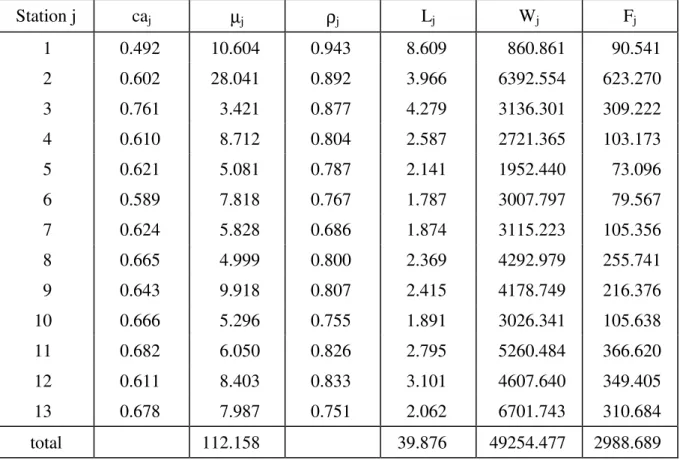
Applying algorithm 1 to the network example, we obtain point A (49254, 2989) depicted in figure 5. Table 5 presents the final values of caj, µj, ρj, Lj, Wj and Fj for each station. Note that the values of caj in tables 4 (point O) and 5 (point A) are almost the same in spite of the capacity changes at stations.
Table 5: Parameters and performance measures relative to point A
Station j caj µj ρj Lj Wj Fj
1 0.492 10.604 0.943 8.609 860.861 90.541
2 0.602 28.041 0.892 3.966 6392.554 623.270
3 0.761 3.421 0.877 4.279 3136.301 309.222
4 0.610 8.712 0.804 2.587 2721.365 103.173
5 0.621 5.081 0.787 2.141 1952.440 73.096
6 0.589 7.818 0.767 1.787 3007.797 79.567
7 0.624 5.828 0.686 1.874 3115.223 105.356
8 0.665 4.999 0.800 2.369 4292.979 255.741
9 0.643 9.918 0.807 2.415 4178.749 216.376
10 0.666 5.296 0.755 1.891 3026.341 105.638
11 0.682 6.050 0.826 2.795 5260.484 366.620
12 0.611 8.403 0.833 3.101 4607.640 349.405
13 0.678 7.987 0.751 2.062 6701.743 310.684
total 112.158 39.876 49254.477 2988.689
Point A indicates that we can substan-tially improve performance (i.e., reduce the network WIP from 71089 to 49254) without changing the resources (2989). This reduction is obtained by appropriately redistributing the resources among stations (compare tables 4 and 5); it does not imply
0 100 200 300 400 500 600 700
1 2 3 4 5 6 7 8 9 10 11 12 13
stations
re
so
u
rc
es
Point O (71089,2989)
Point A (49254,2989) Series2
Series1
Figure 6: Resources for each station at points O and A
0 2000 4000 6000 8000 10000 12000 14000
1 2 3 4 5 6 7 8 9 10 11 12 13
stations
W
IP
Point O (71089,2989)
Point A (49254,2989) Series2
Series1
0 0,1 0,2 0,3 0,4 0,5 0,6 0,7 0,8 0,9 1
1 2 3 4 5 6 7 8 9 10 11 12 13
stations
u
ti
liz
at
io
n
Point O Point A Series2 Series1
Figure 8: Utilization for each station at points O and A
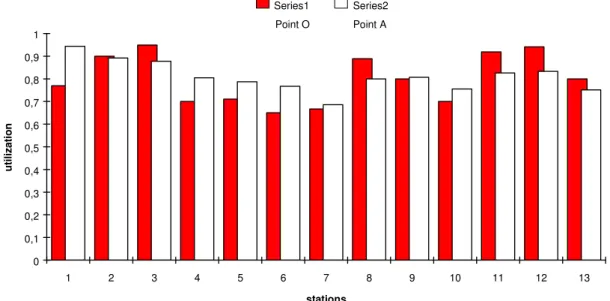
As we move the system from point O to point A, we must “sell” capacity of stations 1, 4, 5, 6, 7, 9 and 10 in order to “buy” capacity for stations 2, 3, 8, 11, 12 and 13. Although the network capacity at point O, 115.4, is different of the network capacity at point A, 112.2 (compare tables 3 and 5), their cost are exactly the same: 2989. Figure 7 shows the impact of capacity change on the WIP of each station. Note that the WIP increases a little at stations 1, 4, 5, 6, 7, 9
and 10, but decreases substantially at stations 3, 8, 11 and 12.
Figure 8 compares the mean utilization at the stations of points O and A. Stations 3, 8, 11 and 12, with high utilization at point O, had their utilization reduced at point A. On the other hand, station 1 had its utilization substantially increased at point A (from 0.769 to 0.943); however, the effect on network WIP is not so large (from 197 to 861) since v1 is small compared to other stations (see table 3 and figure 7).
3.3 Efficient Redistribution of WIP
Let’s assume that the system is again at point O (71089, 2989). Considering the data of tables 2 and 3, we can formulate the following (second) question: Is it possible to reduce the network resources to under 2989 without changing the network WIP of 71089? In other words, is it possible to redistribute the WIP of 71089 (by inter-changing capacity among stations) such that the necessary network resources are reduced? And if this reduction is possible, what is the redistribution that leads to the minimum value of network resources?
The optimal WIP redistribution problem
can be solved by an exact iterative
rithm, similar to algorithm 1. This algo-rithm, here called algorithm 2, solves a
convex program at each iteration and is described in details in BITRAN & MORÁBITO (1995a).
Table 6: Parameters and performance measures relative to point B
Station j caj µj ρj Lj Wj Fj
1 0.492 10.390 0.962 13.114 1311.434 76.112
2 0.598 26.978 0.927 5.841 9415.943 525.354
3 0.760 3.275 0.916 6.355 4658.410 260.353
4 0.607 8.143 0.860 3.730 3923.519 64.327
5 0.616 4.720 0.847 3.039 2772.018 46.459
6 0.581 7.215 0.832 2.489 4189.145 40.719
7 0.617 5.255 0.761 2.686 4463.872 61.536
8 0.657 4.660 0.858 3.402 6163.572 194.739
9 0.638 9.270 0.863 3.465 5994.499 157.403
10 0.657 4.868 0.822 2.664 4262.773 65.111
11 0.672 5.690 0.879 4.047 7616.165 289.389
12 0.604 7.923 0.884 4.537 6741.802 279.960
13 0.668 7.330 0.819 2.946 9576.101 216.651
total 105.717 58.315 71089.253 2278.113
Point B indicates that we can reduce the network resources from 2989 to 2278 without changing the network WIP of 71089 (compare tables 4 and 6). Similarly to the efficient redistribution of resources, the
efficient redistribution of WIP does not imply a process, technology, or throughput change. Figure 9 presents for each station the WIP obtained before (point O) and after (point B) the redistribution.
0 2000 4000 6000 8000 10000 12000 14000
1 2 3 4 5 6 7 8 9 10 11 12 13
stations
W
IP
Point O (71089,2989)
Point B (71089,2278) Series2
Series1
0 100 200 300 400 500 600
1 2 3 4 5 6 7 8 9 10 11 12 13
stations
re
so
u
rc
es
Point O (71089,2989)
Point B (71089,2278) Series2
Series1
Figure 10: Resources for each station at points O and B
0 0,1 0,2 0,3 0,4 0,5 0,6 0,7 0,8 0,9 1
1 2 3 4 5 6 7 8 9 10 11 12 13
stations
u
ti
liz
at
io
n
Point O Point B Series2 Series1
Figure 11: Utilization for each station at points O and B
As we move the system state from point O to point B, we “transfer” WIP from stations 3, 8, 11 and 12 to other stations (compare points O and B in figure 9). This transfer is obtained by appropriately interchanging capacity between stations such that the network WIP of 71089 is maintained. Figure 10 illustrates the
3.4 Efficient Frontier
Algorithms 1 and 2 move the system to a point on the tradeoff curve depicted in figure 5 (recall that points A and B belong to the curve). Algorithm 1 moves the system from point O to point A by efficiently redistribut-ing the resources of point O, while algo-rithm 2 moves the system from point O to point B by efficiently redistributing the WIP of point O. The remaining points on the curve can also be obtained applying algorithms 1 and 2 for arbitrary values of network resources and WIP. In particular, the curve of figure 5 was traced applying algorithm 2 to the network WIP values 40000, 50000, ..., 90000 indicated in the figure (see the corresponding dots in the figure that originated the curve).
Alternatively, this curve can also be generated with less computational effort using a heuristic algorithm proposed in BITRAN & TIRUPATI (1989a). The algorithm assumes that the system is at a point on the curve, and employs a simple and intuitive greedy heuristic to find the
remaining points. This procedure is illustrated in the following example: Consider that we want to add 100 labor hours of capacity to the stations of a network. For simplicity, assume that the cost of adding 1 hour to any station is constant, let’s say $1 (and hence, allocating 100 hours is equivalent to allocating $100 to the network). The question is: How should we
distribute this extra capacity to the stations such that the network WIP is minimized?
Given that we can add capacity to the stations in small quantities, let’s partition these 100 hours in sufficiently small increments and add them, one after another, according to the following greedy rule: The
next increment is added to the station that results in the largest reduction of the network WIP, and so on, until all increments have been added to the network. The smaller the increments, the more accurate is the solution generated by this procedure. The complete description of the heuristic algorithm can be found in BITRAN & TIRUPATI (1989a), and BITRAN & MORÁBITO (1994, 1995c).
The tradeoff curve of figure 5 defines an
efficient frontier, that is, the minimum
resource value necessary to produce each WIP or, equivalently, the minimum WIP produced by each value of resources. Let’s take for example point A (49254, 2989) and consider that, according to the competitive strategy, the system should operate with a WIP less than or equal to 40000. What is the minimum resource requirement to reduce the WIP from 49254 to 40000? As we travel through the points on the curve to the left of point A, we find point C (40000, 3609). Hence, the system needs an additional capacity investment of 620 (3609-2989).
Heterogeneous and Non-Interchangeable Capacity
So far we have assumed that the network capacity is homogeneous and totally interchangeable between stations. Algo-rithms 1 and 2 can also be applied when part of the capacity µj at station j is not inter-changeable; in this case it is enough to impose a lower bound on the variable µj. The more general case where capacity need not be homogeneous nor interchangeable involves additional considerations. If the unit cost of “selling” capacity (i.e., removing
In the next section we assume that the efficient redistribution of resources (or WIP) has been done and the system state is at a certain point on the curve of figure 5, let us say at point A (49254, 2989). In the preceding discussion we have shown that, starting from a point on the curve, we can
reduce WIP by adding capacity to the network. In the sequel we discuss other alternatives to reduce WIP, such as uncer-tainty reduction. The next tradeoff curves to be presented were also generated with algorithms 1 and 2.
4. Changing the Variability Parameters, Throughput and Product Mix
he tradeoff curve of figure 5 was generated with the data of tables 2 and 3, where the variability parame-ters (i.e., the ca’k for all product classes and the csj for all stations), the throughput and the product mix remained fixed. We varied the capacity µj at each
station and consequently, we varied the resources, the WIP and the mean utilization at each station. In this section we analyze what happens to that tradeoff curve as we change the variability parameters, the throughput and the product mix of the network.
4.1 Changing the Variability Parameters
In figure 3 we show that as we reduce the variability parameters ca and cs of a single-stage queueing system, we obtain “flatter” tradeoff curves between the mean utilization and the product leadtime at the station. In the limit as ca and cs tend to 0, every variability is eliminated, the curve tends to the horizontal axis, and the product leadtime tends to the expected value of the processing time at the station, E(S). We can also extend this observation to queueing network systems. As we reduce the variability parameters ca’k, k=1,...,r, and csj, j=1,...,n, we expect the same flattening effect of the tradeoff curves between network resources and WIP.
We may reduce the variability parame-ters, for example, by working closer with
suppliers, investing in labor training, and process improvement. In this way we expect to obtain lower WIP levels without addi-tional capacity investments. An immediate question is: Under what conditions uncer-tainty reduction produces better performance (e.g. lower WIP levels) than simply investing in capacity expansion?
Figure 12 presents the tradeoff curve of figure 5 (curve 1) next to three other curves generated with smaller values of ca’k and csj. In the first (curve 2) we reduce by half all ca’k values of table 2, in the second (curve 3) we reduce by half all csj values of table 3, and in the third (curve 4) we reduce by half all ca’k and csj values.
2000 2500 3000 3500 4000 4500 5000
30000 35000 40000 45000 50000 55000 60000
WIP
re
so
u
rc
es
A
B1 B2
B3 A3
C1
C2
C3
curve 1 2 3 4
Figure 12: Changing the variability parameters: Curve 1 (ca’k,csj), curve 2 (ca’k/2,csj),
curve 3 (ca’k,csj/2) and curve 4 (ca’k/2,csj/2)
10000 20000 30000 40000 50000 60000 70000 80000 90000
5000 6000 7000 8000 9000 10000 11000 12000 13000 14000 15000
WIP
re
so
u
rc
es
. curve 2
curve 3
Figure 13: Variability parameter changes for small WIP values: Curve 2 (ca’k/2,csj) and
curve 3 (ca’k,csj/2)
Starting from point A (49254, 2989), the points B1 (45584, 2989), B2 (40645, 2989) and B3 (36948, 2989) can be obtained with algorithm 1, and the points C1 (49254, 2803), C2 (49254, 2537) and C3 (49254, 2351) with algorithm 2. Consider that the system is originally at point A and let’s take, for example, the curve 4. Define V as the required investment to reduce by half all
of figure 12 at hand, we can now measure the tradeoff between investing in capacity
versus investing in variability reduction.
Curve 4 is flatter than curve 3, which is flatter than curve 2, which is flatter than curve 1. For high utilization levels, the effect of reducing csj is more sensible than that of reducing ca’k (compare curves 2 and 3). Nevertheless, we expect the inverse for
low utilization. In order to illustrate this effect, figure 13 presents curves 2 and 3 for small WIP values (much less than 30000) and hence, low utilization at stations. Note that for WIP values less than the crossing point between curves 2 and 3, the effect of reducing ca’k becomes more sensible than that of reducing csj.
Technology Substitution
As we have seen, utilizing the tradeoff curves of figure 12 we can assess the tradeoff between adding capacity and investing in uncertainty reduction, without changing neither the technology, the throughput, nor the product mix of the network. Now let’s assume that we have an alternative technology that allows us to produce the same mix of products at the same throughput rate. Figure 14 depicts its
hypotethical curve (curve 5) together with the curves of the current technology (curve 1) and the current technology with uncer-tainty reduction (curve 4). These two last ones correspond respectively to the curves 1 and 4 of figure 12. Note that now we have a new tradeoff analysis: the tradeoff between buying this substitute technology versus
investing in uncertainty reduction in the current system.
1500 2000 2500 3000 3500 4000 4500 5000
30000 35000 40000 45000 50000 55000 60000
stations
re
so
u
rc
es
A
C3 B3
A3
curve 1
4
5
Figure 14: Tradeoff between uncertainty reduction and technology changing: Curve 1 (ca’k,csj), curve 4 (ca’k/2,csj/2) and curve 5 (new technology)
4.2 Changing the Throughput
The tradeoff curves also help the analysis of throughput changing in the network. Figure 15 presents curve 1 of figure 5, together with two other curves generated by varying the original network throughput,
unit), and in the second (curve 3), we increase them by 10% (11 products per time unit). Note in the figure that curve 2 is flatter than curve 1, while curve 1 is flatter
than curve 3. The throughput variation apparently translates the curve and the
smaller the throughput, the flatter is the curve.
1000 2000 3000 4000 5000 6000 7000 8000 9000 10000 11000
20000 25000 30000 35000 40000 45000 50000 55000 60000
WIP
re
so
u
rc
es
A
curve 1
2 3
C1 C2
B1
Figure 15: Changing the throughput: Curve 1 (10 products/hour), curve 2 (9 products/hour) and curve 3 (11 products/hour)
Starting at point A (49254, 2989), we obtain points B1 (32079, 2989) and B2 (98107, 2989) (the latter does not appear in figure 15) with algorithm 1, and points C1 (49254, 1798) and C2 (49254, 4378) with algorithm 2. Consider again that the system is at point A and take, for example, curve 3.
Note that it is unlikely that the system will survive the 10% growth of the throughput without additional resources (point B2). However, even a 50% increase of the current resources is not sufficient to maintain the same WIP level of point A (point C2).
4.3 Changing the Product Mix
The effects of changes in the product mix, such as removing old products, modifying the proportion among products, including new products, can also be analyzed with the tradeoff curves. Figure 16 presents curve 1 of figure 5, together with three other curves generated by modifying the product mix. In the first (curve 2) we
eliminate product class 1 (i.e., λ1=0), in the second (curve 3) we duplicate the mean arrival rate of product class 1 (i.e., λ1=2), and in the third (curve 4) we introduce a new product class (class 11) with the same mean arrival rate of class 1 (i.e., λ11=1) but with a very different routing. Table 7 presents the input data for product class 11. Table 7: Input data of product class 11
Class k λ’k ca’k nkl nk
Note that curve 2 corresponds to a throughput of 9 products per time unit, while curves 3 and 4 to a throughput of 11 products per time unit. Curve 2 is flatter than curve 1, whereas curve 1 is flatter than curves 3 and 4. This result is consistent with our discussion of throughput changing in section 4.2. However, curve 3 is flatter than curve 4 in spite of having the same
through-put (recall that in curve 3 we duplicate the mean arrival rate of class 1 and in curve 4 we introduce class 11 with the same mean arrival rate, variability parameter and number of operations of class 1). This shows that, in this example, the routing of class 11 produces higher WIP than the routing of class 1.
1000 2000 3000 4000 5000 6000 7000
30000 35000 40000 45000 50000 55000 60000
WIP
re
so
u
rc
es
A
curve 1
2 3 4
B1
C1 C2 C3
Figure 16: Changing the product mix: Curve 1 (original curve), curve 2 (class 1 deleted), curve 3 (class 1 duplicated) and curve 4 (class 11 added)
Starting at point A (49254, 2989), we obtain points B1 (36607, 2989), B2 (77768, 2989) and B3 (103211, 2989) (points B2 and B3 do not appear in figure 16) with algorithm 1, and points C1 (49254, 2184), C2 (49254, 3973) and C3 (49254, 4435) with algorithm 2. Note that if we eliminate product class 1, we reduce the mean utilization of the original network, and the effect on network WIP corresponds to the
horizontal distance between points A and B1. On the other hand, if we duplicate product class 1 or introduce product class 11, we raise the mean capacity utilization, yielding to a substantial increase in the network WIP, as shown by points B2 and B3. Similar results were found in section 4.2 as we increased by 10% the throughput of the network (compare figures 15 and 16).
5. Discrete Alternatives for Capacity Changes
n sections 3 and 4 we have assumed that capacity can be added or removed from each station by amounts small enough to consider the total capacity at the station,
µj, as a continuous variable. This is not
always valid. In this section we briefly analyze the more general case where capacity changes at each station is limited to a finite set of discrete alternatives. In a previous paper, BITRAN & TIRUPATI
(1989b) presented a heuristic algorithm that considers capacity at each station as a discrete variable. The algorithm utilized in this section, here named algorithm 3, is an
extension of that algorithm. Basically it is an iterative algorithm that, at each iteration, solves an integer linear program and updates the variability parameters; for a complete description of algorithm 3 the readers are referred to BITRAN & MORÁBITO (1995a).
Consider that, instead of choosing any value for the capacity µj, we are limited to a finite set of nj discrete alternatives at each station j. This set is described by the vector {µj1, µj2, ..., µj,nj}, where µji denotes the capacity at station j under alternative i and satisfies µji>λj for all i. Table 8 presents a set with 5 possible capacity alternatives for each station of the network example. Note that the first alternative corresponds to point O of figure 5 (compare to table 3).
Table 8: Five discrete alternatives for capacity changes at each station
Station j 1 2 3 4 5
1 13.004 10.5 11.0 14.0 15.0
2 27.778 26.0 27.0 28.0 30.0
3 3.160 3.5 3.5 4.0 4.5
4 10.000 7.5 8.0 9.0 11.0
5 5.631 4.5 4.7 5.0 6.0
6 9.225 6.5 7.0 9.0 12.0
7 5.999 5.0 5.5 6.0 6.5
8 4.500 4.5 5.0 5.5 6.0
9 10.000 8.5 9.0 10.0 11.0
10 5.711 4.5 4.7 5.0 6.0
11 5.441 5.3 5.6 5.9 6.0
12 7.440 7.5 8.0 8.5 9.0
13 7.502 6.5 7.0 7.5 8.0
total 115.391
Each alternative i, i=1,...,nj, requires the resource level Fji(µji) at station j, defined similarly to expression (2) as:
Fji(µji) = aj µji2 + bj µji + cj
Note that for each alternative we can calculate the resource requirements at the station. After choosing a capacity alternative for each station j, we may apply the decomposition method (section 3.1) to
obtain the 4 parameters {λj, caj, µj, csj}. Let us assume that we chose alternative i at station j (i.e., µj=µji) and so, we obtain {λj, caj, µji, csj}. Using these parameters we can also calculate the WIP at station j under alternative i, Wji, defined similarly to expression (1) as:
Wji = vj Lji(λj, caj, µji, csj)
Lji(λj, caj, µji, csj) is the mean number of products (in queue and in processing) at station j under alternative i. Lji can be calculated in the same way as Lj in expres-sion (1). Note that, once we have chosen an alternative at each station, we may obtain the WIP for each station and for the whole network. We can use algorithm 3 mentioned above to search for the best capacity choice at the stations.
Applying algorithm 3 to the network example of the previous sections (with the 5 available alternatives of table 8), we obtain point D (70927, 2359) indicated in figure 5 and presented in table 9. Note that the algorithm selected different alternatives for the stations (see the second column of the table). The columns caji, µji, ρji, and so on, indicate the parameters and performance measures at station j under alternative i relative to point D.
Table 9: Parameters and performance measures of point D
Station j Alt. i caji µji ρji Lji Wji Fji
1 2 0.492 10.500 0.952 10.315 1031.498 83.475
2 3 0.598 27.000 0.926 5.782 9321.135 527.310
3 2 0.760 3.500 0.857 3.652 2676.847 337.032
4 3 0.610 8.000 0.875 4.229 4448.631 55.280
5 4 0.619 5.000 0.800 2.285 2084.087 66.850
6 3 0.584 7.000 0.857 2.954 4971.318 28.210
7 3 0.622 5.500 0.727 2.266 3765.365 79.392
8 1 0.660 4.500 0.889 4.386 7947.184 168.120
9 3 0.637 9.000 0.889 4.300 7438.939 134.640
10 4 0.654 5.000 0.800 2.348 3756.943 77.000
11 3 0.671 5.600 0.893 4.597 8651.750 271.197
12 3 0.606 8.000 0.875 4.216 6265.355 290.720
13 4 0.666 7.500 0.800 2.637 8568.902 239.850
total 106.100 53.967 70927.955 2359.077
Note that the caj values at point D, as well as at point B, are very close to the caj values at point O (compare tables 4, 6 and 9). The value of the required resources at point B, 2278, becomes a lower bound on the value of the required resources at point D (equal to 2359).
Similarly to algorithm 2, we can also apply algorithm 3 to trace the efficient frontier of the problem with discrete alternatives for capacity changes. Naturally this efficient frontier now is not defined as a continuous curve anymore, but as a set of discrete points.
n sections 3, 4 and 5 we defined the capacity at each station as the mean processing rate µj. We considered each station j as a “single machine”, or a set of machines, operators, tools, etc., that can be approximated by a single machine with mean processing rate µj. This approximation is not always reasonable. We may have situations where we must describe the capacity at each station as a set of machines, each one with a given mean processing rate.
In the case where we have identical ma-chines at each station (i.e., with the same mean processing rate), algorithms very similar to algorithms 1, 2 and 3 can be applied. Such algorithms consider the
decision variable at each station as the number of machines, instead of the mean processing rate. Furthermore, performance measures such as the WIP defined in expression (1) must be redefined according to the multi-machine formulas of queueing theory. For more details of these algorithms, see e.g. BOXMA et al (1990), VAN VLIET & RINNOOY KAN (1991), BITRAN & TIRUPATI (1989b), and BITRAN & MORÁBITO (1994, 1995c).
The more general case when we may have distinct machines at the same station involves additional difficulties, and is a topic for future research.
7. Conclusions
n this paper we emphasized the applica-tion of tradeoff curves to the analysis of
discrete manufacturing systems. Initially we discussed the importance of reducing uncertainty and understanding system relationships. We presented the manufactur-ing environment as a dynamic system, and modeled it as an open queueing network.
In order to generate tradeoff curves be-tween network WIP and resources, we solved optimization problems of these measures applying algorithms known in the literature. To illustrate we presented several tradeoff curves for a manufacturing network
example of a semi-conductor factory, and used them to analyze the effects of uncer-tainty reduction, throughput variation and product mix changes.
Tradeoff curves describe the relationship between performance measures, and can be effectively used to analyze strategic objectives as a function of the resources required to meet specific goals. Therefore, we can design a new manufacturing system or redesign an existing one in such a way to reflect our decision of how to compete in the market.
Acknowledgments
The authors would like to thank Luis A. C. Pedrosa of the Sloan School of Management and the three referees for their helpful
comments. This research was partially supported by a post-doctoral fellowship from FAPESP (grant #93/0891-7).
References:
I
ALBIN, S.L.: “Delays for customers from different
arrival streams to a queue”. Mgmt. Sci. 32,
329-340, 1986.
BITRAN, G.R. & DASU, S: “A review of open queueing network models of manufacturing
systems”. Queueing Syst. 12, 95-134, 1992.
BITRAN, G.R. & MORÁBITO, R.: “Open queueing networks: Optimization and perform-ance evaluation models for discrete manufacturing
systems”. WP#3742-94, Sloan School of
Man-agement, MIT, 45p., 1994 (to appear in Produc-tion and OperaProduc-tions Management).
BITRAN, G.R. & MORÁBITO, R.: “Manufacturing systems design: Tradeoff curve analysis”.
WP#3805-95, Sloan School of Management,
MIT, 33p., 1995a (submitted to Production and
Operations Management).
BITRAN, G.R. & MORÁBITO, R.: “Um exame dos modelos de redes de filas abertas aplicados a sistemas de manufatura discretos: Parte 1”.
Gestão & Produção 2(2), 109-220, 1995b. BITRAN, G.R. & MORÁBITO, R.: “Um exame
dos modelos de redes de filas abertas aplicados a sistemas de manufatura discretos: Parte 2”.
Gestão & Produção 2(3), 297-320, 1995c. BITRAN, G.R. & SARKAR, D.: “Targeting
problems in manufacturing queueing networks -
An iterative scheme and convergence”. EJOR 76,
501-510, 1994a.
BITRAN, G.R. & SARKAR, D.: “Focused factory design: Complexity, capacity and inventory
tradeoffs”. Technical Memorandum, AT&T Bell
Lab., 36p., 1994b.
BITRAN, G.R. & TIRUPATI, D.: “Multiproduct queueing networks with deterministic routing: Decomposition approach and the notion of
interference”. Mgmt. Sci. 34(1), 75-100, 1988.
BITRAN, G.R. & TIRUPATI, D.: “Tradeoff curves, targeting and balancing in manufacturing
queue-ing networks”. Oper. Res. 37, 547-564, 1989a.
BITRAN, G.R. & TIRUPATI, D.: “Capacity planning in manufacturing networks with discrete
options”. Annals of Oper. Res. 17,
119-136,1989b.
BOXMA, O.J.; RINNOOY KAN, A.; VAN VLIET, M.: “Machine allocation problems in
manufacturing networks”. EJOR 45, 47-54, 1990.
BUZACOTT, J.A. & SHANTHIKUMAR, J.G.: Stochastic models of manufacturing systems,
Prentice-Hall, Englewood Cliffs, NJ, 1993.
HSU, L.F.; TAPIERO, C.S.; LIN, C.: “Network of queues modeling in flexible manufacturing
systems: A survey”. RAIRO 27(2), 201-248, 1993.
KRAJEWSKI, L.J. & RITZMAN, P.L.: Operations management: Strategy and analysis, 2nd.ed.,
Addison-Wesley, Reading, MA, 1990.
KUSIAK, A.: Intelligent manufacturing systems,
Prentice-Hall, Englewood Cliffs, NJ, 1990.
SKINNER, W.: “The focused factory”. Harvard Bus. Rev., May-June, 113-121, 1974.
SHANTHIKUMAR, J.G. & BUZACOTT, J.A.:
“Open queueing network models of dynamic job
shops”. Int. J. Prod. Res. 19, 255-266, 1981.
SURI, R. & DE TREVILLE, S.: “Full speed ahead: A look at rapid modeling technology in operations
management”. OR/MS Today 18, 34-42, 1991.
SURI, R.J.; SANDERS, L.; KAMATH, M.:
“Performance evaluation of production
net-works”. Handbooks in OR/MS, S. C. Graves (ed.),
vol 4, Elsevier, North-Holland, Amsterdam, 1993.
VAN VLIET, M. & RINNOOY KAN, A.: “Machine allocation algorithms for job shop
manufactur-ing”. Journal of Intelligent Manufacturing 2,
83-94, 1991.
WHITT, W.: “The queueing network analyzer”. Bell Syst. Tech. J. 62, 2779-2815, 1983.
WHITT, W.: “Approximations for the GI/G/m
queue”. Production and Oper.Mgmt. 2(2),
114-161, 1993.
WHITT, W.: “Towards better multi-class parametric decomposition approximations for open queueing
networks”. Annals of Oper.Res. 48, 221-248,
1994.
UMA VISÃO GERAL DA ANÁLISE DE CURVAS DE TRADEOFF
NO PROJETO DE SISTEMAS DE MANUFATURA
Incerteza nos sistemas de manufatura tem sido há muito tempo fonte de complexidade gerencial. Neste artigo discutimos o impacto de diferentes fontes de incerteza e apresentamos um metodologia para avaliar tal impacto no comportamento do sistema. Introduzimos o conceito de curvas de tradeoff como uma característica de um sistema de manufatura e ilustramos sua utilização para tomar decisões com respeito à quantidade e tipo de capacidade necessária para gerir o sistema eficientemente, para avaliar o impacto de incerteza na chegada e processamento de produtos, assim como as conseqüências de mudanças na taxa média de produção e no mix de produtos. A metodologia é ilustrada com um exemplo derivado de uma aplicação real numa indústria de semicondutores.