*e-mail: [email protected]
Bentonites from Boa Vista, Brazil: Physical,
Mineralogical and Rheological Properties
Luciana Viana Amorima*, Cynthia Morais Gomesa, Helio de Lucena Liraa, Kepler Borges Françab, Heber Carlos Ferreiraa
aDepartamento de Engenharia de Materiais, Universidade Federal de Campina Grande bDepartamento de Engenharia Química, Universidade Federal de Campina Grande
Av. Aprígio Veloso, 882, 58109-970, Campina Grande, Paraíba, Brazil
Received: May 3, 2004; Revised: September 16, 2004
The aim of this work is to characterize physically and mineralogically six samples of natural and industrialized bentonites from Paraíba, Brazil, and to study its rheological properties to be used as a components of water based drilling fluids. Also it is intended to compare the evolution of the mineralogical composition and rheology of these clays after 40 years of exploitation. The natural bentonite clays were transformed into sodium bentonite by addition of concentrated Na2CO3 solution. The suspensions were prepared with 4.86% w/w to measure their rheological properties (apparent and plastic viscosities and water loss). The results showed that: i) the samples present typical mineralogical compositions of bentonites, but after four decades of exploitation, presents inferior quality and ii) among the clays samples, only one presented satisfactory rheological prop-erties be used as a components of water based drilling fluids.
Keyword:Bentonite, mineralogical characterization, rheology, drilling fluids
1. Introduction
The name bentonite was suggested initially to the plas-tic clays found in Fort Benton, Wyoming, USA. These clays present the property of increasing several times its initial volume in the presence of humidity. They are composed, predominantly, of smectite clay minerals, and it is usually sodium and calcium montmorillonites1.
The bentonites are included in the class of the minerals with larger industrial interest. According to Murray2, the
several industrial applications of these clays are due to its physical and chemical properties (such as, high surface area and cation exchange capacity). They are traditionally ap-plied in oil well drilling mud, as a bonding agent for foun-dry molding sands, pelletizing iron ores, sealants, animal feed bonds, bleaching clay, agricultural carriers, pet litter adsorbents, adhesives, pharmaceuticals, emulsion stabiliz-ers, desiccants, catalysts, cosmetics and paint, and, recently, it has been used in nanocomposites. The importance of these practical applications is related to rheological properties3.
Sodium montmorillonite clay is particularly of interest due to its high swelling capacity and formation of a gel-like struc-ture at relatively low clay concentrations4.
Research performed in the early 90’s by the Bureau of Mines of the U.S.A, showed that the sum of bentonite
de-posits in the world is about 1.36 billion tons, and the U.S.A. has more than 50.0% of the total5. In Brazil, the bentonites
can be found in relatively small deposits. The most impor-tant one is located in the northeast of Brazil, Paraíba State, in the city of Boa Vista (Fig. 1). These clays were discov-ered in the beginning of the 60’s and the first studies showed that these clays were naturally polycationic and could be trans-formed into sodium bentonites with rheological properties in accordance with the specifications of American Petroleum Institute - API. It was verified that these clays were com-posed of the clay minerals montmorillonite, illite, kaolinite and mixed layers of illite-montmorillonite and quartz. Also it was established that when these clays are treated with a con-centrated sodium carbonate solution it is possible to obtain sodium bentonites capable to substitute the natural sodium bentonites imported by Brazil6. An extensive study related
with the treatment of these clays with sodium carbonate was done, and resulted in 18 different processes7.
In the 70’s and 80’s decades research was carried out in the Federal University of the Paraíba-UFPB8-14 and in the
University of São Paulo-USP15,16 with the objective to
The origin of the clays from Boa Vista-PB was studied by Gopinath et al.17 and showed that these clays are
altera-tions of glassy material, derived from volcanic ash. Years later, in 1988, the same authors showed that these clays are composed of montmorillonite, illite, kaolinite, quartz and feldspar and can be labeled bentonite18.
With the discovery of these bentonites Brazil gradually started to produce bentonites in the sodium and calcium forms, supplying the demands of the internal market. Ac-cording to the National Department of Mineral Production - DNPM, the amount of natural and treated (sodium ben-tonite) clays produced in the Paraíba State represents 96.0% of the national production and 74.0% of this amount is pro-duced in Campina Grande City, Paraiba State and 4.0% is produced in the São Paulo State5.
The drilling fluids, also called muds, are used in the oil wells drilling process to remove cuttings, to keep formation fluids confined to their formations, to lubricate the bit, and to build an impervious coating on the wall of the hole in order to impede the penetration of water from the drilling fluid into the formation1. According to Caenn and
Chillingar19, the water based drilling fluids are used all over
the world, in most of the perforations. Petrobras, the Brazil-ian Petroleum Company, uses water based drilling fluids with bentonite clay in onshore and offshore perforations. Almost all of this clay comes from Boa Vista City, Paraíba State.
Nowadays, after 40 years of exploitation some different type of clays from Boa Vista, PB become exhausted and oth-ers become rare, such as Chocolate clay having good proper-ties. On the other hand there are some clays found in great amount such as Bofe e Verde-lodo butwith inferior quality.
The objectives of this work are: i) to characterize physi-cally and mineralogiphysi-cally three samples of natural bentonites from Boa Vista City, Brazil and three industrialized sam-ples; ii) to study the rheological properties of these clays to be used as thixotropic agents for water based drilling fluids and iii) to carry out a comparative study of the evolution of the mineralogical composition and rheology of these clays after 40 years of exploitation.
2. Materials and Methods
2.1. Bentonites
Three samples of natural bentonites were studied, from Boa Vista City, Paraíba State, Brazil, namely locally as Bofe, Chocolate and Verde-lodo. Three samples of industrialized bentonites in the sodium form, supplied by local industries and identified as Dolomil, Brasgel and Brasgel PA, were also studied. The natural clays were dried at 60 ± 2 °C for a period of 7 days, milled and screened in a ASTM 200 (ap-erture size of 0.074 mm) sieve.
2.2. Physical and mineralogical characterization
The water content and the particle size were evaluated according to the Brazilian norm N-260520. The cation
ex-change capacity (CEC) and the surface area were determined by the method of methylene blue adsorption21.
The chemical composition of the clays was analyzed according to the methods developed by the Laboratory of Mineral Analyses (LAM), Center of Sciences and Technol-ogy (CCT), Federal University of Campina Grande (UFCG), Brazil22.
Differential thermal analysis (DTA) and thermo-gravimetric analysis (TGA) were obtained with a BP Engenharia equipment, model BP 3000, operating at a rate of 12.5 °C/min and maximum temperature of 1000 °C. For DTA calcined aluminum oxide (Al2O3) was used as a refer-ence powder.
The X-ray diffraction pattern of the natural and indus-trialized samples and treated with ethylene glycol were ob-tained with a Diffractometer Siemens/Brucker, model AXS D5005, with CuKα radiation (λ = 1.54056 Å).
Infrared spectrums were obtained with a Nicolet Avatan equipment, model 360, operating in the range of 4000-400 cm-1. The sample powders were tested in the form of a
disc by pressing using potassium bromide (KBr).
Transmission electron micrographs were obtained with a TEM Philips CM 200 equipment, operating at 200 kV. 2.3. Transformation of natural bentonites into sodium bentonites
The natural clays were treated with Na2CO3 concentrated solution (200 g/L) in proportions of: 75, 100, 125, 150 and 175 meq/100 g of dry clay for the sample Bofe, and 50, 75, 100, 125 and 150 meq/100 g of dry clay for the sample Chocolate and Verde-lodo. After, the samples were cured for a period of 5 days in humid chamber, according to the process developed by Zandonadi et al.7.
2.4. Preparation of suspensions
Petrobras standards N-260520. After, the suspensions remain
for a period of 24 h in a humid chamber, at 100% of relative humidity.
2.5. Determination of the rheological properties
The rheological properties of the suspensions were car-ried out according to the Petrobras standards N-260520. The
apparent viscosity (AV) and plastic viscosity (PV), were measured by using a Fann viscosimeter, model 35A, and the water-loss (WL) through a filter paper, was determined by using a filter press Fann model. The pH was evaluated by using a digital pH meter, Analyser model.
3. Results and Analysis
3.1. Physical and mineralogical characterization
3.1.1. Water content and particle size
According to the Petrobras specification N-260423, the
water content of the natural and activated clays should not exceed the maximum of 14.0%. Through the data contained in the Table 1, it is observed that all the samples presented water contents below the maximum, with exception of the samples Chocolate and Brasgel PA.
In relation to the particle size, the samples Bofe and Verde-lodo contained the smallest amount of coarser grains (> 74 µm). According to the Petrobras standards N-260423, all samples
contained particle sizes below the specification (< 4.0%). 3.1.2. Cation exchange capacity and surface area
The values of the cation exchange capacity ranged from 76 meq/100 g of clay for the sample Bofe, to 104 meq/100 g of clay for the samples Brasgel and Brasgel PA. The sur-face area ranged from 593 m2/g for the sample Bofe to
811 m2/g for the samples Brasgel and Brasgel PA (Table 2);
these values are typical for bentonites24. The industrialized
samples presented larger values of CEC and specific area; this behavior is due to the fact that these clays are in the sodic form and are easily dispersed.
3.1.3. Chemical analysis
The loss on ignition (LI) represents the loss of inserted water, water from hydroxyl groups on the clay minerals, organic matter and carbonates24. The loss on ignition ranged
from 8.59%, for the sample Brasgel PA, to 20.47%, for the sample Chocolate (Table 3). Fe2O3 ranged from 6.83%, for the sample Bofe, to 8.78%, for the sample Verde-lodo (Ta-ble 3). The amounts of Fe2O3, are derived from the crystal-line lattice of illite, that contains about 4% to 6% of Fe2O3, and from the clay minerals of the smectite group, that is, montmorillonite or members from the series nontronite-beidellite, according to Souza Santos24.
Table 2. Cation exchange capacity (CEC) and surface area deter-mined by the method of methylene blue adsorption.
Samples CEC Surface area
(meq/100 g of dry clay) (m2/g)
Bofe 76 593
Chocolate 92 717
Verde-lodo 68 530
Dolomil 100 780
Brasgel 104 811
Brasgel PA 104 811
Table 1. Water content and particle size for the natural and indus-trialized bentonites.
Samples Water content Particle size
(%) + 200 Mesh
(0.074 mm) (%)
Bofe 2.77 0.02
Chocolate 4.31 0.44
Verde-lodo 2.45 0.06
Dolomil 3.79 2.00
Brasgel 2.88 0.10
Brasgel PA 5.28 1.26
Maximum value* 14.0 4.0
* According to the Petrobras specification23.
Table 3. Chemical composition of the natural and industrialized bentonites.
Samples Chemical analyses (%)
LI* IR** SiO
2 Fe2O3 Al2O3 CaO MgO Na2O K2O
Bofe 18.42 1.79 54.97 6.83 16.82 Trace Trace 0.38 0.15
Chocolate 20.47 2.74 46.10 7.66 21.09 Trace Trace 1.68 0.22
Verde-lodo 15.43 2.20 45.68 8.78 23.65 Trace Trace 1.82 1.99
Dolomil 20.42 2.51 45.93 7.54 20.10 Trace Trace 2.84 0.34
Brasgel 18.37 2.14 51.69 7.19 18.76 Trace Trace 1.50 0.23
Brasgel PA 8.59 1.49 55.46 7.88 22.00 Trace 3.00 1.00 0.50
Media*** 16.30 ND 51.10 6.78 17.30 0.52 3.46 0.58 0.55
*LI - loss ignition at 1000 °C, **IR - insoluble residue, ***Sample studied by Souza Santos6 when the deposit was discovered in Boa Vista,
All samples included traces of calcium oxide (CaO) and magnesium oxide (MgO). The MgO content of Brasgel PA, was 3.00%. The sample Verde-lodo contained 1.99% of K2O, which is more than the other samples.
Figure 2. Differential thermal analysis and thermogravimetric curves for the bentonites: a) Bofe; b) Chocolate; c) Verde-lodo; d) Dolomil; e) Brasgel; f) Brasgel PA.
3.1.3. Thermal analysis
The differential thermal analysis and thermogravimetric curves of the clays are presented in Fig. 2. They are similar and typical for bentonites. The differential thermal curves
(d) (a)
(b) (e)
present endothermic peaks characteristic of adsorbed water and hydroxyl groups from the clay mineral structure. Also the curve presents endo-exothermic peaks characteristic from formation of α or β-quartz of mullite. The thermo-gravimetric curve presented a slope related to the loss of hygroscopic water and hydroxyl groups.
The samples Bofe, Chocolate and Verde-lodo present un-dulations at approximately 220°C, 240°C and 230°C, re-spectively. These are due to the presence of water coordi-nated to calcium and magnesium. This confirms the nature of polycationic clays. It was also observed that all the samples presented an endothermic band between 500°C and 650°C, characteristic of the hydroxyl loss of bentonite rich in iron.
3.1.4. X-ray diffraction
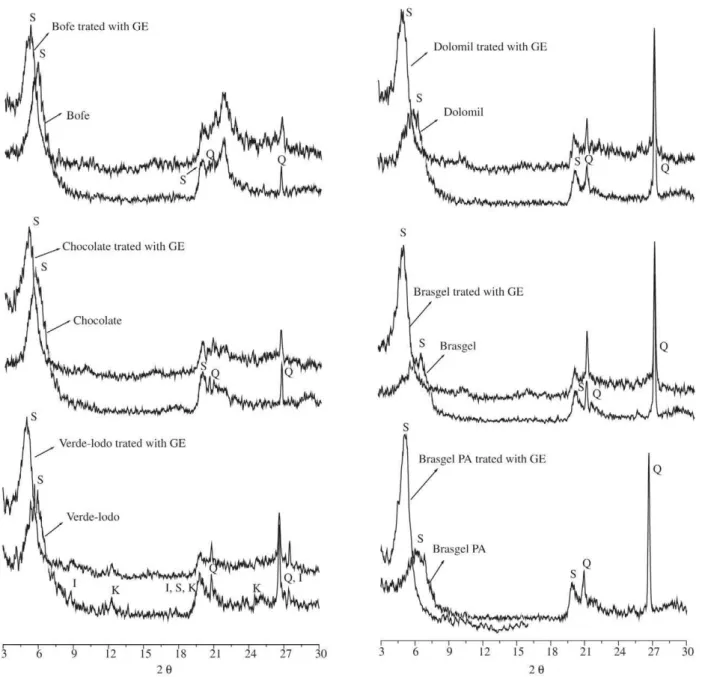
The X-ray diffraction pattern of the samples (Fig. 3) presents typical diffractograms of bentonite, with a pres-ence of clay minerals from the smectite group. These are confirmed by the change of its characteristic peak, after treat-ment with ethylene glycol, from 14-15 Å to 17 Å. All the samples presented a peak at 3.35 Å, characteristic of the presence of the quartz. For the sample Verde-lodo (Fig. 3) a peak at 7.19 Å was observed, characteristic of kaolinite and a band between 4.55 Å and 4.35 Å, with superposition of peaks, characteristic of kaolinite, illite and clay minerals from the smectite group, probably montmorillonite or mem-ber from the nontronite-beidellite series.
3.1.5. Infrared spectroscopy
The infrared spectrums of the clay samples are presented in Fig. 4. The spectra of the samples are quite similar, with Si-O-Si stretching vibration band that manifests at 1039.8 cm-1, O-H stretching bands situated at 3626.25 cm-1
and 3425.08 cm-1 and a stretching and bending vibration of
hydration water that are manifested at 1635 cm-1. The set of
the weak bands, which occurred in the range 920-550 cm-1
Figure 4. Infrared spectrums for the bentonite samples: a) Bofe; b) Chocolate; c) Verde-lodo; d) Dolomil; e) Brasgel; f) Brasgel PA. is ascribed to R-OH vibrations. According to Mendioroz et al.25, the octahedral layers occurred at 920, 800 and 525 cm-1.
According to Srasra et al.26, the tetrahedral bending modes
of Al-O-Si, Si-O, Si-O-Mg and Si-O-Si of the clay miner-als occurred at 545, 472 and 429 cm-1, respectively.
3.1.6. Transmission electron microscopy
typi-Figure 5. Micrographs of the bentonite samples: a) Bofe; b) Chocolate; c) Verde-lodo; d) Dolomil; e) Brasgel; f) Brasgel PA. Continue next page.
(a) (b)
cal aspects of clay minerals from the smectite group, with irregular profile particles, undefined shape and great ten-dency to present curled edges, probably due to small plate diameter. Also, some irregular flake-shaped aggregates can be seen due to the attraction between the particles. In the micrograph (Fig. 5c) for sample Verde-lodo particles with hexagonal profile and lath-shapes can be observed, indicat-ing the presence of kaolinite and illite, respectively, con-firmed by X-ray results.
3.2. Rheological behavior
The rheological properties of the bentonite suspensions are given in Table 4. The increase in the proportion of Na2CO3 provide to the dispersions prepared with the natu-ral clays an increase on apparent viscosity (AV) and de-crease on plastic viscosity (PV) and water loss (WL), ex-cept for the sample Bofe, where PV did not present signifi-cant variations. This behavior shows the capacity of the natural clays to transform to the sodic form. The amount of Na2CO3 that gave best results was: 150 meq/100 g of dry clay, for the sample Bofe; 75 meq/100 g of dry clay, for the sample Chocolate; and 100 meq/100 g of dry clay, for the sample Verde-lodo.
Comparing the results presented in the Table 4 with the Petrobras specifications20, it was observed that: i) the
dis-persions with Bofe presented values of AV lower than the minimum (15 cP). For the Chocolate and Verde-lodo sam-ples AV were greater than 15 cP, except for Chocolate treated with 50 meq/100 g of dry clay and Verde-lodo treated with 50 and 75 meq/100 g of dry clay; ii) for PV, only the disper-sions with Bofe clay, treated with all different proportions of Na2CO3, and Verde-lodo, treated with 50 meq/100 g of dry clay, presented values in agreement with the specifica-tions, however very close to the minimum value (4.0 cP); and iii) among the studied clays, only Chocolate, treated with all proportions of Na2CO3, and Bofe, treated with 150 and 175 meq/100 g of dry clay, presented values of WL below the maximum (18.0 mL), according to Petrobras specifications20. The pH values were close to the maximum
value (10.0).
For industrialized clays the apparent viscosity changed from 8.3 cP for the sample Brasgel to 16.1 cP for the sam-ple Brasgel PA. For the plastic viscosity the values change from 4.0 cP, for Brasgel PA to 5.0 cP, for Brasgel. The wa-ter loss changes from 20.5 mL, for the samples Dolomil and Brasgel, to 16.3 mL, for the sample Brasgel PA. The Figure 5. Micrographs of the bentonite samples: a) Bofe; b) Chocolate; c) Verde-lodo; d) Dolomil; e) Brasgel; f) Brasgel PA.
(e)
values of pH were close to 9.8, for all the samples. Compar-ing these results with the specifications20 for water based
drilling fluids, it was observed that the values of AV pre-sented by the suspensions prepared with the industrialized clays were inferior to the Petrobras specifications (15 cP)20,
except for the suspensions prepared with the sample Brasgel PA that presented AV equal to 16,1 cP. The values obtained to PV, are in agreement with the specifications, however very close of the minimum value (4.0 cP); except for the sample Brasgel (5.0 cP). For WL, only the suspensions pre-pared with the sample Brasgel PA presented values below the maximum (18.0 mL). In relation to the pH values, all the samples presented results close to the maximum value (10.0).
4. Discussion
The water content of the samples is very low when com-pared with the Petrobras specifications (maximum 14%)20
and can cause hydration problems if the clays is dry in high temperatures (above 60°C). According to Souza Santos24,
the hydration of the bentonite could be related with the pres-ence of the potassium in its structure. During the dry proc-ess, when the interlayer water is excluded, the clays con-taining potassium can acquire a crystalline structure simi-lar to muscovite mica. This modification hinders the water penetration between the layers. Consequent suspension of the clay in water causes small values of apparent and plas-tic viscosities. Among the studied clays, only the Verde-lodo
sample presented a high content of K2O (1.99%), which can affect the rheologic properties. The amount of K2O in this sample is several times superior than when it was dis-covery, according to the Souza Santos6 results. The calcium,
magnesium and sodium oxides of the natural clays also dif-fer from the results presented by Souza Santos 30 years ago, and are inferior when compared with today results. The amounts of Na2O and loss on ignition were superior. Also it is important to say the amount MgO decrease from 3.5% to traces.
The thermodifferential curves and X-ray diffraction of the natural (Bofe, Verde-lodo and Chocolate) and industri-alized clays confirm that these sample are predominantly composed of clay minerals of the group of the smectite, probably montmorillonites or members of the series nontronite-beidellite. All the samples contained quartz in its composition. The sample Verde-lodo contained illite and kaolinite. The presence of these clay minerals can affect the process of sodium transformation of bentonites, and conse-quently influence its rheological behavior. The presence of clay minerals montmorillonites in all the samples and illite and kaolinite in the sample Verde-lodo was confirmed by the electron micrographs. The mineralogical composition of the studied clays is similar to the clays studied by Souza Santos6 30 years ago.
The natural clays, after treated with a Na2CO3 solution, can be transformed into sodium form, with rheological prop-erties that do not satisfy the specifications of Petrobras20, to
Table 4. Rheological properties of the suspensions prepared with the natural clays activated with Na2CO3 and of the suspensions prepared with the industrialized clays.
Natural Amount of Na2CO3 Properties rheological pH
samples (meq/100g of dry clay) AV (cP) PV (cP) WL (mL)
Bofe 75 7.1 4.3 18.8 9.9
100 8.1 4.5 18.5 10.0
125 10.0 4.0 18.5 10.0
150 12.5 4.8 17.7 10.0
175 8.3 4.3 17.8 10.3
Chocolate 50 13.6 3.8 16.5 9.5
75 18.5 3.8 16.0 9.9
100 19.6 3.0 15.3 10.0
125 18.8 2.3 15.8 10.0
150 21.5 1.3 16.5 10.0
Verde-lodo 50 9.5 4.0 21.8 10.0
75 12.9 2.0 22.5 10.1
100 16.9 1.5 22.0 10.2
125 18.9 1.3 23.5 10.2
150 20.4 1.0 23.8 10.0
Dolomil 11.8 4.3 20.5 9.9
Brasgel 8.3 5.0 20.5 9.8
Brasgel PA 16.1 4.0 16.3 9.9
be used as water based drilling fluids. The reasons for this are probably due to the presence of calcium and magne-sium, as bicarbonates, in the suspensions. The calcium and magnesium bicarbonates present high solubility and, when in solution, they are dissociated liberating the cations cal-cium and magnesium and can occupy the sodium positions in the structure of the clay, with reversible cation exchange. Although the mineralogical compositions of the clays are similar to the ones tested, the rheological properties showed that the clays do not present the same values of apparent and plastic viscosities. In some samples the presence of other minerals and/or non-montmorillonite clay minerals, prob-ably contributed to its behavior with flocculated structure and gel formation of the suspensions.
Among the industrialized clays, only the sample Brasgel PA presented rheological properties in agreement with the Petrobras specifications20.
5. Conclusions
The study of the physical, mineralogical and rheological properties of three samples of clays natural bentonites and three industrialized ones from Boa Vista, Brazil, led to the following conclusions:
• the physical properties presented by the samples are in agreement with the specifications of Petrobras20;
• the clay samples are composed of clay minerals from the smectite group, probably, montmorillonite or mem-bers of the series nontronite-beidellite. Also other minerals such as quartz and other clay minerals such as kaolinite and illite are included in the sample Verde-lodo;
• the natural clays, when treated with Na2CO3 solution can be transformed into sodium form. However the rheological properties do not satisfy the Petrobras specifications;
• among the industrialized clays, only Brasgel PA pre-sented rheological properties fit to be used as a com-ponent of water based drilling fluids;
• after four decades of exploitation, the bentonite from Boa Vista presents mineralogical composition similar to the one from the beginning of industrialization but its rheological properties became so different and the results show a drop in the quality of these clays.
Acknowledgment
The authors thank to the National Agency of Petroleum – ANP, FINEP, MCT, CNPq/CTPETRO and the CNPq’s ‘DCR’ program for the financial support for the develop-ment of this work.
References
1. Darley, H.C.H.; Gray, G.R. Composition and Properties
of Drilling and Completion Fluids, Gulf Publishing Company, Houston, p. 1-2, 553, 1988.
2. Murray, H.H. Applied Clay Science, v. 17, p. 207-221, 2000.
3. Nakaishi, K., Applied Clay Science, v. 12, p. 377-386, 1997.
4. Luckham P. F.; Rossi, S. Advances in Colloid and Inter-face Science, v. 82, p. 43-92, 1999.
5. Trindade, M.H.A. Bentonite. www.dnpm.org.br, 20 de setembro. 2001.
6. Souza Santos, P. Estudo Tecnológico de Argilas Montmoriloníticas do Distrito de Boa Vista, Município de Campina Grande, Paraíba, Tese de Cátedra, Universidade de São Paulo, Brasil, 1968.
7. Zandonadi, A.R.; Souza Santos, P.; Lourenço, P.O.B. Cerâmica, v. 16, p. 263, 1970.
8. Kiminami, R.H.G.A.; Ferreira, H.C. Cerâmica, v. 26, p. 307-312, 1980.
9. Kiminami, R.H.G.A.; Ferreira, H.C. Cerâmica, v. 27, p. 21-36, 1981.
10. Kiminami, R.H.G.A.; Ferreira, H.C. Cerâmica, v. 27, p. 225-244, 1981.
11. Barbosa, M.L. Estudo de Algumas Propriedades Reológicas de Argilas Esmectíticas da Localidade de Bravo, Distrito de Boa Vista, Campina Grande, Paraíba, Após Cura em Câmara Climatizada, Dissertação de Mestrado, DEQ/UFPB, Campina Grande, PB, 1985.
12. Queiroz, M.F.V. Influência do Tratamento de Cura em Câmara Úmida e Climatizada nas Propriedades Reológicas e nos Teores de Carbonatos e Bicarbonatos das Argilas Esmectíticas de Boa Vista, Município de Campina Grande-PB, Dissertação de Mestrado – DEQ/ UFPB, Campina Grande, PB, 1985.
13. Ramos, R.R. Estudo de Algumas Propriedades Reológicas e Teores de Carbonatos e Bicarbonatos Após Cura em Câmara Úmida e Autoclave de Três Argilas Esmectíticas Tratadas com Carbonato de Sódio da Localidade de Bravo, Distrito de Boa Vista, Município de Campina Grande-PB, Dissertação de Mestrado, DEQ/UFPB, Campina Grande, PB, 1985. 14. Lira, H.L. Modificações de Propriedades Reológicas
de Esmectíticas Sódicas por Tratamento Térmico, Dissertação de Mestrado – DEQ/UFPB, Campina Grande, PB, 1988.
15. Valenzuela Díaz, F.R. Estudos, em Escala de Laboratório, Visando Corrigir a Viscosidade Plástica Dilatante de Esmectita de Cor Verde-lodo, de Lages, Distrito de Boa Vista, Campina Grande, Paraíba, Dissertação de Mestrado, Universidade de São Paulo, Brasil, 1983.
17. Gopinath, T.R.; Schuster, H.D.; Schuckmann, W.K. Revista Brasileira de Geociências, v. 11, p. 185-192, 1981.
18. Gopinath, T.R.; Schuster, H.D.; Schuckmann, W.K. Revista Brasileira de Geociências v. 18, p. 345-352, 1988.
19. Caenn, R.; Chillingar, G.V. Journal of Petroleum Sci-ence and Engineering, v. 14, p. 221-230, 1996. 20. Petrobras. Ensaio de Viscosificante para Fluido de
Perfuração Base de Água na Exploração e Produção de Petróleo, Método, N-2605, Rio de Janeiro, Brasil, 1998.
21. Ferreira, H.C.; Chen, T.; Zandonadi, A.R.; Souza Santos, P. Cerâmica, v. 18, p. 333-326, 1972.
22. Anônimo. Métodos para Análise Química. Laboratório de Análises Minerais, Centro de Ciências e Tecnologia, Universidade Federal da Paraíba, Brasil, 2000. 23. Petrobras. Viscosificante para Fluido de Perfuração
Base de Água na Exploração e Produção de Petróleo, Especificação, N-2604. Rio de Janeiro, Brasil, 1998. 24. Souza Santos, P., Ciência e Tecnologia de Argilas,
Editora Edgard Blücher Ltda., SP, Brasil, p. 310-312, 1989.
25. Mendioroz, S.; Pajares, J.A.; Brito, I.; Pesquera, C.; Gonzalez, F., Blanco, C. Langmuir, v. 3, p. 676-681, 1987.