R
E
V
I
E
W
A
R
T
I
C
L
E
S
Vegetal fibers in polymeric composites: a review
Paulo Henrique Fernandes Pereira
1*
, Morsyleide de Freitas Rosa
1, Maria Odila Hilário Cioffi
2,
Kelly Cristina Coelho de Carvalho Benini
2, Andressa Cecília Milanese
2,
Herman Jacobus Cornelis Voorwald
2and Daniela Regina Mulinari
31
Embrapa Agroindústria Tropical, Fortaleza, CE, Brazil
2
Departamento de Materiais e Tecnologia, Faculdade de Engenharia de Guaratinguetá,
Universidade Estadual Paulista – UNESP, Guaratinguetá, SP, Brazil
3
Centro Universitário de Volta Redonda – UniFOA, Volta Redonda, RJ, Brazil
Abstract
The need to develop and commercialize materials containing vegetal ibers has grown in order to reduce environmental impact and reach sustainability. Large amounts of lignocellulosic materials are generated around the world from several human activities. The lignocellulosic materials are composed of cellulose, hemicellulose, lignin, extractives and ashes. Recently these constituents have been used in different applications; in particular, cellulose has been the subject of numerous works on the development of composite materials reinforced with natural ibers. Many studies have led to composite materials reinforced with ibers to improve the mechanical, physical, and thermal properties. Furthermore, lignocellulosic materials have been treated to apply in innovative solutions for eficient and sustainable systems. This paper aims to review the lignocellulosic ibers characteristics, as well as to present their applications as reinforcement in composites of different polymeric matrices.
Keywords: thermoplastic composite, thermoset composite, lignocellulosic residues.
1. Introduction
Nowadays, as an argument to reduce environmental contamination has increased the human conscientization related to correct disposal of materials, in particular there is an effort to industrial waste reuse and to renewable resources use. Thus, in recent years there has been a growth in the development of materials that meet global trends as economic viability, uses, costs and environmental impact. Numerous experimental studies have appeared with focus on the use of natural fibers as reinforcement in composites with thermoplastic or thermoset polymer matrices[1]. A statistical analysis of scientific publications in the area of natural fibers composites with thermoplastic and thermoset matrices employing the Web of Science database of peer‑reviewed
literature is presented in Figure 1. In this statistical search
were found publications referred as technical‑scientific articles from January 2000 to May 2014. This review shows that the interest on the development of ecologically viable materials, especially with less environmental impact, with the use of raw materials from natural sources, like the natural fibers, is growing in the last decade and reveals an emerging area of polymeric composites.
This paper presents a comprehensive approach on
lignocellulosic fibers as well as on the properties of polymer composites formed with these fibers. Recent publications are considered, along with a brief review on grounds in the chemical composition of lignocellulosic materials and the effect of addition fibers on the mechanical, thermal and physical properties of thermoplastic and thermoset matrices.
2. Fiber Attributes Affecting Polymer Composite
Properties
2.1 Source and morphology of the cellulosic fibers
The traditional source of cellulosic fibers has been wood and, for many countries, this will continue to be the case[2]. Other large sources are cotton, flax, jute, sisal, curauá, hemp and by products from the cultivation of corn, wheat, rice, sugarcane, pineapple, banana and coconut.
The dimension and arrangement of unit cells in a fiber determine the structure and also influence the fiber properties affecting consequently the polymeric composite properties. The amount of each element as well as morphology and properties of fibers are dependent on the plant species, crop production, place of extraction, plant age, plant part chosen and soil conditions where they were grown[3-6]. These variables represent one of the prominent barriers for the large‑scale manufacture of lignocellulosic‑based composites.
Lignocellulosic fibers are characterized by their cellular structures composed by cells that contains crystalline (highly ordered) and amorphous (disordered) regions interconnected through lignin and hemicellulose fragments[7]. These regions do not possess well‑defined borders and present a transition from an ordered arrangement of the cellulose chains to amorphous[8].
middle lamella, the thin primary wall, and the secondary wall, which is subdivided into external secondary wall (S1), middle secondary wall (S2) and internal secondary wall (S3). These layers are composed of microfibrils oriented into space in defined (angles) form, according to the each layer[9-12].
The primary wall, initially deposited during the growth of cells, consists in a disordered arrangement of cellulose fibrils placed in a matrix of pectin, hemicellulose, lignin, and
protein[10,11]. Secondary walls consist of crystalline cellulose microfibrils organized in a spiral arrangement, where the middle layer (S2) determines the fiber mechanical properties. This is consisted by an amount of microfibrils, in a helical conformation of long chains of cellulose. Microfibrils have a diameter of 10 to 30 nm and are arranged in an amorphous region formed of lignin and hemicellulose, and
it is a resulting of a packaging 30‑100 of extended cellulose
chain[10,11]. The middle lamella, that is outer layer of cell, is composed predominantly by pectin that acts as cement between fibers[11].
The fiber strength can be an important factor in selecting a natural fiber for a specific application. A high aspect ratio (length/width) is very important in cellulose‑based fiber composites as it gives an indication of possible strength properties. Fiber dimensions, defects, strength, variability, crystallinity, and structure must be taken into consideration.
2.2 Chemical composition of the cellulosic fibers
Vegetable fibers have considerably complex structures, defined by a wide variety of organic compounds such as lignin, hemicellulose, waxes, fatty acids, fats, pectins
Figure 1. Number of publications about natural fibers composites with thermoplastic and thermoset matrices in the last years from Web
of Science database.
Figure 2. Schematic representation of plant fiber structure: primary wall, middle lamella, lumen, S1 ‑ external secondary wall, S2 ‑ middle
among others, and their properties have been investigated by several researchers[13-22].
Cellulose, hemicellulose and lignin are the three main constituents of vegetable fibers. For this reason, they are also referred to as cellulosic or lignocellulosic fibers. The proportion of these components in a fiber depends on the age, source of the fiber and the extraction conditions used to obtain the fibers. Table 1 provides average values of vegetal fibers properties, including their chemical constituents.
The major component of vegetal fibers is the cellulose, which is a long‑chain polysaccharide formed by units of β‑D glucose building blocks that bind together through the connections 1 and 4 carbons β (1→ 4) glycosidic[58-60].
Meyer and Mark[61] have described cellulose crystal structure initially in 1928. Depending on the crystalline geometry, cellulose is classified as I, II, III, IV and X in all cases, the monomeric unit is repeated approximately every 1.03 nm. The most stable configuration around the link β (1→4) implies in the rotation of 180° between glucose units by repetitive cellulose unit, which is called as cellobiose. Two adjacent glucose units are linked from the eliminating of one water molecule between its hydroxyl groups, bonded to carbon 1 and 4. The position β of the OH group requires a rotation of the next glucose unit about the axis C1 ‑ C4 of pyranosidic ring[58,62‑64].
Hemicellulose is present in all layers of the plant cell wall, however it is concentrated in the primary and secondary layers, where occurs in association with cellulose
and lignin[58,63,64].
Lignin is a highly crosslinked molecular complex with amorphous structure and acts as a binder agent between individual fiber cells and the fibrils forming the cell wall[3]. Aromatic polymers involve multiple layers of celulose‑lignin/hemicelulose and form the composite material constituting of cellulose walls[7]. It is basically composed by phenylpropane units in a form of a three‑dimensional and amorphous macromolecule[63]. The different coupling between the lignin precursors (p‑cumarylic alcohols, and coniferyl sinapylic) give rise to various types of linkages between phenylpropane units, the most frequent are β‑O‑4 and α‑O‑4 (50‑65%), β‑1 (9‑15%), β‑5 (6‑15%), 5‑5 (2‑9%) e β‑β (2‑5%)[58].
Lignin is also responsible for rigidity property of the plant cell wall and acts as a permanent agent to cells connection, producing an impact and compression resistant structure[62].
2.3 Surface modification of natural fibers
Natural fibers are incompatible with the hydrophobic polymer matrix and have a tendency to form aggregates, which affect the quality interface of fiber‑matrix. These
Table 1. Chemical constituents and crystallinity index (CI) for a wide variety of fiber types. Fiber type Density (g/
cm-3)
Cellulose (wt.%)
Hemicellulose (wt.%)
Lignin (wt.%)
Ashes (wt.%) CI (%) Ref.
Bast, bark or
stem fibers
Jute 1.3-1.4 60 22.1 15.9 1.0 58 [23-29]
Ramie 1.5 80-85 3-4 0.5 - 62.9 [23,27,28,30,31]
Kenaf 1.5 72 20.3 9 4.0 72.1 [26,27,28,32,33]
Flax 1.5 71 18.6-20.6 2.2 - 86.1 [23,26,27,32,34,35]
Hemp 1.5 72 10 3 2.3 79.9 [26,27]
Leaf
Sisal 1.5 74-75 10-13.9 7.6-7.9 0.4 72.2 [24,25,27,36,37]
Banana 1.5 60-65 6-8 5-10 1.2 39 [28,36,38]
Abaca 1.5 56-63 20-25 7.9 - 68.7 [36,39]
Raffia - 44.6 13.5 2.7 - 64 [40]
Pineapple 0.8-1.6 83 - 12 - 38 [23,25,36,41]
Curauá 1.4 70.7 21.1 7.5 0.8 75.6 [23,30,42]
Piassava 28,6 31.6 - 48.4 - - [23,43]
Fruit/ Seed
Kapok - 50.7 49.3 13.4 - 35.3 [44,45]
Cotton stalk 1.5 50,6 28.4 23.1 - 74 [40]
Sleeve - 55 20.6 23.8 - - [46]
Weed - 69 - 17 - 74.1 [47]
Luffa cylindrica 0.82 62 20 11.2 0.40 59.1 [48,49]
Coir 1.2 43-53 14.7 38-40 44 [23,25,26,37,43]
Wood Soft density - 30-60 20-30 21-37 ≤1 - [50]
Hard density - 31-64 25-40 14-34 ≤1 71.6 [50,51]
Talus
Rice straw - 43.2 31.7 16.9 9.9 77 [32,40,51]
Wheat straw - 43.2 34.1 22 4.99 54.4 [32,51,52,53,54,55]
Barley - 31-45 14-15 24-29 - - [56]
Corn straw - 39.82 23.19 11.98 - 50.3 [36,51]
Reed
Bamboo 0.6-1.1 33-45 30 20-25 - 59.7 [23,25,27,36,39]
Bagasse 1.25 69.4 21 4.4 0.6 45.2
[30,38,40,
are hydrophilic fibers and thus exhibit poor resistance to moisture. To eliminate these problem physical and chemical methods can be used to optimize natural fiber interface[1,65‑68]. These structures contain reactive functional groups that are capable of bonding with reactive groups in the matrix polymer. Thus, modification of natural fibers is attempted to produce fibers hydrophobic in order to improve interfacial adhesion between the fiber and the matrix polymer.
a) Physical methods
Some physical methods are used to change the properties of the natural fibers such as electric discharge (corona, cold plasma) and corona treatment. This is one of the most techniques for surface oxidation activation of natural fibers, which changes the surface energy of them. The same effects are reached by cold plasma treatment of various fibers[69].
b) Chemical methods
The different surface modifications of natural fibers such as alkali, acetylation, silane treatment and peroxide treatment with various coupling agents and others have resulted in improving fiber strength, fiber fitness and fiber‑matrix adhesion in natural fiber composites[70-74].
Alkali treatment of fibers is the common method to produce high quality fibers[69]. In this treatment, parameters as type and concentration of the alkali solution, operational temperature, temperature treatment time, material strength, as well as the applied additives are considered. Various silanes were found to have effectively improved the interface properties of wood‑polypropylene, mineral filled elastomers, and fiber reinforced epoxies and phenolics[75].
Silanes having reactive alkyl groups bond chemically in order to form adhesives reacting with appropriate groups and thus promote adhesion. Silanes having non‑reactive alkyl groups have no chemical coupling activity and, in such cases adhesion appears to arise from improved interfacial compatibility. Silanes have been used to promote adhesion to hydrophilic adherents, such as glass, aluminum, clay, talc, calcium carbonate etc.[76]. The silane coupling agents were found to be effective for modified natural fiber‑polymer matrix interface. Hashemi et al.[77] investigated polypropylene/bagasse fiber composites prepared by compounding polypropylene (PP) with bagasse fibers as reinforcing filler. Surfaces of fibers were modified through the use of silane coupling agents (Vinyltrimethoxysilane and γ‑Glycidoxypropyltrim ethoxysilane). The fiber coating was performed by mixing of silane with fibers and cured through microwave oven in presence of catalyst. It was found that modification of surface fiber will change the physical, mechanical, morphological, and rheological properties of composite. It was observed from scanning electron microscopy that fiber adhesion to matrix has been improved and so as dispersion. Addition of fibers increases the melt viscosity in unmodified fibers but reduced the melt viscosity for modified fibers and even the viscosity is lower at higher loading compared with unmodified fibers. The tensile strength and tensile modulus increased in modified fibers compared with the unmodified on the same loading, but elongation at break decreased. The effect of coupling agent on properties of filled PP depends on the content of coupling agents and optimum amount was achieved through measurement of water absorption.
Ruggiero et al.[78] analyzed unbleached (SCB) and peroxide bleached (PB‑SCB) sugarcane bagasse fibers grafted with hydroxyphenylbenzotriazole UV absorber (1) and/or hindered nitroxide radical of piperidinyloxy type[3]. PB‑SCB fibers were also acetylated with acetic anhydride.
In the recent years, procedures for the modification of metallic oxide coated cellulose fibers, Cell/MxOy, have been studied[79,80]. This material type has been used for specific applications: TiO2 for bactericidal activities[81], ZrO
2 for retention and analysis of Cr (VI)[82], sulphate[83] and Al
2O3 for adsorption of some metal halides from ethanol solution[84].
The experimental methodology of the fibers coating process depends on the form in which the cellulose is obtained, as fiber or membrane. As fiber form, the cellulose treatment with a precursor reagent can be made in aqueous or non‑aqueous solvent[85].
Mulinari et al.[86] evaluated the effect of the modification using zirconium oxychloride on cellulose fibers from sugarcane bagasse to reinforce high‑density polyethylene in order to improve mechanical properties. Results showed a successfully performance and that the reinforcement of high‑density polyethylene presented a tensile strength value higher than that with non‑modified cellulose fibers from sugarcane bagasse.
Other type treatment is the delignification, which is generally carried out by extracting using alcohol or benzene reagents and with NaOH followed by drying at room temperature. Many oxidative bleaching agents such as alkaline calcium or sodium hypochlorite and hydrogen peroxide are commercially used. Bleaching generally results in weight loss and improved tensile strength. Weight losses are mainly attributed to the action of the bleaching agent or alkaline reagent on the noncellulosic constituents of fibers as hemicellulose and lignin[82].
2.4 Lignocellulosic fibers as reinforcement in
composites
Lignocellulosic fibers are being considered as scientific and technological innovation in the area of new materials, point out the importance of agro waste application, specially, from vegetal fibers as raw material[87]. The use, reuse, and recycling of lignocellulosic materials minimize environmental problems and, consequently, improves the health of humanity. It is possible through the use of them, for example, with a propose of reinforce polymer to produce composites, regarding the fact that this fibers have properties such as low cost, low density, biodegradability, recyclability and low abrasiveness, specific mechanical properties capable of improving the mechanical properties of polymeric matrices, flexibility in processing, and the possibility of easily changing its properties through surface treatments[88-92]. Another important advantage of the vegetal fiber is strong ecological appeal that comes into your aggregated use, since these fibers can be obtained from industrial waste or simply vegetation considered as invasive with no useful
Vegetal fibers can be used in a wide range of application such as filters for heavy metals retention[86], crafts, and as reinforcement to produce polymer matrix composites[95].
Fibers as reinforcement present some characteristics that will interfere in the final properties of composites. Vegetal fibers, due to hydrophilic characteristic, absorbing large quantities of water and are incompatible with most hydrophobic thermoplastics, such as polypropylene and polyethylene, damaging the interfacing of composite[91,92,96].
In general, for composites reinforced with natural fibers, the surface treatments are used in order to remove amorphous constituents such as hemicellulose and lignin, with the goal of to get as much cellulose as possible with higher levels of crystallinity. Higher mechanical properties
and thermal degradation resistance can associate to higher
cellulose content at the fiber[91].
Other important characteristic regarding to strengthen
a polymer with natural fiber is the thermal degradation of fibers, which is in average around 200°C, limitant parameter to processing temperature. The fiber size, morphology, and fiber orientation are also characteristics that influence directly the composites final properties[93,97,98].
Composite processing also affects the final properties of materials, thereby obtaining of natural composites requires specific conditions with this respect, in operational processing materials are subject to temperature variations, at shear tension besides to be exposed to oxygen[59].
A great amount of natural fibers have now been studied for applications as reinforcement of composites that use thermoplastic or thermosettings matrices, the most used are sisal, jute, bamboo, curauá, bagasse from sugarcane and green coconut shell fibers[99-115].
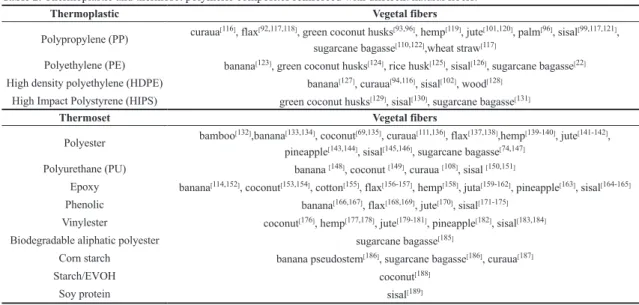
Table 2 describes some fibers applied as reinforcement with various thermoplastic and thermoset polymeric matrices.
Besides mentioned fibers, every day new fibers appear as an alternative to produce natural composites, in literature there are studies with palmers fibers[41], wheat straw[117] and
rice straw[190], pineapple crown[41], banana pseudostem[186,191], banana pells[95] and many other fibers can be extracted from different regions of the world.
Thermoplastic matrix composites development
reinforced with natural fibers have grown in recent years due to favorable environmental aspects and mainly due to its higher mechanical properties when compared to the unreinforced matrix[94].
According to the literature, the most commonly used thermoplastic polymers as matrix for natural composites are those conventional thermoplastics called as commodity, such as polyethylene (PE), high‑density polyethylene (HDPE), polypropylene (PP) and polyvinyl chloride (PVC). Other less frequently used polymers are polystyrene (PS) and high impact polystyrene (HIPS)[101,192].
Some of the main properties of thermoplastic polymers commonly used as matrix in natural composites are described
in Table 3.
Polyolefin such as polypropylene and polyethylene (low and high density) are polymers originating from unsaturated aliphatic hydrocarbons monomers and present a double reactive carbon‑carbon double bond[199].
The polypropylene (PP), a highly crystalline linear chain polymer, due to the mechanical properties, processability, cost, and low process temperature is considered one of the most commonly thermoplastic used as matrix for natural
composites[93,99].
Depending upon the density, the polyethylene (low or high) may have a range of properties that vary in agreement with the polymer crystallinity degree, which improves properties such as tensile modulus, yield strength and hardness[199].
Borsoi et al.[200] studied the production and characterization of polystyrene composites reinforced with cotton fibers. Considering the results of tensile and bending tests, the authors concluded that with the addition of 20% of cotton fibers there was an improvement in composites properties, which was influenced by coupling agent.
Table 2. Thermoplastic and thermoset polymeric composites reinforced with different natural fibers.
Thermoplastic Vegetal fibers
Polypropylene (PP) curaua[116], flax[92,117,118], green coconut husks[93,96], hemp[119], jute[101,120], palm[96], sisal[99,117,121], sugarcane bagasse[110,122],wheat straw[117]
Polyethylene (PE) banana[123], green coconut husks[124], rice husk[125], sisal[126], sugarcane bagasse[22]
High density polyethylene (HDPE) banana[127], curaua[94,116], sisal[102], wood[128]
High Impact Polystyrene (HIPS) green coconut husks[129], sisal[130], sugarcane bagasse[131]
Thermoset Vegetal fibers
Polyester bamboo[132],banana[133,134], coconut[69,135], curaua[111,136], flax[137,138],hemp[139-140], jute[141-142], pineapple[143,144], sisal[145,146], sugarcane bagasse[74,147]
Polyurethane (PU) banana [148], coconut [149], curaua [108], sisal [150,151]
Epoxy banana[114,152], coconut[153,154], cotton[155], flax[156-157], hemp[158], juta[159-162], pineapple[163], sisal[164-165]
Phenolic banana[166,167], flax[168,169], jute[170], sisal[171-175]
Vinylester coconut[176], hemp[177,178], jute[179-181], pineapple[182], sisal[183,184]
Biodegradable aliphatic polyester sugarcane bagasse[185]
Corn starch banana pseudostem[186], sugarcane bagasse[186], curaua[187]
Starch/EVOH coconut[188]
Rosario et al.[99] observed that 30% of residue sisal fiber into polypropylene (PP) matrix caused a 70% increase in Young’s modulus and 140% in Izod impact strength, a decreasing in the ultimate tensile strength and the deformation at rupture of 9% and 198% respectively, was also observed. According to authors this reduction in ultimate tensile strength can be minimized with a previous treatment of the fiber in order to improve fiber/matrix adhesion. No thermal degradation was observed by thermogravimetric analysis, since stability temperature (240°C) is significantly higher than the composite process temperature that was 200°C.
Le Moigne et al.[117] and colleagues evaluated statistically the size and shape distribution of flax, sisal and wheat straw after mixing in polypropylene (PP) composites. The fiber type was an important factor that influenced the size distribution and shape of the fibers after mixing with the polymer. The flax fibers were fractures in the elementary fibers long form[117].
George et al.[101] studied the effect of stearic acid, potassium permanganate (KMnO4), toluene diisocyanate, and polypropylene modified with maleic anhydride treatments on the mechanical properties of jute fibers composites processed by hot compression molding. With the addition of 55.89 wt% of jute the properties in tensile, flexural and impact tests presented a considerably improvement. Considering all treatments, the modification with KMnO4 was the most effective to increasing of tensile (53.06 MPa to 68.26 MPa) and modulus (2557 MPa to 3278 MPa) strength properties, in relation to composites with untreated fibers.
The polyvinyl chloride (PVC) is the most important polymer from the class of chlorinated monomers and the second most consumed thermoplastic in the world. The PVC defines a class of polymers with good mechanical properties by high intermolecular forces generated because the polarity of chlorine[20,199]. According to Grizzo et al.[201] the main characteristics of PVC is its versatility; thermal, electrical and acoustic insulation; flame propagation; chemical, weathering and creep resistance; recyclability and good processability; and cost/benefit.
The properties study of composites reinforced with natural fibers, considering as parameter: the type of natural fiber used, the fiber surface treatment and composites processing in the final properties of the material, is very important once, depending on the composites class, the material could be used in wide range of application, such as packaging, aerospace, sports, construction, and especially in the automotive industry[89,92].
3. Lignocellulosic Fibers/Thermoset Matrices
Composites
The main thermoset resins used in the production of composite materials are unsaturated polyesters, vinyl ester, derived esters, phenolic, amino, epoxy and furans[179]. The physical and mechanical properties of thermoset resins commonly used are listed in Table 3.
The unsaturated polyesters present a wide range of properties and, consequently applications. This material has as advantages, compared with other thermoset resins, the ability to cure at room temperature, good mechanical properties and transparency, besides being produced on a
large scale[179]. The use of natural fibers as reinforcement for unsaturated polyester has been widely reported in studies involving the sisal, jute, flax, coconut, banana, pineapple, hemp, curaua and sugarcane bagasse fibers.
Epoxy resins used for high‑performance composites have
high mechanical strength and environmental degradation
resistance and are commonly used in the aerospace and naval industries[3]. Epoxy resin reinforced with natural fibers is widespread in works involving sisal, jute, flax, coconut, banana, pineapple, cotton and hemp fibers.
Mohan and Kanny[164] studied sisal/epoxy composites synthesized with the addition, by weight, of nanoclays with 1%, 3% and 5% concentrations. Authors concluded that the nanoclay can be successfully used as filler, that provides good water barrier properties, improving also the tensile properties with further improvement of wear, Tg and dynamic flexural properties. Results showed tensile strength
Table 3. Physical and mechanical properties of the major thermoplastic and thermoset polymers used as matrices of natural composites[3,193,194, 195‑198].
Properties Thermoplastic matrix
PP PE HDPE PS PVC
Density (g/cm3) 0.90-0.91 0.91-0.95 0.94-0.97 1.04-1.05 1.38
Tensile modulus (GPa) 1.1-1.6 0.3-0.5 0.5-1.1 2.5-3.5 3.0
Tensile strength (MPa) 20-40 25-45 30-40 35-60 53
Melting temperature (oC) 175 115 137 240 212
Properties Thermoset matrix
Polyester Epoxy Vinyl ester Phenolic
Density (g/cm3) 1.0-1.5 1.1-1.6 1.2-1.4 1.29
Tensile modulus (GPa) 2.0-4.5 3.0-6.0 3.1-3.8 2.8-4.8
Tensile strength (MPa) 40-90 28-100 69-86 35-62
Elongation at break ‑ Tensile mode (%) ‹ 2.6 1-6 4-7 1.5-2
Compression strength (MPa) 90-250 100-200 86 210-360
Water Absorption ‑ 24h at 20°C (%) 0.1-0.3 0.1-0.4 0.05-0.6 0.1-0.36
Cure temperature (°C) 25-200 25-200 25-150 25-200
of 45 MPa, 50 MPa, 55 MPa and 57 MPa for composites with 0% (no addition), 1%, 3% and 5% of nanoclay filled composites, respectively.
The vinyl ester resins combine the excellent characteristics of epoxy resin as chemical, thermal and mechanical resistance with easily processing and fast curing stage observed in the polyesters resin[3].
Rassman et al.[178] compared the mechanical properties (tensile, flexural and impact) and water absorption properties of composites reinforced with hemp (kenaf) fibers produced using three different systems of resin (polyester, vinyl ester and epoxy). Laminates of 15%, 22.5% and 30% fiber volume fraction were manufactured by resin transfer molding (RTM). As a general conclusion, all mechanical properties increased in agreement with growth of fiber volume for all three resin systems. The laminated hemp/polyester showed good values of modulus and impact resistance, laminates hemp/epoxy showed the highest tensile strength (30% ‑ 64.5 MPa) and those with hemp/vinyl ester exhibited good absorption characteristics of water. Scanning electron microscopy examinations of impact test specimens show that epoxy laminates failed by fiber fracture, polyester laminates by fiber pullout and vinyl ester one by a combination of pullout and fiber fracture.
Regarding phenolic resin, it was recorded as application mainly when high resistance to fire is required, associated to the fact that this resin maintains its properties at elevated temperatures[3].
The work presented by the authors Barreto et al.[171] show the preparation and characterization of composites of jute/phenolic‑based cashew nuts shell liquid. Fibers (bi directional textile) were chemically modified with alkali treatment (5% and 10% NaOH for 6h) and then bleached with sodium hypochlorite NaClO/H20 (1:1) at 60‑75 °C for 4h. The authors concluded that chemical treatment depends on several variables (reagent concentration, temperature and time), with results affecting directly thermal and mechanical properties, biodegradability and consequently fiber/matrix adhesion. The jute fiber composites showed an improvement of 28% in their mechanical properties due to chemical treatment with 5% NaOH (23.5 MPa) and a decrease of 64% for the composite treated with 10% NaOH (6.6 MPa) when compared with jute/phenolic composite without treatment (18.3 MPa).
Some thermoset resins such as polyurethanes (PU), the bismaleimidas (BMI) and cyanate ester (CE) are less frequently used to composites manufacture with natural fibers[3].
The green composites that use polyurethane resin based on castor oil reinforced by sisal fibers have been studied by Milanese et al.[151]; Silva et al.[202]; Melo and Pasa[203], with jute fibers by Neto et al.[22]; banana peel fiber by Merlini et al. [148]; sugarcane bagasse by Miléo et al.[204], and coconut fibers by Mothé and Araújo[149].
Silva et al.[202] reported the hygroscopic, thermal and mechanical properties of sisal/castor oil PU composites evaluated regard to reinforcement geometry (short fiber, long fiber and woven fabric) and alkaline treatment of fibers with sodium hydroxide solution (10% wt) for 1h.
In general, the alkaline treatment improved quasi‑static tensile properties of composites with short fibers randomly oriented (43 MPa to 46 MPa) and long aligned sisal fibers (107 MPa to 120 MPa), whereas a negative effect of the alkaline treatment was observed in the mechanical behavior of bidirectional fabric composite (39 MPa to 34.5 MPa).
4. Conclusions
1. The use of lignocellulosic fibers has increased with the years, mainly due to environmental aspects and low cost. The range of application of these fibers is large, but they have been highlighted as reinforcements for polymer composites with thermoplastic or thermoset
matrices.
2. Vegetal fibers, also called lignocellulosic fibers, are basically composed by lignin, hemicellulose and cellulose, and the amount, morphology and how these constituents are found in the fibers depend on many factors.
3. Thus the study of lignocellulosic fiber reinforced polymer composite focus on understanding the properties of composites according to fiber properties, taking into account parameters such as, the type of fiber reinforcement and matrix content, fiber surface
treatments and processing conditions.
4. Depending on the type of polymer matrix, thermoplastic or thermoset, a single fiber may also have a different effect on the final properties of the composites. This study showed therefore a summary of the main results obtained in recent studies using natural composite.
5. Acknowledgements
The authors acknowledge the financial support from Fundação Cearense de Apoio ao Desenvolvimento Científico e Tecnológico, process n° DCR‑0024‑00522.01.00/12 and Fundação de Amparo à Pesquisa do Estado de São Paulo (Fapesp), process n° 2011/14.153‑8.
6. References
1. Li, W. Y., Jin, A. X., Liu, C. F., Sun, R. C., Zhang, A. P., &
Kennedy, J. F. (2009). Homogeneous modification of cellulose with
succinic anhydride in ionic liquid using 4‑dimethylaminopyridine as a catalyst.Carbohydrate Polymers, 78(3), 389-395. http://
dx.doi.org/10.1016/j.carbpol.2009.04.028.
2. Belgacem, M. N., & Gandini, A. (2011). Monomers, polymers and composites from renewable resources. Oxford: Elsevier. 3. Mohanty, A. K., Misra, M., & Drzal, L. T. (2005). Natural
fibers, biopolymers, and biocomposites. Boca Raton: CRC Press. http://dx.doi.org/10.1201/9780203508206.
4. Wallenberger, F. T., & Weston, N. (2004). Natural fibers, plastics and composites. Boston: Kluwer Academic Publishers. http:// dx.doi.org/10.1007/978-1-4419-9050-1.
5. Ogeda, T. L., & Petri, D. F. S. (2010). Hidrólise enzimática
de biomassa.Química Nova, 33(7), 1549-1558. http://dx.doi.
org/10.1590/S0100‑40422010000700023.
6. Faruk, O., Bledzki, A. K., Fink, H. P., & Sain, M. (2014).
7. Klemm, D., Heublein, B., Fink, H. P., & Bohn, A. (2005).
Cellulose: fascinating biopolymer and sustainable raw material. Angewandte Chemie International Edition, 44, 3358-3393. 8. Tasker, S., Badyal, J. P. S., Backson, S. C. E., & Richards, R. W.
(1994). Hydroxyl accessibility in celluloses.Polymer, 35(22), 4717-4721. http://dx.doi.org/10.1016/0032‑3861(94)90723‑4. 9. Abdul Khalil, H. P. S., Bhat, A. H., & Ireana Yusra, A. F. (2012).
Green composites from sustainable cellulose nanofibrils: a review.Carbohydrate Polymers, 87(2), 963-979. http://dx.doi.
org/10.1016/j.carbpol.2011.08.078.
10. Silva, R., Haraguchi, S. K., Muniz, E. C., & Rubira, A. F.
(2009). Aplicações de fibras lignocelulósicas na química de
polímeros e em compósitos.Química Nova, 32(3), 661-671.
http://dx.doi.org/10.1590/S0100‑40422009000300010. 11. Pietak, A., Korte, S., Tan, E., Downard, A., & Staiger, M. P.
(2007). Atomic force microscopy characterization of the surface
wettability of natural fibres.Applied Surface Science, 253(7), 3627-3635. http://dx.doi.org/10.1016/j.apsusc.2006.07.082. 12. Carvalho, W., Canilha, L., Ferraz, A., & Milagres, A. M. F.
(2009). Uma visão sobre a estrutura, composição e biodegradação da madeira. Química Nova, 32(8), 2191-2195. http://dx.doi.
org/10.1590/S0100‑40422009000800033.
13. Harries, H. C. (1978). The evolution, dissemination and
classification of Cocos nucifera.Botanical Review, 44(3), 265-319.
14. Satyanarayana, K. G., Pillai, C. K. S., Sukumaran, K., Pillai,
S. G. K., Rohatgi, P. K., & Vijayan, K. (1982). Structure
property studies of fibres from various parts of the coconut
tree. Journal of Materials Science, 17(8), 2453-2462. http://
dx.doi.org/10.1007/BF00543759.
15. Geethamma, V. G., Thomas Mathew, K. T., Lakshminarayanan, R., & Thomas, S. (1998). Composite of short coir fibres and
natural rubber: effect of chemical modification, loading and orientation of fibre.Polymer, 39(6-7), 1483-1491. http://dx.doi.
org/10.1016/S0032‑3861(97)00422‑9.
16. Mukherjee, P. S., & Satyanarayana, K. G. J. (1986). An
empirical evaluation of structure‑property relationships in natural fibres and their fracture behaviour.Materials Science,
21(12), 4162-4168. http://dx.doi.org/10.1007/BF01106524. 17. Mahato, D. N., Mathur, B. K., & Bhattacherjee, S. J. (1993).
Effects of alkali treatment on electrical and spectral properties of coir fibre.Journal of Materials Science Letters, 12(17), 1350. http://dx.doi.org/10.1007/BF00241705.
18. Rowell, R. M., Han, J. S., & Rowell, J. S. (2000). Characterization and factors affecting fiber properties. In E.Frollini, A. Leão,
& L. H. C.Mattoso (Eds.), Natural polymers and agrofibers composites (pp. 115-134). São Carlos: USP.
19. Silva, G. G., De Souza, D. A., Machado, J. C., & Hourston, D.
J. (2000). Mechanical and thermal characterization of native
brazilian coir fiber.Journal of Applied Polymer Science,
76(7), 1197-1206. http://dx.doi.org/10.1002/(SICI)1097‑
4628(20000516)76:7<1197::AID‑APP23>3.0.CO;2‑G. 20. Martins, G. S., Iozzi, M. A., Martins, M. A., Mattoso, L. H. C.,
& Ferreira, F. C. (2004). Caracterização mecânica e térmica de
compósitos de poli (cloreto de vinila) reforçados com fibras
de sisal. Polímeros: Ciência e Tecnologia, 14(5), 326-333.
http://dx.doi.org/10.1590/S0104‑14282004000500010. 21. Tomczak, F., Sydenstricker, T. H. D., & Satyanarayana, K.
G. (2007). Studies on lignocellulosic fibers of Brazil. Part
II: Morphology and properties of Brazilian coconut fibers. Composites Part A: Applied Science and Manufacturing, 38(7), 1710-1721. http://dx.doi.org/10.1016/j.compositesa.2007.02.004. 22. Corradini, E., Ito, E. N., Marconcini, J. M., Rios, C. T., Agnelli,
J. A. M., & Mattoso, L. H. C. (2009). Interfacial behavior of
composites of recycled poly(ethyelene terephthalate) and
sugarcane bagasse fiber.Polymer Testing, 28(2), 183-187.
http://dx.doi.org/10.1016/j.polymertesting.2008.11.014. 23. Hattalli, S., Benaboura, A., Ham‑Pichavant, F., Nourmamode,
A., & Castellan, A. (2002). Adding value to Alfa grass (Stipa
tenacissima L.) soda lignin as phenolic resins 1. Lignin
characterization. Polymer Degradation & Stability, 76(2), 259-264. http://dx.doi.org/10.1016/S0141‑3910(02)00022‑8. 24. Leão, A. L., Rowell, R., & Tavares, N. (1998). Applications of natural fibers in automotive industry in Brazil. In P. N. Prasad,
J. E.Mark, S. H. Kandil, & Z. H.Kaifi (Eds.), Science and technology of polymers and advanced materials (pp. 755-761).
New York: Plenum Press.
25. Satyanarayana, K. G., Ravikumar, K. K., Sukumaran, K.,
Mukherjee, P. S., Pillai, S. G. K., & Kulkarni, A. G. (1986).
Structure and properties of some vegetable fibres.Journal of Materials Science, 21(1), 57-63. http://dx.doi.org/10.1007/
BF01144699.
26. Majeed, K., Jawaid, M., Hassan, A., Abu Bakar, A., Abdul Khalil, H. P. S., Salema, A. A., & Inuwa, I. (2013). Potential
materials for food packaging from nanoclay/natural fibres filled hybrid composites.Materials & Design, 46, 391-410.
http://dx.doi.org/10.1016/j.matdes.2012.10.044.
27. Dicker, M. P. M., Duckworth, P. F., Baker, A. B., Francois, G.,
Hazzard, M. K., & Weaver, P. M. (2014). Green composites: A
review of material attributes and complementary applications. Composites Part A: Applied Science and Manufacturing, 56, 280-289. http://dx.doi.org/10.1016/j.compositesa.2013.10.014. 28. Sarikanat, M., Seki, Y., Sever, K., & Durmuşkahya, C.
(2014). Determination of properties of Althaea officinalis L.
(Marshmallow) fibres as a potential plant fibre in polymeric
composite materials. Composites Part B: Engineering, 57, 180-186. http://dx.doi.org/10.1016/j.compositesb.2013.09.041. 29. Saha, P., Manna, S., Chowdhury, S. R., Sen, R., Roy, D.,
& Adhikari, B. (2010). Enhancement of tensile strength of
lignocellulosic jute fibers by alkali‑steam treatment.Bioresource Technology, 101(9), 3182-3187. http://dx.doi.org/10.1016/j.
biortech.2009.12.010. PMid:20074944
30. Satyanarayana, K. G., Guimarães, J. L., & Wypych, F. (2007).
Studies on lignocellulosic fibers of Brazil. Part I: source, production, morphology, properties and applications. Composites
Part A: Applied Science and Manufacturing, 38(7), 1694-1709.
http://dx.doi.org/10.1016/j.compositesa.2007.02.006. 31. Li, X., He, L., Zhou, H., Li, W., & Zha, W. (2012). Influence of
silicone oil modification on properties of ramie fiber reinforced polypropylene composites.Carbohydrate Polymers, 87(3), 2000-2004. http://dx.doi.org/10.1016/j.carbpol.2011.10.023. 32. Faruk, O., Bledzki, A. K., Fink, H. P., & Sain, M. (2012).
Biocomposites reinforced with natural fibers: 2000–2010. Progress in Polymer Science, 37(11), 1552-1596. http://dx.doi.
org/10.1016/j.progpolymsci.2012.04.003.
33. Karimi, S., Tahir, P. M., Karimi, A., Dufresne, A., & Abdulkhani, A. (2014). Kenaf bast cellulosic fibers hierarchy: a comprehensive
approach from micro to nano.Carbohydrate Polymers, 101, 878-885. http://dx.doi.org/10.1016/j.carbpol.2013.09.106.
PMid:24299851
34. Le Moigne, N., Longerey, M., Taulemesse, J. M., Bénézet, J. C., & Bergeret, A. (2014). Study of the interface in natural
fibres reinforced poly(lactic acid) biocomposites modified by
optimized organosilane treatments. Industrial Crops and Products, 52, 481-494. http://dx.doi.org/10.1016/j.indcrop.2013.11.022. 35. Tserki, V., Zafeiropoulos, N. E., Simon, F., & Panayiotou, C.
(2005). A study of the effect of acetylation and propionylation
surface treatments on natural fibres. Composites Part A: Applied
Science and Manufacturing, 36(8), 1110-1118. http://dx.doi.
36. Azwa, Z. N., Yousif, B. F., Manalo, A. C., & Karunasena, W.
(2013). A review on the degradability of polymeric composites
based on natural fibres.Materials & Design, 47, 424-442.
http://dx.doi.org/10.1016/j.matdes.2012.11.025.
37. Ratna Prasad, A. V., & Rao, K. M. (2011). Mechanical properties
of natural fibre reinforced polyester composites: Jowar, sisal and bamboo.Materials & Design, 32(8-9), 4658-4663. http://
dx.doi.org/10.1016/j.matdes.2011.03.015.
38. Guimarães, J. L., Frollini, E., Da Silva, C. G., Wypych, F.,
& Satyanarayana, K. G. (2009). Characterization of banana,
sugarcane bagasse and sponge gourd fibers of Brazil. Crops
and Products, 30(3), 407-415. http://dx.doi.org/10.1016/j. indcrop.2009.07.013.
39. Liu, K., Takagi, H., Osugi, R., & Yang, Z. (2012). Effect of
physicochemical structure of natural fiber on transverse thermal conductivity of unidirectional abaca/bamboo fiber composites. Composites Part A: Applied Science and Manufacturing, 43(8), 1234-1241. http://dx.doi.org/10.1016/j.compositesa.2012.02.020. 40. Habibi, Y., El‑Zawawy, W. K., Ibrahim, M. M., & Dufresne, A. (2008). Processing and characterization of reinforced
polyethylene composites made with lignocellulosic fibers from Egyptian agro‑industrial residues.Composites Science and Technology, 68(7-8), 1877-1885. http://dx.doi.org/10.1016/j. compscitech.2008.01.008.
41. Sipião, B. L. L., Paiva, R. L. M., Goulart, S. A. S., & Mulinari,
D. R. (2011). Effect of chemical modification on mechanical
behaviour of polypropylene reinforced pineapple crown fibers
composites. Procedia Engineering, 10, 2028-2033. http://
dx.doi.org/10.1016/j.proeng.2011.04.336.
42. Hoareau, W., Trindade, W. G., Siegmund, B., Castellan, A.,
& Frollini, E. (2004). Sugar cane bagasse and curaua lignins
oxidized by chlorine dioxide and reacted with furfuryl alcohol: characterization and stability.Polymer Degradation & Stability, 86(3), 567-576. http://dx.doi.org/10.1016/j.
polymdegradstab.2004.07.005.
43. D’Almedia, J. R. M., Aquino, R. C. M. P., & Monteiro, S. N. (2006). Tensile mechanical properties, morphological
aspects and chemical characterization of piassava (Attalea funifera) fibers.Composites Part A: Applied Science and Manufacturing, 37(9), 1473-1479. http://dx.doi.org/10.1016/j. compositesa.2005.03.035.
44. Wang, J., Zheng, Y., & Wang, A. (2012). Effect of kapok fiber
treated with various solvents on oil absorbency.Industrial Crops and Products, 40, 178-184. http://dx.doi.org/10.1016/j. indcrop.2012.03.002.
45. Tye, Y. Y., Lee, K. T., Wan Abdullah, W. N., & Leh, C. P. (2013).
Potential of Ceiba pentandra (L.) Gaertn. (kapok) fiber as a resource for second generation bioethanol: parametric optimization and comparative study of various pretreatments prior enzymatic saccharification for sugar production.Bioresource Technology,
140, 10-14. http://dx.doi.org/10.1016/j.biortech.2013.04.069.
PMid:23672935
46. Elizalde‑González, M. P., & Hernández‑Montoya, V. (2007).
Characterization of adsorbent materials prepared from avocado kernel seeds: natural, activated and carbonized forms. Biochemical Engineering Journal, 36, 230-238.
47. Henrique, M. A., Silvério, H. A., Flauzino Neto, W. P., &
Pasquini, D. (2013). Valorization of an agro‑industrial waste,
mango seed, by the extraction and characterization of its cellulose nanocrystals.Journal of Environmental Management, 121, 202-209. http://dx.doi.org/10.1016/j.jenvman.2013.02.054.
PMid:23542530
48. Almeida, J. M. R., Boynard, C. A., & Monteiro, S. N. (2000).
Effect of chemical treatments on the surface morphology of sponge gourd (Luffa cylindrica) fibers. In Proceedings
from 3rd International Symposium on Natural Polymers
and Composites – ISNaPol (pp. 27). São Pedro: Embrapa
Instrumentação Agropecuária.
49. Tanobe, V. O. A., Sydenstricker, T. H. D., Munaro, M., & Amico, S. C. A. (2005). A comprehensive characterization of
chemically treated Brazilian sponge‑gourds (Luffa cylindrica). Polymer Testing, 24(4), 474-482. http://dx.doi.org/10.1016/j.
polymertesting.2004.12.004.
50. Jawaid, M., & Abdul Khalil, H. P. S. (2011). Cellulosic/
synthetic fibre reinforced polymer hybrid composites: a review.Carbohydrate Polymers, 86(1), 1-18. http://dx.doi.
org/10.1016/j.carbpol.2011.04.043.
51. Xu, F., Shi, Y. C., & Wang, D. (2013). X‑ray scattering studies
of lignocellulosic biomass: a review.Carbohydrate Polymers,
94(2), 904-917. http://dx.doi.org/10.1016/j.carbpol.2013.02.008.
PMid:23544649
52. Alemdar, A., & Sain, M. (2008). Biocomposites from wheat straw
nanofibers: morphology, thermal and mechanical properties. Composites Science and Technology, 68(2), 557-565. http://
dx.doi.org/10.1016/j.compscitech.2007.05.044.
53. Chen, L., Hong, F., Yang, X. X., & Han, S. F. (2013).
Biotransformation of wheat straw to bacterial cellulose and
its mechanism. Bioresource Technology, 135, 464-468. http://
dx.doi.org/10.1016/j.biortech.2012.10.029. PMid:23186663 54. Cordeiro, N., Ornelas, M., Ashori, A., Sheshmani, S., &
Norouzi, H. (2012). Investigation on the surface properties
of chemically modified natural fibers using inverse gas chromatography.Carbohydrate Polymers, 87(4), 2367-2375.
http://dx.doi.org/10.1016/j.carbpol.2011.11.001.
55. Kaushika, A., Singh, M., & Verma, G. (2010). Green nanocomposites
based on thermoplastic starch and steam exploded cellulose nanofibrils from wheat straw.Carbohydrate Polymers, 82(2), 337-345. http://dx.doi.org/10.1016/j.carbpol.2010.04.063. 56. Bledzki, A. K., Mamun, A. A., & Volk, J. (2010). Barley husk
and coconut shell reinforced polypropylene composites: the effect of fibre physical, chemical and surface properties. Composites Science and Technology, 70(5), 840-846. http://
dx.doi.org/10.1016/j.compscitech.2010.01.022.
57. Anselmo Filho, P., & Bahr, O. (2004). Biomass resources for
energy in North‑Eastern Brazil.Applied Energy, 77(1), 51-67.
http://dx.doi.org/10.1016/S0306‑2619(03)00095‑3. 58. Fengel, D., & Wegener, G. (1989). Wood chemistry, ultrastructure,
reactions. New York: Walter de Gruyter.
59. Castro, D. O. (2010). Biocompósitos a partir de biopolietileno de alta densidade reforçado por fibras de curauá(Dissertação
de Mestrado). Universidade de São Paulo, São Carlos. 60. Hendriks, A. T. W. M., & Zeeman, G. (2009). Pretreatments to
enhance the digestibility of lignocellulosic biomass.Bioresource Technology, 100(1), 10-18. http://dx.doi.org/10.1016/j.
biortech.2008.05.027. PMid:18599291
61. Meyer, K. H., & Mark, H. (1928). Uber den bau des krystallisierten
anteils der cellulose.Berichte der Deutschen Chemischen Gesellschaft, 61, 593-614.
62. D’ Almeida, M. L. O. (1998). Celulose e papel: tecnologia de fabricação da pasta celulósica (2nd ed.). São Paulo: SENAI. 63. Rowell, R. M. (2005). Handbook of wood chemistry and wood
composites. Bota Raton: CRC.
64. Hon, D. N. S. (1996). Chemical modification of lignocellulosic materials.New York: Marcel Dekker.
65. Troedec, M. L., Sedan, D., Peyrsatout, C., Bonnet, J. P., Smith, A., Guinebretiere, R., Gloaguen, V., & Krausz, P. (2008).
Influence of various chemical treatments on the composition and structure of hemp fibres. Composites Part A: Applied
Science and Manufacturing, 39(3), 514-522. http://dx.doi.
66. Torres, F. G., & Cubillas, M. L. (2005). Study of the
interfacial properties of natural fibre reinforced polyethylene. Polymer Testing, 24(6), 694-698. http://dx.doi.org/10.1016/j.
polymertesting.2005.05.004.
67. Joseph, P. V., Joseph, K., Thomas, S., Pillai, C. K. S., Prasad,
V. S., Groeninckx, G., & Sarkissova, M. (2003). The thermal
and crystallisation studies of short sisal fibre reinforced polypropylene composites.Composites Part A: Applied Science and Manufacturing, 34(3), 253-266. http://dx.doi.org/10.1016/
S1359‑835X(02)00185‑9.
68. Araújo, J. R., Waldman, W. R., & De Paoli, M. A. (2008).
Thermal properties of high density polyethylene composites with natural fibres: coupling agent effect.Polymer Degradation & Stability, 93(10), 1770-1775. http://dx.doi.org/10.1016/j.
polymdegradstab.2008.07.021.
69. Mulinari, D. R., Baptista, C. A. R. P., Souza, J. V. C., &
Voorwald, H. J. C. (2011). Mechanical properties of coconut
fibers reinforced polyester composites.Procedia Engineering,
10, 2074-2079. http://dx.doi.org/10.1016/j.proeng.2011.04.343. 70. Souza, P. S., Rodrigues, E. F., Prêta, J. M. C., Goulart, S. A.
S., & Mulinari, D. R. (2011). Mechanical properties of HDPE/
textile fibers composites.Procedia Engineering, 10, 2040-2045.
http://dx.doi.org/10.1016/j.proeng.2011.04.338.
71. Goulart, S. A. S., Oliveira, T. A., Teixeira, A., Miléo, P. C., &
Mulinari, D. R. (2011). Mechanical behaviour of polypropylene
reinforced palm fibers composites.Procedia Engineering, 10, 2034-2039. http://dx.doi.org/10.1016/j.proeng.2011.04.337. 72. Oliveira, T. A., Teixeira, A., Mulinari, D. R., & Goulart, S.
A. S. (2010). Avaliação do uso de agente compatibilizante no
comportamento mecânico dos compósitos PEBD reforçados com fibras de coco verde.Cadernos UniFOA, 14, 11-17. 73. Liu, L., Yu, J., Cheng, L., & Qu, W. (2009a). Mechanical
properties of poly(butylene succinate) (PBS) biocomposites reinforced with surface modified jute fibre. Composites Part
A: Applied Science and Manufacturing, 40(5), 669-674. http://
dx.doi.org/10.1016/j.compositesa.2009.03.002.
74. Brugnago, R. J., Satyanarayana, K. G., Wypych, F., & Ramos,
L. P. (2011). The effect of steam explosion on the production
of sugarcane bagasse/polyester composites. Composites Part
A: Applied Science and Manufacturing, 42(4), 364-370. http://
dx.doi.org/10.1016/j.compositesa.2010.12.009.
75. Bailly, M., & Kontopoulou, M. (2009). Preparation and
characterization of thermoplastic olefin/nanosilica composites using a silane‑grafted polypropylene matrix.Polymer, 50(11), 2472-2480. http://dx.doi.org/10.1016/j.polymer.2009.03.034. 76. Frollini, E., Leão, A. L., & Mattoso, L. H. C. (2000). Natural
polymers and agrofibers composites. São Carlos: USP. 77. Hashemi, S. A., Arabi, H., & Mirzaeyan, N. (2007). Surface
modification of bagasse fibers by silane coupling agents through microwave oven and its effects on physical, mechanical, and rheological properties of PP bagasse fiber composite.Polymer
Composites, 28(6), 713-721. http://dx.doi.org/10.1002/pc.20398. 78. Ruggiero, R., Machado, A. E. H., Hoareau, W., Gardrat,
C., Nourmamode, A., Grelier, S., & Castellan, A. (2006).
Photodegradation of sugarcane bagasse fibers: influence of acetylation or grafting UV‑absorber and/or hindered nitroxide radical on their photostability.Journal of the Brazilian Chemical Society, 17(4), 763-770. http://dx.doi.org/10.1590/S0103‑ 50532006000400019.
79. Marques, P. A. A., Trindade, T., & Neto, C. P. (2006). Titanium
dioxide/cellulose nanocomposites prepared by a controlled hydrolysis method.Composites Science and Technology, 66(7-8), 1038-1044. http://dx.doi.org/10.1016/j.compscitech.2005.07.029. 80. Pavan, F. A., Francisco, M. S. P., Landers, R., & Gushikem,
Y. (2005). Adsorption of phosphoric acid on niobium oxide
coated cellulose fiber: preparation, characterization and ion
exchange property.Journal Brazilian Society, 16(4), 815-820.
http://dx.doi.org/10.1590/S0103‑50532005000500021. 81. Daoud, W. A., Xin, J. H., & Zhang, Y. (2005). Surface
functionalization of cellulose fibers with titanium dioxide nanoparticles and their combined bactericidal activities. Surface Science, 599(1-3), 69-75. http://dx.doi.org/10.1016/j.
susc.2005.09.038.
82. Mulinari, D. R., & Da Silva, M. L. C. P. (2008). Adsorption
of sulphate ions by modification of sugarcane bagasse cellulose.Carbohydrate Polymers, 74(3), 617-620. http://
dx.doi.org/10.1016/j.carbpol.2008.04.014.
83. Karnitz, O. Jr, Gurgel, L. V. A., Freitas, R. P., & Gil, L. F.
(2009). Adsorption of Cu(II), Cd(II), and Pb(II) from aqueous
single metal solutions by mercerized cellulose and mercerized sugarcane bagasse chemically modified with EDTA dianhydride (EDTAD).Carbohydrate Polymers, 77(3), 643-650. http://
dx.doi.org/10.1016/j.carbpol.2009.02.016.
84. Alfaya, R. V. S., & Gushikem, Y. (1999). Aluminum oxide
coated cellulose fibers modified with n‑propylpyridinium chloride silsesquioxane polymer: preparation, characterization, and adsorption of some metal halides from ethanol solution. Journal of Colloid and Interface Science, 213(2), 438-444.
http://dx.doi.org/10.1006/jcis.1998.6032. PMid:10222085 85. Esumi, K. (1999). Polymer interfaces and emulsions. New
York: Marcel Dekker.
86. Mulinari, D. R., Silva, G. L. J. P., Rodrigues, L. A., & Silva,
M. L. C. P. (2007). Adsorção de íons fosfato nos compósitos
celulose/ZrO2.nH2O preparados pelos métodos da precipitação convencional e em solução homogênea.Cerâmica, 53(328), 345-353. http://dx.doi.org/10.1590/S0366‑69132007000400003. 87. Satyanarayana, K. G., Arizaga, G. G. C., & Wypych, F. (2009).
Biodegradable composites based on lignocellulosic fibers—an overview.Progress in Polymer Science, 34(9), 982-1021. http://
dx.doi.org/10.1016/j.progpolymsci.2008.12.002.
88. Tita, S. P. S., Paiva, J. M. F., & Frollini, E. (2002). Resistência ao
impacto e outras propriedades de compósitos lignocelulósicos: matrizes termofixas fenólicas reforçadas com fibras de bagaço de cana‑de‑açúcar.Polímeros: Ciência e Tecnologia, 12(4), 228-239. http://dx.doi.org/10.1590/S0104‑14282002000400005. 89. Ku, H., Wang, H., Pattarachaiyakoop, N., & Trada, M. (2011).
A review on the tensile properties of natural fiber reinforced polymer composites.Composites Part B: Engineering, 42(4), 856-873. http://dx.doi.org/10.1016/j.compositesb.2011.01.010. 90. Ghali, L., Aloui, M., Zidi, M., Bendaly, H., M’Sahli, S., & Sakli,
F. (2011). Effect of chemical modification of Luffa cylindrical
fibres on the mechanical and hydrothermal behaviours of polyester/luffa composites.BioResources, 6(4), 3836-3849. 91. Arrakhiz, F. Z., Elachaby, M., Bouhfid, R., Vaudreuil, S., Essassi,
M., & Qaiss, A. (2012). Mechanical and thermal properties
of polypropylene reinforced with Alfa fiber under different
chemical treatment. Materials & Design, 35, 318-322. http://
dx.doi.org/10.1016/j.matdes.2011.09.023.
92. Le Duc, A., Vergnes, B., & Budtova, T. (2011). Polypropylene/
natural fibres composites: analysis of fibre dimensions after compounding and observations of fibre rupture by rheo‑optics. Composites Part A: Applied Science and Manufacturing, 42(11), 1727-1737. http://dx.doi.org/10.1016/j.compositesa.2011.07.027. 93. Ishizaki, M. H., Visconte, L. L. Y., Furtado, C. R. G., Leite, M.
C. A. M., & Leblanc, J. L. (2006). Caracterização mecânica e
morfológica de compósitos de polipropileno e fibras de coco verde: influência do teor de fibra e das condições de mistura. Polímeros: Ciência e Tecnologia, 16(3), 182-186.
94. Araujo, J. R., Mano, B., Teixeira, G. M., Spinacé, M. A. S., &
De Paoli, M. A. (2010). Biomicrofibrilar composites of high
and Technology, 70(11), 1637-1644. http://dx.doi.org/10.1016/j. compscitech.2010.06.006.
95. Pereira, P. H. F., Benini, K. C. C. C., Watashi, C. Y., Voorwald,
H. J. C., & Cioffi, M. O. H. (2013). Characterization of High
density polyethylene (HDPE) reinforced with banana peel fibers.BioResoures, 8(2), 2351-2365.
96. Haque, M. M., Hasan, M., Islam, M. S., & Ali, M. E. (2009).
Physico‑mechanical properties of chemically treated palm and coir fiber reinforced polypropylene composites.Bioresource Technology, 100(20), 4903-4906. http://dx.doi.org/10.1016/j.
biortech.2009.04.072. PMid:19477124
97. Morandim‑Giannetti, A. A., Agnelli, J. A. M., Lanças, B. Z.,
Magnabosco, R., Casarin, S. A., & Bettini, S. H. P. (2012).
Lignin as additive in polypropylene/coir composites: Thermal,
mechanical and morphological properties. Carbohydrate
Polymers, 87(4), 2563-2568. http://dx.doi.org/10.1016/j.
carbpol.2011.11.041.
98. Summerscales, J., Dissanayake, N. P. J., Virk, A. S., & Hall,
W. (2010). A review of bast fibres and their composites. Part
1 – Fibres as reinforcements. Composites Part A: Applied
Science and Manufacturing, 41(10), 1329-1335. http://dx.doi.
org/10.1016/j.compositesa.2010.06.001.
99. Rosário, F., Pachekoski, W. M., Silveira, A. P. J., Santos, S. F.,
Júnior, H. S., & Casarin, S. A. (2011). Resíduos de sisal como
reforço em compósitos de polipropileno virgem e reciclado. Ciência e Tecnologia, 21(2), 90-97.
100. Fuentes, C. A., Tran, L. Q. N., Van Hellemont, M., Janssens, V., Dupont‑Gillain, C., Van Vuure, A. W., & Verpoest, I.
(2013). Effect of physical adhesion on mechanical behaviour
of bamboo fibre reinforced thermoplastic composites. Colloids
and Surfaces A: Pysicochemical and Engeneering Aspects,
418, 7-15. http://dx.doi.org/10.1016/j.colsurfa.2012.11.018. 101. George, G., Jose, E. T., Jayanarayanan, K., Nagarajan, E. R.,
Skrifvars, M., & Joseph, K. (2012). Novel bio‑commingled
composites based on jute/polypropylene yarns: effect of
chemical treatments on the mechanical properties. Composites
Part A: Applied Science and Manufacturing, 43(1), 219-230.
http://dx.doi.org/10.1016/j.compositesa.2011.10.011. 102. Choudhury, A. (2008). Isothermal crystallization and mechanical
behavior of ionomer treated sisal/HDPE composites.Materials Science and Engineering A, 491(1-2), 492-500. http://dx.doi.
org/10.1016/j.msea.2008.03.011.
103. Mattoso, L. H. C. (1999). Conferência internacional de
compósitos reforçados com fibras vegetais.Polímeros: Ciência e Tecnologia, 9(2), 16. http://dx.doi.org/10.1590/
S0104‑14281999000200008.
104. Joseph, K., Medeiros, E. S., & Carvalho, L. H. (1999).
Compósitos de matriz poliéster reforçados por fibras curtas
de sisal. Polímeros: Ciência e Tecnologia, 9(4), 136-141.
http://dx.doi.org/10.1590/S0104‑14281999000400023. 105. Paiva, J. M. F., Silva, S. P., Tanaka, I. A., Trindade, W. G.,
Angelucci, C. A., & Frollini, E. (2000). Impact strength of phenolic matrices reinforced with lignocellulosic material.
In L. H. C., Mattoso, A. Leão, & E.Frollini (Eds.), Natural polymers and composite (pp. 460-468). São Carlos: EMBRAPA. 106. Pandey, A., Soccol, C. R., Nigam, P., & Soccol, V. T. (2000).
Biotechnological potential of agro‑industrial residues. I: sugarcane bagasse.Bioresource Technology, 74(1), 69-80.
http://dx.doi.org/10.1016/S0960‑8524(99)00142‑X. 107. Mochnacz, S., Amico, S. C., & Sydenstricker, T. H. D. (2002).
Caracterização e modificação superficial de fibras de sisal para utilização em compósitos poliméricos. In: Anais do
Congresso em Ciências dos Materiais do Mercosul (pp. 182).
Joinville: SULMAT.
108. Mothé, C. G., & Araújo, C. R. (2004). Caracterização térmica
e mecânica de compósitos de poliuretano com fibras de curauá.Polímeros: Ciência e Tecnologia, 14(4), 274-278. 109. Adinugraha, M. P., Marseno, D. W., & Haryadi, P. (2005).
Synthesis and characterization of sodium carboxymethylcellulose from cavendish banana pseudo stem (Musa cavendishii LAMBERT).Carbohydrate Polymers, 62(2), 164-169. http://
dx.doi.org/10.1016/j.carbpol.2005.07.019.
110. Luz, S. M., Gonçalves, A. R., & Del`Arco, A. P. Jr (2007).
Mechanical behavior and microstructural analysis of sugarcane bagasse fibers reinforced polypropylene composites. Composites
Part A: Applied Science and Manufacturing, 38(6), 1455-1461.
http://dx.doi.org/10.1016/j.compositesa.2007.01.014. 111. Monteiro, S. N., Aquino, R. C. M. P., Lopes, P. D., Carvalho,
E. A., & D`Almeida, J. R. (2006). Comportamento mecânico
e características estruturais de compósitos poliméricos reforçados com fibras contínuas e alinhadas de caruará. Revista Matéria, 11(3), 197-203.
112. Mohan Rao, K. M., & Mohana Rao, K. (2007). Extraction and
tensile properties of natural ibres: vakka, date and bamboo. Composite Structures, 77, 288-295.
113. Albertini, S., Do Carmo, L. F., & Prado Filho, L. G. (2007).
Utilização de serragem e bagaço de cana‑de‑açúcar para adsorção de cádmio.Ciência e Tecnologia de Alimentos, 27(1), 113-118. http://dx.doi.org/10.1590/S0101‑20612007000100020. 114. Sapuan, S. M., Leenie, A., Harimi, M., & Beng, Y. K. (2006).
Mechanical properties of woven banana fibre reinforced epoxy composites.Materials & Design, 27(8), 689-693.
http://dx.doi.org/10.1016/j.matdes.2004.12.016.
115. Bilba, K., Arsene, M. A., & Ouensanga, A. (2007). Study of
banana and coconut fibers botanical composition, thermal degradation and textural observations.Bioresource Technology,
98(1), 58-68. http://dx.doi.org/10.1016/j.biortech.2005.11.030.
PMid:16442281
116. Mano, B., Araújo, J. R., Spinacé, M. A. S., & De Paoli, M. A. (2010). Polyolefin composites with curaua fibres: effect
of the processing conditions on mechanical properties, morphology and fibres dimensions.Composites Science and Technology, 70(1), 29-35. http://dx.doi.org/10.1016/j. compscitech.2009.09.002.
117. Moigne, N. L., Oever, M., & Budtova, T. (2011). A statistical
analysis of fibre size and shape distribution after compounding in composites reinforced by natural fibres. Composites. Part
A, Applied Science and Manufacturing, 42(10), 1542-1550.
http://dx.doi.org/10.1016/j.compositesa.2011.07.012. 118. John, M. J., & Anandjiwala, R. D. (2009). Chemical modification
of flax reinforced polypropylene composites. Composites
Part A: Applied Science and Manufacturing, 40(4), 442-448. 119. Yan, Z. L., Wang, H., Lau, K. T., Pather, S., Zhang, J. C., Lin,
G., & Ding, Y. (2013). Reinforcement of polypropylene with
hemp fibres.Composites Part B: Engineering, 46, 221-226.
http://dx.doi.org/10.1016/j.compositesb.2012.09.027. 120. Acha, B. A., Reboredo, M. M., & Marcovich, N. E. (2007).
Creep and dynamic mechanical behavior of PP–jute composites: effect of the interfacial adhesion. Composites Part A: Applied
Science and Manufacturing, 38(6), 1507-1516. http://dx.doi.
org/10.1016/j.compositesa.2007.01.003.
121. Kaewkuk, S., Sutapun, W., & Jarukumjorn, K. (2013).
Effects of interfacial modification and fiber content on physical properties of sisal fiber/polypropylene composites. Composites Part B: Engineering, 45(1), 544-549. http://dx.doi.
org/10.1016/j.compositesb.2012.07.036.
122. Cerqueira, E. F., Baptista, C. A. R. P., & Mulinari, D. R.
(2011). Mechanical behaviour of polypropylene reinforced
sugarcane bagasse fibers composites.Procedia Engineering,
![Figure 2. Schematic representation of plant fiber structure: primary wall, middle lamella, lumen, S1 ‑ external secondary wall, S2 ‑ middle secondary wall and S3 ‑internal secondary wall [ 10,11 ] .](https://thumb-eu.123doks.com/thumbv2/123dok_br/18869716.419773/2.765.61.689.88.380/schematic-representation-structure-external-secondary-secondary-internal-secondary.webp)