Brazilian Journal of Physics, vol. 34, no. 2A, June, 2004 419
Monte Carlo Study of the Spin-1 Baxter-Wu Model
M. L. M. Costa and J. A. Plascak
Departamento de F´ısica, Instituto de Ciˆencias Exatas, Universidade Federal de Minas Gerais,
C. P. 702, 30123-970, Belo Horizonte, MG, Brazil
Received on 9 October, 2003
The two-dimensional spin-1 Baxter-Wu model is studied by using Monte Carlo simulations. The standard single-spin-flip Metropolis algorithm is used to generate the configurations from which the order parameter, specific heat and magnetic susceptibility are measured. The finite-size scaling procedure is employed in order to get the critical behavior. Extensive simulations show that the critical exponents are different from those of the spin-1/2 model suggesting that the spin-1 model is in a different universality class.
1
Introduction
The Baxter-Wu model is a system of spins defined on a two-dimensional triangular lattice with the classical spin vari-ablessi taking only integer values. It was first introduced
by Wood and Griffiths [1] as a model which does not exhibit invariance by a global inversion of all spins. The system is described by the Hamiltonian
H=−J
<ijk>
sisjsk, (1)
where the coupling constantJis positive and the sum is over all triangles made up of nearest-neighbor sites on the trian-gular lattice. For the spin-1/2 model, wheresi = ±1, the
exact solution obtained by Baxter and Wu giveskBTc/J =
2/ln(1 +√2)andα=ν =2
3[2]. The system has also been studied with quenched impurities by Monte Carlo [3] and Monte Carlo renormalization group approaches [4]. Con-formal invariance studies [5, 6] have shown that the pure spin-1/2 Baxter-Wu and the four-state Potts models have the same operator content and are in the same universality class. More recently, the short time critical dynamics has been in-vestigated through the relaxation of the order parameter at the critical temperature by Monte Carlo simulations [7]. On the other hand, for spin values greater or equal to one there are neither exact solutions nor even much approximate ap-proaches. It is the purpose of this work to study the model above for the spin-1 case by using Monte Carlo simulations, where the variablessitake the valuessi=−1,0,1.
Monte Carlo methods [8, 9] form the largest and most important class of numerical methods used for solving sta-tistical physics problems. The basic idea behind Monte Carlo simulation is to simulate the random thermal fluc-tuation of the system from state to state over the course of an experiment. Performing a high-precision finite-size scaling analysis using standard Monte Carlo techniques is very difficult due to constraints on the available computer resources. The introduction of histogram techniques to ex-tract the maximum information from Monte Carlo
simula-tion data at a single temperature enhances the potential res-olution of Monte Carlo methods substantially [10, 11]. In this sense, we apply the histogram techniques together with the Metropolis simulation algorithm in order to investigate the thermal behavior of the spin-1 Baxter-Wu model defined by Eq. (1) by considering the specific heat, order parameter and magnetic susceptibility. Our main interest is to obtain, through a finite-size scaling analysis, the phase transition temperature as well as the critical exponents of the model.
In the next section we present the thermodynamic quan-tities and the details of the simulations. In section III we discuss the results and in section IV we summarize our con-clusions.
2
Simulation background
The simulations have been carried out by using the single-spin-flip Metropolis algorithm. In the course of the simu-lations we considered triangular lattices with linear dimen-sionsL×Land fully periodic boundary conditions for sys-tem sizes of length18 ≤ L ≤ 108. Due to the fact that the system has, in addition to the ferromagnetic phase (with all spins up), three different ferrimagnetic phases with three different sublattices (one sublattice up and spins on the other two sublattices down) the allowed values ofLare always a multiple of 3. In this way, all ground states of the infinite lattice would fit on any finite lattice. Following equilibra-tion (which comprised6×104
MCS) runs comprising up to 5×10⁶
MCS (Monte Carlo steps per spin) were performed. Histogram reweighting [10, 11] and finite-size scaling tech-niques were used to precisely locate the second-order phase transition. Regarding the histograms, great care has been taken in order to assure the reliabily of the extrapolated re-sults for all lattice sizes.
420 M. L. M. Costa and J. A. Plascak
square average of the magnetization of the three sublattices
m=
mA2+mB2+mC2
3 , (2)
wheremA,mBandmC are the magnetizations per spin of
the different sublattices, the order parameter susceptibility defined as
χ=βL2
m2
− m2 , (3) whereβ = 1/kBT (withkB the Boltzmann constant and
...means an average over the generated Monte Carlo con-figurations), and the specific heat
C=β2L−2
E2
− E2 , (4) whereEis the mean value of the energy.
According to finite-size scaling theory the critical tem-perature scales as
TL=Tc+λL−1/ν , (5)
whereλis a constant,Tcis the critical temperature of the
in-finite system, andTL is the effective transition temperature
for the lattice of linear sizeL. This effective temperature can be given by the position of the maximum of any of the following quantities: the temperature derivative ofm,lnm
orlnm2
, the order parameter susceptibility or the specific heat. The above temperatures are given in units ofJ/kB. An
independent estimate ofν, however, can be made through the evaluation of the maximum logarithmic derivative of any power of the order parametermnsince one has
dU dT
max
=aL1/ν,
(6)
whereais a constant andU is eitherlnmorlnm2 (or, in general,lnmn). In addition, the specific heat and the
mag-netic susceptibility scale, at the transition temperature, as
C∝Lα/ν, χ∝Lγ/ν, (7)
whereαandγare the critical exponents of the specific heat and susceptibility, respectively. From Eqs. (2-7) one can obtain the critical temperature and critical exponents of the model.
3
Results
The independent evaluation of the critical exponentν, as ob-tained from Eq. (6) without any consideration of the critical temperatureTc, is shown in Fig. 1 for the maximum
deriva-tive of the logarithm ofmandm2
(although other powers of
mcan also be used). From both cases one hasν = 0.617(4), which is different fromν= 0.666for the spin-1/2 model.
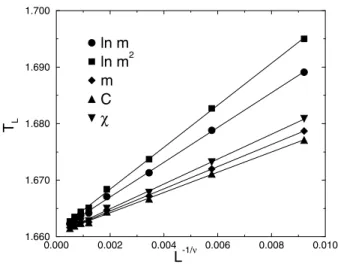
Withν determined quite accurately we proceed to esti-mate the position ofTc. As discussed in the previous
sec-tion, the location of the maxima of the various thermody-namic derivatives, namely the maximum of the specific heat, susceptibility, and the derivatives ofmandlnmandlnm2
,
provide estimates for the transition temperature which scale with system size as Eq. (5). A plot of these estimates is given in Fig. 2. The results from the linear fit are listed in Table 1. One can note that they are indeed quite close to each other and a final estimate isTc= 1.6607(3).
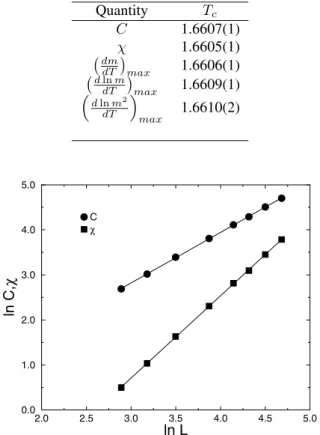
The logarithm of the maximum value of the specific heat and order parameter susceptibility as a function of the log-arithm of Lis shown in Fig. 3. From these data one has
α= 0.692(8)andγ= 1.13(1).
2.5 3.0 3.5 4.0 4.5 5.0 ln L
3.0 4.0 5.0 6.0 7.0
derivative
ln m ln m2
Figure 1. Logarithm of the maximum values of the derivatives of lnmandlnm2as a function of the logarithm of the sizeL. The
straight lines, with slopes corresponding toν= 0.617(3)in both cases, show the asymptotic behavior of the fits. The errors are smaller than the symbol sizes.
0.000 0.002 0.004 0.006 0.008 0.010 L-1/ν
1.660 1.670 1.680 1.690 1.700
TL
ln m ln m2 m C
χ
Brazilian Journal of Physics, vol. 34, no. 2A, June, 2004 421
TABLE 1. Estimated critical temperatures from different thermodynamic quantities according to the linear fit shown in Fig. 2.
Quantity Tc
C 1.6607(1)
χ 1.6605(1)
dm dT
max 1.6606(1) dlnm
dT
max 1.6609(1)
dlnm2
dT
max 1.6610(2)
2.0 2.5 3.0 3.5 4.0 4.5 5.0 ln L
0.0 1.0 2.0 3.0 4.0 5.0
ln C,
χ
C χ
Figure 3. Logarithm of the maximum values of the specific heatC and order parameter susceptibilityχas a function of the logarithm ofL. The straight lines are fits to Eqs. (7) withα/ν = 1.121(6) and γ/ν = 1.829(9). The errors are smaller than the symbol sizes.
4
Conclusions
It is clear, from the quality of the above results, that a well defined second order phase transition takes place in the model atTc = 1.6607(3)with critical exponentsν =
0.617(3),α= 0.692(6)andγ= 1.13(1), which are indeed different from the spin-1/2 case, namelyν = 2/3,α= 2/3 andγ = 7/6. This means that this three spin interaction model has exponents which depend on the spin value. It is worth saying that the present model can also have an extra interaction with a crystal field of the formD
isi
2
. This is a generalization in the direction of the so-called Blume-Capel model [12]. What we have done here is studied the special caseD = 0. However, in the limitD → −∞one recov-ers the spin-1/2 model. From the present results we then expect that along the second-order transition line for differ-ent values of D one has a line with varying critical expo-nents. In addition, as we have shown, a second-order phase
transition takes place atD = 0in contrast with the conjec-ture that the spin-1 Baxter-Wu model is critical only in the limitD → −∞[13]. Some preliminary results, agreeing with the picture of a line of second-order phase transition with varying exponents and the presence of a multicritical point, for the present system with crystal field interaction, have already been obtained from conformal invariance with finite-size scaling theory and the mean field renormalization group approach [14]. Work in this direction using Monte Carlo simulations is now in progress.
Acknowledgments
We would like to thank R. Dickman for fruitful discus-sions and a critical reading of the manuscript. Financial sup-port from the Brazilian agencies CNPq, CAPES, FAPEMIG and CIAM-02 49.0101/03-8 (CNPq) are gratefully acknowl-edged.
References
[1] D. W. Wood and H. P. Griffiths, J. Phys. C5, L253 (1972).
[2] R. Baxter, F. Wu, Phys. Rev. Lett.31, 1294 (1973).
[3] M. A. Novotny and D. P. Landau, Phys. Rev. B 32, 5874 (1985).
[4] M. A. Novotny and D. P. Landau, Phys. Rev. B 32, 3112 (1985).
[5] F. C. Alcaraz and J. C. Xavier, J. Phys. A30, L203 (1997).
[6] F. C. Alcaraz and J. C. Xavier, J. Phys. A32, 2041 (1999).
[7] M. Santos and W. Figueiredo, Phys. Rev. E 63, 042101 (2001)
[8] D. P. Landau and K. Binder A Guide to Monte Carlo Sim-ulation in Statistical Physics, (Cambridge University Press, Cambridge, England, 2000).
[9] M. E. J. Newman and G. T. Barkema,in Monte Carlo Meth-ods in Statistical Physics, Oxford University Press, (1999).
[10] A. M. Ferrenberg and R. H. Swendsen, Phys. Rev. Lett.61, 2635 (1988);63, 1195 (1989).
[11] A. M. Ferrenberg,in Computer Simulation Studies in Con-densed Matter Physics III, edited by D. P. Landau, K. K. Mon, and H. -B. Schuttler (Springer-Verlag, Heidelberg, 1991).
[12] M. Blume, Phys. Rev.141, 517 (1966); H. W. Capel, Physica
32, 966 (1966).
[13] W. Kinzel, E. Domany, and A. Aharony, J. Phys. A: Math. Gen.14, L417 (1981).
[14] M. L. M. Costa, J. C. Xavier, and J. A. Plascak, Phys. Rev. B