Occupational skin cancer: Systematic review
JÉSSICA SUELLEN SENA¹*, RÉGIO JOSÉ SANTIAGO GIRÃO², SIONARA MELO FIGUEIREDODE CARVALHO³, ROSIELLY MELO TAVARES¹,
FERNANDO LUIZ AFFONSO FONSECA4, PATRÍCIA BARROS AQUINO SILVA¹, MARIA CLARA FORTES PORTELA BARBOSA¹
1Medical Student, Faculdade Integral Diferencial (Facid/DeVry), Teresina, PI, Brazil
2MSc in Health Sciences from Faculdade de Medicina do ABC (FMABC). Dermatology Lecturer of the Facid/DeVry, Teresina, PI, Brazil
3MSc in Health Sciences from FMABC. Oncology Lecturer of the Universidade Federal do Ceará (UFC), Fortaleza, PI, Brazil
4Post-doctoral from Instituto Israelita de Ensino e Pesquisa Albert Einstein and the Roche Center for Medical Genomics. Adjunct Professor III, Universidade Federal de São Paulo, and Lecturer of Pharmaceutical Sciences
and Environmental Health Management, FMABC, Santo André, SP, Brazil
S
UMMARYStudy conducted at Faculdade Integral Diferencial (Facid/DeVry), Teresina, PI, Brazil
Article received: 9/25/2014 Accepted for publication: 5/25/2015
*Correspondence: Address: Rua Veterinário Bugyja Brito, 1354, Horto Florestal Teresina, PI – Brazil Postal code: 64052-410 [email protected]
http://dx.doi.org/10.1590/1806-9282.62.03.280
Objective: To analyze the epidemiological proile, risk factors in the workplace environment and prevention methods for professionals at risk of skin cancer.
Method: A systematic review of articles on occupational skin cancer, published in the Lilacs, Scielo, Medline and Cochrane Library from January 1st, 2008, to
De-cember 31st, 2013, was performed. The search included the following terms:
“neo-plasias cutâneas” (DeCS), “exposição ocupacional” (DeCS), “epidemiologia” (DeCS) as well as the keyword “prevenção”, and their equivalents in English.
Results: After analyzing the titles and summaries of articles, the search strate-gy resulted in 83 references, of which 22 articles met the eligibility criteria.
Discussion: We found that sun exposure is the main occupational risk factor for skin cancer, causing outdoor workers to be the most vulnerable to developing oc-cupational skin cancer. Professionals with low levels of education and European descent are at increased risk of developing this cancer.
Conclusion: Outdoor workers are more vulnerable to developing
occupation-al skin cancer, estimating that professionoccupation-als with low level of education and Eu-ropean descent are at increased risk of developing this cancer. Therefore, com-panies need to invest more in the health of workers by providing protective equipment and thus preventing occupational skin cancer.
Keywords: skin cancers, occupational exposure, disease prevention, epidemiology.
I
NTRODUCTIONOccupational cancer occurs when professionals are ex-posed to certain substances or a combination of these at work. This is caused most often due to misinformation about the health risks, favoring greater exposure to these substances inadvertently.1
Workplaces generally have a greater concentration of carcinogens than other environments outside of work.2
In view of this, exposure to numerous risk factors both at work and in the non-occupational environment as well as favorable climatic conditions may favor the emergence of skin cancer.3-5
The main risk factor associated with the development of this neoplasm is exposure to UV radiation. It causes chronic cutaneous photoaging as well as having a carci-nogenic effect on the skin in two ways: directly, when it acts directly on the cell, causing DNA mutation, and in-directly, by causing induction of T lymphocytes.3-5
Interest in this research occurred due to the fact that skin cancer may be the neoplasm that is most incident and avoidable in Brazil, as well as the major association with certain professional activities owed to exposure to numerous risk factors at work in a prolonged or cumu-lative manner.1,2,5,12
As such, the objectives of the study were: To analyze the epidemiological proile, the risk factors in the work environment and the prevention methods for profession-als at risk of skin cancer. Furthermore, the sociodemo-graphic variable of the professionals at risk was veriied, identifying the professionals related to the risk of acquir-ing skin cancer and effective protection methods.
M
ETHODLilacs, Scielo, Medline and the Cochrane Library databas-es. The search for articles was performed in February 2014 and was limited to articles published between January 1st,
2008, and December 31st, 2013.
Initially, the search strategy was based on the inter-section of the following terms:
• #1 “Skin neoplasms” (DeCS);
• #2 “Occupational exposure” (DeCS);
• #3 “Epidemiology” (DeCS);
• #4 “Prevention” (keyword).
The following searches were conducted: #1 and #2; #1 and #3; #1 and #4. A search with the above terms in Portu-guese was performed subsequently. The articles found using this strategy were irstly selected using their titles and abstracts.
The analysis of the articles followed subsequently in-clusion and exin-clusion criteria. We included: a) articles that presented at least one combination of the established terms in the title; b) manuscripts in English or Portu-guese; c) original texts with full online access; d) prospec-tive or retrospecprospec-tive observational (descripprospec-tive or analyt-ical), experimental or quasi-experimental studies. We excluded: a) case reports, case series and literature review type studies; b) non-original studies, including editorials, reviews and letters to the editor.
The articles included in the sample were read in their entirety, and the relevant data for the research was ex-tracted and included in a worksheet containing the au-thors, year of publication, description of the sample and main conclusions of the study.
R
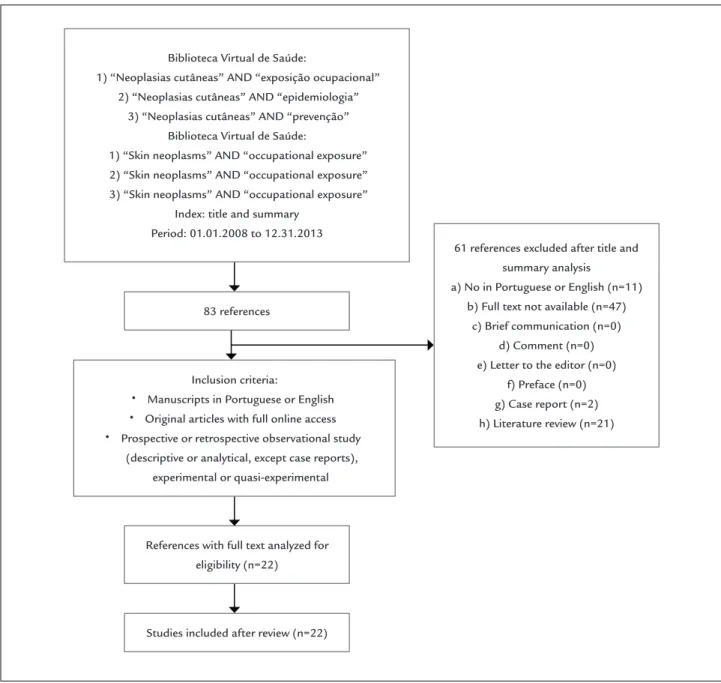
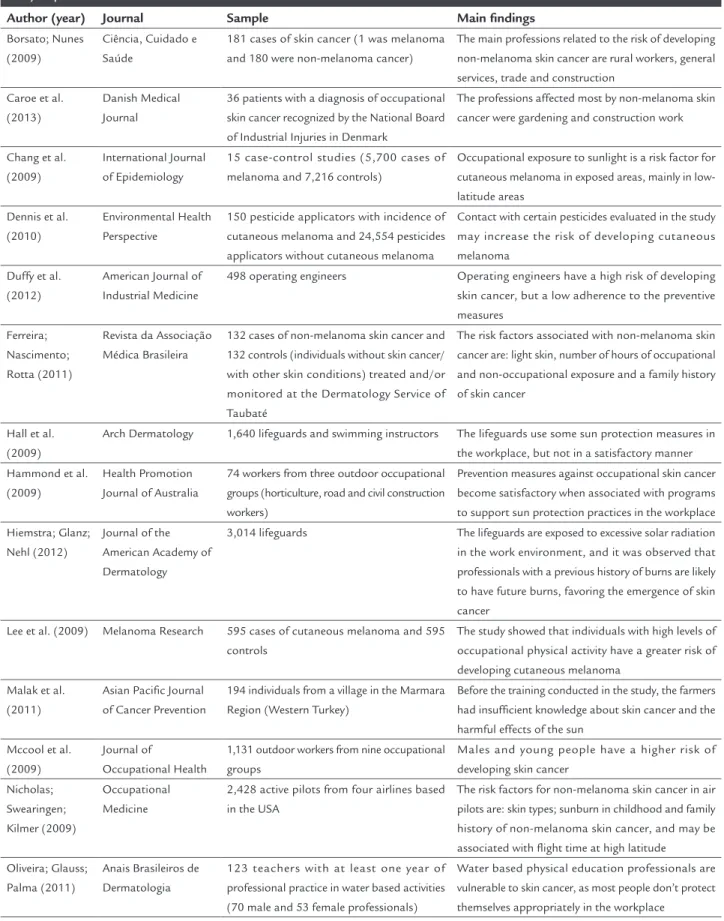
ESULTSInitially, the search strategies for examining the titles and abstracts of the articles resulted in 83 references. After analysis according to the eligibility criteria, 61 articles were deleted and 22 articles were retrieved and included in the inal sample (Figure 1 and Table 1).
D
ISCUSSIONOnly 14 of the 22 articles analyzed assessed the epidemi-ological proile of the professionals at risk of skin cancer, noting a similarity of the data collected from the articles. The references analyzed noted that occupational skin can-cer arises in individuals at more advanced ages, that is, from the sixth decade of life onward.6-9
The only discrepancy noted among the articles was that Lee et al.10 conducted a case control study and noted
that the average age of individuals with cutaneous malig-nant melanoma was 48.9 years, which did not differ much
from the age of the control group. Even though this is an earlier age than that observed in other articles, this does not contradict the literature, as according to Korand et al.11
cutaneous melanoma has a higher incidence in the age range of 40 to 60 years of age.
Another variable of the epidemiological proile ana-lyzed was that light-skinned individuals, that is, types I and II in the Fitzpatrick scale (light skin that burns easi-ly, but never tans and light skin that burns easily and tans minimally, respectively) are more likely to develop skin cancer, as well as individuals of European descent.7,8,10,12-16
Most of the articles that analyzed the epidemiologi-cal proile noted that workers who had risk factors for occupational skin cancer have, in general, a low level of education, which is consistent with the literature, given that this favors these professionals not being aware of the risk factors for skin cancer and preventive measures. Also, the lower the educational level, the greater the tendency to work for larger periods, whether hours or days of work, than those with a higher level of education.15,17-19
For Hammond et al.,14 their study observed
profes-sions at risk of skin cancer, who were builders, gardeners and road workers. These had a larger percentage of work-ers with secondary education, noting that they had a great-er knowledge of preventive measures against skin cancgreat-er, since those who had an average risk of developing this neo-plasm protected themselves less than those with a high risk. However, the sample of these workers was small, and may not have provided suficient evaluation because the workers composing the sample might not have known the preventative measures for this neoplasm.
The risk factors of skin cancer for professionals in the work environment were analyzed in 16 articles selected in this study. Ten of these 16 articles noted that sun exposure is the main factor of occupational risk. Ultraviolet radia-tion reaches the Earth’s surface every day; therefore, pro-fessionals in the outdoor environment have a high risk of sun exposure and consequent risk of skin cancer.4,6-8,12,18-22
In view of this, it has been observed that chronic and excessive exposure in the irst 10 to 20 years of life, espe-cially at times when the sun’s rays are more intense, this is, from 10 am to 4 pm, increases the risk of skin cancer, as at a young age there is a higher chance of cumulative sun ex-posure in the workplace.18,19 According to Simões et al.19
builders are professionals at risk, as they have a 44 hour work week, with excessive exposure to UV rays.
Popim et al.18 analyzed postal workers in the city of
of-FIGURE 1 Flowchart summarizing the process of selection of studies for this review.
Biblioteca Virtual de Saúde:
1) “Neoplasias cutâneas” AND “exposição ocupacional” 2) “Neoplasias cutâneas” AND “epidemiologia”
3) “Neoplasias cutâneas” AND “prevenção” Biblioteca Virtual de Saúde:
1) “Skin neoplasms” AND “occupational exposure” 2) “Skin neoplasms” AND “occupational exposure” 3) “Skin neoplasms” AND “occupational exposure”
Index: title and summary Period: 01.01.2008 to 12.31.2013
83 references
61 references excluded after title and summary analysis
a) No in Portuguese or English (n=11) b) Full text not available (n=47)
c) Brief communication (n=0) d) Comment (n=0) e) Letter to the editor (n=0)
f) Preface (n=0) g) Case report (n=2) h) Literature review (n=21) Inclusion criteria:
• Manuscripts in Portuguese or English • Original articles with full online access • Prospective or retrospective observational study
(descriptive or analytical, except case reports), experimental or quasi-experimental
References with full text analyzed for eligibility (n=22)
Studies included after review (n=22) fers less protection against the sun’s rays; being young; time and duration of sun exposure and residing in a trop-ical environment, that is, in a hot climate.
Another study that presented these same risk factors was that of Ferreira, Nascimento and Rotta,8 adding a
positive family history of skin cancer, as well as noting that the number of hours of non-occupational sun expo-sure doubles the chance of developing a non-melanoma skin cancer.
Other studies have evaluated other professions which have sun exposure as risk factors. Oliveira, Glauss and Palma4 evaluated that physical education instructors for
water based activities are vulnerable due to unsuitable conditions in the workplace; Hiemstra, Glanz and Nehl21
observed that prior sunburn is an important predictor for future burns in lifeguards, and is also a risk factor for skin cancer. Likewise, Duffy et al.,7 found that operating
engineers have excessive exposure to UV light and a low rate of use of sunscreen.
TABLE 1 Shows an overview of all the studies included in the inal sample and all the data collected and used for the sample analysis process.
Author (year) Journal Sample Main indings
Borsato; Nunes (2009)
Ciência, Cuidado e Saúde
181 cases of skin cancer (1 was melanoma and 180 were non-melanoma cancer)
The main professions related to the risk of developing non-melanoma skin cancer are rural workers, general services, trade and construction
Caroe et al. (2013)
Danish Medical Journal
36 patients with a diagnosis of occupational skin cancer recognized by the National Board of Industrial Injuries in Denmark
The professions affected most by non-melanoma skin cancer were gardening and construction work
Chang et al. (2009)
International Journal of Epidemiology
15 case-control studies (5,700 cases of melanoma and 7,216 controls)
Occupational exposure to sunlight is a risk factor for cutaneous melanoma in exposed areas, mainly in low-latitude areas
Dennis et al. (2010)
Environmental Health Perspective
150 pesticide applicators with incidence of cutaneous melanoma and 24,554 pesticides applicators without cutaneous melanoma
Contact with certain pesticides evaluated in the study may increase the risk of developing cutaneous melanoma
Duffy et al. (2012)
American Journal of Industrial Medicine
498 operating engineers Operating engineers have a high risk of developing skin cancer, but a low adherence to the preventive measures
Ferreira; Nascimento; Rotta (2011)
Revista da Associação Médica Brasileira
132 cases of non-melanoma skin cancer and 132 controls (individuals without skin cancer/ with other skin conditions) treated and/or monitored at the Dermatology Service of Taubaté
The risk factors associated with non-melanoma skin cancer are: light skin, number of hours of occupational and non-occupational exposure and a family history of skin cancer
Hall et al. (2009)
Arch Dermatology 1,640 lifeguards and swimming instructors The lifeguards use some sun protection measures in the workplace, but not in a satisfactory manner Hammond et al.
(2009)
Health Promotion Journal of Australia
74 workers from three outdoor occupational groups (horticulture, road and civil construction workers)
Prevention measures against occupational skin cancer become satisfactory when associated with programs to support sun protection practices in the workplace Hiemstra; Glanz;
Nehl (2012)
Journal of the American Academy of Dermatology
3,014 lifeguards The lifeguards are exposed to excessive solar radiation in the work environment, and it was observed that professionals with a previous history of burns are likely to have future burns, favoring the emergence of skin cancer
Lee et al. (2009) Melanoma Research 595 cases of cutaneous melanoma and 595 controls
The study showed that individuals with high levels of occupational physical activity have a greater risk of developing cutaneous melanoma
Malak et al. (2011)
Asian Paciic Journal of Cancer Prevention
194 individuals from a village in the Marmara Region (Western Turkey)
Before the training conducted in the study, the farmers had insuficient knowledge about skin cancer and the harmful effects of the sun
Mccool et al. (2009)
Journal of
Occupational Health
1,131 outdoor workers from nine occupational groups
Males and young people have a higher risk of developing skin cancer
Nicholas; Swearingen; Kilmer (2009)
Occupational Medicine
2,428 active pilots from four airlines based in the USA
The risk factors for non-melanoma skin cancer in air pilots are: skin types; sunburn in childhood and family history of non-melanoma skin cancer, and may be associated with light time at high latitude
Oliveira; Glauss; Palma (2011)
Anais Brasileiros de Dermatologia
123 teachers with at least one year of professional practice in water based activities (70 male and 53 female professionals)
Water based physical education professionals are vulnerable to skin cancer, as most people don’t protect themselves appropriately in the workplace
the body most affected were covered by clothing, such as the lower limbs and trunk.16
Another article found that being a pilot for more than 20 years is a risk factor for non-melanoma skin cancer, es-pecially in the case of professionals with more light time at high latitude, as this increase exposure to ionizing ra-diation.7 We may conclude that the irst article was
in-consistent with the others assessing exposure to solar ra-diation in the workplace, but this may have been due to some limitations, such as lack of determination of cos-mic radiation to which the light crew was exposed and the possibility that some results may have arisen by chance because of the large number of comparisons.
Another article that presented a contradiction was the study of Surdu et al.,23 which showed an inverse
rela-tionship between non-melanoma skin cancer, primarily basal cell carcinoma (BCC), and sun exposure in the work-place. However, this article presented limitations that may have favored this contradiction, as the evaluation of sun exposure may have been misclassiied, or participants may have had low levels of sun exposure, as well as having been protected against UV exposure, leading to these profes-sionals not developing skin cancer.
It was observed that the professions related to the risk of developing skin cancer in the workplace were out-door workers.6,12 According to Caroe et al.,6 gardening and
construction were the occupations with the highest amount of non-melanoma skin cancer due to exposure to UV radiation. Meanwhile, Borsato and Nunes12
pres-ent rural works followed by general services workers, trade and construction as professionals at risk of non-melano-ma skin cancer.
Therefore, articles that have rated the professions of outdoor workers as being at greater risk of skin cancer have presented construction and farm workers as the most cited professions, and we can conclude that these are the most at risk.6,9,12,14,15,19,24
In addition to solar radiation, workers can have oth-er risk factors of an occupational ordoth-er, including arse-nic, tar, mineral oils and lubricants, among others, but which also require prolonged and chronic exposure to such substances.12
According to Surdu et al.,23 women exposed to
arse-nic in the workplace have a high incidence of BCC in re-gions exposed to solar radiation, such as the face, scalp and neck. They also noted that there is no increased risk TABLE 1 (Cont.) Shows an overview of all the studies included in the inal sample and all the data collected and used for the sample analysis process.
Author (year) Journal Sample Main indings
Popim et al. (2008)
Ciência & Saúde Coletiva
33 postal workers for the Brazilian Postal Service in Botucatu
Postal workers are a risk group for skin cancer
Reeder; Gray; Mccool (2013)
Journal of
Occupational Health
1,061 workers There is a difference in the form of primary prevention for skin cancer among the various occupations examined, but this protection is not performed satisfactorily
Schernhammer et al. (2011)
Journal of the National Cancer Institute
68,336 white, non-Hispanic nurses The professionals who work the night shift have less risk of developing skin cancer
Silva et al. (2013)
International Journal of Cancer
16,329 crew members and 3,165 air trafic control oficers
The crew members present high rates of melanoma in relation to the general population
Simões et al. (2011)
Revista Gaúcha de Enfermagem
50 workers at a construction company in Rio de Janeiro
The knowledge of workers about the causes that may lead to emergence of skin cancer is relevant, as well as the prevention methods
Stock et al. (2009)
Annals of Behavioral Medicine
148 male, outdoor workers UV photography interventions may encourage the reduction of UV exposure in outdoor workers Surdu et al.
(2013a)
PLOS ONE 618 cases of non-melanoma skin cancer and 527 controls among white residents from three European countries (eight cities located in Hungary, Romania and Slovakia)
The study showed an inverse association between exposure to natural and artiicial UV radiation and the risk of non-melanoma skin cancer
Surdu et al. (2013b)
International Journal of Cancer
618 incident cases of non-melanoma skin cancer and 527 controls
in the absence of occupational exposure to sunlight. How-ever, this conclusion is not signiicant because it was based on only four exposed controls.
Nevertheless, it is believed that chronic arsenic expo-sure increases the mutagenicity of other carcinogens, such as UV radiation.23 Dennis et al.25 found a consistent
asso-ciation of melanoma and pesticide applicators, due to con-tact with pesticides containing arsenic, as well as pesticides containing maneb/mancozeb and parathion.
The absence of UV exposure can be a protective fac-tor for skin cancer, as Schernhammer et al.26 noted that
nurses with more than 10 years of nighttime work have less chance of developing skin cancer than nurses who never worked on the night shift. For McCool et al.,24 sun
exposure is a risk factor present in the environment of outdoor work, but modifying the work shift to reduce this risk is often not feasible. Therefore, other alternative measures should be taken, consisting of the use of sun-screen to reduce excessive exposure to UV rays.
According to Lee et al.,10 the case control study
par-ticipants who had high levels of occupational activities have an increased risk of cutaneous malignant melano-ma; however, this article had no statistical signiicance and no dose-response relationship was observed. The article by Chang et al.20 noted that the risk of
melano-ma to the head and neck is increased in workers exposed to the sun, especially at low latitudes due to high tem-peratures.
The prevention of occupational skin cancer occurs when there is a contact protection of causative agents of cellular damage in the workplace with the skin of the professionals. Prevention measures were examined in eight articles, which noted a predominance of the use of the following sun protection equipment: sunscreen, hats, caps, long pants, long-sleeve shirts, sunglasses and sun-shades.3,4,13-16,18,19,24
The protection measures were used signiicantly more among women, especially sunscreen.4,13,16,24 According to
McCool et al.,24 males and younger people have a lower
index of adherence to the use of protective equipment be-cause they underestimate the risk and overestimate the ability to cope with that risk.
There was a contradiction among the articles in the assessment of the protection method most widely used in the workplace. In the study conducted by McCool et al.,24 the authors found that viticulture, landscaping and
postal workers used more sunscreen than the other pro-fessional groups evaluated in the study. For Hall et al.,13
the most common protection method among the life-guards was the use of sunglasses.
Reeder, Gray and McCool,15 concluded that the
equip-ment used most by professionals was “any kind of hat”, but less than a third of these were wide-brimmed to pro-tect the areas that usually develop skin cancer, namely, the face, ears and neck, and the profession that showed the highest protection index among those studied was viticulture. According to this study, only 5% of the sam-ple reported not using sun protection measures, but the method of protection was being performed in an unsat-isfactory manner.
In view of this, the encouragement of programs for prevention of skin cancer associated with intervention measures in health and safety at work are recommended, because in order for this protection to be effective this as-sociation must be consolidated and be relevant to the professional groups.
According to Hall et al.,13 lifeguards teaching lessons
in swimming pools presented higher protection scores, although while reporting that they perform these pro-tective measures, more than half of these professionals reported having had sunburn at least once, further in-dicating the need to improve solar safety measures. There-fore, it was concluded that even after providing the equip-ment, if there is no incentive the professionals do not value its use.18
For Stock et al.,3 the use of UV photography and
in-formation about skin cancer intervention to reduce ex-posure to sunlight in male outdoor workers was effective. Likewise, the media is an important communication tool for spreading information about prevention and promo-tion of health. This article also noted that the workplace was cited as a means of disseminating preventive mea-sures, therefore there is a need to improve safety condi-tions in the workplace, that is, to provide personal pro-tective equipment, as well as investing in programs encouraging the use of such equipments and teaching the correct way to use them.19
C
ONCLUSIONWe conclude that sun exposure is the main occupation-al risk factor for skin cancer, with a higher incidence in rural and construction workers. Few articles assessing other causative agents of occupational skin cancer be-yond solar radiation were retrieved, as well as professions that do present sunlight as the main risk factor. As such, this review shows the need for further studies to investi-gate other professions and risk factors that may be asso-ciated with this occupational cancer.
greater investments by companies in worker health are required through the provision of protective equipment. In addition, prevention and health promotion programs should be encouraged, as well as providing easier access to information on the correct forms of protection.
R
ESUMOCâncer de pele ocupacional: revisão sistemática
Objetivo: analisar o peril epidemiológico, os fatores de risco no ambiente de trabalho e os métodos de preven-ção dos proissionais de risco para câncer de pele.
Método: foi realizada uma revisão sistemática de artigos sobre o câncer de pele ocupacional, publicados entre 1 de janeiro de 2008 e 31 de dezembro de 2013, nas bases de dados Lilacs, Scielo, Medline e Biblioteca Cochrane. A pesquisa baseou-se na intersecção dos seguintes termos: “neoplasias cutâneas” (DeCS), “exposição ocupacional”
(DeCS), “epidemiologia” (DeCS) e a palavra-chave “pre-venção” e seus equivalentes em inglês.
Resultados: após a análise dos títulos e resumos dos ar-tigos, a estratégia de busca resultou em 83 referências, das quais 22 artigos preencheram os critérios de elegibi-lidade.
Discussão: a exposição solar é o principal fator de risco ocupacional para câncer de pele e os trabalhadores ao ar livre são os mais vulneráveis a desenvolvê-lo. Aqueles com baixo nível de escolaridade e ascendência europeia apre-sentam maior risco de desenvolver a neoplasia.
Conclusão: os trabalhadores ao ar livre são mais vulne-ráveis a desenvolver câncer de pele ocupacional. Os pro-issionais com baixo nível de escolaridade e ascendência europeia apresentam maior risco de desenvolver a neo-plasia. São necessários mais investimentos das empresas na saúde dos trabalhadores por meio de fornecimento de equipamentos de proteção, a im de prevenir o câncer de pele ocupacional.
Palavras-chave: neoplasias cutâneas, exposição
ocupa-cional, prevenção de doenças, epidemiologia.
R
EFERENCES1. Ribeiro FSN, Wunsch Filho V. Avaliação retrospectiva da exposição ocupacional a cancerígenos: abordagem epidemiológica e aplicação em vigilância em saúde. Cad Saúde Pública. 2004; 20(4):881-0.
2. BRASIL, Ministério da Saúde. Instituto Nacional do Câncer (INCA). Diretrizes para a vigilância do câncer relacionado ao trabalho. Rio de Janeiro, 2012.
3. Stock ML, Gerrard M, Gibbons FX, Dykstra JL, Weng CY, Mahler HI, et al. Sun protection intervention for highway workers: long-term eficacy of UV
photography and skin cancer information on men’s protective cognitions and behavior. Ann Behav Med. 2009; 38(3):225-36.
4. Oliveira LMC, Glauss N, Palma A. Hábitos relacionados à exposição solar dos professores de educação física que trabalham com atividades aquáticas. An Bras Dermatol. 2011; 86(3):445-0.
5. Diepgen TL, Fartasch M, Drexler H, Schmitt J. Occupational skin cancer induced by ultraviolet radiation and its prevention. Br J Dermatol. 2012; 167(Suppl 2):76-84.
6. Carøe TK, Ebbehøj NE, Wulf HC, Agner T. Occupational skin cancer may be underreported. Dan Med J. 2013; 60(5):A4624.
7. Duffy SA, Choi SH, Hollern R, Ronis DL. Factors associated with risky sun exposure behaviors among operating engineers. Am J Ind Med. 2012; 55(9):786-2.
8. Ferreira FR, Nascimento LFC, Rotta O. Fatores de risco para câncer da pele não melanoma em Taubaté, SP: um estudo caso-controle. Rev Assoc Med Bras. 2011; 57(4):431-7.
9. Surdu S, Fitzgerald EF, Bloom MS, Boscoe FP, Carpenter DO, Haase RF, et al. Occupational exposure to ultraviolet radiation and risk of non-melanoma skin cancer in a multinational European study. PLoS One. 2013; 8(4):e62359.
10. Lee TK, MacArthur AC, Gallagher RP, Elwood MJ. Occupational physical activity and risk of malignant melanoma: the Western Canada Melanoma Study. Melanoma Res. 2009; 19(4):260-6.
11. Konrad P, Fabris RM, Melao S, Blanco LFO. Perfil epidemiológico e histopatológico dos casos de melanoma cutâneo primário diagnosticados em Criciúma no período entre 2005 e 2007. An Bras Dermatol. 2011; 86(3):457-61.
12. Borsato FG, Nunes EFPA. Neoplasia de pele não melanoma: um agravo relacionado ao trabalho. Ciênc Cuid Saúde. 2009; 8(4):600-6.
13. Hall DM, McCarty F, Elliott T, Glanz K. Lifeguards’ sun protection habits and sunburns: association with sun-safe environments and skin cancer prevention program participation. Arch Dermatol. 2009; 145(2):139-4. 14. Hammond V, Reeder AI, Gray AR, Bell ML. Are workers or their workplaces
the key to occupational sun protection? Health Promot J Austr. 2008; 19(2):97-1.
15. Reeder AI, Gray A, McCool JP. Occupational sun protection: workplace culture, equipment provision and outdoor workers’ characteristics. J Occup Health. 2013; 55(2):84-97.
16. Silva IS, Stavola B, Pizzi C, Evans AD, Evans SA. Cancer incidence in professional light crew and air trafic control oficers: disentangling the effect of occupational versus lifestyle exposures. Int J Cancer. 2013; 132(2):374-84.
17. Malak AT, Yildirim P, Yildiz Z, Bektas M. Effects of training about skin cancer on farmers’ knowledge level and attitudes. Asian Pac J Cancer Prev. 2011; 12(1):117-20.
18. Popim RC, Corrente, JE, Marino, JAG, Souza CA. Câncer de pele: uso de medidas preventivas e peril demográico de um grupo de risco na cidade de Botucatu. Ciênc Saúde Coletiva. 2008; 13(4):1331-6.
19. Simões TC, Souza NVDO, Shoji S, Peregrino AAF, Silva D. Medidas de prevenção contra câncer de pele em trabalhadores da construção civil: contribuição da enfermagem. Rev Gaúcha Enferm. 2011; 32(1):100-6. 20. Chang YM, Barrett JH, Bishop DT, Armstrong BK, Bataille V, Bergman W,
et al. Sun exposure and melanoma risk at different latitudes: a pooled anal-ysis of 5700 cases and 7216 controls. Int J Epidemiol. 2009; 38(3):814-30. 21. Hiemstra M, Glanz K, Nehl E. Changes in sunburn and tanning attitudes
among lifeguards over a summer season. J Am Acad Dermatol. 2012; 66(3):430-7.
22. Nicholas JS, Swearingen CJ, Kilmer JB. Predictors of skin cancer in commercial airline pilots. Occup Med (Lond). 2009; 59(6):434-6.
23. Surdu S, Fitzgerald EF, Bloom MS, Boscoe FP, Carpenter DO, Haase RF, et al. Occupational exposure to arsenic and risk of nonmelanoma skin cancer in a multinational European study. Int J Cancer. 2013; 133(9):2182-91. 24. McCool JP, Reeder AI, Robinson EM, Petrie KJ, Gorman DF. Outdoor workers
perceptions of the risk of excessive sun-exposure. J Occup Health. 2009; 51(5):404-11.
25. Dennis LK, Lynch CF, Sandler DP, Alavanja MC. Pesticide use and cutaneous melanoma in pesticide applicators in the agricultural health study. Environ Health Perspect. 2010; 118(6):812-7.