RevPaulPediatr.2015;33(4):467---473
www.rpped.com.br
REVISTA
PAULISTA
DE
PEDIATRIA
REVIEW
ARTICLE
Sleep
in
adolescents
of
different
socioeconomic
status:
a
systematic
review
Érico
Pereira
Gomes
Felden
∗,
Carina
Raffs
Leite,
Cleber
Fernando
Rebelatto,
Rubian
Diego
Andrade,
Thais
Silva
Beltrame
UniversidadedoEstadodeSantaCatarina(UDESC),Florianópolis,SC,Brazil
Received17September2014;accepted18January2015 Availableonline28August2015
KEYWORDS
Sleep; Adolescent; Socialclass
Abstract
Objective: Toanalyzethesleepcharacteristicsinadolescentsfromdifferentsocioeconomic levels.
Datasource:Original studies found inthe MEDLINE/PubMed and SciELO databases without languageandperiodrestrictionsthatanalyzedassociationsbetweensleepvariablesand socio-economic indicators. The initialsearch resultedin 99articles. After readingthe titles and abstractsandfollowinginclusionandexclusioncriteria,12articleswithoutcomesthatincluded associationsbetweensleepvariables(disorders,duration,quality)andsocioeconomicstatus (ethnicity,familyincome,andsocialstatus)wereanalyzed.
Datasynthesis: The studiesassociatingsleepwithsocioeconomic variablesarerecent, pub-lished mainlyafter theyear2000. Half oftheselectedstudies wereperformed withyoung Americans,andonlyonewithBrazilianadolescents.Regardingethnicdifferences,thestudies donothaveuniformconclusions.Themainassociationsfoundwerebetweensleepvariables andfamilyincomeorparentaleducationallevel,showingatrendamongpoor,lowsocialstatus adolescentstomanifestlowduration,poorqualityofsleepingpatterns.
Conclusions: Thestudyfoundanassociationbetweensocioeconomicindicatorsandqualityof sleepinadolescents.Lowsocioeconomicstatusreflectsaworsesubjectiveperceptionofsleep quality, shorterduration,andgreaterdaytimesleepiness.Consideringtheinfluenceofsleep onphysicalandcognitivedevelopmentandonthelearningcapacityofyoungindividuals,the literatureonthesubjectisscarce.Thereisaneedforfurtherresearchonsleepindifferent realitiesoftheBrazilianpopulation.
©2015SociedadedePediatriadeS˜aoPaulo.PublishedbyElsevierEditoraLtda.Thisisanopen accessarticleundertheCCBY-license(https://creativecommons.org/licenses/by/4.0/).
DOIoforiginalarticle:http://dx.doi.org/10.1016/j.rpped.2015.01.011
∗Correspondingauthor.
E-mail:[email protected](E.P.G.Felden).
468 FeldenEPGetal.
PALAVRAS-CHAVE
Sono;
Adolescentes; Nívelsocioeconômico
Sonoemadolescentesdediferentesníveissocioeconômicos:revisãosistemática
Resumo
Objetivo: Analisar as características do sono em adolescentesde diferentes níveis socioe-conômicos.
Fontesdedados: ForamanalisadosestudosencontradosnasbasesdedadosMEDLINE/PubMed eSciELOqueapresentassemresultadosoriginais,semrestric¸õesdeidiomaedeperíodo,com associac¸õesentrevariáveisdesonoeindicadoressocioeconômicos.Abuscainicialtevecomo resultado 99 estudos.Diante dos critérios deinclusão e exclusãoe apósa leiturados tex-toscompletos,12artigosapresentaram emseusdesfechosassociac¸õesentreasvariáveisde sono(distúrbios,durac¸ãoequalidade)eosparâmetrossocioeconômicos(etnia,rendaeclasse social).
Síntesedosdados: Osestudosrelacionandoosonocomvariáveissocioeconômicassãorecentes edatadosapartirdoano2000.Metadedaspesquisasselecionadasfoirealizadacomjovens norte-americanos,eapenasumacomadolescentesbrasileiros.Comrelac¸ãoàsdiferenc¸as étni-cas,osestudosnãoapresentamconclusõesuniformes.Asprincipaisassociac¸õesforamcoma rendafamiliareníveldeescolaridadedospais,evidenciando-seumatendênciaentrejovens pobresecomstatussocialmaisbaixodemanifestarembaixadurac¸ãoemáqualidadedosono.
Conclusões: Constatou-seassociac¸ãoentreosindicadoressocioeconômicoseosonodos adoles-centes.Obaixostatussocioeconômicorefletiu-senumapiorpercepc¸ãosubjetivadaqualidade do sono, menor durac¸ão e maior sonolência diurna. Considerando a importância do sono para odesenvolvimento físico ecognitivoe para aaprendizagemdos jovens, onúmero de pesquisasaindaéescasso.Sugere-semaisinvestigac¸õessobreosonoemdiferentesrealidades dapopulac¸ãobrasileira.
©2015SociedadedePediatriadeS˜aoPaulo.PublicadoporElsevierEditoraLtda.Esteéumartigo OpenAccesssobalicençaCCBY(https://creativecommons.org/licenses/by/4.0/deed.pt).
Introduction
Peoplegothroughimportantchangesduringthecourseof theirlives, both in terms of physical shapeand behavior. In adolescence, in particular, one can observe important changes in the sleep/wake cycle, including a delay in the sleep phase, characterized by later bed- and wake-up times.1,2 This biological tendency of adolescents can be accentuated by behaviors such asthe use of comput-ers, games and TV at night. Additionally, environmental issues,such as social commitments early in the morning, increase the prevalence of short sleep duration in this population.3
ThestudybyBernardoetal.4identifiedaprevalenceof 39%ofadolescentswithshortsleepdurationinSãoPaulo. Perez-Chadaetal.5observedthat49%oftheassessed Argen-tineanadolescentshadshortsleepduration.Sleepdisorders have been associated withseveral health outcomes,such ascognitivedevelopmentdisorders,6psychiatricdisorders,7 metabolicandexcessweightdisorders,8,9aswellasahigher degreeofstress.10
In addition to the biological issues, the environment seemstohaveadecisiveinfluenceonthesleep/wakecycle. Inthiscontext,theliteratureindicatesthatsocioeconomic status is one of the most relevant social variables for the understanding of health issues.11---13 As for sleep, the studies are scarce and this association is little explored, especiallyregardingstudieswithadolescents.However,itis knownthatacknowledgingtheassociationsandcausallinks between sleep and socioeconomic status is fundamental
fortheunderstandingofadolescentsleepandtomediatea proposalforhealtheducation.
Considering the abovementioned facts and taking into accounttheimportanceofstudiesthatinvestigatethe asso-ciation between sleep and socioeconomic status for the planningof publichealthactionsandthescarcityof stud-iesthatsummarize theliteratureonthis topic,this study aimed tomake asystematic review toevaluate the asso-ciation between sleep characteristics in adolescentsfrom differentsocioeconomiclevels.
Method
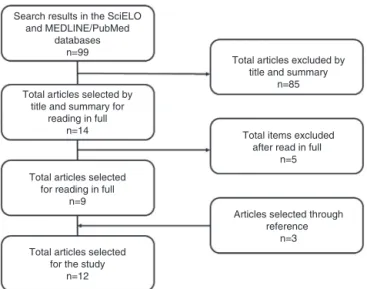
A systematic literature review was performed using the SciELOandMEDLINE/PubMeddatabases,withnoperiod lim-itations or languageexclusion.The searchusedtheterms ‘‘sleep’’ and ‘‘socioeconomic status’’ together with the term ‘‘adolescents,’’ as well as the equivalent terms in Portuguese.Additionally,thesearchwasexpandedby ana-lyzingtherelevantstudiesfoundinthereferencesofarticles selectedintheinitialsearch.Thefirstsearchresultedina totalof99studies,asdescribedinFig.1.
Sleepinadolescentsofdifferentsocioeconomicstatus 469
Search results in the SciELO and MEDLINE/PubMed
databases n=99
Total articles excluded by title and summary
n=85
Total items excluded after read in full
n=5
Articles selected through reference
n=3 Total articles selected by
title and summary for reading in full
n=14
Total articles selected for reading in full
n=9
Total articles selected for the study
n=12
Figure1 Flowchartofthearticleselection processforthe
review.
Articleslimitedtopopulationswithspecificconditions,such asmentalretardationandheartdiseasewereexcludedfrom thisreview.
Consideringtheabovementionedinclusionandexclusion criteria,basedonthereadingoftitlesandabstracts,85 arti-cleswereexcludedastheydidnotstratifyadolescentsfrom children’sandadult’ssamples,didnotincludeadolescents in the assessed population and/or only analyzed popula-tionswithchronic,noncommunicablediseasesand/orwith moreseveresleepdisorders.Additionally,themaincauseof exclusionwasthefactthatsomearticlesshowedsleepand socioeconomicstatus asindependentvariables,not show-ing associations or differences between them. Therefore, we selected 14studies tobe read in full.After that, the articleswereread;theinformationwasextractedfromthe fulltextsanddiscussedinagroup,resultingintheselection ofninestudies.Additionally,weincluded threemore arti-clesfoundinthereferences,totaling12articlesincludedin thefinalanalysis.Thedataextractionwasperformed inde-pendently by fourinvestigators,whereas theanalysis and resultswerediscussedinagroup.
Article quality assessment was performed using the proposal created by Downs and Black,14 consisting of 27 questionsthat estimate communication, external validity, internalvalidity(biasandconfoundingfactors)and statisti-calpower.This assessmentwasperformed bytwoauthors and,incasesofdoubt,athirdreviewerwasconsultedfora finaldecision.Forthepresentstudy,questions8,13,14,15, 17,19,20,21,22,23,24and26wereexcluded,as inter-ventionstudieswerenotincludedinthereview,andthusa totalof15questionswereanalyzed.Accordingtothe qual-ityassessmentproposal,thequestionsreceivedascoreof zero (0)or one (1) point,except for question five,which rangedfromzero(0)totwo(2)points.Moreover,question 27, whichanalyzes statistical power, variedfromzero (0) tofive(5)points.Thus,anarticlecouldattainamaximum scoreof20points.Giventhelownumberofselected arti-cles,thisanalysisaimedtodiscussfactorsrelatedtoarticle qualityandwasnotanexclusioncriterion.
Results
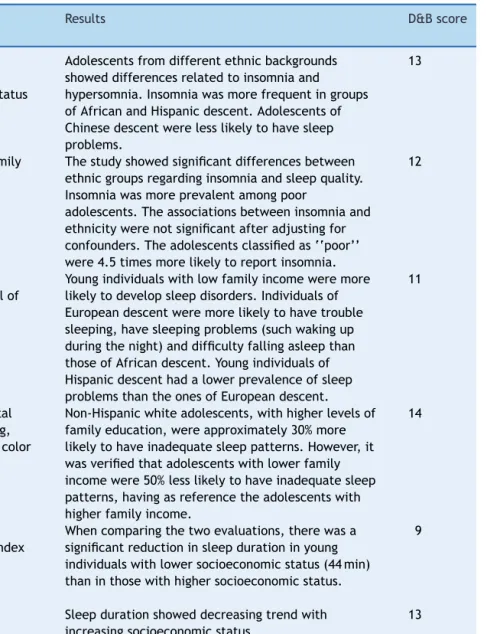
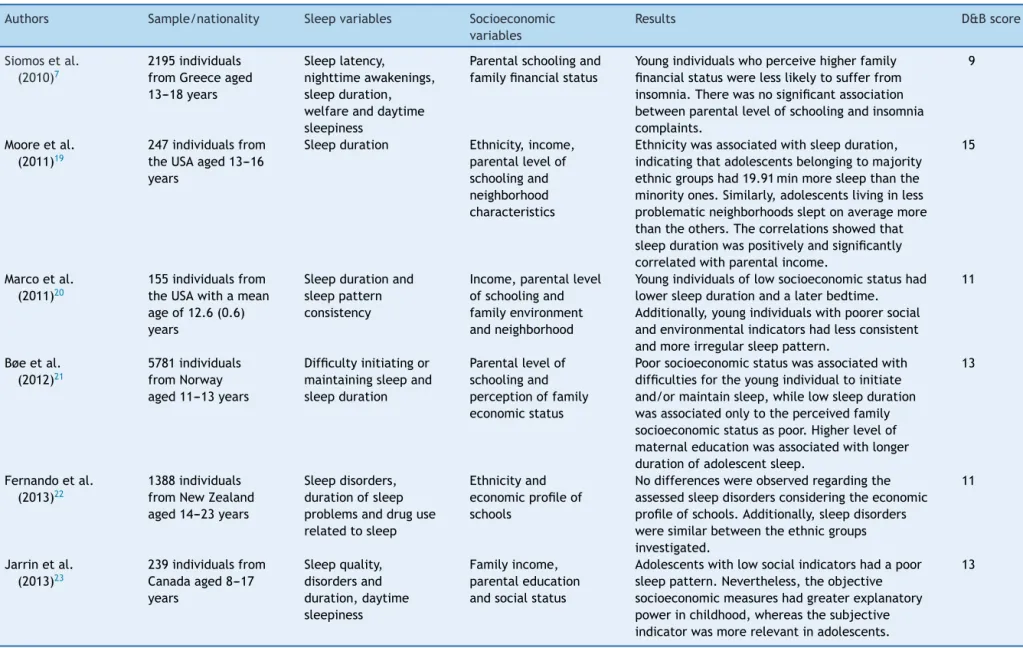
Tables 1 and 2 disclose general information about the 12 studiesincludedinthisreview,accordingtothedateof pub-lication(2000---2009inTable1and2010onwardsinTable2). The samples come from different countries: six fromthe USA,onefromNewZealand,onefromAustralia,onefrom Greece,onefromNorway,onefromCanadaandonefrom Brazil.Articlepublicationoccurred from2000 to2013;11 of them had a cross-sectional design and only one wasa longitudinalstudy.
Themost ofteninvestigatedsleepvariables weresleep duration,qualityanddisorders. Consideringthe socioeco-nomicvariables,weobservedseveralanalysisparameters, suchasschoolinglevelofparentsorguardians,income, eth-nicityandsocioeconomicstatusorlevel.
Ofthesixstudiesthatanalyzedadolescentsfrom differ-entethnicbackgrounds,differenceswereobservedrelated to sleep quality and sleep disorders such as insomnia or hypersomnia,inthreeofthem.Inotherstudies,which com-paredsleepvariablesaccordingtodifferentethnicgroups, itwasobservedthatprevalenceofsleepdisordersorpoor qualityofsleepwassimilarbetweenthegroups.
Theresearchersreported,infivereviewedstudies,that theadolescentsfromlow-incomefamiliesorwithmore obvi-ousindicatorsofpovertyweremorelikelytodevelopsleep disorders,suchasinsomnia anddifficultyinitiating and/or maintainingsleep.
Sleepdurationwasassociatedwithparentalincomeand ethnicity, and three studies indicated a decline in sleep durationinyoungindividualsoflowersocioeconomicstatus whencomparedtothoseofhighersocioeconomicstatus.In theonlystudycarriedoutinBrazil,sleepdurationtended todecreasewithincreasingsocioeconomicstatus.Regarding themeasures appliedin thestudies, twoarticles usedan actimeterastheobjectivemeasure toevaluate the dura-tion of sleep, whereas the other studies used subjective measuressuchasquestionnairesandinterviews.
Quality assessments of the selected studies are also describedinTable1(D&Bscore).Themedianscore, accord-ingtotheproposalbyDownsandBlack,14was12.2(minimum ofnineandmaximumof15points).Themeanscoreofthe articles was12, with a standard deviation of 1.78 point. Overall, the methodological limitations of the selected articles were related to the descriptions of individuals, considering,forinstance,theneedformoredetailed infor-mationonsampleloss.Itisworthmentioningthat,ofthe12 articles,noneprovidedinformationonthestatisticalpower ofthetestsused.Furthermore,thequestionsthatbestmet thecriteriaproposedforqualityanalysisarerelatedtothe internalvalidity(bias),presentinalltheanalyzedarticles.
Discussion
470
Felden
EPG
et
al.
Table1 Synthesisoftheselectedstudiespublishedbetween2000and2009.
Authors Sample/nationality Sleepvariables Socioeconomic variables
Results D&Bscore
Robertsetal. (2000)15
5423individuals fromtheUSAaged 10---17years
Insomniaand hypersomnia
Ethnicityand perceptionof socioeconomicstatus
Adolescentsfromdifferentethnicbackgrounds showeddifferencesrelatedtoinsomniaand hypersomnia.Insomniawasmorefrequentingroups ofAfricanandHispanicdescent.Adolescentsof Chinesedescentwerelesslikelytohavesleep problems.
13
Robertsetal. (2004)16
5118individuals fromtheUSAaged 13---18years
Insomnia,sleep duration,qualityof sleepandrestful sleep
Ethnicityandfamily lifestyle
Thestudyshowedsignificantdifferencesbetween ethnicgroupsregardinginsomniaandsleepquality. Insomniawasmoreprevalentamongpoor
adolescents.Theassociationsbetweeninsomniaand ethnicitywerenotsignificantafteradjustingfor confounders.Theadolescentsclassifiedas‘‘poor’’ were4.5timesmorelikelytoreportinsomnia.
12
Robertsetal. (2006)17
4.175individuals fromtheUSAaged 11to17yearsand adultcaregivers
Problemsfalling asleep,nighttime awakenings,insomnia andunrestfulsleep
Ethnicity,family incomeandlevelof schoolingof caregivers
Youngindividualswithlowfamilyincomeweremore likelytodevelopsleepdisorders.Individualsof Europeandescentweremorelikelytohavetrouble sleeping,havesleepingproblems(suchwakingup duringthenight)anddifficultyfallingasleepthan thoseofAfricandescent.Youngindividualsof Hispanicdescenthadalowerprevalenceofsleep problemsthantheonesofEuropeandescent.
11
Smaldonetal. (2007)18
68,418individuals fromtheUSAaged 6to17years
Qualityofsleep Ethnicity,parental levelofschooling, incomeandskincolor
Non-Hispanicwhiteadolescents,withhigherlevelsof familyeducation,wereapproximately30%more likelytohaveinadequatesleeppatterns.However,it wasverifiedthatadolescentswithlowerfamily incomewere50%lesslikelytohaveinadequatesleep patterns,havingasreferencetheadolescentswith higherfamilyincome.
14
Dollmanetal. (2007)6
900individuals fromAustraliaaged 10---15years(390in 1985and510in 2004)
Durationofsleep, bedtimeandwakeup time
Australian
socioeconomicindex
Whencomparingthetwoevaluations,therewasa significantreductioninsleepdurationinyoung individualswithlowersocioeconomicstatus(44min) thaninthosewithhighersocioeconomicstatus.
9
Bernardoetal. (2009)4
863individuals fromBrazilaged 10---19years
Sleepdurationand sleepdisorders
Socialclasses Sleepdurationshoweddecreasingtrendwith increasingsocioeconomicstatus.
13
Sleep
in
adolescents
of
different
socioeconomic
status
471
Table2 Synthesisoftheselectedstudiespublishedfrom2010onwards.
Authors Sample/nationality Sleepvariables Socioeconomic variables
Results D&Bscore
Siomosetal. (2010)7
2195individuals fromGreeceaged 13---18years
Sleeplatency, nighttimeawakenings, sleepduration, welfareanddaytime sleepiness
Parentalschoolingand familyfinancialstatus
Youngindividualswhoperceivehigherfamily financialstatuswerelesslikelytosufferfrom insomnia.Therewasnosignificantassociation betweenparentallevelofschoolingandinsomnia complaints.
9
Mooreetal. (2011)19
247individualsfrom theUSAaged13---16 years
Sleepduration Ethnicity,income, parentallevelof schoolingand neighborhood characteristics
Ethnicitywasassociatedwithsleepduration, indicatingthatadolescentsbelongingtomajority ethnicgroupshad19.91minmoresleepthanthe minorityones.Similarly,adolescentslivinginless problematicneighborhoodssleptonaveragemore thantheothers.Thecorrelationsshowedthat sleepdurationwaspositivelyandsignificantly correlatedwithparentalincome.
15
Marcoetal. (2011)20
155individualsfrom theUSAwithamean ageof12.6(0.6) years
Sleepdurationand sleeppattern consistency
Income,parentallevel ofschoolingand familyenvironment andneighborhood
Youngindividualsoflowsocioeconomicstatushad lowersleepdurationandalaterbedtime. Additionally,youngindividualswithpoorersocial andenvironmentalindicatorshadlessconsistent andmoreirregularsleeppattern.
11
Bøeetal. (2012)21
5781individuals fromNorway aged11---13years
Difficultyinitiatingor maintainingsleepand sleepduration
Parentallevelof schoolingand perceptionoffamily economicstatus
Poorsocioeconomicstatuswasassociatedwith difficultiesfortheyoungindividualtoinitiate and/ormaintainsleep,whilelowsleepduration wasassociatedonlytotheperceivedfamily socioeconomicstatusaspoor.Higherlevelof maternaleducationwasassociatedwithlonger durationofadolescentsleep.
13
Fernandoetal. (2013)22
1388individuals fromNewZealand aged14---23years
Sleepdisorders, durationofsleep problemsanddruguse relatedtosleep
Ethnicityand economicprofileof schools
Nodifferenceswereobservedregardingthe assessedsleepdisordersconsideringtheeconomic profileofschools.Additionally,sleepdisorders weresimilarbetweentheethnicgroups investigated.
11
Jarrinetal. (2013)23
239individualsfrom Canadaaged8---17 years
Sleepquality, disordersand duration,daytime sleepiness
Familyincome, parentaleducation andsocialstatus
Adolescentswithlowsocialindicatorshadapoor sleeppattern.Nevertheless,theobjective socioeconomicmeasureshadgreaterexplanatory powerinchildhood,whereasthesubjective indicatorwasmorerelevantinadolescents.
13
472 FeldenEPGetal.
anddelineateopportunitiesforandbarrierstodevelopment andalsothe higheror lowerprobabilityof havingcertain healthconditions.Nevertheless,studieshave shown possi-bleassociationsbetweensocialaspectsandsleep.4,15,22
In this sense, this systematic review aimed toanalyze theassociationbetweensocioeconomicstatusandsleepin adolescents,asthisisanagegroupthatisparticularly vul-nerabletosleepproblems.The selectedarticlesaimedto answerhowsleepvariables,suchassleepquality,timeto wakeupandgotosleep,sleepduration,daytimesleepiness, amongothers,areassociatedwithsocioeconomicindicators oftheadolescents.
Ingeneral,thereisanassociationbetweensleep varia-blesandsocioeconomicstatus.Jarrin,McGrathandQuon,23 forinstance,explainthatfamilieswithlowersocioeconomic statushavelessorganizedhouses,withmorenoiseandless knowledgeaboutsleephygiene.Thus,thelowsocialstatus couldbeastressorandreducethequalityofsleep.Among the analyzed studies,6,20,21 this association seems tobe a trendamong adolescents fromforeign samples. However, for Smaldoneetal.,18 this outcomewas notthe same.In thisstudy,non-Hispanicwhiteadolescentswithhigherlevel offamilyeducationwereapproximately30%morelikelyto haveinadequatesleeppatterns,whencomparedwithother ethnicgroups(non-Hispanic blacks,Hispanicsandothers). Intheanalyzedstudies,associationsbetweenethnicityand socioeconomic variables showed noagreement.15---17,19,22,25 Oneoftheexplanations,accordingtoRobertsetal.,17would bethatsleepproblemsareassociatedwiththesocialstatus ofaminority,notbeingassociatedwithethnicity.Another importantpoint,accordingtosomeauthors,16,17isthefact thatyoung individuals who belongto minoritygroups can expressmentalsufferinginanegativeway,especiallyamong immigrants. These are more susceptible to ethnic preju-diceandnegativestereotypes and,therefore,more likely tointernalizetheirminoritystatus,whichcanaffecttheir perceptionsandbehaviors.
ThestudybyMarcoetal.20wastheonlyonetocarryout adiscussion ontheassociations betweensleep and socio-economiclevels,consideringschoolandnon-schooldays.In general,itwasfoundthatschoolhours,aswellashousing andhygieneconditionsmodifytheefficiencyanddurationof sleep,withthelow-incomeadolescentsshowingworsesleep qualityonschooldaysandweekends.Nevertheless,housing conditionsandneighborhoodcharacteristics becomemore importantonweekends,asonschooldays,theschool sched-ulecontributestotheadolescents’sleepregulation.
In addition to quality, other sleep variables were associated in the selected studies, especially sleep dis-orders, such as insomnia,15---17 hypersomnia,15 nocturnal awakenings,7,17,23restlesslegsyndrome,sleepwalking, talk-ing during sleep, bruxism and delayed sleep phase.22 Excessive daytime sleepiness is a possible indicator of increasedneed forsleepandisassociatedwithdecreased schoolperformance,negativelyinfluencinglearning,social interactionand adolescent quality of life. Adolescence is associatedwithdelayedsleepphaseandthemorningschool hours,whichleadtodecreased sleepduration.2 Addition-ally,asverifiedinthisreview,excessivedaytimesleepiness isassociatedwithbothbiologicalandbehavioralfactorsand withvariablesrelatedtotheenvironmentwherethe adoles-centlives.7,23
Based on the reading of the selected articles, it was observedthatdifferentindicatorswereusedtodetermine the socioeconomic status of adolescents. In international studies, the questions on parental level of schooling and familyincomeare theones more oftenused.In Brazil, it is common touse the economic classification criterion of theBrazilianAssociationofPopulationStudies---ABEP.This isa questionnairethattakesintoaccountthehead ofthe family’seducationallevel,thepossessionofconsumergoods suchashomeappliances,electronicsandautomobiles.The sumofthenumberofitemsprovidesascore,which catego-rizesthefamilyinrelationtoitseconomicstatus.26
Itwasverifiedthatthemainformofsleepassessmentwas throughquestionnaires,i.e.,subjectively.Amongthese,we highlightquestionsrelatedtosleepduration,obtainedfrom the bedtime and wake up time reported by adolescents. Few studies used directmeasures, such asthe actimeter, fortheiranalysis.19,20Thistoolischaracterizedbybeingan objectivemeasure,similartoawristwatch,whichcontainsa devicethat,basedontheindividual’smovement,estimates sleeping and waking hours through electronic sensors.19 Additionally, theactigraphy allowsobtainingmoreprecise information on the times with greater and lesser motor activityduringthedayandnightaswellassleeplatencyand efficiency.Inbothstudiesusingactigraphy,itwasobserved thatyoungindividualswithlowsocioeconomicstatus20 and fromethnicminorities19hadshortersleepduration.
There was a methodological limitation of the articles mentioned in this review when considering the checklist proposedbyDownsandBlack.14Thedescriptionofthe sta-tistical power of the statistical tests used in the studies wasnot shown in any of the articles, indicating that this informationneeds tobe better understood and described byresearchers.
Theonly studywitha Braziliansample wastheone by Bernardo et al.,4 carried out with adolescents from São Paulo.Thisstudyidentifiedtrendsthatwereoppositetothe onesfoundinforeignsamples,i.e.,adolescentswithhigher socioeconomicstatushad worseindicators ofsleep.Thus, it is necessary to develop other Brazilian studies to bet-tersupporttheeducationalproposalsinhealthandsleep, consideringtherealityofdevelopingcountries.
Final
considerations
Basedontheanalysisofthearticlesselectedforthis system-aticreview,we observedasignificantassociation between socioeconomicindicatorsandsleepofadolescents.In gen-eral,thelow socioeconomicstatusis reflectedina worse subjectiveperceptionofsleepquality,shorterdurationand greaterdaytimesleepiness.
Regardingethnicfactors,amoredirectinvestigation is requiredwithanepidemiologicalcontexttotry toexplain whetherthereisanassociationwithsleepvariables.
Sleepinadolescentsofdifferentsocioeconomicstatus 473
thoseseenintheforeignstudies,showingshorterdurationof sleepamongadolescentsinhighersocioeconomicclasses.4
Consideringthatsleepcaninfluencethebehavioraland emotional states, physical and cognitive development,in additiontolevelsofattentionandlearningofadolescentsor studentsingeneral,itisemphasizedthatbadsleephabits, initiated in childhood and adolescence, can persist into adulthood. Therefore,we need morestudies onthe asso-ciationsbetween sleepand socioeconomicstatusin order toattainbetterplanningofpublicandeducationalpolicies.
Funding
Thisstudydidnotreceivefunding.
Conflicts
of
interest
Theauthorsdeclarenoconflictsofinterest.
References
1.CarskadonMA,VieiraC,AceboC.Associationbetweenpuberty anddelayedphasepreference.Sleep.1993;16:258---62. 2.PereiraEF,TeixeiraCS,LouzadaFM.Daytimesleepinessin
ado-lescents:prevalenceandassociatedfactors.RevPaulPediatr. 2010;28:98---103.
3.Moore M, Meltzer LJ. The sleepy adolescent: causes and consequences of sleepiness in teens. Paediatr Respir Rev. 2008;9:114---20.
4.BernardoMP,PereiraEF,LouzadaFM,D’AlmeidaV.Sleep dura-tioninadolescentsofdifferentsocioeconomic status.JBras Psiquiatr.2009;58:231---7.
5.Perez-Chada D, Perez-Lloret S, Videla AJ, Cardinali D, Bergna MA, Fernandez-Acquier M, et al. Sleep disordered breathing and daytime sleepiness are associated with poor academic performance in teenagers. A study using the pediatric daytime sleepiness scale (PDSS). Sleep. 2007;30: 1698---703.
6.DollmanI,RidleyK,OldsT,LoweE.Trendsinthedurationof school-daysleep among10- to 15-year-oldSouth Australians between1985and2004.ActaPaediatr.2007;96:1011---4. 7.Siomos KE, Avagianou P-A, Floros GD, Skenteris N, Mouzas
OD, Theodorou K, et al. Psychosocial correlates of insom-nia in an adolescent population. Child Psychiatry Hum Dev. 2010;41:262---73.
8.O’DeaJA, Dibley MJ,Rankin NM. Low sleep and low socio-economic status predict high body mass index: a 4-year longitudinalstudyofAustralianschoolchildren.PediatrObes. 2012;7:295---303.
9.Rey-López JP, Carvalho HB, Moraes AC, Ruiz JR, Sjostrom M,Marcos A, et al. Sleep time and cardiovascular risk fac-torsinadolescents: theHELENA(HealthyLifestyleinEurope by Nutrition in Adolescence) study. Sleep Med. 2014;15: 104---10.
10.Pereira EF, Moreno C, Louzada FM. Increased commuting to schooltimereducessleepdurationinadolescents.Chronobiol Int.2014;31:87---94.
11.PopoolaVO,TammaP,ReichNG,PerlTM,MilstoneAM.Risk fac-torsfor persistentmethicillin-resistantstaphylococcusaureus colonizationinchildrenwithmultipleIntensiveCareUnit admis-sions.InfectControlHospEpidemiol.2013;34:748---50. 12.ElHamidHusseinRA.Socioeconomicstatusanddietaryhabitsas
predictorsofhomebreakfastskippinginyoungwomen.JEgypt PublicHealthAssoc.2014;89:100---4.
13.YaogoA,FombonneE,KouandaS,LertF,MelchiorM.Lifecourse socioeconomic position and alcoholuse in young adulthood: resultsfromtheFrenchTEMPOcohortstudy.AlcoholAlcohol. 2014;49:109---16.
14.DownsSH,BlackN.Thefeasibilityofcreatingachecklistforthe assessmentofthemethodologicalqualitybothofrandomised andnon-randomisedstudiesofhealthcareinterventions.J Epi-demiolCommunityHealth.1998;52:377---84.
15.Roberts RE, Roberts CR, Chen IG. Ethnocultural differences in sleep complaints among adolescents. J Nerv Ment Dis. 2000;188:222---9.
16.RobertsRE,LeeES,HernandezM,SolariAC.Symptomsof insom-niaamongadolescentsinthelowerRioGrandevalleyofTexas. Sleep.2004;27:751---60.
17.RobertsRE,RobertsCR,ChanW.Ethnicdifferencesinsymptoms ofinsomniaamongadolescents.Sleep.2006;29:359---65. 18.SmaldoneA,HonigJC,ByrneMW.SleeplessinAmerica:
inad-equatesleepandrelationshipstohealthandwell-beingofour nation’schildren.Pediatrics.2007;119:S29---37.
19.MooreM,KirchnerHL,DrotarD,JohnsonN,RosenC,Redline S.Correlatesofadolescentsleeptimeandvariabilityinsleep time:theroleofindividualandhealthrelatedcharacteristics. SleepMed.2011;12:239---45.
20.MarcoCA,WolfsonAR,SparlingM,AzuajeA.Family socioeco-nomicstatusandsleeppatternsofyoungadolescents.Behav SleepMed.2011;10:70---80.
21.BøeT,HysingM,StormarkKM,LundervoldAJ,SivertsenB.Sleep problems asa mediatoroftheassociationbetween parental educationlevels,perceivedfamilyeconomyand poormental healthinchildren.JPsychosomRes.2012;73:430---6.
22.FernandoAT,SamaranayakeCB,BlankCJ,RobertsG,ArrollB. SleepdisordersamonghighschoolstudentsinNewZealand.J PrimHealthCare.2013;5:276---82.
23.JarrinDC,McGrathJJ,QuonEC.Objectiveandsubjective socio-economicgradientsexistforsleepinchildrenandadolescents. HealthPsychol.2014;33:301---5.
24.AlvesMT,SoaresJF,XavierFP.Avaliac¸ãoecurrículo:umdiálogo necessário.In:ProceedingsoftheVIIReuniãodaABAVE.2013. p.15---32.
25.Roberts M, Minott DA, Pinnock S, Tennant PF, Jackson JC. Physicochemicalandbiochemicalcharacterizationoftransgenic papayamodifiedforprotectionagainstPapayaringspotvirus.J SciFoodAgric.2014;94:1034---8.