2010 Jul-Aug; 18(4):778-85 www.eerp.usp.br/rlae
Corresponding Author:
Alessandra Nazareth Caine Pereira Roscani Rua José Paulino, 1875 Ap. 62B Vila Itapura
CEP: 13023-102 Campinas, SP, Brasil E-mail: [email protected]
Attention Demands in the Workplace and the Capacity to
Direct Attention of Nurses
1Alessandra Nazareth Caine Pereira Roscani
2Edinêis de Britto Guirardello
3This was a descriptive, correlational study designed to evaluate the capacity to direct
attention (CDA) of the nurse and to verify an association between the CDA and attention
demand situations. For data collection the instruments used were: the Attentional Function
Index and the Directed Attention Demands. The participants were 169 nurses of a teaching
hospital in the State of São Paulo. The mean perception of performance or CDA was 60.4
which differed between the variables: unit of work (p=0.013), work hours (p=0.044),
presence of health problems (p=0.026) and problems of a psychological nature (p=0.005).
There was a negative association between the situations of demand and CDA (r = - 0.294,
p<0.0001). It was concluded that nurses showed good CDA, which was related to some
professional and demographic variables, and the higher the attentional demands, the lower
the CDA.
Descriptors: Nursing; Attention; Health Facility Environment.
1 Paper extrated from Master’s Thesis “Capacidade de direcionar atenção e demandas de atenção do enfermeiro no ambiente de
trabalho” presented to Programa de Pós-graduação em Enfermagem, Faculdade de Ciências Médicas, Universidade Estadual de Campinas, SP, Brazil.
2 RN, M.Sc. in Nursing, Hospital de Clínicas, Universidade Estadual de Campinas, SP, Brazil. E-mail: [email protected]. 3 RN, Free Lecture, Associate Professor, Faculdade de Ciências Médicas, Universidade Estadual de Campinas, SP, Brazil. Email:
Demandas de atenção no ambiente de trabalho e capacidade de direcionar atenção do enfermeiro
Este é um estudo descritivo e correlacional, cujo objetivo foi avaliar a capacidade
de direcionar atenção (CDA) do enfermeiro e veriicar se há associação entre CDA
e as situações de demanda de atenção. Para a coleta de dados foram utilizados os
instrumentos: Attentional Function Index e Demandas de Atenção. Participaram do estudo
169 enfermeiros de um hospital de ensino do interior do Estado de São Paulo. A média
da percepção de desempenho, ou CDA, foi de 60,4 e diferiu entre as variáveis: unidade de trabalho (p=0,013), carga horária (p=0,044), presença de algum problema de saúde
(p=0,026) e problema de cunho psicológico (p=0,005). Existe associação negativa entre
as situações de demanda e CDA (r=-0,294; p<0,0001). Conclui-se que os enfermeiros
apresentaram boa CDA, inluenciada por aspectos demográicos e proissionais e que
quanto maior as situações de demanda de atenção menor a CDA.
Descritores: Enfermagem; Atenção; Ambiente de Instituições de Saúde.
Demandas de atención en el ambiente de trabajo y la capacidad del enfermero de dirigir su atención
Se trata de un estudio descriptivo y correlacional que tuvo por objetivo evaluar la
capacidad que tiene el enfermero de dirigir su atención (CDA) y veriicar se hay
asociación entre CDA y situaciones de demanda de atención. Para la recolección de
datos se utilizó los instrumentos: Attentional Function Index y Demandas de Atención.
Participaron del estudio 169 enfermeros de un hospital de enseñanza del interior del
estado de Sao Paulo. El promedio de la percepción de desempeño (CDA) fue de 60,4
y tuvo resultados diferentes entre las variables: unidad de trabajo (p=0,013); carga
horaria (p=0,044); presencia de algún problema de salud (p=0,026) y problema de
orden psicológico (p=0,005). Existe una asociación negativa entre las situaciones de
demanda y CDA (r=- 0,294; p<0,0001). Se concluye que los enfermeros presentaron
buena CDA, la cual es inluenciada por aspectos demográicos y profesionales y que cuanto más grandes son las situaciones de demanda de atención, menor es la CDA.
Descriptores: Enfermería; Atención; Ambiente de Instituciones de Salud.
Introduction
The environment of professional nursing practice
has been the focus of national and international studies,
due to two factors, the irst related to the quality of care
provided, with the main aspect being patient safety(1-2)
and the second, related to the reduction or the shortage
of these professionals(3-5).
Nursing is a profession that requires dedication of
the individual that is willing to implement it. Besides
requiring the scientiic and technical knowledge to handle
the demands of high complexity and specialization, it
calls for the continuous professional development of
communication and relationship skills, since it cannot
dispense with its affective aspects, sensitivity and
interpersonal relationships. It mainly requires physical
and psychological skills to meet client needs, initiative
and the ability to make quick decisions, which the life of
another person often depends on.
The American Association of Critical Care Nursing
(AACN) highlights the importance of specialized
knowledge, skills and experience to cope with changes
arising from the complexity of patient care. It emphasizes
that the improvement of the working environment will
favor the retention and recruitment of nurses(6).
Nurses, in the exercise of their activities, are faced
with multiple situations of attention demand in the
or capacity to direct attention (CDA) in information
processing, decision making and acquisition of new
knowledge and skills. The CDA is a kind of selective
attention, which requires in individuals the inhibition
of distractive, competitive stimuli, as they process and
organize important information(7). This is necessary
for the effective functioning of daily life, because
it allows the person to perceive, think clearly and
maintain the intended activity despite distractions in the
environment(8-9).
For example, situations involving care of seriously
ill patients or those with a risk of imminent death are
considered sources of attention demands(10-12) and
exposure to these demands can override the CDA,
resulting in attention fatigue(7-8), which is manifested
as a decreased ability to concentrate, irritability,
intolerance, impatience and reduced performance in the
management of daily activities.
The theme of attention demands has been addressed
in people with health problems(8-9,13-14), the elderly(15),
students(16-17) and nurses(10-12). The sources of attention
demand of the nurse can be evaluated using a speciic
instrument, called Directed Attention Demands(10).
It is understood that it is important to identify the
different sources of attention demands that the nurse is
exposed(12) since the workload and physical and mental
attrition, accidents and occupational illnesses and
absenteeism are associated with the work environment of
these professionals(18-20). However their isolated analysis
only allows the recognition of those situations of more
or less attention demand. Therefore, studies aimed at
evaluating the nurses` perception of performance for
attention or CDA are relevant to understanding the
inluence of these attention demands on the individual’s
capacity to direct attention.
The motivation for this study arose from professional
experience as a nurse in critical care units where, by the
very nature of this environment, there is an exposure
of the professional to multiple demand situations that
inluence the ability to maintain focus or concentration on
daily activities. Given this, there was a need to evaluate
the CDA of nurses and to test the hypothesis that the
greater the attention demand situations experienced by
nurses, the lower their capacity to direct attention.
It is noteworthy that the imbalance between these
variables can cause both personal and professional
damage, demonstrating that to understand and
reevaluate the context of the work environment of nurses
may relect in better results for care and, consequently,
for the institutions it contributes for the managers and
administrators in developing strategies that enhance the
practice of the professional nurse.
Objectives
The aim of this study was to evaluate the CDA or
perception of performance in the attention of nurses in
the workplace and, as secondary objectives: a) to verify
if differences exist between the CDA and demographic and professional variables, and b) to verify if association
between the CDA and attention demand situations of
nurses exists.
Method
Location of study
The study was conducted in a teaching hospital, in
the state of São Paulo, of tertiary care that gives complex
and hierarchical assistance, with a care capacity of 359
beds.
Population and sample
The study population consisted of 272 nurses who
carry out care activities in different shifts of nursing
services. The sample consisted of nurses who met
the inclusion criteria: a) carry out direct patient care,
b) working time at least six months in the institution and c) consent to participate in the study. Those nurses
who were absent due to vacation or medical leave and
those whose instruments were incomplete or were not
returned were excluded from the sample.
Instruments
Two instruments were used for data collection: the
Attentional Function Index (AFI)(17) and the Directed
Attention Demands(10).
The AFI aims to subjectively measure how the
individual evaluates their performance in certain situations that require concentration or CDA. It consists
of 16 items in a visual analogue scale ranging from
zero to 100 mm. The score is obtained with the mean
of the sum of all items. Values near zero indicate a low
perception of performance and values near 100 indicate
a high perception of performance. It is an instrument
which has good internal consistency, with Cronbach alphas ranging from 0.84 to 0.94(8-9,17).
The Directed Attention Demands instrument
aims to identify situations of attention demand in the
work environment of nurses(10). It is comprised of 39
Roscani ANCP, Guirardello EB.
(14 items), psychological environment (12 items) and
behavioral environment (13 items). There are two types
of measures: frequency and intensity, which can be
analyzed independently or through a score resulting
from the product of both.
The irst asks the nurse about the frequency that
they have experienced a given situation, using a Likert
scale, with ive alternative answers ranging from “never,
rarely” to “often/all the time.” In the second, the nurse is
asked to answer how much mental effort is required for
that particular situation itself, through a visual analogue
type measurement scale, which ranges from zero to
100 millimeters. The score is obtained by the product of
frequency by intensity. It is an instrument that also has
good internal consistency, with a Cronbach’s alpha 0.90
to 0.91(10-12).
For this study, the opinion of the professionals was
considered, regarding the frequency and intensity of
each situation, and calculated as a total score, which
takes into consideration the two measures for each
situation.
A characterization form was also used containing
personal and professional aspects of the nurses, such
as: age, sex, marital status, presence of any health
problems, length of professional training, professional
qualiications, number of employment contracts and
weekly working hours.
Procedure
Initially, project approval was obtained from the
Research Ethics Committee of the Faculty of Medical
Sciences of UNICAMP. Data collection was performed
by one of the researchers, in the period from June to
July 2008, during the workday of the nurses with prior
consultation of the nursing services work schedules.
Nurses who met the inclusion criteria to participate
in the study were informed about the aims and those
who agreed were asked to sign the Informed Consent.
They were then given the envelope containing the
instruments and a copy of the Informed Consent, any
doubts were clariied and the location and date for the
return of the instruments were set.
Data analysis
For statistical analysis of the data the program
SPSS®
(Statistical Package for the Social Sciences)
version 15.0. was used. To describe the sample proile,
according to the study variables, frequency tables were
created of the frequency of the categorical variables
and descriptive statistics for the continuous variables.
The variable ‘presence of any health problem’, when
described, was related to the variable, ‘the presence
of disorders of a psychological nature’ since these can
affect cognitive performance of the individual.
In the comparison of the variables, we used the
Chi-square test or Fisher exact test for categorical variables;
the Mann-Whitney test for continuous or ordered
variables between two groups, and the Kruskal-Wallis
between three or more groups. To analyze the variance
between instruments and personal and professional
variables the analysis of variance (ANOVA) was used,
followed by the Tukey’s test, when statistical differences
were found.
The reliability of the instruments was assessed
using Cronbach’s alpha, with values above 0.70
being considered as an acceptable level. The Pearson
correlation coeficient was used to measure the
association between the attention demand situations
and the scale of perceived attention performance. The
level of signiicance adopted for the statistical tests was
5%, i.e. p<0.05.
Results
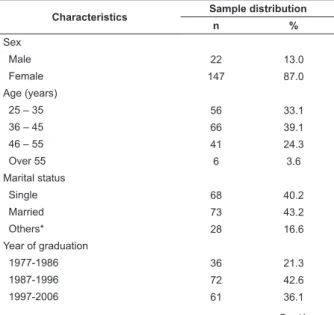
The participants were 169 nurses, mostly female,
with a mean age of 40 years, the majority married (43.2%)
and working the night shift (40.2%). The average time
since professional graduation was 16 years, with most
(56.8%) at a Latu sensu (post graduation specialization)
level of qualiication and with one employment contract
(68%) (Table 1).
Characteristics Sample distribution
n %
Sex
Male 22 13.0
Female 147 87.0
Age (years)
25 – 35 56 33.1
36 – 45 66 39.1
46 – 55 41 24.3
Over 55 6 3.6
Marital status
Single 68 40.2
Married 73 43.2
Others* 28 16.6
Year of graduation
1977-1986 36 21.3
1987-1996 72 42.6
1997-2006 61 36.1
Table 1 – Sociodemographic and professional
characteristics of the nurses. Campinas,2009 (n = 169)
Table 1 – Continuation
Characteristics Sample distribution
n %
Professional qualification
Graduate degree 57 33.7
Lato sensu** 96 56.8
Stritcto sensu*** 9 5.3
Others 7 4.1
Employment contracts
One 115 68.0
Two or more 54 32.0
Work shift
Morning 52 30.8
Afternoon 49 29.0
Night 68 40.2
*Others: Separated, divorced, widowed, others; **Lato sensu:Specialization and Residency ***Stricto sensu: MSc/PhD.
The average length of time worked in the unit was
9.5 (± 6.63) years and in the institution 13.3 (± 7.46)
years. The hours worked in the last week, for the majority,
63 (37.3%), was 36 hours. Another aspect approached
with the nurses was related to health problems, noting
that 73 (43.2%) reported some type of problem and of
these 14 (19.2%) reported problems of a psychological
nature.
As regards the CDA of nurses, it was found that
the mean of perception of performance of these nurses
was 60.4, with means per item ranged from 34.9 to
72.0 (Table 2). In assessing the internal consistency
of the instrument, a reliability coeficient of 0.83 was
obtained.
Table 2 - Mean and standard deviation of the score given by respondents to situations of perceived attention
performance of the nurse. Campinas, 2009 (n = 169)
Items Mean SD* Min – Max**
Finishing things you have started 72.0 21.0 0 - 100
Make your mind up about things 71.1 19.9 2 - 100
Keeping you mind on what you are doing 70.1 21.9 8 - 100
Getting started on activities (tasks, jobs) you intend to do 69.6 20.4 14 - 100
Planning your daily activities 69.1 21.2 0 -100
Keeping track of what you are saying or doing (keeping your train of thought) 67.7 22.8 0 - 100
Keeping you mind on what others are saying 66.4 22.6 0 - 100
Following through on your plans 64.5 22.3 0 - 100
Remember to do all the things you started out to do 62.9 23.9 0 - 100
Being patient with others 62.3 25.3 7 - 100
Keeping yourself from saying or doing things you did not want do say or to do 61.9 23.9 0 - 100
Do things that take time and effort 60.9 23.6 0 - 100
How hard you find it to concentrate on details 48.2 25.9 0 - 100
Getting easily annoyed or irritated 47.5 27.8 0 - 100
Forgetting to do important things 38.0 28.3 0 - 100
How often you make mistakes on what you are doing 34.9 28.0 0 - 99
Total 60.4 12.8 26,4 - 92,6
*SD: Standard Deviation ** Min – Max.: Minimum – Maximum
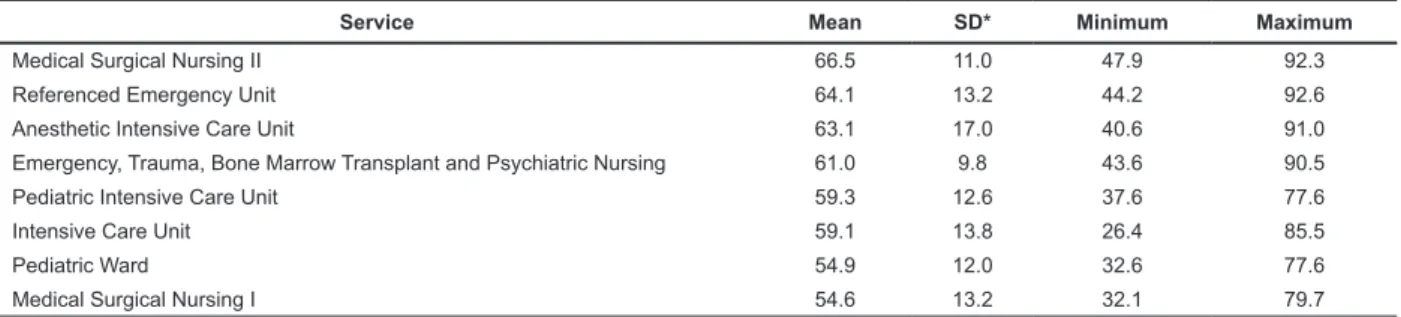
The perception of attention performance judged
by nurses differed between the services (p=0.013),
in which nurses from the Medical Surgical Nursing II
Service obtained higher means in relation to the nurses
of the Medical Surgical Nursing I Service (p=0.004) and
Pediatrics (p=0.035), as shown in Table 3.
Table 3 –Mean and standard deviation of the perception of performance of attention of the nurse by the nursing
services. Campinas, 2009 (n = 169)
Service Mean SD* Minimum Maximum
Medical Surgical Nursing II 66.5 11.0 47.9 92.3
Referenced Emergency Unit 64.1 13.2 44.2 92.6
Anesthetic Intensive Care Unit 63.1 17.0 40.6 91.0
Emergency, Trauma, Bone Marrow Transplant and Psychiatric Nursing 61.0 9.8 43.6 90.5
Pediatric Intensive Care Unit 59.3 12.6 37.6 77.6
Intensive Care Unit 59.1 13.8 26.4 85.5
Pediatric Ward 54.9 12.0 32.6 77.6
Medical Surgical Nursing I 54.6 13.2 32.1 79.7
Roscani ANCP, Guirardello EB.
By comparing the differences in relation to the
perception of performance of attention of nurses and the
personal and professional variables, the data indicated
differences in the variables ‘hours worked last week’ and
‘health problems’.
The nurses who worked up to 40 hours, judged
less perception of performance of attention or CDA
in relation to those who worked more than 40 hours
(p=0.044), and those who reported a health problem
also had lower means of performance of attention
(p=0.026) compared to the other nurses. Evaluation of
the data of the group of nurses with health problems
indicated that those with a problem of a psychological
nature showed lower CDA compared to the other nurses
(p=0.005).
Evaluating of whether an association exists between
the AFI and Directed Attention Demands resulted in
a negative association of low magnitude (r=- 0.294,
p<0.01) demonstrating that when the situations of
attention demand are greater, the CDA is lower.
Discussion
The study highlights the predominance of women,
explained by the sociohistorical trajectory of the
profession(21), which corroborates other studies(1,10-11,22).
The mean age of the nurses showed a young adult group,
which resembles the indings of other studies(11,22). Another important aspect was that in this age group
there is a predominance of married nurses, data similar
to a national study(23).
The mean length of experience of 16 years
corroborates with other studies(2,22) and shows the
existence of professionals with extensive experience
by staying at the same location, which enables the
acquisition of skills necessary for the exercise of the
profession. The mean working time in the institution was
similar to another study with nurses from the critical
care unit(22) and higher than the national studies(11-12).
Furthermore, most have some kind of
post-graduation at lato sensu level, with the quest for
qualiication being a requirement of the labor market that requires professionals with speciic knowledge and
expertise.
Most nurses have only one employment contract,
which is similar to studies with nurses from private
institutions(11-12). It is noteworthy that during the study,
despite having only one work contract, some nurses
reported having carried out more working hours than
that established in their labor contract, which can be
justiied by overtime, resulting from the needs of the
service or for an improvement in their salary.
Regarding the measure of perceived attention
performance or CDA, the nurses presented a good
perception of performance which resulted in a
satisfactory level of internal consistency that resembles
other studies(7,9,17,24). No studies were found in the
literature that could be used for comparison with this
study. However, these indings are similar to studies
evaluating the CDA with students(16-17) and people with
health problems(8-9,13-14,24-25).
It is noteworthy that CDA is essential for nurses in
performing activities that require concentration such as
planning and giving assistance to the patient and their
family, coordinating activities related to their role in
the unit as well as to relating with the interdisciplinary
team.
An interesting inding was that the CDA of nurses
was different among the services because the nurses of
the Medical-Surgical Nursing I and the pediatrics service
judged lower perception of attention performance in
relation to nurses from the other services. The reasons
for this inding may be related to the characteristics of a
hospital where the patient with high complexity of care
is also assisted in other units like no Intensive Care Units
that usually did not have the equipment and human
resources necessary to attend patients who normally
have a high nursing dependency and a risk of instability,
as is the case for pediatric, neuroclinical, neurosurgical,
traumatological, orthopedic, hematological and
nephrological patients.
An unexpected inding was that the nurses who had
worked over 40 hours in the previous week reported a higher
perception of performance of attention in relation to nurses
whose worked less than 40 hours. One of the explanations
for this inding may be that the option of performing more
hours than their employment contract, aimed at improving
personal income, can lead to better planning, organization
and consequently personal achievement, which would
minimize physical and mental fatigue.
It is noteworthy that the perception of attention
performance of the nurse was lower for those with health
problems and health problems of a psychological nature,
showing their inluence on the CDA.
Concerning the hypothesis of a negative correlation
between the situations of attentional demands and CDA
or perception of performance for attention, this was
conirmed, because the greater the situations of demand
in the workplace, the lower the CDA or perception of
Faced with these indings, it shows the necessity
of the nurses, nursing managers and administrators to adopt strategies to promote positive working
environments that minimize situations of attention
demand for nurses in their work environment, which will facilitate better attention performance or CDA and
consequently improve the assistance provided by this professional.
This study allowed an evaluation of how nurses perceive their performance in situations that require
concentration or mental effort. However, a limitation of this study was the impossibility of comparing the
measure of perceived performance or CDA with nurses,
indicating the need for further related research.
Conclusion
The study allowed the conclusion that the nurses had a good perception of the attention performance or
CDA. But this differed with the nurses of the pediatric and Medical Surgical I services, whose averages were
lower than other nurses in other services.
The nurses who worked a weekly workload of less
than 40 hours, judged the CDA means lower in relation
to nurses with a workload exceeding 40 hours, which
was unexpected in this study. The presence of health
problems and a condition of a psychological nature
also interfered with the CDA of these nurses.
There is a negative association between CDA
and attentional demands, i.e. the more attentional
demand situations in the work environment of nurse,
the lower the perception of performance for activities
of quotidian life.
This highlights the importance of the contribution
of these indings for future studies, since the
situations experienced in the work environment of
nurses interfere with their physical and psychological
health, and with their performance of activities that
require mental effort or an increase in concentration.
The indings of this study highlight the need to assess
the CDA with other groups of nurses and other health
institutions and the importance of comparison with
future studies.
References
1. Aiken LH, Clarke SP, Sloane DM, Lake ET, Cheney T. Effects of hospital care environment on patient mortality and nurse outcomes. JONA. 2009; 39(7/8):45-51.
2. Kutney-Lee A, Lake ET, Aiken LH. Development of the hospital nurse surveillance capacity profile. Res Nurs Health 2009; 32:217-28.
3. Aiken LH, Clarke SP, Sloane DM, Sochalski JA, Busse R, Clarke H, et al. Nurse’s reports on hospital care in five countries. Health Affairs. 2001; 20:43-53.
4. Mendes IAC, Marziale MHP. Shortage of qualified health workers: a call to action for nurses. Rev. Latino-Am. Enfermagem. março/abril 2008;16(2):171-2. Inglês, Português, Espanhol. 5. Huston CJ. The current nursing shortage: causes, consequences and solutions. In: Huston, CJ. Professional issues in nursing: challenges and opportunities. 2. ed Philadelphia: Lippincott Williams & Wilkins, 2010. p. 71-91.
6. AACN: Standards for establishing and sustaining healthy work environments: A Journey to Excellence 2005. [Acesso em: Jan 2010]. Disponível em: http://www.aacn.org/aacn/pubpolcy.nfs/ vwdoc/workeny?opendocument.
7. Kaplan S. The restorative benefits of nature: toward an integrative framework. J Environ Psychol. 1995;15(3):169-82. 8. Cimprich B. Attentional fatigue following breast cancer surgery. Res Nurs Health. 1992; 15:199–207.
9. Cimprich B. Age and extent of surgery affect attention in women treated for breast cancer. Res Nurs Health. 1998;21:229–38. 10. Guirardello EB. Adaptação cultural e validação do instrumento demandas de atenção dirigida. Rev Esc Enferm USP. 2005;39(1):77-84.
11. Brito C. Demandas de atenção do enfermeiro de unidades de cuidados críticos. [Dissertação]. Campinas (SP): Universidade Estadual de Campinas; 2006.
12. Santos LSC, Guirardello EB. Nurses’ attention demands in the work setting. Rev. Latino-Am. Enfermagem. jan/fev 2007;15(1):27-33. Inglês, Português, Espanhol.
13. Jansen DA, Cimprich B. Attentional impairment in persons with multiple sclerosis. J Neurosci Nurs. 1994;26(2):95-102. 14. Pontes L, Guirardello EB, Campos CJG. Demandas de atenção de um paciente na unidade de transplante de medula óssea. Rev Esc Enferm USP. 2007;41(1): 154-60.
15. Jansen DA. Attentional demands and daily functioning among community-dwelling elders. J Comm Health Nurs. 2006;23(1):1-13.
16. Tennessen CM, Cimprich B. Views to nature: effects on attention. J Environ Psychol 1995; 15:77-85.
17. Reis CK. Adaptação cultural e validação do Attentional Function Index para cultura Brasileira. [Dissertação]. Campinas (SP): Universidade Estadual de Campinas; 2007.
18. Cavalheiro AM, Moura Junior DF, Lopes AC. Stress in nurses working in intensive care units. Rev. Latino-Am. Enfermagem. jan/fev 2008;16(1):29-35. Inglês, Português, Espanhol. 19. Martins JT, Robazzi MLCC . Nurses’ work in intensive care units: feelings of suffering. Rev. Latino-Am. Enfermagem. jan/ fev 2009;17(1):52-8. Inglês, Português, Espanhol.
Roscani ANCP, Guirardello EB.
21. Padilha MICS, Vaghetti HH, Brodersen G. Gênero e
enfermagem: uma análise reflexiva. Rev Enferm UERJ.
[internet]. jun. 2006 [acesso em: 20 abril 2009]; 14(2):292-300. Disponível em : <http://www.portalbvsenf.eerp.usp.br/ scielo.php
22. Stone WP, Gershon RRM . Nurse work environments and occupation safety in intensive care units. JONA: J Nurs Adm. July/Aug 2009;39(7/8).
23. Stacciarini JNR, Trocolli BT. The stress in nursing profession. Rev. Latino-Am. Enfermagem. março 2001;9(2):17-25. Inglês, Português, Espanhol.
24. Letho RH e Cimprich B. Anxiety and directed attention in women awaiting breast cancer surgery. Oncol Nurs Forum. 1999; 26(4):767-72.
25. Cimprich B, Ronis D. Attention and symptom distress in women with and without breast cancer. Nurs Res 2001;50(2):86-94.
Received: Aug. 20th 2009