Original Article
Rev. Latino-Am. Enfermagem2010 Jul-Aug; 18(4):703-8 www.eerp.usp.br/rlae
Corresponding Author: Tahissa Frota Cavalcante
Rua Capitão Justino Ferreira Ramos, nº 230, casa 02 Bairro Lagoa Redonda
CEP: 60833-025 Fortaleza, CE, Brasil E-mail: [email protected]
Demographic Factors and Risk Indicators of Stroke: Comparison
Between Inhabitants of Fortaleza Municipal District and the
National Profile
1Tahissa Frota Cavalcante
2Rafaella Pessoa Moreira
3Thelma Leite de Araujo
4Marcos Venicios de Oliveira Lopes
5The aim of this study was to compare the demographic factors and the risk indicators for
the occurrence of the stroke in the city of Fortaleza with other cities, based on national
studies. A transversal study developed with 180 patients who were diagnosed with stroke
in nine different public institutions within the period from October 2007 to April 2008.
For data collection, a questionnaire was applied by interviewing the patient and/or their
companions. The following tests were used for the comparative analysis of epidemiological
data: The Chi-Square Test for the adherence and the T-Test for the mean. The patients with
stroke evaluated in Fortaleza were younger and had higher rates of hypertension than in
the national profile, however, fewer were smokers or consumers of alcohol. It is necessary
to increase knowledge about the health of the Brazilian population by region, since there
are specific influential factors in the occurrence of stroke.
Descriptors: Nursing; Epidemiology; Stroke.
1 Work developed in the Joint Project Cuidado em Saúde Cardiovascular. Supported by CNPq, Process # 306149/2006-0.
2 RN, Doctoral Student, Universidade Federal do Ceará, CE, Brazil. Professor, Faculdade Católica Rainha do Sertão, CE, Brazil. E-mail:
3 RN, Doctoral Student, Universidade Federal do Ceará, CE, Brazil. E-mail: [email protected].
Fatores demográicos e indicadores de risco de acidente vascular encefálico: comparação entre moradores do município de Fortaleza e o peril nacional
O objetivo deste estudo foi comparar fatores demográicos e indicadores de risco para o aparecimento de acidente vascular encefálico (AVE), entre o município de Fortaleza e
outros municípios, com base em estudos nacionais. É um estudo transversal, desenvolvido
com 180 pacientes que apresentaram o diagnóstico de AVE, no período de outubro de
2007 a abril de 2008. Referidos pacientes foram captados em nove instituições públicas.
Para a coleta de dados, aplicou-se formulário, por meio de entrevista, ao paciente e/ou
acompanhante. Para análise comparativa dos dados epidemiológicos, foram utilizados os
seguintes testes estatísticos: teste qui-quadrado para aderência e teste t para média.
Os portadores de AVE avaliados em Fortaleza são mais jovens e apresentaram maiores
índices de hipertensão arterial. Em contrapartida, são menos etilistas e tabagistas. É necessário ampliar o conhecimento sobre a saúde da população brasileira, estratiicada por regiões, já que existem fatores inluenciadores especíicos para a ocorrência do acidente vascular encefálico.
Descritores: Enfermagem; Epidemiologia; Acidente Cerebral Vascular.
Factores demográicos e indicadores de riesgo de accidente vascular encefálico: comparación entre residentes del municipio de Fortaleza con el peril nacional
El objetivo de este estudio fue comparar factores demográicos e indicadores de riesgo para el aparecimiento del accidente vascular encefálico (AVE) entre el municipio de
Fortaleza y otros municipios, con base en estudios nacionales. Estudio transversal
desarrollado con 180 pacientes que presentaron el diagnóstico de AVE, en el período de
octubre de 2007 a abril de 2008. Los pacientes fueron captados en nueve instituciones
públicas. Para la recolección de datos, se aplicó un formulario por medio de entrevista
al paciente y/o acompañante. Para análisis comparativo de los datos epidemiológicos
fueron utilizados las siguientes pruebas estadísticas: Chi-cuadrado para adherencia y
prueba t para promedio. Los portadores de AVE evaluados en Fortaleza son más jóvenes
y presentaron mayores índices de hipertensión arterial. En contrapartida, son menos
alcohólicos y tabaquistas. Concluimos que es necesario ampliar el conocimiento sobre la salud de la población brasileña estratiicada por regiones, ya que existen factores especíicos que inluyen en la ocurrencia del accidente vascular encefálico.
Descriptores: Enfermería; Epidemiología; Accidente Cerebrovascular.
Introduction
Health in Brazil has an epidemiological proile characterized by heterogeneity. However, improvements
have been observed within the country’s health situation
which favor the aging population such as, increase in life
expectancy at birth, reduced maternal-infant mortality,
increased survival, control and eradication of some
diseases(1).
This situation leads to an increase in chronic
diseases, particularly of the cardiovascular system,
which attain relevance in the morbimortality data of the
country(1-2). Among the cardiovascular diseases, stroke is
a pathology with profound implications for public health,
705 Cavalcante TF, Moreira RP, Araujo TL, Lopes MVO.
In 2003, in the Northeast of Brazil, the mortality rate
from stroke was 54.6/100,000 inhabitants(2). In Ceará,
in 2004, this rate was 44.8/100,000 inhabitants(4). In
Fortaleza, in the same year, diseases of the circulatory
system accounted for 25.4% of all hospitalizations,
in the National Health System, of individuals over 65
years(5).
This aging of the population, associated with
increased risk factors for cerebrovascular disease such
as arterial hypertension, diabetes mellitus, smoking,
alcohol consumption, dyslipidemia and obesity, explains,
in part, the high incidence of stroke(3).
The high trend of hospitalizations for stroke generates a signiicant increase in costs of hospital admissions, which require specialized and complex
treatments. The serious health and social consequences,
such as the physical, emotional and functional sequelae
also need to be considered(1). Furthermore, from the
hospital discharge, a partnership between the hospital
and home becomes vital, in order to ensure continuity
of care, reduce readmissions and, therefore, reduce the
cost of hospitalization for stroke(6).
These sequelae involve some degree of dependency, especially in the irst year after the occurrence of the stroke, with approximately 30% to 40% of survivors
unable to return to work, making them dependent on retirement and Social Security beneits(1,7-8).
A study on the epidemiology of cardiovascular
diseases in Brazil has shown that inter and intra-regional
differences exist and that those are not being studied(2).
Another study shows that mortality from stroke is higher
in the poorest regions of Brazil, such as the Northeast,
and, in many cases, this high morbimortality is attributed
to unfavorable social factors(9).
The aim of this study was to compare the
demographic factors and risk indicators for the onset of
stroke between the city of Fortaleza and other cities,
based on national studies.
This work is of importance in view of the need for
studies that address the recognition and early detection
of probable triggering factors of cerebrovascular disease
in the population. It should also be emphasized that
there is a shortage of nursing research focused on this
theme, since a large part refers only to aspects of the
caregiver and patient in the rehabilitation phase(10-12).
Materials and Methods
This was a cross-sectional study carried out with
180 patients who had a clinical diagnosis of stroke.
The inclusion criteria chosen were: to have the medical
diagnosis of stroke, age over 18 years, no previous
history of stroke. Sampled by convenience, consecutively
from October 2007 to April 2008, patients were selected
from nine public institutions.
These were: the emergency unit of a tertiary
level, public, general hospital and eight institutions of
the Cearense Benevolent Association of Rehabilitation
(ABCR) located in the city of Fortaleza, Ceará, Brazil.
While the hospital was selected to be a reference for
treating patients with stroke in the Northeast region, the
ABCR were selected for the care of patients suffering
from motor disability due to sickness or injury and in
need of rehabilitation. Prominent among the clientele
were people suffering from sequelae originating from
stroke.
For the data collection, a questionnaire was
applied by interviewing the patient. However, for
patients unable to communicate verbally, the interview
data were obtained from their companions. The
questionnaire contained topics on socioeconomic data,
such as sex, age, marital status, income and schooling
and cerebrovascular risk factors: arterial hypertension,
diabetes mellitus, smoking and alcohol consumption.
For analysis of the variables, marital status was
considered as the patient living with or without a partner
at the time. For schooling, the criteria were the years
of study of each participant. All risk indicators were
recognized as present when there was explicit reference
by the respondent and/or companion at the time of data
collection.
With the exception of the variables sex, marital
status and alcohol consumption, the total number
of respondents was less than 180, because in these
cases there was no response from the participant or
companion. The data were compiled as spreadsheets
using Excel®
software and statistical analysis was carried
out using SPSS®
version 16.0.
For comparative analysis of epidemiological data
the following statistical tests were used:
Kolmogorov-Smirnov test to verify the adherence of numeric
variables to the normal distribution, the Chi-Square
test for the adequacy of adjustment and t test for the mean. The signiicance level adopted for the study was 0.05.
The reference data from national studies(1,3,13) used
for comparison with data collected in this research for each
variable were: sex (ratio male/female - 1.2:1)(1,3), age
(mean = 65.2 years)(13), arterial hypertension (50.0%)(3),
Rev. Latino-Am. Enfermagem 2010 Jul-Aug; 18(4):703-8.
alcohol consumption (35.1%)(13). Regarding the variables
schooling, income and marital status, no national studies
were found that addressed the prevalence of these. Thus,
the analysis of these data was merely descriptive.
In compliance with the ethical recommendations,
the study was approved by all directors of the
participating institutions and was then sent to the
Research Ethics Committee. Thus, the recommendations
of Resolution 196/96, concerning research developed with human beings, were fulilled and approval was
obtained under the protocol numbers 180906/07 and
211/7.
In addition, all participants were informed about the established goals and signed the free prior informed consent form. Acceptance and signature of the terms of consent of patients with substantially decreased capacity for discernment were given by legal representatives and/ or family members of those subjects, without suspension of the rights of information of the individual, within the limits of their capacity.
Results
The sociodemographic data of patients with stroke
is presented in Table 1.
Variables Nº % p value
Sex 0.134*
Male 88 48.9
Female 92 51.1
Marital status
With partner 97 53.9
Without partner 83 46.1
Variables Mean SD† P25‡ P75§ Median K-S (p value)|| p value
Age (years) 62.3 13.6 53.0 72.0 62.5 0.85 0.005¶
Schooling (years) 4.3 4.4 0 7.0 3.0 0.00
-Income R$/month 513.4 460.4 415.0 415.0 415.0 0.00
-Table 1 - Distribution of patients with stroke by sociodemographic data. Fortaleza, 2008
* Chi-Square test for the adequacy of the adjustment. † SD - Standard Deviation. ‡ P25 - 25th percentile. § P75 - 75th percentile. || K-S -
Kolmogorov-Smirnov test. ¶T Test.
When analyzing sociodemographic variables the
following were found: predominantly female (51.1%),
marital status with partner (53.9%), mean age (62.3
years), median schooling (three years of study) and
median income (R$415.00/month).
The variables schooling and income presented
skewed distributions (p<0.05), with greater
concentration on lower values, indicating low income
and education. The mean age of the sample was
statistically lower than that observed in a national
study (mean 65.2 years) (p = 0.005).
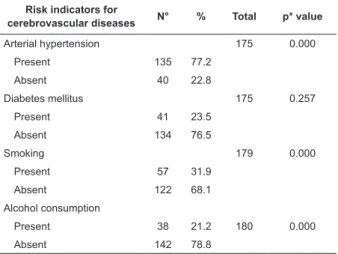
Regarding risk indicators for the occurrence of
cerebrovascular diseases, 77.2% of patients with
stroke were hypertensive, 23.5% diabetic, 31.9%
smokers and 21.2% consumed alcohol. The proportion
of risk indicators for cerebrovascular diseases in
Fortaleza was statistically different from the values
found in national studies for arterial hypertension,
smoking and alcohol consumption.
In Fortaleza, patients with stroke had a higher
frequency of arterial hypertension (p = 0.000) and
lower frequency of smoking (p = 0.000) and alcohol
consumption (p = 0.000).
Risk indicators for
cerebrovascular diseases N° % Total p* value
Arterial hypertension 175 0.000
Present 135 77.2
Absent 40 22.8
Diabetes mellitus 175 0.257
Present 41 23.5
Absent 134 76.5
Smoking 179 0.000
Present 57 31.9
Absent 122 68.1
Alcohol consumption
Present 38 21.2 180 0.000
Absent 142 78.8
Table 2 - Distribution of risk indicators for cerebrovascular
diseases present in patients with stroke. Fortaleza,
2008
707 Cavalcante TF, Moreira RP, Araujo TL, Lopes MVO.
Discussion
In this study, women were prevalent. Contrary to these obtained indings, several national surveys found a slightly higher prevalence of stroke in the male
population(1,13-16).
Despite not inding a statistical association regarding sex with another national study, it is believed that this
slight predominance of females can be attributed to age
because the survival of women until older ages is higher
than men, and thus there is an apparent excess of stroke
in the female population(3).
As shown by some studies that relate the mortality
rates for stroke with gender, this mortality is higher
among women than among men(9,17).
In this study, the mean age of subjects was 62.3
years (SD = 13.6). Although stroke is a cerebrovascular
disease which can happen at any age, its incidence
increases with advancing age, and approximately doubles
with each decade of life(3). According to some authors,
the incidence of stroke peaks between the seventh
and eighth decades of life, when the cardiovascular
and metabolic alterations combine, due to the aging
process(18).
Other studies on this subject have conirmed this information. For example, work carried out in Spain
with patients with stroke found an average age of 75.7
years (SD=1.9)(17) and a multicenter study conducted in
seven European countries found that the average age of
patients was 70.9 years (SD=12.4)(14).
This slight discrepancy in the mean age is explained by patients being evaluated at the irst episode of the disease. However, when compared with another study, which also considered the irst episode of stroke, the patients in this study were younger. Another study
states that there are a considerable number of people
below the age of 50 affected by stroke(19).
The fact that this disease occurs in younger people is justiied in part by the high prevalence of arterial hypertension (77.2%) found in the evaluated population.
Furthermore, this prevalence was higher when compared
to another study conducted in the Southeast region of
Brazil (p = 0.000).
A study which estimated the prevalence of
arterial hypertension in Brazil found that the Northeast
region has the highest prevalence (7.2% to 40.3%),
followed by the Southeast region (5.04% to 37.9%),
the South (1.28% to 27.1%) and the Midwest (6.3%
to 16.7%)(20).
The inter-regional disparities probably relect a difference in the quantity of risk factors, which include
lifestyle (physical activity level, smoking and alcohol
consumption), as well as access to diagnostic and
therapeutic resources(2). This is because the Northeast
region is one of the poorest in Brazil and has limited
access to primary, secondary and tertiary health
services.
The high prevalence and clustering of risk factors
for cerebrovascular disease among patients with
hypertension reinforces the need not only to improve
the diagnosis and treatment of arterial hypertension, but also to approach integrally the risk proile of this population. Among the risk factors addressed by the
study, smoking was found in 31.9% of patients and
consumption of alcohol in 21.2%. In this study fewer
patients smoked and consumed alcohol compared to
other patients evaluated in a study conducted in the
Southeast.
It is important to consider that other factors such as
schooling and income may interfere in the occurrence of
cerebral vascular accident. However, it was not possible
to compare these data because of the lack of national
studies that addressed such aspects.
The increased incidence of stroke is also related to
the decrease in socioeconomic level. Regarding causes
for this situation a study shows a higher frequency of
risk factors for cerebrovascular disease, unfavorable
psychosocial factors and limited access to health
services(21). Moreover, a longitudinal study with 47,942
participants identiied a strong relationship between the incidence of stroke and years of schooling, showing that
the incidence was two times higher among people with
a low education(22).
Conclusion
The patients with stroke evaluated in Fortaleza were
younger and had higher rates of arterial hypertension.
In contrast, there were fewer alcohol consumers and
smokers. However, there was a limitation in this study,
namely the inability to compare other factors such as
schooling and socioeconomic status.
Rev. Latino-Am. Enfermagem 2010 Jul-Aug; 18(4):703-8.
References
1. Falcão IV, Carvalho EMF, Berreto KML, Lessa FJD, Leite VMM. Acidente vascular cerebral precoce: implicações para adultos em idade produtiva atendidos pelo Sistema Único de Saúde. Rev Bras Saúde Matern Inf. 2004; 4(1):95-102.
2. Curioni C, Cunha CB, Veras RP, André C. The decline in mortality from circulatory diseases in Brazil. Pan Am J Public Health. 2009; 25(1):9-15.
3. André C. AVC agudo. In: André C. Manual de AVC. Rio de Janeiro: Revinter; 2006. p. 37-51.
4. Secretaria de Saúde do Estado do Ceará (BR). Indicadores e dados básicos para a saúde no Ceará 2004. Fortaleza; 2005. 5. Ministério da Saúde (BR). Sistema de Informações Hospitalares. Indicadores municipais de saúde: morbidade hospitalar no município de Fortaleza-CE. Brasília; 2004. [acesso em: 20 out 2006]. Disponível em: http://www..saude.gov.br 6. Mesquita SRAM, Anselmi ML, Santos CB, Hayashida M. Programa Interdisciplinar de internação domiciliar de Marília-SP: custos de recursos materiais consumidos. Rev. Latino-Am. Enfermagem. 2005; 13(4):555-61.
7.Moreira RP. Acidente vascular encefálico - análise dos diagnósticos de enfermagem da classe Atividade/Exercício. [dissertação]. Fortaleza: Universidade Federal do Ceará; 2008. 8. Perlini NMOG, Faro ACM. Cuidar de pessoa incapacitada por acidente vascular cerebral no domicílio: o fazer do cuidador familiar. Rev Esc Enferm USP. 2005;39(2):154-63.
9. Lotufo PA. Stroke in Brazil: a neglected disease. São Paulo Med J. 2005; 123(1):3-4.
10. Bocchi SCM, Angelo M. Entre a liberdade e a reclusão: o apoio social como componente da qualidade de vida do binômio cuidador familiar-pessoa dependente. Rev. Latino-Am. Enfermagem. 2008;16(1):15-23.
11. Marques S, Rodrigues RAP, Kusumota L. O idoso após acidente vascular cerebral: alterações no relacionamento familiar. Rev. Latino-Am. Enfermagem. 2006;14(3):364-371.
12. Bocchi SCM. Vivenciando a sobrecarga ao vir-a-ser um cuidador familiar de pessoa com acidente vascular cerebral (AVC): uma análise do conhecimento. Rev. Latino-Am. Enfermagem. 2004;12(1):115-21.
13. Pires SL, Gagliardi RJ, Gorzoni ML. Estudo das freqüências dos principais fatores de risco para acidente vascular cerebral isquêmico em idosos. Arq Neuropsiquiatr. 2004;62(3-B):844- 51.
14. Di Carlo A, Lamassa M, Baldereschi M, Pracucci G, Consoli D, Wolfe CDA, et al. Risk factors and outcome of subtypes of ischemic stroke. Data from a multicenter multinational hospital-based registry. The European Community Stroke Project. J Neurol Sci. 2006; 244: 143-50.
15. Medrano Albero MJ, Boix Martínez R, Cerrato Crespán E, Ramírez Santa-Pau M. Incidencia e prevalencia de cardiopatia isquêmica y enfermedad cerebrovascular en Espana: revisión sistemática de la literatura. Rev Esp Salud Pública. 2006; 80(1):5-15.
16. Moreno VP, García Raso A, García Bueno MJ, Sánchez Sánchez, A, Meseguer E, Mata R et al. Factores de riesgo vascular en pacientes com ictus isquémico. Distribución según edad, sexo y subtipo de ictus. Rev Neurol. 2008; 46(10):593-8.
17. Sanclemente Ansó C, Alonso Valdés F, Rovira Pujol E, Vigil Martín D, Vilaró Pujals J. Accidentes vasculares cerebrales en la comarca de Osona. Factores de riesgo cardiovascular. An Med Int. (Madrid) 2004; 21(4):161-5.
18. Zétola VHF, Nóvak EM, Camargo CHF, Carraro Júnior H, Coral P, Muzzio JÁ, et al. Acidente vascular cerebral em pacientes jovens: análise de 164 casos. Arq Neuropsiquiatr. 2001;59(3B):740-5.
19. Gomes SR, Senna M. Cliente com acidente vascular cerebral e as interfaces da assistência de enfermagem para reabilitação. Online Braz J Nurs. 2008; [Internet]. 7(2). [acesso em: 14 setembro 2008]. Disponível em: http://www.uff.br/objnursing/ index.php/nursing/article/view/j.1676-4285.2008.1420/386. 20. Passos VMA, Assis TD, Barreto SM. Hipertensão arterial no Brasil: estimativa de prevalência a partir de estudos de base populacional. Epidemiol Serv Saúde. 2006;15(1):35-45. 21. Kurth T, Berger K. The socioeconomic stroke puzzle. Stroke. 2007; 38:4-5.
22. Kuper H, Adami HO, Theorell T, Weiderpass E. The socioeconomic gradient in the incidence of stroke – a prospective study in middle-aged women in Sweden. Stroke. 2007; 38:27-33.
Received: Aug. 20th 2009