ABSTRACT
BACKGROUND AND OBJECTIVES: Methadone is a synthe-tic long-duration opioid with pharmacological properties quali-tatively similar to morphine for its action on µ-opioid receptor. It is primarily used to treat cancer pain refractory to morphine. his study aimed at presenting a review of this drug with focus on pharmacokinetic and pharmacodynamic aspects, in addition to its clinical indication.
CONTENTS: Articles available in Medline, Scielo, Cochrane library and Pubmed platforms until July 2014 were reviewed using the following descriptors: Methadone; Acute Pain; Chro-nic Pain; Cancer Pain; and Opioids.
CONCLUSION: Its pharmacological properties make metha-done a unique opioid analgesic, since it is less susceptible to tolerance, prevents hyperalgesia, is less conducive to abusive consumption and has a possible better action on neuropathic pain. However, risks of accidental death due to overdose, of ar-rhythmias and of pharmacological interactions should not be overlooked. In addition, there is lack of conclusive clinical trials comparing methadone to other analgesics with regard to risks and beneits.
Keywords: Methadone, Opioids, Pain.
RESUMO
JUSTIFICATIVA E OBJETIVOS: Metadona é um opioide
sintético de longa duração com propriedades farmacológicas qualitativamente semelhantes às da morina por ação sobre o receptor µ-opioide. É utilizada principalmente no tratamento
Revisiting methadone: pharmacokinetics, pharmacodynamics and
clinical indication*
Revisitando a metadona: farmacocinética, farmacodinâmica e uso clínico
José Osvaldo Barbosa Neto1, Marília Arrais Garcia2, João Batista Santos Garcia3
*Received from Federal University of São Luís, MA, Brazil.
1. Federal University of Maranhão, Service of Clinical Anesthesiology, São Luís, MA, Brazil.
2. School of Medicine of ABC, Santo André, SP, Brazil.
3. Federal University of Maranhão, Service of Pain and Palliative Care, Teaching Hospital, Cancer Hospital of Maranhão, São Luís, MA, Brazil.
Submitted in November 03, 2014
Accepted for publication in February 09, 2015 Conlict of interests: none – Sponsoring sources: none.
Correspondence to: José Osvaldo Barbosa Neto
Rua Parnaíba, Nº2. Apto 1303 - Ponta do Farol 65075-839 São Luís, MA, Brasil.
© Sociedade Brasileira para o Estudo da Dor
de dor oncológica refratária à morina. O objetivo deste estudo foi apresentar uma revisão desse fármaco com foco nos aspectos farmacocinéticos e farmacodinâmicos, além de seu uso clínico.
CONTEÚDO: Foi realizada uma revisão dos artigos disponíveis nas plataformas Medline, Scielo, biblioteca Cochrane e Pubmed até julho de 2014, por meio dos seguintes descritores: Metadona; Dor Aguda; Dor Crônica; Dor Oncológica; e Opioides.
CONCLUSÃO: As suas propriedades farmacológicas fazem da metadona um analgésico opioide singular, uma vez que é me-nos suscetível a tolerância, previne hiperalgesia, é meme-nos propícia a consumo abusivo, e tem uma possível melhor ação sobre dor neuropática. Todavia, os riscos de morte acidental por overdose, de surgimento de arritmia cardíaca, e de interação farmacoló-gica não devem ser menosprezados. Além disso, faltam estudos clínicos conclusivos comparando metadona a outros analgésicos quanto a seus riscos e benefícios.
Descritores: Dor, Metadona, Opioides.
INTRODUCTION
Methadone is a synthetic long-lasting opioid primarily used to treat cancer pain refractory to morphine1.
his study aimed at presenting a historical review of this drug, as well as introducing pharmacokinetic and pharmacodyna-mic aspects, in addition to its clinical indication.
CONTENTS
Articles available in Medline, Scielo, Cochrane library and Pubmed platforms until July 2014 were reviewed using the following descriptors: Methadone; Acute Pain; Chronic Pain; Cancer Pain; and Opioids.
Background
Methadone was synthesized in 1938 by Max Bockmuhl and Gustav Erhart, supposedly by order of the then German lea-der (Führer) – Adolf Hitler, to replace morphine, the supply of which was plummeting since the beginning of World War II. By that time, it received the trade name of Dolophine, after the irst name of Hitler2. However, this information is
controversial since the word Dolophine has its origin in La-tin, where Dolor means pain and Fin end3. his opioid was
used by German soldiers during the war period to control pain, however with poor acceptance due to its adverse efects.
he name methadone derives from fragments of its chemical name (6-dimethylamine-4,4-diphenyl-3heptanone)4 and is
currently accepted to designate its racemic mixture.
Notwithstanding its recent appearance, the stigma of having been extensively used to detoxify heroin users has limited the acceptance of this drug to control pain2. However, the
recog-nition of its special pharmacological characteristics, added to its low cost, has helped the spread of its use to treat chronic pain, especially cancer and neuropathic pain5.
Farmacokinetics
Methadone is a basic liposoluble drug with pKa of 9.2, which is administered as a racemic mixture of two enantiomers: R--methadone and SR--methadone6. When orally administered it
has fast and almost complete absorption. It may be detected in the plasma 30 minutes after oral dose, and time to reach plasma peak concentration is 2.5h for oral solution and 3h for tablets. Bioavailability is high, varying from 67 to 95%7.
Drug absorption by oral mucosa is also possible7.
It is an opioid agonist with long half-life, approximately 24h, and with wide variability among individuals (8 – 90h), being far superior than other opioids used for pain therapy, such as morphine (t1/2=2-4h), hydromorphone (t1/2=2-3 hours) or fentanyl (t1/2=4 hours)8 (Table 1).
Table 1. Comparison of pharmacokinetic properties of methadone and morphine8
Parameters Methadone Morphine
Bioavailability 80% 35%
Plasma binding 60-90% 35%
Half-life 30 h 3-4 h
Active metabolites No Yes
Inluence by kidney failure + +++
Inluence by liver failure +++ +
+ Mildly / +++ A lot.
Time for analgesia onset after administration of a single intra-venous bolus is approximately 10 to 20 minutes and duration is from 4 to 8h, which is less than excretion time and increases build-up risk after repeated doses8.
It is a lipophilic substance extensively distributed throughout tissues such as brain, intestine, kidney, liver, muscles and lun-gs. his characteristic justiies the large distribution volume of this opioid described in human studies9. And due to the
fact that tissue distribution is superior to plasma proteins binding capacity, its apparent distribution volume during the balance state is much higher than plasma volume itself. his volume varies according to the study, depending on the proi-le of included patients10.
Methadone extensively binds to plasma proteins (reaching 86%) and, being a basic substance, it is predominantly bound to acid α-glycoprotein. Since it is a plasma protein which in-creases in acute phase reactions, this variability may determi-ne the variation of drug plasma concentration, especially in
cancer patients11.
Clinically, these pharmacokinetic properties lead to building--up of methadone in tissues after the administration of repe-ated doses, thus increasing the risk of overdose. And when the analgesic is withdrawn, a small plasma concentration is maintained due to gradual methadone redistribution to the intravascular. Also, this is probably the reason why this opioid is less prone to induce withdrawal syndrome.
It is metabolized in the liver and excreted by the kidneys. As result of its basic pH (pKa=9.2) and lipophilic properties, changes in urinary pH may alter its excretion. When urinary pH is above 6, kidney excretion is responsible for just 4% of total excreted drug, while in pH below 6, 30% of total dose are excreted by the kidneys12.
As to liver excretion, methadone has low extraction ratio, which implies high bioavailability after oral administration, in addition to bringing relevant consequences with regard to interindividual variability, since the excretion of this subs-tance depends both on drug free fraction and intrinsic liver enzymatic activity7. Methadone is metabolized in the liver
metabolism by several P450 cytochromes which degrade it to its inactive metabolites (2-ethyl-1.5-dimethyl-3.3-diphenyl pyrrolidine and 2-ethyl-5-methyl-3.3-diphenyl-pyrroline)13.
In vitro experimental data suggested that CYP3A4 would be the isoform with highest responsibility for methadone metabolism in humans14. However, recent data suggest that
CYP2B6 would be the primary isoform for methadone meta-bolism and excretion in vivo15.
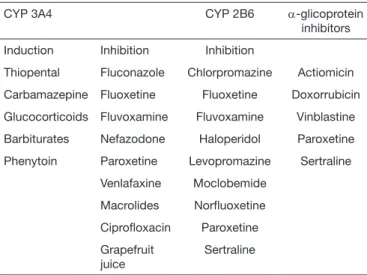
In addition to methadone, cytochrome CYP2B6 is also res-ponsible for the metabolism of other drugs, such as: bupro-pion, efavirenz and clopidogrel, which implies risks of in-teraction among such drugs7,16. Table 2 shows examples of
pharmacological interaction with methadone.
A wide variability of responses has been observed among in-dividuals exposed to methadone, which may be attributed to genetic polymorphism in the encoding of cytochromes invol-ved with its metabolism, in addition to the polymorphism of carrier proteins and opioid receptors17.
Table 2. Pharmacological interaction with methadone7
CYP 3A4 CYP 2B6 α-glicoprotein
inhibitors
Induction Inhibition Inhibition
Thiopental Fluconazole Chlorpromazine Actiomicin
Carbamazepine Fluoxetine Fluoxetine Doxorrubicin
Glucocorticoids Fluvoxamine Fluvoxamine Vinblastine
Barbiturates Nefazodone Haloperidol Paroxetine
Phenytoin Paroxetine Levopromazine Sertraline
Venlafaxine Moclobemide
Macrolides Norluoxetine
Ciproloxacin Paroxetine
Grapefruit juice
Normally, methadone or its metabolites are excreted by the urine (20-50%) and by feces (10-45%), but in the presence of kidney failure there is increased fecal excretion both of me-tabolism products and methadone itself, to the point of being able to eliminate the whole drug18. his way, methadone may
be considered safe for kidney failure in patients undergoing dialysis. But some authors recommend dose reduction when glomerular iltration rate is below 10mL/min18.
Methadone can be found in breast milk, but in concentra-tions which, in theory, are harmless to the infant and it is also able to cross the placental barrier, but by this route it may induce withdrawal syndrome in the neonate19,20.
Pharmacodynamics
Methadone is an opioid agonist acting by binding to µ, κ and δ opioid receptors (MOR, KOR and DOR, respectively). Its pharmacodynamic properties, such as analgesia, respiratory depression, dependence and tolerance are primarily triggered by MOR activation7.
Tolerance is deined as decreased opioid agonist analgesic potency after previous exposure to the same opioid. Cross--tolerance is a phenomenon resulting from decreased respon-se to an opioid agonist after previous exposure to a diferent opioid21. An experimental study has shown that methadone
is an opioid less sensitive to tolerance, since its ED50 was not altered after previous exposure to morphine21. Chronic opioid
therapy may also produce opioid-induced hyperalgesia (OIH) which sensitizes patients or triggers acute pain episodes21,22.
It has been shown that chronic opioid exposure, predominantly to methadone, decreases coronary disease extension, as com-pared to non-exposed patients23. his inding was conirmed
by an experimental study where exposure to morphine (MOR agonist) has decreased the area of myocardial infarction when administered before ischemia and reperfusion24,25. Methadone
has the efect of decreasing myocardial ischemia through MOR activation, and is dependent on ischemic injury duration26.
Isomers pharmacodynamics
R-Methadone has 10 times higher ainity for MOR and DOR receptors than its S isomer, and its analgesic activity may be 50 times higher. S-Methadone is seemingly inacti-ve as opioid, and as R-Methadone, it is a non-competitiinacti-ve antagonist of the N-methyl-D-aspartate receptor (rNMDA) which is responsible for OIH and participates in the tolerance phenomenon27.
Silverman28 has summarized the mechanisms responsible for
hyperalgesia: rNMDA activation; inhibition of the glutamate carrier system (increases the amount of available glutamate to activate the receptor); calcium-regulated intracellular kinase C protein participation as a link between OIH cell mechanis-ms; chronic morphine administration (induces neurotoxicity via spinal cord dorsal horn apoptosis).
In addition to its action on rNMDA, S-Methadone promo-tes strong serotonin and norepinephrine uptake inhibition in the central nervous system29. Due to the combination of
those properties, methadone is a tool to help managing
chro-nic neuropathic pain, tolerance and OIH as a function of its pharmacodynamic properties30-32.
Pharmacogenetics
he polymorphism of genes encoding opioid receptors and the enzymes involved in methadone metabolism contribute for the wide variability of its pharmacology among individuals33.
A study with healthy volunteers has shown that mutation of 118A4G in the OPRM1 gene, which encodes MOR, is asso-ciated to decreased levomethadone single dose efect evaluated by pupillometry. However, data on the relationship between genetic variability and methadone pharmacological efect are not consistent and there is incongruence among results. his same study has not found association between methadone efect and polymorphism of genes encoding glycoprotein-P, cytochromes P3A, 2B6, 1A2, 2C8, 2C9, 2C19 and 2D633,34.
Administration routes
Methadone, as other opioids, is preferably orally adminis-tered, but other routes are possible, such as: rectal, venous, muscular, subcutaneous, nasal, sublingual, spinal and epidu-ral.
he rectal route is used in the clinical practice through micro--enemas or suppositories35,36. Bioavailability after rectal
admi-nistration is in average 76%, which is very similar to the oral route (86%), it has faster onset time, plasma peak time is 1.4h and duration is 10h37.
It may be intravenously administered via patient-controlled analgesia pump (PCA), continuous infusion and/or intermit-tent bolus38,39. Analgesia onset after venous bolus is 10-20
mi-nutes and its duration is 4-8h39.
he subcutaneous route is used to replace the oral route, but it is recommended to decrease 50% of the dose40.
Subcuta-neous administration is limited by local inlammatory reac-tion which requires injecreac-tion site rotareac-tion41. Although there
is no consensus among authors about the recommendation of this route, studies have shown positive experiences with this use40. To prevent inlammatory reactions, it is recommended
to rotate the injection site, the addition of hyaluronidase and dilution in 16mL of 0.9% saline40-42.
Methadone may be used by subarachnoid route although being rapidly distributed to plasma. However, few studies were carried out to evaluate this route43. Epidural route may
be used to control chronic and postoperative pain44.
his opioid may be also administered by intranasal or sublin-gual routes45. In a pilot study, signiicant breakthrough pain
relief was obtained 5 minutes after sublingual methadone ad-ministration46.
Clinical indications
Methadone is indicated to treat moderate to severe pain whi-ch cannot be totally controlled by simple analgesics.
Perioperative period
treatment. Acute postoperative pain is a risk factor for the development of chronic pain47-49.
Anesthetic care trend in the last decades is to use short-lasting and short half-life opioids (fentanyl, alfentanil, sulfentanil and remifentanil), but the transition of the intraoperative to the postoperative period, especially in very painful surgeries, may be a challenge. As the efect of used drugs is dissipated, patients may experience severe pain50. At this moment, it is
indicated the use of long-lasting opioids. he methadone is an efective alternative to conventional opioids to control posto-perative pain38,44,51-55.
Cancer pain
Pain is highly prevalent in cancer patients, to an extension that, depending on the severity of the disease and type of tumor, 30 to 70% of patients have pain since the onset of the disease56. However, the recommendation published by the
World Health Organization (WHO) to use the concept of steps to treat cancer patients’ pain, has provided up to 90% relief56.
Breakthrough pain is responsible for uncontrolled pain in 40-80% of cancer patients and is deined as transient worsening of pain (referred as intense or excruciating) as from a moderate or mild baseline pain56-58. Breakthrough pain reaches its peak
in approximately 3 minutes59 and lasts in average 30 minutes,
and methadone is a feasible opioid for this scenario. Since oral methadone has its onset in approximately 10 minutes (lower than morphine, for example, which is approximately 30 minutes), it could relieve or minimize pain in an adequate time period, that is, before its spontaneous resolution56,58,59.
Methadone for cancer pain has been evaluated in a Cochrane review (2008)60 which has concluded that its efect was
si-milar to morphine. he author also concludes that there has been a higher non-adherence rate to methadone due to its adverse efects.
In a recent review evaluating oral methadone as compared to other oral or transdermal opioids, the author has concluded that methadone may be used as irst line opioid therapy, it has low cost and there is a trend to sedation and build-up. he author also states that initial dose should be calculated as from a morphine dose converted as from a 4:1 relationship61.
Notwithstanding the lack of adequate clinical trials, opioid switching to methadone is indicated when a diferent opioid fails62. However, this drug titration may be a challenge for the
following reasons: lack of reliable conversion to/from metha-done; increased methadone potency in patients exposed to moderate to high doses of a diferent opioid; wide variability of methadone pharmacokinetics and of the potential to inte-ract with other drugs63.
Several switching methods to methadone have been already published, but two strategies are more frequently used. In one of them, the progressive increase of methadone equianalgesic dose is simultaneous to the decrease of previous opioid64,65.
he other strategy involves totally withdrawing the opioid being used and the dose is totally replaced by equianalgesic dose66.
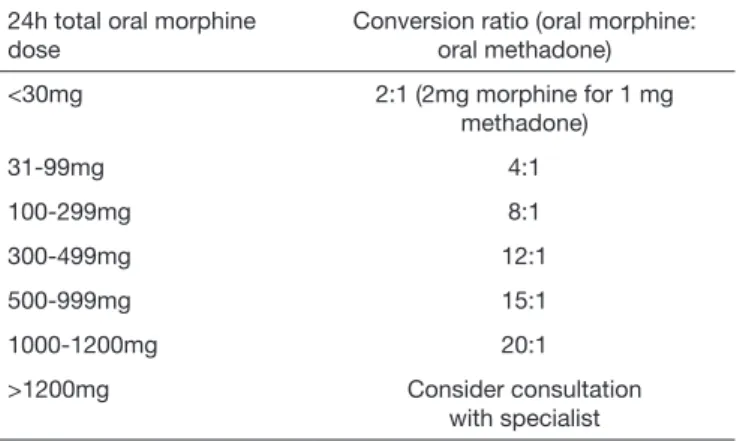
Incomplete cross-tolerance should be taken into considera-tion when opioid is switched to methadone, because a higher potency than that anticipated is to be expected. For this re-ason, methadone dose is decreased in 50-90% of total dose calculated as from previous opioid67. Table 3 shows the
con-version of morphine to methadone adopted by the American Academy of Hospice and Palliative Care.
Table 3. Conversion table from morphine to methadone66
24h total oral morphine dose
Conversion ratio (oral morphine: oral methadone)
<30mg 2:1 (2mg morphine for 1 mg
methadone)
31-99mg 4:1
100-299mg 8:1
300-499mg 12:1
500-999mg 15:1
1000-1200mg 20:1
>1200mg Consider consultation
with specialist
In a systematic review studying the use of opioids in moderate to severe cancer pain in patients with kidney failure, the au-thors have concluded that methadone, fentanyl and alfentanil are opioids posing less risks when adequately used68.
In managing cancer pain, the combination of two strong opioids is a strategy being investigated. he rational is that the association of two diferent opioids would promote a sy-nergic action on analgesia, allowing the use of lower doses of each one, in addition to limiting the development of opioid tolerance and decreasing adverse efects6. However, this
stu-dy is just beginning and data are mostly from experimental models.
Non-cancer chronic pain
Chronic pain is pain persisting beyond tissue healing period, which is approximately three months70. When chronic pain
is not associated to cancer or end-of-life care, it is generally called “non-cancer chronic pain”71-72.
Opioids have been used to manage pain and are among most frequently prescribed drugs for this objective. heir use in non-cancer chronic pain patients is growing in the last de-cades73,74. Opioids may be considered for patients with at
le-ast moderate pain and who had no pain control with other classes of analgesics. However, some clinical conditions have knowingly lower response to opioids and are those that have psychosocial aspects as aggravating factors (chronic low back pain, headache and ibromyalgia)75-77.
Results of two studies show that up to 50% of cases in which opioids were switched to methadone had prolonged satisfac-tory analgesia79. When used for neuropathic pain, methadone
Opioid-induced hyperalgesia (OIH)
Chronic opioid therapy may paradoxically sensitize patients to pain or even induce acute pain, phenomenon known as OIH, as already discussed22. Some clinical situations seem to
more frequently predispose to the appearance of this pheno-menon: intraoperative remifentanil infusion80 and use of high
opioid dose22,81,82. Table 4 shows a strategy to diagnose and
treat OIH.
Table 4. Strategies for diagnosis and treatment of opioid-induced hyperalgesia3
1 – Increase opioid dose and evaluate whether there is increase in eficacy (tolerance).
2 – Decrease or withdraw opioid and evaluate OIH.
3 – Use opioids with properties able to decrease OIH.
4 – Use speciic NMDA receptor antagonists.
5 – Associate non-steroid anti-inlammatory drugs
Methadone is the opioid with the highest ability of decrea-sing high opioid dose-induced hyperalgesia through NMDA receptor inhibition. his hypothesis was conirmed by several studies showing that switching to methadone has decreased or even resolved hyperalgesia27,84,85. his because NMDA
recep-tor and central glutaminergic system play a central role in the development of OIH, as well as in tolerance and sensitization (Table 5)
Table 5. Role of N-methyl-D-aspartate on opioid-induced hyperala-gesia83
1. NMDA receptors are activated after exposure to opioids. When inhibited, they prevent tolerance and OIH
2. Glutamate carrier system is inhibited, increasing available gluta-mate concentration to bind to rNMDA
3. Intracellular calcium-regulated kinase C protein is probably a bin-ding between tolerance cell mechanisms and OIH
4. There might be interchange between neural pain and tolerance mechanisms.
rNMDA = N-methyl-D-aspartate receptor.
Adverse effects
Methadone adverse efects are similar to those described for morphine. However, for being a long-lasting opioid with un-predictable half-life, methadone demands special attention due to the risk of build-up and intoxication, especially during the irst days of use or during analgesic dose titration. Building-up of this opioid may induce respiratory arrest and eventually death, since severe respiratory depression may be seen with doses as low as 30mg in non-tolerant individuals86,
and with higher doses in tolerant individuals. A characteristic of methadone-induced respiratory depression is that its peak occurs after the analgesic peak and is maintained for a longer period, especially in the beginning of treatment86,87.
Approximately 30% of analgesic-related deaths in the Uni-ted States in 2009 were attribuUni-ted to methadone, although this drug responds for just 2% of opioid consumption88.
There is no question that opioid analgesics expose users to
risk of intoxication and even of death. So, the use of me-thadone should include systematic evaluations and measu-res to minimize such risk, such as patients’ education and symptoms monitoring in the beginning of treatment or dose titration5.
Effects on QT interval
Prolonged QT interval is a pro-arrhythmic state associated to increased risk for ventricular arrhythmia, especially Torsade de Pointes (TdP) which is a polymorphic ventricular tachyar-rhythmia presenting variation of polarity along ECG baseline tracing. Clinically, patient presents with palpitation, syncope and even sudden death39,89.
his electrocardiographic alteration may be induced by drugs and is related to potassium channels block (Ether-a-go-go) with consequent potassium low inhibition during myocar-dial repolarization, which increases repolarization time, re-presented on tracing as longer QT interval39. he risk for TdP
is directly proportional to QT interval duration, and is parti-cularly higher when this interval is above 500ms, in addition to methadone doses above100mg/day90-92.
In spite of the risk for ventricular arrhythmia, there is no evi-dence supporting screening ECG for patients with no risk factors. However, authors recommend that patients with risk factors be submitted to ECG before starting treatment and during dose titration93,94. When intravenously administered,
it is recommended to record ECG in the following moments: before starting therapy and after 24h of use; whenever there is signiicant dose increase; whenever there is major clinical alteration (hydroelectrolytic disorder, congestive heart failure, new drugs)95. Electrolytes monitoring is also recommended
for patients at higher risk39.
CONCLUSION
Its pharmacological properties make methadone a unique opioid analgesic, since it is less susceptible to tolerance, pre-vents hyperalgesia, is less prone to abusive consumption and has better theoretical action on neuropathic pain, in addi-tion to convenient dosage schedule allowed by its prolonged action time. However, methadone should be used based on the knowledge of its pharmacological properties, safe opioid prescription practices and good clinical judgment.
REFERENCES
1. Leppert W. he role of methadone in cancer pain treatment-a review. Int J Clin Pract. 2009;63(7)1095-109.
2. Payte JT. A brief history of methadone in the treatment of opioid dependence: a personal perspective. J Psychoactive Drugs. 1991;23(2):103-7
3. Shah S, Diwan S. Methadone: does stigma play a role as a barrier to treatment of chronic pain? Pain Physician. 2010;13(3):289-93.
4. Fishman SM, Wilsey B, Mahajan G, Molina P. Methadone reincarnated: novel clinical applications with related concerns. Pain Med. 2002;3(4):339-48.
5. Trafton JA, Ramani A. Methadone: a new old drug with promises and pitfalls. Curr Pain Headache Rep. 2009;13(1):24-30.
6. Nilsson MI, Widerlöv E, Meresaar U, Anggård E. Efect of urinary pH on the dispo-sition of methadone in man. Eur J Clin Pharmacol. 1982;22(4):337-42.
8. Payne R, Inturrisi CE. CSF distribution of morphine, methadone and sucrose after intrathecal injection. Life Sci. 1985;37(12):1137-44.
9. Gabrielsson JL, Johansson P, Bondesson U, Paalzow LK. Analysis of methadone dis-position in the pregnant rat by means of a physiological low model. J Pharmacokinet Biopharm. 1985;13(4):355-72.
10. Wolf K, Hay AW, Raistrick D, Calvert R. Steady-state pharmacokinetics of methado-ne in opioid addicts. Eur J Clin Pharmacol. 1993;44(2):189-94.
11. Abramson FP. Methadone plasma protein binding: alterations in cancer and displace-ment from alpha 1-acid glycoprotein. Clin Pharmacol her. 1982;32(5):652-8. 12. Anggard E, Gunne LM, Homstrand J, McMahon RE, Sandberg CG, Sullivan
HR. Disposition of methadone in methadone maintenance. Clin Pharmacol her. 1975;17(3): 258-66.
13. Sporkert F, Pragst F. Determination of methadone and its metabolites EDDP and EMDP in human hair by headspace solid-phase microextraction and gas chromato-graphy-mass spectrometry. J Chromatogr B Biomed Sci Appl. 2000;746(2):255-64. 14. Iribarne C, Dréano Y, Bardou LG, Ménez JF, Berthou F. Interaction of
me-thadone with substrates of human hepatic cytochrome P450 3A4. Toxicology. 1997;117(1):13-23.
15. Kharasch ED, Hofer C, Whittington D, Walker A, Bedynek PS. Methadone phar-macokinetics are independent of cytochrome P4503A (CYP3A) activity and gastroin-testinal drug transport: insights from methadone interactions with ritonavir/indinavir. Anesthesiology. 2009;110(3):660-72.
16. Swerdlow M. Anticonvulsant drugs and chronic pain. Clin Neuropharmacol. 1984;7(1):51-82.
17. Li Y, Kantelip JP, Gerritsen-van Schieveen P, Davani S. Interindividual variabi-lity of methadone response: impact of genetic polymorphism. Mol Diagn her. 2008;12(2):109-24.
18. Dean M. Opioids in renal failure and dialysis patients. J Pain Symptom Manage. 2004;28(5):497-504.
19. Wojnar-Horton RE, Kristensen JH, Yapp P, Ilett KF, Dusci LJ, Hackett LP. Methado-ne distribution and excretion into breast milk of clients in a methadoMethado-ne maintenance programme. Br J Clin Pharmacol. 1997;44(6):543-7.
20. Wang EC. Methadone treatment during pregnancy. J Obstet Gynecol Neonatal Nurs. 1999;28(6):615-22.
21. Angst MS, Clark JD. Opioid-induced hyperalgesia: a qualitative systematic review. Anesthesiology. 2006;104(3):570-87.
22. Chu LF, Angst MS, Clark D. Opioid-induced hyperalgesia in humans: molecular me-chanisms and clinical considerations. Clin J Pain. 2008;24(6):479-96.
23. Marmor M, Penn A, Widmer K, Levin RI, Maslansky R. Coronary artery disease and opioid use. Am J Cardiol. 2004;93(10):1295-7.
24. Schultz JJ, Hsu AK, Gross GJ. Ischemic preconditioning and morphine-induced car-dioprotection involve the delta (delta)-opioid receptor in the intact rat heart. J Mol Cell Cardiol. 1997;29(8):2187-95.
25. Liang BT, Gross GJ. Direct preconditioning of cardiac myocytes via opioid receptors and KATP channels. Circ Res. 1999;84(12):1396-400.
26. Gross ER, Hsu AK, Gross GJ. Acute methadone treatment reduces myocardial infarct size via the delta-opioid receptor in rats during reperfusion. Anesth Analg. 2009;109(5):1395-402.
27. Callahan RJ, Au JD, Paul M, Liu C, Yost CS. Functional inhibition by methadone of N-methyl-D-aspartate receptors expressed in Xenopus oocytes: stereospeciic and subunit efects. Anesth Analg. 2004;98(3):653-9.
28. Silverman SM. Opioid induced hyperalgesia: clinical implications for the pain practi-tioner. Pain Physician. 2009;12(3):679-84.
29. Codd EE, Shank RP, Schupsky JJ, Rafa RB. Serotonin and norepinephrine uptake inhibiting activity of centrally acting analgesics: structural determinants and role in antinociception. J Pharmacol Exp her. 1995;274(3):1263-70.
30. Mercadante S, Arcuri E. Hyperalgesia and opioid switching. Am J Hosp Palliat Care. 2005; 22(4):291-4.
31. Axelrod DJ, Reville B. Using methadone to treat opioid-induced hyperalgesia and refractory pain. J Opioid Manag. 2007;3(2):113-4.
32. Davies MP. Methadone. In: Davies M, Glare P, Hardy J, editors. Opioids in Cancer Pain. Oxford, New York: Oxford University Press; 2005. 173-98p.
33. Lötsch J, Skarke C, Wieting J, Oertel BG, Schmidt H, Brockmöller J, et al. Mo-dulation of the central nervous efects of levomethadone by genetic polymorphisms potentially afecting its metabolism, distribution, and drug action. Clin Pharmacol her. 2006;79(1):72-89.
34. Eap CB, Broly F, Mino A, Hämmig R, Déglon JJ, Uehlinger C, et al. Cytochrome P450 2D6 genotype and methadone steady-state concentrations. J Clin Psychophar-macol. 2001;21(2):229-34.
35. Ripamonti C, Bianchi M. he use of methadone for cancer pain. Hematol Oncol Clin North Am. 2002;16(3):543-55.
36. Watanabe S, Belzile M, Kuehn N, Hanson J, Bruera E. Capsules and suppositories of methadone for patients on high-dose opioids for cancer pain: clinical and economic considerations. Cancer Treat Rev. 1996;22(Suppl A):131-6.
37. Dale O, Shefels P, Kharasch ED. Bioavailabilities of rectal an oral methadone in heal-thy subjects. Br J Clin Pharmacol. 2004; 58(2):156-62.
38. Neto JO, Machado MD, de Almeida Correa M, Scomparim HA, Posso IP, Ashmawi HA. Methadone patient-controlled analgesia for postoperative pain: a randomized, controlled, double-blind study. J Anesth. 2014;28(4):505-10.
39. Shaiova L, Berger A, Blinderman CD, Bruera E, Davis MP, Derby S, et al. Consensus
guideline on parenteral methadone use in pain and palliative care. Palliat Support Care. 2008;6(2):165-76.
40. Makin MK. Subcutaneous methadone in terminally-ill patients. J Pain Symptom Ma-nage. 2000;19(4):237-8.
41. Bruera E, Fainsinger R, Moore M, hibault R, Spoldi E, Ventafridda V. Local toxicity with subcutaneous methadone. Experience of two centers. Pain. 1991;45(2):141-3. 42. Mathew P, Storey P. Subcutaneous methadone in terminally ill patients: manageable
local toxicity. J Pain Symptom Manage. 1999;18(1):49-52.
43. Hassenbusch SJ, Portenoy RK, Cousins M, Buchser E, Deer TR, Du Pen SL, et al. Polyanalgesic Consensus Conference 2003: an update on the management of pain by intraspinal drug delivery--report of an expert panel. J Pain Symptom Manage. 2004;27(6):540-63.
44. Shir Y, Rosen G, Zeldin A, Davidson EM. Methadone is safe for treating hospitalized patients with severe pain. Can J Anesth. 2001;48(11):1109-13.
45. Dale O, Hofer C, Shefels P, Kharasch ED. Disposition of nasal, intravenous, and oral methadone in healthy volunteers. Clin Pharmacol her. 2002;72(5):536-45. 46. Hagen NA, Fisher K, Stiles C. Sublingual methadone for the management of
cancer--related breakthrough pain: a pilot study. J Palliat Med. 2007;10(2): 331-7. 47. Brennan F, Carr DB, Cousins M. Pain management: a fundamental human right.
Anesth Analg. 2007;105(1):205-21.
48. Taylor A, Stanbury L. A review of postoperative pain management and the challenges. Curr Anaesthesia Critical Care 2009;20(4):188-94.
49. Kehlet H, Jensen TS, Woolf CJ. Persistent postsurgical pain: risk factors and preven-tion. Lancet. 2006;367(9522):1618-25
50. Bowdle TA, Ready LB, Kharasch ED, Nichols WW, Cox K. Transition to post-ope-rative epidural or patient-controlled intravenous analgesia following total intravenous anaesthesia with remifentanil and propofol for abdominal surgery. Eur J Anaesthesiol. 1997;14(4):374-9.
51. Kharasch ED. Intraoperative methadone: rediscovery, reappraisal, and reinvigoration? Anesth Analg. 2011;112(1):13-6.
52. Gottschalk A, Durieux ME, Nemergut EC. Intraoperative methadone improves pos-toperative pain control in patients undergoing complex spine surgery. Anesth Analg. 2011;112(1):218-23.
53. Simoni RF, Cangiani LM, Pereira AM, Abreu MP, Cangiani LH, Zemi G. [Eicacy of intraoperative methadone and clonidine in pain control in the immediate postopera-tive period after the use of remifentanil]. Rev Bras Anestesiol. 2009;59(4):421-30. 54. Udelsmann A, Maciel FG, Servian DC, Reis E, de Azevedo TM, Melo Mde S.
Metha-done and morphine during anesthesia induction for cardiac surgery. Repercussion in postoperative analgesia and prevalence of nausea and vomiting. Rev Bras Anestesiol. 2011;61(6):695-701.
55. Richlin DM, Reuben SS. Postoperative pain control with methadone following lower abdominal surgery. J Clin Anesth.1991;3(2):112-6.
56. Hagen NA, Biondo P, Stiles C. Assessment and management of breakthrough pain in cancer patients: current approaches and emerging research. Curr Pain Headache Rep. 2008;12(4): 241-8.
57. Saltzburg D, Foley KM. Management of pain in pancreatic cancer. Surg Clin North Am.1989;69(3):629-49.
58. Portenoy RK, Payne D, Jacobsen P. Breakthrough pain: characteristics and impact in patients with cancer pain. Pain. 1999;81(1-2):129-34.
59. Fisher K, Stiles C, Hagen NA. Characterization of the early pharmacodynamic proile of oral methadone for cancer-related breakthrough pain: a pilot study. J Pain Symp-tom Manage. 2004;28(6): 619-25.
60. Nicholson AB. Methadone for cancer pain. Cochrane Database Syst Rev. 2007;17(4):CD003971.
61. Cherny N. Is oral methadone better than placebo or other oral/transdermal opioids in the management of pain? Palliat Med. 2011;25(5):488-93.
62. Walker PW, Palla S, Pei BL, Kaur G, Zhang K, Hanohano J, et al. Switching from methadone to a diferent opioid: what is the equianalgesic dose ratio? J Palliat Med. 2008;11(8):1103-8.
63. Weschules DJ, Bain KT. A systematic review of opioid conversion ratios used with methadone for the treatment of pain. Pain Med. 2008;9(5):595-612.
64. Lawlor PG, Turner KS, Hanson J, Bruera ED. Dose ratio between morphi-ne and methadomorphi-ne in patients with cancer pain: a retrospective study. Cancer. 1998;82(6):1167-73.
65. Ripamonti C, Zecca E, Bruera E. An update on the clinical use of methadone for cancer pain. Pain. 1997;70(2-3):109-15.
66. Mercadante S, Casuccio A, Calderone L. Rapid switching from morphine to metha-done in cancer patients with poor response to morphine. J Clin Oncol. 1999;17(10): 3307-12.
67. Fine PG, Portenoy RK. Establishing “best practices” for opioid rotation: conclusions of an expert panel. J Pain Symptom Manage. 2009;38(3):418-25.
68. King S, Forbes K, Hanks GW, Ferro CJ, Chambers EJ. systematic review of the use of opioid medication for those with moderate to severe cancer pain and renal impair-ment: a European Palliative Care Research Collaborative opioid guidelines project. Palliat Med. 2011;25(5):525-52.
69. Fallon MT, Laird BJ. A systematic review of combination step III opioid therapy in cancer pain: an EPCRC opioid guideline project. Palliat Med. 2011;25(5):597-603. 70. International Association for the Study of Pain. Classiication of chronic pain.
71. Chouc R. Clinical Guidelines from the American Pain Society and the American Academy of Pain Medicine on the use of chronic opioid therapy in chronic non-cancer pain? what are the key messages for clinical practice? Pol Arch Med Wewn. 2009;119(7-8):469-77.
72. Moulin DE, Clark AJ, Speechley M, Morley-Forster PK. Chronic pain in Canada---prevalence, treatment, impact and the role of opioid analgesia. Pain Res Manag. 2002;7(4):179-84.
73. Raja SN, Haythornthwaite JA, Pappagallo M, Clark MR, Travison TG, Sabeen S, et al. Opioids versus antidepressants in postherpetic neuralgia: A randomized, placebo--controlled trial. Neurology. 2002;59(7):1015-21.
74. Lamb L, Pereira JX, Shir Y. Nurse case management program of chronic pain patients treated with methadone. Pain Manag Nurs. 2007;8(3):130-8.
75. Martell BA, O’Connor PG, Kerns RD, Becker WC, Morales KH, Kosten TR, et al. Systematic review: opioid treatment for chronic back pain: prevalence, eicacy, and association with addiction. Ann Intern Med. 2007;146(2):116-27.
76. Saper JR, Lake AE 3rd, Hamel RL, Lutz TE, Branca B, Sims DB, et al. Daily schedu-led opioids for intractable head pain: long-term observations of a treatment program. Neurology. 2004;62(10):1687-94.
77. Goldenberg DL, Burckhardt C, Croford L. Management of ibromyalgia syndrome. JAMA. 2004;292(19):2388-95.
78. Moulin DE, Palma D, Watling C, Schulz V. Methadone in the management of intrac-table neuropathic noncancer pain. Can J Neurol Sci. 2005;32(3):340-3.
79. Fredheim OM, Kaasa S, Dale O, Klepsta Landro NI, Borchgrevink PC. Opioid switching from oral slow release morphine to oral methadone may improve pain control in chronic non-malignant pain: a nine-month follow-up study. Palliat Med. 2006;20(1):35-41.
80. Altier N, Dion D, Boulanger A, Choinière M. Management of chronic neuropathic pain with methadone: a review of 13 cases. Clin J Pain. 2005;21(4):364-9. 81. Guignard B, Bossard AE, Coste C, Sessler DI, Lebrault C, Alfonsi P, et al. Acute
opio-id tolerance: Intraoperative remifentanil increases postoperative pain and morphine requirement. Anesthesiology. 2000;93(2):409-17.
82. Baron MJ, McDonald PW. Signiicant pain reduction in chronic pain patients after detoxiication from high-dose opioids. J Opioid Manag. 2006;2(5):277-82. 83. Hay JL, White JM, Bochner F, Somogyi AA, Semple TJ, Rounsefell B. Hyperalgesia in
opioid-managed chronic pain and opioid-dependent patients. J Pain. 2009;10(3):316-22.
84. Lee M, Silverman SM, Hansen H, Patel V, Manchikanti L. A comprehensive review of opioid-induced hyperalgesia. Pain Physician. 2011;14(2):145-61.
85. Sjøgren P, Jensen NH, Jensen TS. Disappearance of morphine induced hiperalge-sia after discontinuing or substituting morphine with other opioid agonists. Pain. 1994;59(2):313-6.
86. Ehret GB, Desmeules JA, Broers B. Methadone-associated long QT syndrome: im-proving pharmacotherapy for dependence on illegal opioids and lessons learned for pharmacology. Exper Opin Drug Saf. 2007;6(3):289-303.
87. Modesto-Lowe V, Brooks D, Petry N. Methadone deaths: risk factors in pain and addicted populations. J Gen Intern Med. 2010;25(4):305-9.
88. Paulozzi LJ, Ryan GW. Opioid analgesics and rates of fatal drug poisoning in the United States. Am J Prev Med. 2006;31(6):506-11.
89. Kuehn BM. Methadone overdose deaths rise with increased prescribing for pain. JAMA. 2012;308(8):749-50.
90. Dessertenne F. Ventricular tachycardia with two variable opposing foci. Arch Mal Coeur Vaiss. 1966;59(2):263-72.
91. Wilcock A, Beattie JM. Prolonged QT interval and methadone: implications for palliative care. Curr Opin Support Palliat Care. 2009;3(4):252-7.
92. Keller GA, Ponte ML, Girolamo G. Other drugs acting on nervous system associated with QT-interval prolongation. Curr Drug Saf. 2010;5(1):105-11.
93. Stringer J, Welsh C, Tommasello A. Methadone-associated Q-T interval prolongation and torsades de pointes. Am J Health Syst Pharm. 2009;66(9):825-33.
94. Cruciani RA. Methadone: to ECG or not to ECG… hat is still the question. J Pain Symptom Manage. 2008;36(5):545-52.