2014 Sept.-Oct.;22(5):801-9
DOI: 10.1590/0104-1169.3282.2483
www.eerp.usp.br/rlae
Copyright © 2014 Revista Latino-Americana de Enfermagem This is an Open Access article distributed under the terms of the Creative Commons Attribution Non-Commercial License (CC BY-NC).
This license lets others distribute, remix, tweak, and build upon your work non-commercially, and although their new works must also acknowledge you and be non-commercial, they don’t have to license their derivative works on the same terms.
Corresponding Author:
Maria Antonieta de Barros Leite Carvalhaes
Universidade Estadual Paulista “Júlio de Mesquita Filho”
Faculdade de Medicina de Botucatu. Departamento de Enfermagem Distrito de Rubião Júnior, s/n
CEP: 18600-000, Botucatu, SP, Brasil E-mail: [email protected]
1 MSc, RN, Prefeitura Municipal de Botucatu, Botucatu, SP, Brazil.
2 PhD, Professor, Departamento de Enfermagem, Faculdade de Medicina de Botucatu, Universidade Estadual Paulista “Júlio de Mesquita Filho”,
Botucatu, SP, Brazil.
3 PhD, Adjunct Professor, Departamento de Enfermagem, Faculdade de Medicina de Botucatu, Universidade Estadual Paulista “Júlio de Mesquita
Filho” , Botucatu, SP, Brazil.
4 PhD, Associate Professor, Escola de Enfermagem de Ribeirão Preto, Universidade de São Paulo, WHO Collaborating Centre for Nursing Research
Development, Ribeirão Preto, SP, Brazil.
Evaluation of the Capillary Blood Glucose Self-monitoring Program
Mariana Cristina Augusto
1Maria José Trevizani Nitsche
2Cristina Maria Garcia de Lima Parada
3Maria Lúcia Zanetti
4Maria Antonieta de Barros Leite Carvalhaes
2Objective: to evaluate the structure, process and results of the Capillary Blood Glucose Self-monitoring
Program in a Brazilian city. Method: epidemiological, cross-sectional study. The methodological framework
of Donabedian was used to construct indicators of structure, process and outcome. A random sample
(n = 288) of users enrolled and 96 health professionals who worked in the program was studied. Two
questionnaires were used that were constructed for this study, one for professionals and one for users,
both containing data for the evaluation of structure, process and outcome. Anthropometric measures
and laboratory results were collected by consulting the patients’ health records. The analysis involved
descriptive statistics. Results: most of the professionals were not qualified to work in the program
and were not knowledgeable about the set of criteria for patient registration. None of the patients
received complete and correct orientations about the program and the percentage with skills to perform
conducts autonomously was 10%. As regards the result indicators, 86.4% of the patients and 81.3%
of the professionals evaluated the program positively. Conclusion: the evaluation indicators designed
revealed that one of the main objectives of the program, self-care skills, has not been achieved.
Rev. Latino-Am. Enfermagem 2014 Sept.-Oct.;22(5):801-9.
Introduction
The assessment of health services, technologies
and programs has been greatly stimulated in Brazil, for
monitoring health professionals’ performance as well as
for managers to make decisions about human resources
and inputs in health, at the federal, state and municipal
level.
The National Performance Assessment Policy of the Uniied Health System (SUS) indicates that health assessment permits the adoption of intervention
measures in response to possible distortions, contradictions and dificulties met in the health services(1). Nevertheless, there are dificulties to
established institutional evaluation processes in Brazil,
due to the lack of tradition and understanding about
the need for the professionals themselves to assess the
service they are inserted in(1-2). In fact, the assessment
of health services is a complex process that involves political, social, cultural, educational and inancial aspects(3).
Among the ongoing health programs in Brazil, the
Distribution Program of Glucometers and Inputs for
Self-Monitoring of Capillary Glucose (PAMGC) for Diabetes
Mellitus (DM) patients is highlighted. The PAMGC was
implemented after the approval of Brazilian Federal
Law 11.347 in 2006, making obligatory the supply of
materials free of charge, such as glucometers, reactive
strips for capillary glucose measures and digital puncture
lancets, to type 1 (DM 1) and type 2 (DM 2) Diabetes
Mellitus patients on insulin therapy for the purpose of
self-monitoring at home(4).
Capillary glucose self-monitoring at home allows
DM patients to develop skills with a view to autonomy
and decision-making to achieve good glucose control
measures, reduce acute and chronic complications and,
consequently, improve their quality of life. This care
technology is recommended as an essential part of the
therapeutic strategies for adequate control of DM 1(5-6).
Recently, its eficacy in DM 2 patients on insulin therapy has also been proven(7-8), when the capillary glucose
measures are used for treatment adjustments. In
Brazil, a clinical trial involving DM 1 patients evidenced
improvements in metabolic control as a result of capillary
glucose self-monitoring(9) .
Nevertheless, Brazilian literature about the
assessment of the PAMGC is scarce(10) and the
effectiveness of this Program and its beneits for the control of the disease are unknown. Thus, the objective
in this study was to assess the structure, process
and outcome of the Capillary Glucose Self-Monitoring
Program in course in a medium-sized city in the interior
of the State of São Paulo, Brazil. The intent is to offer
support for the reorientation of the PAMGC proposed by
the Ministry of Health, so as to improve the metabolic
control of health service users.
Method
In this epidemiological and cross-sectional study,
the PAMGC was assessed in a medium-sized city in the
interior of the State of São Paulo in 2010. Therefore,
Donabedian’s methodological reference framework was
used(2-3) to construct the quality indicators of three
components: structure, process and outcome.
In the structure assessment, the investigation of
the training of the health professionals and patients
enrolled in the PAMGC at the start of its implementation
was privileged. In the process context, the intent was
to assess whether the activities/actions the health
professionals referred were those recommended by
the technical and standards of the PAMGC and the
frequency of the health service users self-monitoring.
As regards the outcome component, the proportion of
health service users with self-care skills was selected
as the main indicator, that is, who were capable of:
analyzing the glucose levels, because they are familiar
with the normal parameters; recognizing signs and
symptoms of hyper and hypoglycemia and using these
data for decision making, according to their knowledge
level about the disease. In addition, the health service
professionals and users’ subjective perception was assessed about the beneits deriving from the Program as an outcome indicator.
The normative and technical frameworks used
were: Federal Law 11.347 (2006), which established
the compulsory supply of glucometers and inputs by
the SUS(4); Decree 2.583 from 2007, which regulates
how the inputs should be made available(11); the
recommendations for care delivery to DM patients on
insulin by the Ministry of Health(12) and the Brazilian
Diabetes Society(6). The city adopts these frameworks to
direct care delivery to DM patients in the public primary
healthcare network.
The eligible population consisted of 1,132
individuals over 18 years of age registered in the PAMGC
of the city under study between 2006 and June 2009.
Thus, it was guaranteed that all individuals for inclusion
in the sample would be enrolled in the Program for at
The sample included 288 DM 1 or DM 2 patients on insulin, with a 5% error and 95% reliability coeficient, in view of an unknown prevalence (50%) and study
power corresponding to 80%.
The users were numbered at each health unit
and randomly selected through a draft performed in
statistical software. Considering possible losses due to
deaths, incorrect addresses and refusals, the researchers
decided to systematically replace any previously drafted
user who could not be contacted by the immediately
subsequent user.
To achieve the sample size (288), 326 individuals
were drafted and contacted, making the replacements
needed due to losses (ten deaths, 22 refusals to
participate and six users who were not located).
As regards the professionals, no draft was used for
sampling purposes. Instead, all of them were considered
eligible for the study. Ninety-six out of 106 secondary and
higher education professionals were investigated who
worked with the health service users registered in the
Program, including 49 nurse’s aides and seven nursing
technicians, 19 baccalaureate nurses and 21 physicians
(general practitioners and general clinicians). The losses
(N=10) were due to refusals and/or impossibility to
contact the user after three attempts.
To collect the data, two instruments were
elaborated, involving professionals specialized in
assessment, DM and nutrition, given the lack of earlier
studies that assessed the PAMGC. The questionnaires
went through a pretest, reformulation and pilot test,
registering any doubts for the purpose of correction and further application to the selected sample. The irst questionnaire was aimed at collecting data about the
sociodemographic and clinical variables of the patients
enrolled in the Program (gender, age, skin color, marital
status, education, diabetes type, time since diagnosis of
the disease, length of insulin use and date of inclusion
in the Program). The second questionnaire was used to
collect the variables related to the structure, process
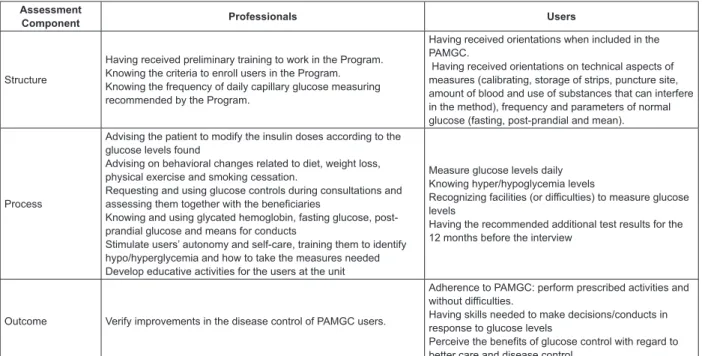
and outcome assessment, presented in Figure 1.
Assessment
Component Professionals Users
Structure
Having received preliminary training to work in the Program. Knowing the criteria to enroll users in the Program. Knowing the frequency of daily capillary glucose measuring recommended by the Program.
Having received orientations when included in the PAMGC.
Having received orientations on technical aspects of measures (calibrating, storage of strips, puncture site, amount of blood and use of substances that can interfere in the method), frequency and parameters of normal glucose (fasting, post-prandial and mean).
Process
Advising the patient to modify the insulin doses according to the glucose levels found
Advising on behavioral changes related to diet, weight loss, physical exercise and smoking cessation.
Requesting and using glucose controls during consultations and assessing them together with the beneficiaries
Knowing and using glycated hemoglobin, fasting glucose, post-prandial glucose and means for conducts
Stimulate users’ autonomy and self-care, training them to identify hypo/hyperglycemia and how to take the measures needed Develop educative activities for the users at the unit
Measure glucose levels daily Knowing hyper/hypoglycemia levels
Recognizing facilities (or difficulties) to measure glucose levels
Having the recommended additional test results for the 12 months before the interview
Outcome Verify improvements in the disease control of PAMGC users.
Adherence to PAMGC: perform prescribed activities and without difficulties.
Having skills needed to make decisions/conducts in response to glucose levels
Perceive the benefits of glucose control with regard to better care and disease control.
Figure 1 – Structure, process and outcome variables used in PAMGC assessment, Botucatu, 2010.
In addition, the patient iles were consulted in the Primary Healthcare services where they were enrolled,
so as to obtain test results related to the most recent
consultation, such as: urea, creatinine, blood culture,
simple urine, cholesterol and fractions, fasting glucose
and glycated hemoglobin.
The interviews were scheduled and held at the
Primary Healthcare services (83% of cases) by four
interviewers, two nurses and two undergraduate nursing
students, who had been trained and were supervised by
one of the authors. For 17% of the users, the interview
was held at home due to reduced mobility. The health
professionals were interviewed at their units, upon
appointment. All interviews were held in June and July
Rev. Latino-Am. Enfermagem 2014 Sept.-Oct.;22(5):801-9.
The data were typed in an Excel worksheet, version 2007, veriied and, after consistency analysis and correction of possible errors, transferred for analysis
in SPSS 12.0. The individuals’ absolute and relative
frequencies were calculated for each variable and in
combination, and the indicators were estimated.
Approval for the project was obtained from the
Research Ethics Committee at Botucatu Medical School,
UNESP, protocol 338/2009. To guarantee the professionals’
anonymity and further their participation in the study,
no data were collected about their characteristics, such
as age, gender and experience in the city’s primary
healthcare network. In addition, measures were taken
for the interviews to take place under conditions that
guaranteed the interviewees’ privacy.
Results
The patients studied were predominantly women
(63.9%), white (88.2%), married (57.3%), over 60
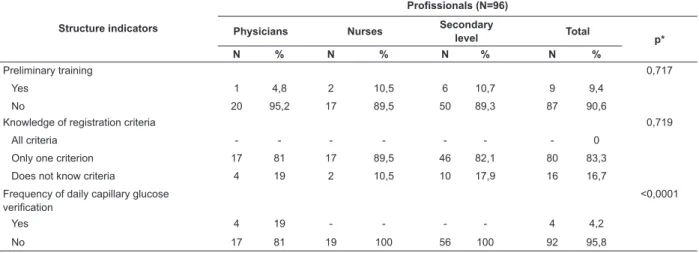
Table 1 - Structure indicators for the health professionals working in the Distribution Program of Glucometers and
Inputs for Self-Monitoring of Capillary Glucose, Botucatu, SP, Brazil, 2010.
Structure indicators
Profissionals (N=96)
Physicians Nurses Secondary
level Total p*
N % N % N % N %
Preliminary training 0,717
Yes 1 4,8 2 10,5 6 10,7 9 9,4
No 20 95,2 17 89,5 50 89,3 87 90,6
Knowledge of registration criteria 0,719
All criteria - - - 0
Only one criterion 17 81 17 89,5 46 82,1 80 83,3
Does not know criteria 4 19 2 10,5 10 17,9 16 16,7
Frequency of daily capillary glucose verification
<0,0001
Yes 4 19 - - - - 4 4,2
No 17 81 19 100 56 100 92 95,8
*P-value, chi-square test
Table 2 - Structure indicators for patients registered in the Distribution Program of Glucometers and Inputs for
Self-Monitoring of Capillary Glucose, Botucatu, SP, Brazil, 2010.
Structure indicators Pacients
N %
Orientations when registering in PAMGC
Yes 253 87,8
No 35 12,2
Orientations about technical aspects of measuring
Calibration. storage of strips. puncture site. amount of blood. use of substances that can interfere in the method 11 3,8
Received between two and four correct orientations 50 17,4
Received one correct orientation 144 50,0
Received incorrect orientations or does not recall the orientations 83 28,8 Orientations about frequency of capillary glucose verifications
Yes 247 85,8
(63.6%) and with up to four years of education (63.9%).
As for how long ago they had been diagnosed with DM,
59.7% had known their condition for more than 11
years and 95.1% suffered from DM 2. Half (50.7%) of
the patients had been on insulin for more than six years and 54.9% were registered in the PAMGC in the irst semester of 2009.
As regards the knowledge about the criteria for
registration in the Program, only 9.4% of the health
professionals had received training to work in the
Program and only four (4.2%) knew the frequency of daily capillary glucose veriication (Table 1).
As regards the information needed to start their
participation in the Program, 11 (3.8%) patients indicated
they received information about self-monitoring and only
nine (3.1%) referred to the glucose levels that correctly
indicate normality, hyper or hypoglycemia (Table 2).
Table 3. Process indicators for professionals working in the Distribution Program of Glucometers and Inputs for
Self-Monitoring of Capillary Glucose, Botucatu, SP, Brazil, 2010.
Process indicators
Profissionals Physicians
(N=21)
Nurses (N=19)
Auxiliaries and technicians (N=56)
Total
(N=96) P
N % N % N % N %
Advises the patient to modify insulin doses (N=21)
Yes 6 28,6
No 15 71,4 0,421
Diet, weight loss and physical exercise
Diet, weight loss, physical exercise and smoking cessation
2 9,5 2 10,5 1 1,7 5 5,2
Diet, weight loss and physical exercise 13 61,9 10 52,6 28 50,0 51 53,1 Diet and weight loss 4 19,0 6 31,6 23 41,1 33 34,4 No lifestyle orientation 2 9,5 1 5,30 4 7,2 7 7,3 Requests and verifies glucose controls during
consultations (N=40)
Yes 21 100 19 100
No - - - - 0,034
Requests recommended tests (N=40)
All (fasting glucose, lipid profile, glycated hemoglobin, urea and creatinine)
6 28,6 12 63,1 18 45,0
Requests at least glycated hemoglobin and fasting glucose
15 71,4 6 31,6 21 52,5
Does not request minimal tests (glycated hemoglobin and fasting glucose)
- 1 5,3 1 2,5 0,016
Knows levels and uses glycated hemoglobin for conducts (N=40)
Yes 4 19,1 1 5,2 5 12,5
No 17 80,9 18 94,7 35 87,5 0,647
Knows levels and uses fasting glucose for conducts (N=96)
Yes 8 38,1 8 42,1 22 39,3 38 39,6
No 13 61,9 11 57,9 34 60,7 58 60,4
Knows correct values and uses post-prandial glucose (N=96)
0,671
Yes 3 14,3 4 21,1 6 10,7 13 13,5
No 18 85,7 15 78,9 50 89,3 83 86,5
Knows correct values and uses mean glucose (N=96) 0,056
Yes 4 19,1 3 15,8 2 3,6 9 9,4
No 17 80,9 16 84,2 54 96,4 87 90,6
Structure indicators Pacients
N %
No 41 14,2
Orientations about frequency of capillary glucose verifications
Follow Ministry of Health recommendations 231 80,2 Differ from Ministry of Health indications or did not receive orientations 57 19,8 Orientations about glucose control parameters
Yes 186 65,6
No 102 35,4
Orientations about capillary glucose parameters
Know correct fasting. mean and post-prandial glucose levels 9 3,1 Know correct values of one or two glucose control parameters 154 53,5 Indicate incorrect values for two or more parameters 23 8,0
Patient did not receive orientation 102 35,4
Table 2 - continuation
Process Assessment
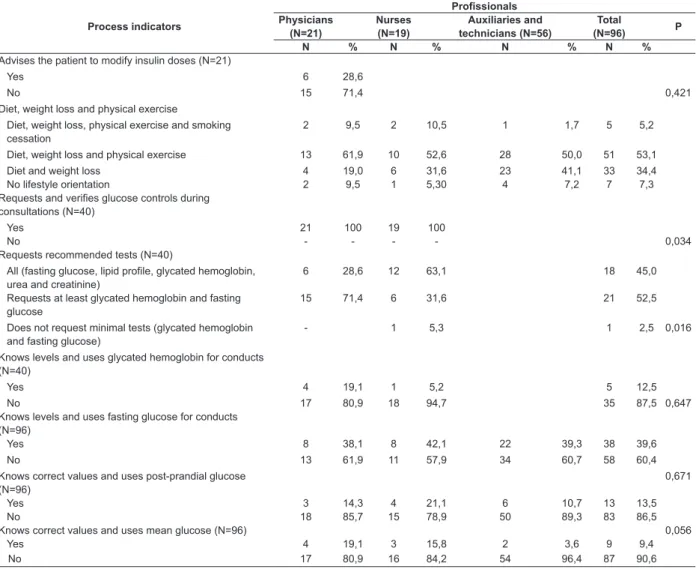
Regarding the health professionals, most
physicians indicated that they do not advise the patients
to adjust the insulin doses according to the capillary glucose results obtained at home. Forty-ive percent of the professionals regularly request the recommended
laboratory tests to monitor DM patients on insulin,
with nurses demonstrating greater compliance with oficial protocols. The proportions of professionals who referred using and who correctly indicated the normality
parameters of fasting (39.6%), and post-prandial
capillary glucose (13.5%) and glycated hemoglobin
Rev. Latino-Am. Enfermagem 2014 Sept.-Oct.;22(5):801-9.
Differences were found between the information
referred by the professionals and that found in the health iles with regard to the laboratory tests. Most of the health professionals (97.5%) indicated that they
request at least one fasting glucose and HbA1C test for
the health service users; 67% of them had no records of these tests in their iles for the twelve months before the data collection.
Another process indicator highlighted is that
90.3% of the health service users indicated that they
manipulate the glucometer and measure their glucose
easily, although the Health services do not offer regular
educative activities to train the patients for adherence to
the monitoring process (data not shown in Table).
In Table 4, the results of the Program’s structure,
process and outcome assessment are summarized.
It is emphasized that 100% of the patients did not
receive complete and correct orientations about the
PAMGC and that only one professional (2.5%) referred
practicing all of the following actions: requesting the
capillary glucose measures to the patients for the sake
of therapeutic decision making, advising on a diet,
increased physical exercise and smoking cessation
(when relevant) and requesting glycated hemoglobin, fasting glucose and lipid proile tests at the required intervals. The outcome indicators showed that only
9.7% of the patients were skilled to take conducts in
response to the capillary glucose measures obtained at
home. According to 86.4% of them, the participation
in the PAMGC was positive for the sake of self-care
and disease control. Among the professionals, 81.3% referred that the Program offered beneits for the purpose of disease control.
Table 4 - Synthesis of structure, process and outcome indicators (in percentages) for the Distribution Program of
Glucometers and Inputs for Self-Monitoring of Capillary Glucose, Botucatu, SP, Brasil, 2010
Indicators % of professional
or patients
Structure
Professionals who know the registration criteria and disease control parameters
-Process
Professionals who request capillary glucose levels during consultations, advise on diet, physical exercise and smoking cessation, when relevant, and request glycated hemoglobin, fast glucose and lipid profile, urea and creatinine tests.
2,5
Patients who follow recommendations on number of glucose measures 15,3
Patients with glycated hemoglobin, fasting glucose and lipid profile, urea and creatinine tests during 12 months before interview date.
18,0
Outcome
Professionals who consider that the PAMGC improved the patients’ disease control 81,3
Patients with skills to act on glucose levels 9,7
Patients who consider the inclusion in the PAMGC positive for their care and control 86,4
Discussion
The structure, process and outcome assessment of
the PAMGC in the city of Botucatu evidenced weaknesses
and contradictions. The analysis of the Program
structure revealed that the professionals and patients are insuficiently trained to obtain the potential beneits of glucose self-monitoring. Glucose monitoring without
a plan that implies the patients’ involvement with the
team or the underuse of the outcomes for the sake of
therapeutic adequacy do not contribute to improve the
glucose control, thus indicating that monitoring alone is
not effective(13).
This shortage may affect the negative process
and outcome indicators. It should be highlighted that
the analysis of the quality of care delivery showed that
the percentage of patients enrolled in the Program with
knowledge and skills to take autonomous conducts,
based on the results of the capillary glucose
self-monitoring at home, was about 10%.
Besides the deicient technical aspects related to the patients’ registration in the Program and the
implementation of the recommended actions, the
professionals’ lack of preparation can explain the lack of
regular educative activities in the Program under study. It was veriied that the orientations offered address only part of the strategic content the Program proposes with
regard to clinical care, health promotion, management of
capillary glucose self-monitoring at home and technical
updates related to DM(4,10).
In view of the public policies related to the adoption
the therapeutic plan for diabetes patients on insulin(15),
the health professionals’ actions lacked expression,
as almost half of them (46.9%) do not explore
fundamental issues to achieve metabolic control during
the consultations, such as dietary compliance, increased
physical exercise and the importance of weight loss and
smoking cessation.
These results are in accordance with a study
undertaken in a sample of resident physicians, which evidenced that most of them experienced dificulties to use capillary glucose self-monitoring after receiving
training about DM treatment(16). Thus, it is acknowledged
that training about handling equipment and inputs
should be permanent, as well as about how to interpret
the results of the capillary glucose self-monitoring at
home. The professionals and health service users’ lack
of training puts the utility of this technology at risk as
a tool to reduce complications and enhance disease control in the city under study, inluencing the autonomy for self-care.
The inding that most of the physicians indicate that they do not advise the users to adjust the insulin
doses according to the capillary glucose measures
obtained reveals an underlying problem, which is the
professionals’ disbelief in the users’ self-care ability to
adjust the treatment with a view to their autonomy. These results can be validated by the inding that, in most cases, the professionals do not even verify the
worksheets with the capillary glucose levels at home
during the consultations. It should be emphasized,
however, how important it is for the professionals to
share the decisions about the therapeutic plan with the
users, favoring the right to know and decide on their own
health(17-18). A study to assess the metabolic control of
patients registered in the PAMGC, held in Ribeirão
Preto-SP, showed that the metabolic control improved even
without systematic monitoring by the multidisciplinary health team, characterized by the signiicant reduction of HbA1C(10).
Based on the constructed structure, process and outcome indicators, it could be identiied that one of the main objectives of the PAMGC, the joint construction
of self-care skills(4,11,19), has not been achieved in the
city. Further research is needed, however, to compare
the Program outcomes in different locations or regions of the country, with a view to deining their external validity. In summary, it needs to be deined whether the negative indicators are a particularity of the city under
study or whether the PAMGC has weaknesses at the
national level.
The contradiction between the negative structure
and process indicators and the health service users and
professionals’ perceived positive impact of the Program
arouses questions about the utility of satisfaction as
an outcome indicator. In fact, the health service users
are reluctant to express criticism and dissatisfaction
with the health services where they are monitored. In addition, their perceptions can be inluenced by their expectations, earlier experiences or current health
condition(20). Thus, access to equipment and inputs
without any counterpart, i.e. as a right, may have been suficient for the positive assessments. It is known that, in many chronic illness situations, like DM and
cancer for example, access to medication and/or inputs
needed for treatment has often depended on legal
proceedings(21).
The results of this assessment strongly suggest that
the local primary health care managers need to prioritize
the implementation of the PAMGC. The value of the
program is beyond doubt but, besides the registration
of DM patients on insulin, the indication of capillary
glucose self-monitoring at home and the provision of
material, the health professionals need better skills in order to verify the beneits of this technology, offering training, updated knowledge, pedagogical skills for
communication, listening and understanding in dealing
with the health users, so as to enable them to verify the beneits of this technology(22).
One of the limitations of this study was the absence
of the service managers responsible for putting the
PAMGC in practice. In future studies, their inclusion is
recommended with a view to better understanding their
conceptions and actions regarding the Program.
The main hypothesis to explain the negative
results obtained is related to the lack of clarity
about the objectives of the PAMGC among the main
actors: professionals and health service users. The
professionals seemed to believe that their responsibility
was to comply with the federal law that established the
free distribution of glucometers and inputs, instead
of the effective implementation of the PAMGC for the
DM patients on insulin under their care. The users also
seemed to have a limited conception about their role
in the Program: simply obtaining the equipment and
material for capillary glucose measuring at home. As
a result, the use of capillary glucose self-monitoring at home to gain beneits from this technology remains a challenge for primary health care in the city under
Rev. Latino-Am. Enfermagem 2014 Sept.-Oct.;22(5):801-9.
Conclusion
Based on the results, it can be concluded that, with
regard to the structure, most of the health professionals
were not appropriately trained and were not familiar with
the criteria for registering the users in the Program. The
process indicators showed that, in comparison with the physicians, adherence levels to oficial protocols were higher among the nurses. What the outcome indicators
is concerned, 86.4% of the patients and 81.3% of the
professionals assessed the Program positively. On the
whole, through the constructed assessment indicators, it could be identiied that one of the main objectives of the Program, the development of self-care skills for
diabetes patients on insulin, has not been achieved.
References
1. Ministério da Saúde (BR). Política Nacional de
Avaliação de Desempenho do SUS. Brasília: MS; 2007.
2. Donabedian A. Striving for Quality in Health Care. An
Inquity into Policy and Practice. Ann Arbor, Michigan:
Health Administration Press; 1991.
3. Donabedian A. Evaluating the quality of medical care.
Milbank Mem Fund Q. 1966;44(Suppl l):166-206.
4. Ministério da Saúde (BR). Lei nº.11.347. Dispõe sobre
a distribuição gratuita de medicamentos e materiais
necessários à sua aplicação e à monitoração da
glicemia capilar aos portadores de diabetes inscritos em
programas de educação para diabéticos. Diário Oficial da
União, Brasília; 28 set 2006.
5. American Diabetes Association. Standards of medical
care in diabetes. Diabetes Care. 2013;32(Suppl
1):S11-S66.
6. Sociedade Brasileira de Diabetes. Diretrizes da
Sociedades Brasileira de Diabetes. São Paulo: SBD;
2009.
7. Polonsky WH, Fisher L, Schikman CH, Hinnen
DA, Parkin CG, Jelsovsky Z, et al. A structured
self-monitoring of blood glucose approach in type 2 diabetes
encourages more frequent, intensive, and effective
physician interventions: results from the STeP study.
Diabetes Technol Ther. 2011;13:797-802.
8. Poolsup N, Suksomboon N, Rattanasookchit S.
Meta-analysis of the benefits of self-monitoring of blood
glucose on glycemic control in type 2 diabetes patients:
an update. Diabetes Technol Ther. 2009;11:775-84.
9. Grossi SA, Lottemberg SA, Lottemberg AM, Della
Manna T, Kuperman H. Home blood glucose monitoring in
type 1 diabetes mellitus. Rev. Latino-Am. Enfermagem.
2009;17: 194-200.
10. Veras VS, Araújo MFM, Rodrigues FFL, Santos MA,
Damasceno MMC, Zanetti ML. Assessment of metabolic
control among patients in a capillary glucose
self-monitoring program. Acta Paul Enferm. 2012;25:453-8.
11. Ministério da Saúde (BR). Portaria nº 2.583. Define
elenco de medicamentos e insumos disponibilizados pelo
Sistema Único de Saúde, nos termos da Lei nº 11.347,
de 2006, aos usuários portadores de diabetes mellitus.
Diário Oficial da União, Brasília; 2007.
12. Ministério da Saúde (BR). Cadernos de Atenção
Básica nº16 – Diabetes Mellitus. Brasília; Ministério da
Saúde; 2006.
13. Grossi SAA, Cianciarullo TI, Manna TD. Caracterização
dos perfis glicêmicos domiciliares como estratégia para
os ajustes insulinoterápicos em pacientes com diabetes
mellitus do tipo 1. Rev Esc Enferm USP. 2003;37:62-71.
14. Ministério da Saúde (BR). Política Nacional de
Promoção da Saúde. [Internet]. Disponível em:
http://portal.saude.gov.br/portal/arquivos/pdf/
portaria687_2006_anexo1.pdf
15. Guzmán JR, Lyra R, Aguilar-Salinas CA, Cavalcanti
S, Escano F, Tambasia M, et al. Treatment of type 2
diabetes in Latin America: a consensus statement by the
medical associations of 17 Latin American countries. Rev
Panam Salud Publica. 2010;28:463-71.
16. Zanoni PH, Parisi MCR, Admoni SN, Queiroz MS, Nery
M. Curso de imersão em diabetes como técnica educativa
para profissionais médicos. Arq Bras Endocrinol Metabol.
2009;53:355-9.
17. Teixeira CRS, Zanetti ML, Pereira MCA. Perfil de
diagnósticos de enfermagem em pessoas com diabetes
segundo modelo conceitual de Orem. Acta Paul Enferm.
2009;22: 385-91 .
18. Fortes PAC. Ética, direitos dos usuários e políticas
de humanização da atenção à saúde. Rev Saúde Soc.
2004;13:30-5.
19.Montenegro RM Junior, Silveira MMC, Nobre IP, Silva
CAB. Assistência multidisciplinar e o manejo efetivo do
diabetes mellitus: desafios atuais. RBPS. 2004;17
:200-5.
20. Zanetti ML, Otero LM, Biaggi MV, Santos MA, Péres
DS, Guimarães FPM. Satisfaction of diabetes patients
under follow-up in a diabetes education program. Rev.
Latino-Am. Enfermagem. 2007;15:583-9.
21. Chieffi AL, Barata RB. Judicialização da política
pública de assistência farmacêutica e equidade. Cad
Received: Dec 10th 2013
Accepted: Aug 29th 2014
22. Santos MA, Peres SP, Zanetti ML, Otoro LM, Teixeira
CRS. Programa de educação em saúde: expectativas
e benefícios percebidos por pacientes diabéticos. Rev