2013 May-June;21(3):734-41 www.eerp.usp.br/rlae
Corresponding Author:
Nathalia Hammerschmidt Kolb Carneiro Universidade Federal do Paraná Av. Lothário Meissner, 632 Jardim Botânico
CEP: 80210-170, Curitiba, PR, Brasil E-mail: [email protected]
Prevalence of pre-frailty for the component of gait speed in older adults
Maria Helena Lenardt
1Nathalia Hammerschmidt Kolb Carneiro
2Susanne Elero Betiolli
3Dâmarys Kohlbeck de Melo Neu Ribeiro
3Patrick Alexander Wachholz
4Objective: to investigate pre-frailty and the factors associated with this condition, taking into
account the measurements of the older adults’ gait speed. Method: participants were selected
by means of inclusion/exclusion criteria and a cognitive tracking test. The sample was calculated
based on the estimation of populational proportion and made up of 195 older adults who were using
a Primary Health-Care Center in Curitiba in the state of Paraná. Data was collected using a
socio-demographic/clinical questionnaire and the gait speed test. Results: pre-frailty for gait speed has
moderate prevalence (27.3%), and is associated with the 60 – 69 years age range, a low level of
schooling, not feeling oneself to be alone, using anti-hypertensives, having cardiovascular disease
and being overweight. Conclusion: it is considered relevant to identify those older adults with
pre-frailty, as this creates the possibility for immediate intervention with the aim of stabilizing
the picture. There is a significant shortage of studies on the syndrome of frailty in Brazilian older
adults, principally referring to components in isolation. Given that gerontological nursing is at an
early stage regarding this issue, it is understood that the identification of the prevalence must be
the key point of the research on the matter.
Descriptors: Frail Elderly; Nursing; Gait.
1 PhD, Retired Professor, Departamento de Enfermagem, Universidade Federal do Paraná, Curitiba, PR, Brazil.
2 Master’s Student, Departamento de Enfermagem, Universidade Federal do Paraná, Curitiba, PR, Brasil. Scholarship holder at the Coordenação de Aperfeiçoamento de Pessoal de Nível Superior (CAPES).
3 Doctoral Student, Departamento de Enfermagem, Universidade Federal do Paraná, Curitiba, PR, Brasil. Scholarship holder at the Coordenação de Aperfeiçoamento de Pessoal de Nível Superior (CAPES).
Introduction
Senescence involves a wide range of physiological
and psychosocial changes which accompany the natural
process of aging in humans(1). The action of personal and
environmental factors over the course of an individual’s life, in conjunction with the interaction caused by the
person’s genetic inheritance (whether this is protective
or detrimental) can, as the years go by, impede the more
traditional delimitation of concepts such as natural aging
(senescence) and aging with frailty, which are usually
separated – principally in very elderly individuals - by a tenuous line.
Although there is not a consensus regarding its deinition, aging with frailty is understood as a clinical state of vulnerability to stressing factors, which results in
a decline in the physiological reserves, with a subsequent reduction in the eficiency of homeostasis(2-3). Two large
prospective populational studies, the Women’s Health and Aging Studies (WHAS)(1) and the Cardiovascular
Health Study (CHS)(4), operationalized and validated the
phenotypic criteria for the syndrome of frailty and
pre-frailty most used at the present time, through evaluating
the following components: unintentional weight loss,
reduction in the strength of hand grip, reduction in
physical activity, self-reported fatigue and reduction in gait speed.
According to these criteria, an older adult is
considered frail if he or she meets three or more of the ive characteristics of the syndrome of frailty; the pre-frail phenotype encompasses those individuals who meet
only one or two of the above-mentioned components; the older adults with negative or normal responses to the ive elements are considered non-frail(2).
Gait speed has been studied as a potential
predictor for adverse events, and its correlation with
the cycle of frailty has been suggested in preliminary
investigations(5-7). This study’s object was to
investigate pre-frailty and the factors associated with this condition, taking gait speed into account, in older
service users of a Primary Health-Care Center in the
South of Brazil.
Methods
This is a quantitative, cross-sectional study carried
out in a Primary Health-Care Center (UBS) in the city
of Curitiba, Paraná. The target population was made up of older adults aged 60 or over who were waiting for a
consultation in the UBS, in the period September 2010
– March 2011.
The size of the sample was determined based on
the estimation of the populational proportion. A degree of conidence of 95% (α=0.05), a variance of 0.12 and a sampling error ixed at ive percentage points were taken into account. 10% was added to the size of the
sample because of the possibility of losses or refusals,
which resulted in a sampling plan of 203 older adults. The following inclusion criteria were adopted for
selecting the older adults: (a) to be aged sixty or over;
(b) to have a score above the cut-off point (according to level of schooling) on the administration of the
Mini-Mental State Examination (MMSE) cognitive test(8): a
minimum of 13 points for illiterates, 18 points for those with medium to low schooling, and 26 points for those
with a high level of schooling(9) and (c) to be able to walk
around, with or without support.
Older adults were excluded if they had previous diagnoses of severe physical or mental illnesses or
handicaps, which could hinder participation in the stages
of interview and evaluation of the phenotypes of frailty and of walking, or which raised an unacceptable risk of
falls while carrying out the latter.
The sample was recruited by convenience and the individuals were invited to participate in the study in the
order of their arrival at the reception of the UBS. The
objective of the research was explained and those who
were willing to participate signed the Terms of Free and Informed Consent (TCLE). Following this, in a reserved
area termed the Health Space, the Mini-Mental State
Examination (MMSE)(8) was administered, for tracking
of changes in cognitive function (cognitive screening) in
the older adults.
Following this, the socio-demographic questionnaire and the gait speed test were administered.The
socio-demographic variables investigated were: age, marital
state, with whom the older adult lived, level of schooling
and family income. The clinical variables included: health problems, number of hospitalizations, history of falls,
feelings of solitude, urinary function, use of cigarettes
and alcohol, use of assistive technology (walking stick, walking frame, crutches, corrective lenses) use of
medication and Body Mass Index (BMI).
One literature review(5) discusses 9 cohort
studies, which associated gait speed tests over a
distance of six meters. In a similar way, a separate
international literature review study(10), which assessed
the applicability of gait speed tests, indicates that the marking of 6 meters suggested by the authors(5,11) has
been widely used for elderly patients and that usually
Rev. Latino-Am. Enfermagem 2013 May-June;21(3):734-41.
For this reason, in order to evaluate the gait speed,
the older adults were advised to walk six meters, in their usual way, on a lat surface, signposted with four marks: start, one meter, ive meters, and end. So as to reduce the effects of acceleration and deceleration, the
test was started one meter before the second reference,
and the walk was interrupted one meter after the third
mark(11). The digital stopwatch measured the time taken
in seconds for covering the four meters.
Gait speed was calculated in meters per second
(m/s), in line with an international study on frailty in
older adults(4), so as to realize comparisons. In the
study in question(4), values in the lower quintile (the
value in which 20% of the sorted sample is found)
were considered as frailty markers. In the present
investigation, however, because of the computer
program used, the lower quartile (a value in which 25%
of the sorted sample is found) was used as the frailty
marker.
The data was organized and stored in the Excel®
2007 software, in which the subjects were separated
according to their level of frailty (pre-frail and non-frail
older adults, according to the gait speed marker). The
EpiInfo software, version 6.04, was used for analyzing
the results, and descriptive statistics was applied,
through the distribution of the absolute and percentual
frequencies, the mean and standard deviation, and
non-parametric tests (Chi-squared and Fisher) for the
association of variables. The results were considered
statistically signiicant when p<0.05, that is, with a level of signiicance of 5%.
The study was approved by the Health Sciences
Department Ethics Committee for Research on
Human Beings, being approved under record CEP/SD:
913.038.10.04 CAAE: 0023.0.091.000-10. The ethical
precepts of the voluntary and consensual participation
of each subject were respected.
Results
After applying the inclusion and exclusion criteria proposed for the study, the inal sample was made up of 195 older adults. Of the total of older adults, 27.3% had reduced gait speed, and were classiied as in a pre-frail condition for this component.
Regarding the socio-demographic proile of the older adults with reduced gait speed (27.3%), 18% are
female and 9.3% are male. There was a prevalence of
the age range from 60 to 69 years (10.8%; Table 1),
with the minimum age being 60 years and the maximum
age being 93 years (mean=72.90; ±7.9).
It can be seen from Table 1 that 11.3% of the older
adults who were pre-frail for this component stated
themselves to be widowed and the majority (18%) live
with more than one family member. Regarding level of schooling, 15.4% of the older adults had not inished basic education, and 13% considered their inancial situation to be average.
Table1 – Socio-demographic proile of the older adult with pre-frailty for gait speed. Curitiba, PR, Brazil, 2011
Variable/Classification
Pre-frail for GS* Non-frail for GS* Total
P value†
n (%) n (%) n (%)
Sex
Male 18 (9.3) 65 (33.3) 83 (42.6)
0.137
Female 35 (18.0) 77 (39.4) 112 (57.4)
Age
60 to 69 years 21 (10.8) 86 (44.1) 107 (54.9)
<0.001†
70 to 79 years 19 (9.8) 48 (24.5) 67 (34.3)
80 years or over 13 (6.7) 08 (4.1) 21(10.8)
Marital status
Widow(er) 22 (11.3) 37 (18.9) 59 (30.2)
0.084
Married 19 (9.8) 79 (40.5) 98 (50.3)
Divorced 06 (3.1) 15 (7.7) 21 (10.8)
Single 06 (3.1) 11 (5.6) 17 (8.7)
Who lives with
Family member 35 (18.0) 89 (45.6) 124 (63.6)
0.855
Spouse 10 (5.2) 32 (16.3) 42 (21.5)
Alone 08 (41) 21 (10.8) 29 (14.9)
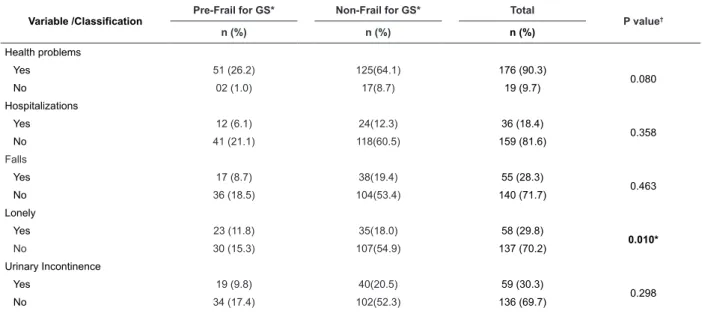
The majority of the older adults with reduced gait
speed have health problems (26.2%). The illnesses reported were classiied according to their distinctive characteristics and grouped in the following way:
cardiovascular, musculo-skeletal, of the digestive
system, metabolic, respiratory, auditory, dyslipidemias,
visual, urological and others. Cardiovascular illnesses
predominated (32.1%) and the number of illnesses
varied from zero to nine (mean 2.76; ±1.7; Table 2). It was possible to note a signiicant quantity of older adults who stated that they had not received
inpatient treatment or suffered an episode of falling
in the previous twelve months (21.1% and 18.5%,
respectively), did not feel lonely (15.3%), did not
suffer from urinary incontinence (17.4%), did not
smoke (24.7%) and did not drink alcohol (24.1%).
Further, regarding the use of assistive technology, the
majority reported that they do not use walking sticks
(25.1%), walkers (27.1%) or crutches (26.6%). The
use of glasses was mentioned by 23.5% of the older
adults (Table 2). Table 1 - (continuation)
Variable/Classification
Pre-frail for GS* Non-frail for GS* Total
P value†
n (%) n (%) n (%)
Schooling
Junior high incomplete 30 (15.4) 91 (46.5) 121 (61.9)
0.015†
Illiterate 14 (7.2) 16 (8.2) 30 (15.4)
High school complete 06 (3.1) 15 (7.7) 21 (10.8)
High school incomplete 03 (1.6) 03 (1.6) 06 (3.2)
Junior high complete 0 (0) 15 (7.7) 15 (7.7)
Higher education 0 (0) 02 (1.0) 02 (1.0)
Financial Situation
Average 25 (13.0) 99 (50.6) 124 (63.6)
0.126
Satisfactory 17 (87) 08 (4.1) 25 (12.8)
Insatisfactory 11 (56) 35 (18.0) 46 (23.6)
Total 53 (27.3) 142 (72.7) 195(100)
NB: Result expressed by frequency (percentual). *Chi-Squared test, p<0.05
†Gait Speed
Table 2 – Clinical proile of the older adult with pre-frailty for gait speed. Curitiba, PR, Brazil, 2011
Variable /Classification
Pre-Frail for GS* Non-Frail for GS* Total
P value†
n (%) n (%) n (%)
Health problems
Yes 51 (26.2) 125(64.1) 176 (90.3)
0.080
No 02 (1.0) 17(8.7) 19 (9.7)
Hospitalizations
Yes 12 (6.1) 24(12.3) 36 (18.4)
0.358
No 41 (21.1) 118(60.5) 159 (81.6)
Falls
Yes 17 (8.7) 38(19.4) 55 (28.3)
0.463
No 36 (18.5) 104(53.4) 140 (71.7)
Lonely
Yes 23 (11.8) 35(18.0) 58 (29.8)
0.010*
No 30 (15.3) 107(54.9) 137 (70.2)
Urinary Incontinence
Yes 19 (9.8) 40(20.5) 59 (30.3)
0.298
No 34 (17.4) 102(52.3) 136 (69.7)
Rev. Latino-Am. Enfermagem 2013 May-June;21(3):734-41.
The quantity and the class of the medications used
varied among the older adults in the sample. It may be observed that 9.8% use ive or more medications, with the maximum number of medications used being 16.
The main classes of drugs used by the older adults with
reduced gait speed were: antihypertensives (24.1%), oral hypoglycemics (11.3%) and anti-inlammatories (9.8%). It is noteworthy that 15.3% had a BMI
compatible with being overweight.
Among the older adults, the slowest gait speed was
0.29 m/s, and the fastest was 0.71 m/s, with a mean of
0.50 m/s. Among the males, the slowest speed was 0.24
m/s, the fastest was 0.71 m/s, and the mean was 0.47
m/s. The value of the speed corresponding to the lower quartile identiied in the sample was equal to 0.71 m/s.
There was a signiicant association between pre-frailty for gait speed and the socio-demographic variables of age (p<0.001) and schooling (p=0.015). The clinical
variables which were signiicantly associated with reduced gait speed were: presence of cardiovascular diseases (p=0.003); use of antihypertensives (p=0.005); not
feeling lonely (p=0.010); and BMI compatible with being overweight (p=0.005).
Discussion
The distribution of the 53 older adults with frailty
for gait speed shows 18% female and 9.3% male, which is consistent with studies in which female longevity was identiied, a phenomenon known as the feminization of aging(12)
. Although older adults nowadays have the
advantage of longevity, they were also more frequently the victims of discrimination in access to education, salary, food, meaningful work and political power. These cumulative disadvantages mean that older women tend
to be poorer and present greater disabilities at more advanced ages(13).
Variable /Classification
Pre-Frail for GS* Non-Frail for GS* Total
P value†
n (%) n (%) n (%)
Smoker
Yes 05 (2.5) 13(6.7) 15 (9.2)
0.952
No 48 (24.7) 129(66.1) 177 (90.8)
Alcohol consumer
Yes 06 (3.1) 19(9.7) 25 (12.8)
0.701
No 47 (24.1) 123(63.1) 170 (87.2)
Walking Stick
Yes 04 (2.0) 04(2.0) 08 (4.0)
0.138
No 49 (25.1) 138(70.9) 187 (96.0)
Walker
Yes 0 (0) 01(0.5) 01 (0.5)
0.540
No 53 (27.1) 141(72.4) 191 (99.5)
Crutches
Yes 01 (0.5) 01(0.5) 02 (1.0)
0.465
No 52 (26.6) 141(72.4) 193 (99.0)
Ocular Prosthesis
Yes 46 (23.5) 135 (69.3) 181 (92.8)
0.341
No 07 (3.6) 07 (3.6) 14 (7.2)
Medications
Yes 52 (26.6) 137 (70.3) 189 (96.9)
0.182
No 01 (0.5) 05 (2.6) 06 (3.1)
Body Mass Index (BMI)
Low Weight 01 (0.5) 0 (0) 01 (0.5)
0.005†
Eutrophy 22 (11.3) 41 (21.0) 63 (32.3)
Overweight 30 (15.3) 101 (51.9) 131 (67.2)
Total 53 (27.3) 142 (72.7) 195 (100)
Table 2 - (continuation)
NB: Results expressed by frequency (percentual) *Chi-Squared Test, p<0.05
The men obtained a lower mean gait speed
(0.47 m/s) than the women (0.50 m/s). These results
diverge from those from research(14) which assessed
the results of eight cohort studies undertaken in the
United Kingdom, which covered approximately 40,000
individuals aged between 50 and 90 years. The study(14)
showed that the women’s gait speed results were lower
than the men’s, although this difference was attenuated
after adjusting for body size. According to the study(14),
gait speed tends to reduce gradually with aging, at a
more accelerated rate between 65 and 85 years, and
with a decline which is more accentuated among women
compared to among the men.
However, in like manner to the present study,
a study undertaken in Peru(15) with 246 older adults,
which aimed to determine the factors associated
with reduction in gait speed, also did not indicate a signiicant relationship between this variable and the sex of the participants. Thus, it is suggested that further
investigations focussing on this should be undertaken,
so that a better relationship between gait speed and
gender in older adults may be established.
In the relation between older adults’ age and gait speed, a signiicant difference was observed in the group aged from 60 to 69 years (p<0.001). This age range had a mean speed of 0.67 m/s, whereas the older
adults aged between 70 and 79 had a mean speed of
0.58 m/s and those aged 80 or over had a mean speed
of 0.50 m/s. These results match those found in the
literature(14-15), demonstrating that older adults aged 80
or over present reduced gait speed more frequently.
This may be explained, in part, by the aging process,
in which physiological changes in neuro-musculoskeletal
function occur(16).
There was a signiicant relationship between gait speed and low schooling (p=0.015). Of the 53 older adults, 22.6% did not inish Junior High School. A study(17) carried out with 235 older adults ascertained
that the probability of those with the lowest level of
schooling manifesting moderate to severe functional dependence was ive times greater than those with a high level of schooling. Those individuals with the lowest
level of schooling tend more frequently to adopt habits
which are prejudicial to health, whether this is through dificulty in accessing information or because of living conditions which lead to the incorporation of behaviors
considered unhealthy(18).
Health problems were reported by 90.3% of the
participants in the present investigation. Of these,
26.2% had altered gait speed. In spite of the high
prevalence of illnesses referred to by the older adults,
attention is drawn to the scarcity of data in the
literature relating the presence of morbidities and
pre-frailty to gait speed. However, regarding the scale of
the frequency of the illnesses, this research’s result is similar to the indings of an epidemiological study carried out in the municipality of São Paulo(19), in which
2,143 older adults participated. According to the results
of that investigation, high blood pressure was the most
prevalent illness, being observed in 53.3% of the older
adults; followed by arthritis/rheumatism/arthrosis
in 31.7%; cardiac problems in 18.2%; and diabetes
mellitus in 17.8% of the participants(19).
The research(19) cited above points out, further,
that the main signs and symptoms mentioned by the
older adults who had cardiovascular illnesses were:
chest pain; swelling in the feet and ankles; persistent
vertigo/dizziness; and severe fatigue or tiredness.
It is believed that these factors are important when
considering change in gait speed, which constitutes a possible explanation for the signiicant result between these two variables.
Of the older adults who needed drug therapy
(96.9%), 26.6% had a reduced gait speed. Of these, 9.8% used more than ive medications, which constitutes polypharmacy (use of ive or more medications), an effect observed in various studies already undertaken
with the elderly population. According to research(20)
undertaken with 1,598 older adults resident in the
metropolitan region of Belo Horizonte in the state of
Minas Gerais, there was a moderate percentage of
polypharmacy (14.3%) among the subjects interviewed.
Results such as these show the importance of attitudes
to be taken for the quantities of medications taken to be
reduced where possible.
The majority of the participants use
antihypertensives (69.2%). Among these, 24.1% are
pre-frail for the component studied. A similar result was
indicated by a study(19) in which 80.6% of the older adults
used this type of medication. The association between
reduction in gait speed and use of antihypertensives was shown to be statistically signiicant, with a value of p=0.005, which suggests that some of the symptoms
resulting from high blood pressure – such as dizziness
and tiredness – may entail changes in older adults’ gait
speed.
One may observe in the literature works which
relate the reduction in gait speed with greater
incidence of falls in older adults(18-21). In the present
Rev. Latino-Am. Enfermagem 2013 May-June;21(3):734-41.
association between these variables. A study(22) which
assessed walking in older adults aged 82 or over
concluded that changes in walking, as adaptations for
gaining stability, are adaptations made by older people
in response to fear of falling. Hence, it is to be expected
that reducing speed should contribute to a reduction
in the incidence of falls rather than to an increase in
the same. The investigation(22) supports the hypothesis
that the predictive factor for the tendency to fall among
older adults is the variability of the temporal and spatial
data of the act of walking during the pacing rather than
the reduction in the speed resulting from the aging
process.
The self-reporting by older adults of “not feeling lonely” was associated signiicantly with reduction in gait speed (p=0.010). Data was not found in the scientiic literature permitting the discussion of the relationship between these variables. This inding may be explained by the subjectivity present in feeling oneself to be
lonely or not, which could not be investigated here
due to the present study’s quantitative approach. A
qualitative investigation could possibly contribute to an
understanding of this relationship.
The high rate of overweightness (n=30; 15.3%) in
the present study stands out, this being shown to be statistically signiicant in reducing gait speed (p=0.005). One investigation(23) which assessed BMI in 699 older
adults in the community also indicated a higher rate
(50%) of overweightness in the individuals evaluated.
Among the innumerable consequences of being
overweight, one may cite the wear on the joints as a factor inluencing the older adult’s walking. One should also stress the scarcity in the literature of studies which
directly relate BMI with gait speed, which indicates
evidence for further studies.
The instrument of evaluation of gait speed was
shown to be useful as an indicator for pre-frailty in older
adults, given the prevalence of its relationship with this
condition. In addition to this, it is an easy test to apply
and one which does not require great resources to be
carried out, being able to be realize widely in health
institutions. In isolation, it was shown to be capable of
identifying slowing-down of gait speed among the older
adults investigated, which is considered a possible sign of deicit in functional capacity and presence of illnesses related to walking. One cannot, however, infer that this
type of evaluation indicates changes in the older adult’s
general state of health. For that, it would be necessary
to include variables which evidence the older adults’
state of health in association with the gait speed.
Conclusion
Moderate prevalence of pre-frailty for gait speed is
inferred in the older adults evaluated (27.3%). Thus, primary care health professionals who work directly
with this population should consider identifying the
older adults who are in this pre-frailty condition and
investigate how it relates with the socio-demographic
and clinical variables – as there is the possibility of immediate intervention with the aim of stabilizing the
picture.
The factors associated with the condition of
pre-frailty indicated by the reduction in gait speed were: age range between 60 and 69, low schooling, not
feeling oneself to be lonely, having cardiovascular
disease, using antihypertensive, and being overweight.
Identifying these variables makes it possible for health
professionals working in geriatrics and gerontology to elaborate an action plan which aims to minimize the
harm caused by this condition and, consequently, the
slowing of gait.
The study’s quantitative approach did not allow the understanding of speciic relationships with subjective variables. To that end, the undertaking of further
studies with a qualitative focus is suggested, as these
would permit better interpretations of, and extraction of
meaning from, the statistical data.
The Brazilian literature is signiicantly short of studies which assess the condition of pre-frailty in older
adults, regarding the reduction in gait speed. In the
same way, there is a shortage of investigations relating this component with the socio-demographic and clinical
variables of individuals who live in the community. The
publication of works in this area would help in a better
understanding of the variables associated with the reduction in gait speed. This contribution represents
an important advance in the construction of knowledge
concerning the syndrome of frailty in older adults.
References
1. Lowry KA, Vallejo AN, Studenski SA. Successful Aging as a Continuum of Functional Independence: Lessons
from Physical Disability Models of Aging. Aging and
Disease. 2012;3(1):5-15.
2. Fried L, Ferrucci L, Darer J, Williamson JD, Anderson G. Untangling the concepts of disability, frailty and
comorbidity: implications for improved targeting and
care. J. Gerontol A Biol Sci Med Sci. 2004;59(3):255-63.
3. Xue QL. The frailty syndrome: definition and natural
Received: Aug. 17th 2012
Accepted: Feb. 8th 2013
4. Fried L, Tangen CM, Walston J, Newman AB, Hirsch
C, Gottdiener J, et al. Frailty in older adults: Evidence
for a phenotype. J. Gerontol A Biol Sci Med Sci. 2001;
56A(3):146-56.
5. Studenski S, Perera S, Patel K, Rosano C, Faulkner K,
Inzitari M, et al. Gait speed and survival in older adults.
Jama. 2011;(305):50-8.
6. Varela Pinedo L, Ortiz Saavedra PJ, Chávez Jimeno
H. Gait speed as an indicator of fragility in
community-dwelling elders in Lima, Peru. Rev Esp Geriatr Gerontol.
2010;45(1):22-5.
7. Afilalo J. Frailty in Patients with Cardiovascular
Disease: Why, When, and How to Measure. Curr
Cardiovasc Risk Rep. 2011;5(5):467-72.
8. Folstein MF, Folstein SE, McHugh PR. “Mini-mental
state”: a practical method for grading the cognitive
state of patients for the clinician. J.Psychiatr Res.
1975;12(3):189-98.
9. Bertolucci PH, Brucki SM, Campacci SR, Juliano Y. The
Mini-Mental State Examination in a general population:
impact of educational status. Arq. Neuro-Psiquiatr.
1994;52(1):1-7.
10. Graham JE, Ostir GV, Kuo Y, Fisher SR, Ottenbacher
JK. Relationship Between Test Methodology and Mean
Velocity in Timed Walk Tests: A Review.Arch Phys Med
Rehabil. 2008;89(5):865-72.
11. Geraldes AAR, Oliveira ARM, Albuquerque RB,
Carvalho JM, Farinatti PTV. A força de preensão manual
é boa preditora do desempenho funcional de idosos
frágeis: um estudo correlacional múltiplo. Rev Bras Med
Esporte. 2008;14(1):12-6.
12. Camarano AA. Mulher idosa: suporte familiar ou
agente de mudança? Estud. av. 2003;17(49):35-63.
13. Feliciano AB, Moraes SA, Freitas ICM. O perfil do
idoso de baixa renda no Município de São Carlos, São
Paulo, Brasil: um estudo epidemiológico. Cad. Saúde
Pública. 2004;20(6):1575-85.
14. Cooper R, Hardy R, Sayer AA, Ben-Shlomo, Birnie
K, Cooper C, et al. Age and Gender Differences in
Physical Capability Levels from Mid-Life Onwards:
The Harmonisation and Meta-Analysis of Data from
Eight UK Cohort Studies. PLos ONE [internet].
2011 [acesso em: 06 nov 2012];11(6):e27899.
Disponível em: http://www.plosone.org/article/
info%3Adoi%2F10.1371%2Fjournal.pone.0027899
15. Fernando VPL, José OSP, Alejandro CJH. Velocidad
de la marcha en adultos mayores de la comunidad en
Lima, Perú. Rev Med Hered. 2009;20(3):133-8.
16. Schenatto P, Milano D, Berlezi EM, Bonamigo ECB.
Relação entre aptidão muscular e amplitude articular,
por faixa etária, na marcha do idoso. Rev. Bras. Geriatr.
Gerontol. 2009;12(3):377-89.
17. Rosa TEC. Fatores determinantes da capacidade
funcional de idosos. Rev. Saúde Pública. 2003;37(1):40-8.
18. Maciel ACC, Araújo LM. Fatores associados às
alterações na velocidade de marcha e força de preensão
manual em idosos institucionalizados. Rev. Bras. Geriatr.
Gerontol. 2010;13(2):179-89.
19. Lebrão ML, Laurenti R. Sáude, bem-estar e
envelhecimento: o estudo SABE no município de São
Paulo. Rev Bras Epidemiol. 2005;8(2):127-41.
20. Loyola Filho AI, Uchoa E, Lima-Costa MF. Estudo
epidemiológico de base populacional sobre o uso de
medicamentos entre idosos na Região Metropolitana de
Belo Horizonte, Minas Gerais, Brasil. Cad. Saúde Pública.
2006;22(12):2657-67.
21. Figliolino JAM. Análise da influência do exercício físico
em idosos com relação a equilíbrio, marcha e atividade
de vida diária. Rev Bras de Geriatria e Gerontologia.
2009;12(2):227-38.
22. Maki BE. Gait changes in older adults: predictors
of falls or indicators of fear. J Am Geriatr Soc.
1997;45(3):313-20.
23. Santos DM, Sichieri R. Índice de massa corporal e
indicadores antropométricos de adiposidade em idosos.