www.eerp.usp.br/rlae
Corresponding Author:
Débora Poletto Av. Cônego Peres, 1121 Centro
CEP: 95320-000, Nova Prata, RS, Brasil E-mail: [email protected]
Living with intestinal stoma: the construction of autonomy for care
1Débora Poletto
2Denise Maria Guerreiro Vieira da Silva
3Objective: to investigate the care undertaken in the health services for people with intestinal
stoma, from the perspective of articulating the actions proposed in the Amplified and Shared
Clinic, with a view to promoting autonomy. Method: qualitative study. Participants: 10 people
who received a stoma, and their family members. Data was collected between 10th January
and 30th June 2011, through two semi-structured interviews. Analysis was through the stages:
anxiety, synthesis, theorization and recontextualization. Results: presented in the categories:
(1) the need to carry out stoma care; (2) receiving health support and care after discharge from
hospital; (3) returning to daily activities and social reinsertion. Conclusion: the study identified
common factors which influence the process of development of autonomy and the relationship
which health professionals have with this achievement.
Descriptors: Health Education; Ostomy; Personal Autonomy.
1 Paper extracted from Master’s Thesis “Avaliação qualitativa da atenção à saúde na perspectiva das pessoas com estoma intestinal”, presented
to Universidade Federal de Santa Catarina, Florianópolis, SC, Brazil.
2 MSc, Professor, Faculdade Fátima Educação, Caxias do Sul, RS, Brazil.
Rev. Latino-Am. Enfermagem 2013 Mar.-Apr.;21(2):531-8.
Introduction
A person who has surgery for intestinal stoma
faces a condition which includes the diversion of waste
products to the abdomen and a consequent change
in body image. This type of surgery involves physical
issues related to the loss of body integrity, violation
of hygiene rules, loss of sphincter control with loss of
control of feces and involuntary release of gases and
odor. There may also be change in esteem and
self-concept, feelings of uselessness, depression, sadness,
and rejection, among others. These changes may result
in profound alterations in lifestyle, social relationships
and daily routines(1-3).
To attend these people integrally, health
professionals and services need to be prepared and
available. A person newly in this condition needs new
knowledge in relation to their personal care. In addition
to understanding the stoma, the technical skills and
the physical and biological care, the person also needs
attention directed at their social adaptation, and to
emotional and spiritual care. Mastering these skills and
knowledge is a basis for accepting, and coping with, the
new condition(4).
The person, as a unique individual, is the result
of their subjectivity, inluences from their context, and
interactions with other people. The factors responsible
for the construction of this individual uniqueness vary.
The biological and subjective differences, inserted into
an organizational, political, cultural, social and religious
context, are products of this uniqueness(5-6). Because
of this, all people need the health services to provide
care with a wider view, taking in this variability between
the subjects, the better to understand the condition
and support the promotion of the co-construction of
autonomy.
The term ‘autonomy’ comes from the Greek; ‘auto’
means ‘own’, and ‘nomos’, ‘law, rule’. In this sense,
autonomy leads one to the idea of personal freedom
to deine one’s own rules(7-8). Autonomy is a person’s
capacity to understand themselves and the context in
which they are inserted and, through this, to know how
to act upon themselves and this context. Autonomy is
not an absolute concept, or a static state; it is a dynamic,
gradual process, with the possibility of improvement,
and has variable degrees in line with coeficients relating
to the criteria of the person her- or him-self(5-6).
When speaking of the co-construction of autonomy,
it is considered that health professionals can assist
people in widening their knowledge, working with the aim
of presenting the technical dimension involved in their
health process, and of supporting the development of
their relexive ability in relation to the different situations
and contexts, intervening in their dependency network
and decision-making, recognizing the consequences and
rescuing and/or promoting their autonomy(5-6).
It’s important to emphasize that the directive of
the National Policy for the Humanization of the Brazilian
Uniied Health Service, expressed in the Ampliied and
Shared Clinic(9), involves health education to achieve individual autonomy and freedom, in which scientiic
knowledge is not imposed vertically, but is made
available to people clearly and in a way appropriate to
their level of understanding, promoting conditions such
that they may better deal with their condition.
Qualiied listening, creating spaces for links and mutual conidence and making the practice of dialog
and joint construction of knowledge possible, is part of a
vision for health promotion based on the Ampliied and
Shared Clinic, in which individuality must be respected,
people are once more placed as responsible for their
lives, and the professional’s technical knowledge alone
is insuficient to promote the autonomy of the person
with a stoma(6,9).
The authors’ practical experience with people with
intestinal stoma has led them to question the care which
has been given, as even after a relatively long period
since the surgery, these people remain with doubts
and are unaware of care steps which are important
for keeping themselves healthy. The authors have
questioned the changes which the policies promoting
humanization have effectively promoted, and whether
these policies meet the peculiarities of these people’s
different conditions. Due to these factors, the authors
recommend the relevancy of carrying out an evaluative
study of the care given to people with intestinal stoma
permitting the recognition of the advances made - and
of the remaining gaps.
The authors therefore undertook a study with the
objective of investigating the care given in the health
services to people with intestinal stoma from the
perspective of the articulation of the actions proposed in
the Ampliied and Shared Clinic aiming at the promotion
of the autonomy of people who received a stoma in a
metropolitan region in the south of Brazil.
Method
This was a qualitative study undertaken in the
study’s starting points were three public general hospitals
– one federal and two state – in a metropolitan region of
the south of Brazil, responsible for the highest number
of intestinal stoma operations in the region. Subsequent
to the identiication of the people who had received
stoma surgery in the hospitals, the other stages were
carried out in the residences of the people with stomas.
These institutions were deined as research locales because they allowed the recognition and identiication
of the people who underwent the surgery in this period,
promoting the opportunity for irst contact with the
same and/or their family members.
Sampling was done in an intentional fashion,
seeking to include all the people who had undergone
the surgery in the period established for the irst stage
of data collection – that is, the period January – April
2011. The total number of operations for intestinal
stoma in the period was 14. Two people did not enter
as participants in the research due to living outside the
region established; one person declined to participate in
the research; and one person remained hospitalized for
a long period due to complications referent to the cause
of the stoma, which inviabilized his participation in the
time of the data collection period.
In this way, the participants were 10 people who
had undergone intestinal stoma, plus their family carers,
resident in the metropolitan region, in these three
hospitals.
The participants’ identiication occurred in the
hospital institution through weekly visits to the institutions
by the researcher, looking for those who had undergone
this surgery. The irst contact made with the participants
took place in the hospital, in the post-operative period,
when the research’s purpose was explained and the
subject invited to participate in the same.
Data collection was through two distinct interviews
for each of the 10 participants, totalling 20 interviews.
These interviews occurred in the residences of the people
with stomas, after these had consented to the same and
the interviews had been arranged by telephone.
The irst interview happened approximately 30
days after discharge from hospital and was guided by a
semi-structured script in two parts: the irst containing
socio-economic data, and the second, questioning the
participants about the health care received in its different
dimensions, based on the guideline of the Ampliied
and Shared Clinic. The second interview took place
approximately 90 days after discharge, and aimed to
investigate how the process of learning and adaptation on
the part of the person with the new condition of a stoma
occurred, following the approach of the Ampliied and
Shared Clinic. Following the participants’ consent, with
guidance about anonymity, the research’s objectives,
and signing of the Terms of Free and Informed Consent,
all the interviews were recorded. All interviews were
transcribed in full.
For data analysis, Trentini and Paim’s(10) proposal
was used. This has a process of analysis made up of
four stages, termed: anxiety, where the information
is grouped according to similarities, with the help of
theoretical material for the organization of the data;
synthesis, a process in which the subjective analysis of the information occurs, effecting the association
and grouping of the previous codiications, constituting
the categories; theorization, forming part of a process
seeking the study’s theoretical references and carrying
out comparative analysis, discovering the values of
the existing information and the study’s conclusions;
and the process of recontextualization, which refers
to the socialization of the results and to the necessary
observations.
The ethical precepts contained in Resolution nº
196/96 CNS/MS(11) were respected, along with its
provisions which rule on regulatory Directives and Norms
in Research Involving Human Beings. This study was
approved by the Federal University of Santa Catarina’s
Research Ethics Committee in December 2010, under
protocol number 1106/2010; by the Research Ethics
Committee of Hospital Governador Celso Ramos, under
number 0062/2010; and by the committee of the São
José Regional Hospital, under number 72/2010.
To maintain the participants’ conidentiality, they were identiied by the letters PS1, PS2, PS3 and so on,
in accordance with order of collection, with the letter
P referring to Person, and the letter S to Stoma; their
family carers who participated in the interviews were
identiied as CPS1; CPS2 and so on, with the letter C
indicating Carer for person with stoma.
Results and Discussions
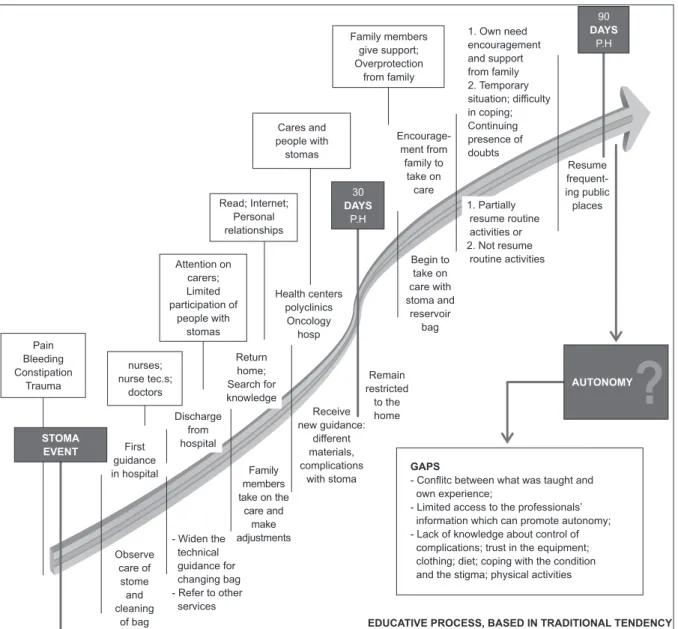
In this study, the authors identiied a pattern
among the people with stoma interviewed, related to
the process of the development of their autonomy. To
illustrate this, a igure was elaborated, showing the
90 days after surgery, relating data about what or
who inluenced the process of the construction of their
autonomy.
As the process is visualized in Figure 1, the
Rev. Latino-Am. Enfermagem 2013 Mar.-Apr.;21(2):531-8.
the different stages identiied in the study: The need
to carry out care for the stoma; Health support and
attention following discharge from hospital; The family
carer’s support in developing autonomy; Return to daily
activities and social reinsertion.
Figure 1 - Process of development of autonomy in people with intestinal stoma
The need for carrying out care of the stoma
The participants in the research received the irst technical guidance related to speciic care for their stomas
from the health professionals in the hospital institutions.
This information was given through demonstration by
the health team, especially the nurses, on how to carry
out cleaning and changing of the reservoir bag.
The guidance, at that time, was particularly directed
at family members accompanying the patients, these
being called to observe, and encouraged to undertake
the care.
The initial demonstration of care of the stoma and the skin around the stoma, and the progressive training
for self-care, form part of the educative strategies indicated, such that when the person with a stoma is discharged from hospital, they and/or a family member
should be able to clean the stoma and the skin, and change and maintain the collection equipment(12-13). Knowing how to undertake these speciic care actions is
a determining factor for the practice of self-care.
The association between self-care and the achievement of autonomy is inevitable, especially for
speciic skills in caring for the stoma and in the use of the
collective equipment and the associated materials(5,7).
Health care entails assistential care linked with
educative practice. Providing guidance for self-care is
the health professional’s role, doing this gradually and
carefully, offering technical information, integrating
what is new with the person’s previous knowledge,
aiming for the promotion of autonomy. In this
context, the aim of the practice of health education
is the emancipation and liberty of the person, who,
when suficiently guided about their new condition, is
able to take safe and informed decisions, exercising
control over their own life and self-care, even taking
into account the limitations imposed by the new
condition(14-15).
Relecting on the actions of the Ampliied and Shared
Clinic(9) and the inluence which this has on health care
given from this perspective, it was possible to note that
the participants do not recognize the spaces for user
embracement, listening and dialog, nor the openness
of the health professionals to their needs. In spite of
the guidance for technical care having been given, many
doubts, going beyond the stoma itself, remained; and
insecurity about living with this new condition was also
present.
A nurse came, did it and showed my daughter how
the cleaning was to be done. So she did it there close to my
daughter and that’s, that’s how it works. From then on it’s your
responsibility. So it’s something which leaves you scared right
from the start. It’s something new you don’t know, you don’t
know the procedure. They showed it once, just once, and said
to my daughter “from now on, that’s how you have to do it, the
responsibility is yours.” (PS4)
When talking of listening spaces, the authors are
referring to the willingness of the health professionals
to pay attention to the person’s speech, their gestures
and their differences. Through this practice, the health
professionals recognise the issues to be addressed,
as the expressions of the persons attended direct the
educative action for their anxieties and hopes. For this
reason, the health professional needs to understand
what fundamental individual point is to be worked on
in the educative process and needs to use dialog to
promote knowledge with a view to autonomy(16).
The authors note that the technical viewpoint,
still very present among these health professionals
who attend people with stoma, needs to be widened,
changing the “object” of work, seen as the patient,
who is inert to the decisions – where the guidance is
dictated – and, perceiving the person as a concrete
singular subject, with ability to dialog and work in the
perspective of the Shared Clinic.
Support and health care after discharge from hospital
The authors identiied that as part of the guidance
process, the people with stoma and their family members
were informed during the period of inpatient treatment about the health services which they were to seek after
returning home, and were referred to these with the
necessary documentation.
Leaving hospital is a special moment, as on leaving
this institution, the person no longer has access to the
physical, material and professional resources which
until then were available – and needs to face the home
environment with the existing resources(12).
To acquire his or her autonomy, the person needs to
initiate daily and constant care of the equipment, which
is no easy task, as it keeps the patient in direct contact
with the surgical site, with their altered body image,
with direct handling of their feces and the awareness of their limitations, arising from the stoma. The use of
the equipment forces the person with a stoma to face
the real change which has occurred with the surgery(17).
The authors noted the health professionals’ care
in correctly referring the people to the health services
indicated, in accordance with their needs, with the aim
of promoting health care’s support at the different levels
of complexity. Through this referral, the people sought
the services for their care in primary care or in centers
of excellence. These places provided care, gave more
extended guidance and had the equipment necessary
for the care available, providing access to reservoir bags
and to associated materials.
The guarantee of access to the speciic equipment
provided the people with security, as they knew that
the bags and quality material were available for them
to carry out the care, which positively inluenced their
personal autonomy.
Unfortunately, the authors noted that in primary
care, offered by the capital’s Health Centers, attendance
was restricted to distribution of the equipment, without
the health professionals giving any type of guidance or
care speciic to the stoma.
In order to care for the health of people with stomas,
the Health Centers have essential responsibilities and
are fundamental parts of the healthcare network, with
actions of guidance for self-care and the prevention of complications with the stoma being a duty of the health
professionals in this area(18). These Health Centers are
Rev. Latino-Am. Enfermagem 2013 Mar.-Apr.;21(2):531-8.
social reality and, due to this, are expected to have
greater ease in creating links with the service users and
in establishing interpersonal, social and environmental
relationships, which may inluence the achievement of
autonomy.
The authors also noted in the research that the
people received care which was limited to technical
aspects of stoma care, as it did not include aspects
related to alterations in diet, in the possibility of physical
effort, as well as what to wear, returning to work, and
social reinsertion.
The dificulty is that I haven’t gone out yet. I have parties
to go to, things like that, weddings, I always used to wear smart
clothes to go out, and now I‘m worried about how I’m going to
get my pants on, you know, because I’m not fat, so I used to
wear pants like this, nearly close to my navel, so now, how am I
going to tuck my shirt into my pants? And what am I supposed
to do with the bag? This is really worrying me. I used to like – I
was always well-dressed, everybody used to comment, and now
I don’t know what I’m going to do. (PS10)
The need for health professionals who are
prepared for attending these people is fundamental,
as appropriate support in health care, linked with
guidance, facilitates acceptance of the situation and
these people’s return to their activities with greater
security. The guides developed by specialists in the
area indicate the importance of addressing the issues,
covering health education for a variety of aspects:
physiological, nutritional, recreational and social, as well
as those related to clothes, medications, body image,
psychological support, personal relationships, sexuality,
complications related to the surgery, and the resources
available(12-13,19).
However, the research ascertained that the
viewpoint of the majority of health professionals
remains centered on the technical aspects, this being a
limiting factor in the development of personal autonomy.
The guidance was dictated, often, without attention
to individual needs and to their return to the home
environment. There was not always commitment to
the people’s and family members’ understanding of the
guidance, which was given in an automatic way. For this
reason, there was no development of these people’s
co-autonomy in conjunction with the professionals, which
as stated previously is an essential link.
It was identiied that through the inluence of the
institution, the professionals and personal research,
thirty days post-discharge the people with stoma
and/or their family members know how to handle the
equipment for stoma care and are familiar with the
process of cleaning and adjusting the reservoir bag and
how to use some of the associated materials, such as
the activated charcoal ilter and the hydrocolloid paste
and powder for protecting the skin. The authors also
noticed that the people make their irst adaptations to the care, as they recognize speciic individual conditions
which render the basic technical guidance inadequate
or non-ideal. These changes occur in situations such
as, for example, whether or not to use the associated
materials, the type of bag preferred, the appropriate
diet, positioning for adjusting the bag and the need for
help, among others.
Autonomy requires more than just the
carrying-out of care in conventional situations. The health
professionals have an important role in preparing people
with a stoma to face situations mindfully and to take
decisions when necessary.
I can’t manage to change it myself, because of the position,
because I have to stay lying down, [...] and sitting up won’t do,
because when you apply the bag, you have to do it right, so that
it doesn’t pull at your skin and annoy you. So, what I mean to
say is, there always has to be somebody else to do this. (PS7)
One can see from this account, common among
participants in this research, that observation of the care
carried out by the health professional in the hospital
institution inluenced how it was carried out in the home. These people were probably lying down in their hospital
beds when the health professionals undertook their care
of the stoma and the adjustment of the reservoir bag
and – due to this – it was perceived that the adjustment
of the bag always had to be done in that position. This
situation relects the lack of appropriate communication
on the part of the team, with a view to the person’s
understanding, and to the practice of self-care, and,
consequently, to the construction of autonomy.
The health services can work so as to attenuate
the implications brought by the condition and by the
loss of autonomy and self-control. For this, the health
professionals need to be prepared to provide care with a view to maintaining or re-establishing personal identity
to deal with the emotions and social stigmas(15).
Returning to daily activities and social reinsertion
Concerning the return to daily activities, a division
of people occurred: some initiated the process,
gradually taking up their activities once more, while
others preferred to remain restricted to their homes, dependent on family carers, waiting for the
already-arranged surgical anastomosis.
thing here (points to stoma)? I can’t work. You have to be whole
to work in my profession. No, because I can’t do anything.I
hang around the house, as they say, doing my treatment, taking
care of myself, but I can’t do anything, not while I’ve got this
here, I can’t do anything. (PS1)
The dificulty in returning to social or work activities
may occur because of the limits imposed by the surgery’s
physical changes, or because of the change in body
image and self-esteem, as well as because of the fear
of the social stigma related to the condition, which may
also, sometimes, inluence its acceptance(3-20).
One quantitative study sought to identify the return
to social and work activities of people who had undergone
this same surgical intervention. It was identiied that the
majority of people resume their activities, either totally
or partially. Those who did not resume their activities
attributed this dificulty to factors such as insecurity, physical problems, dificulty in cleaning the bag, shame,
and others(21), corroborating the factors found in the
accounts of the participants in the present study.
Health professionals have an important role in
addressing the alterations in body image and the
representation of loss of sphincter control, so as
to promote knowledge and personal self-esteem,
demystifying the stigma created and positively inluencing
social reinsertion, and consequently producing a further
advance for personal autonomy.
Final considerations
The information given by the health professionals
to the people and their family members about speciic
technical care helped in developing the skills necessary
to care for the stoma and handle the equipment. The
family members left the hospital institution with a certain
basic skill for carrying out this care. They gradually took
on the responsibilities and began to undertake the
self-care with the stoma and the reservoir bag.
In spite of this essential skill, the authors note the
lack of an ampliied shared health care in which the health
professionals value the person in his or her uniqueness and
elaborate activities with a view to preparing for facing daily
life, and the process of developing personal autonomy.
The Ampliied and Shared Clinic is an important
directive, proposing practical actions which can address
issues like this, as the opportunities created by the
proposed actions make it possible to recognize and
understand the individual process, and thus to be able
to work in line with emerging needs.
The health professional needs to get beyond the
technical work and the verticalized attendance in favor
of practice from the viewpoint of the Ampliied and
Shared Clinic, so as to practise dialog and to permit the
creation of links and health education, factors which
are fundamental to support the person with a stoma, to
relect on his or her decisions - and thus to develop a
co-autonomy.
The authors noted that the people with stomas, in
the 90 days post-discharge – despite this being a short
period for adaptation – started to resume or develop
their personal autonomy, some more than others,
taking responsibility for self-care, gradually returning
to their daily routine and taking responsibility for some
personal decisions, although not to the full extent of
their capability.
This study allowed the authors to understand which
factors can inluence people with stomas to develop
or resume their autonomy, and how it is that the
health professionals are fundamental to this process,
working as educators, supporting the achievement, and
encouraging the care and the return to activities.
References
1. Martins ML, Perugini VC, Silva RDM. Processo de
viver com estomia: facilidades e limites. Rev Estima.
2006;4(1):15-20.
2. Salimena AMO, Valente WR, Melo MCSC, Paschoalin
HC, Souza IEO. Compreendendo as vivências de
mulheres ao enfrentar a condição de ter um estoma
intestinal. Rev Estima. 2008;6(3):12-8.
3. Cascais AFM, Martini JG, Almeida PJS. O impacto da
ostomia no processo de viver humano. Texto Contexto
Enferm. 2007;16(1):163-7.
4. Monge RA, Avelar MCQ. A assistência de enfermagem
aos pacientes com estomia intestinal: percepção dos
enfermeiros. Online Braz J Nurs. [periódico na Internet].
2009 [acesso 12 set 2011]; 8(1). Disponível em: http://
www.objnursing.uff.br/index.php/nursing/article/
view/j.1676-4285.2009.2208/468.
5. Campos GWS. Clínica e saúde coletiva compartilhadas:
teoria Paidéia e reformulação ampliada do trabalho
em saúde. In: Campos GWS, Minayo MCS, Akerman
M, Drumond M Júnior, Carvalho YM. Tratado de Saúde
Coletiva. São Paulo: Hucitec; Rio de Janeiro: Ed. Fiocruz;
2006. p. 41-80.
6. Onocko Campos RT, Campos GWS. Co-construção de
autonomia: o sujeito em questão. In: Campos GWS,
Minayo MCS, Akerman M, Drumond M Jr, Carvalho YM,
Rev. Latino-Am. Enfermagem 2013 Mar.-Apr.;21(2):531-8.
Received: Mar. 13th 2012 Accepted: Jan. 16th 2013
Hucitec; Rio de Janeiro: Ed. Fiocruz; 2006. p. 669-88.
7. Oliveira DLLC. A enfermagem e suas apostas no
autocuidado: investimentos emancipatórios ou práticas de
sujeição? Rev Bras Enferm. jan-fev 2011;64(1):185-8.
8. Fleury-teixeira P, Vaz FAC, Campos FCC, Álvares J,
Aguiar RAT, Oliveira VA. Autonomia como categoria
central no conceito de promoção de saúde. Ciência
Saúde Coletiva. 2000;3(2):2115-22.
9. Ministério da Saúde (BR). Secretaria de Atenção à
Saúde. Política Nacional de Humanização da Atenção
e Gestão do SUS. Clínica ampliada e compartilhada.
Brasília: Ministério da Saúde; 2009. 64 p.
10. Trentini M, Paim L. Pesquisa convergente assitencial:
um desenho que une o fazer e o pensar na prática
assistencial em saúde-enfermagem. 2 ed. Florianópolis:
Insular; 2004.
11. Conselho Nacional de Saúde (BR). Diretrizes e
normas regulamentadoras de pesquisa envolvendo
seres humanos [base de dados na Internet]. Brasília:
Ministério da Saúde; 1996 [acesso 19 jun 2010].
Disponível em: http://portal.saude.gov.br/portal/
arquivos/pdf/sisnepabrasco.pdf.
12. Cesaretti IUR. Cuidando da pessoa com estoma no
pós-operatório tardio. Rev Estima. 2008;6(1):27-32.
13. Wound Ostomy and Continence Nurses Society
(WOCN). Management of the patience with a fecal
ostomy: best practice guideline for clinicians. New
Jersey: WOCN; 2010. 44 p.
14. Bellato R, Pereira WR, Maruyama SAT, Oliveira PC. A
convergência cuidado-educação-politicidade: um desafio
a ser enfrentado pelos profissionais na garantia aos
direitos à saúde das pessoas portadoras de estomias.
Texto Contexto Enferm. abr-jun 2006;15(2):334-42.
15. Entwistle VA, Carter SM, Cribb A, MCcaffery
Kirsten. Supporting Patient Autonomy: The Importance
of Clinician-patient Relationships. J Gen Intern Med.
2010;25(7):741–5.
16. Freire P. Pedagogia do Oprimido. Rio de Janeiro: Paz
e Terra; 1987.
17. Silva A, Shimizu HE. O significado da mudança
no modo de vida da pessoa com estomia intestinal
definitiva. Rev. Latino-Am. Enfermagem. 2006
jul-ago;14(4):483-90.
18. Ministério da Saúde (BR). Portaria nº 400, de 16
de novembro de 2009 [base de dados na Internet].
Brasília: Ministério da Saúde; 2009 [acesso 9 maio
2010]. Disponível em: http://bvsms.saude.gov.br/bvs/
saudelegis/sas/2009/prt0400_16_11_2009.html.
19. Registered Nurses’ Association of Ontario (RNAO).
Ostomy Care and Management. Clinical Best Practice
Guidelines. Toronto, Canadá: iaBPG; 2009.
20. Barnabe NC, Dell’acqua MCQ. Estratégias de
enfrentamento (coping) de pessoas ostomizadas
[periódico na Internet]. Rev. Latino-Am. Enfermagem.
2008 jul-ago [acesso 26 set 2011]; 16(4): [8p]
Disponível em: http://www.scielo.br/pdf/rlae/v16n4/
pt_10.pdf.
21. Bechara RN, Bechara MS, Bechara CS, Queiroz HC,
Oliveira RB, Mota RS, et al. Abordagem Multidisciplinar