Disponible en castellano/Disponível em língua portuguesa SciELO Brasil www.scielo.br/rlae 1 RN, PhD in Nursing , Adjunct Professor, e-mail: [email protected]; 2 RN, MS in Nursing, Assistant Professor. Triângulo Mineiro Federal University, UFTM, Brazil
THE INTERFACE OF TEACHING, RESEARCH AND EXTENSION IN UNDERGRADUATE
COURSES IN HEALTH
Darlene Mara dos Santos Tavares1 Ana Lúcia de Assis Simões1 Márcia Tasso Dal Poggetto2 Sueli Riul da Silva1
Tavares DMS, Simões ALA, Poggetto MTD, Silva SR. The interface of teaching, research and extension in undergraduate courses in health. Rev Latino-am Enfermagem 2007 novembro-dezembro; 15(6):1080-5.
This article aimed to describe and evaluate the extension program “Integrating knowledge to the family integral care” composed of five projects that aimed to enrich knowledge and develop skills in the academic field, to accomplish health actions, based on the families’ and community’ needs. A total of 33 faculties from the nursing, medical and biomedical schools at the “Triângulo Mineiro Federal University” participated in the projects during eight months in the ”Family Health Program”, out-patient clinics and at the School Hospital, attending 2,000 clients. The faculty members were subjects in their own learning process, experiencing and reflecting upon this social reality. The program also favored inter-institutional integration, as well as, showed connection between teaching-research-extension.
DESCRIPTORS: teaching; research; community-institutional relations; education, nursing; diploma programs; consumer participation; family
INTERRELACIÓN ENSEÑANZA, INVESTIGACIÓN, EXTENSIÓN EN LOS CURSOS DE
PREGRADO EN SALUD
Este artigo tuvo por objetivo describir y evaluar el programa “Integrando conocimientos para la atención integral a la familia”, compuesto por cinco proyectos que visaron ampliar conocimientos y desarrollar habilidades en el académico, para la realización de acciones de salud, con base en las necesidades de la familia y comunidad. Participaron 33 académicos de los cursos de enfermería, medicina y biomedicina de la Universidad Federal del Triángulo Mineiro”, por ocho meses en los Programas de Salud de la Familia, ambulatorios y Hospital Escuela, atendiendo a 2.000 clientes. Los académicos fueron sujetos de su aprendizaje, vivenciando y reflexionando sobre la realidad social. El programa favoreció integración interinstitucional y indisociabilidad enseñanza-investigación-extensión.
DESCRIPTORES: enseñanza; investigación; relaciones comunidad-institución; programas de pregrado en enfermería; participación comunitaria; familia
INTERFACE ENSINO, PESQUISA, EXTENSÃO NOS CURSOS DE GRADUAÇÃO DA SAÚDE NA
UNIVERSIDADE FEDERAL DO TRIÂNGULO MINEIRO
Este artigo objetivou descrever e avaliar o programa de extensão “Integrando saberes para a atenção integral à família” composto por cinco projetos que visaram ampliar conhecimentos e desenvolver habilidades no campo acadêmico, para a realização de ações em saúde, baseadas nas necessidades da família e comunidade. Participaram 33 acadêmicos dos cursos de enfermagem, medicina e biomedicina da Universidade Federal do Triângulo Mineiro, por oito meses nos Programa Saúde da Família, ambulatórios e Hospital Escola, atendendo 2.000 clientes. Os acadêmicos foram sujeitos de seu aprendizado, vivenciando e refletindo sobre a realidade social. O programa favoreceu integração interinstitucional e indissociabilidade entre ensino-pesquisa-extensão.
INTRODUCTION
U
niversity extension starts in England, in thesecond half of the XIX century, where continued
education courses are performed with adult population.
At American Universities, however, such activities focus
on providing services in rural and urban areas(1).
When it comes to Brazil, the first experiences,
at São Paulo University (1911), followed the English
model. Yet, in the 20s, the Higher School of Agriculture
and Veterinary Science of Viçosa and the Agricultural
School of Lavras implement the American model(1).
It is in 1931, through Decree # 19,851, that
university extension is first legally registered. The idea
was that the knowledge produced in Universities was
also given to the population that was not part of the
academic environment and that it could contribute in
social development. However, the courses,
conferences and practices performed could not reach
their goals and such actions were limited to the
freshmen and academics(1).
Thus, until 1961, university extension was
developed, especially, for professionals who held a
university certificate through courses, conferences
and rural technical care. Despite the fact that
university extension contributes to education and
research, it perpetuated the distance between
universities and the population, reinforcing separate
actions among education, research and extension(2).
Between 1960 and 1964, there is a
proliferation of discussions about political and
ideological issues and education in Brazil, lead by the
students’ movement. In this context, academics start
to perform university extension detached from
university projects, centered on developing activities
to help the population in need(1-2).
In 1964, with the Military Strike and, aiming
to keep an eye on the students’ movement, the
Government proposes, in 1968, a national project:
Rondon, providing academic contact with the Brazilian
reality. Due to the absence of consistent participation
by academic departments and teachers in this project,
the learning and teaching process was limited(1).
Despite the obligatory natures of university
extension in higher education institutions, through
University Reform Basic Law # 5,540 of 1968, the
unidirectional relationship from the university,
knowledge transmitter, to the community, knowledge
receiver, continues as the dislocation among teaching,
research and extension(1-2).
In the 80s, discussions about the relationship
between university and community start,
strengthened by the creation of Extension Provosts
for the Forum of Brazilian Public Universities in 1987,
which proposed this concept of university extension
as “an educational, cultural and scientific process that
articulates teaching and research in an inseparable
way and enables the transforming relationship
between university and society”(3).
At the Federal University of the Triângulo
Mineiro (UFTM), university extension is described as
“inseparable teaching and research activity, in order
to fulfill its educational, cultural, scientific and social
role in the community, in an interacting, exchanging
and contributing mutual perspective”(4).
By reflecting on these concepts and trying to
contribute to an effective (re)organization and
implementation of SUS (Brazilian Single Health
System) guidelines and the need to prepare
professionals capable of responding to the real needs
of the population, one may say that the basis of the
education process is the tripod
education-research-extension. On the other hand, integral care to the
family has led to the reconsideration of pedagogical
projects, aiming to train health professionals with a
new profile.
Integral care to family development has been
one of the topics of the social development agenda.
Yet, there is a lack of professionals with a profile to
develop such activities(5). According to the cited
authors, “if the professionals’ education, especially
the physician and the nurse, is not replaced in the
educational apparatus, the care model will not be the
everyday reality”.
Integral care to the family occupies a
privileged space in the education-research-extension
tripod, facing the challenge not of the individual need,
but of the family unit within a community context(6).
On the one hand, the market needs
professionals with a new profile - closer to basic health
actions and, on the other hand, the Health Ministry
invests in permanent education of the professionals
working in the Family Health Program (FHP).
Nevertheless, there is a challenge for education
institutions, in other words, to discuss and change
their curricula to respond to this need.
In this sense, as a health professional
education institution, UFTM is concerned with inserting
nursing undergraduates within health services so that
reasoning and critical judgments, knowledge and
decision making abilities, flexible behavior,
interpersonal and intergroup relationships, as well as
the capacity to work in groups.
Bearing this in mind, teachers from the
Undergraduate Nursing Center at UFTM elaborated
an Extension Program with five projects. This article
aims to describe and assess the program called
integrating knowledge with integral family care.
It is important to say that this report
experience was approved by the Ethics Committee
for Research Involving Human Beings at UFTM,
protocol # 777.
BUILDING THE PROGRAM INTEGRATING
KNOWLEDGE WITH INTEGRAL FAMILY CARE
During outpatient care and internships at the
UFTM Teaching Hospital (TH), one may say that, despite
all efforts made, some gaps remain in terms of family
response, especially due to lack of information about
what needs to be done at home, to clients who need
specific care when leaving the hospital, as well as to
family reports about the difficulties to adapt to a new
reality. Other problems observed during internships
include the clients’ social isolation and the difficulty to
accept some health problems.
It is known that illness and hospitalization
cases are unknown, traumatizing and threatening
episodes, as they put security, integrity, privacy and
even human beings’ individuality at stake.
Thus, facing the reality involved in being sick
and hospitalized poses the challenge of humanization,
so that “values and attitudes regarding human life
consolidate a new culture of health response”(7).
From this perspective, developing extension
acts towards human life maintenance with dignity,
during hospitalization, contributes to the performance
of integral family care, respecting particularities of
the illness and hospitalization process. This was one
of the areas of the program, through the Humanizing
hospital care: focus on client and family project.
When they return to their homes, the entire
family dynamics is changed. Integral family care is
based on the premise of the family’s great potential
as an ally in maintaining and restoring its members’
health; however, such potential is influenced by
experiences lived that influence such actions at
home(6).
There are countless challenges to be faced
by the family when one of the members returns after
being hospitalized. He/she may need specific attention
for his/her readaptation and family reorganization.
The situations that demand family preparation
to overcome new challenges include ostomy. On the
one hand, this procedure solves the person’s organic
problem but, on the other, it produces new problems
resulting from the sudden change in the body’s aspect
and its elimination habits. The person loses control
and needs of using collector devices for the effluents,
changing the person’s and family’s routine.
Considering the affective and social
relationship, or the physical aspect, the family
environment constitutes one of the most powerful
forces that influence the development of self-care
capacity, stimulating ostomy patients to adapt to the
new living conditions. For this reason, it is relevant to
develop an extension project in which the family is
prioritized during the whole self-care capacity process.
This is the action sphere of the project Interdisciplinary
care to the ostomized client and his/her family.
In this context, cancer problems are also
relevant. Due to the great incidence and the high
mortality of this disease, it is considered a public
health problem. Therefore, it should receive care and
be addressed in all dimensions: health promotion,
prevention, treatment compatible with integral care.
This justified the development and discussion of the
project Integral care to gynecological tumor patients
and their family, especially with the women.
The clients, who have ulcer wounds, as well
as their family, need integral care in order to clarify
not only the injury treatment, but also the development
of attitudes aimed at preventing new harm.
Patients with surgical or traumatic ulcer
wounds generally present a longer hospitalization time
and, consequently, the appearance of hospital
infections, increasing treatment costs and also
producing physical disabilities and psychosocial
problems.
The treatment of cutaneous injuries requires
specific knowledge about healing, factors interfering
in this process and the use of adequate means and
bandages. Nevertheless, extension activities that
prioritize integral care, considering the real needs of
patients with wounds and their families, may optimize
the healing process, decreasing time and treatment
costs, which is the study object of Integral care to
Integral care to the family should be guided
by the interdisciplinary approach and directed at
autonomy, independence and self-care achievement
by clients and family members. Having the family as a
care perspective means to consider that the family
environment is the place where one learns about health
and sickness, based on a process of living life, where
the changes that occur are built each day(6). This idea
guided the work done by the project: Service-Education
Articulation: integral care to the family.
To accomplish this program, initially, an
institutional moment occurred, with internal discussion
among the faculty involved. One of the topics
discussed was the option for the methodology seen
as “the conception of methods and techniques to be
used with a philosophical basis”(8). It is also a concrete
way to trace the program, defining its objectives and
adequacy from the middle to the end.
Among the challenges that deserved some
attention from the faculty, undergraduate insertion in
the development of this university extension program
stood out because this would terminate the idea of a
direct relationship between extension and care, which
is a simple transference of knowledge from one who
knows to one who does not know(9).
The understanding of university extension can
be different among many social actors (faculty,
principals and family), which may cause little impact
in the life of the population(10). Thus, some guidelines
were defined for the development of this extension
program, such as active participation and
co-responsibility among faculty, academics, health
professionals and family involved and living the social
reality, aiming at the reconstruction of individual and
collective knowledge as well as its transformation.
From this point of view, the program
objectives were traced. For the social field: develop
educational activities for health promotion; attend
clients and families, integrally helping them to
understand and facilitating their adaptation to the
changes resulted from health problems; stimulating
clients’ active participation in their self-care process,
favoring the maintenance of autonomy and
independence; minimize the stress and impact
hospitalization causes in the client and family; facilitate
client and family adaptation to the hospital
environment; achieve articulation among institutions
with a view to an integral family response, identify
the social and health organizations’ power present in
the clients’ area of residence, which can contribute
with the improvement of their quality of life and expand
health care for the population.
The objectives in the academic field were:
identify the client, family and main health problems
and area he/she is working in; develop abilities for
performing health actions, based on needs identified
and built with families and communities; experience
interdisciplinary group work, share and deepen
knowledge with client, family, workers and teachers,
among other partners and socialize extension products
based on the development of research in scientific
events and field journals.
With these objectives, the articulation among
institutions and managers, health professionals and
other institutions in the cities that constitute the
Regional Health Management (RHM) was established,
aiming to strengthen the partnerships.
This program was approved and financed by
the Ministry of Education, in response to call PROEXT/
MEC/SeSu, in 2004.
IMPLEMENTING THE PROGRAM:
INTEGRATING KNOWLEDGE FOR INTEGRAL
HEALTH CARE
At first, students were selected from all
graduation courses at UFTM (biomedicine, nursing and
medicine), prioritizing senior students, thus favoring
more autonomous action, as well as the interface with
the supervised trainee and the internee, allowing for
compliance with the curriculum.
This selection was made through a group
dynamics, where the academics’ performance was
observed according to the following criteria: leadership
behavior, team work, cooperation with colleagues,
relationship, initiative, creativity, planning capacity,
knowledge on health and integral family care, interest
in social mobilization and in this program. An individual
activity was also done, where the academics received
a case and made intervention proposals.
Thirty-three students were selected from the
biomedicine, nursing and medicine courses, who
participated in the Program for eight months, inserted
in the following Programs: Family Health, outpatient
clinic and Teaching Hospital. Before the beginning of
the extension activity, there was a moment of reflection
and deepening on the themes: Family Health, team
work, interpersonal relationship, ethics and citizenship,
Throughout the Program, each academic
fulfilled a total of 10 hours a week, receiving a monthly
extension incentive scholarship. In this period, around
2,000 clients and families were seen through these
activities: reality observation, families’ integral care
needs and priority setting; reception, home visits;
health education, participation in different courses;
meetings (administrative; team, community and
family); health promotion, specific for each profession
(nurse and medical visits, performing laboratory
exams) and report elaboration.
The academics elaborated reports of the
activities performed monthly, as well as the main
challenges faced and how they faced them.
Periodical meetings were held among the
academics of each project and their respective
coordinator, and among all students and coordinators
for experience sharing, when the necessary
adjustments were made.
During vacation, the academics from the
project: Articulation service-education: integral care
to the family, developed part of their activities in cities
under GRS jurisdiction.
At the end of the program, students
elaborated a report on their experiences, following
specific rules. These reports were presented during
the II Journey of University Extension of UFTM, with
further dissemination in annals. The students were
stimulated to present their reports in other scientific
events and to publish university extension products
in specialized journals.
ASSESSING THE PROGRAM: INTEGRATING
KNOWLEDGE FOR INTEGRAL CARE TO THE
FAMILY
The assessment was performed in two ways:
formative and summative. In the first, the academics
were followed by the professors and/or health service
professionals. The students recorded the activities,
distinguishing: denomination and quantification of
activities, difficulties found and ways to solve them;
received orientation; acquired and/or deepened
knowledge. Regarding the summative assessment, done
by the professional or teacher who followed the student,
the performance was assessed by: performance and
interest in the proposed activities, technical and scientific
ability when executing the tasks; organization; initiative,
interest, cooperation and creativity; ethical and
professional posture; relationship (work/client/family/
community/colleagues team), assiduity and punctuality.
The degree of satisfaction among clients and
family involved in the program was also checked, as
well as their criticism and suggestions.
In the opinion of clients and families,
regarding the bursar performance, 100% referred that
their expectations on health care were attended. The
opportunity to clarify the doubts whenever needed
was referred by 67.8% and 32.2% did it most of the
times. It was seen that security in all care delivered
represented 86%, while most of the times for 14%.
The extension actions collaborated in 92.2% for health
recovery and in 7.1% for health promotion.
From the academic perspective, the main
challenges when developing the program were:
transportation to the place, client not present at home
and the interpersonal relationship. The ways they faced
these were: scheduling home visits, previous
preparation and team activity discussion. They also said
that a higher availability of material resources could
contribute to a better effectiveness of health actions.
The main orientations received were related
to contents of asepsis/antisepsis, family relationship
and physiopathology of some diseases.
Regarding the main acquired knowledge, they
distinguished the client and family approach; greater
knowledge about diseases, interdisciplinary work and
Family Health Program organization and functioning.
The activity was considered satisfactory by
83.3% of the students, 10% did not opine and 6.6%
did not get satisfactory results. In Table 1, the
academic assessment is shown.
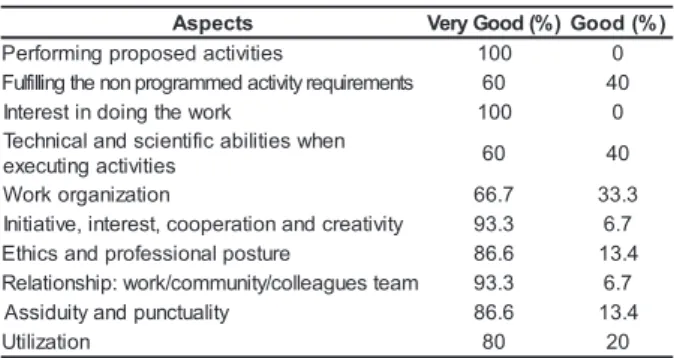
Table 1 - Academic performance assessment by the health
professional and/or coordinator. Uberaba/MG, 2005
s t c e p s
A VeryGood(%)Good(%) s e i t i v i t c a d e s o p o r p g n i m r o f r e
P 100 0
s t n e m e r i u q e r y t i v it c a d e m m a r g o r p n o n e h t g n il li fl u
F 60 40
k r o w e h t g n i o d n i t s e r e t n
I 100 0
n e h w s e i t il i b a c i f i t n e i c s d n a l a c i n h c e T s e i t i v i t c a g n i t u c e x
e 60 40
n o i t a z i n a g r o k r o
W 66.7 33.3
y t i v i t a e r c d n a n o i t a r e p o o c , t s e r e t n i , e v i t a i t i n
I 93.3 6.7
e r u t s o p l a n o i s s e f o r p d n a s c i h t
E 86.6 13.4
m a e t s e u g a e ll o c / y t i n u m m o c / k r o w : p i h s n o it a l e
R 93.3 6.7
y t il a u t c n u p d n a y t i u d i s s
A 86.6 13.4
n o i t a z il i t
U 80 20
Table 1 distinguishes that most of the
academics received excellent assessments, showing
the interest and interaction of academics, health
CONSIDERATIONS
Discerning the possibility of building new
extension-education alternatives produces the need
to break with what is happening traditionally, and also
the commitment to assume other responsibilities and
challenges. In this perspective, a new way of seeing
and performing extension demands is suggested,
among other propositions, new patterns of relationship
among professionals, academics and community.
Through this description, one may infer that
the students’ experience in everyday practice with
health teams offered immeasurable contributions for
professional and academic development, through the
opportunity of realizing activities in the community,
getting closer to their social and cultural context; to
the interaction with professionals inserted in services;
to the development of interpersonal and intergroup
abilities, to the practical application of theoretical
knowledge and recognition of the wealth of this
extension program for information exchange and
development of education and health promotion
activities.
We emphasize the undeniable importance of
the participation and contribution by nurses and other
professionals from the health team, because, through
this partnership, the goals proposed in the project
could be reached. The follow-up and support offered
to the academics during the development and the
extension activity facilitated their insertion in the action
fields and in the sharing of experiences, thus producing
an exchange of knowledge and abilities between
academics and professionals inserted in the service.
Facing this reality, it is of extreme importance
to maintain students in the community and health
services, so that the started program can continue
making the experience and learning of other groups
available, and also privilege the population with the
participation of students who certainly have a lot to
offer to improve the quality of life of this population.
REFERENCES
1. Nogueira MDP. Extensão universitária no Brasil: uma revisão conceitual. In: Farias DS, (organizador). Construção conceitual da extensão universitária na América Latina. Brasília (DF): Universidade de Brasília; 2001.
2. Fórum nacional de pró-reitores de extensão das universidades públicas brasileiras. Indissociabilidade entre ensino, pesquisa e extensão e a flexibilização curricular: uma visão da extensão. Belo Horizonte (MG); 2003.
3. Nogueira MDP, organizadora. Extensão universitária: diretrizes conceituais e políticas. Belo Horizonte (MG): PROEX/UFMG; 2000.
4. Faculdade de Medicina do Triângulo Mineiro. Regulamento de Pesquisa, Extensão e Iniciação Científica. Diretrizes e Normas. 1996; 75-100.
5. Levcovitz E, Garrido NG. Saúde da Família: a procura de um modelo anunciado. Ministério da Saúde (BR). Saúde da Família - Construindo um novo Modelo. Cad Saúde da Família 1996, 1(1):3.
6. Ângelo M. O contexto familiar. In: Duarte YAO, Diogo MJD, organizadoras. Atendimento familiar: um enfoque gerontológico. São Paulo (SP): Atheneu; 2000. p. 27-31. 7. Lei n° 10.172 de 9 de Janeiro de 2001, Pub. DO, nº7, seção 1 (10 jan.2001).
8. Thiollent MA. Metodologia participativa e sua aplicação em projetos de extensão universitária. In: Thiollent M, Araujo T Filho, Soares RLS, organizadores. Metodologia e experiências em projetos de extensão. Niterói (RJ): Eduff; 2000. p.19-28.
9. Freire P. Extensão ou comunicação. Rio de Janeiro (RJ): Paz e Terra; 1975.
10. Silva MGM. Extensão Universitária no sentido do ensino e da pesquisa. In: Faria DS, organizadora. Construção conceitual da extensão universitária na América Latina. Brasília (DF): Universidade de Brasília; 2001. p. 91-105.