DIZZINESS HANDICAP INVENTORY - IN A GROUP
OF PATIENTS UNDERGOING CUSTOMIZED
VESTIBULAR REHABILITATION
Dizziness handicap inventory - em um grupo de pacientes
submetidos a reabilitação vestibular personalizada
Ana Carla Leite Romero (1), Matheus Siqueira Yoshihiro Hayashi (1), Marcos Seizo Kishi (1), Ana Claúdia Vieira Cardoso (1), Ana Cláudia Figueiredo Frizzo (1)
(1) Faculdade de Filosoia e Ciências da Universidade Esta
-dual Paulista - UNESP - Marília (SP), Brasil. Conlict of interest: non-existent
to days and may be accompanied by hearing loss and neurovegetative disorders such as nausea, vomiting, sweating, pallor, tachycardia, and the chronic form, in which seizures are intermittent or constant, ranging from mild to severe, and variable impact on the patients´ quality of life3.
Vestibular rehabilitation (VR) has been recog
-nized as the treatment of choice for patients with persistent vertigo caused by vestibular dysfunction, providing a marked improvement in the quality of life4. Even though rehabilitation exercises are relatively simple and easily done at home, as long as they follow a pre-established exercise protocol, recognized in scientiic community5-11 and super -vised by a trained professional, actually only a small portion of patients who have dizziness symptoms’ receive rehabilitation treatment 12,13.
The authors 14 recommend vestibular rehabili -tation program in three elements: habituation
INTRODUCTION
The integrity of the vestibular system is essential for the body balance and their maintenance in space. When something interferes with the normal functioning of this system emerges the dizziness and / or imbalance that may be of peripheral and / or central origin 1.
Dizziness is one of the most common symptoms in the world, affects both genders and presents higher prevalence in adults, especially elderly2. Vertigo is the most common type, and the main symptom is the rotational sensation and spatial disorientation, and it presents the acute form, in which the seizures are sudden, last from seconds
ABSTRACT
Purpose: to investigate the impact of VR personalized and compare the physical, emotional and
functional pre and post implementation of the Dizziness Handicap Inventory aspects. Methods: a
total of 10 patients with symptoms caused by disorders of the vestibular system and diagnosis of chronic vestibular dysfunction. These were evaluated for physical, emotional and functional Dizziness Handicap Inventory through the pre and post customized vestibular rehabilitation. Results: in the pre
Dizziness Handicap Inventory has been found that the physical was the highest scoring, followed by the emotional and functional Vestibular rehabilitation was effective, since there was a decrease in complaints of quality of life, and better results in all the aspects evaluated in Dizziness Handicap Inventory post, only one patient had only improves the functional and emotional aspects, in addition
to worsening the physical aspects. Conclusion: the Brazilian Dizziness Handicap Inventory applied
pre and post customized vestibular rehabilitation proved to be an eficient test to monitor patients undergoing vestibular rehabilitation, able to show signiicant improvement in symptoms of chronic vertigo, and the negative impact on quality of life of patients in this study.
computerized records and more accurate indings, tests of the vestibular system are not particularly sensitive or speciic to demonstrate the possible psychological interference in clinical and the patients suffering with dizziness, which suggests the impor
-tance of this type of questionnaire20.
Considering the above, the present study aimed to describe the results obtained from the application of the DHI, pre and post customized vestibular rehabilitation in order to verify the eficiency of rehabilitation in this population.
METHODS
This is an observational, descriptive and thera
-peutic study.
This research was submitted to analyses and approval of the Committee of Ethics in Research of the Faculty of Philosophy and Sciences - UNESP and was performed after its approval, protocol number 0475/2012.
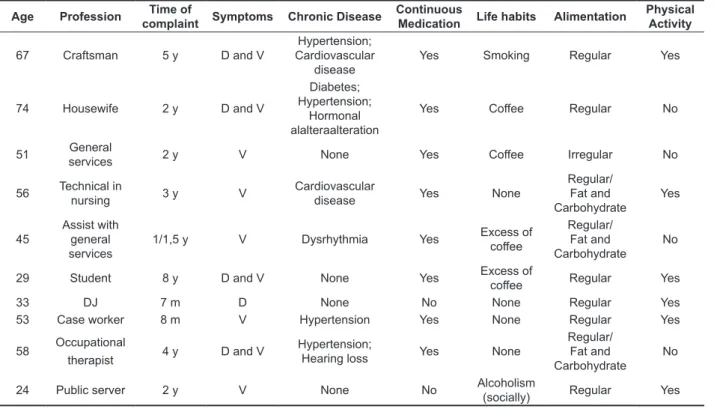
All participants presented symptoms caused by disorders of the vestibular system and were attended on the training program for students of physiotherapy and speech therapy of this university. Table 1 describes the proile of the patients in this study.
exercises that promote central nervous system compensation through repetition and stimulation of sensory organs, postural control exercises and conditioning activities overall.
These authors 5,11,15-17 found in their studies that
vertigo patients report improvement in symptoms after vestibular rehabilitation based on habituation exercises, and require no other treatment, which suggests that vestibular rehabilitation is effective in treating these patients.
In order to describe the consequences of dizziness, both physical and emotional functioning in daily activities of the vertiginous individual, it was developed and validated a speciic questionnaire, the “Dizziness Handicap Inventory” (DHI)18, which has been adapted to a Brazilian version19. This tool is easy to apply, to analyze and to interpret, and assists in the diagnosis, choice of treatment and the clinical evolution, it is possible to compare with other studies, and it is the only questionnaire with the purpose of assess the effects of self-perception caused by dizziness 18,19.
The DHI leads to an effective improvement of balance symptoms, minimizes the probability of falls and increases feelings of security and independence of the elderly after RV20. Despite the advances in the diagnosis of vertigo by otoneurological exams with
Table 1- Description of the patients’ proile
Age Profession Time of
complaint Symptoms Chronic Disease
Continuous
Medication Life habits Alimentation
Physical Activity
67 Craftsman 5 y D and V
Hypertension; Cardiovascular
disease
Yes Smoking Regular Yes
74 Housewife 2 y D and V
Diabetes; Hypertension;
Hormonal alalteraalteration
Yes Coffee Regular No
51 General
services 2 y V None Yes Coffee Irregular No
56 Technical in
nursing 3 y V Cardiovascular disease Yes None
Regular/ Fat and
Carbohydrate Yes
45
Assist with general
services 1/1,5 y V Dysrhythmia Yes
Excess of coffee
Regular/ Fat and
Carbohydrate No
29 Student 8 y D and V None Yes Excess of
coffee Regular Yes
33 DJ 7 m D None No None Regular Yes 53 Case worker 8 m V Hypertension Yes None Regular Yes 58 Occupational
therapist 4 y D and V Hypertension; Hearing loss Yes None
Regular/ Fat and
Carbohydrate No
24 Public server 2 y V None No Alcoholism
(socially) Regular Yes
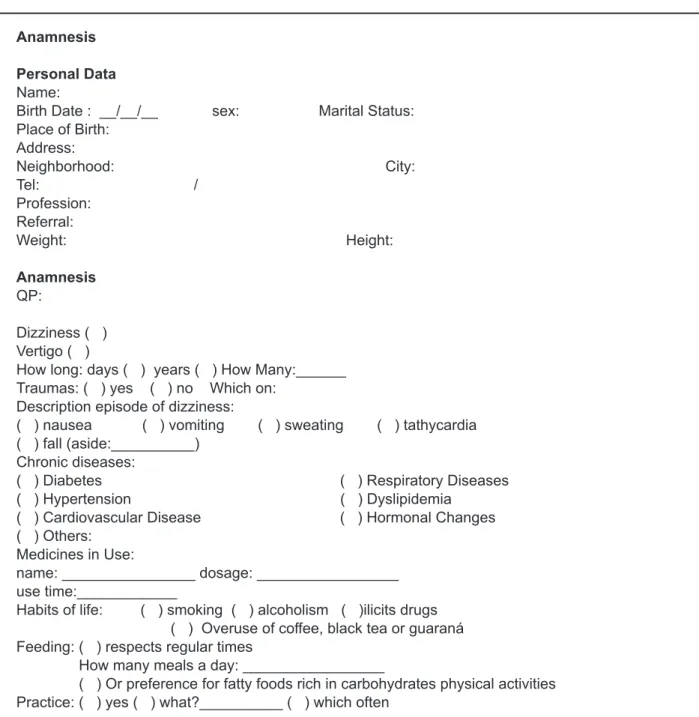
symptoms, chronic diseases, use of medica
-tions, dietary habits and physical activity. There were excluded from the study patients who had no symptoms that were suggestive of chronic vertigo.
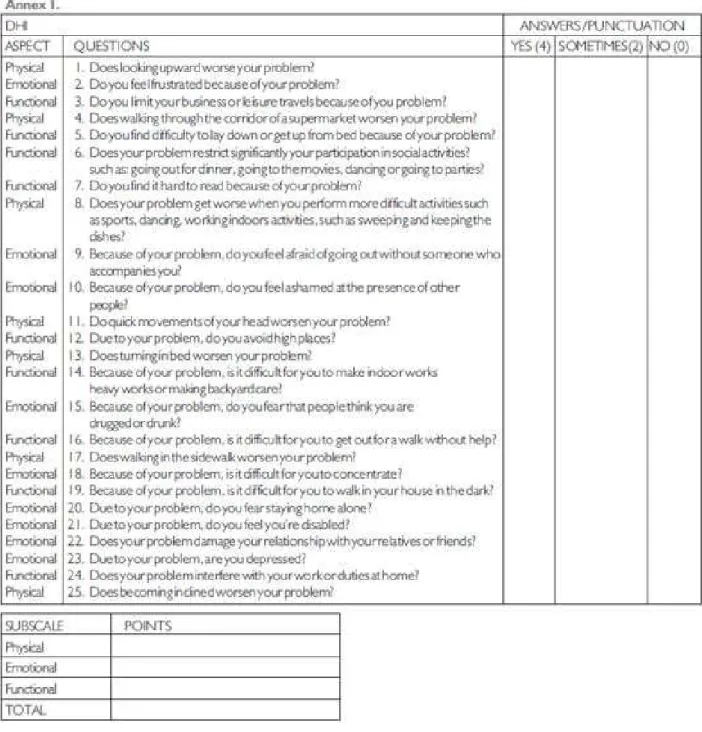
• Application of a daily living questionnaire, DHI
(Figure 2)21, which contains 25 questions, seven of which assess the physical aspects, nine the emotional aspects and seven the functional aspects, the patients were instructed to answer each question with the following answers: “yes”, “no” or “sometimes.” For every “yes” were added four points, for every “no” were added zero points and for every “sometimes”, two points, the maximum score that a patient could achieve was 100 points. The higher the score values worse the quality of life. Another professional applied the questionnaire; this professional did not participate in the intervention in order to avoid bias in the application. The questionnaire was analyzed before and after customized vestibular rehabilitation.
• The vestibular evaluation consisted of tests
which evidenced the presence of spontaneous, semi-spontaneous and optokinetic nystagmus, search of saccadic movements and skew deviation, identiication of the quality and symmetry of eye movement and the presence or absence of nystagmus in diagnosis of peripheral vestibular dysfunction as Herdmann assessment protocol (1996)15, adapted by a team of speech therapists and physiotherapists.
• The personalized vestibular rehabilitation
therapy was performed for eight weeks and was composed of selected protocols among the various authors 5-10, especially Cawthorne & Cooksey7,8 and according to the requirements
of each patient. An analysis of the selected protocols were performed and was prepared a customized protocol which consisted of head and eye movements, head and body movements and other activities to improve balance, targeting
the neurophysiological mechanisms of compen
-sation and habituation of the patient. The main goal of the protocol was to stabilize the visual and increase vestibular-visual interaction during head motion, provide better static and dynamic stability in situations of sensory conlict and decrease individual sensitivity during head movement5-10. A speech therapist and physiotherapist performed the interdisciplinary intervention.
Data analysis was performed as descriptive and quantitative in order to investigate the impact of Vestibular Rehabilitation and compare the scores of physical, emotional and functional aspects, pre-and post DHI. At irst was given the normality of the data A total of ten patients participated in the
intervention study (clinical trial), they presented dizziness and / or vertigo and were diagnosed with chronic vestibular dysfunction hypothesis. Among the patients, nine were female (90%) and one male (10%). Their ages ranged from 29 to 74 years with average of (50.71) years.
As inclusion criteria were selected all participants that attended the training program for students of physiotherapy and speech therapy who had medical diagnosis as chronic vestibular dysfunction, attributed to the fact that they presented constant symptoms, usually mild, and these symptoms impacted on quality of life. Furthermore, were included only those participants who performed 16 sessions of vestibular rehabilitation personalized proposals.
Were excluded from the sample patients who had no medical diagnosis of chronic vestibular dysfunction and who did not undergo 16 sessions proposed.
As for the time-related complaints it ranged from seven months to eight years, they also informed that there was a luctuation on the time of symptom; crises manifested themselves during different periods of time. During this period there were no reported injuries due to the complaint.
The higher incidences of chronic diseases reported by patients were hypertension and cardio
-vascular disease; only two did not present these
diseases.
The most common symptoms when describing an episode of dizziness were: nausea and vomiting, six patients reported nausea, four reported vomiting, three mentioned sweating and two presented tachycardia.
In anamnesis, eight patients reported use of medication for hypertension, diabetes and cardio
-vascular disease. No participants used medication for vestibular disorders during customized vestibular rehabilitation (CVR).
As for eating habits and physical activity, the group presented divergent information; some patients reported having a regular eating habits and physical activity, while the other part was found to have irregular eating habits and do not practice any physical exercises.
In order to perform this study were applied the following:
• Post-Informed consent term: As resolution of
the National Health Council 196/96, prior to the beginning of the evaluations, participants must have signed the term of Informed Consent to permit the realization of the study;
• Anamnesis (Figure 1): A questionnaire focusing
Anamnesis
Personal Data
Name:
Birth Date : __/__/__ sex: Marital Status: Place of Birth:
Address:
Neighborhood: City:
Tel: /
Profession: Referral:
Weight: Height:
Anamnesis
QP:
Dizziness ( ) Vertigo ( )
How long: days ( ) years ( ) How Many:______ Traumas: ( ) yes ( ) no Which on:
Description episode of dizziness:
( ) nausea ( ) vomiting ( ) sweating ( ) tathycardia ( ) fall (aside:__________)
Chronic diseases:
( ) Diabetes ( ) Respiratory Diseases
( ) Hypertension ( ) Dyslipidemia
( ) Cardiovascular Disease ( ) Hormonal Changes
( ) Others: Medicines in Use:
name: ________________ dosage: _________________ use time:____________
Habits of life: ( ) smoking ( ) alcoholism ( )ilicits drugs ( ) Overuse of coffee, black tea or guaraná Feeding: ( ) respects regular times
How many meals a day: _________________
( ) Or preference for fatty foods rich in carbohydrates physical activities Practice: ( ) yes ( ) what?__________ ( ) which often
RESULTS
The customized vestibular rehabilitation was held at an average of 16 sessions per patient twice a week. At irst were provided explanations about the body balance, physiology of exercise and guidelines by means of the Shapiro-Wilk test for comparison
of results between individuals of the same group,
and in sequence was applied Wilcoxon. The differ
-ences in the tests were considered statistically signiicant when the value of “p” was less than 0.05 (5%), indicated with an asterisk (*). The statistical software used was STATISTICA 7.0 Software.
of eye and body movements. All patients were instructed to practice the exercises at home every day for eight weeks, following a printed script that explained the manner and order of exercises. Patients attended the appointments and were supervised on weekly visits. These visits aimed at tracking, monitoring and indication of new custom exercises.
At the end of the rehabilitation program, nine patients reported signiicant improvement of vestibular symptoms, and were submitted to DHI again.
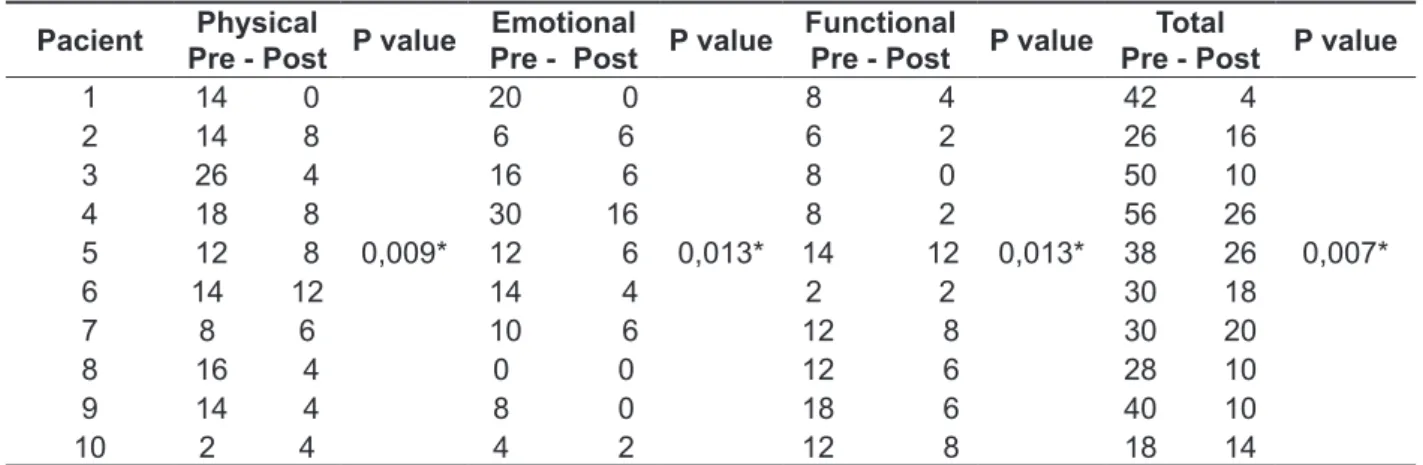
Table 2 presents the DHI score for each patient individually, and the p values comparing pre-and post- customized vestibular rehabilitation.
on inadequate conducts, such as: eating habits, excessive use of caffeine, tobacco, preference for fatty foods and stress, which had as a consequence delay of the improve.
The activities were selected on an individual basis considering the potential and dificulties of each patient in accordance to their physical limita
-tions and, when necessary, the movements and activities were adapted as, for example, perform the exercise seated (for the elderly), stick pictures on the wall rather than follow them swinging arms, thus providing the correct performance of the exercise.
When the symptom improvement was achieved exercises were modiied in terms of complexity of movements, carrying out activities in the standing position and expansion of the speed and amplitude
Table 2 - Dizziness Handicap Inventory score, pre and post customized vestibular rehabilitation
Pacient Physical
Pre - Post P value
Emotional
Pre - Post P value
Functional
Pre - Post P value
Total
Pre - Post P value
1 14 0 20 0 8 4 42 4 2 14 8 6 6 6 2 26 16 3 26 4 16 6 8 0 50 10 4 18 8 30 16 8 2 56 26
5 12 8 0,009* 12 6 0,013* 14 12 0,013* 38 26 0,007* 6 14 12 14 4 2 2 30 18
7 8 6 10 6 12 8 30 20 8 16 4 0 0 12 6 28 10 9 14 4 8 0 18 6 40 10 10 2 4 4 2 12 8 18 14
Shapiro-Wilk e Wilcoxon Test.
It was observed that of the ten patients, nine showed improvement in all aspects of the question
-naire, and one got better scores on the emotional and functional aspects, which allowed a statistically signiicant result in all aspects.
Figure 3 shows the scores for the group regarding physical, emotional and functional aspects; from the application of DHI pre and post customized
vestibular rehabilitation. In the graph it is evident that physical aspects had higher scores, followed by the emotional and functional aspects. The graph also shows a reduction of the score obtained by each patient; post customized vestibular rehabili
At the beginning of treatment six patients reported that they practiced have some physical activity. At the end of 16 sessions, nine patients showed improvement in symptoms of chronic vestibular dysfunction, suggesting that CVR was also effective in patients who did not practice any physical activity.
The literature26 states that the physical scale is the most commonly affected, probably because many older people have a sedentary life and are away from professional and social activities, which makes minor household activities more demanding. In this study we also observed that when comparing the functional, emotional and physical aspects, the last was where patients had higher evolution, and began to feel more comfortable when performing activities requiring greater movement, all patients reported at the beginning of CVR, insecurity in perform activities involving movement of the head, restriction to perform certain movements, fear of falling and to perform some daily living activities, among other signs and symptoms, and at the end of the CVR program the symptoms had disappeared, which corroborates other studies in which these results were also observed 25-28.
In the present study, it was veriied that when the DHI questionnaire pre-customized vestibular rehabilitation was applied, all patients reported that the dizziness caused some impact on their quality of life, in relation to functional, and emotional or physical aspects. These indings are consistent with studies 20,24-27 that applied the DHI in populations with
DISCUSSION
The damages that dizziness / vertigo cause to the quality of life have attracted the attention of many researchers 21,22 and the use of an instrument such
as the DHI questionnaire to assess the quality of life of individuals suffering from dizziness is important for health professionals 18.
Researchers23-25 observed, in a recent study, that customized vestibular rehabilitation is more effective than the original protocols of vestibuloocular relex stimulation to improve the quality of life of individuals with chronic vertigo.
All patients, a total of 10, underwent customized vestibular rehabilitation and after eight weeks of intervention, nine patients had increased their security sense, self-esteem, self-conidence and returned slowly to perform activities of daily living they were accustomed without the manifestation of symptoms.
When applying DHI post customized vestibular rehabilitation, nine patients showed a difference between the scores before and after treatment between 10 and 40 points, and reported signiicant improvement of the symptoms related to physical, emotional and functional aspects. Authors18 claim that a difference of 18 points between the pre-and post-treatment would be indicative of signiicant change, which could be considered as a beneit, but in this study we found that a 10 point difference showed a signiicant improvement in the individuals´ quality of life.
Legend: VR- Vestibular Rehabilitation
Figure 3 - Dizziness Handicap Inventory score for the group, pre and post customized vestibular rehabilitation
Physical
Emotional
Functional
improvement in quality of life, and reduced the DHI score in all its subscales.
CONCLUSION
The DHI, Brazilian version, applied pre and post customized vestibular rehabilitation proved to be an effective test to monitor patients undergoing vestibular rehabilitation, this device was able to show signiicant improvement in symptoms of chronic vertigo, and improved the quality of life of the patients in this study.
chronic symptoms of vertigo, and also observed a negative impact on their quality of life.
In this study was found that customized vestibular rehabilitation was effective in the improvement of vestibular symptoms of these patients and DHI was a tool that allowed tracking of patient outcomes. These indings are consistent with a research 28,29
who studied 37 patients with various otoneuro
-logical status and concluded that CVR is effective in reducing symptoms and improving the impact of dizziness on patient’s quality of life, in addition corroborates with researchesthat applied the DHI before and after CRP and found that all patients had
REFERENCES
1. Paulino CA, Prezotto AO, Calixto RF. Associação entre estresse, depressão e tontura: uma breve revisão. Rev Equilíbrio Corporal e Saúde.
2009;1:33-45.
2. Caixeta GC, Dona F, Gazzola JM. Processamento cognitivo e equilíbrio corporal em idosos com disfunção vestibular. Braz j otorhinolaryngol.
2012;78(2):87-95.
3. Swartz R, Longwell P. Treatment of vertigo. Am fam physician. 2005;71(6):1115-22.
4. Patatas OH, Ganança CF, Ganança FF. Quality of life of individuals submitted to vestibular rehabilitation. Braz j otorhinolaryngol. 2009;75(3):387-94.
5. Ruckenstein MJ, Staab JP. Chronic subjective dizziness. Otolaryngol clin. 2009;42(1):71-7.
6. Jung JY, Kim JS, Chung PS, Woo SH, Rhee CK. Efeito da reabilitação vestibular sobre tontura em idosos. Am j otolaryngol. 2009;30(5):295-9.
7. Cawthorne FS. The physiological basis for head exercises. J Chart Soc Physio Ther.1944;29:106-7. 8. Cooksey FS. Rehabilitation in vestibular injuries. Pro r soc med. suppl.1945;39(5):273-8.
9. Ganança MM, Mangabeira-Albernaz PL, Caovila HH, Ito YI, Ganança FF, Pontes PAL. Reabilitação do paciente labiríntico por meio de exercícios optovestibulares. 87° Encontro de Especialistas Ache - Atualização Diagnóstica e Terapêutica; 1989 Aug 35-7.
10. Brandt T, Daroff RB. Physical therapy for benign paroxysmal positional vertigo. Arch otolaryngol.
1980;106(8):484-5.
RESUMO
Objetivo: investigar o impacto da Reabilitação Vestibular personalizada e comparar os aspectos
físicos, emocionais e funcionais pré e pós a aplicação do Dizziness Handicap Inventory. Métodos:
participaram 10 pacientes, com sintomas decorrentes de distúrbios do sistema vestibular e hipó
-tese diagnóstica de disfunção vestibular crônica. Estes foram avaliados quanto aos aspectos físicos, emocionais e funcionais por meio do Dizziness Handicap Inventory pré e pós reabilitação vestibular
personalizada. Resultados: no Dizziness Handicap Inventory pré foi veriicado que o aspecto físico
foi o mais pontuado, seguido pelo emocional e funcional. A reabilitação vestibular foi eicaz, uma vez
que houve diminuição nas queixas de qualidade de vida, e melhores resultados em todos os aspec
-tos avaliados no Dizziness Handicap Inventory pós, apenas um paciente obteve melhora somente
dos aspectos emocionais e funcionais, além de piora dos aspectos físicos. Conclusão: o Dizziness
Handicap Inventory brasileiro aplicado pré e pós reabilitação vestibular personalizada mostrou-se como um teste eicaz para acompanhar pacientes submetidos a reabilitação vestibular, capaz de
mostrar a melhora signiicante nos sintomas da vertigem crônica, além do impacto negativo na quali
-dade de vida dos pacientes deste estudo.
Paciente Pré e Pós-reabilitação Vestibular. Arq int otorrinolaringol. 2008;12(4):517-22.
23. Handa PF, Kuhn AMB, Cunha F, Schafleln R, Ganança FF. Qualidade de vida em pacientes com vertigem posicional paroxística benigna e/ ou doença de Ménière. Braz J Otorhinolaryngol.
2005;71(6):776-83.
24. Mantello EB, Moriguti JC, Rodrigues-Júnior AL, Ferrioli E. Efeito da reabilitação vestibular sobre a qualidade de vida de idosos labirintopatas. Rev bras otorrinolaringol. 2008;74:172-80.
25. Morozetti PG, Ganança CF, Chiari BM. Comparação de diferentes protocolos de reabilitação vestibular em pacientes com disfunções vestibulares periféricas. J Soc Bras Fonoaudiol.
2011;23(1):44-50.
26. Mirallas NDR, Conti MHS, Vitta A, Laurenti R, Saes SO1 Avaliação e reabilitação vestibular no indivíduo idoso. Rev Bras Geriatr Gerontol.
2011;14(4):687-98.
27. PereiraAB, SantosJN, VolpeFM. Efeito da
manobra de Epley na qualidade de vida dos pacientes com vertigem posicional paroxística benigna. Rev bras otorrinolaringol. 2010;76:704-8. 28.Gopinath B, McMahon CM, Rochtchina E, Mitchell P. Dizziness and vertigo in an older population: the Blue Mountains prospective crosssectional study. Clin otolaryngol. 2009;34(6):552-6.
29. Castro ASO. Dizziness Handicap Inventory: adaptação cultural para o português brasileiro, aplicação e reprodutibilidade e comparação com os resultados à vestibulometria. [Dissertação]. São Paulo (SP): Universidade Bandeirante de São
Paulo; 2003.
11. Semont A, Freyss G, Vitte E. Curing the BPPV with a liberatory maneuver. Arch otolaryngol.
1998;42:290-3.
12. Zee D. Ventipo, in current tharapy in neurological desear. Ontário: B. C. Decker. 1985;8-13.
13. Cooksey FS. Rehabilitation in vestibular injuries. Proc r soc med. Suppl.1946;39:273-5.
14. Jayarajan V, Rajenderkumar D. A survey of dizziness management in general practice. J laryngol otol. 2003;117(8):599-604.
15. Polensek SH, Sterk CE, Tusa RJ. Screening for vestibular disorders: a study of clinicians’ compliance with recommended practices. Med sci monit. 2008;14(5):238-42.
16. Teixeira CS, Pereira EF, Rossi AG, Daronco LSE. Reabilitação vestibular: tendências e indicações. RBCEH. 2010;7(2):280-8.
17. Tavares FS, Santos MFC, Knobel KAB. Reabilitação vestibular em um hospital universitário. Rev bras otorrinolaringol. 2008;74(2):241-7.
18. Jacobson GP, Newman, CW. The development of the dizziness handicap inventory. Arch otolaryngol head neck surg.1990;116(4):424-7.
19. Castro AS, Gazzola JM, Natour J, Ganança FF. Versão Brasileira do Dizziness Handicap Inventory. Pró-Fono R Atul Cient. 2007;19(1):97-104.
20. Peres M, Silveira E. Efeito da reabilitação vestibular em idosos: quanto ao equilíbrio, qualidade de vida e percepção. Ciênc saúde coletiva.
2010;15(6):2805-14.
21. Zeigelboim BS, Klagenberg K, Rosa MRD, Paulin F, Jurkiewicz AL, Marques JM. Achados vestibulares em população idosa. Fisioter mov.
2008;21:89-99.
22. Nishino LK, Granato L, Campos CAH. Aplicação do Questionário de Qualidade de Vida Diária em
Received on: May 28, 2014 Accepted on: August 08, 2014
Mailing adress:
Ana Claudia Figueiredo Frizzo Avenida Hygino Muzzy Filho, 737 Marília – SP – Brasil
CEP: 17525-900