145
DOI: 10.1590/0004-282X20160003
ARTICLE
The minimal caloric test asymmetric response
in vertigo-free migraine patients
A resposta assimétrica ao teste calórico mínimo nos pacientes com enxaqueca sem vertigem
Eliana Teixeira Maranhão
1,2, Péricles Maranhão-Filho
3, Maurice Borges Vincent
3,Ronir Raggio Luiz
4In 1860, Brown Séquard
1described vertigo and
disequi-librium after cold water injection into the ear. One year
lat-er Prosplat-er Ménière
2localized the vertigo sensation in the
in-ner ear. In 1906, Robert Bárány
3popularized the procedure
of irrigating the ears with 10 to 20 cc of cold water to
pro-duce a marked nystagmus. Kobrak, in 1920 and 1923
4at-tempted to use less amount of water to minimize the
asso-ciated discomfort and side efects of the caloric testing. In
1942, Fitzgerald and Hallpike
5described their caloric method
in which the ears were irrigated for forty seconds with water
7°C above and below body temperature. In 1968, Linthicum
6described he Minimal Caloric Test (MCT) consisting of only
0.2 cc ice water instillation in the external ear canal. With the
purpose to conirm Linthicum results, Nelson
7reviewed the
MCT and proved its eicacy. Along the same minimalist line,
Weinberg J. et al.
8suggested that the MCT can be done with
an eardrum stimulus by a simple wet cotton wood. In the last
decades, few vestibular studies have used the MCT
9.
Migraine is one of the most common primary headaches
10,11.
Vertigo symptoms are well known in migraine
12,13and
vestibu-lar dysfunctions have been found in migraineurs
14. To further
investigate vestibular dysfunction in migraine, in this study – a
byproduct of a larger bedside tests study
15– 30 vertigo-free
mi-graine patients and 30 paired controls were evaluated to test
the hypothesis that vertigo-free migraine patients present
ves-tibular dysfunctions as detected by the MCT.
METHOD
hirty (25 females) vertigo-free migraine patients accord
-ing to the ICHD 2
ndedition
16, 19 to 62 y-o (median 39.3 years)
and 30 gender and age paired controls participated in the
study. Patients were sequentially selected amongst the
out-patient headache clinic from the Hospital Universitário
Clementino Fraga Filho - UFRJ, from March 2012 until
1Instituto Nacional de Câncer (INCA), Setor de Fisioterapia, Rio de Janeiro RJ, Brazil; 2American Physical Therapy Association for Vestibular Rehabilitation, Alexandria VA, USA;
3Universidade Federal do Rio de Janeiro, Hospital Universitário Clementino Fraga Filho, Serviço de Neurologia, Rio de Janeiro RJ, Brazil; 4Universidade Federal do Rio de Janeiro, Instituto de Estudos de Saúde Pública, Rio de Janeiro RJ, Brazil.
Conflict of interest: There is no conlict of interest to declare.
Correspondence: Péricles de Andrade Maranhão Filho; Rua Prefeito Dulcídio Cardoso, 1680 / 1802; 22620-311 Rio de Janeiro RJ, Brasil;
E-mail: [email protected]
Received 26 June 2015; Received in inal form 27 September 2015; Accepted 16 October 2015.
ABSTRACT
Vertigo symptoms and subclinical vestibular dysfunctions may occur in migraine. The Minimal Caloric Test (MCT), an easy-to-perform,
convenient and yet informative procedure was used to test the vestibular function in 30 vertigo-free migraine patients outside
attacks and 30 paired controls. Although not statistically significant, a right-to-left nystagmus duration asymmetry greater than
25% was present in both groups. This difference was greater in the patients group, suggesting the presence of subclinical vestibular
imbalance in migraine.
Keywords: migraine, vestibular system, minimal caloric test.
RESUMO
Vertigem e alterações vestibulares subclínicas têm sido identiicadas na enxaqueca. O teste calórico mínimo é simples de realizar,
informativo e conveniente. Ele foi realizado em 30 pacientes com enxaqueca sem queixa de vertigem e 30 controles pareados. Embora não
estatisticamente signiicativo, ocorreu assimetria direita-esquerda superior a 25% na duração do nistagmo em ambos os grupos, maior
nos pacientes, o que sugere a presença de desequilíbrio vestibular subclínico na enxaqueca.
146
Arq Neuropsiquiatr 2016;74(2):145-148September 2013. Subjects were irst examined to rule out the
presence of spontaneous nystagmus and the external ear
canal (EEC) were inspected to both dispel any earwax ob
-struction and to evince the canal shape trough the tympanic
membrane. Other excluding criteria included spontaneous
nystagmus, Ménière disease, vestibular neuritis, benign
po-sitional paroxysmal vertigo; use of anxiolytic, antidepressant
and antivertiginous drugs for the last two days, or pain
kill-ers more than twice a day. A paper cup was half illed with
water and three ice cubes to keep the temperature between
1° to 3°C throughout the test. A 1 mL syringe was illed with
0.2 mL ice water for instillation into the EEC. A stopwatch
was used to time the duration of nystagmus. A Frenzel gog
-gle (Micromedical Infrared Goo-gles RealEyes x DVR 2.2 C),
was itted for better detection of the small nystagmus beats
throughout the test. Subjects were positioned in the supine
position with the head bended 30° forward (Figure 1). he
head was then rotated to the side so that the ice water was
instilled in a single plunge and trickled by gravity to the
ear-drum. he subjects were left in this position for ten seconds
and then turned straight ahead. Due to it’s great variability
7,
we did not consider the time elapsed between the EEC
plunge and the nystagmus onset. While observing for
nys-tagmus, continuous questioning – simple mental
arithme-tic or other tasks – kept the person alert. If no nystagmus
was observed after instillation, the procedure was repeated
ive minutes later with 0.4
mL (applied in only two control
individuals). After the end of nystagmus, a ive minutes’ inter
-val was allowed before the same procedure was performed
on the other side. he Student
t
test were used for
statisti-cal analyses, p-values < 0.05 were considered signiicant. A
diference between the ears response greater than 25% was
considered as a canal paresis. he local Ethics Committee ap
-proved this study (protocol # 159-11). All images were used in
accordance with legally authorized.
RESULTS
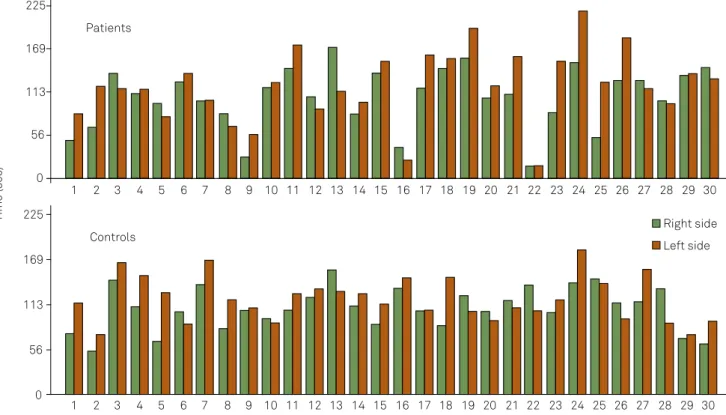
From 60 individuals (120 ears), all but two presented
nystagmus in response to 0.2 mL MCT. Two respond
-ed with 0.4 mL bilaterally. Eleven patients (36.7%)
showed a diference greater than 25% in the nystag
-mus duration between the ears. he nystag-mus duration
ranged from 16 to 218 seconds – right ear: 16 to 158 seconds
(mean: 106.2
±
39.4 seconds); left ear: 17 to 218 seconds
(mean: 121.2
±
45.8 seconds). he average right-to-left difer
-ence in the patients group was 20.97
±
15.9%.
In the control group nine individuals (30%) had the nys
-tagmus duration diference greater than 25% between the
ears. In this group the nystagmus duration ranged less exten
-sively, from 55 to 165 seconds. Right ear: 55 to 156 seconds
(mean: 108.5
±
26.3 seconds); Left ear: 75 to 165 seconds
(mean: 119.7
±
27.8 seconds). he average right-to-left dif
-ference in the control group was 18
±
11.5% (Figure 2).
he diferences between patients and controls were not
statistically signiicant.
DISCUSSION
his study points to a greater right-to-left MCT asymme
-try and greater response variability in vertigo-free migraineurs
as compared with controls. he result may indicate a greater
instability of the vestibular response in migraine, which is in
line with previous vestibular tests in this condition
17,18.
Fifty-ive years ago, the labyrinthine function was wrongly
considered less important in humans: “the phylogenetically
ancient and vital organ of balance has sufered debasement
in the more evolved animals, and diminishes in importance
as we ascend the phylogenetic scale”
19. However, a
break-through in neurophysiological and clinical knowledge on
the previously unknown labyrinth took place in the last
dec-ades, paralleling the recognition of the relationship between
dizziness and headache
20,21,22. he bithermal caloric test
(BCT) procedures represent the gold standard in respect of
the analysed parameters of vestibular evoked nystagmus
23,24.
Nevertheless, the established BCT procedures require that
a large quantity of water (50-100 mL) be maintained at an
exact temperature (30
oC and 44
oC), and also involve the
use of cumbersome equipment for air heating. hese con
-ditions are diicult to fulill outside the vestibular labora
-tory, particularly when a consultant outside the
depart-ment of otorhinolaryngology performs the examination
9.
Lintchicum et al.
6tested 67 cases of acoustic neuroma using
MCT and showed that 83% of the patients presented
a
re-duced vestibular response. hey highlighted that, provided
there is no spontaneous nystagmus, the MCT can be em
-ployed for diagnosis purposes since it requires little time
and equipment to be performed and causes less discomfort
to the patient. Nelson
7used Linthicum’s method in normal
Figure 1.
MCT. Tuberculin syringe of 0.2 cc ice water (A), Frenzel
goggle (B), chronometer (C), absorbent paper (D), ampliied eye
in the computer screen (E).
A
B
C
D
147
Eliana Teixeira Maranhão et al. The minimal caloric test in migraine patients
subjects and vertiginous patients searching for the amount
of ice water necessary to initiate the nystagmus, its
dura-tion, and intensity as well. hey stressed that although the
standard 30°C Hallpike stimulus
5was about four times as
intense as the 0.2 cc ice water, the latter could be used as
screening test to all physicians.
Schmäl et al.
9, compared the MCT (1 ml and 2 ml) with
the established vestibular caloric test procedures. hey
found a strong nystagmus correlation between cold
wa-ter (30°C) and bithermal wawa-ter (30°C and 44°C) with MCT,
and also concluded that using a small amount of ice water,
Frenzel glasses and a tuberculin syringe, MCT can be per
-formed with minimum technical and inancial efort. More
recently, Leigh and Zee
24compared the caloric tests and
re-inforced the importance and feasibility of MCT. Our study
conirms that MCT is a clean and quickly monothermal bed
-side test that can be applied by professionals working out-side
vestibular laboratory, e.g. in a hospital ward or oices. Being
essentially a low-frequency stimulus, caloric testing can
de-tect vestibular impairment that may not be apparent during
higher-frequency head rotation
22.
As part of a larger work in which we evaluate the vestib
-ular system of migraine patients without vertigo complains
with vestibular bedside tests
15, we compared herein the
MCT-induced nystagmus duration in our study population. In
only two control subjects (3.3%) 0.4 mL was required to induce
the response. None of the individuals presented spontaneous
nystagmus. Although not statistically signiicant, eleven mi
-graine patients (36.7%) showed unilateral vestibular weakness
average with asymmetric responses – greater than 25% – to
a larger extent when compared with nine (30%) healthy con
-trols. To the best of our knowledge this is the irst report on
the results of MCT in vertigo-free migraine patients. Migraine
is generally a nervous system hyperexcitability disorder
25.
Vestibular hyperexcitability could lead to greater, longer and
perhaps more unstable MCT responses in migraine. We did
not verify whether the headache side would interfere with the
results, although it is known that in migraine unilateral
head-aches are usually not side-locked
26. Further studies – with
larger samples and considering headache frequency,
intensi-ty, location, treatment efects and disease duration – are nec
-essary to verify whether our results really point to a
migrain-ous subclinical vestibular dysfunction or are indicative of
another epiphenomenon.
Acknowledgements
he authors are in debit with: Dr. Lucia Joily, Dr. Bruna
Fernandes de Souza Melo and Dr. Aluan Ungierowicz from
UFRJ Otorhinolaryngology Department for helping with
some MCT’s, as well as Danielle Zacaron Santos, PT. and Mr.
Péricles Maranhão Neto provided with technical assistance
in the preparation of this manuscript.
Figure 2.
Minimal Caloric Test responses (seconds) in 30 patients (upper panel) and controls (lower panel). Each pair of blue
and green bars, representing respectively the right and the left sides, correspond to one subject, as indicated in the x axis. The
Right-to-left asymmetry tends to be greater amongst patients. Samples 1 and 2 of control group used 0.4 cc.
0
56
113
169
225
0
56
113
169
225
Time (sec)
Patients
Controls
1
2
3
4
5
6
7
8
9
10
11
12
13
14
15
16
17
18 19 20 21 22
23
24 25 26 27 28
29
30
1
2
3
4
5
6
7
8
9
10
11
12
13
14
15
16
17
18 19 20 21 22
23
24 25 26 27 28
29
30
Right side
148
Arq Neuropsiquiatr 2016;74(2):145-148References
1. Brown-Séquard CE. Physiology and pathology of the central nervous system. Philadelphia; Collins; 1860.
2. Baloh R. Prosper Ménière and his disease. Arch Neurol. 2001;58(7):1151-6. doi:10.1001/archneur.58.7.1151 3. Baloh R. Robert Bárány and the controversy surrounding his
discovery of the caloric reaction. Neurology. 2002;58(7):1094-9. doi:10.1212/WNL.58.7.1094
4. Linthicum Jr FH, Waldorf R, Luxford WM, Caltogirone S. Infrared/ video ENG recording of eye movements to evaluate the inferior vestibular nerve using the minimal caloric test. Otolaryngol Head Neck Surg. 1988;98(3):207-10.
5. Fitzgerald G., Hallpike CS. Studies in human vestibular function: I. Observations on the diretional preponderance
(“Nystagmubereitschaft”) of caloric nystagmus resulting from cerebral lesions. Brain. 1942;65(2):115-37. doi:10.1093/brain/65.2.115 6. Linthicum Jr. FH., Churchill D. Vestibular test results in
acoustic tumor cases, Arch Otolaryngol. 1968;88(6):604-7. doi:10.1001/archotol.1968.00770010606007
7. Nelson JR. The minimal ice water caloric test. Neurology. 1969;19(6);577-85. doi:10.1212/WNL.19.6.577
8. Weinberg J, Sadé J. A simple and time saving cold mini caloric test. J Laryngol Otol. 1984;98(7):701-5. doi:10.1017/S0022215100147310 9. Schmäl F, Lübben B, Weinberg K, Stoll W. The minimal ice water
caloric test compared with established vestibular caloric test procedures. J Vestib Res. 2005;15(4):215-24.
10. Wang SJ, Chen PK, Fuh JL. Comorbidities of migraine. Front Neurol. 2010;1:16. doi:10.3389/fneur.2010.00016
11. Manzoni GC, Stovner LJ. Epidemiology of headache. In: Nappi G; Moskowitz MA, editors. Handbook of clinical neurology. Amsterdam: Elsevier B.V., 2011. p. 3-22.
12. Lempert T, Neuhauser H. Epidemiology of vertigo, migraine and vestibular migraine. J Neurol. 2009;256(3):333-8. doi:10.1007/s00415-009-0149-2
13. Brevern M, Neuhauser H. Epidemiological evidence for a link between vertigo and migraine. J Vestib Res. 2011;21(6):299-304. doi:10.3233/VES-2011-0423
14. Brant T, Dieterich M, Strupp M. Vertigo and dizziness: common complains. London: Springer; 2009.
15. Maranhão ET, Maranhão-Filho P, Luiz RR, Vincent MB. Vestibular bedside tets in migranious patients without vertigo complain. Arq Neuropsiq. 2015 Forthcoming.
16. The international classiication of headache disorders 2ndedition.
Cephalalgia. 2004;24 Supp 1:1-151.
17. Çelebisoy N, Gokcay F, Sirin H, Biçak N. Migrainous vertigo: clinical, oculographic and posturographic indings. Cephalalgia. 2008;28(1):72–7. doi:10.1111/j.1468-2982.2007.01474.x 18. Teggi R, Colombo B, Bernasconi L, Bellini C, Comi G, Bussi
M. Migrainous vertigo: results of caloric testing and stabilometric indings. Headache. 2009;49(3):435-44. doi:10.1111/j.1526-4610.2009.01338.x
19. Smith BH. Vestibular disturbances in epilepsy. Neurology. 1960;10(5):465-9. doi:10.1212/WNL.10.5.465
20. Neuhauser H, Leopold M, von Brevern M, Arnold G, Lempert T. The interrelations of migraine, vertigo, and migrainous vertigo. Neurology. 2001;56(4):436-41. doi:10.1212/WNL.56.4.436
21. Neuhauser H, Lempert T. Vertigo and dizziness related to migraine: a diagnostic challenge. Cephalalgia. 2004;24(2):83-91.
22. Brevern M, Zeise D, Neuhauser H, Clarke AH, Lempert T. Acute migrainous vertigo: clinical and oculographic indings. Brain. 2005;128(2):365-74. doi:10.1093/brain/awh351
23. Haim T. Caloric test. Available from: http://www.tchain.com/ otoneurology/practice/caloric_test.htm [Last access: June 26, 2015]. 24. Leigh RJ, Zee SD. The neurology of eye movements. 4th ed. New York:
Oxford Univesity Press; 2006.
25. Brighina F, Bolognini N, Cosentino G, Maccora S, Paladino P, Baschi R et al. Visual cortex hyperexcitability in migraine in response to sound-induced lash illusions. Neurology. 2015;84(20):2057-61. doi:10.1212/WNL.0000000000001584