ENCOMS: Argentinian survey in cost of illness
and unmet needs in multiple sclerosis
ENCOMS: encuesta argentina sobre costos de la enfermedad y necesidades no cubiertas
en pacientes con esclerosis múltiple
Celica Ysrraelit1, Fernando Caceres2, Andres Villa3, Marcela Parada Marcilla3, Jorge Blanche3,
Marcos Burgos4, Ignacio Casas Parera3, Oscar Colombo3, Ernesto Crespo3, Norma Deri5, Patricio Labal3, Monica Maluendez3, Alejandra Martinez3, Mario Melcon6, Pedro Nofal7, Edgardo Reich8, Vladimiro Sinay9, Adriana Tarulla3, Santiago Vetere3, Andres Barboza3, Roberto Rey10, Margarita Moreno11,
Alejandra Bacile12, Juan I. Rojas13, Gaston Kuperman14, Mercedes Resk14, Gustavo Seifer14, Gerardo Machinicki15, Jorge Cuneo14
ABSTRACT
The objective of the study was to assess the cost of multiple sclerosis (MS) patients in Argentina categorized by disease severity using a societal perspective.Method:Cross-sectional study including MS patients from 21 MS centers in 12 cities of Argentina. Patients were stratified by disease severity using the expanded disability status scale (EDSS) (group 1 with EDSS score between 0 and 3; group 2 with EDSS.3 and,7; group 3 with EDSS$7). Direct and indirect costs were analyzed for the second quarter of 2012 from public sources and converted to US Dollars.Results:266 patients were included. Mean annual cost per MS patient was USD 36,025 (95%CI 31,985-38,068) forts patients with an EDSS between 0-3; USD 40,705 (95%CI 37,199-46,300) for patients with EDSS .3 and,7, and USD 50,712 (95%CI 47,825-62,104) for patients with EDSS$7.Conclusions:This is the first Argentine study evaluating the costs of MS considering disease severity.
Keywords:multiple sclerosis, costs, cost-of-illness, Argentina, Latin America.
RESUMO
El objetivo del estudio fue evaluar el costo de los pacientes con esclerosis múltiple (EM) en Argentina categorizados por severidad de la enfermedad. Método: Estudio de corte transversal que incluyó pacientes con EM en 12 ciudades de Argentina. Los pacientes se estratificaron segúnexpanded disability status scale(EDSS) (grupo 1 EDSS entre 0 y 3; grupo 2 EDDS.3 y,7; grupo 3 EDSS$7). Los costos directos e indirectos fueron analizados para el segundo trimestre de 2012 y convertidos a dólares estadounidenses.Resultados: 266 pacientes fueron incluidos. El coste medio anual por paciente con EM fue de USD 36,025 (31,985-38,068 IC95%) para los pacientes con un EDSS entre 0-3; USD 40,705 (37,199-46,300 IC95%) para los pacientes con EDSS.3 y,7 y USD 50,712 (47,825-62,104 IC95%) para los pacientes con EDSS $7. Conclusiones:Primer estudio argentino evaluar los costes de la EM considerado la gravedad de la enfermedad.
Palavras-chave:esclerosis múltiple, costos, enfermedad, Argentina, Latino-América.
1Fleni, Buenos Aires Argentina;
2Instituto Neurociencias de Buenos Aires, Buenos Aires Argentina; 3Private Office, Buenos Aires Argentina;
4Hospital San Bernardo, Argentina;
5Hospital Fernandez, Buenos Aires Argentina; 6SMYL, Argentina;
7Centro Regional Integral de Neurociencia, Argentina; 8Hospital Julio Mendez, Buenos Aires Argentina. 9Fundacion Favaloro, Buenos Aires Argentina;
10Instituto Argentino de Investigación Neurologica, Buenos Aires Argentina; 11Centro Neurologico Integral, Argentina;
12Instituto de Neurociencias Cordoba, Cordoba Argentina; 13Hospital Italiano de Buenos Aires, Buenos Aires Argentina; 14Novartis, Argentina;
15Novartis Latinoamerica & Canada, Argentina.
Correspondence:Gastón Kuperman; Hospital Italiano de Buenos Aires; Argentina Gascon 450; Buenos Aires 1411; Argentina; E-mail: [email protected]
Disclosure:the research was conducted with a grant from Novartis Argentina.
DOI:10.1590/0004-282X20140016
Multiple sclerosis (MS) is the second most common cause of neurological disability in working-age population, after car accidents, having an impact on quality of life, social activities and also the environment of affected patients1. The course of the disease is highly variable, but
it is most typically characterized by a relapsing pattern of acute exacerbations followed by periods of remission (relaps-ing-remitting MS [RRMS]). However, in up to 50% of patients, this pattern evolves into a progressive course in which the clinical condition slowly deteriorates over the years (secondary progressive MS [SPMS])2. Considering the
natural course of this disease, the progressive physical dis-ability carries hard economic consequences from the early loss of work capacity3,4. MS patients required repeated
hos-pitalizations during disease exacerbations and the need of assistance in daily life activities, being the socioeconomic cost of the disease high for patients, families, health care systems and society as a whole4.
Mean total lifetime cost per patient of MS in the US was estimated to be USD 2.5 millions in 19945, and some
publications have addressed MS epidemiology and costs worldwide6,7,8,9,10,11. Nonetheless, current knowledge of MS
epidemiology and economic burden comes from North American and European studies9,10,12,13.
In Argentina, reported prevalence rates of MS range between 16 to 21 cases per 100,000 inhabitants9,14,15.
Despite this information, the economic burden associated with the disease in Argentina as well as in the region of Latin America, is unknown.
In order to better understand the impact of the disease on national health systems in the region, the objective of the study was to measure the socioeconomic burden that MS imposes to the Argentine society by disease severity and to contribute detailed cost information in the country.
METHOD
Study design
The Treatment Experience, Burden and Unmet Needs in Multiple Sclerosis Study (ENCOMS) in Argentina was an adaptation of the successful experience of TRIBUNE per-formed in several European countries and Canada16,17,18,19,20,
but using validated questionnaires for Argentina. The study was then a national, cross-sectional, observational and ret-rospective study including MS patients from 21 MS centers in 12 cities of Argentina. It was conducted to collect information on demographics, disease characteristics, dis-ease severity, comorbidities, relapses as well as resource util-ization and patient reported outcomes (PRO) associated with MS (ICD-10; G35, ICD-9; 340). Cities involved in the study were: Buenos Aires, Salta, Mendoza, Córdoba, Santa Cruz and Ushuaia. The study began in August 2011 and enrollment ended in February 2012. Site staff identified eli-gible patients by screening patient records, and an invitation to participate in the study was sent to patients who met the inclusion criteria (MS diagnosis21,22,23and at least 18 years
old). Patients having any physical or mental condition mak-ing them ineligible to participate or were already enrolled in other clinical trial were excluded. The study protocol and questionnaire were approved by the Ethics Committee prior to the initiation of the study.
Assessments
Patients self-completed a written-questionnaire in Spanish during enrolment interview. Patients provided information on: age, sex, living arrangements, educational level, employ-ment status, and informal caregiver(s). Disease information including year of diagnosis, year of first symptoms, type of MS, disability (captured using the self-administered Expanded Disability Status Scale (EDSS)24), comorbidities
(arthritis, osteoporosis, depression, anxiety, sleep disorders, hypertension and urinary tract infections/incontinence) and treatment with disease modifying drugs (DMDs) was also captured. The disability scale version used in the study was the modified and validated version that had been previously used in other cost-of-illness studies in MS20. Patients were
asked about relapses experienced in the last 12 months, including occurrence and number of relapses, number of those requiring steroid treatment and number of days of inpatient care for relapses.
Resource utilization
Data on healthcare including inpatient and outpatient care, magnetic resonance imaging (MRI) studies performed, consultations with medical practitioners, treatment with DMDs, prescription and over-the-counter medication as well as non-medical resources used (wheelchairs), professional and informal care and patients’productivity loss (sick leave
Ysrraelit C.has received travelling grants from Merck Serono, Teva, Biogen Idec and Bayer Schering and has been investigator for Novartis, Merck Serono and Biogen Idec.Cáceres F.has received financial support for research activities from Novartis.Villa A.M.has received financial support for research activities from Novartis and speaker honoraria from Biogen Idec.Parada Marcilla M.has no conflict of interest.Melcon M.has no conflict of interest.Blanche J.has no conflict of interest.Burgos M.has no conflict of interest.Casas Parera I.has no conflict of interest.Colombo I.
has no conflict of interest.Crespo E.has no conflict of interest.Deri N.has no conflict of interest.Labal P.has no conflict of interest.Maluendez M.has no conflict of interest.Martinez A.has no conflict of interest.Melcon M.has no conflict of interest.Nofal P.has no conflict of interest.Reich E.has no conflict of interest.Sinay V.has no conflict of interest.Tarulla A.has no conflict of interest.Vetere S.has no conflict of interest.Barboza A.has no conflict of interest.Rey R.has no conflict of interest.Moreno M.has no conflict of interest.Bacile A.has no conflict of interest.Rojas J.I.has received honoraria from Novartis as a scientific advisor. He has received travel grants and attended courses and conferences on behalf of Merck-Serono Argentina, and honoraria as scientific advisor from Novartis Argentina.G. Seiferhas received honoraria as scientific advisor from Novartis Argentina.Kuperman, G.; Resk, M.; Machinicki, G. Cuneo, J.are employee of Novartis Argentina.
and retirement due to the disease), was collected using the questionnaire. Different recall periods were used for different resources. Hospital stays, investigations/MRIs and use of wheelchair were recorded for the previous year. A 3-month recall period was used for outpatient admissions, consulta-tions with hospital-based or private practice physicians, use of DMDs, services such as home care and nursing, informal care by family and friends, and absences from work due to sickness. Patients were asked to report the use of co-medication and over-the-counter medication during the last month.
Costs
To obtain the cost per patient per year, resources used were first annualized assuming that the use of each resource during the recall period was representative of the patients’
use during a whole year. The annual use of each resource was multiplied by its respective unit cost to get the annual cost. Second quarter 2012 unit costs were derived from pub-lic sources of Argentina including theInstituto Nacional de Estadísticas y Censos25(Indec), the
Nomenclador Nacional26,
drugs public price list27 and, when necessary, costs from
the Sanitary and Clinical Effectiveness Institute (IECS) cost database28. Unit cost in Argentine pesos was converted to
US dollars using June 2012 exchange rate (USD 1=AR$ 4.46). Costs are shown in Table 1. The cost of sick leave was calcu-lated by multiplying the patient-reported days lost from work due to MS by the average gross salary per day. To estimate productivity losses of early retirement due to MS, the mean annual number of hours worked in 2011 in Argentina was multiplied by the gross salary20. Informal care was rated using
productivity loss of the working caregiver, multiplied by the average gross salary. In order to asses only the hours leading to informal caregiver productivity loss, the average working hours per week were considered19,20.
Statistical analysis
Patients were stratified according to disease severity using the EDSS (group 1 with EDSS between 0 and 3; group 2 with EDSS .3 and ,7; group 3 with EDSS $7) for the analysis. Use of resources was determined for each group and cost was obtained from the estimated resource utiliza-tion. Confidence intervals (95%) for costs were estimated by non-parametric bootstrapping. A non-parametric statist-ical test for independent samples (Wilcoxon-Mann-Whitney test) was used to determine whether differences between comparisons performed were statistically signific-ant (p-value,0.05).
RESULTS
Patient characteristics
A total of 266 patients were enrolled. Mean age of patients enrolled was 42.3±10.5 years, Reported mean age at the onset of the disease was 31.6±9 years Almost 20% of patients had a university degree and 16.5% of patients were currently retired due to the disease. Most MS patients had the relapsing-remitting form of the disease (87.6%). When stratifying the sample included, 188 (70.7%) patients had an EDSS score between 0 and 3; 51 (19.2%) an EDSS .3 and,7 and 27 (10.1%) an EDSS$7). Patients with mild dis-ability were younger than moderate or severe MS patients (p-value=0.007). The remaining patient characteristics including comorbidities, employment status and living situ-ation are displayed in Table 2.
Resource utilization
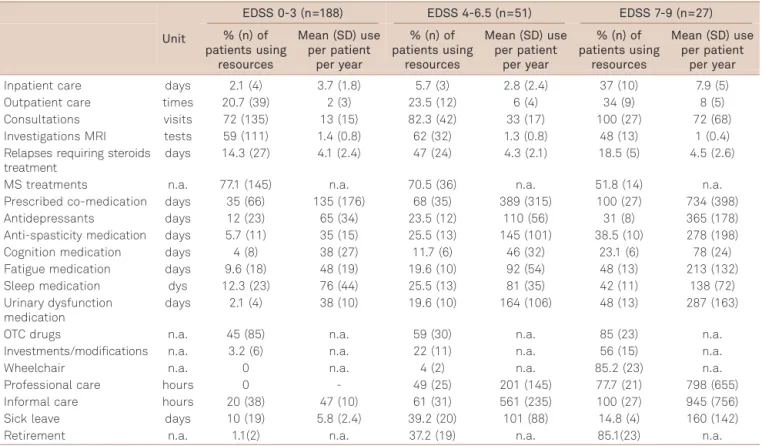
The proportion of patients who received inpatient care, had medical visits and used co medications significantly increased across disability severity subgroups, being 10%, 27% and 100%, respectively, in patients with an EDSS $7, while the proportion of patients with MS-specific medication decreased from 77.1% to 51.8% in patients with EDSS between 0 and 3 and EDSS$7 respectively. Informal care was more frequently reported among patients with severe disability compared with patients with moderate and mild disability (100% vs. 61% vs. 21%, respectively). Almost 85% of patients with an EDSS $7 were retired due to MS. Other resource utilization by patients is shown in Table 3.
Costs
The mean cost per MS patient per year stratified by ability from a societal perspective was measured and is dis-played in Table 4 and Figure. The mean cost of patients significantly increased across disability severity groups, being of USD 36,025 (95% confidence interval (CI) 31,985-38,068) in patients with an EDSS between 0 and 3, USD 40,705 (95% CI37,199-46,300) in patients with EDSS .3 and ,7 Table 1.Unit costs in US Dollars (June 2012).
Unit costs US dollars
Interferon beta 1 a SC (monthly cost) 4212
Interferon beta 1 a IM (monthly cost) 3366
Interferon beta 1 b (monthly cost) 3473
Copaxone (monthly cost) 3714
Natalizumab (monthly cost) 4302
Professional care (hour) 7
Wheelchair 304
Informal care (hour) 7
Antidepressant treatment (month) 28
Anti-spasticity medication (month) 13
Cognition medication (month) 46
Fatigue medication (month) 19
Sleep medication (month) 11
Urinary dysfunction medication (month) 25
Sick leave (day) 54
and USD 50,712 (95%CI 47,825-62,104) in patients with EDSS $7. In patients with EDSS $7, the cost for patients’ sick leave and retirement due to MS was an important compon-ent, comprising 25.7% of total costs, while direct non-med-ical costs represented 21.6% of the total cost. Informal care was assessed on the base case analysis using only working caregiver productivity loss. In patients with EDSS$7, mean annual cost of informal care per patient represented 12.5% of the total annual cost per patient, while in patients with EDSS between 0 and 3 and.3 and,7, informal care repre-sented 0.2% and 5.6%, respectively, of total costs. In patients with EDSS between 0 and 3, most of the cost came from direct medical costs including MS-specific medication.
DISCUSSION
The robust ENCOMS study showed that MS imposes a significant economic burden on Argentine society. Mean annual cost per patient was estimated at USD 36,025 in patients with an EDSS between 0 and 3 and reached USD 50,712 in patients with EDSS $7. This economic burden increases with higher physical disability. This was accounted for by the increase in resource utilization of medical visits, informal care, professional care, sick leave as well as retire-ment due to MS in the sample analyzed.
Our study is consistent with previous cost-of-illness studies performed in Canada20 and some European
coun-tries16,18,29. In Canada, Karampampa et al. also demonstrated
that increased physical disability was associated with increased direct and indirect costs partially explained by a higher need for medical and non-medical care associated with disability progression20. In the Canadian study, the
mean annual cost per patient for 2009 was estimated at CAD 30,836 for patients with mild disability (EDSS score 0-3), CAD 46,622 for patients with moderate disability (EDSS 4-6.5), and CAD 77,981 for patients with severe dis-ability due to MS (EDSS score 7-9)20. The increase in the
eco-nomic burden of the disease associated with the increase in physical disability, was also showed by Karampampa et al in the European health care systems such as those from Spain, France, Germany and the United Kingdom19.
In Argentina, this is the first study designed to capture the economic burden of the disease. In Latin America, a compre-hensive cost study, from a third party payer perspective and including MS patients from 3 MS centers in the country was done by Romero et al in Colombia between 2003 and 200830. The study estimated direct and indirect costs
accord-ing to disease progression as measured by EDSS in MS patients. The disease was classified into 4 categories accord-ing to EDSS: category 1 EDSS 0-2.5, category 2 EDSS 3-5.5, category 3 EDSS 6-7.5, and category 4 EDSS 8-9.5) and costs for each category were estimated. The study showed that Table 2.Baseline characteristics of multiple sclerosis (MS)
patients enrolled.
Variable N % or SD
Number participants enrolled 266
-Gender
Male 83 31.2
Female 183 68.8
Age
Mean current age 42.3 ±10.5
Patients by current age cohorts
18-29 years 39 14.7
30-39 years 64 24.1
40-49 years 76 28.6
50-59 years 84 31.8
60-69 years 3 1.13
Mean age at onset 31.6 ±9
Patients by age at onset cohorts
18-29 years 122 45.9
30-39 years 82 30.9
40-49 years 60 22.6
50-59 years 2 0.8
60-69 years 0
-Living situation
Alone 53 20
Family, spouse/partner 210 79
Nursing home 3 1
Education level
Secondary school 154 57.9
Professional diploma 59 22.2
University degree 53 19.9
Employment situation
Employed 144 54.3
Student 19 7.1
Unemployed 59 22.1
Retired due to MS 44 16.5
Informal caregiver
At least one informal caregiver 181 70.4
Spouse or family member 156 58.7
Friend, neighbor 25 9.4
MS type
Relapsing remitting 233 87.6
Secondary progressive 19 7.1
Primary progressive 14 5.3
Comorbidities
Urinary incontinence 41 15.5
Sleep disorders 45 17
Arthritis 8 3
Hypertension 17 6.4
Cognitive disorders 48 18.1
Disease severity
Mean EDSS score 2.6 ±2.2
Number of patients by EDSS cohorts
EDSS 0-1 96 36.1
EDSS 2-3 92 34.6
EDSS 4-5 39 14.7
EDSS 6-6.5 12 4.5
EDSS 7, 8 & 9 27 10.2
MS treatment
Currently treated 206 77.4
Currently untreated but treated in the past 36 13.5
Treatment-naïve 24 9
the mean annual cost per patient varied across disease cat-egories, with the highest cost in category 2 (USD 25,713) and the lowest one in category 4 (USD 10,543). The cost of DMDs accounted for 91.5% of the mean total annual cost for categories 1, 2 and 3. Indirect costs were minimal, except
for category 4, where higher costs of DMDs were offset by lower use of DMDs30. Despite this valuable information, the
study did not take into account some direct non-medical costs as well as indirect costs such as professional care, informal care, sick leave and retirement due to MS30. This
Table 3.Resource utilization by EDSS.
Unit
EDSS 0-3 (n=188) EDSS 4-6.5 (n=51) EDSS 7-9 (n=27)
% (n) of patients using
resources
Mean (SD) use per patient
per year
% (n) of patients using
resources
Mean (SD) use per patient
per year
% (n) of patients using
resources
Mean (SD) use per patient
per year
Inpatient care days 2.1 (4) 3.7 (1.8) 5.7 (3) 2.8 (2.4) 37 (10) 7.9 (5)
Outpatient care times 20.7 (39) 2 (3) 23.5 (12) 6 (4) 34 (9) 8 (5)
Consultations visits 72 (135) 13 (15) 82.3 (42) 33 (17) 100 (27) 72 (68)
Investigations MRI tests 59 (111) 1.4 (0.8) 62 (32) 1.3 (0.8) 48 (13) 1 (0.4)
Relapses requiring steroids treatment
days 14.3 (27) 4.1 (2.4) 47 (24) 4.3 (2.1) 18.5 (5) 4.5 (2.6)
MS treatments n.a. 77.1 (145) n.a. 70.5 (36) n.a. 51.8 (14) n.a.
Prescribed co-medication days 35 (66) 135 (176) 68 (35) 389 (315) 100 (27) 734 (398)
Antidepressants days 12 (23) 65 (34) 23.5 (12) 110 (56) 31 (8) 365 (178)
Anti-spasticity medication days 5.7 (11) 35 (15) 25.5 (13) 145 (101) 38.5 (10) 278 (198)
Cognition medication days 4 (8) 38 (27) 11.7 (6) 46 (32) 23.1 (6) 78 (24)
Fatigue medication days 9.6 (18) 48 (19) 19.6 (10) 92 (54) 48 (13) 213 (132)
Sleep medication dys 12.3 (23) 76 (44) 25.5 (13) 81 (35) 42 (11) 138 (72)
Urinary dysfunction medication
days 2.1 (4) 38 (10) 19.6 (10) 164 (106) 48 (13) 287 (163)
OTC drugs n.a. 45 (85) n.a. 59 (30) n.a. 85 (23) n.a.
Investments/modifications n.a. 3.2 (6) n.a. 22 (11) n.a. 56 (15) n.a.
Wheelchair n.a. 0 n.a. 4 (2) n.a. 85.2 (23) n.a.
Professional care hours 0 - 49 (25) 201 (145) 77.7 (21) 798 (655)
Informal care hours 20 (38) 47 (10) 61 (31) 561 (235) 100 (27) 945 (756)
Sick leave days 10 (19) 5.8 (2.4) 39.2 (20) 101 (88) 14.8 (4) 160 (142)
Retirement n.a. 1.1(2) n.a. 37.2 (19) n.a. 85.1(23) n.a.
EDSS: expanded disability status scale; MS: multiple sclerosis; MRI: magnetic resonance imaging; OTC: over the counter; SD: standard deviation.
Table 4.Annual cost per patient by EDSS in 2012 US dollars, 95% confidence interval (CI).
EDSS 0-3 (n=188) EDSS 4-6.5 (n=51) EDSS 7-9 (n=27)
Mean SD 95%CI Mean SD 95%CI Mean SD 95%CI
Inpatient care 18 9 5-32 37 32 29-77 683 432 577-866
Outpatient care 72 108 58-98 245 164 188-365 473 296 336-702
Consultations 65 75 32-123 189 97 140-244 501 473 389-686
Investigations MRI 149 85 108-193 146 90 116-196 87 35 58-150
MS treatments 35,280 5,120 32,656-39,053 32,260 4,777 29,060-39,034 26,422 23,703 21,582-29,421 Relapses requiring
steroid treatment
135 79 99-190 465 227 365-705 192 111 138-292
Prescribed co-medication 22 14 19-27 96 57 78-109 400 220 335-485
OTC drugs 36 50 29-62 84 64 67-201 698 389 426-991
Total direct medical costs 35,778 32,567 33,096-39,855 33,438 49,643 28,944-41,568 26,737 8,658 24,298-33,096
Wheelchair 0 0 n.a. 12 70 5-142 259 193 196-438
Professional care 0 0 n.a. 685 494 508-1933 4,310 3,538 2,772-5,289
Informal care 63 13 44-118 2,305 965 1,714-3405 6,364 5,091 5,115-7,992
Total direct non-medical costs
63 9 34-75 3,001 534 2,144-3785 10,933*+ 3,670 7,896-14,189
Sick leave 31 13 16-42 2,133 1,859 1,567-2,647 1,276 1,132 944-1,953
Retirement 152 100 50-269 2,133 845 1,644-2,800 11,766 6,446 6,993-14,292
Total indirect costs 183 80 123-215 4,266 920 2,923-6,291 13,042*+ 10,404 9,117-19,405
Total costs 36,025 7,991 31,985-38,068 40,705 8,773 37,199-46,300 50,712*+ 5,337 47,825-62,104
*Difference is statistically significant compared to the mild subgroup of patients (p-value,0.05);+Difference is statistically significant compared to the
might explain the economic burden differences observed in patients with severe disability in the study by Romero and our findings. No other studies analyzing the economic burden of the disease, stratifying by physical disability and consider-ing direct as well as indirect costs in the Latin American region were identified.
The study has many limitations. First of all, the sample involves patients from all disability spectrums; however, the proportion of patients with severe disability was lower in relation to patients with moderate and mild disability. Therefore, a larger sample would be necessary to generalize
the results. Another limitation observed in previous studies on which ENCOMS was based19relates to the fact that cost
estimates are likely to reflect how the sample of MS patients was derived. Cost estimates would probably have been lower if the sample had included MS patients recruited from the community rather than from specialized clinics. The above could lead to the fact that many patients are receiving MS-specific treatments as well as professional and informal care in relation to total MS population in Argentina. Despite this, we tried to overcome the possibility of bias by including patients from several MS centers from wide-spread cities from Argentina in order to include patients from all possible backgrounds.
The important and novel information provided about the disease-related economic burden is the main contribution of this study to existing literature for MS both in Argentina and the region in terms of costs in a developing country. This information is a valuable tool to make relevant and wise decisions in the field by understanding the exact behavior of the disease in the local setting and supplementary to the use of information from Europe and North America, where resource utilization as well as cost could be rather different from those observed in a developing country like Argentina4,9.
In conclusion, the ENCOMS study provides the Argentine health care system as well as local stakeholders with import-ant information about the economic burden of the disease in our country. Future research performed in our country as well as in other countries of the region, taking in consid-eration direct and indirect costs of the disease, will expand knowledge and improve management of the disease in the region in terms of this highly relevant issue.
References
1. Simmons RD. Life issues in multiple sclerosis. Nat Rev Neurol 2010;6:603-610.
2. Lublin FD, Reingold SC. Defining the clinical course of multiple sclerosis: results of an international survey. National Multiple Sclerosis Society (USA) Advisory Committee on Clinical Trials of New Agents in Multiple Sclerosis. Neurology 1996;46:907-911.
3. Patwardhan MB, Matchar DB, Samsa GP, McCrory DC, Williams RG, Li TT. Cost of multiple sclerosis by level of disability: a review of literature. Mult Scler 2005;11:232-239.
4. Kobelt G, Pugliatti M. Cost of multiple sclerosis in Europe. Eur J Neurol 2005:12(Suppl1):S63-S67.
5. Whetten-Goldstein K, Sloan FA, Goldstein LB, Kulas ED. A compre-hensive assessment of the cost of multiple sclerosis in the United States. Mult Scler 1998;4:419-425.
6. Sharac J, McCrone P, Sabes-Figuera R. Pharmacoeconomic con-siderations in the treatment of multiple sclerosis. Drugs 2010;70:1677-1691.
7. Kobelt G, Pugliatti M. Cost of multiple sclerosis in Europe. Eur J Neurol 2005;12(Suppl1):S63-S67.
8. Kurtzke JF. MS epidemiology world wide. One view of current status. Acta Neurol Scand Suppl 1995;161:23-33.
9. Cristiano E, Patrucco L, Rojas JI. A systematic review of the epidemiology of multiple sclerosis in South America. Eur J Neurol 2008;15:1273-1278.
10. Pugliatti M, Sotgiu S, Rosati G. The worldwide prevalence of multiple sclerosis. Clin Neurol Neurosurg 2002;104:182-191.
11. Rosati G, Aiello I, Pirastru MI, et al. Epidemiology of multiple sclerosis in Northwestern Sardinia: further evidence for higher frequency in Sardinians compared to other Italians. Neuroepidemiology 1996;15:10-19.
12. Rosati G. The prevalence of multiple sclerosis in the world: an update. Neurol Sci 2001;22:117-139.
13. Kurtzke JF. Epidemiology of multiple sclerosis. Does this really point toward an etiology? Lectio Doctoralis. Neurol Sci 2000;21:383-403.
14. Cristiano E, Patrucco L, Rojas JI, et al. Prevalence of multiple sclerosis in Buenos Aires, Argentina using the capture-recapture method. Eur J Neurol 2009;16:183-187.
15. Melcon M, Gold L, Carra A, et al. Argentine Patagonia: prevalence and clinical features of multiple sclerosis. Mult Scler 2008;14:656-662.
16. Karampampa K, Gustavsson A, Miltenburger C, Mora S, Arbizu T. Treatment experience, burden and unmet needs (TRIBUNE) in MS study: results from Spain. Mult Scler 2012;18(Suppl2):S35-S39. 60000
50000
40000
30000
US Dollar
s
Annual cost per patient by EDSS
EDSS 0-3
EDSS 4-6.5
EDSS 7-9 20000
10000
0
Indirect costs Direct non-medical costs
Direct medical costs
17. Karampampa K, Gustavsson A, Miltenburger C, Teruzzi C, Fattore G. Treatment experience, burden and unmet needs (TRIBUNE) in MS study: results from Italy. Mult Scler 2012;18(Suppl2):S29-S34.
18. Karampampa K, Gustavsson A, Miltenburger C, Neidhardt K, Lang M. Treatment experience, burden and unmet needs (TRIBUNE) in MS study: results from Germany. Mult Scler 2012;18(Suppl2):S23-S27.
19. Karampampa K, Gustavsson A, Miltenburger C, Eckert B. Treatment experience, burden and unmet needs (TRIBUNE) in MS study: results from five European countries. Mult Scler 2012;18(Suppl2):S7-S15.
20. Karampampa K, Gustavsson A, Miltenburger C, Kindundu CM,
Selchen DH. Treatment experience, burden, and unmet needs (TRIBUNE) in multiple sclerosis: the costs and utilities of MS patients in Canada. J Popul Ther Clin Pharmacol 2012;19:11-25.
21. Polman CH, Reingold SC, Edan G, et al. Diagnostic criteria for multiple sclerosis: 2005 revisions to the "McDonald Criteria". Ann Neurol 2005;58:840-846.
22. Polman CH, Reingold SC, Banwell B, et al. Diagnostic criteria for multiple sclerosis: 2010 revisions to the McDonald criteria. Ann Neurol 2011;69:292-302.
23. Poser CM, Paty DW, Scheinberg L, et al. New diagnostic criteria for multiple sclerosis: guidelines for research protocols. Ann Neurol 1983;13:227-231.
24. Kurtzke JF. A new scale for evaluating disability in multiple sclerosis. Neurology 1955;5:580-583.
25. INDEC. Dirección General de Estadísticas y Censos. Censo
Nacional de Población, Hogares y Vivienda, Argentina 2001. http://www.indec.gov.ar/
26. Nomenclador de Prácticas Médicas Nacional. www.softmedico.com/ nnfull.html.
27. Kairos. Tecnología y Ciencia para Farmacia. www.ar.kairosweb.com.
28. www.iecs.org.ar.
29. Karampampa K, Gustavsson A, Miltenburger C, Tyas D. Treatment experience, burden and unmet needs (TRIBUNE) in MS study: results from the United Kingdom. Mult Scler 2012;18(Suppl2):S41-S45.