Guidelines for druG TreaTmenT of epilepsy
A critical review
Carlos A.M. Guerreiro
1Abstract – This article critically reviews the role of evidence-based medicine and its guidelines, from their logistic preparation to their interpretation. The strengths and weaknesses of the methodological points are presented, as well the reasons for the extreme popularity of the guidelines in developed countries. The review discusses the main foundations of the most cited guidelines and some recent large studies. Some of the final conclusions are that clinical experience is always an important factor to consider, even in the face of solid evidence, to achieve the best possible management of any particular patient.
Key wordS: antiepileptic drugs, guidelines for medical treatment of epilepsy, evidence-based medicine.
Guias para tratamento medicamentoso de epilepsia: uma revisão crítica
Resumo – este artigo revê de modo crítico o papel da medicina baseada em evidência e alguns dos guias mais citados, desde a logística de preparação até a interpretação. os pontos fortes e as limitações são apresentados, assim como o porquê da extrema popularidade, especialmente nos países desenvolvidos. São discutidos aspectos importantes e os principais achados, assim como recentes ensaios clínicos sobre o uso de novas drogas antiepilépticas. o artigo conclui que mesmo quando há evidência apoiando certa escolha, a experiência clínica não deve ser substituída ou negligenciada, uma vez que a conduta final deve ser tomada pelo clínico diante do seu paciente considerando as suas necessidades especiais.
PAlAvrAS-ChAve: drogas antiepilépticas, guias de tratamento medicamentoso das epilepsias, medicina baseada em evidência.
1Md, Phd, Full Professor of Neurology, State Universit of Campinas (UNICAMP), Campinas SP, Brazil.
received 6 June 2008. Accepted 18 June 2008.
Dr. Carlos A. M. Guerreiro - Department of Neurology / FCM / University of Campinas (UNICAMP) - Caixa Postal 6111 - 13083-970 Campinas SP - Brasil. E-mail: [email protected]
The objective of this article is to review critically the utility of the guidelines for the drug treatment of epilep-sy. This study discusses the guidelines most cited in the lit-erature, particularly the American Academy of Neurology (AAN), American epilepsy Society1,2 and the International league against epilepsy (IlAe) guidelines3. It also address-es the issue of why guidelinaddress-es are so popular among doc-tors and the recent large english trials (SANAd) on new antiepileptic drugs (Aed)4,5 .
WhaT is evidence-based medicine?
The term “evidence-based medicine” (eBM) was irst coined by Sackett in the early 1990s6. The authors subse-quently reined the deinition of eBM as “integrating the best research evidence with clinical expertise and patient values to achieve the best possible patient management”. evidence-based medicine replaced the term “clinical
ep-idemiology”. It is also sometimes called “evidence-based practice”. evidence-based medicine acts on actual clinical outcomes and not theoretical ones7.
The goal of eBM is to apply research evidences to clinical practice more consistently. In other words, it gives a more pragmatic perspective – a better use of evidence in medicine. The practice of eBM may also be advantageous in de-veloping countries due to the shortage of medical fund-ing and the need for rationalization8. The use of medical intervention, which shows no evidence of beneit, is not eficacious, or is unsafe, is completely unjustiiable. on the other hand, rationalization is necessary for the imple-mentation of a cost-effective practice.
In essence, eBM warns that one has to exercise caution when using medical action based only on clinical experi-ence or on the interpretation of pathophysiological data.
The balance of evidence/lack of evidence is not an absolute matter. liberati et al.9 mention four reasons that help to understand this point: a. for many clinical prac-tices, even when armed with well-conducted randomized clinical trials (rCTs), all we can conclude is a “weight-of-evidence” overall evaluation, because of conlicting re-sults in the rCTs; b. in some circumstance no rCTs are done; c. the rCTs are of poor quality; and d. rCTs cannot be conducted for practical or ethical reasons.
other factors decrease the effectiveness of eBM. To-day there is great commercial inluence in medical activity. The lack of independent medical information and the pol-lution caused by commercial interference is obvious. Med-ical practice, even today, is full of ineffective interventions due to intentionally or unintentionally created messages. Frequently, the quality of medical research is poor. Medi-cal care systems are strongly inluenced by pharmaceutiMedi-cal companies’ lobbies. Independent research, supported by public institutions, is very necessary. Conlicts of interest of investigators present a threat to the credibility of research. despite all the limitations, eBM has lead to a bet-ter quality of clinical research, and greabet-ter awareness in health professionals, administrators and policy makers.
a brief hisTory of clinical Trials
Possibly, the irst controlled clinical trial was in 1747, carried out by James lind, a royal Navy surgeon. In search-ing for a cure for scurvy, he gave sick sailors, whom he had divided into six groups of two each, one of the fol-lowing treatments: 1. a quart of cider/day; 2. ether; 3. vin-egar; 4. seawater; 5. a paste of garlic, radish, Peruvian bal-sam, and myrrh; and 6. oranges and lemons. After six days he observed that all sailors, except the two in group 6, remained aflicted with scurvy. This study was
unblind-ed, but as a result, limes were stocked on all ships of the royal Navy, and scurvy among sailors (limeys) became a problem of the past. More recently, since the discovery of vitamin C, the reasons for the outcome and the manage-ment became obvious. however, it was only in the 1950s that the randomized clinical trial became the standard for the excellence in research10.
componenTs of clinical decision makinG every clinical decision depends on evidence, which may come from textbook information, articles, courses, classes, a colleague’s opinion, etc.
The clinical decision depends on various factors: the doctor’s knowledge of evidence, skills, and attitude in ap-proaching the problem; the health system’s access rules such as resources, funding, supply, etc.; the patient’s val-ues, concerns, expectations; and concerns about litigation, particularly in more developed societies.
The role of the evidenced-based guidelines is to mea-sure, qualitatively and quantitatively, the available data and differentiate the sources and strength of different informa-tion. In other words, they give selected values to the data.
Guidelines
The Institute of Medicine deines practice guidelines as “systematically developed statements to assist prac-titioner and patient decisions about appropriate health care for speciic clinical circumstances”11.
The American Academy of Neurology(AAN) guide-lines use the term “practice parameter” to deine state-ments based on evidence that are deined as “strategies for patient management, developed to assist physicians in clinical decision-making, including standards, guidelines, and other patient management strategies”. They should
be comprehensive, integrate evidence with clinical expe-rience, be current, lead to recommendations (AAN meth-ods), and be widely disseminated. This approach has the advantage of having the validity of their statements. on the other hand, there are many gaps in knowledge, and the clinician may have many questions without answers.
Not all guidelines are evidence-based. Some of them are a consensus among authors. An algorithm of the nec-essary steps to create a guideline is shown in Figure.
World-Wide inTeresT in Guidelines
There is an increasing interest in guidelines worldwide. The busy clinician hardly manages to read the main arti-cles in their area of interest due to the proliferation of scientiic publications. Information available on the Inter-net is not always good quality. In 2006, Medline included more than 730,000 new articles. due to this immense vol-ume of medical information, the use of best-evidences are the only possible strategies to identify the most promi-nent studies. data can be obtained from diverse sourc-es: original articles, abstracts with methodological evalu-ation, systematic reviews, and guidelines. Abstracts with methodological evaluation may be available through the ACP Journal Club, accessed on the website www.acpjc. com. PubMed (www.pubmed.org) is used to locate orig-inal articles. Full articles are available at “Periódicos da Capes” (www.periodicos.capes.gov.br). The BIreMe virtu-al hevirtu-alth library (BvS) offers a pay-per-view article service on www.bireme.br.
The eBM guidelines are made freely available by the National Guideline Clearing house (NGC) on the site www.guideline.gov12.
The eBM guidelines aim to improve the quality of pa-tient care and possibly eficiency in the use of health care resources. They orient those who develop policy, audit, proile, monitor quality and conduct utilization reviews. Some countries have a culture of litigation, and doctors need a continuously updated status for diagnosis and treatment procedures. The guidelines are considered one way to have updated reviews. This has become a medical
necessity for neurologists due to the ever-changing scien-tiic and practical positions in daily medical care.
To illustrate this point, some of the most recent AAN guidelines related to seizures or epilepsy are listed in Ta-ble I. The guidelines continue to be downloaded from the AAN website at a rapid rate and they have the highest ci-tation index in articles.
example of The problem: When The Guidelines Go beyond The evidence
one ubiquitous problem in the guidelines is the ex-treme lack of good quality methodological trials resulting in poor evidence-based information. Therefore, there is an obvious gap between research and clinical practice. Because of this, the guidelines organizers sometimes use consensus information to make the guidelines more useful clinically.
Two examples may illustrate this point.
Firstly, the National Institute for Clinical excellence (NICe) guidelines state in their conclusion: “The newer antiepileptic drugs gabapentin, lamotrigine, oxcarbaze-pine, tiagabine, topiramate, and vigabatrin (as an adjunc-tive therapy for partial seizures), within their licensed in-dications, are recommended for the management of epi-lepsy in people (including children) who have not beneit-ed from treatment with the older antiepileptic drugs such as carbamazepine or sodium valproate, or for whom the older antiepileptic drugs are unsuitable”19. even though most epileptologists agree with this statement, it is clear that there is no evidence-based data to support it.
Secondly, the AAN guidelines1,2 take into account the adverse events proiles of Aeds. It is clear from the litera-ture that was impossible to get information about adverse events based on controlled, randomized, double-blind tri-als. So, this information was obtained by consensus among the guidelines members and not on evidence-based data. The reader is not always aware of this point.
When There is no evidence
one cannot take the extreme point of view and not use a speciic therapeutic intervention just because there
Table 1. AAN Recent guidelines about seizures and epilepsy.
1. evaluating a irst nonfebrile seizure in children (2000).13
2. Treatment of the child with a irst unprovoked seizure (2003)14.
3. Temporal lobe and localized neocortical resections for epilepsy (2003)15.
4. eficacy and tolerability of the new antiepileptic drugs: I: Treatment of new onset epilepsy (2004)1.
5. eficacy and tolerability of the new antiepileptic drugs: II: Treatment of refractory epilepsy (2004)2.
6. Use of serum prolactin in diagnosing epileptic seizures (2005)16.
7. Neuroimaging in the emergency patient presenting with seizure (2007)17.
is no rCT. The classic example of this would be the para-chute. It would be absurd to deny the use of it just be-cause there is no randomized, controlled trial demon-strating its utility.
In these circumstances some interventions may be used based on pathophysiological knowledge, experience, and common sense, even without rCTs; for example, the use of some antibiotics in certain infectious disease or surgeries to drain an extradural hematoma.
The “pecoT” principle
The formation of the clinical question is part of the answer challenge. The ive parts of the PeCoT structur-al approach are: Patients/Participants/Population, expo-sure/Intervention, Comparison, outcome, and Time20. An example of its application would be: For adults with par-tial onset seizures (P), which Aed (e) compared to an ad-equate comparator (C) provides the highest eficacy (o) over the irst year of exposure (T)?3.
clinical Wisdom
Some of the information available is general and may not be applicable to your current patient. Patients differ in relation to their genetic background, environment, reaction to disease, desires and expectations, and acceptance of risk. The decision to use or not to use riluzole may or may not be a reasonable evidence-based treatment for mo-tor neuron disease. does your disabled patient want to prolong life for a few more weeks with a much-compro-mised quality of life? Common sense and the clinical ex-perience of the neurologist may be the deciding factor for the management of this patient.
It is better to start from a position that something may work rather than it must work. An extreme nihilistic position does not help at all. Intervention may not work or may work marginally. In the words of warlow (2007): “on the other hand, over-optimism fuelled by too many drug company dinners is equally damaging. well-informed uncertainty is a legitimate professional position, but it must not lead to paralysis of action in individual cases, even if the action is ‘do nothing’”21.
Guidelines for neWly diaGnosed epilepsy Some of the most cited guidelines for newly diag-nosed epilepsy are: International: IlAe Treatment Guide-lines3; National: AAN (eficacy and tolerability of the new Aeds I and II)1,2; National Institute for Clinical excellence (NICe) - diagnosis and management of the epilepsies in adults and children in primary and secondary care13; and Scottish Intercollegiate Guidelines Network (SIGN) - di-agnosis and management of epilepsy in adults22.
ilae TreaTmenT Guidelines for neWly diaGnosed or unTreaTed epilepsy3
The IlAe guidelines try to answer the following ques-tion: “Based on the best available evidence, what is the optimal initial monotherapy for newly diagnosed or un-treated patients?”
To construct this guideline the authors used an ex-tensive review from Medline, Current Contents and the Cochrane library to identify all applicable articles from 1940 to July, 2005.
The criteria for class I classiication were: a double-blind randomized controlled trial (rCT) design, ≥ 48 week treatment duration without forced exit criteria, informa-tion on ≥ 24-week seizure freedom data (eficacy) or ≥ 48-week retention data (effectiveness), demonstration of su-periority or 80% power to detect a ≤ 20% relative differ-ence in eficacy/effectiveness versus an adequate com-parator, and appropriate statistical analysis. Class II stud-ies met all criteria except for having either a treatment duration of 24 to 47 weeks or, for noninferiority analysis, the power to exclude only a 21-30% relative difference. Class III studies included other randomized double-blind and open trials, and class Iv included other forms of evi-dence such as expert opinion and case reports.
one criterion emphasized was the ability of the study to detect a difference outcome. An acceptable compar-ator was deined as any drug shown to be superior to an-other drug, anan-other dose of the same drug or anan-other treatment modality or placebo in at least one trial satis-fying all other criteria above mentioned. The detectable noninferiority boundary (dNIB) was calculated for all rCTs that failed to identify a difference in the appropriate end point(s) as well as the sample size. So, when drug A was considered “similar” to drug B, the above parameters were calculated to verify if this conclusion was appropriate or not. In many studies the sample size or the dNIB has not been suficient to develop an outcome conclusion.
A total of 50 rCTs and seven meta-analyses contrib-uted to the analysis. only four rCTs had class I evidence, whereas two had class II evidence; the remainder were evaluated as class III evidence.
This guideline divided the basic question into eight clinical questions (Q) for patients (adults, elderly, children) with partial-onset seizures (Q1,Q2,Q3); patients with gen-eralized-onset tonic-clonic seizures (Q4,Q5); children with localized idiopathic syndrome/epilepsy - benign epilep-sy with centrotemporal spikes (BeCTS) (Q6) and children with generalized idiopathic epilepsy, absence seizures and juvenile myoclonic epilepsy (Q7,Q8).
Table 2. Recommendation, levels of evidence and clinical trial ratings, according to ILAE guidelines3.
recommendation (level of evidence)
Clinical trial ratings Conclusions
level A 1 Class I rCTs or ≥ 2 Class II rCTs Aed should be considered for initial monotherapy candidate level B 1 Class II rCTs or ≥ 3 Class III rCTs Aed should be considered for initial monotherapy candidate level C 2 Class III rCTs Aed may be considered for initial monotherapy candidate -
alternative irst-line monotherapy candidate
level d Class III, or Iv rCTs or expert opinion weak eficacy or effectiveness data available to support the use of the Aed for initial monotherapy
level e No rCT data available either no data or inadequate eficacy or effectiveness data available to decide if Aed could be considered for initial monotherapy level F Aed considered as ineffective or
signiicant risk of seizure aggravation
Aed should not be used for initial monotherapy
Table 3. Summary of studies and levels of evidence for each seizure type and epilepsy syndrome, according to ILAE guidelines3.
Seizure type or epilepsy syndrome Class I Class II Class III level of eficacy and effectiveness evidence (in alphabetic order)
Adults with partial-onset seizures 2 1 30 level A: CBZ, PhT level B: vPA
level C: GBP, lTG, oXC, PB, TPM, vGB Children with partial-onset seizures 1 0 17 level A: oXC
level B: None
level C: CBZ, PB, PhT, TPM, vPA elderly with partial-onset seizures 1 1 2 level A: GBP, lTG
level B: None level C: CBZ Adults with generalized-onset tonic-clonic seizures 0 0 23 level A: None
level B: None
level C: CBZ, lTG, oXC, PB, PhT, TPM, vPA Children with generalized-onset tonic-clonic seizures 0 0 14 level A: None
level B: None
level C: CBZ, PB, PhT, TPM, vPA Children with absence seizures 0 0 6 level A: None
level B: None level C: eSM, lTG, vPA
BeCTS 0 0 2 level A: None
level B: None level C: CBZ, vPA
JMe 0 0 0 level A: None
level B: None level C: None
BeCTS, Benign epilepsy with centrotemporal spikes; CBZ, carbamazepine; eSM, ethosuximide; GBP, gabapentin; JMe, juvenile myoclonic epilepsy; lTG, lamotrigine; oXC, oxcarbazepine; PB, phenobarbital; PhT, phenytoin; TPM, topiramate; vGB, vigabatrin; vPA, valproic acid.
A recommendation summary for the different seizure/ epilepsy types is shown in Table 3.
Some authors consider this report more as a system-atic review than a guideline23.
The main conclusions of this evidence-based analysis of Aed eficacy and effectiveness as initial monotherapy for epileptic seizures and syndromes were:
1. There is an alarming lack of well-designed, proper-ly conducted rCTs for patients with generalized seizures/ epilepsies and for children in general.
3. Apart from the drug eficacy and effectiveness, the choice of an Aed must take into account variables such tolerability and safety proiles, pharmacological proper-ties, available formulations and cost. To decide on an Aed, the doctor and the patient must consider all relevant vari-ables and not only eficacy and effectiveness (Table 4).
aan Guidelines for The TreaTmenT of neW onseT epilepsy1
The AAN guidelines for the treatment of new onset epilepsy are the result of an evaluation of the evidence of eficacy, tolerability and safety of seven new Aeds: gaba-pentin, lamotrigine, topiramate, tiagabine, oxcarbazepine, levetiracetam, and zonisamide. These guidelines are the answers to two questions: 1. how does the eficacy and tolerability of the new Aeds compare with the older Aeds in patients with newly diagnosed epilepsy? 2. what is the evidence that the new Aeds are effective in adults or chil-dren with primary or secondary generalized epilepsy? The search was done in Medline and in Current Contents be-tween January, 1987 and March, 2003 to identify relevant articles, and in the Cochrane library in September, 2002.
The study rating in class I, II, III and Iv was different from the IlAe guideline system, as were the recommen-dations A, B, C, and U. eficacy was deined as the ability to reduce seizures in the context of a clinical trial. what these trials were not able to demonstrate was the effec-tiveness of these drugs.
In a controlled trial, evidence of eficacy was found for gabapentin, lamotrigine, topiramate and oxcarbaze-pine in monotherapy in adolescents and in adults recent-ly diagnosed with partial or mixed seizures. There was also evidence of eficacy found for lamotrigine in recently di-agnosed absence seizures in children. There was no ev-idence of eficacy found in recently diagnosed
general-ized epileptic syndromes. A summary of the indings of the AAN guidelines for newly diagnosed epilepsy is shown in Table 5.
aan Guidelines for The TreaTmenT of refracTory epilepsy2
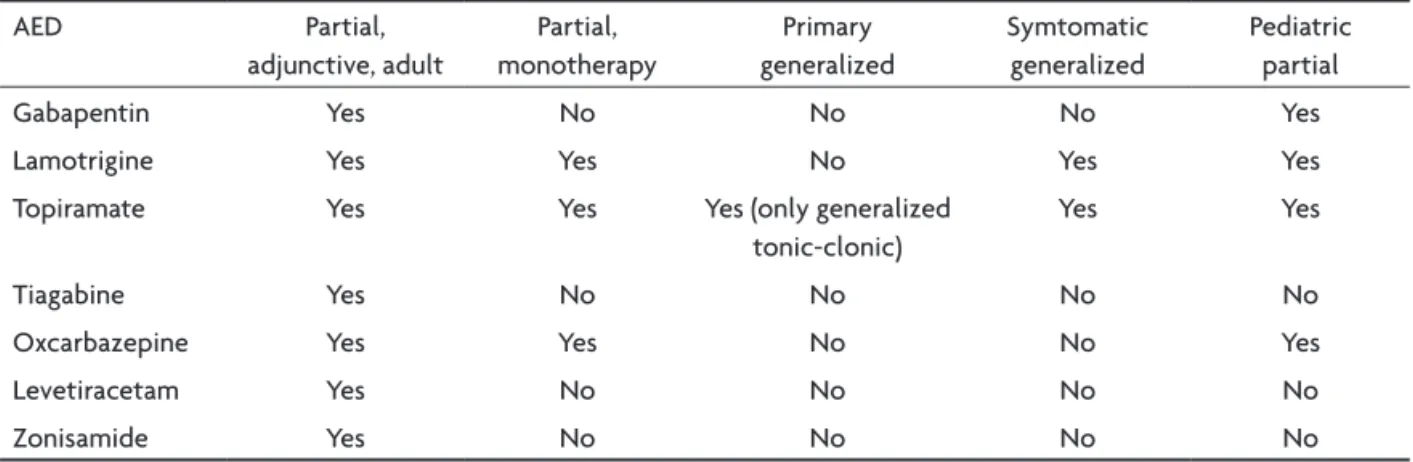
The AAN guidelines for the treatment of refractory epilepsy utilized similar methods and drugs to the guide-lines described above and aimed at evaluating the evi-dence of eficacy, tolerability and safety in the treatment of children and adults with refractory partial and gener-alized epilepsy. The outcomes found suggest that all new drugs are appropriate for use as adjunctive treatment in adults with partial epilepsy. Gabapentin may be effective in the treatment of mixed epilepsy, and gabapentin, la-motrigine, oxcarbazepine and topiramate in the treatment of refractory epilepsies in children. limited evidence sug-gests that lamotrigine and topiramate are also effective for idiopathic generalized epilepsy in adults and children, as well as for the treatment of lennox-Gastaut syndrome. Table 4. Factors that affect a speciic AED choice for the patient with newly-diagnosed or untreated
epilepsy, according the ILAE uideline3.
Aed-speciic variables Patient-speciic variables Nation-speciic variables Seizure or epilepsy syndrome
Speciic eficacy/effectiveness Genetic background dose-dependent adverse effects Gender
Idiosyncratic reactions Age
Chronic toxicities Comedications Aed availability Teratogenicity Comorbidities Aed cost Carcinogenicity Insurance coverage
Pharmacokinetics relative wealth
Interaction potential Ability to swallow pills/tablets Formulations
Table 5. Summary of aan evidence-based guidelines level A or B recommendation for use1.
Aed Newly diagnosed monotherapy partial/mixed
Newly diagnosed absence
Gabapentin yes No
lamotrigine yes yes
levetiracetam No No
oxcarbazepine No No
Tiagabine No No
Topiramate yes No
A summary of the indications and recommendation use is shown in Table 6.
sTandard and neW anTiepilepTic druGs (sanad) sTudy4,5
A controlled, randomized unblinded trial was conduct-ed in two phases: A and B.
In the irst phase, in which carbamazepine would be the pattern drug, 1721 patients were recruited and ran-domized to receive carbamazepine, gabapentin, lamotrig-ine, oxcarbazepine or topiramate. The primary outcomes were: time to treatment failure, and time to 12-month re-mission, and the assessment was by intention to treat and per protocol. It was concluded that lamotrigine is clinical-ly better than carbamazepine for time to treatment fail-ure outcomes and that this is a cost-effective alternative for patients diagnosed with partial onset seizures.
In phase B of the study, in which valproate would be the pattern drug, 716 patients were recruited and random-ized to receive valproate, lamotrigine, or topiramate. Pri-mary outcomes were similar to phase A of the study. It was concluded that valproate is better than topiramate and more eficacious than lamotrigine, and should remain the drug of irst choice for many patients with generalized and unclassiied epilepsies. however, the authors added that, because of the known potential for adverse effects of valproate during pregnancy, the beneits for seizure control in women of childbearing years should be care-fully weighed against the potential harm.
The pros23 and cons24 of this study have been much discussed in the literature. Panayiotopoulos24 emphasiz-es some of the critical aspects, such as: the study popula-tion did not differentiate subpopulapopula-tions of children and elderly; diagnoses were suboptimal due to classiication problems by the clinician; eeG and brain imaging were only optional; the study did not differentiate between the use of carbamazepine or a slow release formulation. It became clear that it is almost impossible to evaluate
Aed eficacy in open studies. This is the weakest point of these large studies. According to the IlAe criteria these studies would be classiied as class III, which demonstrates the limitation of the main indings.
comparison of recommendaTions of differenT Guidelines and sanad sTudies The different recommendations for newly diagnosed epilepsy patients are in Table 7.
how does one explain diverse outcomes in recom-mendations?
Note that different PeCoT questions were asked in the different guidelines. There are different methods of classifying and rating the studies as well the recommen-dation systems. The main objective of the AAN guide-lines was to evaluate the new drugs and not compare new with existing drugs. These different methods led to dif-ferent conclusions and recommendations. Some differ-ences between the AAN and IlAe guidelines are shown in Table 8.
The Guidelines’ shorT life (dynamic process) The essence of guidelines comes from good quality trials and the scientiic production is a dynamic process. This point may explain the brevity of the validity of many Table 6. Summary of AAN evidence-based guidelines level A or B recommendation for use2.
Aed Partial, adjunctive, adult
Partial, monotherapy
Primary generalized
Symtomatic generalized
Pediatric partial
Gabapentin yes No No No yes
lamotrigine yes yes No yes yes
Topiramate yes yes yes (only generalized tonic-clonic)
yes yes
Tiagabine yes No No No No
oxcarbazepine yes yes No No yes
levetiracetam yes No No No No
Zonisamide yes No No No No
Table 7. General recommendation for initial monotherapy in adults in different guidelines and studies.
Seizure NICe AAN* IlAe SANAd Partial onset CBZ lTG,
TPM, oXC
CBZ, PhT
lTG
Generalized onset vPA None vPA
Absence lTG None
guidelines. every guideline, if not submitted to a continu-ous updating process, becomes obsolete shortly after dis-semination. The levetiracetam study published after the IlAe guideline publication illustrates this argument25. A re-view of this guideline may lead one to consider this study as class I and the Aed as a irst line drug for recently-di-agnosed partial epilepsy in adults.
commenTs and conclusions
every guideline for the drug treatment of epilepsy is limited by the lack of good quality rCTs. In other words, there is a huge evidence-based gap in the subject.
For several reasons, trials are not available. Because of this, evidence is not as robust as is considered necessary.
It would not be too much to say that “the absence of evidence is not equivalent to evidence of absence”.
Understanding the logistics involved in constructing a guideline is important to develop a critical mind funda-mental for an adequate medical stance facing the treat-ment of epilepsy.
The lack of knowledge about pathophysiological as-pects of epilepsies as well their etiologies reduces the accu-racy of evidence-based medicine and good clinical practice. Guidelines are considered by many clinicians as a way to obtain updated medical information. however, most clinicians are busy and do not have the expertise to eval-uate the major weakness of many clinical trials. The ability to critically evaluate the guidelines is fundamental to the usefulness of this tool, which should never be considered as gospel in medical treatment or management.
The following extract from Panayiotopoulos24 (orig-inally from an authoritative eBM source (http://www. cebm.net/index.asp)) is very appropriate: “without clin-ical expertise, practice may become tyrannized by evi-dence, for even excellent external evidence may be appli-cable to or inappropriate for an individual patient.”
Finally, when there is no available data, clinical judg-ment (clinical experience) and the analysis of risk-beneit will have a predominant role in the clinical decision about the best treatment for your patient.
Author disclosure – dr Guerreiro has received grants and
re-search support from Abbott, GlaxoSmithKline, Janssen-Cilag, No-vartis, and Bial; consultation and advisory board honoraria from Abbott, Janssen-Cilag and Novartis; speaking honoraria from Ab-bott, Janssen-Cilag, and Novartis. he also is co-author of the IlAe Guidelines study3.
references
1. French JA, Kanner AM, Bautista J, et al. Eficacy and tolerability of the new antiepileptic drugs: I: Treatment of new onset epilepsy: report of the Therapeutics and Technology Assessment Subcommittee and Qual
-ity Standards Subcommittee of the American Academy and the Ameri
-can Epilepsy Society. Neurology 2004;62:1252-1260.
2. French JA, Kanner AM, Bautista J, et al. Eficacy and tolerability of the new antiepileptic drugs: II: Treatment of refractory epilepsy: report of the Therapeutics and Technology Assessment Subcommittee and Qual
-ity Standards Subcommittee of the American Academy of Neurology and the American Epilepsy Society. Neurology 2004;62:1261-1273. 3. Glauser T, Ben-Menachen E, Bourgeois B, et al. ILAE treatment guide
-lines: evidence-based analysis of antiepileptic drug eficacy and effec
-tiveness as initial monotherapy for epileptic seizures and syndromes. Epilepsia 2006;47:1094-1120.
4. Marson AG, Al-Kharusi AM, Alwaidh M, et al. The SANAD study of effectiveness of carbamazepine, gabapentin, lamotrigine, oxcarbaze
-pine, or topiramate for treatment of partial epilepsy: an unblinded ran
-domised controlled trial. Lancet 2007;369:1000-1015.
5. Marson AG, Al-Kharusi AM, Alwaidh M, et al. The SANAD study of effectiveness of valproate, lamotrigine, or topiramate for generalized and unclassiiable epilepsy: an unblinded randomised controlled trial. Lancet 2007;369:1016-1026.
6. Sackett DL, Strauss SE, Richardson WS, et al. Evidence Based Medicine. How to Practice and Teach EBM. Edinburgh: Churchill Livingstone, 2000. 7. Glasziou P, Del Mar C, Salisbury J. Evidence-based Medicine Work
-book. Finding and applying the best research evidence to improve pa
-tient care. London: BMJ Books, BMJ Publishing Group, 2003. 8. Dans AL, Dans LF. The need and means for evidence-based medicine
in developing countries. ACP J Club 2000;133:11-12.
9. Liberati A, Moja LP, Moschetti I. Evidence-based medicine: its contri
-butions in the way we search, appraise and apply scientiic informa
-tion to patient care. In: Candelise L, Hughes R, Liberati A, Uitdehaag BM, Warlow C (Eds). Evidence-based Neurology. Management of Neu
-rological Disorders. Blackwell Publishing, BMJ Books, 2007:3-10. Table 8. Differences between the ILAE and AAN guidelines.
variable IlAe AAN
Topic New onset only Adults, children
New onset, refractory Adults, children Team N=10, 6 countries N=24, 1 country Aeds examined 23 Aeds 7 new US Aeds Study years 1940-2005 1987-2003 Scoring system IlAe system AAN system data re-analysis yes, used to rank No
10. Mayer D. Essential Evidence-based Medicine. Cambridge: University Press, 2004.
11. Institute of Medicine. Deinition of key terms. In: Field MJ, Lohr KN, (Eds). Clinical practice guidelines: directions for a new program. Wash
-ington, DC: National Academy Press, 1990:33-51.
12. Cavalcante AB, Silva E. Prática da medicina baseada em evidências: acessando com eiciência bases de dados eletrônicas. Einstein. Educ Contin Saúde. 2007;5(4Pt 2):109-111.
13. Hirtz D, Ashwal S, Berg A, et al. Practice parameter: evaluating a irst nonfebrile seizure in children: report of the quality standards subcom
-mittee of the American Academy of Neurology, The Child Neurology Society, and The American Epilepsy Society. Neurology 2000;55:616-623. 14. Hirtz D, Berg A, Bettis D, et al. Practice parameter: treatment of the
child with a irst unprovoked seizure: Report of the Quality Standards Subcommittee of the American Academy of Neurology and the Practice Committee of the Child Neurology Society. Neurology 2003;60:166-175. 15. Engel J Jr, Wiebe S, French J, et al. Practice parameter: Temporal lobe
and localized neocortical resections for epilepsy. Report of the Quality Standards Subcommittee of the American Academy of Neurology, in Association with the American Epilepsy Society and the American As
-sociation of Neurological Surgeons. Neurology 2003;60:538-547. 16. Chen DK, So YT, Fisher RS. Use of serum prolactin in diagnosing ep
-ileptic seizures. Report of the Therapeutics and Technology Assess
-ment Subcommittee of the American Academy of Neurology. Neurol
-ogy 2005;65:668-675.
17. Harden CL, Huff JS, Schwartz TH, et al. Neuroimaging in the emergen
-cy patient presenting with seizure (an evidence-based review). Report of the Therapeutics and Technology Assessment Subcommittee of the American Academy of Neurology. Neurology 2007;69:1772-1780.
18. Krumholz D, Wiebe S, Gronseth G, et al. Practice Parameter: Evaluat
-ing an apparent unprovoked irst seizure in adults (an evidence-based review). Report of the Quality Standards Subcommittee of the Ameri
-can Academy of Neurology and the Ameri-can Epilepsy Society. Neu
-rology 2007;69:1996-2007.
19. National Institute for Clinical Excellence. Newer drugs for epilepsy in adults. www.nice.org.uk/Docret.asp?d=110081 - accessed May 5, 2008) (National Institute for Clinical Excellence. Newer drugs for epilepsy in children. www.nice.org.uk/Docret.asp?d=113359 - accessed May 5, 2008. 20. Handbook for the preparation of explicit evidence-based clinical prac
-tice guidelines. New Zealand Guidelines Group. www.nzgg.org.nz/ download/iles/nzgg_guideline_handbook.pdf accessed May 5,2008. 21. Warlow C. What to do when there is no evidence. In: Candelise L,
Hughes R, Liberati A, Uitdehaag BM, Warlow C (Eds). Evidence-based Neurology. Management of Neurological Disorders. Blackwell Publish
-ing, BMJ Books, 2007:11-14.
22. Diagnosis and management of epilepsy in adults. Guideline no. 70, Publication: April 2003, www.sign.ac.uk/guidelines/fulltext/70/in
-dex.html
23. Chadwick D, Marson T. Choosing a irst drug treatment for epilepsy after SANAD: randomized controlled trials, systematic reviews, guide
-lines and treating patients. Epilepsia 2007;48:1259-1263.
24. Panayiotopoulos CP. Evidence-based epileptology, randomized controlled trials, and SANAD: a critical clinical view. Epilepsia 2007;48:1268-1274.
25. Brodie MJ, Perruca E, Ryvlin P, Ben-Menachem E, Meencke HJ. Com
-parison of levetiracetam and controlled-release carbamazepine in new