Arq Neuropsiquiatr 2009;67(3-A):591-594
591
Pain in Parkinson’s disease
Grace Helena Letro
1, Elizabeth M.A.B. Quagliato
2, Maura Aparecida Viana
2abstract – Pain may precede the diagnosis in Parkinson’s disease (PD). The goal of this study was to assess the pain in a group of 20 females and 30 males with PD, after excluding co-morbidities as causes. It was used the following tools: Unified Parkinson’s Disease Rating Scale, McGill questionnaire and Beck Depression Inventory. In 27 patients (54%), the pain was associated with PD, occurring in 22 (44%) in the off period and 5 (10%) in both on and off periods. The off period resulted in an increased frequency of pain, which was related to stiffness. There was no association between pain and tremor in off period, neither between pain and Modified Hoehn and Yahr stage, nor the Schwab and England scale. It was not observed an association between pain and depression, neither between pain and dyskinesia. It was noticed the improvement in pain in 16 patients with levodopa (59.26%). KEY WoRDS: Parkinson’s disease, pain, levodopa.
dor na doença de Parkinson
resumo – Dor pode preceder o diagnóstico na doença de Parkinson (DP). o objetivo deste estudo foi avaliar a dor num grupo de 20 mulheres e 30 homens com DP. Após a exclusão das co-morbidades como causa. Foi usado o seguinte: Unified Parkinson`s Disease Rating Scale, o questionário de dor McGill e o Inventário de Depressão de Beck. Em 27 pacientes (54%), a dor associou-se com a DP, ocorrendo em 22 (44%) no período off e em 5 (10%) nos períodos on e off. o período off resultou num aumento da freqüência da dor, o qual se relacionou com a rigidez. Não houve associação entre dor e tremor no período off, estágio Hoehn e Yahr modificado, nem a escala de Schwab e England. Não foi observado associação entre dor e depressão, nem entre dor e discinesia. Foi observada a melhora da dor em 16 pacientes com levodopa (59.26%).
PAlAvRAS-CHAvE: doença de Parkinson, dor, levodopa.
1Post Graduation Student from the Neurology Department of Faculty of Medical Science from the University of Campinas, Campinas SP, Brazil; 2Clinic of Movement Disorders from the State University Hospital of Campinas (Unicamp), Campinas SP, Brazil.
Received 9 December 2008, received in inal form 2 April 2009. Accepted 3 June 2009.
Dra. Grace Helena Letro – Rua Engenheiro Cândido Gomide 468 - 13070-200 Campinas SP - Brasil. E-mail: [email protected]
Pain has been reported since the irst descriptions of Parkinson’s disease1 (PD). It has been shown as an onset
symptom of the disease occurring before motor symp-toms. Patients with PD reported sensitive symptoms, pre-ceding or following the motor picture (from 40% to 75%)2,3.
The causes of pain in PD are the co- morbidities, disease symptoms and complications of PD treatment itself. Af-ter the irst months or years of levodopa treatment, mo-tor and non momo-tor luctuations generally occur, triggered by the pharmacokinetic properties on this drug, leading to decreased effectiveness. Among the non motor symptoms it could be found sensitive, psychical, cognitive and auto-nomic changes. Pain luctuates with motor symptoms6,7,
specially in the presence of stiffness and akinesia, but not related to tremor8. Stiffness and akinesia contribute to 1/3
of pain in PD cases8. Aching, cramping and joint pains
fre-quently result from a lack of mobility in affected limbs3.
Shoulder pain is a common complaint in PD, which may
precede the motor symptoms or may manifest itself dur-ing disease evolution. one of the two main types of shoul-der pain in PD is the pseudorheumatic, directly related to neurological symptoms, which is dopamine responsive. The other one is pain due to degenerative lesions that could appear or worsen with PD. Another etiology of pain is the primary sensitive syndrome, frequent in young PD patients, whose cause is unknown, suggesting that the bas-al ganglia may contribute to nociception9. This pain is
de-scribed as vague, poorly located, discomfort, tension, tick-ling, burning and it could precede the motor symptoms of PD, with little response to dopaminergic therapy2,9.
Genital pain usually occurs in perimenopausal or post-menopausal patients. In PD female patients, it may luc-tuate with motor symptoms. levodopa improves the pain in some cases, although in others it may worsen10,11. oral
Arq Neuropsiquiatr 2009;67(3-A)
592
Parkinson’s disease: pain letro et al.
Dyskinesias related to levodopa cycle may cause pain. Dystonia preferably occurs in the off period and general-ly on feet13. Primary parkinsonian pain is complex and may
involve sensory pathways within the basal ganglia and the thalamocortical basal ganglia circuits14. lesions in dorsal
horn layer I, parasympathetic and sympathetic pre and postganglionic neurons were described in PD patients that were positive for α – synuclein15.
Goetz et al.4 used McGill questionnaire to evaluate
pain in PD. This questionnaire is worldwide applied for other painful syndromes and it is also used in Brazil19 .
The objective of this study to evaluate the frequen-cy of pain in a group of 50 patients and correlate it to the worsen parkinsonian symptoms (off period), depression, dyskinesia and also to observe the levodopa effect in pain associated with PD.
Method
This prospective study was carried out from March 2005 to February 2006 in the Movement Disorders Clinic from the Neu-rology Department on the Clinical Hospital of the State Univer-sity of Campinas. The 50 PD patients were included in this re-search after reading and signing the Free and Informed Consent approved by the Research Ethical Committee of the Faculty of Medical Sciences from the State University of Campinas.
Patients aged 40 years or more, with idiopathic PD according
to the london Brain Bank criteria16 and taking levodopa were
in-cluded in this study. A brain computer tomography (CT) or brain magnetic resonance imaging (MRI) was performed to exclude other diagnosis. Exclusion criteria were the use of dopamine blocker substances and a score of less than 20 on Mini Mental
State Examination17 (MMSE). Patients remained without
medi-cation for 12 hours before the irst assessment, being evaluat-ed in off period. They were submittevaluat-ed to a questionnaire which included epidemiological data, sensitive and motor symptoms. The differential diagnosis between secondary pain to PD and os-teoarthrosis was established by both clinical history and physi-cal examination. The patients were assessed with Uniied Parkin-son’s Disease Rating Scale subscales II (daily activity), III (motor
examination), Iv (motor complications)18, v (modiied Hoehn and
Yahr staging) and vI (Schwab and England) in the off period. Af-ter these assessments, they took their usual doses of levodopa and were evaluated again after 60 minutes (on period), with both McGill questionnaire19 and Beck Depression Inventory (BDI)20.
Spearman correlation was applied to study the relationship among the UPDRS subscales, the duration of disease time and pain total index. Methodological analysis of variance with rank transformation was applied to compare the pain total index to gender, depression and dyskinesia. In order to Fisher Test was used to assess the effects of levodopa in the pain.
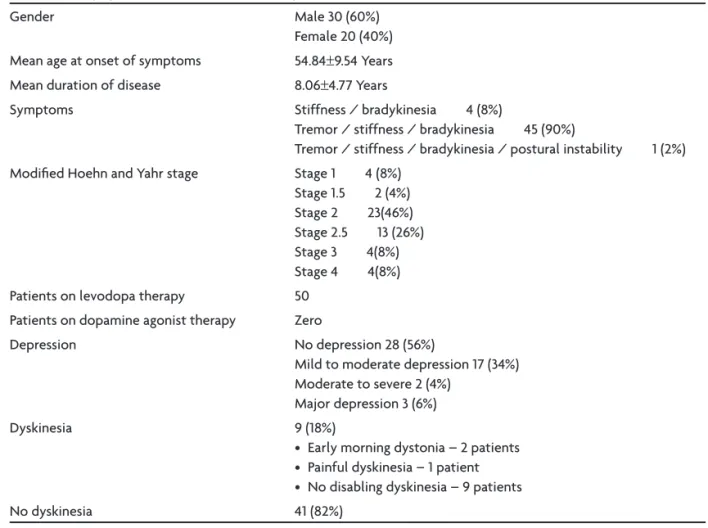
Table 1. Demographic and clinical data of 50 PD patients.
Gender Male 30 (60%)
Female 20 (40%)
Mean age at onset of symptoms 54.84±9.54 Years
Mean duration of disease 8.06±4.77 Years
Symptoms Stiffness / bradykinesia 4 (8%)
Tremor / stiffness / bradykinesia 45 (90%)
Tremor / stiffness / bradykinesia / postural instability 1 (2%)
Modiied Hoehn and Yahr stage Stage 1 4 (8%)
Stage 1.5 2 (4%) Stage 2 23(46%) Stage 2.5 13 (26%) Stage 3 4(8%) Stage 4 4(8%)
Patients on levodopa therapy 50
Patients on dopamine agonist therapy Zero
Depression No depression 28 (56%)
Mild to moderate depression 17 (34%) Moderate to severe 2 (4%)
Major depression 3 (6%)
Dyskinesia 9 (18%)
• Early morning dystonia – 2 patients • Painful dyskinesia – 1 patient • No disabling dyskinesia – 9 patients
Arq Neuropsiquiatr 2009;67(3-A)
593
Parkinson’s disease: pain letro et al.
results
Table 1 shows demographic and clinical data of 50 PD patients.
Nine (18%) patients had one or more pains related to co-morbidities and some of them had also present-ed pain relatpresent-ed to PD. osteoartrosis was found in six pa-tients (12%), radiculopathy l4–l5 in four (8%); disc hernia C4–C5 in two(4%) and disc hernia T9–T10 in one (2%).
Pa-tients with osteoarthrosis presented pain through joint movements, improved with rest, analgesic and anti-in-lammatory drugs.
In PD patients the pain appeared or increased during the periods of less mobility (off periods), when analge-sics, antidepressants and anti-inlammatories drugs were ineffective.
This study observed that pain for PD appeared during evolution of disease, on the body side which presented more motor symptoms. Neuroimage examinations did not show changes on cervical, thoracic and lumbar spine CT or MRI. Table 2 shows evaluation of pain.
There was association between stiffness and pain in off period (p=0.0315), but not between tremor and pain (p=0.7912). There was a correlation between the activities of daily living (UPDRS subscale II) and pain during off pe-riod (p=0.0146), but it was not signiicant between motor
examination (UPDRS subscale III) and pain (p=0.0563). It was not observed association between modiied Hoehn and Yahr staging (p=0.09791) and pain, neither the Schwab and England scale and pain in off period (p=0.1602), nor duration disease (p=0.0523) and pain (p value based on the correlation coeficient of Spearman).
Table 3 shows correlation among gender, depression and dyskinesia with pain.
discussion
In this study, it was observed that 54% of patients had pain, according to literature2,4,21,22. The onset of pain
oc-curred during the evolution of PD, on the body side which presented more motor symptoms. Predominance of pain was found in the off period in 44% of patients. Stiffness was suggested as a pain factor, but it was not occurred in relation to tremor. Studies have shown a predominance of pain in the off period and may be related to increase of stiffness3,4,23. The onset of pain on the most affected body
side does not mean that pain is caused only by stiffness and/or bradykinesia, a hypothesis that could show that both the pain and motor symptoms share similar mecha-nisms, what means that modulation of pain could be per-formed by dopaminergic pathways on basal ganglia, where the lack of dopamine leads to a painful condition10,24,25.
Association between dyskinesia and pain was not seen as is others studies4,23. Probably this is not observed,
be-cause the sample of dyskinesia patients was little and the methodology applied is for great sample.
Depression was not an important factor to trigger the pain. Starkstein et al. have shown that pain is signiicant-ly more severe in patients with major depression than in patients with minor or no depression26. According to
BDI, this study observed no depression in 56% of the pa-tients, mild to moderate in 34%, moderate to severe in 4% and mayor depression in 6%. These data corroborated to Starkstein et al.26, who concluded that the pain is more
se-vere in patients suffering with major depression.
It was shown an association between activities of daily living (UPDRS-subscale II) in the off period, but it was not observed association between Schwab and England scale
Table 2. Evaluation of pain.
Pain 27 (54%)
No pain 23 (46%)
Pain attributed to osteoarthrosis* 6 (12%)
Site of pain attributed to PD limb 8 (16%)
shoulder 7 (14%) generalized 5 (10%)
lumbar 4 (8%) cervical 2 (4%) back 1 (2%)
Pain improvement under levodopa effect 16 (59.26%)
No pain improvement levodopa effect 11 (40.74%)
*These patients had also presented pain related to PD.
Table 3. Correlation among gender, depression and dyskinesia to pain.
Pain
variables n Mean SD Min Median Max p-value*
Male 30 11.03 13.98 0.00 3.00 46.00 0.3303
Female 20 15.05 16.60 0.00 9.50 53.00
Depression 22 17.50 17.52 0.00 12.50 53.00 0.0733
No depression 28 8.82 11.75 0.00 0.00 37.00
Dyskinesia 9 13.44 12.06 0.00 14.00 33.00
No dyskinesia 41 12.46 15.75 0.00 7.00 53.00 0.5935
Arq Neuropsiquiatr 2009;67(3-A)
594
Parkinson’s disease: pain letro et al.
ADl and pain in the off period. Although, this scale of ac-tivities of daily living is used to assess the severity of the disease, it was observed that UPDRS – subscale II was more sensible. Association between modiied Hoehn and Yahr stage and pain was not observed. There has been a greater predominance of stage 2 (46%) and 2.5 (23%). Perhaps, this association had not occurred due to these stages which are minimally disabling27 or because these patients on these
stages are taking levodopa and responding this medication. The improvement of the pain was found in 59.26% of the patients under levodopa effect. However, in 40.7% of these patients this was not observed, suggesting that in addition to the patients who were in “wearing-off” status, there must have been nondopaminergic mechanisms re-lated to primary pain in PD14. Recent studies had shown a
reduction of the threshold to pain in PD14,28.
Brefel-Cour-bon et al.28 investigated the pain in PD patients and
con-trols by means of thermal stimulation and cerebral activ-ity with positron emission tomography. They concluded that pain threshold in PD patients in off condition was signiicantly lower than in controls and the administra-tion of levodopa signiicantly raised pain threshold in PD patients, but not in controls. Moreover, PD patients have higher pain induced by activation in nociceptive pathways, which can be reduced by levodopa.
Gender and duration of disease were equivalent be-tween the two groups (pain and no pain) in other study4.
This study observed neither the relation between gender and pain, nor duration of disease and pain.
Pathophysiology of PD primary pain is little under-stood, as well as the olfactory dysfunctions29. The
involve-ment of the dopaminergic system in pain transmission is still controversial. Presynaptic dysfunction of nigrostri-atal dopaminergic pathway in burning mouth syndrome, suggested that the pathophysiology of this disease is the same for the pain in PD12. other possibility is that the
physiopathological changes in the irst pathways of pain transmission in the spinal dorsal cord described by Braak et al.15 lead to a pain in PD patients.
In summary, this study showed that the pain is a fre-quent complaint in PD patents. Stiffness might be a fac-tor for the beginning of pain, but the tremor did not show this effect. However, there have been patients with pain in both on and off periods; probably these patients were in “wearing-off” status, requiring adjustment to medica-tion. Neither dyskinesia nor depression was suggested re-lation to pain in PD. More than 50% of patients had im-proved under levodopa effect. Recognizing if the pain in PD is a primary or secondary condition, allows the adjust-ment of levodopa when necessary. In other situations, the use of analgesic, anti-inlammatory, antidepressant or an-ticonvulsive drugs, associated with physiotherapy permits a better quality of life to parkinsonian patients.
references
1. Charcot JM. Lectures on diseases of the nervous system. London: Ed. The New Sydenham Society 1877;1:137.
2. Snider SR, Fahn S, Isgreen WP, Cote LJ. Primary sensory symptoms in parkinsonism. Neurology 1976;34:957-959.
3. Ford B. Pain in Parkinson’s disease. Clin Neurosci 1998;5:63-72. 4. Goetz CG, Tanner CM, Levy M, Wilson RS, Garron DC. Pain in
Parkin-son’s disease. Mov Disord 1986;1:45-49.
5. Quinn NP, Lang AE, Koller WC, Marsden CD. Painful Parkinson’s dis-ease. Lancet 1986;1:1366-1369.
6. Machteld EH, Sage JL. Nonmotor luctuations in patients with Parkin -son’s disease. Neurology 1996;47:1180-1183.
7. Raudino F. Non motor off in Parkinson’s disease. Acta Neurol Scand 2001;104:312-315.
8. Vaserman-Lehuédé N, Vérin Marc. Rhum [Engl Ed] 1999;66:220-223. 9. Chudler EH, Dong WK. The role of the basal ganglia in nociception and
pain. Pain 1995;60:3-38.
10. Nutt JG, Carter JH. Sensory symptoms in parkinsonism related central dopaminergic function [Letter]. Lancet 1981;345:2436-2437.
11. Ford B, Greene PG, Fahn S. Oral and genital tardive pain syndromes. Neurology 1994;44:2115-2119.
12. Clifford TJ, Warsi MJ, Burnett CA, Lamey PJ. Burning mouth in Parkin-son’s disease sufferers. Gerondontology 1998;15:73-78.
13. Pacchetti C, Albani G, Martignoni E, Godi L, Alfonsi E, Nappi G. “Off” painful dystonia in Parkinson’s disease treated with botulinum toxin. Mov Disord 1995;10(Suppl 3):S333-S336.
14. Djaldetti R, Shifrin A, Rogowisk Z, Sprecher E, Melaned E, Yarnitsky D. Quantitative measurement of pain sensation in patients with Par-kinson’s disease. Neurology 2004;62:2171-2175.
15. Braak H, Sastre M, Bohl JRL, Vos RAI, Tredeci KD. Parkinson’s dis-ease: lesions in dorsal horn layer I, involvement of parasympathet-ic and sympathetparasympathet-ic and sympathetparasympathet-ic pre and postganglionparasympathet-ic neurons. Acta Neuropathol 2007;113:421-429.
16. Hughes AJ, Daniel SE, Kilford L, Lees AJ. Accuracy of clinical diagno-sis of idiopathic Parkinson’s disease: a clinicopathological study of 100 cases. J Neurol Neurosurg Psychiatry 1992;55: 181-184.
17. Folstein MF, Folstein SF, McHugh PR. Mini-Mental State. A practical method for grading the cognitive state of patients for the clinician J Psy-chiatry Res 1975;12:189-198.
18. Fahn S, Elton RL and members of the UPDRS Development Commit-tee. Uniied Parkinson’s disease rating scale. In: Fahn S, Marsden CD, Goldstein M, Calne DB (Eds). Recent development in Parkinson’s dis-ease, New Jersey: Florham Park, 1987:153-163.
19. Pimenta CAM, Teixeira MJ. Avaliação da dor. Rev Med 1997; 76:27-35. 20. Beck AT, Ward CH, Mendelson M, Moc J, Erbaugh G. An inventory for
measuring depression. Arch Gen Psychiatry 1961; 4:53-63.
21. Koller W.C. Sensory symptoms in Parkinson’s disease. Neurology 1984; 34:957-959.
22. Silva EG, Viana M, Quagliato EMAB. Pain in Parkinson’s disease. Arq Neuropsiquiatr 2008;66:26-29.
23. Serratice G, Michel B. Pain in Parkinson’s disease patients. Rev Rhum [Engl Ed] 1999;66:331-338.
24. Hagelberg N, Forssell H, Rinne JO, et al. Striatal dopamine D1 and D2 receptors in burning mouth syndrome. Pain 2003; 101:149-154. 25. Hagelberg N, Martikainem IK, Mansikka H, et al. A Dopamine D2
re-ceptor binding in the human brain is associated with the response to painful stimulation and pain modulatory capacity. Pain 2002;99:273-279. 26. Starkstein SE, Preziosi TJ, Robinson RG. Sleep disorders, pain and
de-pression in Parkinson’s disease. Eur J Neurol 1991;31: 352-355. 27. Hoehn MM, Yahr MD. Parkinsonism: onset, progression and
mortali-ty. Neurology 1967;17:427-442.
28. Brefel-Courbon C, Payoux P, Thalamas C, et al. Effect of levodopa on pain threshold in Parkinson’s disease:a clinical and positrons emission tomography study. Mov Disord 2005; 20:1557-1563.