OR
IGI
N
A
L
R
E
S
E
A
R
C
H
Corresponding author: Cinthia Santos Miotto Amorim – Rua Cipotânea 51, Cidade Universitária – São Paulo (SP), Brazil – CEP 05360-160 – Phone: +55 11 30918423 – E-mail: [email protected] – Financial source: National Council for Scientiic and Technological Development (CNPq) / Coordination for the Improvement of Higher Education Personnel (CAPES) – Conlict of interest: Nothing to declare – Presentation: Feb. 2016 – Accepted for publication: Oct. 2016. Trial registration: ClinicalTrials.gov, NCT01778881. 1Department of Physical Therapy, Speech-language Pathology and Audiology and Occupational Therapy, School of Medicine,
University of São Paulo São Paulo (SP), Brazil.
2Department of Operative Dentistry, School of Dentistry, University of São Paulo São Paulo (SP), Brazil. 3Department of Pediatric Otolaryngology, Federal University of São Paulo São Paulo (SP), Brazil.
ABSTRACT | Objective: The aim of the present study was to evaluate symptoms of the muscle pain, sleep quality, oral health, anxiety, stress and depression in individuals with diferent severity degrees of bruxism. Methods: Seventy-two individuals with bruxism were enrolled in the study, classiied into: moderate (n=25) and severe (n=47) bruxism. Pain intensity was assessed using the Visual Analogical Scale, pain threshold with algometer, sleep quality by the Pittsburgh Sleep Quality Index, oral health by the Oral Health Impact Proile, anxiety by the State-Trait Anxiety Inventory, stress by the Perceived Stress Scale and depression using the Beck Depression Inventory. The signiicance level considered was 5%. Results: The results showed that individuals with severe bruxism presented greater muscle pain intensity, sleep disorder, worse oral health, high anxiety level and dysphoria with statistically signiicant diferences (p<0.05) than individuals with moderate bruxism, except in pain threshold and stress (p<0.05). Conclusion: Data suggest that individuals with severe bruxism have more intense symptoms. They present greater muscle pain, alterations in sleep quality and oral health, anxiety and depression than individuals with moderate bruxism. However, both present similarity in stress.
Keywords | Bruxism; Pain; Sleep; Oral Health; Anxiety.
RESUMO | Objetivo: Avaliar sintomas de dor muscular, qualidade de sono, saúde bucal, ansiedade, estresse e depressão em indivíduos com diferentes graus de severidade do bruxismo. Métodos: Setenta e dois indivíduos com bruxismo participaram do estudo e 423
foram classiicados com bruxismo moderado (n=25) e severo (n=47). A intensidade da dor foi avaliada pela Escala Visual Analógica, limiar de dor com o algômetro, qualidade de sono pelo Índice de Qualidade de Sono de Pittsburgh, saúde bucal pelo Peril de Impacto de Saúde Bucal, ansiedade pelo Inventário de Ansiedade Traço-Estado, estresse pela Escala de Estresse Percebido e depressão pelo Inventário de Depressão de Beck. O nível de signiicância considerado foi 5%. Resultados: Os resultados demonstraram que indivíduos com bruxismo severo apresentaram maior intensidade de dor muscular, distúrbio do sono, pior qualidade de saúde bucal, elevado grau de ansiedade e disforia, com diferenças estatisticamente signiicantes (p<0,05) comparados com bruxismo moderado, exceto no limiar de dor e estresse (p>0,05). Conclusão: Os dados sugerem que indivíduos com bruxismo severo tem sintomas mais intensos. Eles apresentam maior intensidade de dor muscular, alterações na qualidade do sono e saúde bucal, ansiedade e depressão do que indivíduos com bruxismo moderado. Porém, ambos apresentam similaridade no estresse.
Palavras-chave | Bruxismo; Dor; Sono; Saúde Bucal; Ansiedade.
RESUMEN | Objetivo: Evaluar los síntomas dolor muscular, calidad de sueño, salud bucal, ansiedad, estrés y depresión en sujetos con diferentes niveles de gravedad del bruxismo. Método: Participaron del estudio 72 personas con bruxismo, clasiicado según los niveles moderado (n=25) y grave (n=47). Se evaluaron la intensidad del dolor mediante la
Symptoms in diferent severity degrees of bruxism: a
cross-sectional study
Sintomas em diferentes graus de severidade de bruxismo: um estudo transversal
Los síntomas de diferentes niveles de gravedad del bruxismo: estudio transversal
Cinthia Santos Miotto Amorim1, Glauco Fioranelli Vieira2, Eliete Ferreira Osses Firsof2, Jecilene Rosana
Escala Visual Analógica, umbral de dolor con algómetro, la calidad de sueño por el Índice de Calidad de Sueño de Pittsburgh, la salud bucal mediante el Peril del Impacto de Salud Bucal, la ansiedad por el Inventario de Ansiedad Rasgo-Estado, el estrés mediante la Escala de Estrés Percibido y la depresión por el Inventario de Depresión de Beck. Se consideró el nivel de signiicación de 5%. Resultados: Los sujetos con bruxismo grave presentaron más intensamente dolor muscular, trastorno de sueño, peor calidad de salud bucal, alto grado de ansiedad y disforia, con diferencias
estadísticamente signiicativas (p<0,05) en comparación con los sujetos con bruxismo moderado, con excepción del umbral de dolor y estrés (p>0,05). Conclusión: Los datos mostraron que los sujetos con bruxismo grave sufren síntomas más intensos. A pesar de sufrir síntomas más intensos de dolor muscular, calidad de sueño y salud bucal alterada, ansiedad y depresión que los sujetos con bruxismo moderado, el estrés está presente en los dos niveles de bruxismo.
Palabras clave | Bruxismo; Dolor; Sueño; Salud Bucal; Ansiedad.
INTRODUCTION
A recent international consensus deined bruxism as a repetitive jaw-muscle activity characterized by the clenching and/or grinding of the teeth and/or by the bracing or thrusting of the mandible, which can occur during the day and/or while sleeping1. In addition,
bruxism can be classiied as primary, which is not related to clinical disorders; or secondary, associated with other conditions2. Although the prevalence of sleep and
awake bruxism in adults is approximately 8% and 20%, respectively, studies have indicated that between 85% and 90% of the population have possibly succumbed to episodes of bruxism throughout their lives3.
Bruxism can be associated with diferent factors such as peripheral (morphological), pathophysiological (central) and psychosocial factors2. Psychosocial factors,
such as anxiety, stress and depression, can trigger and perpetuate bruxism4. Consequently, bruxism can
cause masticatory and cervical muscle pain; headache; decrease pain thresholds in the orofacial and cervical muscles; change sleep quality and oral health; and increase anxiety, stress and depression2,4.
Persistent stressful situations can be associated with the increasing and signiicant seek for treatments for bruxism and its symptoms in recent years5,6. In this
regard, bruxism afects millions of people throughout the world and is considered the most detrimental among all the parafunctional activities of the stomatognathic system4. Even though some support for the association
among bruxism, pain, change in sleep quality and oral health; anxiety, stress and depression has been provided, it remains a controversial issue. While bruxism can trigger these symptoms, it can also be generated by them2,4,7-16.
Although there are studies about bruxism and psychosocial symptoms, those that associate bruxism with muscle pain,
sleep quality, oral health, anxiety, stress and depression simultaneously are scarce, methodologically diferent and poor. In addition, some of these studies present lack of information about bruxism type, heterogeneous assessment tools and the use of single clinical approach to the diagnosis of bruxism, not allowing a distinction between the sleep and awake bruxism2,4,7-16.
herefore, the knowledge of symptoms in diferent severity degrees of the bruxism is relevant for choice of therapeutic approaches, such as physiotherapeutic interventions and dental treatments, with the objectives of preventing and/or controlling bruxism and its symptoms5,6. hus, the objective of this study was to
evaluate symptoms of the muscle pain, sleep quality, oral health, anxiety, stress and depression in individuals with diferent severity degrees of bruxism.
METHODOLOGY
his study included 72 individuals with bruxism aged 18–60 years from a school of dentistry.
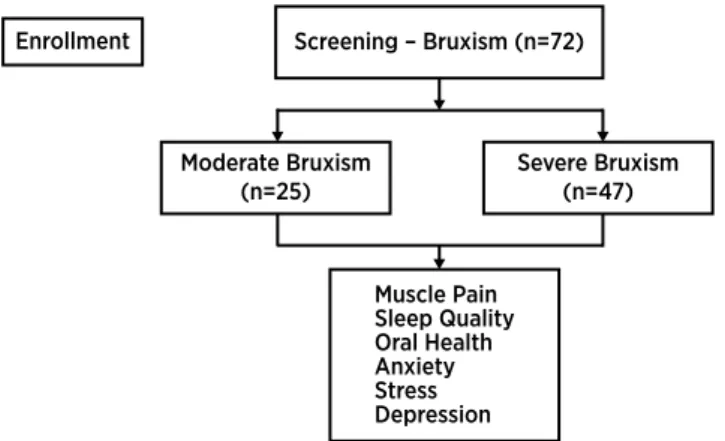
Participants were classiied into: moderate bruxism (n=25) and severe bruxism (n=47). We used the bruxism severity classiication questionnaire that consists of 25 items: mild (3-5 points), moderate (6-10 points) or severe (11-15 points). hese points are based on several signs and symptoms of bruxism6,17. Figure 1 shows the
low diagram of the study.
Sleep and awake bruxism diagnoses were based on clinical examination and anamnesis by the professional dentist of sleep and awake bruxism, conirmed by the diagnostic criteria of International Classiication for Sleep Disorders (ICSD) of the American Academy of Sleep Medicine18, and positive response to the question
you or are you aware of clenching and/or grinding your teeth during the day?”, respectively.
Participants with more than two missing teeth, except the third molars; systemic and/or degenerative disease; neurological and/or psychiatric disorders (except anxiety and depression) by doctor; use of medication that could afect the sleep or motor behavior; periodontal diseases and direct trauma or past surgical in the orofacial region were excluded.
Enrollment Screening – Bruxism (n=72)
Moderate Bruxism (n=25)
Muscle Pain Sleep Quality Oral Health Anxiety Stress Depression
Severe Bruxism (n=47)
Figure 1. Flow diagram of the study
Procedures
Demographic and anthropometric data were collected, as well as the bruxism history. For the degree of severity of the parafunctional habits, we used severity classiication questionnaire that consists of 14 items: mild (3-5 points), moderate (6-10 points) or severe (11-14 points)20; pattern of cervical spine curvature (normal,
hyperlordosis or rectiication) was determined by radiograph; and maximum active mouth opening using a digital pachimeter (Digimess®,www.digimess.com.br, São Paulo, Brazil). Pain, sleep quality, oral health, anxiety, stress and depression outcomes were also assessed21.
Pain
Severity of pain of the masseter, anterior temporalis, upper trapezius and sternocleidomastoid muscles separately, at rest at the moment of evaluation, was assessed using the Visual Analogical Scale (VAS), constructed as a 10 cm horizontal line. he labels “no pain” (left) and “worst imaginable pain” (right) were used. Participants were instructed to mark pain intensity21.
Pain threshold was evaluated using an algometer (Fischer, www.wagnerinstruments.com, Greenwich, CT) with a rubber extremity with 1 cm of diameter.
Perpendicular pressure was applied on the trigger points of the masseter supericial ibers, anterior temporalis, upper trapezius, and sternocleidomastoid sternal division muscles, bilaterally and increased at a rate of approximately 1 kg/s. Pain threshold of trigger points of most tender were reported by participants upon digital pressure stimulation by a trained single examiner, marked with demographic pencil and considered positive when values were lower than 2.6 kg/cm2 according to Marques
et al22. Pain threshold relects the lowest intensity of
pressure at which an individual perceives pain22.
Severity of symptoms: teeth clenching, sleeping diiculty and primary tension type headache were assessed using Visual Analogical Scales (VAS) at the time of the assessment. For teeth clenching, the labels “absence” (left) and “maximum clenching” (right) were used; for sleep diiculty, “no diiculty” and “very diicult”; and for headache, “no headache” and “worst imaginable headache”. Participants were instructed to mark the intensity of symptoms21.
Sleep quality
Sleep quality during the last month was measured using the Pittsburgh Sleep Quality Index (PSQI)23. his
questionnaire has been translated and validated into Portuguese. It consists of 19 questions grouped into seven domains. Total score range from 0 to 4: good sleep quality; 5 to 10: poor sleep quality; or above 10: sleep disorder 24.
Oral health
he assessment of oral health was performed by using the Oral Health Impact Proile -14 (OHIP-14). his questionnaire has been translated and validated into Portuguese. It consists of 14 questions. Total scores range from 0 to 56, and higher scores are suggestive of poor oral health 25,26.
Anxiety
Stress
Stress was evaluated using the Perceived Stress Scale (PSS-10), which has also been translated and validated to Portuguese. It consists of 10 questions with scores ranging from 0 to 4. Total scores range from 0 to 40, and higher values suggest higher stress levels 29, 30.
Depression
he Beck Depression Inventory (BDI) was used to assess depression. It has also been translated and validated to Portuguese and consists of 21 groups of four statements, assessing depressive symptoms over the last week. Scores below or similar to 15 suggest normality; from 16 to 20, dysphoria; and from 21 to 63, the individuals are deemed as having indications of depression, even if without a diagnostic of the disease31,32.
Statistical analysis
Descriptive statistics included mean and standard deviation or median and percentiles and percentage of gender, marital status, education, parafunctional habits and pattern of cervical curvature. Normality of
data distribution was tested using the Kolmogorov-Smirnov test. Student t-test was used for parametric outcomes and the Mann-Whitney test for non-parametric outcomes for the analyses between the two groups (moderate bruxism and severe bruxism). All data were analyzed using the SigmaStat 3.5 and SPSS 19 software. A level of signiicance of α = 5% was used.
RESULTS
Data regarding the clinical and demographic characteristics are presented in Table 1. Individuals with moderate and severe bruxism were similar for the variables: age, mass, height, body mass index (BMI) and mouth opening.
Table 2 describes data of pain in the masseter, anterior temporal, sternocleidomastoid and upper trapezius muscles; pain threshold; teeth clenching; sleeping diiculty; tension type headache; sleep quality, oral health, anxiety, stress and depression of the individuals with moderate and severe bruxism. he data showed statistically signiicant diferences for all the variables (p<0.05), except for pain threshold and stress (p>0.05).
Table 1. Demographic and clinical characteristics of individuals with bruxism
Outcomes Bruxism M (n=25) Mean (SD)
Bruxism S (n=47) Mean (SD)
Total (n=72)
Mean (SD) p*
Age (years) 35 (9.8) 38 (11.5) 37 (10.7) 0.185
Mass (kg) 68 (12.7) 69.8 (13.9) 68.9 (13.3) 0.683
Height (cm) 1.7 (0.1) 1.7 (0.1) 1.7 (0.1) 0.783
BMI (kg/cm2) 24 (4.3) 25 (4.5) 25 (4.4) 0.182
Mouth opening (cm) 4.8 (7.5) 4.7 (7.3) 4.8 (7.4) 0.483
n (%) n (%) n (%)
Gender
Female 16 (64) 35 (74) 51 (71)
Marital status
Single 16 (64) 20 (43) 36 (50)
Married 7 (28) 22 (47) 29 (40)
Divorced 2 (8) 5 (11) 7 (10)
Education (years)
9 to 12 8 (32) 20 (43) 28 (39)
More than 12 17 (68) 27 (57) 44 (61)
Parafuncional Habits
Mild (3–5) 16 (64) 27 (57) 43 (60)
Moderate (6–10) 9 (36) 20 (43) 29 (40)
Cervical Curvature
Normal 7 (28) 11 (23) 18 (25)
Hyperlordosis 6 (24) 13 (28) 19 (26)
Rectiication 12 (48) 23 (49) 35 (49)
DISCUSSION
Results demonstrated that individuals with severe bruxism had more muscle pain, alterations in sleep quality and oral health, anxiety and dysphoria than individuals with moderate bruxism. However, both presented similarity in pain threshold and stress. Greater intensities of muscle pain were observed in individuals with severe bruxism, although both groups presented low or positive values of pain threshold in the trigger points of most tender22.
herefore, pain occurs not only in masticatory muscles, but also in the craniofacial complex and cervical spine, characterized by pain originating in trigger points located in palpable nodules in the tense iber band of the masticatory muscles, whose participation in the toning activity of the cervical muscles is also evident13. In parallel, low orofacial and
cervical muscle pain thresholds due to bruxism relect increase in nociceptive excitability at these speciic points7,33.
In our study, individuals with headache reported greater intensity of teeth clenching and pain, and studies shown that 65% of individuals with bruxism have temporal tensional type headaches, probably due to tonic muscle hyperactivity of the masticatory muscles8,34. A study demonstrated association between
sleep bruxism and tensional type headaches, indicating that individuals with bruxism have a three-fold higher chance of developing them, justiied by the central sensitization mechanism released by trigger points present in the craniofacial muscles13,35.
In addition to moderate sleeping diiculty, individuals with severe bruxism presented sleep disorder. In contrast, individuals with moderate bruxism demonstrated mild sleeping diiculty and poor sleep quality. his indicates a negative association between sleep quality and bruxism, which constitutes a sleep-related movement disorder deined as oral activity characterized by grinding or clenching of the teeth during sleep, associated with sleep arousals1, excessive diurnal tiredness, insuicient
and non-recuperative sleep and insomnia with sleep Table 2. Muscle pain, sleep quality, oral health, anxiety, stress and depression in individuals with bruxism
Outcomes
Bruxism M (n=25) Bruxism S (n=47)
p
Mean (SD) Mean (SD)
Median [25–75%] Median [25–75%] Muscle Pain (0–10cm)
Masseter 4.9 [3–7] 7.3 [6–8] <0.001*
Anterior Temporal 5.6 (2.4) 6.9 (2.1) 0.025*
Sternocleidomastoid 5.5 (1.8) 6.6 (2.2) 0.035*
Upper Trapezius 6.4 (2.1) 7.8 (1.8) 0.005*
Pain threshold (kg/cm2)
Masseter R 1.1 (0.4) 1.1 (0.4) 0.814
Masseter L 1.1 (0.4) 1.1 (0.4) 0.910
Anterior Temporal R 1.3 (0.4) 1.3 (0.5) 0.859
Anterior Temporal L 1.3 (0.4) 1.2 (0.4) 0.275
Sternocleidomastoid R 1.4 (0.5) 1.4 (0.5) 0.845
Sternocleidomastoid L 1.1 (0.4) 1.1 (0.3) 0.550
Superior Trapezius R 1.9 (0.9) 1.7 (0.6) 0.228
Superior Trapezius L 1.3 (0.3) 1.4 (0.4) 0.310
Teeth Clenching (0–10cm) 8.2 [6–9] 9 [8–10] 0.016*
Sleeping Diiculty (0–10cm) 4.4 (2.4) 6.9 (2.8) <0.001*
Tension Type Headache (0–10cm) 6 (2.9) 7.5 (2.3) 0.029*
Sleep quality (0–21) 9 [8–10] 12 [10–13] <0.001*
Oral health (0–56) 17 (7.2) 26 (7.8) <0.001*
Anxiety (20–80)
State 49 (11) 55 (8.2) 0.028*
Trait 46 (10.8) 52 (10.2) 0.035*
Stress (0–40) 22 (5.2) 23 (5.3) 0.453
Depression (0–63) 13 (5.6) 18 (5.6) 0.002*
interruptions. Another study associated less than eight hours sleep, alteration in subjective quality, disturbances and habitual eiciency with sleep and awake bruxism, suggesting compromising of good sleep quality, everyday activities and exacerbation of psychosocial factors, which can contribute to increase bruxism2,10 .
he more severe the bruxism, probably the greater is the negative self-perception of the social impact and oral health-related quality of life, corresponding to 46% of the individuals with severe bruxism compared with 37% of individuals with moderate bruxism in this study. his suggests that bruxism is potentially detrimental to oral health due to the unpleasant efects such as destroying teeth and breaking illings10.
In recent years, there has been an increase in the attention focused on oral health, since it is considered to be an important aspect of disorders as bruxism, due to the resulting symptoms such as physical pain, present in the individuals who enrolled in our study11,25.
Psychosocial factors are associated with bruxism and some studies have indicated that anxiety is one of the most altered. he more severe the bruxism, the higher is the trait and state anxiety, indicating a diference between individuals with moderate and severe bruxism, as observed in our study15,30.
It appears that children with bruxism are more anxious than children without bruxism, and chances of an anxious child developing bruxism range from 36% to 40%36. Similarly, it seems that individuals with more
severe bruxism tend to show a moderate to severe level of anxiety, diferent from those without bruxism or with the mild form37.
Both individuals with moderate and severe bruxism in this study had stress perception of about 60%, corroborating evident and association of stress with moderate to severe bruxism due to the increase in the level of catecholamine (stress hormones) in the urine14. It
appears that stress determines the occurrence of bruxism, and both contribute to the origin and maintenance of pain, a marked characteristic in our study34,38.
Individuals with moderate and severe bruxism presented normality and dysphoria, respectively; similar to the study that indicated an association of pain and depression39. It has also been suggested
that bruxism and pain probably increase the risk of moderate to severe depression, pointing out that pain is maintained by constant peripheral muscle sensitization impulses, increasing the levels of depression and other symptoms12. In addition, indicatives of depression are
common in bruxism, since the risk of developing it is greater, although the role of the neurotransmitters of the central nervous system, such as dopamine, is still not completely clear4.
Numerous consequences of bruxism are not limited to dental problems and stomatognathic system. As observed in this study, the more severe the bruxism, probably the greater may be muscle pain, alterations in sleep and oral health quality, anxiety and dysphoria, which can be associated with the increasing and signiicant number of seek for treatment for bruxism. It indicates the need for health services focused on diferentiated therapeutic approaches, such as physiotherapeutic interventions and dental treatments, aiming at preventing and/ or controlling bruxism and its symptoms. According to other study, symptoms of bruxism are the best and preferable variables for the evaluation of individuals with bruxism, suggesting that bruxism treatment should be performed by a multidisciplinary team involving a combination of therapeutic resources aiming to achieve positive results in reduction in symptoms5,6.
Although bruxism can occur during both wakefulness and sleep, the majority of studies do not distinguish between these forms of bruxism. It is usually grouped together and generically referred to as “bruxism”. In our study, a distinction was performed by the professional dentist based on clinical examination and anamnesis conirmed by the two diferent tools: one for awake bruxism and another for sleep bruxism. Moreover, they are the easiest and most adopted acceptable methods to gather data in large-sample studies4.
CONCLUSION
Data suggest that individuals with severe bruxism have more intense symptoms. hey present greater muscle pain, alterations in sleep quality and oral health, anxiety and depression than individuals with moderate bruxism. However, both present similarity in stress.
REFERENCES
1. Lobbezoo F, Ahlberg J, Glaros AG, Kato T, Koyano K, Lavigne GJ, et al. Bruxism deined and graded: an international consensus. J Oral Rehabil. 2013;40(1):2-4.
3. Koyano K, Tsukiyama Y, Ichiki R, Kuwata T. Assessment of bruxism in the clinic. J Oral Rehabil. 2008;35(7):495-508. 4. Manfredini D, Lobbezoo F. Role of psychosocial factors in the
etiology of bruxism. J Orofac Pain. 2009;23(2):153-66. 5. Wieckiewicz M, Paradowska-Stolarz A, Wieckiewicz W.
Psychosocial aspects of bruxism: the most paramount factor inluencing teeth grinding. Biomed Res Int. 2014;2014:469187. 6. Molina OF, dos Santos Junior J, Nelson SJ, T. N. Proile
of TMD and Bruxer compared to TMD and nonbruxer patients regarding chief complaint, previous consultations, modes of therapy, and chronicity. Cranio: the journal of craniomandibular practice. 2000;18:205-19.
7. Rajpurohit B, Khatri SM, Metgud D, Bagewadi A. Efectiveness of transcutaneous electrical nerve stimulation and microcurrent electrical nerve stimulation in bruxism associated with masticatory muscle pain--a comparative study. Indian J Dent Res. 2010 Jan-Mar;21(1):104-6.
8. Serra-Negra JM, Paiva SM, Auad SM, Ramos-Jorge ML, Pordeus IA. Signs, symptoms, parafunctions and associated factors of parent-reported sleep bruxism in children: a case-control study. Braz Dent J. 2012;23(6):746-52.
9. Serra-Negra JM, Paiva SM, Flores-Mendoza CE, Ramos-Jorge ML, Pordeus IA. Association among stress, personality traits, and sleep bruxism in children. Pediatr Dent. 2012;34(2):e30-4. 10. Serra-Negra JM, Scarpelli AC, Tirsa-Costa D, Guimaraes
FH, Pordeus IA, Paiva SM. Sleep bruxism, awake bruxism and sleep quality among Brazilian dental students: a cross-sectional study. Braz Dent J. 2014;25(3):241-7.
11. Dahlstrom L, Carlsson GE. Temporomandibular disorders and oral health-related quality of life. A systematic review. Acta Odontol Scand. 2010;68(2):80-5.
12. Fernandes G, Franco AL, Siqueira JT, Goncalves DA, Camparis CM. Sleep bruxism increases the risk for painful temporomandibular disorder, depression and non-speciic physical symptoms. J Oral Rehabil. 2012;39(7):538-44. 13. Fernandez-de-Las-Penas C, Ge HY, Arendt-Nielsen L,
Cuadrado ML, Pareja JA. The local and referred pain from myofascial trigger points in the temporalis muscle contributes to pain proile in chronic tension-type headache. Clin J Pain. 2007;23(9):786-92.
14. Ommerborn MA, Schneider C, Giraki M, Schafer R, Handschel J, Franz M, et al. Efects of an occlusal splint compared with cognitive-behavioral treatment on sleep bruxism activity. Eur J Oral Sci. 2007;115(1):7-14.
15. Winocur E, Uziel N, Lisha T, Goldsmith C, Eli I. Self-reported bruxism - associations with perceived stress, motivation for control, dental anxiety and gagging. J Oral Rehabil. 2011;38(1):3-11.
16. Manfredini D, Lobbezoo F. Relationship between bruxism and temporomandibular disorders: a systematic review of literature from 1998 to 2008. Oral Surg Oral Med Oral Pathol Oral Radiol Endod. 2010;109(6):e26-50.
17. Molina OF, Simião BRH, Marchezan RF, Silva NDP, KR. G. A comprehensive method to classify subgroups of bruxers in temporomandibular disorders (TMDs) individuals: frequency, clinical and psychological implications. RSBO. 2013;10:11-9.
18. Sateia MJ. International classiication of sleep disorders-third edition: highlights and modiications. Chest. 2014;146(5):1387-94.
19. Pintado MR, Anderson GC, DeLong R, Douglas WH. Variation in tooth wear in young adults over a two-year period. J Prosthet Dent. 1997;77(3):313-20.
20. Molina OF, dos Santos J, Mazzetto M, Nelson S, Nowlin T, Mainieri ET. Oral jaw behaviors in TMD and bruxism: a comparison study by severity of bruxism. Cranio. 2001;19(2):114-22.
21. Maluf SA, Moreno BG, Crivello O, Cabral CM, Bortolotti G, Marques AP. Global postural reeducation and static stretching exercises in the treatment of myogenic temporomandibular disorders: a randomized study. J Manipulative Physiol Ther. 2010;33(7):500-7.
22. Marques AP, Ferreira EA, Matsutani LA, Pereira CA, Assumpcao A. Quantifying pain threshold and quality of life of ibromyalgia patients. Clin Rheumatol. 2005;24(3):266-71. 23. Bertolazi AN, Fagondes SC, Hof LS, Dartora EG, Miozzo IC,
de Barba ME, et al. Validation of the Brazilian Portuguese version of the Pittsburgh Sleep Quality Index. Sleep Med. 2011;12(1):70-5.
24. Buysse DJ, Reynolds CF, 3rd, Monk TH, Berman SR, Kupfer DJ. The Pittsburgh Sleep Quality Index: a new instrument for psychiatric practice and research. Psychiatry Res. 1989;28(2):193-213.
25. Oliveira BH, Nadanovsky P. Psychometric properties of the Brazilian version of the Oral Health Impact Proile-short form. Community Dent Oral Epidemiol. 2005;33(4):307-14.
26. Slade GD. Derivation and validation of a short-form oral health impact proile. Community Dent Oral Epidemiol. 1997;25(4):284-90
27. Spielberger CD. Manual for the State-Trait Anxiety Inventory (STAI: Form Y). Palo Alto, CA: Consulting Psychologists; 1983. 28. Biaggio AMB. Tradução e Adaptação do Manual de Psicologia
Aplicada IDATE. Rio de Janeiro1979.
29. Cohen S, Kamarck T, Mermelstein R. A global measure of perceived stress. J Health Soc Behav. 1983;24(4):385-96. 30. Reis RS, Hino AA, Anez CR. Perceived stress scale: reliability
and validity study in Brazil. J Health Psychol. 2010;15(1):107-14. 31. Gorenstein C, Andrade, L. Validation of a Portuguese
version of the Beck Depression Inventory and the State-Trait Anxiety Inventory in Brazilian subjects. Braz J Med Biol Res. 1996;29(4):453-7.
32. Beck AT, Ward CH, Mendelson M, Mock J, Erbaugh J. An inventory for measuring depression. Arch Gen Psychiatry. 1961;4:561-71
33. Conti PC, Stuginski-Barbosa J, Bonjardim LR, Soares S, Svensson P. Contingent electrical stimulation inhibits jaw muscle activity during sleep but not pain intensity or masticatory muscle pressure pain threshold in self-reported bruxers: a pilot study. Oral Surg Oral Med Oral Pathol Oral Radiol. 2014 Jan;117(1):45-52.
35. De Luca Canto G, Singh V, Bigal ME, Major PW, Flores-Mir C. Association between tension-type headache and migraine with sleep bruxism: a systematic review. Headache. 2014;54(9):1460-9. 36. Restrepo CC, Alvarez E, Jaramillo C, Velez C, Valencia I.
Efects of psychological techniques on bruxism in children with primary teeth. J Oral Rehabil. 2001 ;28(4):354-60. 37. Ahlberg J, Lobbezoo F, Ahlberg K, Manfredini D, Hublin C,
Sinisalo J, et al. Self-reported bruxism mirrors anxiety and stress in adults. Med Oral Patol Oral Cir Bucal. 2013;18(1):e7-11.
38. Ahlberg K, Savolainen A, Paju S, Hublin C, Partinen M, Kononen M, et al. Bruxism and sleep eiciency measured at home with wireless devices. J Oral Rehabil. 2008;35(8):567-71.