The microhymenopteran Spalangia endius Walker is a well-known pupal parasitoid of Musca domestica L. (Morgan et al. 1976) and it is used for the control of this fly in confined animal production systems (Crespo et al.1998).
The estimation of the populational parameters has been used to study the population dynamics of a species in particular (Southwood 1995), to select natural enemies (Janssen & Sabelis 1992), to evaluate the impact of a beneficial insect on
BIOLOGICAL CONTROL
Populational Parameters of
Spalangia endius
Walker (Hymenoptera:
Pteromalidae) on Pupae of
Musca
domestica
L. (Diptera: Muscidae)
Treated with Two Strains of
Beauveria
bassiana
(Bals.) Vuil.
(Deuteromycetes)
R
obeRtoL
ecuona, D
ianac
RespoanDF
RanciscoLaR
ossaIMYZA INTA Castelar. C.C. 25 (1712) Castelar, Buenos Aires, Argentina, [email protected]
Neotropical Entomology 36(4):537-541 (2007)
Parámetros Poblacionales de Spalangia endius Walker (Hymenoptera: Pteromalidae) sobre Pupas de
Muscadomestica L. (Diptera: Muscidae) Tratadas con Dos Cepas de Beauveriabassiana (Bals.) Vuil. (Deuteromycetes)
RESUMEN - El parasitoide Spalangia endius Walker es un reconocido controlador de pupas de dípteros, tal como la Musca domestica L. El hongo entomopatógeno Beauveria bassiana (Bals.) Vuil. es un regulador de poblaciones de insectos, incluidas estas plagas sinantrópicas. El objetivo del trabajo fue explorar las posibilidades de utilización conjunta de ambos agentes para el control de la mosca. Se trataron pupas recién formadas de esta plaga con una suspensión de conidios (108 conidios/ml). Pupas
inoculadas con dos cepas (Bb6 y Bb10) del hongo fueron ofrecidas a los parasitoides hembra. En un ensayo se les ofreció pupas inoculadas el primer día y en otro, inoculadas también al día siguiente; en los dos ensayos se les colocaron pupas normales hasta la muerte del parasitoide. Se usaron 30 hembras de S. endius para cada cepa y ensayo. A través del estudio de la progenie del parasitoide se construyeron tablas de vida, obteniéndose las tasas netas de reproducción (R0) e intrínsecas de incremento natural
(rm) entre otros parámetros demográficos, así como el porcentaje de parasitoidismo y la proporción de sexos. B. bassiana no afectó significativamente la biodemografía del parasitoide cuando se lo expuso una sola vez, en cambio la R0 y la rm fueron más bajas que en el testigo sin el hongo cuando fueron expuestos dos veces, aunque no se observó esporulación en los cadáveres de S. endius.
PALABRAS-CLAVE: Control biológico, mosca doméstica, hongo entomopatógeno
ABSTRACT - The parasitoid Spalangia endius Walker is an efficient controller of Dipteran pupae, such as Musca domestica L. The entomopathogenic fungus Beauveria bassiana (Bals.) Vuil. is a regulator of insect populations, including these synanthropic pests. The aim of this work was to explore the possibilities of utilizing both agents in a combined form for the biocontrol of the domestic fly. Recently formed M. domestica pupae were inoculated by immersion in conidia suspension (108 conidia/ml) with two strains of B. bassiana (Bb6 and Bb10). The inoculated pupae were offered to the female parasitoid. In one bioassay they were offered pupae inoculated a single day and in other, pupae inoculated the following day as well. In both bioassays non inoculated (control) pupae were offered to the parasitoids until their death. Thirty females of S. endius were used for each strain and bioassay. From the study of the parasitoid offspring, life tables were built and the reproduction net rate (R0) and intrinsic natural increase (rm) were obtained among other demographic parameters; the parasitism percentages and sex ratios were also analyzed. B. bassiana did not affect significantly the biodemography of the parasitoid when pupae were inoculated a single time. On the other hand the R0 and the rm were smaller than that
of the control without the fungus when pupae were inoculated twice, although sporulation was not observed in the cadavers of S. endius.
a pest (Bellows et al. 1992) and to analyze the possibilities of success in a parasitoid release, in rural facilities, for the control of synanthropic dipterans (Morgan et al. 1989). On the other hand, the entomopathogenic fungus Beauveria bassiana (Bals.) Vuil. is an efficient regulator agent of populations of several orders and families of insects (Ferron et al. 1991), among them Diptera Muscidae as the domestic fly (Watson et al. 1995, 1996; Darwish & Zayed (2002) that has been investigated with the purpose of developing a mycoinsecticide to be used in the Integrated Pest Management (IPM) (Lecuona et al. 2005b). The objective of the present work consisted on analyzing the possibilities of using both agents (parasitoid and entomopathogenic fungus) in a combined form for the biocontrol of the domestic fly.
Materials and Methods
M. domestica rearing. In the Domestic Fly Insectary (DFI) of the Institituto de Microbología y Zoología Agrícola (IMYZA) – Instituto Nacional de Tecnología Agropecuaria (INTA), Castelar, Buenos Aires, Argentina), this species is massively reared since 1992. The larvae are maintained for five days at 28 ± 1ºC and 50 ± 10% RH on a diet that contains 40% of wheat bran, 50% beer yeast and 10% water. At the third instar they are separated by sieve and placed on dry corn flour in plastic trays until reaching the pupal stage.
S. endius rearing. Massive rearing of the parasitoid is carried out, in the DFI of the IMYZA, on pupae of domestic fly, following the methodology proposed by Morgan (1986). The fly pupae are exposed to the parasitoids when the presence of the cuticle in third larval instar, present in the pupary formation, is evidenced. These pupae are selected by their white color that indicates the beginning of pupation, and they are placed in chambers at a temperature of 29 ± 1°C and 60-70% RH; the adults of S. endius emerge after 21 days, approximately.
B. bassiana culture. The strains Bb6 and Bb10 of the fungi collection of the Laboratory of Entomopathogenic Fungi (LEF) of IMYZA were used. These strains were isolated from Diatraea saccharalis (F.) (Lepidoptera: Pyralidae) in Argentina. To be used in this work, the strains were reisolated through a passage in adults of M. domestica and they were maintained in dishes with complete agar media (CAM) containing (g/l): KH2PO4, 0,4; Na2HPO4, 1,4; SO4Mg, 0,6; KCl, 1; NH4NO3,0,7; glucose, 10; agar, 15; and yeast extract, 5. Conidia were collected from fungal colonies of 14 days old and incubated in dishes at 26 ± 0,5ºC. The viability was checked at 18, 22, 26, 30 and 34 ± 0.5ºC by counting the number of germinated conidia, incubated in CAM with 1 x 10⁷ conidia/ml, in 10 microscope fields at 8, 12, 16, 20
and 24h after inoculation. Conidia are considered germinated when the germinative tube reaches the same or longer length as the width of the conidial body.
Bioassays. Cohorts of 30 females (< 12h old) each of S. endius coming from the massive rearing of the DFI were used. Each female was placed individually in glass tubes
of 15 x 1.5 cm, covered with cotton. Two bioassays were carried out with pupae of M. domestica (< 24h old); in the first one, they were inoculated a single time with the fungal strains and in the second, the treatment was repeated the following day. The pupae were inoculated independently with the strains Bb6 and Bb10 by immersion, during three seconds for three consecutive times in a conidia suspension at a concentration of 108 conidia/ml in sterile water added with
Tween 80 (0.05%). The immersion was carried out placing the pupae in a cylindrical plastic basket (Ø = 41 mm; h = 40 mm) and this one well as well placed in a 120 ml plastic cup containing the suspension.. Then, the pupae were placed on paper towel to drain the spare liquid, finishing its drying in a laminar flow cabinet. Once dried out, 15 pupae were placed in contact with the females of the parasitoid of each tube. In both bioassays, control treatment was carried out using immersed pupae as previously described, in sterile water with Tween 80 (0,05%) but without the fungus. After the first one and / or second day, according to the bioassay pupae were offered to the parasitoids. The bioassays were maintained in darkness at 26 ± 0.5°C and 50 ± 10% RH. The pupae were replaced daily until the death of all the females of the parasitoids.
Previous sexing, the parasitoids offspring and the emerged flies from non parasitoidized pupae were scored. For each female parasitoid, the following parameters were obtained: longevity, preoviposition period and the number of male and females descendants per day. Due to the difficulty of obtaining data about the parasitoid development inside the pupae of the host fly, the number of dead parasitoids in the preimaginal stage was estimated subtracting to the total of offered pupae, the number of emerged flies, the number of born parasitoids and the number of pupae dead naturally. This last number was obtained making observations on 50 pupae taken daily of the same massive rearing previously used for the two described bioassays.
The estimated populational parameters were: net reproductive rate (R0) that represents the average total
number of females per female produced in a generation; intrinsic rate of populational increase (rm) that expresses the innate capability of increase in number per time unit, mean generational time (T), that is the mean longevity of a generation; finite rate of increase (λ), that is the number of times the population increases per time unit and duplication time (D) that represents the time that a population needs to be duplicated in number. The Standard Errors of Mean (SEM) of each studied populational parameters with α = 0.05, indispensable for the comparison among cohorts, were calculated by the “jackknife” method (Thomazini & Berti Filho 2000, La Rossa & Kahn 2003). The analysis of the demographic parameters, as well as the longevity of mature females of S. endius was carried out through ANOVA and Newman-Keuls test with α = 0.05, using the statistical software STATISTICA’ 99 ed., Statsoft Inc., 1999.
percentages and emerged female parasitoids was carried out through common procedures used for the comparison among proportions (Pagano & Gauvreau 2001).
Results and Discussion
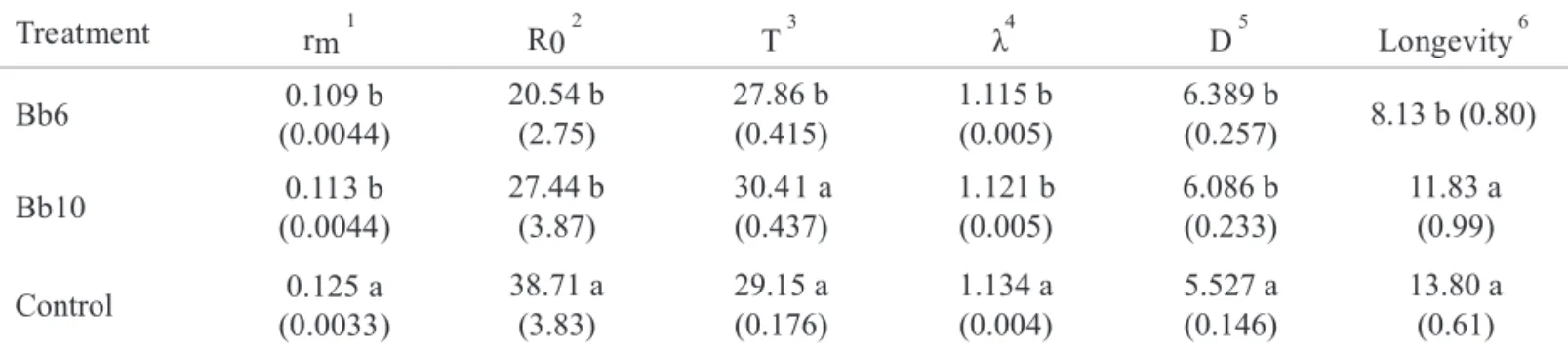
The demographic parameters of S. endius were not affected by the strains of B. bassiana when they were inoculated a single time, since differences with the control were not found (Table 1).On the other hand, when they were inoculated twice (Table 2) both strains influenced on the demography of the parasitoid, reducing the capability of populational increase. Although the generational time (T) was significantly smaller in the pupae treated with Bb6 strain, there were no differences in the intrinsic rate of natural increase (rm) regarding to the treatment with the Bb10. The parameters (λ and D) showed the same tendency as rm because they are mathematically related to this rate. The proportion of emerged females of S. endius was not affected by the fungus in both bioassays since significant differences with their respective controls were not observed (α = 0.05) varying from 61% to 64% with one immersion and from 66% to 67% with two immersions.
In a previous study (La Rossa et al. 2002), the populational parameters of S. endius were obtained on pupae of M.
domestica, being the rm and R0 0.119 and 24.54, respectively, smaller than those of the controls of the present assay. Thus, the remaining humidity caused by the immersions would be able to increase those rates. The parasitoidism percentage in the pupae treated with the fungus was significantly lower than that of the control with one or two immersions. In the first bioassay differences were observed among the two strains, showing the treatment with the strain Bb10, the lowest percentage (Fig. 1A). In the second bioassay both strains acted reducing the proportion of parasitoidized pupae with regard to the control (Fig. 1 B).The discrepancy between the parasitoidism percentages and the populational parameters, evidenced mostly in the bioassay with one immersion, is due to that in the first ones both sexes are computed in the observations while in the seconds only are involved the females and the descendant of the same sex. Thus, while the parasitoidism percentage showed differences among the treatments, the populational parameters were similar in the first bioassay.
Although B. bassiana would not directly affect M. domestica pupae the insertion of this fungus in confined animal production systems would help to control the adult flies (Lecuona et al. 2005b). The presence of B. bassiana conidia on the pupae of flies could produce significant reductions in the parasitoidism percentage without altering the populational parameters of S. endius with a single application (Bioassay 1).
Table 1. Demographic parameters and longevity of females of S. endius on pupae of M. domestica treated with two strains of B. bassiana with a single immersion (Bioassay 1).
Treatment rm 1 R0 2 T 3 λ4 D 5 Longevity 6
Bb6 0.144 a
(0.0028) 45.425 a (3.47) 26.38 a (0.101) 1.156 a (0.003) 4.792 a (0.095) 14.60 a (0.48)
Bb10 0.141 a
(0.0029) 41.139 a (3.135) 26.34 a (0.145) 1.152 a (0.004) 4.914 a (0.096) 12.93 a (0.40)
Control 0.142 a
(0.0028) 40.218 a (2.934) 26.08 a (0.177) 1.152 a (0.003) 4.894 a (0.095) 13.87 a (0.60 )
1Intrinsic rate of natural increase; 2Net reproductive rate; 3Generational time (days); 4Finite rate of increase (1/day); 5Duplication
time (days); 6Adult longevity (days); 7Standard error of mean. Values followed by the same letter in each column do not differ
significantly (Newman-Keuls Test, α = 0.05), n = 30.
Table 2. Demographic parameters and longevity of females of S. endius on pupae of M. domestica treated with two strains of B. bassiana with two successive immersions in a 24h interval (Bioassay 2).
Treatment rm 1 R0 2 T 3 λ4 D 5 Longevity 6
Bb6 0.109 b
(0.0044) 20.54 b (2.75) 27.86 b (0.415) 1.115 b (0.005) 6.389 b
(0.257) 8.13 b (0.80)
Bb10 0.113 b
(0.0044)
27.44 b (3.87)
30.4 1 a (0.437) 1.121 b (0.005) 6.086 b (0.233) 11.83 a (0.99)
Control 0.125 a
(0.0033) 38.71 a (3.83) 29.15 a (0.176) 1.134 a (0.004) 5.527 a (0.146) 13.80 a (0.61)
1Intrinsic rate of natural increase; 2Net reproductive rate; 3Generational time (days); 4Finite rate of increase (1/day); 5Duplication
time (days); 6Adult longevity (days); 7Standard error of mean. Values followed by the same letter in each column do not
Geden et al. (1995) working with 13 strains of B. bassiana found that only two of them were slightly more virulent in adult flies that on the parasitoid Muscidifurax abductor Girault & Sanders. In the present study sporulation of B. bassiana was not observed in cadavers of S. endius, but the longevity of the adult parasitoids was significantly smaller with the strain Bb6 with two immersion treatments (Table 2). This could be indicating the presence of some factor that would affect the parasitoid-host relationship when the exposition is frequent. For the above mentioned and in accordance with Skovgård & Steenberg (2002), it would not be convenient to apply the fungus on the parasitoid rearing places. Anyway, the bioassays performed in the present work are considered under an extreme condition, since in future mycoinsecticide applications the aspersions would not be directed toward the places where there are pupae of flies (manure). Also, surely not liquid but solid formulations would be used in form of baits, minimizing the impact on the populations of S. endius and other pteromalids species used in biological control (Lecuona et al. 2005a).
Acknowledgments
To Luis Díaz and Mariana Turica for their technical assistance in the development of the present work and to Estela Favret for the bibliographical search and the help in its translation into English.
References
Bellows, T. Jr., R. Van Driesche & J. Elkinton. 1992. Life tables
construction and analysis in the evaluation of natural enemies.
Annu. Rev. Entomol. 37: 587-614.
Crespo, D., R. Lecuona & J. Hogsette. 1998. Biological control: An important component in integrated management of Musca domestica (Diptera: Muscidae) in caged-layer poultry houses
in Buenos Aires, Argentina. Biol. Control 13: 16-24. Darwish, E. & A. Zayed. 2002. Pathogenicity of two
entomopa-thogenic hyphomycetes Beauveriabassiana and Metarhizium
anisopliae, to the housefly Muscadomestica L. J. Egypt. Soc.
Parasitol. 32: 785-796.
Ferron, P., J. Fargues & G. Riba. 1991. Fungi as microbial insecticides against pest. In D.K. Arora, L. Ajello & K.G. Mukerjii (eds.), Handbook of applied micology. New York,
Marcel Dekker, 733p.
Geden, C., D. Rutz & D. Steinkraus. 1995. Virulence of different
isolates and formulations of Beauveriabassiana for house flies and
the parasitoid Muscidifuraxraptor. Biol. Control 5: 615-621.
Janssen, A. & M. Sabelis. 1992. Phytoseiid life-histories, local
predator-prey dynamics and strategies for control of tetranichid
mites. Exp. Appl. Acarol. 14: 233-250.
La Rossa, F., D. Crespo & R. Lecuona. 2002. Population parameters
of Spalangiaendius Walker (Hymenoptera: Pteromalidae) on pupae of Muscadomestica L. (Diptera: Muscidae). Neotrop.
Entomol. 31: 597-600.
La Rossa, F. & N. Kahn. 2003. Dos programas de computadora para
confeccionar tablas de vida de fertilidad y calcular parámetros
biológicos y demográficos en áfidos (Homoptera: Aphidoidea). RIA INTA 32: 127-132.
Lecuona, R., D. Crespo & F. Tarocco. 2005a. Evaluación de
cebos experimentales en gránulos utilizando al hongo
entomopatógeno Beauveriabassiana como componente activo,
para el control de mosca doméstica, p.70-71. XXVII Congreso Nacional de Entomología. Valdivia, Chile, 23- 25/11/05. Lecuona, R., M. Turica, F. Tarocco & D. Crespo. 2005b. Microbial
control of Musca domestica (Diptera: Muscidae) with
entomopathogenic fungi. J. Med. Entomol. 42: 332-336.
Morgan, P. 1986. Mass culturing Microhymenopteran pupal
parasites (Hymenoptera: Pteromalidae) of filth breeding flies, p.62-87. In Patterson R. & D. Rutz (eds), Biological control of Muscoid flies, Misc. Publ. 61, Ent. Soc. Amer., College Park, Maryland, 174p.
Morgan, P., H. Hoyer & R. Patterson. 1989. Life story of
Spalangiacameroni Perkins (Hymenoptera: Pteromalidae), a
microhymenopteran pupal parasitoid of moscoid flies (Diptera: Muscidae). J. Kans. Entomol. Soc. 62: 381-386.
Fig. 1. Parasitoidism percentage of S. endius on pupae of M. domestica treated with two strains of B. bassiana, with a single
immersion (A) and two immersions (B). Same letters on the columns indicate that there are not significant statistical differences among percentages. The outline at the top of columns indicates the 95% Confidence Interval range.
65
60
55
50
Control Bb6 Bb10
a b c
A 65
60
55
50
Control Bb6 Bb10
a b b
Morgan, P., R. Patterson & G. Labrecque. 1976. Host parasitoid relationship of the house fly, Muscadomestica L., and the protolean parasitoid Spalangiaendius Walker. (Diptera:
Muscidae and Hymenoptera: Pteromalidae). J. Kans. Entomol. Soc. 49: 483-488.
Pagano, M. & K Gauvreau. 2001. Fundamentos de bioestadística.
2 ed. México, Thomson Learning, 525p.
Skovgård, H. & T. Steenberg. 2002. Activity of pupal parasitoids
of the stable fly Stomoxyscalcitrans and prevalence of
entomopathogenic fungi in the stable fly and house fly Musca domestica in Denmark. Biol. Control 47: 45-60.
Southwood, T. 1995. Ecological methods. 2 ed. London, Chapman & Hall, 524p.
Thomazini, M. & E. Berti Filho. 2000. Tabela de vida de fertilidade
de Muscidifuraxuniraptor Kogan & Legner (Hymenoptera: Pteromalidae) em pupas de Muscadomestica L. (Diptera:
Muscidae). Ann. Soc. Entomol. Brasil 29: 715-721.
Watson, D., C. Geden, S. Long & D. Rutz. 1995. Efficacy of
Beauveriabassiana for controlling the house fly and stable fly
(Diptera: Muscidae). Biol. Control 5: 405-411.
Watson, D., D. Rutz & S. Long. 1996. Beauveria bassiana and
sawdust bedding for the management of the house fly Musca domestica (Diptera: Muscidae) in calf hutches. Biol. Control
7: 22l-227.