Article
ISSN 0102-695X
doi: 10.1590/S0102-695X2011005000038 Received 1 Aug 2010
Accepted 27 Sep 2010 Available online 18 Mar 2011
and
Maytenus ilicifolia
for production of high
load tablets
Verônica M. L. Alves,
1Lívia C. L. Sá-Barreto,
2Gustavo H. B.
Souza,
1Marcílio S. S. Cunha-Filho
*,21Escola de Farmácia, Universidade Federal de Ouro Preto, Brazil,
2Instituto de Ciências da Saúde, Campus Universitário de Sinop, Universidade Federal
do Mato Grosso, Brazil.
Abstract: The aim of this study was to investigate the feasibility of a co-processing technique for improving the manufacturing properties of Maytenus ilicifolia
(Schrad.) Planch., Celastraceae, and Cassia angustifolia Vahl, Fabaceae, extracts in order to obtain tablets containing a high dose of such extracts. An experimental mixture design was used to optimise the formulation composition. Flowability parameters, such as compressibility index, time flow and angle of repose, were determined. Additional important industrial parameters, such as granulometry, bulk density and moisture stability, were also studied. The results demonstrated that co-processing technique was able to improve the flowability of vegetal extracts, making these materials suitable for a direct compression process. The contour plots revealed that formulations with a higher amount of lactose produced the best flow results as well as a larger particle size and a greater bulk density. Tablets from co-processed extracts containing lactose as majority diluent showed appropriate physical-chemical characteristics and presented a more stable moisture sorption behaviour compared to commercial gelatine capsules.
Keywords: Maytenus ilicifolia Cassia angustifolia
co-processed extract flowability
tablets
Introduction
Medicinal plants are used therapeutically all around the world and are an important aspect of various traditional medicine systems. During the past few decades, the application of phytotherapy has increased, even in industrialized countries (WHO, 2007). Despite the great potential of herbal medicine, research indicates a lack of information among health professionals about phytotherapy, with the result that this therapeutic resource has remained relatively obscure (Veiga Junior, 2008). Scant literature is available about the preparation and formulation of phytotherapeutics, which explains why most of these products are homemade to date.
A tablet form is the preferred medium of pharmaceutical scientists and clinicians. The ease of manufacturing, low cost, convenience of administration and accurate dosing capabilities make tablets a popular and versatile dosage form (Gohel & Jogani, 2005). Nevertheless, the most common vehicles for medicinal plants are capsules and oral liquids (Vieira et al., 2010).
Dried extracts from medicinal plants are often used as active components in solid dosage forms because of their high stability. However, these products generally
present dei cient rheological properties, inadequate
compressibility and high sensitivity to atmospheric
moisture, resulting in difi cult direct compression (Souza et al., 2007). The l ow behaviour of pharmaceutical
powders determines important properties of solid dosage forms; in some cases, the success or failure of a product
has hinged on its l ow behaviour during manufacturing
(Prescott & Barnum, 2000).
Co-processing methods are often used to improve rheological and compression characteristics of pharmaceutical excipients (Cunha-Filho & Sá-Barreto, 2009). These techniques transform a small,
cohesive, poorly l owable powder into a l owable and
directly compressible material by engineering particles without affecting the structure at a molecular level. Co-processing is achieved by combining two or more materials by an appropriate process, such as co-grinding or agglomeration, resulting in a product with superior properties compared to the simple physical mixtures of their components (Gohel & Jogani, 2005).
Rev. Bras. Farmacogn. Braz. J. Pharmacogn. 21(3): May./Jun. 2011 spray-dried extracts together with microcrystalline
cellulose to produce tablets using both eccentric and rotary presses. Zhao et al. (2010) reported the feasibility of superfine grinding technique in improve physical-chemical properties of Astragalus membranaceus
powders. Others studies highlight the importance of the use of excipients during spray-drying process, to obtain dried extracts with better flow characteristics (Oliveira & Petrovick, 2010).
The purpose of this work was to investigate the feasibility of an agglomeration technique to produce co-processed extracts using pharmaceutical excipients in order to improve rheological properties, compaction behaviour and moisture stability. To this end, two plants were selected - Cassia angustifolia Vahl, Fabaceae, and
Maytenus ilicifolia (Schrad.) Planch., Celastraceae, -
that are used medicinally worldwide (Silva et al., 2004; Santos-Oliveira et al., 2009).
Material and Methods
Material
The plant materials used in this study were commercial samples obtained from All Chemistry do Brasil®. Dried leaf extracts from Maytenus ilicifolia
(Schrad.) Planch. Celastraceae (MI), lot 33695, and
Cassia angustifolia Vahl (CA), Fabaceae, lot 33884,
were used.
The excipients used were microcrystalline cellulose PH 101 (MCC), lactose monohydrate (lactose), polyvinylpyrrolidone (PVP), magnesium stearate and maize starch (starch) purchased from Henrifarma®. All
solvents were of analytical grade.
Angle of repose and low time
The angle of repose was assessed by the ixed funnel method (Staniforth, 2005). Briely, 50 g of each
sample was poured into the funnel, forming a conical pile. The angle of repose was measured by the internal angle subtended by the surface of a heap of powder against the plane that supported it and was then measured with a protractor. Flow time was established by determining the
time the samples took to low from a standard funnel. All
measurements were taken in ten replicate.
Bulk density
The bulk density was the density including pores and interparticle voids. Powder samples were levelled carefully (without compacting) into a 100 mL cylinder. The bulk density was calculated from the ratio of the weight of the sample to the bulk volume. This procedure was carried out in triplicate.
Compressibility index and Hausner index
The compressibility index and Hausner index were determined using bulk density and tap density values (RFE, 2005). Approximately 50 g of powder was gently poured into a 100 mL graduated cylinder and the initial volume was recorded. Then it was tapped in a series of 250 times until a constant volume was reached,
and the inal volume was recorded. The tapped density
was calculated as the ratio between the sample weight
and the inal volume (Carr, 1965). All experiments were
performed in triplicate. The compressibility and Hausner indices were calculated using the equations below:
Compressibility Index = 100 x (δt - δa)/δt Hausner Index = δa/δt
where δa is the bulk density of material freely settled and δt is the tapped density of material.
Particle size analysis
In order to determine the size particle distribution of dried extracts and co-processed samples, a sieve analysis was performed in an automatic sieve shaker using 710, 590, 500, 420, 210, 149 and 88 µm sieves in triplicate. The linearization of the Gaussian particle size distribution was developed using probits statistical analysis (Pasqualoto et al., 2005). The mean cumulative particle size dates were converting into probit values using probit spreadsheet. The particles’ mean diameter and standard deviation were calculated from probit regression.
Co-processing method
The procedure chosen to co-process the extracts was the agglomeration process by wet granulation. Mixtures of dry extract and excipients were blended in a V mixer for 20 min. Batches of 100 g were wetted with an aqueous solution of PVP 15% (w/v), manually blended and strained using an oscillating granulator, sieved through 2.5 mm pores. The granules were dried in a circulating air oven at 25 °C for 24 h. The dried granules were calibrated through a sieve of 1.5 mm using an oscillating granulator and stored.
Experimental design
The formulations were elaborated according to a
mixture design. The effect of varying composition on low
properties, particle size and bulk density were studied using a simplex lattice design without constraints. This design included ten experimental points. Mass fractions
of illers (MCC, lactose and starch) in a formulation were
Experiments were carried out in a random order to avoid the incidence of systematic error.
Table 1. Component proportions of simplex lattice design. Formulation Starch
(%)
MCC (%)
Lactose (%)
Dried extract (%)
PVP (%)
1 49 0 0 49 2
2 0 49 0 49 2
3 0 0 49 49 2
4 24.5 24.5 0 49 2
5 24.5 0 24.5 49 2
6 0 24.5 24.5 49 2
7 16.3 16.3 16.3 49 2
8 32.6 8.2 8.2 49 2
9 8.2 32.6 8.2 49 2
10 8.2 8.2 32.6 49 2
The best itting mathematical model was selected for each response. The results were itted with
polynomial functions of MCC, lactose and starch content by means of stepwise multiple regression analysis. The validation of the model was performed through analysis
of variance with a level of signiicance 0.05 and through the coeficient of determination (R2). Adequate precision
(APrecision) was calculated as a signal of noise ratio relative to the associated error. A ratio greater than four is desirable (Anderson & Whitcomb, 2005). All statistical calculation and graphic plots were performed using the software Design-Expert version 8®.
Preparation of tablets
Selected co-processed extracts were mixed with 0.5% magnesium stearate in a V mixer for 5 min and were incorporated into tablet form. Batches of 100 g were compressed into tablets on a Primel Faber® eccentric
press using a compression force of 30 kgF. For the CA
co-processed extract, a 13 mm die and lat-faced punches
were used; for MI co-processed extracts, a 14 mm die and
lat-faced punches were employed. The loading depth of
the press was adjusted to obtain tablets of CA and MI extracts with a theoretical weight of 400 mg and 500 mg, respectively, in order to keep the dose at that which is used commercially for each plant.
Physical-chemical characterization of tablets
Tablet formulations were subjected to the following tests according to The United States Pharmacopeia (USP, 2008).
Weight
The weights of twenty randomly selected tablets
were determined individually and the mean weight and
coeficient of weight variation were calculated.
Hardness
The hardness of ten randomly selected tablets was obtained using an OFF-TEC Galileo® apparatus. The
mean hardness and coeficient of hardness variation were
calculated.
Friability
Tablet friability was measured as the percentage of weight loss of twenty randomly-selected tablets tumbled in an Ética® friabilator working at 100 rpm for 5
min.
Disintegration time
Disintegration time was measured in water at 37 °C in an Ética® disintegration tester. For each formulation,
six randomly selected tablets were tested.
Water sorption assay
Hygroscopicity of selected tablets was compared with capsules containing dried extracts using the experimental model described by Callahan (Callahan et al., 1982). The amount of 400 mg and 500 mg of CA and MI dried extracts, respectively, were weighted and
manually illed into size zero hard gelatine capsules. The
moisture sorption properties of samples were determined gravimetrically before and after storage at 25 °C under conditions of various relative humidities (5-98% RH) in hermetic systems for 7 d. The various RH conditions were achieved using saturated salt solutions (Greenspan, 1977). The water sorption behaviour was evaluated from the average weight change at each storage time and was expressed as moisture increase per starting weight. The assay was performed in triplicate.
Results and Discussion
The low of powder during manufacturing
dictates the quality of the product in terms of its weight
and content uniformity. However, the low proile of a
powder is complex and multidimensional, and it does in fact depend upon many powder characteristics. For this
reason, no single test could ever quantify lowability
(Prescott & Barnum, 2000). To address this multivariate
problem, several low measurements were performed in order to obtain a more coherent low classiication.
The results for lowability and particles size
Rev. Bras. Farmacogn. Braz. J. Pharmacogn. 21(3): May./Jun. 2011 phytotherapeutics, the low mean particle size favours
the cohesive interparticle forces that lead to poor low properties. These samples exhibited no free-low through
the standard funnel; therefore, the angle of repose was not
determined, and the low time was considered ininite.
The rheological behaviour of pharmaceutical excipients isolated also presented deficient flow properties (Table 2). These materials act as modifying agents that change the surface properties of pharmaceutical ingredients. In this study, it was expected that they could improve the mechanical behaviour of MI and CA extracts. The physical mixture of dried extract and excipient did not increase flow characteristics in any composition evaluated (data not shown). The heterogeneity of the samples, as well as their poor rheological behaviour, makes these materials unsuitable for a compression process.
Co-processing of vegetal extracts with pharmaceutical excipients could lead to the formation of materials with superior mechanical characteristics suitable for direct compression. The technique chosen to produce co-processed plant extract was agglomeration by wet granulation. A simplex lattice design was used in order to determine optimal formulation composition
(Table 1). The results of low parameters, particle size
and bulk density are shown in Tables 3 and 4.
In general, co-processing of both extracts
demonstrated important enhancements in low, bulk
density and particle size behaviour. Several formulations
presented clear evidence of lowability improvement:
a compressibility index lower than 15% and a Hausner index below 1.18 (Tables 3 and 4). Furthermore, an angle
of repose of approximately 35-40° and a low time of less than 15 s corroborate these favourable low results.
The particle size analysis of co-processed extracts exhibited a normal and broad distribution, with values up to 700 µm. In contrast with dried extracts, co-processed material had enlarged diameters, which would
explain their better low properties. Most of the particles
fell within the range of 300-400 µm. Notable differences were pointed out between co-processed extracts (Table 3 and 4). For both CA and MI extracts, with the increasing amount of MCC, the mean particle size decreased. The largest granules were obtained with the formulations containing lactose. This effect in mean particle size on
account of granules formulations is described in literature (Rantanen et al., 2001).
The bulk density results revealed an important
difference between the formulations, speciically the
values situated in the range of 0.3 to 0.5 g/cm3. This
parameter has a special interest for plant extracts because of the high dose requirement and, in the case of tablets, a limitation due to the die diameter.
The experimental mixture design used in this stage of study provided a predictable equation for each
mechanical parameter examined, according to a reined
model (Tables 3 and 4). Most of the resultant equations
obtained with CA co-processed presented coeficients
with second and third order terms, indicating a high level
of interaction between the excipients studied. The itted model for low time and bulk density is linear and shows that the interaction terms are insigniicant. A linear it
was also found for most of the MI co-processed with the exception of compressibility and Hausner indices that
presented signiicant second-order terms.
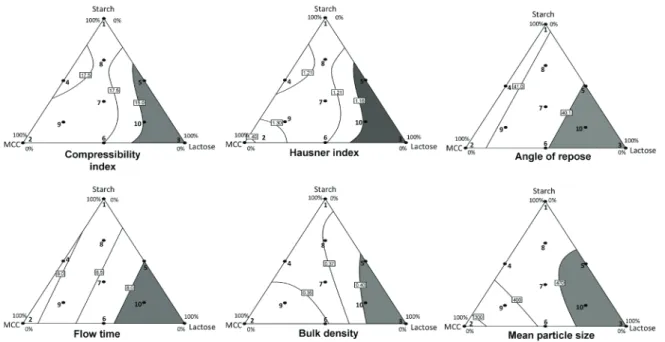
The reined model was used for drawing contour
plots, as shown in Figures 1 and 2. The grey areas represent the proportions of MCC, lactose and starch in the formulation that produced the best results. Similar
proiles were found for both MI and CA extracts. It is
noted from the contour plot that a higher amount of
lactose produced the best low results as well as a greater
particle size and an increased bulk density, whereas MCC generated the least effect. Nevertheless, the addition of a small amount of starch and MCC can favour the mechanical properties of co-processed extracts and show a synergic effect.
The results are very clear in distinguishing formulations 3, 5 and 10 of both MI and CA as the best compositions for all mechanical parameters tested, and they were selected to be used in the compression phase of our study.
The mechanical characteristics of the tablets made with co-processed extracts are described in Figure 3. All selected formulations presented a good appearance and appropriate dimensions. None exhibited lamination or capping, indicating that air was not trapped inside the die, which is a common problem in tablet vegetal extract formulations (Soares et al., 2005). Tablet
weight satisfactorily met pharmacopeial speciications
Table 2. Mechanical properties of MI and CA commercial-dried extracts, milling plants and the pharmaceutical excipients. Sample Compressibility index (%) Hausner index Flow time (s) Mean particles size (µm)
Dried extracts MI 31.0±0.0 1.5±0.0 ∞ 83.7±38.0
CA 23.4±1.2 1.3±0.0 ∞ 81.6±32.8
Excipients
Starch 37.0±1.0 1.6±0.0 ∞
-MCC 36.7±1.5 1.5±0.0 ∞
-Table 3. Mechanical properties of CA co-processed extracts with the correspondent it model and prediction equation for each
parameter tested.
Formulation Compressibility
index (%) Hausner index
Angle of repose
(°) Flow time (s)
Bulk density (g/ mL)
Mean particles size (µm)
1 23.3±1.5 1.30±0.03 41.3±0.9 9.7±0.2 0.37 413.4±232.6
2 30.3±0.6 1.44±0.01 41.3±0.9 9.5±0.1 0.31 247.5±270.4
3 13.7±1.2 1.16±0.01 39.0±0.4 7.2±0.1 0.47 555.3±270.3
4 15.1±1.0 1.18±0.01 42.0±0.3 8.6±0.2 0.37 433.6±256.4
5 13.3±1.5 1.15±0.02 40.5±0.5 7.8±0.3 0.41 501.0±263.2
6 18.0±1.7 1.22±0.03 41.0±0.7 8.3±0.1 0.35 420.8±256.4
7 18.7±0.6 1.23±0.01 40.7±0.5 8.2±0.2 0.36 437.8±270.3
8 19.1±1.0 1.23±0.02 40.3±0.9 8.1±0.1 0.37 443.4±277.8
9 22.0±1.7 1.28±0.03 40.3±0.8 8.7±0.3 0.33 389.8±270.7
10 12.7±3.0 1.15±0.04 38.9±0.6 7.9±0.2 0.41 488.2±270.3
Fit model Special cubic Special cubic Linear Linear Quadratic Quadratic
Predict equation*
= +23.8. X1 + 30.5. X2 + 13.0. X3 - 46.1. X1 . X2 - 21.2. X1 . X3 - 17.1. X2. X3
+ 144.7. X1.X2.X3
= + 1.31. X1 + 1.44. X2 + 1.15. X3 - 0.75. X1. X2 - 0.32. X1. X3 - 0.33. X2. X3
+ 2.21. X1.X2.X3
= + 41.1. X1 + 41.3. X2 + 40.0. X3
= + 8.9. X1 + 9.2. X2 + 7.1. X3
= + 0.37. X1 + 0.31. X2 + 0.47. X3 + 0.09.X1. X2 - 0.06. X1. X3 - 0.18. X2. X3
= + 413. X1 + 254. X2 + 555 . X3 + 372. X1.X2 + 12. X1 . X3 +39.X2. X3
R2 0.91 0.96 0.62 0.66 0.97 0.96
APrecision 13.0 19.5 6.4 8.6 27.3 25.0
Table 4. Mechanical properties of MI co-processed extracts with the correspondent it model and prediction equation for each
parameter tested.
Formulation Compressibility
index (%) Hausner index
Angle of repose
(°) Flow time (s)
Bulk density (g/ mL)
Mean particles size (µm)
1 17.3±0.6 1.21±0.01 38.0±1.0 8.5±0.1 0.39 495.0±277.8
2 18.0±1.0 1.22±0.01 40.6±2.3 9.6±0.1 0.32 475.2±263.2
3 14.0±1.0 1.16±0.01 37.0±1.4 6.0±0.1 0.50 494.6±303.0
4 15.0±2.0 1.18±0.03 39.0±0.7 7.9±0.1 0.39 480.3±294.1
5 12.6±1.5 1.15±0.02 37.0±1.7 6.8±0.1 0.46 503.3±294.1
6 17.0±1.3 1.20±0.02 39.0±1.2 7.5±0.1 0.40 490.8±277.8
7 14.3±0.3 1.17±0.01 37.7±0.9 7.9±0.3 0.41 501.9±285.7
8 15.7±0.5 1.19±0.01 36.0±0.4 7.1±0.1 0.43 490.0±312.5
9 14.7±1.5 1.17±0.02 38.6±1.6 8.5±0.0 0.36 480.1±270.3
10 14.7±1.2 1.17±0.02 36.6±1.5 6.8±0.2 0.44 515.5±303.0
Fit model Quadratic Quadratic Linear Linear Linear Linear
Predict equation*
= +17.6.X1 + 17.6. X2 + 14.2. X3 - 10.8. X1. X2 - 11.2. X1. X3 + 3.6. X2. X3
= + 1.21. X1 + 1.21. X2 + 1.16. X3 - 0.14. X1. X2 - 0.13. X1. X3 + 0.03. X2. X3
= + 37.0. X1 + 40.2. X2 + 36.5. X3
= + 7.8. X1 + 9.2. X2 + 6.0. X3
= + 0.41. X1 + 0.32. X2 + 0.49. X3
= + 496. X1 + 475. X2 + 507. X3
R2 0.72 0.65 0.64 0.79 0.91 0.60
APrecision 7.4 5.6 8.2 12.6 19.9 6.7
*X1: starch, X2: MCC and X3: lactose.
Rev. Bras. Farmacogn. Braz. J. Pharmacogn. 21(3): May./Jun. 2011 (maximum variation of 5%) and the low relative standard
deviation values indicated favourable feeding conditions
allowed by the improved lowability of co-processed
extracts.
Adequate hardness was obtained for most of the formulations. However, formulation number 5 containing CA did not produce hard tablets, as evinced by a hardness under the minimum 3 kgF required. In addition, some problems were found with the friability of formulation 3 containing CA and formulations 5 and 10 made with MI extracts; those tablets showed weight loss values higher
than 1.5%. All tablets disintegrated rapidly, fulilling
compendia requirements. The high values of hardness for some samples did not affect this parameter.
Accordingly, CA formulation 10 and MI formulation 3 passed all quality control assays and were selected for the hygroscopicity study.
The sorption isotherms were drawn by determining the equilibrium moisture content at different relative humidities for selected tablets of MI and CA and by comparing them with the commercially-dried extracts placed inside a gelatine capsule (Figure 4). According
to the Callahan classiication (Callahan et al., 1982) all
samples evaluated are moderately hygroscopic. This behaviour corroborates the known high sensitivity of dried vegetal extracts to atmospheric humidity (Palma et al., 2002; Souza et al., 2007). However marked differences in moisture sorption properties between tablets and capsules were noted.
As expected, gelatine capsules containing extracts were found to be quite sensitive to variations in RH. For both extracts, capsules became brittle in low RH atmosphere and showed softening in high RH environment. On the other hand, the co-processed extract in tablet form seemed to protect the vegetal extract from atmospheric moisture by keeping the level of humidity inside the samples low. This effect may be attributed to the agglomeration and compaction processes that
reduce the speciic surface of material and make the
vegetal tablets more resistant to water incorporation. The physical aspects of tablets remained unchanged during the hygroscopicity assay. Only in high RH conditions was an increase in the moisture of tablet samples observed.
In conclusion, this study demonstrated that co-processing is a feasible technique to overcome the poor
lowability of vegetal extracts. The use of experimental design provided a full understanding of powder-low
properties and may lead to the selection of formulations with better properties and with the least expenditure of time and materials. The contour plots revealed that formulations with a higher amount of lactose produced
the best low results as well as a larger particle size and a
greater bulk density. Tablets elaborated with formulation 3 containing MI co-processed extracts and formulation 10 containing CA co-processed extracts presented the best results of quality control. Those tablets showed appropriate physical-chemical characteristics and revealed a more stable moisture sorption behaviour compared to commercial gelatine capsules.
Figure 2. Contour diagrams of co-processed MI extracts with the experimental points. Each contour represents a constant response factor. Grey areas show regions where mixture composition had the best response.
Figure 3. Quality control results of tablet formulations containing CA and MI extracts. The continuous line and the dotted line indicate the minimum and maximum limits established by Pharmacopoeia, respectively.
Figure 4. Sorption isotherms of tablets and hard gelatine capsules containing CA and MI extracts.
70 80 90 100 110
%
Weight
CA MI
3 5 10 3 5 10
0 3 6 9 12 15
K
g
F
Hardness
CA MI
3 5 10 3 5 10
0 1 2
%
Friability
CA MI
3 5 10 3 5 10
0 10 20 30
m
in
Disintegration time
CA MI
3 5 10 3 5 10
70 80 90 100 110
%
Weight
CA MI
3 5 10 3 5 10
0 3 6 9 12 15
K
g
F
Hardness
CA MI
3 5 10 3 5 10
0 1 2
%
Friability
CA MI
3 5 10 3 5 10
0 10 20 30
m
in
Disintegration time
CA MI
3 5 10 3 5 10
Acknowledgements
Authors thank the CNPq/Brazil and Federal
University of Ouro Preto, Brazil, for the inancial
Rev. Bras. Farmacogn. Braz. J. Pharmacogn. 21(3): May./Jun. 2011
References
Anderson MJ, Whitcomb PJ 2005. RSM Simpliied: optimizing
processes using response surface methods for design of experiments. New York: Productivity Press.
Callahan JC, Cleary GW, Elefant M, Kaplan G, Kensler T, Nash RA 1982. Equilibrium moisture content of pharmaceutical excipients. Drug Dev Ind Pharm 8: 355-369.
Carr RL 1965. Evaluation of low properties of solids. Chem Eng J 72: 163-168.
Cunha-Filho MSS, Sá-Barreto LCL 2009. Excipientes co-processados para compressão direta de comprimidos.
Lat Am J Pharm 28: 304-312.
Gohel MC, Jogani PD 2005. A review of co-processed directly compressible excipients. J Pharm Pharm Sci 8: 76-93.
Greenspan L 1977. Humidity ixed points of binary saturated
aqueous solutions. J Res Nat Bur Stand Sect A Phys Chem 81A: 89-96.
Oliveira OW, Petrovick PR 2010. Secagem por aspersão (spray drying) de extratos vegetais: bases e aplicações. Rev Bras Farmacogn 20: 641-650.
Palma S, Luján C, Llabot JM, Barbosa G, Manzo RH, Allemandi DA 2002. Design of Peumus boldus tablets by direct compression using a novel dry plant extract. Int J Pharm 233: 191-198.
Pasqualoto KFM, Funck JAB, Silva FEB, Kratz CP 2005. Utilização de probitos como instrumento estatístico simples à avaliação da distribuição de tamanho de partícula de dois tipos de celulose microcristalina. Rev Bras Farm 86: 31-34.
Prescott JK, Barnum RA 2000. On powder lowability. Pharm Tech Oct October: 60-85.
Rantanen J, Jørgensen A, Räsänen E, Luukkonen P, Airaksinen, S, Raiman J, Hänninen K, Antikainen O, Yliruusi J
2001. Process analysis of luidized bed granulation.
AAPS PharmSciTech 2: article 21.
Real Farmacopea Española 2005. 3. ed. Madrid: Ministerio de Sanidad y Consumo.
Santos-Oliveira R, Coulaud-Cunha S, Colaço W 2009. Revisão da Maytenus ilicifolia Mart. ex Reissek, Celastraceae. Contribuição ao estudo das propriedades farmacológicas.
Rev Bras Farmacogn 19: 650-659.
Silva CR, Monteiro MR, Caldeira-de-Araújo A, Bezerra RJAC 2004. Absence of mutagenic and citotoxic potentiality of senna (Cassia angustifolia Vahl.) evaluated by
microbiological tests. Rev Bras Farmacogn 14: 01-03. Soares LAL, Ortega GG, Petrovick PR, Schmidt PC 2005.
Dry granulation and compression of spray-dried plant extracts. AAPS PharmSciTech 6: E359-E366.
Souza TP, Martínez-Pacheco R, Gómez-Amoza JL, Petrovick PR 2007. Eudragit E as excipient for production of granules and tablets from Phyllanthus niruri L spray-dried extract. AAPS PharmSciTech 8: E54-E60. Spaniol B, Bica VC, Ruppenthal LR, Volpato MR, Petrovick PR
2009. Compressional behavior of a mixture of granules containing high load of Phyllanthus niruri spray-dried extract and granules of adjuvants: Comparison between eccentric and rotary tablet machines. AAPS PharmSciTech 10: 1013-1023.
Staniforth JN 2005. Fluxo de pós. In Aulton ME (org.).
Delineamento de formas farmacêuticas. 2. ed. Porto Alegre: Artmed, p. 208-221.
World Health Organization 2007. Guidelines for assessing
quality of herbal medicines with reference to
contaminants and residues. Switzerland: World Health Organization.
United States Pharmacopeia 2008. 30. ed. Rockville: United States Pharmacopeial Convention.
Veiga Junior VF 2008. Estudo do consumo de plantas medicinais na Região Centro-Norte do Estado do Rio de Janeiro:
aceitação pelos proissionais de saúde e modo de uso
pela população. Rev Bras Farmacogn 18: 308-313. Vieira SC, Heredia SS, Vieira MC, Zárate NAH 2010.
Levantamento de itoterápicos manipulados em
farmácias magistrais de Dourados-MS. Rev Bras Farmacogn 20: 28-34.
Zhao X, Du F, Zhu Q, Qiu D, Yin W, Ao Q 2010. Effect of
superine pulverization on properties of Astragalus membranaceus powder. Powder Technol 203: 620-625.
*Correspondence
Marcílio S. S. Cunha-Filho
Instituto de Ciências da Saúde, Campus Universitário de Sinop, Universidade Federal do Mato Grosso
Av. Alexandre Ferronato, 1200, Reserva 35, Setor Industrial, 78557-267 Sinop-MT, Brazil