Katarinne Lima Moraes
I, Virginia Visconde Brasil
I, Gabriela Ferreira de Oliveira
I,
Jacqueline Andréia Bernardes Leão Cordeiro
I, Antonio Márcio Teodoro Cordeiro Silva
II,
Rafaela Peres Boaventura
I, Denize Bouttelet Munari
I, Mônica Ribeiro Canhestro
IIII Universidade Federal de Goiás, School of Nursing, Postgraduate Program in Nursing. Goiânia, Goiás, Brazil. II Pontifícia Universidade Católica de Goiás, Department of Medicine. Goiânia, Goiás, Brazil. III Universidade Federal de Minas Gerais, School of Nursing. Belo Horizonte, Minas Gerais, Brazil.
How to cite this article:
Moraes KL, Brasil VV, Oliveira GF, Cordeiro JABL, Silva AMTC, Boaventura RP, et al. Functional health literacy and knowledge of renal patients on pre-dialytic treatment. Rev Bras Enferm [Internet]. 2017;70(1):147-53.
DOI: http://dx.doi.org/10.1590/0034-7167-2015-0169
Submission: 01-12-2016 Approval: 09-01-2016
ABSTRACT
Objective: to analyze the functional health literacy (FHL), i.e., understanding and knowledge about chronic renal disease of 60 patients
in pre-dialytic treatment. Method: this is a cross-sectional study. FHL was measured by B-TOFHLA; and the knowledge, by questionnaire.
Pearson correlation and Chi-square tests were carried out as well as linear regression models. Results: all respondents presented
inadequate FHL, and most showed insuffi cient knowledge about the disease and treatment. Low schooling was a predictive factor for
worst FHL scores. Insuffi cient knowledge was related to age and compromised cognition. Conclusion: although association between
predictive variables has not been found, limited capability to obtain and use health-related information and insuffi cient knowledge about their own condition and treatment can contribute to worse outcomes for CKD. Appropriate intervention strategies are necessary to deal with limited FHL and also greater knowledge and ability of professionals to deal with the matter.
Descriptors:Health Literacy; Knowledge; Chronic Renal Disease; Patient’s Participation; Health Education.
RESUMO
Objetivo: analisar o letramento funcional em saúde (LFS) e o conhecimento sobre doença renal crônica de 60 pacientes em
tratamento pré-dialítico. Método: estudo transversal. O LFS foi mensurado pelo instrumento B-TOFHLA;e o conhecimento, por
questionário. Foram realizados testes de correlaç
ão
de Pearson e Qui-quadrado e modelos de regressões lineares. Resultados:todos entrevistados apresentaram LFS inadequado, e a maioria apresentou conhecimento insufi ciente em relação à doença e ao tratamento. Menor escolaridade foi fator preditivo para piores escores de LFS. Conhecimento insufi ciente foi relacionado à
idade e ao comprometimento cognitivo. Conclusão: embora não tenha sido encontrada associação entre as variáveis preditivas,
a limitada capacidade de obter e usar informações relacionadas à saúde e o conhecimento insufi ciente em relação à própria doença e tratamento podem contribuir para piores desfechos de DRC. São necessárias estratégias de intervenções adequadas ao limitado LFS e maior conhecimento e habilidade dos profi ssionais para lidar com o assunto.
Descritores:Alfabetização em Saúde; Conhecimento; Insufi ciência Renal Crônica; Participação do Paciente; Educação em Saúde.
RESUMEN
Objetivo: analizar la alfabetización funcional en salud (AFS) y el conocimiento sobre la enfermedad renal crónica de 60 pacientes
en prediálisis. Método: estudio transversal. La AFS se midió mediante un instrumento llamado B-TOFHLA, y el conocimiento
se midió con un cuestionario. Se realizaron pruebas de correlación de Pearson, el chi-cuadrado, y modelos de regresión lineal.
Resultados: todos los encuestados tuvieron AFS inapropiado y la mayoría tuvo conocimiento insufi ciente sobre la enfermedad y el tratamiento. Un menor nivel educativo fue factor predictor de peores puntuaciones de AFS. El conocimiento insufi ciente se relaciona
con la edad y el deterioro cognitivo. Conclusión: aunque no se ha encontrado ninguna asociación entre las variables predictoras, la
Functional health literacy and knowledge
of renal patients on pre-dialytic treatment
Katarinne Lima Moraes E-mail: [email protected]
CORRESPONDING AUTHOR
INTRODUCTION
Chronic kidney disease (CKD) – also known as Chronic Re-nal Disease – is considered a global public health problem due
to the high rates of morbidity and mortality(1-2). Early detection
of the disease in high risk groups, such as hypertensive and dia-betic people, has been pointed out as the main measure to slow
its progression and mortality for cardiovascular events(3-4).
In Brazil, there are no studies that estimate the prevalence of individuals with CKD in the pre-dialytic phase, but the Brazilian Government has recently emphasized the early diagnosis in order
to identify people with the disease(4). The efforts have been
direct-ed, in particular, to the care of these people, with guaranteed di-agnostic and therapeutic support suitable for the treatment of the
disease and the risk factors that lead to terminal kidney disease(3).
The challenge is to achieve the goals stipulated for the treatment and control of modifiable risk factors, as well as to assess whether these strategies have been helping patients in the decision-making process that change their behavior regarding health.
Among these goals, health education is considered the
leading main point of pre-dialytic treatment(5), and the most
commonly actions taken are information through printed ma-terial, such as dietary guidelines and medicamental therapy.
However, the content of this material mostly uses special-ized terminology, that requires from people basic reading skills and numeracy, so that they in fact understand its
mean-ing(6-7), that is, it is necessary for them to have suitable
func-tional level of health literacy. Funcfunc-tional health literacy (FHL)
involves the knowledge, motivation and individual skills to access, understand, evaluate and apply health information to make judgments and decisions in everyday life about health, disease prevention and health promotion, to main-tain or improve the quality of life during the course of life(8).
In general, patients with chronic diseases present limited FHL, and among individuals with chronic kidney disease this number may reach 50%, which can influence directly on their knowledge about the disease.
For any individual, it is essential to know their health condi-tion to better manage their condicondi-tions, because no one is able
to decide about something that does not know(12). An
North-American study(11) showed that most of CKD patients in the early
stages is unaware of their condition and, in Brazil, this number
reaches 70%(4).
Studies related to chronic renal patients in pre-dialytic treat-ment performed in Brazil assessed the knowledge of children
and caretakers(13), examined the conceptual weaknesses on
the treatment and prognosis of the disease(14) and also the
me-dicamental adherence(1). Clearly, there is a gap regarding the
analysis of the FHL influence level in CKD patients in relation to the disease and treatment.
Therefore, the aim of this study was to analyze the level of functional health literacy and the knowledge about chronic kidney disease of patients in pre-dialytic treatment.
METHOD
Ethical aspects
The study was approved by the Human and Animal Re-search Ethics Committee of Hospital das Clínicas (Hospital Clinics) of the Federal University of Goiás. The objective of this study was written and orally presented to the participants, and, after the agreement, they signed the Informed Consent Form following the current Brazilian legislation for research with human beings.
Study design, location and period
This is a cross-sectional study performed in the ambulatory clinic of Nephrology of Hospital das Clínicas (Hospital Clinics) of the Federal University of Goiás in Goiânia, Goiás, Brazil, which serves the population referenced by the Brazilian Unified Health System. The study period was from December 2013 to June 2014.
Population or sample, inclusion and exclusion criteria
Participants were 60 patients with chronic kidney disease over 19 years old; able to understand the objectives of the study and to answer questions about the issue; who could read and write; who had, at least, visual acuity of 20/50, determined by the Snel-len visual acuity scale; who received treatment in the Nephrology ambulatory clinic for at least six months, that is, they were in the second medical appointment; who did not have kidney transplant or were hospitalized in the institution during the interview period; who did not have neurodegenerative disease; who did not use medication that would compromise the cognition.
Study protocol
The data were collected through the application of data col-lection instruments and analysis of medical records, with an av-erage duration of 1 hour. The participants were approached in the waiting room of the ambulatory clinic of Nephrology of the institution and invited to answer the data collection instruments. Sociodemographic and clinical variables included in the study were age, gender, educational background, number of children, personal and family income, marital/family situation, treatment time, staging of the disease and number of appointments. Such variables are commonly described in the literature as factors that
may influence on the prognosis and management of CKD(3,11,15).
For this study, the biochemical parameters related to the last ap-pointment of the patient were considered.
limitada capacidad para obtener y utilizar información relacionada con la salud y la falta de conocimiento sobre la enfermedad y el tratamiento pueden contribuir a resultados peores de la enfermedad renal crónica (ERC). Se requieren estrategias de intervenciones adecuadas a la limitada AFS, y al mayor conocimiento y capacidad de los profesionales para tratar el asunto.
The investigation of the cognitive state of chronic kidney patients is an important clinical variable, since the decline of cognitive abili-ties can be evidenced even in patients who are still in the pre-dialyt-ic stage(16). In addition, the application of tracking test on cognitive function is recommended by the literature for a better interpretation of results of tests that assess functional health literacy level(17-18).
To perform the cognitive assessment, we used Mini-Mental State Examination (MMSE) — a simple and easy to use instru-ment, which contains 11 items. The global score is obtained by the sum of the items, with the maximum value of 30 points. The reading of the results obtained with the sum varies ac-cording to the score: lower than 24 points suggests cognitive decline; between 23 and 21, slight decline; between 20 and
11, moderate decline; and lower than 10, serious decline(19).
Functional health literacy was measured by the Brazilian ver-sion of the questionnaire B-THOFLA (Brief Test of Functional Health Literacy in Adults), which contains 36 items of textual un-derstanding and four items relating to numeracy skills. The total test score is 100 points, being 72 points relating to textual under-standing and 28 points to numeracy. The scores from zero to 53 points indicate inadequate functional health literacy; between 54 and 66 points, medium functional health literacy; and, between
67 and 100 points, appropriate functional health literacy(20).
The knowledge assessment was carried out through a
ques-tionnaire(13) containing 21 items concerning kidney function,
cause of kidney disease, CKD principles and pre-dialytic treat-ment. The total score of knowledge is obtained by summing the items answered correctly. This knowledge is classified into five levels: excellent knowledge (90-100%); good knowledge (80-89%); enough knowledge (70-79%); moderate knowledge (60-69%) and insufficient knowledge (59% or less). Then, the
knowledge is stratified into: sufficient when the hit percentage is
higher or equal to 70% and insufficient when lower than 70%(13).
Analysis of results and statistics
The data were analyzed with the aid of a statistical software, and sociodemographic and clinical characteristics were presented in absolute and relative frequencies. Continuous variables were described as median, maximum and minimum value and/or mean and standard deviation. Univariate analysis was used to check pos-sible correlation between independent variables and the knowl-edge level, and the proportions were compared by the Pearson co-efficient. Linear regression was performed with B-TOFHLA scores, years of education, age and number of children as independent variables; and the knowledge score, as the dependent variable.
For statistical analysis, knowledge on CKD was stratified into
two levels: sufficient knowledge (≥ 70% hits) and insufficient
knowledge (70% hits). For the analysis of association between the assessment tool of knowledge and the functional health lit-eracy test, the classifications proposed by the scores were not used, but the total value obtained by each instrument. We con-sidered p<0.05 as the statistically significant value.
RESULTS
Most of respondents were female, with an average age of 63 years (30-90), living in a capital or metropolitan region (75%),
who have been pointed out to be dependent of a caretaker to help in daily activities and on health care assistance (55%). Most of them had up to the some primary education (Table 1).
For most of them, the source of personal income result from retirement (46; 76.7%) and from some labor activity (14; 23.3%). Among retired respondents, 22 (47.8%) mentioned they do activities related to household chores to spend their time. Regarding number of children, 34 (56.7%) respondents reported they have up to three children and 26 (43.3%) more than three children.
The most prevalent etiology of CKD was secondary to systemic arterial hypertension (43; 71.3%) followed by association with hy-pertension and diabetes (16, 26.7%) and systemic lupus erythe-matosus (1; 1.6%). Respondents were mostly in stage three and four (55; 91.7%) of CKD, with median follow-up in the Nephrol-ogy ambulatory clinic of 60 months (6-240), and performed two to three (50; 83.3%) annual follow-up appointments.
All respondents showed inadequate health literacy, with an av-erage of 30.85 ± 13.01 items hit, ranging from 2 to 59 points. On the textual understanding, the average hit was 9.73 ± 7.92 points, and on the numeracy, the average was 21.58 ± 7.97 points.
Among the independent variables, the variable “years of education” was presented as a factor associated with the best scores on the test (Table 2). The behavior of this variable alone, in the backward multivariate regression model, revealed that it is responsible for 11.4% of determination of scores from the test of functional health literacy (p = 0.0082).
Table 1 – Sociodemographic characteristics of 60 chronic renal patients in pre-dialytic treatment, assisted at the Nephrology ambulatory clinic of a teaching hospital, Goiânia, Goiás, Brazil, 2013-2014
Características n (%)
Gender
Female 37 (61.7)
Male 23 (38.3)
Age
< 60 25 (41.7)
≥ 60 35 (58.3)
Education
Literate (< 1 year of schooling) 17 (28.3) < 9 years of education 26 (43.4) ≥ 9 years of education 17 (28.3)
Personal Income*
1 minimum wage 52 (86.7) 2 to 3 minimum wages 8 (13.3)
Household income *
1 minimum wage 15 (25.0) 2 to 3 minimum wages 30 (50.0) > 3 minimum wages 15 (25.0)
Marital status/Family situation
Spouse and family members 34 (56.7) Family members, no spouses 22 (36.6) Live alone 4 (6.7)
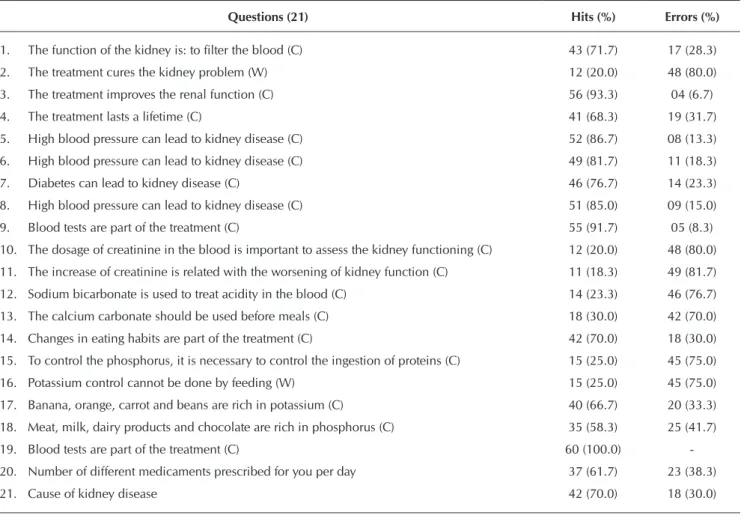
The proportion analysis of hits and errors concerning the knowledge assessment of basic principles of pre-dialytic treat-ment, revealed that the items with the largest proportion of hits were those relating to the use of medications and to the state-ment that the treatstate-ment leads to improvestate-ment of renal function. On the other hand, items related to dosage and to the increased value of creatinine had a higher error proportion (Table 3).
The stratification of knowledge levels showed that most chronic renal patients interviewed have insufficient knowledge (53.4%) about their disease and treatment, followed by moder-ate knowledge (23.3%), enough (13.3%) and good (10.0%).
The average of total hits of the 21 items of the questionnaire was 12.12 ± 3.42 , meaning that 57.7% of the questionnaire was answered correctly. The final assessment of knowledge pointed out that 73.3% of chronic renal patients presented in-sufficient knowledge, that is, hit percentage lower than 70%.
In the simple linear regression model, the sum of knowl-edge was associated with the variables “age, years of school-ing and MMSE score” (Table 4).
Statistically significant variables entered in multiple model by the method of Stepwise Backward Wald. The age was the
greatest influent variable on the total score of knowledge (p =
0.0001), resulting alone in 25.3% on score variation.
Table 2 – Effect of sociodemographic and clinical variables and MMSE score in the TOFHLA total score in the univariate model of 60 patients with chronic kidney disease, assisted in an ambulatory clinic of Nephrology, Goiânia, Goiás, Brazil, 2013-2014
Variables Coefficient of
determination Backward
p
value
Age 0.0134 –0.1028 0.618
Personal Income 0.0068 0.0026 0.538
Years of education 0.1140 0.9894 0.008
Ambulatory treatment time (months) 0.0009 0.0077 0.814
Number of appointments 0.0125 –0.7929 0.599
Number of Comorbidities 0.0072 –1.3562 0.527
Staging of the disease 0.0334 –3.6640 0.158
MMSE Score 0.0077 0.2330 0.512
Table 3 – Proportion of hits and errors of items related to knowledge of chronic kidney disease (correct – C, wrong – W), answered by 60 chronic renal patients in pre-dialytic treatment, assisted in a Nephrology ambulatory clinic at a teaching hospital, Goiânia, Goiás, Brazil, 2013-2014
Questions (21) Hits (%) Errors (%)
1. The function of the kidney is: to filter the blood (C) 43 (71.7) 17 (28.3)
2. The treatment cures the kidney problem (W) 12 (20.0) 48 (80.0)
3. The treatment improves the renal function (C) 56 (93.3) 04 (6.7)
4. The treatment lasts a lifetime (C) 41 (68.3) 19 (31.7)
5. High blood pressure can lead to kidney disease (C) 52 (86.7) 08 (13.3)
6. High blood pressure can lead to kidney disease (C) 49 (81.7) 11 (18.3)
7. Diabetes can lead to kidney disease (C) 46 (76.7) 14 (23.3)
8. High blood pressure can lead to kidney disease (C) 51 (85.0) 09 (15.0)
9. Blood tests are part of the treatment (C) 55 (91.7) 05 (8.3)
10. The dosage of creatinine in the blood is important to assess the kidney functioning (C) 12 (20.0) 48 (80.0)
11. The increase of creatinine is related with the worsening of kidney function (C) 11 (18.3) 49 (81.7)
12. Sodium bicarbonate is used to treat acidity in the blood (C) 14 (23.3) 46 (76.7)
13. The calcium carbonate should be used before meals (C) 18 (30.0) 42 (70.0)
14. Changes in eating habits are part of the treatment (C) 42 (70.0) 18 (30.0)
15. To control the phosphorus, it is necessary to control the ingestion of proteins (C) 15 (25.0) 45 (75.0)
16. Potassium control cannot be done by feeding (W) 15 (25.0) 45 (75.0)
17. Banana, orange, carrot and beans are rich in potassium (C) 40 (66.7) 20 (33.3)
18. Meat, milk, dairy products and chocolate are rich in phosphorus (C) 35 (58.3) 25 (41.7)
19. Blood tests are part of the treatment (C) 60 (100.0)
-20. Number of different medicaments prescribed for you per day 37 (61.7) 23 (38.3)
DISCUSSION
By confirming that the CKD in adults is secondary to hyperten-sion and diabetes, this study follows results of national and
inter-national literature(11,15) and reinforces the need for health
profes-sionals to be vigilant for early identification of markers of renal function damage on groups considered to be at clinic risk, such as
hypertensive and diabetic people(4,15), and also on those with
so-ciodemographic risk factors for CKD such as low education level
and low per capita(3).income. In addition, the population should
be warned that it is an asymptomatic disease in its early stages. The economic implications of the CKD are associated with prevention of work activity in some cases, reduction of working hours, retirement and early exit from the labor market and subse-quent insertion into financial aid programs to the disease, causing readjustments on family dynamics and changes in financial order
to maintain the residence(21). Considering that the elderly
consti-tuted the majority of respondents in this study, work should not just be understood as an income-generating profession, but rather as an activity that allows human beings to feel useful and gives
them a purpose in the context where they are(22).
Besides, experiencing a chronic disease imposes physical, social and emotional limitations which because are occa-sioned by the new condition, directly influence the perception
of the disease(11). Therefore, having family support, as referred
by the respondents, can be considered a positive factor, as it helps the readaptation process to the reality imposed by the
disease(23) as well as in emotional and physical dependence.
Knowledge is the result of information interpretation and its
association with vicarious experiences of each individual(24).
The results of this research, the insufficient knowledge was re-lated to age, cognitive impairment and years of education con-firming the completion of other polls which also indicate that individuals with low schooling and with advanced age
pres-ent insufficipres-ent knowledge about the disease and treatmpres-ent(25).
Age and time of treatment were associated with insufficient
knowledge, although in research with children(13). Different
from the evidence found in this study, time of treatment has also been described as an important variable for perception/
knowledge about the disease(11).
In every consultation, chronic kidney patients are exposed
to information regarding their condition(6), which requires from
them enough cognitive skills of reading and numeracy, so that
information can be processed and result in knowledge(26). The
compromised cognition presented by the members of this study and its association with insufficient knowledge is dis-turbing, at the same time that shows the premise that health services specialized in Nephrology treatment must enlarge their perspective of care, which is still very much centered on
technological dependence and technical procedures(6).
The ignorance of those interviewed about the permanent character of the disease and the belief that the treatment leads to cure of the kidney disease have also been reported
in another study(13). This finding is relevant, because, when
patients does not understand the real sense of the chronicity of the CKD, they can create false expectations, which leads to frustration and discourage them to follow the therapeutic regimen. A research carried out on medicamental adherence of chronic renal patients on dialysis showed that knowledge about the disease and cognitive level may influence on
be-haviors of medicamental adherence(27). Most chronic renal
patients interviewed in this study were hypertensive, so that daily consumption of medicines was part of their daily lives.
This may explain the high percentage of hit in that item(1).
The highest level of education of the current study was responsible for better performance in the FHL test, indicat-ing that reduced readindicat-ing and writindicat-ing skills can limit access to
health information(8,11,28). Considering an assessment tool of
the specific FHL for reading and numeracy skills, people with higher levels of formal education to obtain best results was expected. However, it is important to emphasize that, despite
being a variable of big influence on scores of FHL(28),
hav-ing mastery of numeric and lhav-inguistic code is not essential for
highest levels of literacy(29). Other dimensions of the
phenom-enon should be explored such as access to health services, quality of information offered by health professionals and the communication process between the peers involved.
Although an inappropriate level of FHL have been shown in studies with CKD patients in substitutive renal therapy, and its relation with low level of knowledge about the disease
Table 4 – Effect of sociodemographic and clinical variables and MMSE score in the knowledge total score, in the univariate model, of 60 patients with chronic kidney disease, assisted in a Nephrology ambulatory clinic of Goiânia, Goiás, Brazil, 2013–2014
Variables Coefficient of determination Backward p value
Age 0.2530 –0.1173 0.0001
Personal Income 0.0072 0.0007 0.5250
Years of education 0.3255 0.2507 0.0180
Ambulatory treatment time (months) 0.0001 0.0008 0.9256
Number of appointments 0.0106 0.1919 0.5590
Number of Comorbidities 0.0006 0.0006 0.8450
Staging of the disease 0.0057 –0.3964 0.5740
MMSE Score 0.1906 0.3049 0.0008
have already been highlighted(5), such relation has not been observed in the results of the present study. The small number of participants and the fact that 100% of them present inap-propriate FHL could justify the non association between the variables, however the statistical proximity found (p = 0.052) suggests this association. Although this relation has not been observed, it is important that professionals who assist chronic kidney patients take the level of FHL into consideration, be-cause in general, they tend to overestimate the level of literacy of their patients. This can lead to a gap between the speaker and the receiver, that is, the message ends up lost due to a dealignment between what is spoken and what is understood.
Study limitations
It must be recognized that the investigation of functional health literacy and knowledge of chronic kidney patients in pre-dialytic treatment are still little described by the national literature, so that contextualization of results inside the na-tional panorama turned to be difficult, making the data ob-tained to be mainly descriptive. In addition, the small number of participants in the study limited the achievement of more robust analysis.
Contributions to the field of nursing, health or public policy
The measurement of the FHL is still little explored in Brazil. To include measurement in health practices will allow profes-sionals to intervene on limitations related to access, to under-stand and use information and health services, as well as to
explore/strengthen skills for health decision-making.
CONCLUSION
The results of this study show that chronic renal patients in pre-dialytic treatment present difficulties in processing health information received, transform them into knowledge and so apply them towards self-management of the disease. Even with a limited number of participants, it was confirmed the need to extend research on functional health literacy level of chronic kidney patients in pre-dialytic treatment associated with the knowledge of their disease.
The alert eye of health professionals to the FHL can con-tribute to the resolution of care plans and to delay the entry of patients into modalities of substitutive renal therapies.
This study also signalizes the importance of conducting a national survey to identify the health literacy profile of Brazil-ian population, as it happens in other countries. Such map-ping could subsidize the reformulation of public policies, providing all individuals to access and use information and available health services, minimizing the condition of health vulnerability in which they find themselves.
Important gaps in assistance of chronic renal patients were signalized, related to appropriate intervention strategies to ac-cess limitations, to understand and use information on health. It was possible to notice too little knowledge and skills of pro-fessionals to deal with limited levels of FHL of the population, as well as to work with that fact.
REFERENCES
1. Medeiros MCW, Sá MPC. Adesão dos portadores de doença renal crônica ao tratamento conservador. Rev RENE [Inter-net]. 2011[cited 2015 Jun 10];12(1):65-72. Available from: http://www.revistarene.ufc.br/vol12n1_pdf/a09v12n1.pdf
2. Obrador GT, Mahdavi-Mazdeh M, Collins AJ. Establish-ing the global kidney disease prevention network (KDPN): a position statement from the National Kidney Founda-tion. Am J Kidney Dis [Internet]. 2011[cited 2015 Jun 10];57(3):361-70. Available from: http://www.ajkd.org/ article/S0272-6386(10)01705-1/pdf
3. Bastos MG, Kirsztajn GM. Doença renal crônica: im-portância do diagnóstico precoce, encaminhamento imediato e abordagem interdisciplinar estruturada para melho ra do desfecho em pacientes ainda não submetidos à diálise. J Bras Nefrol. 2011;33(1):93-108.
4. Brasil. Portaria nº 389. Define os critérios para a orga-nização da linha de cuidado da pessoa com doença renal crônica (DRC) e institui incentivo financeiro de custeio destinado ao cuidado ambulatorial pré-dialítico [Internet]. Diário Oficial da União, Brasília, 14 mar. 2014 [cited 2015 Jul 15] Sessão 1, p. 35. Available from: http://sbn. org.br/app/uploads/portaria_n_389-_novas_diretrizes_ clinicas_drc.pdf
5. Green JA, Mor MK, Shields AM, Sevick MA, Arnold RM, Pa-levsky PM, et al. Associations of health literacy with dialysis
adherence and health resource utilization in patients receiv-ing maintenance hemodialysis. Am J Kidney Dis [Internet]. 2013[cited 2015 Jun 10];62(1):73-80. Available from: http:// www.ajkd.org/article/S0272-6386(12)01591-0/abstract
6. Santos L, Mansur HN, Paiva TF, Colugnati FA, Bastos MG. [Health literacy: importance of assessment in ne-phrology]. J Bras Nefrol [Internet]. 2012[cited 2015 Jul 10];34(3):293-302. Available from: http://www.scielo.br/ pdf/jbn/v34n3/v34n3a14.pdf Portuguese.
7. Young B. Health literacy in nephrology: what is it impor-tant? Am J Kidney Dis. 2013;62(1):3-6.
8. Sorensen K, Van den Broucke S, Fullam J, Doyle G, Pelikan J, Slonska Z, et al. Health literacy and public health: a systematic review and integration of definitions and mod-els. BMC Public Health [Internet]. 2012[cited 2015 Jun 10];12(1):1-13. Available from: https://bmcpublichealth. biomedcentral.com/articles/10.1186/1471-2458-12-80
9. Passamai MPB. Letramento funcional em saúde de adul-tos no contexto do sistema único de saúde: um caminho para a promoção da saúde e prevenção de doenças crôni-cas não transmissíveis [Thesis]. Fortaleza: Universidade Estadual do Ceará; 2012.
Kidney Dis [Internet]. 2013[cited 2015 Jun 10];20(4):311-19. Available from: https://www.ncbi.nlm.nih.gov/pmc/articles/ PMC3767572/pdf/nihms-474586.pdf
11. Wright JA, Wallston KA, Elasy TA, Ikizler TA, Cavanaugh KL. Development and results of a kidney disease knowl-edge survey given to patients with CKD. Am J Kidney Dis. 2011;57(3):387-95.
12. Lorig K. Becoming an active self-manager. In: Lorig K, Hol-man H, Sobel D, Laurent D, González V, Minor M, editors. Living a healthy life with chronic conditions: self-manage-ment of heart disease, arthritis, diabetes, depression, asth-ma, bronchitis, emphyseasth-ma, and other physical and mental health conditions. 4. ed. Colorado: Bull Publishing Compa-ny; 2012. p. 15.
13. Canhestro M, Oliveira E, Soares C, Marciano R, Assunção D, Gazzinelli A. Conhecimento de pacientes e familiares sobre a doença renal crônica e seu tratamento conserva-dor. Rev Min Enferm. 2010;14(3):335-44.
14. Gricio TC, Kusumota L, Cândido ML. Percepções e conheci-mento de pacientes com doença renal crônica em trataconheci-mento conservador. Rev Eletron Enferm. 2009;11(4):884-93.
15. Luciano E, Luconi P, Sesso R, Melaragno C, Reis S, Furtado R, et al. Prospective study of 2151 patients with chronic kidney disease under conservative treatment with multidisciplinary care in the Vale do Paraíba, SP. J Bras Nefrol [Internet]. 2012[cited 2015 Jun 10];34(3):226-34. Available from: http:// www.scielo.br/pdf/jbn/v34n3/en_v34n3a03.pdf
16. Condé SAL, Fernandes N, Santos FR, Chouab A, Mota MMEP, Bastos MG. Cognitive decline, depression and quality of life in patients at different stages of chronic kidney disease. J Bras Nefrol [Internet]. 2010[cited 2015 Jun 10];32(3):242-8. Available from: http://www.scielo.br/pdf/jbn/v32n3/en_ v32n3a04.pdf
17. Carthery-Goulart MT, Anghinah R, Areza-Fegyveres R, Bahia VS, Brucki SMD, Damin A, et al. [Performance of a brazil-ian population on the test of functional health literacy in adults]. Rev Saude Publica [Internet]. 2009[cited 2015 Jul 10];43:631-8. Available from: http://www.redalyc.org/artic ulo.oa?id=67240178009 Portuguese.
18. Dahlke AR, Curtis LM, Federman AD, Wolf MS. The mini mental status exam as a surrogate measure of health lit-eracy. J Gen Int Med [Internet]. 2014[cited 2015 Jun 10];29 (4):615-20. Available from: http://link.springer.com/article/ 10.1007%2Fs11606-013-2712-x
19. Brucki SM, Nitrini R, Caramelli P, Bertolucci PH, Okamoto
IH. Sugestões para o uso do mini-exame do estado mental no Brasil. Arq Neuropsiquiatr. 2003;61(3B):777-81.
20. Baker DW, Williams MV, Parker RM, Gazmararian JA, J N. Development of a brief test to measure functional health literacy. Patient Educ Couns. 1999;38:33-42.
21. Godoy MR, Balbinotto-Neto G, Barros PP, Ribeiro EP. Es-timando as perdas de rendimento devido a doença renal crônica no Brasil Divulg Saúde Debate. 2007;38:68-85.
22. Pennafort VPS, Queiroz MVO, Jorge MSB. Children and adolescents with chronic kidney disease in an education-al-therapeutic environment: support for cultural nursing care. Rev Esc Enferm USP [Internet]. 2012[cited 2015 Jun 10];46(5):1057-65. Available from: http://www.scielo.br/pdf/ reeusp/v46n5/en_04.pdf
23. Thomé EGR, Meyer DEE. Mulheres cuidadoras de ho-mens com doença renal crônica: uma abordagem cultural. Texto Contexto Enferm [Internet]. 2011[cited 2015 Jun 10];20(3):303-11. Available from: http://www.scielo.br/pdf/ tce/v20n3/11.pdf
24. Minayo MCS. Qualitative analysis: theory, steps and reli-ability. Cien Saude Colet [Internet]. 2012[cited 2015 Jun 10];17(3):621-26. Available from: http://www.scielo.br/ pdf/csc/v17n3/en_v17n3a07.pdf
25. Tuot DS, Plantinga LC, Hsu C-Y, Jordan R, Burrows NR, Hedgeman E, et al. Chronic kidney disease awareness among individuals with clinical markers of kidney dysfunction. Clin J Am Soc Nephrol. 2011;6(8):1838-44.
26. Jordan JE, Buchbinder R, Osborne RH. Conceptualising health literacy from the patient perspective. Patient Educ Couns. 2010;79(1):36-42.
27. Castro MCM, Aoki MVS, Domingos ES, Coutinho RCS, Silva CF, Couto JL, et al. Determinantes da não-adesão medicamentosa nos pacientes em hemodiálise. J Bras Ne-frol. 2009;31(2):89-95.
28. Osborne R, Batterham R, Elsworth G, Hawkins M, Buch-binder R. The grounded psychometric developement and initial validation of health literacy questionnaire. BMC Public Health [Internet]. 2013[cited 2015 Jun 10];13:1-17. Available from: http://bmcpublichealth.biomedcentral.com/ articles/10.1186/1471-2458-13-658
29. Soares M. Letramento um tema em três gêneros. 3. ed. Belo Horizonte: Autêntica; 2012. 128 p.