Depression is inversely associated with sexual satisfaction
and physical function in men living with HIV/AIDS
Vagner RasoI,II,III,IV, Magdalena Ioana ToleaV, Jorge Simão do Rosário CassebII,III, Alberto José da Silva DuarteII,III, Júlia
Maria D’Andréa GreveI,IV
DOI: 10.5935/MedicalExpress.2016.06.03
I Universidade de Sao Paulo, Faculdade de Medicina, Laboratório de Fisiopatologia Experimental, São Paulo, SP, Brasil;
II Universidade de Sao Paulo Hospital das Clinicas da Faculdade de Medicina, Ambulatório de Imunodeiciências Secundárias, ADEE 3002, São Paulo, SP, Brasil III Universidade de Sao Paulo Laboratório de Investigação em Dermatologia e Imunodeiciências LIM-56, São Paulo, SP, Brasil;
IV Universidade de Sao Paulo, Hospital das Clinicas da Faculdade de Medicina, Instituto de Ortopedia e Traumatologia, Laboratório de Estudos do Movimento,
São Paulo, SP, Brasil;
V Florida Atlantic University, Boca Raton, FL, United States.
OBJECTIVE: To assess the associations between depression and physical itness and function in men living with HIV/AIDS and the role of sexual satisfaction in these associations.
DESIGN: Cross-sectional study conducted with 40 males living with HIV/AIDS (40.75 ± 8.68 years [25-66 yrs. old]) divided in two groups based on CD4+ nadir (low nadir < 200 cells/mm3; high nadir ≥ 200 cells/mm3).
METHODS: Depression was determined by the Beck Depression Inventory. Participants were asked to evaluate their satisfaction with sexual life and their physical itness was assessed by lexibility, muscle strength and peak oxygen uptake (VO2peak). Physical function was measured by time taken to move from seated to standing position (TSSP), time to tie sneakers, and time to walk 3.33 m.
RESULTS: Depression was inversely associated with sexual satisfaction (for low and high CD4+ nadir) and lexibility
(for low CD4+ nadir), and positively associated with walking time (for low CD4+ nadir and total sample), and time
to tie sneakers (for the total sample). Sexual satisfaction was positively associated with muscle strength (for low CD4+ nadir and total sample), but inversely with TSSP (for low CD4+ nadir and total sample), walking time (for low
CD4+ nadir and total sample), and time to tie sneakers (for high CD4+ nadir and total sample).
CONCLUSION: Findings suggest a negative association between depression and physical function regardless of retrospective clinical status of men living with HIV/AIDS and a potential role for sexual satisfaction in explaining this association.
KEYWORDS: AIDS; Lymphocytes; Depression; Physical function; Physical itness; Sexual behavior.
Raso V, Tolea MI, Casseb JSR, Duarte AJS, Greve JMA. Depression is inversely associated with sexual satisfaction and physical function in men living with HIV/AIDS. MedicalExpress (São Paulo, online). 2016;3(6):M160603
Received for Publication on July 30, 2016; First review on August 23, 2016; Accepted for publication on November 29, 2016; Online on
December 21, 2016
E-mail: [email protected]
■
INTRODUCTIONHIV infection per se causes a profound deleterious impact on phenotype, function and number of CD4+ cells,1 which represent some of the most important indicators to guide therapeutic strategies in individuals living with HIV/ AIDS.2 The lowest CD4+ cell count, or CD4+ nadir, disrupts the
balance among functional subsets of peripheral CD4+ cells.1 A count lower than 200 cells·mm3has been independently
associated with negative health outcomes including more aggressive viral hepatitis C in co-infected individuals,3 carotid atherosclerosis,4 neurocognitive impairment5 and
disease progression6 although mainly in pregnant women.7 Moreover, it has also been observed that an incomplete immunological reconstitution, i.e., the inability to restore CD4+ count to more than 200 cells·mm3 substantially
peripheral nervous system disorders; (3) musculoskeletal problems; or (4) cardiopulmonary or metabolic disorders. Other exclusions included cigarette smoking, surgery or bed rest in the previous three months, and any orthopedic conditions that could limit or which could be exacerbated with exercise testing. Forty volunteers aged 25 to 66 were selected for inclusion. All volunteers were informed about the procedures and risks before giving written consent. This study was approved by the research ethics committee of the institution.
Depression
The Beck depression inventory was used to measure level of depressive symptomatology.27 The instrument is a 21-item, self-reported questionnaire designed to detect and quantify depression symptoms. Each item lists four statements arranged in increasing severity about a particular symptom of depression, and the continuous scores were used in the analysis.
Sexual satisfaction
Sexual satisfaction was determined by asking participants to evaluate their level of satisfaction with their sexual life.28 Answers were measured on a five-point Likert
scale scoring from very unsatisfied (1) to very satisfied (5).
Cardiopulmonary parameters
Peak oxygen uptake (VO2peak) was directly measured
breath-to-breath through a modified Heck protocol during
cardiopulmonary exercise testing on a treadmill using an automated gas analyzer (CPX/D, Medgraphics, Saint Paul, MN, USA). During cardiopulmonary testing, the subjects’ respiratory exchange ratio (RER), blood pressure, and cardiac function (by a 12-lead electrocardiogram) were constantly monitored. The incremental protocol consisted of an initial walking velocity of 3.6 km.h-1 with treadmill gradient at 1%. At every minute velocity was increased by 1.2 km.h-1 until volitional exhaustion was reached. The gas exchange data were obtained every 30 seconds, and gas analyzers were calibrated before each stress test in
relation to room air and medically-certified calibration
gases (11.9% and 20.9% O2 and 5.12% CO2, respectively), balanced with nitrogen according to the manufacturer’s instructions. VO2peak was achieved when the following
criteria were satisfied: 1) respiratory exchange ratio > 1.10;
2) age-specific maximum predicted heart rate; 3) volitional
fatigue; and 4) subjective signs of exhaustion toward the
end test (unsteady gait, hyperpnea, sweating, facial flushing,
and grimacing).29
Muscle strength
Muscle strength was determined by isokinetic dynamometer (Biodex Multi-Joint System3, Shirley, NY). Participants performed a 5-minute walking warm-up on a In parallel, depression may occur following the
diagnosis of HIV and commonly persists throughout HIV/ AIDS therapy.9 Generally, depressive symptoms have been associated with lipodistrophy syndrome,10 disability,11 and tend to become more prevalent as the disease progresses,12 especially among those individuals with low nadir (i.e., CD4+ < 200 cells).9,13 Health-related quality of life14 as well as sexual disturbances15,16 are also negatively influenced by psychological factors, which seem to represent the most important contributors to feelings of unattractiveness as well as to diminished interest, sexual desire or satisfaction in individuals living with HIV/AIDS.15,16
Depression per se17 or associated with fatigue18 is related to physical limitations to perform activities of
daily living. A significant proportion of individuals living
with HIV/AIDS experiences impairments with self-care (65%)19 and mobility (40%).20 Sensorimotor abnormalities have been shown to contribute to impaired mobility21 and neuromuscular function20 as well as reduced aerobic power22 and may therefore be responsible for mobility limitations in individuals living with HIV/AIDS. Nevertheless, it is possible that a co-dependent bidirectional association exists between HIV and mobility dysfunction especially with disease progression (i.e., CD4+ < 200 cells).23,24 Although the importance of sexual disturbances in this process is unclear, a low level of sexual satisfaction is associated
with depression risk, fatigue, poor diet and insufficient
physical activity in people with multiple sclerosis.25 Major depressive disorder has been associated with decreased sexual interest and arousal; in addition, individuals without sexual satisfaction, also had a poor quality of life.26 This suggests that sexual satisfaction mediates some effects on health outcomes. Therefore, the purpose of this study was to investigate associations between depression and physical
fitness and physical function in men living with HIV/AIDS
according to CD4+ nadir and the role that sexual satisfaction might play in these associations.
■
METHODVolunteers
Male volunteers living with HIV/AIDS were recruited from an outpatient ambulatory clinic. Fifty-six interested volunteers were contacted by telephone for a preliminary screening focused on their current health status, drugs and cigarette use, and current physical activity level. They were then invited to the hospital for tests including a standard history and physical examination that considered current and past detailed health status, a 12-lead electrocardiogram, depression symptoms, self-reported capability to perform basic and instrumental activities of daily living, body composition, and general laboratory blood and urine tests.
Volunteers were excluded if they had: (1) acute or chronic
treadmill at a velocity ranging from 3.6 to 5.0 km.h-1 with
a fixed 1% inclination. Three sub-maximal warm-up trials
preceded maximal muscle actions at each velocity, and a 2-minute rest period was allowed between tests at each velocity. After the instruction and familiarization trials, the test protocol began with each volunteer performing
knee flexion and extension in the velocities of 60º·s-1 (five repetitions) with each lower extremity, and the highest
level of torque reached by the dominant leg in the five
repetitions was considered (peak torque). We initially instructed participants to push and pull as hard and fast as possible and provided verbal encouragement during testing for motivation.30
Flexibility
Flexibility was measured by a sit-and-reach test.
Subjects were asked to sit on the floor, with their legs
straight and their feet against a Wells-type sit-and-reach box, and then reach forward with their arms as far as possible along a measuring tape running across the box. They were then asked to bend forward slowly and reach as far forward as possible. The best of two trials was considered in the analysis.29
Physical function
Physical function was determined using three tests. Participants were asked to stand up from a seated position three times and time to stand in each trial was considered (chair stand time). The time needed to tie shoes was also recorded. Participants were asked to tie their shoes from a seated position, i.e., each participant sat on a chair with the knees and ankles laterally away according to the width
shoulders, and each shoe beside of the respective foot. Lastly,
the time to walk 3.33 meters in a usual speed was measured
(walking time) in two trials. Briefly, volunteers were
instructed to perform each test as fast as possible (except for walking time), and the best result was used in the analysis.
Blood collection
Volunteers were instructed not to ingest solid or liquid food containing caffeine, chocolate, or cola-based products 48 hours prior to the blood collection. They were also informed not to participate in any exercise sessions and not to perform any moderate or vigorous physical activity 48 h before blood sampling. Participants were asked to
report to the laboratory at 7:00 a.m. after having fasted
overnight. After a 30-min rest period in the sitting position, antecubital venous blood samples were obtained. Blood samples were analyzed on a Cell-Dyn 3500 cell analysis
system (Coulter Corp., Miami, FL).
Flow cytometry
Two hundred microliters of whole blood were
incubated with five microliters of monoclonal antibodies
(CD4+, CD8+ [Becton-Dickinson, Miami, FL]). Whole-blood aliquots with appropriate MAbs were incubated at room temperature in the dark for 20 minutes. Samples
with isotypic control antibodies (IgG1[FITC]/IgG1[PE]/
IgG1[PCy-5) were run in parallel with each sample. A
minimum of 5000 cells were analyzed on a Coulter XL-MCL (Coulter Corp., Miami, FL), and data analyses were
performed using XL System II software. CD4+ lymphocytes
nadir was considered as the lowest count of CD4+ showed by each volunteer during whole infection history according to their medical records. Subsequently, and on the basis of their history, participants were separated in CD4+ nadir < 200 cells/mm3 (n=18) or CD4+nadir > 200 cells/ mm3 (n=22). This cutoff point (CD4+ nadir of < 200 cells/ mm3) has been associated with a higher risk for disease progression.6 From here onwards the 18 participants with CD4+nadir < 200 cells/mm3 will be called as low nadir; the 22 participants with CD4+nadir > 200 cells/mm3 will be called as high nadir.
Statistical Analysis
The Kolmogorov-Smirnov test was used to analyze data normality. Unpaired Student t-test was employed to compare low nadir vs high nadir participants on different
variables (age [chronological age], body weight [total body mass], body height [total height in standing position],
body mass index [body weight / body height2], depression
symptoms, sexual satisfaction, physical fitness, physical
function and immunological parameters). Stepwise multiple regression analysis was employed to investigate associations between depression and sexual satisfaction,
and different measures of physical fitness and physical
function.All analyses were performed using the Predictive Analytics Software 17.0 for Windows package (PASW, Inc.,
Chicago, IL). Statistical significance was determined using
the standard p level of < 0.05.
■
RESULTSHomosexual (N=15 [37%]), heterosexual (N=17
[43%]) and bisexual (N=8 [20%]) represent the categories
of HIV infection risk. The average time since infection diagnosis was 6.1 ± 0.8 years, while the average time since the volunteers developed AIDS was 6.0 ± 0.9 years. Eighteen volunteers received highly active antiretroviral therapy
(HAART). Mean time of HAART was 4.5 ± 0.7 years (range:
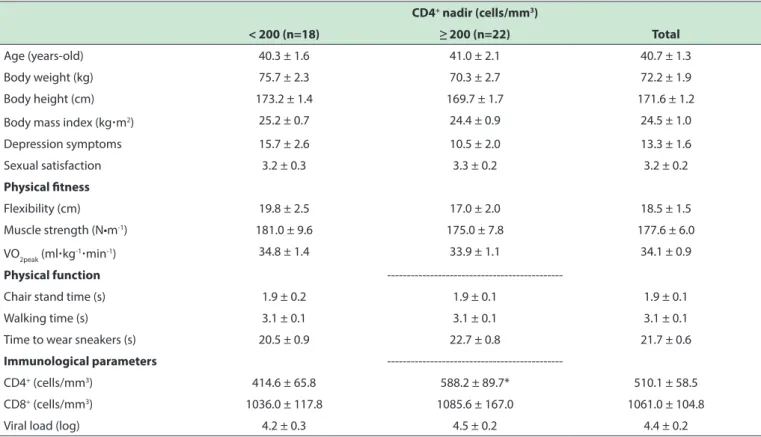
2 to 16 years). Mean adherence to HAART was 9.2 ± 0.3 (0 to 10 scale). CD4+ cell count was significantly higher in high
nadir versus low nadir (Table 1), but no other significant
differences were found between the two groups.
The associations of depression and sexual satisfaction with the various measured parameters
Table 1 - General characteristics, physical itness, physical function, and immunological parameters according to the CD4+ nadir1.
CD4+ nadir (cells/mm3)
< 200 (n=18) ≥ 200 (n=22) Total
Age (years-old) 40.3 ± 1.6 41.0 ± 2.1 40.7 ± 1.3
Body weight (kg) 75.7 ± 2.3 70.3 ± 2.7 72.2 ± 1.9
Body height (cm) 173.2 ± 1.4 169.7 ± 1.7 171.6 ± 1.2
Body mass index (kg·m2) 25.2 ± 0.7 24.4 ± 0.9 24.5 ± 1.0
Depression symptoms 15.7 ± 2.6 10.5 ± 2.0 13.3 ± 1.6
Sexual satisfaction 3.2 ± 0.3 3.3 ± 0.2 3.2 ± 0.2
Physical itness
Flexibility (cm) 19.8 ± 2.5 17.0 ± 2.0 18.5 ± 1.5
Muscle strength (N•m-1) 181.0 ± 9.6 175.0 ± 7.8 177.6 ± 6.0
VO2peak (ml·kg-1·min-1) 34.8 ± 1.4 33.9 ± 1.1 34.1 ± 0.9
Physical function
---Chair stand time (s) 1.9 ± 0.2 1.9 ± 0.1 1.9 ± 0.1
Walking time (s) 3.1 ± 0.1 3.1 ± 0.1 3.1 ± 0.1
Time to wear sneakers (s) 20.5 ± 0.9 22.7 ± 0.8 21.7 ± 0.6
Immunological parameters
---CD4+ (cells/mm3) 414.6 ± 65.8 588.2 ± 89.7* 510.1 ± 58.5
CD8+ (cells/mm3) 1036.0 ± 117.8 1085.6 ± 167.0 1061.0 ± 104.8
Viral load (log) 4.2 ± 0.3 4.5 ± 0.2 4.4 ± 0.2
1 Data are presented as mean ± SD with diferences between the two CD4+ nadir groups tested with unpaired T test (*p<0.05); VO
2peak: peak oxygen consumption.
Table 2 - Association of depressive symptoms and sexual satisfaction with physical itness and function according to CD4+ nadir.
Depression symptoms Sexual satisfaction
CD4+ nadir (cells/mm3) CD4+ nadir (cells/mm3)
< 200 ≥ 200 Total < 200 ≥ 200 Total
Sexual satisfaction -0.080 (0.024)* -0.059 (0.024)* -0.069 (0.015)* —— —— ——
Flexibility -0.583 (0.207)* 0.024 (0.266) -0.197 (0.165) 2.789 (1.910) -1.140 (2.117) 0.800 (1.400)
Muscle strength -0.378 (1.112) -1.205 (1.432) -0.135 (0.093) 5.461 (8.881) 25.316 (10.300)* 13.459 (6.577)*
VO2peak -0.224 (0.135) -0.022 (0.152) -0.789 (0.811) 0.638 (1.263) 0.961 (1.199) 0.938 (0.828)
TSSP 0.027 (0.022) 0.012 (0.013) 0.017 (0.012) -0.447 (0.143)* -0.156 (0.104) -0.301 (0.090)*
Walking time 0.021 (0.009)* -0.0001 (0.009) 0.016 (0.007)* -0.215 (0.063)* -0.105 (0.071) -0.180 (0.052)*
Time to tie sneakers 0.124 (0.099) 0.177 (0.104) 0.145 (0.065)* -0.592 (0.808) -1.867 (0.819)* -1.213 (0.554)*
*p<0.05; Results are presented as beta (standard error); TSSP: time taken to move from seated to standing position
lower sexual satisfaction (β=-0.069 [SE=0.015; p<0.05])
regardless of CD4+ nadir status; (b) lower flexibility and higher walking time in the low nadir group; and (c) with higher time to tie sneakers only when the association was assessed in the larger sample. Table 2 also shows the associations of sexual satisfaction with the same outcome parameters. This was associated with higher muscle strength and lower time to tie sneakers among the high nadir subjects and with poorer TSSP and walking time in the low nadir group.
■
DISCUSSIONOur study provides evidence that the association between depression and physical function observed in the general population32-36 is also present in HIV/AIDS patients. Depressed males living with this chronic condition are more
likely to present a poor physical function profile. Moreover,
although a more formal mediation analysis is needed before
sexual satisfaction is identified as an adequate mediator, our findings suggest that sexual satisfaction may play a
of visceral adipose tissue (e.g., inducing aromatization of testosterone on estrogen), and peripheral and autonomic neuropathy (e.g., inducing disturbances of neural pathway on tissue stimulation and sensitivity, as well as local circulation)
generally caused by HAART, may have a significant impact
on sexual satisfaction.41-44 On the other hand, it has been
demonstrated that there is no significant relationship between diminished sexual desire and deficient levels of
testosterone, dehydroepiandrosterone or mood disorders, but
sexual desire disturbances have been significantly associated
with depressive symptoms.16 It follows that psychological factors as well as route of infection might be more important than disease related factors (e.g., CD4+ cell counts, disease stage).15,16 Our study findings support this hypothesis as we
did not find any statistically significant differences in sexual
satisfaction when volunteers were analyzed by the presence of lipodystrophy syndrome regardless of CD4+ nadir (data not shown).
However, although it could also be possible that the knowledge of HIV infection has an important effect on the psyche, and long-term HAART might additionally have negative psychological effects on sexual health41, the relationship between depression and sexual satisfaction is a complex process.45 It has been suggested that depressive symptoms could induce a pronounced sexual inhibition in some men, but others with elevated excitatory tone could respond with a heightened sexual responsiveness, suggesting a dual control mechanism constituted by different degrees of sexual excitation and inhibition46 that appear to occur regardless of HAART,47 and also, most possibly, independently of CD4+ nadir.
In the same way, our findings regarding the
associations between depression, sexual satisfaction
disturbances, and physical fitness and physical function
could be interpreted to suggest complex interactions among behavioral, psychological and biological factors mediated by mood states changes and social support,11,48 chronic activation of hypothalamic-pituitary-adrenal axis,49 and
synthesis and concentration imbalance of pro-inflammatory
cytokines.50 Therefore, depression is inversely associated with sexual satisfaction, and either depression or sexual
satisfaction also has a negative impact on physical fitness
and physical function regardless of retrospective clinical status of men living with HIV/AIDS. Most possibly, these
findings suggest that programs for detection and treatment
of depression, as well as those addressing issues of sexual satisfaction may have the potential to improve the physical function of men living with HIV/AIDS regardless of the stage in the disease process.
The small sample size, inclusion of men only, and the lack of control for potential confounders represent limitations of this study and, consequently, should be considered when replicating this study design.
physical function indicators (e.g. walking time, time to tie sneakers) in men living with HIV/AIDS. This possible mediating effect of sexual satisfaction on the association between depression and physical function in this select group should be examined more formally in future
studies. Confirmation of this pathway would suggest that
interventions to maintain physical function in men living
with HIV/AIDS might benefit from incorporating strategies
to treat depression, particularly those that address sexual satisfaction in this patient group. Furthermore, although the nadir level appears to moderate the associations between depression, sexual satisfaction and walking time, this trend was not consistent across all measures of physical
function/fitness. Further investigation is needed before
an interaction between retrospective clinical status and depression in relation to physical function in HIV/AIDS patients may be suggested.
Moreover, the results observed for flexibility, muscle
strength, and VO2peak, as well as for time to move from seated to standing position, walking time, and time to tie sneakers were similar for volunteers with low and highnadir; this suggests that retrospective clinical status per se does not seem to represent an important factor that negatively
influences physical fitness or physical function over a
long-term period. Nevertheless, although it appears that nadir level may not play a role in the studied associations, the patterns are not consistent enough to make a clear statement. Further investigation is needed.
Presence of physical impairments has been shown to restrict engagement in activities of daily living.36-40 This seems to apply more to instrumental activities of daily living
(IADL) than to basic ADL, but both of them are associated
with CD4+ cells counts.39 Our results show that those activities which require an elevated metabolic demand (i.e., chair stand time and walking time) were related to depression and sexual satisfaction especially in volunteers with low nadir. Nevertheless, an association with time to tie sneakers, an activity with a low metabolic demand was also noted. It is possible that lifestyle changes promote a cascade of events characterized by psychosocial, cognitive, and physical disturbances that mentally and physically disable the
individuals to perform ADL, which associated to isolation
and depression, could diminish the opportunities for social interaction and independent living, and may contribute to disease progression.11 For example, presence of limitations in
performing ADL is significantly associated with lower quality
of life and higher risk of death, particularly in patients with advanced HIV disease.38 Moreover, ADL limitations have been shown to predict mortality better than CD4+.40
Sexual disturbances seem to be differently influenced
■
CONCLUSIONIn conclusion, our findings suggest a negative
association between depression and physical function regardless of retrospective clinical status of men living with HIV/AIDS and a potential role for sexual satisfaction in explaining this association.
■
CONFLICT OF INTERESTThe authors declare that they have no conflict of
interest with respect to this project.
■
AUTHOR CONTRIBUTIONStudy concept and design: Raso V. Acquisition of data: Raso V. Analysis and interpretation of data: Raso V and Tolea M. Drafting of the manuscript: Raso V and Tolea M.
Critical revision of the manuscript for important intellectual
content: Casseb JSR, Greve JMD, Raso V and Tolea M. Statistical analysis: Raso V. Administrative, technical, or material support: Casseb JSR, Duarte AJS and Greve JMD. Study supervision: Casseb JSR, Duarte AJS and Greve JMD.
A DEPRESSÃO ASSOCIA-SE INVERSAMENTE COM SATISFAÇÃO O SEXUAL E FUNÇÃO FÍSICA EM HO-MENS POSITIVOS PARA HIV/AIDS
OBJETIVO: Analisar as associações entre depressão
eaptidão e função físicasem homens vivendo com HIV/
AIDS, e o papel da satisfação sexual nessas associações.
MÉTODOS: Estudo transversal conduzido com 40
homens vivendo com HIV/AIDS (40,75 ± 8,68 anos [25-66
anos de idade]) divididos em dois grupos de acordo com o
nadir de CD4+ (nadir baixo < 200 células/mm3; nadir alto ≥ 200 células/mm3). A depressão foi estimada pelo inventário
de depressão de Beck. Os participantes auto-classificaram
sua satisfação sexual. A aptidão física foi avaliada por meio
da flexibilidade, força muscular e consumo de oxigênio de
pico (VO2pico). A função física foi mensurada pelo tempo para
levantar-se de uma posição sentada (TLPS), tempo para amarrar o tênis, e tempo para caminhar 3,33 m.
RESULTADOS: A depressão foi inversamente
associada com satisfação sexual (para nadir baixo e alto) e
flexibilidade (para nadir baixo), e positivamente associada
com tempo de caminhada (para nadir baixo e amostra
total), e tempo para calçar e amarrar o tênis (amostra
total). A satisfação sexual foi positivamente associada com força muscular (para nadir alto e amostra total), mas
inversamente com TLPS (para nadir baixo e amostra total),
tempo de caminhada (para nadir baixo e amostra total),
e tempo para calçar e amarrar o tênis (para nadir alto e
amostra total).
CONCLUSÃO: Os dados sugerem que existe associação
negativa entre depressão e função física independente do
quadro clinico retrospectivo de homens vivendo com HIV/ AIDS, e que parece existir, potencialmente, um papel para a satisfação sexual como explicação para essa associação.
PALAVRAS-CHAVE: AIDS; Aptidão física; Depressão; Função física; Linfócitos; Comportamento sexual.
■
REFERENCES1. Sakai K, Gatanhara H, Takata H, Oka S, Takiguchi M. Comparison of CD4(+) T-cell subset distribution in chronically infected HIV(+)
pa-tients with various CD4 nadir counts. Microbes Infect. 2010;12(5):374-81. http://dx.doi.org/10.1016/j.micinf.2010.01.013.
2. Boschi A, Tinelli C, Ortolani P, Arlotti M. Factors predicting the time for CD4 T-cell count to return to nadir in the course of CD4-guided
therapy interruption in chronic HIV infection. HIV Med. 2008;9(1):19-26. http://dx.doi.org/10.1111/j.1468-1293.2008.00522.x.
3. Rauch A, Gaudieri S, Evison J, Nolan D, Cavassini M, Weber R, et al.
Low current and nadir CD4+ T-cell counts are associated with higher
hepatitis C virus RNA levels in the Swiss HIV cohort study. Antivir Ther
2008;13(3):455-60.
4. Kaplan RC, Kingsley LA, Gange SJ, Benning L, Jacobson LP, Lazar J, et al. Low CD4+ T-cell count as a major atherosclerosis risk factor in HIV-infected women and men. AIDS. 2008 Aug 20;22(13):1615-24. http://dx.doi.org/10.1097/QAD.0b013e328300581d.
5. Muñoz-Moreno JA, Fumaz CR, Ferrer MJ, Prats A, Negredo E, Garolera M, et al. Nadir CD4 cell count predicts neurocognitive impairment in
HIV-infected patients. AIDS Res Hum Retroviruses. 2008;24(10):1301-7. http://dx.doi.org/10.1089/aid.2002008;24(10):1301-7.0310.
6. Miller V, Mocroft A, Reiss P, Katlama C, Papadopoulos AI, Katzenstein T, et al. Relations among CD4 lymphocyte count nadir, antiretroviral
the-rapy, and HIV-1 disease progression: results from the EuroSIDA study. Ann Intern Med 1999;130(7):570-7.
http://dx.doi.org/10.7326/0003-4819-130-7-199904060-00005
7. Brown ER, Otieno P, Mbori-Ngacha DA, Farquhar C, Obimbo EM, Nduati R, et al. Comparison of CD4 cell count, viral load, and other markers for the prediction of mortality among HIV-1-infected Kenyan
pregnant women. J Infect Dis. 2009;199(9):1292-300. http://dx.doi.
org/10.1086/597617.
8. Engsig FN, Gerstoft J, Kronborg G, Larsen CS, Pedersen G, Røge B, et al. Long-term mortality in HIV patients virally suppressed for more than three years with incomplete CD4 recovery: A cohort study. BMC Infect Dis. 2010;10:318. http://dx.doi.org/10.1186/1471-2334-10-318.
9. Cook JA, Grey D, Burke J, Cohen MH, Gurtman AC, Richardson JL, et al.
Depressive symptoms and AIDS-related mortality among a multisite
cohort of HIV-positive women. Am J Public Health 2004;94(7):1133-40. http://dx.doi.org/10.2105/AJPH.94.7.1133
10. Crane HM, Grunfeld C, Harrington RD, Uldall KK, Ciechanowski
PS, Kitahata MM. Lipoatrophy among HIV-infected patients is as -sociated with higher levels of depression than lipohypertrophy.
HIV Med 2008;9(9):780-6.
http://dx.doi.org/10.1111/j.1468-1293.2008.00631.x
11. Roubenoff R. Acquired immunodeficiency syndrome wasting, functio
-nal performance, and quality of life. Am J Manag Care
2000;6(9):1003-16.
12. Leserman J. Role of depression, stress, and trauma in HIV disease progression. Psychosom Med. 2008;70(5):539-45. http://dx.doi.
org/10.1097/PSY.0b013e3181777a5f.
13. Leserman J, Pence BW, Whetten K, Mugavero MJ, Thielman NM, Swartz
14. Préau M, Marcellin F, Carrieri MP, Lert F, Obadia Y, Spire B, et al.
Health--related quality of life in French people living with HIV in 2003: results from the national ANRS-EN12-VESPA Study. AIDS 2007;1:S19-27. http://dx.doi.org/10.1097/01.aids.0000255081.24105.d7. 15. Florence E, Schrooten W, Dreezen C, Gordillo V, Nilsson Schönnesson L,
Asboe D, et al. Prevalence and factors associated with sexual
dysfunc-tion among HIV-positive women in Europe. AIDS Care 2004;16(5):550-7. http://dx.doi.org/10.1080/09540120410001716333.
16. B ova C , D u ra n t e A . S e xu a l f u n c t i o n i n g a m o n g H I V i n
-fected women. AIDS Patient Care and STDs 2003;17:75-83. doi:10.1089/108729103321150809. .
17. Goggin K, Engelson ES, Rabkin JG, Kotler DP. The relationship of
mood, endocrine, and sexual disorders in human immunodeficiency virus positive (HIV+) women: An exploratory study. Psychosom Med 1998(1);60:11-16.
18. O’Brien KK, Bayoumi AM, Strike C, Young NL, Davis AM. Exploring disa
-bility from the perspective of adults living with HIV/AIDS: development of a conceptual framework. Health Qual Life Outcomes 2008(1);6:76. http://dx.doi.org/10.1186/1477-7525-6-76.
19. Ferrando S, Evans S, Goggin K, Sewell M, Fishman B, Rabkin J. Fatigue
in HIV illness: relationship to depression, physical limitations, and disability. Psychosom Med 1998(6);60:759-64.
20. Gaidhane AM, Zahiruddin QS, Waghmare L, Zodpey S, Goyal
RC, Johrapurkar SR. Assessing self-care component of
activi-ties and participation domain of the international classification
of functioning, disability and health (ICF) among people living
with HIV/AIDS. AIDS Care 2008;20(9):1098-104. http://dx.doi.
org/10.1080/09540120701808820.
21. Van As M, Myezwa H, Stewart A, Maleka D, Musenge E. The
Inter-national Classification of Function Disability and Health (ICF) in
adults visiting the HIV outpatient clinic at a regional hospital in
Jo-hannesburg, South Africa. AIDS Care 2009;21(1):50-8. http://dx.doi.
org/10.1080/09540120802068829.
22. Bauer LO, Ceballos NA, Shanley JD, Wolfson LI. Sensorimotor dysfunc
-tion in HIV/AIDS: effects of antiretroviral treatment and comorbid psychiatric disorders. AIDS 2005;19(5):495-502. http://dx.doi.
org/10.1097/01.aids.0000162338.66180.0b.
23. Cade WT, Peralta L, Keyser RE. Aerobic exercise dysfunction in human immunodeficiency virus: a potential link to physical disability. Phys Ther 2004;84(7):655-64.
24. Hanass-Hancock J, Nixon SA. The fields of HIV and disability:
past, present and future. J Int AIDS Soc 2009;12:28. http://dx.doi.
org/10.1186/1758-2652-12-28
25. Marck CH, Jelinek PL, Weiland TJ, Hocking JS, De Livera AM, Taylor KL, et al. Sexual function in multiple sclerosis and associations with demographic, disease and lifestyle characteristics: an international cross-sectional study. BMC Neurol 2016; 16:210. http://dx.doi.
org/10.1186/s12883-016-0735-8
26. Thakurta RG, Singh OP, Bhattacharya A, Mallick AK, Ray P, Sen S, Das R. Nature of sexual dysfunctions in major depressive disorder and its
impact on quality of life. Indian J Psychol Med. 2012 Oct;34(4):365-70. http://dx.doi.org/10.4103/0253-7176.108222
27. Beck AT, Ward CH, Mendelson M, Mock J, Erbaugh J. An inventory of
measuring depression. Arch Gen Psychiatry 1961;4:561-71. 28. WHOQOL-HIV Group. Preliminary development of the World Health
Organization’s Quality of Life HIV instrument (WHOQOL-HIV): analysis of the pilot version. Soc Sci Med 2003;57(7):1259-75. http://dx.doi.
org/10.1016/S0277-9536(02)00506-3.
29. Thompson WR, Gordon NF, Pescatello LS. ACSM’s guidelines for exer
-cise testing and prescription. 8th edition. Philadelphia: Wolter Kluwer,
2009.
30. Kraemer WJ, Fry AC. Strength testing: development and evaluation
of methodology. In Peter J. Maud and Carl Foster. Physiological As-sessment of Human Fitness. Champaign, Illinois, Human Kinetics
1995:115-38.
31. Atlantis E, Baker M. Obesity effects on depression: systematic review of epidemiological studies. Int J Obes 2008;32(6):881-91. http://dx.doi.
org/10.1038/ijo.2008.54.
32. Brunoni AR, Lopes M, Fregni F. A systematic review and meta
--analysis of clinical studies on major depression and BDNF levels:
implications for the role of neuroplasticity indepression. Int J
Neurop-sychopharmacol 2008;11(8):1169-80. http://dx.doi.org/10.1017/
S1461145708009309
33. Menselson T, Rehkopf DH, Kubzansky LD. Depression among Latinos in the United States: a meta-analytic review. J Consult Clin Psychol
2008;76(3):355-66. http://dx.doi.org/10.1037/0022-006X.76.3.355
34. Schillerstrom JE, Royall DR, Palmer RF. Depression, disability and
intermediate pathways: a review of longitudinal studies in elders. J Geriatr Psychiatry Neurol 2008;21(3):183-97. http://dx.doi.
org/10.1177/0891988708320971.
35. A l e x o p o u l o s G S . D e p r e s s i o n i n t h e e l d e r l y. L a n c e t
2005;365(9475):1961-70.
http://dx.doi.org/10.1016/S0140-6736(05)66665-2
36. Bedell G. Daily life for eight urban gay men with HIV/aids. Am J
Occup Therapy 2000;54(2):197-206. http://dx.doi.org/10.5014/
ajot.54.2.197
37. Smith MY, Rapkin BD. Unmet needs for help among
per-sons with AIDS. AIDS Care 1995;7(3):353-63. http://dx.doi.
org/10.1080/09540129550126560
38. Stanton DL, Wu AW, Moore RD, Rucker SC, Piazza MP, Abrams JE, et
al. Functional status of persons with HIV infection in an ambulatory
setting. J Acquir Immune Defic Syndr 1994;7(10):1050-6.
39. Rusch M, Nixon S, Schilder A, Braitstein P, Chan K, Hogg RS.
Impair-ments, activity limitations and participation restrictions: Prevalence
and associations among persons living with HIV/AIDS in British
Columbia. Health Qual Life Outcomes 2004:2:46-55. http://dx.doi.
org/10.1186/1477-7525-2-46
40. Justice AC, Aiken LH, Smith HL, Turner BJ. The role of functional sta
-tus in predicting inpatient mortality with AIDS: A comparison with current predictors. J Clin Epidemiol 1996;49(2):193-201. http://
dx.doi.org/10.1016/0895-4356(95)00546-3
41. Hoffmann C, Rockstroh JK, Kamps BS. HIV Medicine. 15st edition, Flying Publisher, 2007.
42. Goldmeier D, Scullard G, Kapembwa M, Lamba H, Frize G. Does incre
-ased aromatase activity in adipose fibroblasts cause low sexual desire in patients with HIV lipodystrophy? Sex Transm Inf 2002;78:64-66. http://dx.doi.org/10.1136/sti.78.1.64
43. Siddiqi NA, Shaikh RN, Ali ST. Assessment of neuropathic factor in
HIV associated impotence: penile electrodiagnosis. Acta Physiol Hung 1996;84(1):73-80.
44. Ali ST, Shaikh RN, Siddiqi A. HIV-1 associated neuropathies in
males: impotence and penile electrodiagnosis. Acta Neurol Belg 1994;94(3):194-9.
45. Bradley MV, Remien RH, Dolezal C. Depression symptoms and sexual HIV risk behavior among serodiscordant couples.
Psycho-som Med 2008;70(2):186-91. http://dx.doi.org/10.1097/
PSY.0b013e3181642a1c
46. Bancroft J, Janssen E. The dual control model of male sexual
respon-se: a theoretical approach to centrally mediated erectile dysfunc
-tion. Neurosci Biobehav Rev 2000;24(5):571-9. http://dx.doi.
org/10.1016/S0149-7634(00)00024-5
47. Siegel K, Schrimshaw EW, Lekas H-M. Diminished sexual activity,
interest, and feelings of attractiveness among hiv-infected women in
two eras of the AIDS epidemic. Arch Sex Behav 2006;35(4):437-49. http://dx.doi.org/10.1007/s10508-006-9043-5
48. Leserman J, Petitto JM, Golden RN, Gaynes BN, Gu H, Perkins DO, et al.
Impact of stressful life events, depression, social support, coping, and
cortisol on progression to AIDS. Am J Psychiatry 2000;157(8):1221-8. http://dx.doi.org/10.1176/appi.ajp.157.8.1221
49. Venkataraman S, Munoz R, Candido C, Witchel SF. The hypothalamic--pituitary-adrenal axis in critical illness. Rev Endocr Metab Disord
2007;8(4):365-73. http://dx.doi.org/10.1007/s11154-007-9058-9 50. Connolly NC, Riddler SA, Rinaldo CR. Proinflammatory cytokines in
HIV disease - A review and rationale for new therapeutic approaches.