ABSTRACT:Introduction: The prevalence of occupational accidentsis very high in Brazil, having impacts
on the health system and social security. This requires prevention, which must start with students of the Basic Education.Objectives:The knowledge on this kind of accidents among children and adolescents studying in an area near a sanitary landill was evaluated, before and after the development of activities on health education.
Methods: A cross-sectional study was conducted in 2013 and included the application of the same questionnaire among students from a school in Cuiabá-MT, Brazil, before and after educational health activities related to the deinition of occupational accidents.Univariate analyses of absolute and relative frequencies and bivariate analyses using the χ2 Test and Fisher’s Exact Test were performed with a signiicance level of 0.05 and 95%CI. Results: There was a statistically signiicant increase of the knowledge on these types of accidents after the educational activities (p < 0.05). Conclusion: The activities carried out indicate that schools are important for the development and systematization of knowledge arising from reality.
Keywords: Occupational accidents. Children. Adolescents. Health education. Sanitary landill. Environmental health.
Modiication of knowledge on occupational
accidents among schoolchildren who
resided in a landill impacted area
Modiicação do conhecimento sobre acidentes de trabalho entre escolares
residentes de uma área impactada por aterro sanitário
Rosangela Maiara Vindoura GomesI, Volney de Magalhães CâmaraII,III,
Delma Perpétua Oliveira de SouzaIV,V
ORIGINAL ARTICLE / ARTIGO ORIGINAL
IUniversidade Federal de Mato Grosso – Cuiabá (MT), Brazil.
IIPan American Health Organization – Brasília (DF), Brazil.
IIISchool of Medicine and Instituto de Estudos em Saúde Coletiva at Universidade Federal do Rio de Janeiro – Rio de Janeiro (RJ), Brazil.
IVDepartment of Psychiatry at Escola Paulista de Medicina from Universidade Federal de São Paulo – São Paulo (SP), Brazil.
VInstituto de Saúde Coletiva at Universidade Federal de Mato Grosso – Cuiabá (MT), Brazil.
Corresponding author: Delma Perpétua Oliveira de Souza. Universidade Federal de Mato Grosso. Instituto de Saúde Coletiva. Avenida Fernando Corrêa da Costa, Campus Universitário, Coxipó, CEP: 78060-900, Cuiabá, MT, Brasil. E-mail: [email protected]
INTRODUCTION
Occupational accidents are a public health issue that impacts the epidemiological pro-ile of the population. Besides the economic cost, mostly paid by social security for formal workers, the psychosocial costs for those who have been in an accident and their families are relevant. In this context, epidemiology allows designing, in the health status of the pop-ulation, information that will contribute to get to know the impacts of the work accidents and their consequences on health services, which have more expenses with emergency care, assistance, and rehabilitation1.
Occupational accidents are usually associated with adults. Even though there are restrictions and speciic legislation, the population of children and adolescents also sufer with this type of problem and its consequences. The early insertion in the work market exposes them to accidents that can be manifested through irreversible lesions, diseases and death2,3.
In 2006, out of the 5.1 million children and adolescents aged 5 – 17 years, 273,000 had lesions or got sick due to work in Brazil4. From 2006 to 2008, the percentage of adolescents who had weekly working hours equal to or higher than 40 increased from 28.6 to 30.2%5. Even with the legislation that protects children and adolescents from early work6, some data require society’s attention. Around the world, about 11% of the people aged between 5 and 17 years are not considered to be workers. In absolute numbers, it is the same as say-ing that 168 million children and adolescents are daily worksay-ing, to the detriment of besay-ing, for example, in school7.
Census 2010 shows that in 131,000 Brazilian families, adolescents aged 10 – 14 years are the main people in charge of providing for the household8. These young workers usually RESUMO:Introdução: A prevalência de acidentes de trabalho no Brasil é elevada, tendo impactos no sistema de saúde e na Previdência Social e requerem ações de prevenção, as quais devem ser iniciadas com estudantes da Educação Básica. Objetivo: Foi estimado o conhecimento sobre acidentes de trabalho, antes e depois de atividades de educação para a saúde, entre escolares que residem em área impactada por um aterro sanitário. Métodos:
Foi realizado em 2013 um estudo transversal que incluiu a aplicação de um mesmo questionário entre alunos matriculados numa escola da rede municipal de Cuiabá-MT, Brasil, antes e depois de atividades de educação para a saúde voltadas para a deinição dos acidentes de trabalho. Procedeu-se análise univariada de frequências absolutas e relativas e análise bivariada utilizando o Teste do χ2 e o Teste Exato de Fisher, com nível de 0,05 de signiicância e IC95%. Resultado: Veriicou-se aumento estatisticamente signiicativo do conhecimento sobre acidente de trabalho de uma fase para outra do programa (p < 0,05). Conclusão: As atividades desenvolvidas evidenciaram a escola como espaço privilegiado para a valorização e a sistematização de saberes advindo da realidade dos escolares.
work with agriculture. Around the world, this economic activity is responsible for 60% of the work ofer, especially in activities involving small family farm businesses7.
The Central-Western region, between 2006 and 2009, did not reduce the percentage of children and adolescents aged between 5 and 17 years who work, ranging from 9.9 to 10.2%9. In the population of children and adolescents living in the state of Mato Grosso, aged from 10 to 17 years, 9.6% already work in some sort of activity. Out of these, only 14.9% are hired as apprentices, according to the current legislation10.
After analyzing the same situation of people living in the rural zone, the percentage in this age group with a formal work registry falls to 1.1%8. These data refer to the precarious-ness of work connections and control, which does not reach the rural area2.
Regarding the work of children and adolescents in Cuiabá-MT, speciically in the area of this study, the main economic activity of the community Coxipó do Ouro is agricul-ture and small family farms11. For some families, another source of income is the activi-ties conduced in the landill, such as the collection of recyclable materials. Many children and adolescents living in this community divide their time between school activities and work in this site12,13.
The landill in Cuiabá has been functioning since 1997, and was created to meet the demand of 200 tons/day. However, in 2011 it received approximately 270 tons a day14. Because of that, the waste that is not treated according to the National Solid Waste Program, is in the outdoors13,15,16.
Children and adolescents working in a landill is not a particular characteristic of this community. Studies already show this practice in other regions of Brazil17-21. Even observ-ing the work of children and adolescents in the landill of Cuiabá, this is part of the reality of this population, which works to contribute with the family income13. Minayo-Gomes and Meirelles22 list the activities performed by children and adolescents and the efects on their health in Brazilian states. Not by accident, the state of Mato Grosso appears among the states where children and adolescents have been working with gar-bage picking since 1996.
Therefore, this study aims at estimating the knowledge on occupational accidents, before and after health education activities, among students from an area impacted by a landill, in order to spread this knowledge among students and encourage them to adopt preven-tive measures.
METHODS
The creation of the health education program, carried out in this study, comprehended contents about education and environmental health, with examples of the context, that is, work, practices that put health at risk, and prevention of work accidents.
The study was conducted in the district of Coxipó do Ouro, located 27 km away from the capital of Mato Grosso. A frontage road also leads to several communities and small farms, whose economic base is family subsistence agriculture. The district counts on a school unit where the research was conducted, which received 260 students (elementary and high school) of approximately 15 communities11.
Another relevant fact is the presence of the landill in Cuiabá, less than 5 km away from this district. The place employs people who live in the surroundings. Many work informally as waste pickers/recyclers. There are children and adolescents who attend the mentioned school among these workers12.
The target population of this study included children and adolescents enrolled in high school in 2013 (5th – 9th grade) in the municipal school network of Cuiabá-MT, located in the district of Coxipó do Ouro. As an inclusion criterion, the student had to be enrolled and attending classes when the study was conducted. Students who were absent in one of the stages of the program were excluded to prevent biased information.
The collection instrument was validated by Câmara et al.23 and used in previous stud-ies24-26. The variables were age (10 – 12 and 13 – 17 years), grade (5th to 6th, 7th to 8th, 9th), gender (male and female), typical work accident (the one that happens because of work or while working for the company that can cause injuries to the worker), and equalization to occupational accidents: labor traic accident (accident in the route from the household to the work place and vice-versa), occupational diseases (developed because of work), aggres-sion inside the work place (accident at the place and time of work).
The methodology was carried out in four moments in October, 2013. In this process, students were led to a moment of relection, concentration, identiication, and socializa-tion. In the irst moment, students answered a questionnaire composed of questions con-taining examples of work accidents, in order to analyze the students’ knowledge about the theme. The construct validity27 was used to validate the answer about work accidents, ana-lyzed by three evaluators.
Right after the questionnaire was applied, the discussion involved the relationship between the environment in which the students are inserted and the risks of the work they do. The activity included pictures from the internet that represented some risks of the location.
In the second moment, students searched, in their life contexts, work situations that could lead to work accidents, being then advised to present this information to the col-leagues, and deciding on strategies to approach this matter. For this moment, the students chose the themes and the group division.
In the fourth moment, the same questionnaire used in the irst moment was reapplied. A day was dedicated to conduct the third and fourth moments, accounting for three days in total. The program was analyzed in two stages: the irst meeting with the students (appli-cation of the questionnaire) and another one, afterward, when the students identiied in their contexts, using a poll that was conducted, presented, and discussed, characteristics of work that could lead to accidents (reapplication of the questionnaire).
The questionnaires were typed twice, and each of them was checked manually. STATA, version 9.0, was used. The univariate analysis was used for absolute and relative frequencies, and the bivariate analysis used the Prevalence-Ratio (PR) based on the χ2 test and Fisher’s exact test, with 0.05 signiicance level and 95%CI.
All students signed the informed assent form, and parties in charge signed the informed consent form. The project was approved by the Ethics Committee of the University Hospital Júlio Müller, at Universidade Federal de Mato Grosso, report no. 179.024/2012.
RESULTS
From a total of 114 enrolled students, 84 answered the questionnaire in the irst stage, and 93 in the second stage. The 9 students who had not participated in the irst stage were excluded in the second stage, according to the exclusion criterion described in “Methods.”
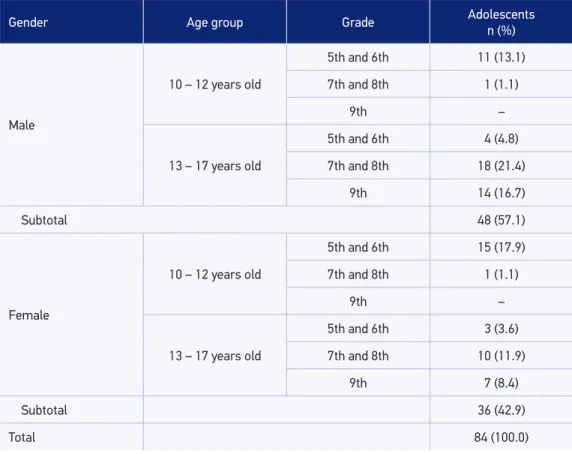
Adolescents were distributed according to gender, age group, and grade (Table 1). Eighty-four students took part, 48 being (57.1%) male and 36 (42.9%) female. Male students aged from 13 to 17 years were prevalent. As to schooling among the female population, those in the 5th and 6th grades were prevalent (21.5%). In the male population, students in the 7th and 8th grades were prevalent (22.5%). Out of the total of 84 students, 92.7% referred working. Out of these, 43.8% worked outside the household, and 57.8% in activities with their families.
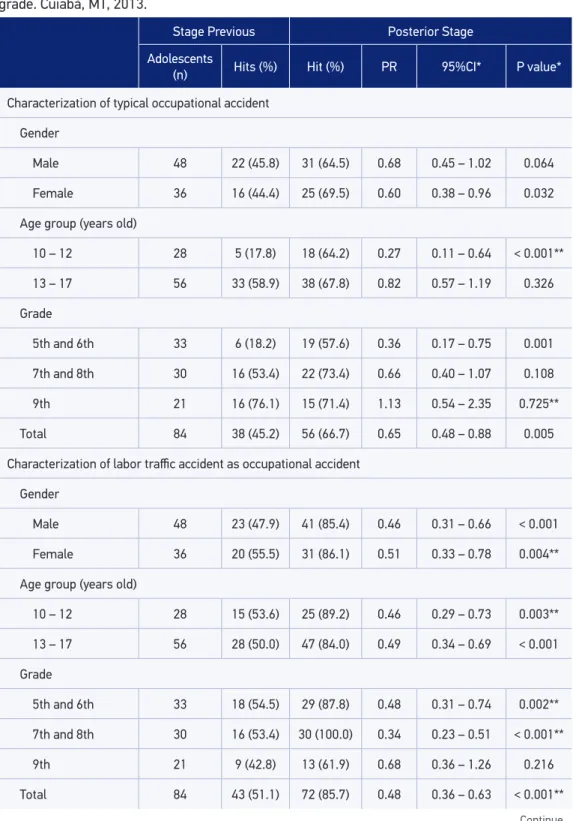
Table 2 shows the characterization between the stages of the program about typical occupational accidents: labor traic accidents, occupational disease, and physical assault. It is possible to observe that the knowledge about occupational accidents increased from 45.2% to 66.2% after the program was conducted. Regarding gender, more hits were found in the female population. From the 5th to the 8th grade, there was a gradual increase in the knowledge about work accidents, especially among students in the 5th and 6th grades, who had more hits between the stages (p < 0.001).
The age group of 10 – 12 years had a 46.4% increase in hits from one stage to the other (p < 0.001). Students aged 13 – 17 years already had previous knowledge about this vari-able, and, at the end of the second stage, they reached 67.8% of hits. Among the total of students, there was an increase of 21.5% (p = 0.005) between the stages.
The correct answers about the characterization of occupational diseases as work accidents (Table 2) stood out among students aged 10 – 12 years, and among students in the 7th and 8th grades, who achieved all hits at the end of the program. The hits were higher than 90.0% in the second stage. Statistically signiicant diferences were observed between the stages of application of the questionnaire (p = 0.001), with 96.4% hits in the second stage in comparison to the irst one.
The characterization of aggression in the work place as a work accident showed more modiication of knowledge between the stages (Table 2), reaching a 61.9% increase (p < 0.001) in the general population of students.
Among the students in the irst stage, 47.6% claimed to have been involved in a work accident, and this percentage was higher among boys (54.1%), in comparison to the female gender (38.9%), without statistically signiicant association (p > 0.05).
DISCUSSION
Processes of production and consumption are among the diferent challenges to be faced by contemporary society. Among these processes, the direct relationship of men with work instruments stands out, since they are not always skilled to prevent accidents29.
Table 1. Distribution of students according to gender, age group, and grade. Cuiabá, MT, 2013.
Gender Age group Grade Adolescents
n (%)
Male
10 – 12 years old
5th and 6th 11 (13.1)
7th and 8th 1 (1.1)
9th –
13 – 17 years old
5th and 6th 4 (4.8)
7th and 8th 18 (21.4)
9th 14 (16.7)
Subtotal 48 (57.1)
Female
10 – 12 years old
5th and 6th 15 (17.9)
7th and 8th 1 (1.1)
9th –
13 – 17 years old
5th and 6th 3 (3.6)
7th and 8th 10 (11.9)
9th 7 (8.4)
Subtotal 36 (42.9)
Table 2. Knowledge about typical occupational accident, labor traic accident, work-related disease and aggression at work, per stage of the program according to gender, age group and grade. Cuiabá, MT, 2013.
Stage Previous Posterior Stage
Adolescents
(n) Hits (%) Hit (%) PR 95%CI* P value*
Characterization of typical occupational accident
Gender
Male 48 22 (45.8) 31 (64.5) 0.68 0.45 – 1.02 0.064
Female 36 16 (44.4) 25 (69.5) 0.60 0.38 – 0.96 0.032
Age group (years old)
10 – 12 28 5 (17.8) 18 (64.2) 0.27 0.11 – 0.64 < 0.001**
13 – 17 56 33 (58.9) 38 (67.8) 0.82 0.57 – 1.19 0.326
Grade
5th and 6th 33 6 (18.2) 19 (57.6) 0.36 0.17 – 0.75 0.001
7th and 8th 30 16 (53.4) 22 (73.4) 0.66 0.40 – 1.07 0.108
9th 21 16 (76.1) 15 (71.4) 1.13 0.54 – 2.35 0.725**
Total 84 38 (45.2) 56 (66.7) 0.65 0.48 – 0.88 0.005
Characterization of labor traic accident as occupational accident
Gender
Male 48 23 (47.9) 41 (85.4) 0.46 0.31 – 0.66 < 0.001
Female 36 20 (55.5) 31 (86.1) 0.51 0.33 – 0.78 0.004**
Age group (years old)
10 – 12 28 15 (53.6) 25 (89.2) 0.46 0.29 – 0.73 0.003**
13 – 17 56 28 (50.0) 47 (84.0) 0.49 0.34 – 0.69 < 0.001
Grade
5th and 6th 33 18 (54.5) 29 (87.8) 0.48 0.31 – 0.74 0.002**
7th and 8th 30 16 (53.4) 30 (100.0) 0.34 0.23 – 0.51 < 0.001**
9th 21 9 (42.8) 13 (61.9) 0.68 0.36 – 1.26 0.216
Total 84 43 (51.1) 72 (85.7) 0.48 0.36 – 0.63 < 0.001**
Stage Previous Posterior Stage
Adolescents
(n) Hits (%) Hit (%) PR 95%CI* P value*
Characterization of occupational disease as work accident
Gender
Male 48 29 (60.4) 46 (95.8) 0.42 0.31 – 0.58 < 0.001**
Female 36 30 (83.4) 35 (97.2) 0.53 0.36 – 0.80 0.046**
Age group (years old)
10 – 12 28 23 (82.1) 28 (100.0) 0.45 0.33 – 0.61 0.019**
13 – 17 56 36 (64.2) 53 (94.6) 0.46 0.34 – 0.62 < 0.001**
Grade
5th and 6th 33 26 (78.8) 32 (96.9) 0.51 0.34 – 0.75 0.023**
7th and 8th 30 24 (80.0) 30 (100.0) 0.44 0.32 – 0.59 0.009**
9th 21 9 (42.8) 19 (90.4) 0.37 0.21 – 0.66 0.001**
Total 84 59 (70.2) 81 (96.4) 0.47 0.37 – 0.59 0.001**
Characterization of physical aggression in the work environment as work accident
Gender
Male 48 10 (29.8) 41 (85.4) 0.23 0.13 – 0.41 < 0.001
Female 36 11 (30.5) 32 (88.9) 0.29 0.17 – 0.50 < 0.001**
Age group (years old)
10 – 12 28 7 (25.0) 25 (89.2) 0.25 0.12 – 0.48 < 0.001**
13 – 17 56 14 (25.0) 48 (85.7) 0.28 0.17 – 0.46 < 0.001
Grade
5th and 6th 33 8 (24.3) 28 (84.8) 0.26 0.14 – 0.50 < 0.001**
7th and 8th 30 7 (23.4) 28 (93.3) 0.21 0.11 – 0.42 < 0.001**
9th 21 6 (28.6) 17 (80.9) 0.33 0.15 – 0.68 < 0.001**
Total 84 21 (25.0) 73 (86.9) 0.26 0.17 – 0.38 < 0.001
PR: prevalence ratio; 95%CI: 95% conidence interval; *Pearson’s χ2 test; **Fisher’s Exact Test.
only includes preservation of the environment, without associating it to its implications on human health16.
From this perspective, the study conducted with students living in a landill-impacted area showed that they are inserted in labor activities, and some of them are carried out in a location that stores solid waste coming from the city of Cuiabá. This fact has been a con-stant since the creation of the landill, in 199714,12.
This situation becomes worse when there are children and adolescents, because this population should be in the school environment, acquiring knowledge to prepare them for life. When children and adolescents are exposed to work early, they may face negative con-sequences, such as occupational accidents and diseases.18,25,26
There was a reduction in the total number of participants between stages 1 and 4 in this study. This is possibly due to the fact that adolescents execute activities related to family work, which causes them to miss classes. This reality of adolescents who start working early to help and complement the family income is also observed in other parts of Brazil, even though it is against the Statute of the Child and Adolescent17-20. As a reper-cussion in health, the waste-picking activity can lead to intoxication caused by rotten food and chemical substances, worms, and accidents caused by machines and disposal trucks, among others17,22.
Considering that children and adolescents work in this rural community, the irst stage of the program observed that students had considerable previous knowledge about what occupational accidents are, showing that they acquired this knowledge because of their own experience in the ield. The results obtained in this study are in accordance with those found by Câmara et al24 regarding the hits between the stages of application of the questionnaire, showing that the program can be reproduced in diferent contexts, however, addressed to the population of teenage students. However, data point out that the schools have not inserted subjects related to work skills in their project, such as the approach of diferent ways to start working and the exposure to occupational accidents.
Considering that 57.8% of the students work at home, it is important to mention that many of them do not consider the activities they do as work, because they think they are natural and mistake them for other things that happen in the family environment (house-hold). Regarding women, who culturally start working early in terms of household chores, and considering the informality of labor relations, this naturalization is even more serious30. It is worth to mention that the students live in small farms and live on subsistence agricul-ture, or accompany their families to work in the landill31.
Literature indicates this age group as being responsible for the largest concentration of work accidents due to physical and cognitive immaturity to conduct the activities, which are mostly carried out by adults. It is also important to point out that, in the irst stage, these students had little previous knowledge about work accidents in comparison to students aged 13 – 17 years, who already work or are about to start working7,9.
These data lead to a worrisome reality, considering that children and adolescents before the age of 14 cannot work, according to the Statute of the Child and Adolescent6, because of the consequences of the work they do can lead to injuries and diseases that can affect their entire lives. Besides, work subtracts the time the child or adolescent has to socialize, to enjoy leisure activities, appreciate family life, and study. The lack of studies in this phase of life reduces their opportunities as adults, and these oppor-tunities are related to having access to better working conditions, as well as housing, leisure, among others2,30.
In this sense, it is important to consider that children and adolescents are subject to work accidents, and this exposure can be considered as the tip of the iceberg, showing the harsh reality of exploitation sufered by these young workers. This can compromise the health of this population segment31.
In Brazil, the information collected about occupational accidents include, in a single age group, all accidents involving adolescents aged up to 19 years old32. Statistics about children who have been involved in work accidents is not collected, because child labor is illegal. The lack of information reduces the social visibility of this problem, and the extension of the economic load of the accidents and diseases involving children and ado-lescents is not known33.
Even though Brazil has made great eforts in the past few years to reduce work among children and adolescents, and, consequently, occupational accidents involving this popula-tion, such reduction is still slow. The goal of eradicating all forms of child labor until 2020 is far from the Brazilian reality7-9. By dealing with the population living in the rural zone, where the lack of control and the informality of labor relations are present, the situation becomes worse33.
The context of working children and adolescents and occupational accidents was observed among students in this study, which pointed out that 47.6% were involved in a work acci-dent until the conclusion of this study. In previous studies, this reality was observed in dif-ferent work contexts24-26.
Promoting initiatives aiming at knowledge as being the promoter of behavioral changes is important for all students, especially those living in the rural area, because this part of the population suffers with the worst indicators of quality of life. Inequalities in public policies are also part of their reality, and these are dealt with invisibility for this population.
By dealing with the materiality of public policies in the rural scope, there are many challenges to be faced. Varied policies are necessary to break with the barriers that were historically built between the countryside and the city34,35. The vulnerability of this pop-ulation may be proven by the historical abandonment it has been submitted to, being neglected when it comes to accessing the policies in comparison to the population living in an urban area35.
From this perspective, it is necessary that public educational policies include the forma-tion of environmental health teachers, so that they can bring themes/contents about work environment, prevention of accidents, and occupational diseases to the school. This approach would contribute to the formation of future workers, assisting teenagers who already work as apprentices.
Some limitations should be considered in this study, especially the cross-sectional design, which does not allow deining causality relations between the knowledge about work acci-dents and the conduction of the educational program. As an advantage, this methodology allowed analyzing the modiication of knowledge among the same students by conducting the program.
CONCLUSION
The analysis of the results obtained in the second stage of the educational program addressed to students in a school impacted by a landill showed the positive modiication of knowledge among participants regarding occupational accidents. Therefore, the school is considered as a privileged space for the development of systematized knowledge, and the appreciation coming from the reality of the students for behavioral changes, with the objective of preventing occupational accidents in all the phases of life of this adolescent, who will be a worker in the future. However, it is worth mentioning the need for multifac-eted actions to change the context of working children and adolescents.
Valuing the knowledge of students, considering their previous knowledge about occu-pational issues, and encouraging the search for new knowledges within their contexts can be essential for the construction of new practices, aiming at the prevention of health dis-eases and conditions.
addressed to those considered as “invisible” for being away from the eyes of society, with-out access to their basic rights.
ACKNOWLEGMENTS
We thank all professionals and students who participated in this study.
1. Scussiato LA, Sarquis LM, Kirchhof AL, Kalinke LP. Peril epidemiológico dos acidentes de trabalho graves no Estado do Paraná, Brasil, 2007 a 2010. Epidemiol Serv Saúde 2013; 22(4): 621-30.
2. Asmus CI, Barker SL, Ruzany MH, Meirelles ZV. Riscos ocupacionais na infância e na adolescência: uma revisão. J Pediatr 1996; 72(4): 203-8.
3. Alessi NP, Navarro VL. Saúde e trabalho rural: o caso dos trabalhadores da cultura canavieira na região de Ribeirão Preto, São Paulo, Brasil. Cad Saúde Públ 1997; 13(Supl. 2): 111-21.
4. Instituto Brasileiro de Geograia e Estatística (IBGE). Pesquisa Nacional por Amostras de Domicílios (2006) Aspectos complementares de Educação, afazeres domésticos e trabalho infantil – 2006. Disponível em: http://www.ibge.gov.br/home/estatistica/populacao/ trabalhoerendimento/pnad2006/suplementos/afazeres/ default.shtm (Acessado em: 12 de agosto de 2014) 5. Instituto Brasileiro de Geograia e Estatística (IBGE).
Pesquisa Nacional por Amostras de Domicílios (2008). Síntese de indicadores 2008. Disponível em: http:// www.ibge.gov.br/home/estatistica/populacao/ trabalhoerendimento/pnad2008/default.shtm (Acessado em: 10 de outubro de 2014).
6. Brasil. Lei Federal nº 8069, de 13 de julho de 1990. Dispõe sobre o Estatuto da Criança e do Adolescente e dá outras providências. Diário Oicial da União; 16 jul. 1990. 7. Organização Internacional do Trabalho (OIT). Medir o
progresso na Luta contra o Trabalho Infantil: Estimativas e tendências mundiais 2000-2012. Genebra: OIT; 2013. 8. Instituto Brasileiro de Geograia e Estatística (IBGE). Censo demográico (2010). Trabalho infantil. Disponível em: http://censo2010.ibge.gov.br/trabalhoinfantil/ (Acessado em: 10 de novembro de 2014).
9. Brasil. Plano Nacional de Prevenção e Erradicação do Trabalho Infantil e Proteção do Adolescente Trabalhador. Brasília: Ministério do Trabalho e Emprego, 2011.
10. Brasil. Decreto nº 5.598, de 1º de dezembro de 2005. Regulamenta a contratação de aprendizes e dá outras providências. Diário Oicial da União; 2 dez 2005. 11. Instituto Brasileiro de Geograia e Estatística (IBGE).
Atlas do Censo Demográico (2010). Rio de Janeiro, 2013. Disponível em: http://censo2010.ibge.gov.br/ apps/atlas/.
12. Carvalho CI. Visão de professores da educação básica de uma escola circunscrita ao ater ro sanitário de Cuiabá-MT sobre saúde ambiental. [Trabalho de conclusão de curso do Curso de Saúde Coletiva]. Mato Grosso: Instituto de Saúde Coletiva (ISC), 2014.
13. Souza I. Questão de saúde: Problema histórico, “lixão” cuiabano preocupa especialista. Midia News, 2014. Disponível em: http://www.navegadormt.com/ noticia.php?codigo=28980&categoria=Meio%20 Ambiente. (Acessado em: 20 de agosto de 2014). 14. Cuiabá. Secretaria Municipal de Infraestrutura.
Diagnóstico ambiental das áreas: EIA/RIMA do aterro sanitário de Cuiabá. Cuiabá: Prefeitura Municipal de Cuiabá; 2011. v. 1. 447p.
15. Brasil. Plano Nacional de Resíduos Sólidos. Brasília: Ministério do Meio Ambiente; 2011.
16. Brasil. Lei n. 12.305, de 2 de agosto de 2010. Institui a Política Nacional de Resíduos Sólidos; altera a Lei no 9.605, de 12 de fevereiro de 1998; e dá outras providências. Diário Oficial da União; 3 ago 2010.
17. Costa RF, Costa AL. Rede de prestação de serviços sociais: o caso da jornada ampliada do programa de erradicação do trabalho infantil no município de Ribeirão Preto. Anais do VIII Congresso Internacional del CLAD sobre la Reforma del Estado y de la Administración Pública. Panamá; 2003. Disponível em: http://unpan1.un.org/intradoc/groups/public/ documents/CLAD/clad0047512.pdf (Acessado em: 15 de agosto de 2014).
18. Grimberg E. A Política Nacional de Resíduos Sólidos: a responsabilidade das empresas e a inclusão social. São Paulo: Instituto Pólis, 2004. Disponível em: http:// www.polis.org.br/uploads/1177/1177.pdf (Acessado em: 17 de agosto de 2014).
19. Gomes FF, Vidal JP. A política municipal de saneamento: sua incidência sobre os catadores de lixo do Aurá em Belém. IV Jornada Internacional de Políticas Públicas. Maranhão: Universidade Federal do Maranhão. Programa de Pós-Graduação em Políticas Públicas; 2009. Disponível em: http://www.joinpp.ufma.br/ jornadas/joinppIV/eixos/9_estados-e-lutas-sociais/ a-politica-municipal-de-saneamento-sua-incidencia-sobre-os-catadores-de-lixo-do-aura-em-belem.pdf (Acessado em: 25 de agosto de 2014).
20. Santos MR. O resíduo sólido urbano na cidade de Bragança-PA: uma análise dos problemas socioambientais e os resultados desse processo. III Congresso Brasileiro de Gestão Ambiental. Goiás: 2012. Disponível em: http://www.ibeas.org.br/ congresso/Trabalhos2012/III-005.pdf (Acessado em: 30 de agosto de 2014).
21. Minas Gerais. Condições de trabalho e características das crianças, adolescentes e adultos que atuam nas áreas de lixão em Minas Gerais. Belo Horizonte: Fundação João Pinheiro, Centro de Estatísticas e Informações; 2013. 22. Minayo-Gomes C, Meirelles ZV. Crianças e adolescentes
trabalhadores: um compromisso para a saúde coletiva. Cad Saúde Públ 1997; 13(Supl. 2): 135-40.
23. Câmara VM, Souza DP, Filhote MI, Luiz RR, Souza CO, Meyer A. Confiabilidade de questionário de conhecimento sobre exposição ao mercúrio na produção de ouro. Rev Saúde Pública 2009; 43(2): 373-6. 24. Câmara VM, Filhote MI, Lima MI, Alheira FV, Martins
MS, Dantas TO, et al. Metodologia para prevenir exposição ao mercúrio em adolescentes de garimpos de ouro em Mariana, Minas Gerais, Brasil. Cad Saúde Públ 1996; 12(2): 149-58.
25. Câmara VM, Lima MI, Asmus CI, Setta DX, Dias EC, Silva JM. Prevenção de acidentes de trabalho entre adolescentes trabalhadores: um estudo de caso em mineração de diamantes. Cad Saúde Colet 2001; 9(1): 21-33. 26. Raymundo VP. Construção e validação de instrumentos:
um desaio para a psicolinguística. Letras de Hoje 2009; 44(3): 86-93.
27. Lima MI, Câmara VM. Uma metodologia para avaliar e ampliar o conhecimento de adolescentes do ensino fundamental sobre acidentes de trabalho. Cad Saúde Públ 2002; 18(1): 115-20.
28. Brasil. MEC cria grupo para examinar causa de evasão escolar. Brasília (DF): Ministério da Educação; 2014. Disponível em: http://www.brasil.gov.br/educacao/2013/11/mec-cria-grupo-para-examinar-causa-de-evasao-escolar (Acessado em: 02 de novembro de 2014).
29. Tambellini AT, Câmara VM. A temática saúde e ambiente no processo de desenvolvimento do campo da saúde coletiva: aspectos históricos, conceituais e metodológicos. Ciênc Saúde Coletiva 1998; 3(2): 47-59. 30. Garavello ET, Marques MM, Fonseca MC, Klemenc
M. O trabalho do adolescente e a sua relação com o aproveitamento escolar e a saúde. Rev Bras Saúde Ocup 2001; 26(99/100): 109-19.
31. Pimenta AA, Freitas FCT, Mendes AMOC, Navarro VL, Robazzi MLCC. Acidentes de trabalho ocorridos entre adolescentes. Texto Contexto Enferm 2013; 22(2): 279-84.
32. Brasil. Ministério da Previdência Social. Anuário Estatístico da Previdência Social em 2012. Disponível em: http://www.mtps.gov.br/dados-abertos/dados- da-previdencia/previdencia-social-e-inss/anuario-estatistico-da-previdencia-social-aeps (Acessado em: 14 de novembro de 2014).
33. Borja-Aburto VH, Santana VS. Trabalho e saúde na região das Américas. In: Galvão LAC, Finkelman J, Henao S (Org.). Determinantes ambientais e sociais da saúde. Rio de janeiro: Opas; Editora Fiocruz; 2011. p. 439-56. 34. Silveira R, Pinheiro R. Sobre o rural, a interiorização
na saúde e a formação médica: concepções e ações com destaque para o contexto da Amazônia Legal. In: Pinheiro R, Müller Neto JS, Ticianel FA, Spinelli MAS. Construção social da demanda por cuidado: revisitando o direito à saúde, o trabalho em equipe, os espaços públicos e a participação. CEPESM, IMS, UERJ, ABRASCO; 2013.
35. Brasil. Educação do Campo: diferenças mudando paradigmas. Brasília: Ministério da Educação; 2007.
Received on: 03/03/2015