(1) Universidade Federal de Santa Catarina, Florianópolis, SC, Brasil.
Research conducted at the Federal University of Santa Catarina
Conlict of interest: non-existent
Speech disorders from the perspective of community health
agents
Agravos fonoaudiológicos sob a ótica do agente comunitário de saúde
Maiara Corrêa de Paula(1)
Karina Mary de Paiva Vianna(1)
Received on: February 08, 2016 Accepted on: November 04, 2016 Mailing address:
Karina Mary de Paiva Vianna Universidade Fedrral de Santa Catarina Campus Reitor João David Ferreira s/n Florianópolis - Santa Catarina – Brasil CEP: 88040-900
E-mail: [email protected]
ABSTRACT
Purpose: to assess the degree of knowledge of community health workers about speech disorders by
means of a survey on the advice they give to patients.
Methods: a cross-sectional study with Community Health Agents (CHAs) who work in Health Centers
(HC) in the Eastern Health District, in the city of Florianópolis, State of Santa Catarina (SC). They answered a questionnaire on sociodemographic features and knowledge about speech disorders. The questionnaire included questions about the advice given to patients in visits for the purpose of health promotion in diffe-rent life cycles. A descriptive and statistical analysis was performed with the STATA 11.0 software.
Results: ifty-ive CHAs answered the survey; their mean age was 44.56 years. Most of them were
women (98.18%) and had inished high school (80%). Among the major health markers of HC, hyperten-sion and diabetes were characterized as chronic non-communicable diseases. The advice given by CHAs on the promotion of maternal and child health showed that they had more knowledge about speech and hearing impaiments in comparison to the health of children and the elderly.
Conclusion: the study showed that CHAs have knowledge about speech and hearing impairments, as
evidenced by the advice they gave to patients. However, such knowledge can be considered as limited. Considering that CHAs are the main link between the community and the health staff, it is crucial that they gain knowledge about speech and hearing disorders, in order to implement effective procedures for health promotion and disease prevention, thus, providing comprehensive health care.
Keywords: Community Health Workers; Health Promotion; Speech, Language and Hearing Sciences;
Chronic Disease; Public Health Surveillance
RESUMO
Objetivo: veriicar o conhecimento dos agentes comunitários de saúde quanto aos agravos
fonoaudioló-gicos, investigando orientações realizadas.
Métodos: estudo transversal com Agentes Comunitários de Saúde (ACS) atuantes nos Centros de Saúde
(CS) do distrito sanitário Leste do município de Florianópolis, SC. Os ACS responderam a um questioná-rio com caracterização sociodemográica e conhecimento quanto a agravos fonoaudiológicos, por meio de questionamentos quanto às orientações realizadas em visitas referentes à promoção da saúde nos diferentes ciclos de vida. Foi realizada uma análise estatística descritiva no programa STATA 11.0.
Resultados: foram entrevistados 55 ACS, com idade média de 44,56 anos, a maioria do sexo
femi-nino (98,18%) e ensino médio (80%). Dentre os principais marcadores de saúde dos CS encontrou-se a Hipertensão arterial e a diabetes caracterizadas como doenças crônicas não transmissíveis. As orienta-ções relacionadas à promoção da saúde materno infantil relatadas pelos ACS envolviam mais conheci-mentos quanto aos agravos fonoaudiológicos em comparação com orientações a respeito da promoção da saúde da criança e do idoso.
Conclusão: o estudo revelou que existe conhecimento por parte dos ACS com relação aos agravos
fono-audiológicos, já que são incorporados nas orientações realizadas pelos mesmos, porém este pode ser entendido como limitado. Considerando-se que o ACS é o principal elo entre a comunidade e a equipe de saúde torna-se essencial incorporar estes conhecimentos ao saber deste proissional como forma de efetivar as ações promoção e prevenção de saúde, conigurando a integralidade do cuidado em saúde.
Descritores: Agente Comunitário de Saúde; Promoção de Saúde; Fonoaudiologia; Doença Crônica;
INTRODUCTION
The expanded concept of health involves “a
complete state of well-being, biopsychosocial balance and not merely the absence of disease or illness” [our translation] and was established at the international conference on primary health care in 1978 1.
Under this inluence, Brazil’s Constitution of 1988 was a milestone in the ield of public health in the country because it inluenced the consolidation of the Uniied Health System (SUS). Thus, a regionalized network of programs and services was deined in order
to provide universal and equal access of the population to the promotion, protection and recovery of health, with the fundamental principles of equality, universality and comprehensiveness2.
In 1991, PACS (Community Health Agents Program)
was created in order to reduce infant mortality3. As a
consequence of the positive results of this program, in
1994, the Family Health Program (PSF) - now called the Family Health Strategy (ESF) - was established. This
is a health care model, based on a health surveillance paradigm that seeks to articulate the measures of the programs with sectoral and cross-sectoral policies. This
model is aimed at improving the population’s quality
of life by strengthening the link between health care providers and the local community4,5. Thus, a
multi-disciplinary team is expected, consisting of doctors, nurses, nursing assistants or patient care technicians, community health workers and dentists.
CHAs have a key role in health centers, as they
represent the link between the population and the health care staff. They can report the demands and problems faced by users of the health system and report possible solutions to the questions and needs of the population. They reside in the community where they work, hence they are aware of the problems affecting the territory and the local population3.
An act was established to regulate the profession only in 2002; however, it was revoked for adjustments four years later. This means that the construction of the
role of CHAs within SUS is characterized by conlicts
and uncertainties6,7.
According to the National Primary Care Policy
(Ordinance 648/2006), CHAs have the following duties:
apply measures that seek to integrate health care providers and the population; work under assignment to a particular number of families; be in regular contact with the families while developing health education
activities; ill in and update records; advise families on
the use of health services; develop activities for health
promotion, prevention of diseases and injuries and health surveillance; through home visits, follow-up all the families under their responsibility and help in the prevention/control of malaria and dengue8. In addition
to these duties, CHAs must have the conceptual, proce -dural and attitudinal skills that will enable an effective link between users of SUS and health workers. Thus, they can contribute to health surveillance activities by identifying and recording information so that health plan of a particular territory can meet the real needs of the local population9.
Aspects of speech pathology and audiology, if
added to the knowledge of CHAs, can contribute to a
broader view of the concept of health. Needs under a new point of view can open doors to new forms of inter-vention; they are an essential link and enable health promotion10,11.
Aspects of speech, language and hearing should be considered as health attributes because their patholo-gical manifestations undermine verbal communication and nonverbal competence and performance, both intra- and interpersonally12. Communication, as an
object of study of Speech Pathology, deserves serious attention of public health policies, as it enables indivi-duals to become agents of transformation of society and reality13.
Health promotion is aimed at optimizing quality of
life and health. Its priority is to identify and address the social determinants that trigger health-disease processes. This way, it differs from disease prevention, which is focused on detection, control and care provision as regards risks and causes14.
Given the above, the aim of the present study was
to assess the knowledge of CHAs about speech and
hearing impairments, in order to implement health surveillance initiatives.
METHODS
The research was approved by the Human Research Ethics Committee (CEPSH) of the State University
of Santa Catarina (UDESC) - Technical Report no. 1.018.426.
This is a descriptive cross-sectional study with
Community Health Agents (CHAs) working in health centers in the Eastern Health District of Florianópolis,
SC. The study was conducted between August and September, 2015.
These were the health centers addressed in the
Saco Grande, João Paulo, Canto da Lagoa, Barra da
Lagoa, Costa da Lagoa and Lagoa da Conceição.
First, the coordinators of the health centers (HC)
were contacted and informed about the objectives of this research. Later, the researcher visited the health centers at the start and /or end time of the daily working
hours of the CHAs, who were also informed about the
research and the request for voluntary participation. Those who agreed to participate signed an Informed
Consent Form (ICF). The CHAs did not participate in
the survey when they were on vacation or on a sick leave, or when they were not found in the health centers after three attempts of contact for participation in the research.
In order to achieve the proposed objectives, a
questionnaire was applied to the CHAs to analyze their
knowledge about speech disorders in the areas of voice, orofacial motricity, language, and hearing. It was
aimed at investigating if CHAs included these aspects
when giving advice on health promotion in different life cycles.
The tool consisted of a survey on characteristics
such as identiication, age, sex, education, length of
work experience in the health care team, if they were tenured, micro-areas of work performance, population under their responsibility, major health markers in their area and closed questions addressing
speech--language problems in the routine work of CHAs. In
addition, the questionnaire contained some blank lines where they could write an explanation or opinion about their activities.
The CHAs responded to the questionnaire indivi -dually, at the health centers, and if they failed to understand any of the questions, the researcher could explain the content of the questions.
For the purposes of analysis, a variable was created
with regard to the general knowledge of the CHAs in
different life cycles. This variable was created based on reports about the advice given during home visits. An analysis was made of the association between this variable and sociodemographic aspects.
The data were entered into a Microsoft Excel spreadsheet, and a descriptive statistical analysis was performed for sociodemographic features and speech and hearing impairments. The Chi Square Test was run in order to check for possible associations between
the knowledge of the CHAs and sociodemographic features, with a signiicance level of 5%. The analyses
were performed with the aid of software STATA 10.0.
RESULTS
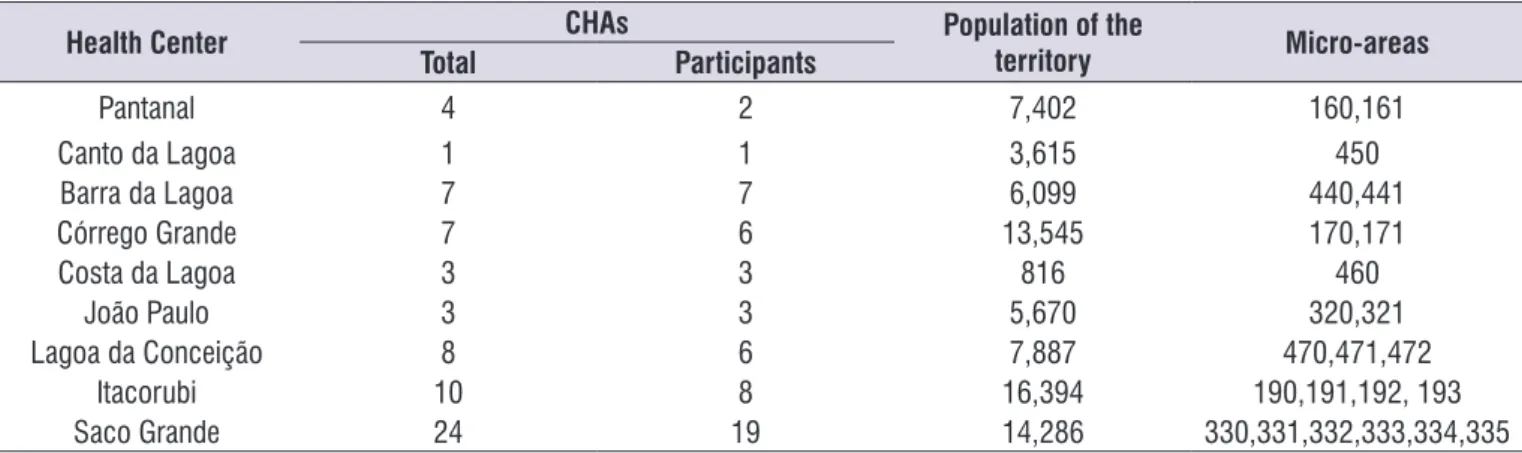
The Eastern Health District is composed of nine Health Centers with 67 CHAs, and 55 of them partici
-pated in the survey. The HC with the largest population
is Itacorubi, totaling 16,394 individuals and only four
micro-areas, while the HC with a larger number of
micro-areas is Saco Grande, with a population of
approximately 12,000 users. This fact is justiied by
the percentage of use of the population: in Itacorubi,
it is 50% of the total population on average, while at the Saco Grande HC, this proile is 100%. Moreover,
the number of areas of social concern is only one in Itacorubi, compared with six in Saco Grande (Table 1).
Table 1. Characterization of the health centers of the Eastern Health District - Florianópolis, SC, Brazil, 2015. (n=55)
Health Center CHAs Population of the
territory Micro-areas
Total Participants
Pantanal 4 2 7,402 160,161
Canto da Lagoa 1 1 3,615 450
Barra da Lagoa 7 7 6,099 440,441
Córrego Grande 7 6 13,545 170,171
Costa da Lagoa 3 3 816 460
João Paulo 3 3 5,670 320,321
Lagoa da Conceição 8 6 7,887 470,471,472
Itacorubi 10 8 16,394 190,191,192, 193
Saco Grande 24 19 14,286 330,331,332,333,334,335
EBF Exclusive Breastfeeding
EAAB: Amamenta e Alimenta Brasil Strategy
Figure 1. Distribution of responses about promotion of maternal and child health. Florianópolis, SC, Brazil, 2015. (n=55)
primary health care. When asked about the relationship between non-communicable diseases, such as diabetes and hypertension, and speech and hearing
aspects, 54.55% said that there may be a correlation. The CHAs are concerned about aspects about maternal and child health, as 98.18% of them
addressed the importance of exclusive breastfeeding
(EBF); 96.36% made some referrals when they realized that a baby had dificulty in coping with EBF. They
also advised mothers on breast care. Most referrals
(67.27%) were made to the health center.
As for the harm of formula feeding and the impor-tance of breast suction for the development of oral
functions, language, and hearing, 83.64% of CHAs
claimed that they addressed these issues in their visits.
Additionally, 78.18% of them reported that they give
advice on the importance of breast suction for nose
breathing. A total of 52.73% of the CHAs has never
participated in training sessions of the Rede Amamenta Brasil strategy (Figure 1).
The average age of the CHAs was 44.56 years
(SD = 8.52) ranging between 28 and 66 years. As
for education, the majority (80%) of the population reported having completed high school and 10.91%,
higher education. There was a prevalence of female
CHAs (98.18%). The average length of work experience at the HC was 12.12 years (SD = 3.48) and only 14.55%
of them claimed to be tenured.
The main health markers reported by CHAs in this
district were: diabetes, hypertension, pregnant women, children, the elderly, tuberculosis, bedridden patients,
mental illness, HIV, alcoholism and drugs.
Most of the CHAs reported that staff meetings occur once a week (78.18%), and 10.91% reported monthly
and fortnightly occurrence.
A large part of the CHAs (65.45%) reported having
knowledge of the work performed by speech
thera-pists, but only 10.91% had some training in that area. Nevertheless, all respondents recognized the
NHS: Newborn Hearing Screening
Figure 2. Distribution of responses about the promotion of child health. Florianópolis, SC, Brazil, 2015. (n=55)
All respondents reported paying frequent visits to
children; 60% of them do that on a monthly basis. Only 56.36% of the CHAs give advice on speech dificulties; 60% on dificulties in activities that require attention and concentration; 70.91% ask parents about their children’s learning dificulties. Importantly, some CHAs
reported that according to the Programa de Saúde na Escola (PSE) program, they began to ask more questions about school and learning issues.
As for the implementation of screening tests,
69.09% reported that they ask parents if their children underwent the Newborn Hearing Screening (NHS) or check the child’s health records. The vast majority (72.73%) said that they do not ask parents about the
lingual frenulum evaluation, and some reported sheer lack of knowledge on the subject. More than half
(54.55%) of the CHAs has never participated in training
offered by the Rede Capital Criança network (Figure 2).
Most home visits to the elderly occur on a monthly
basis (44.44%), while 40.74% of visits have a varying
frequency, on a case-dependent basis, as some patients require a longer follow-up.
As far as hearing is concerned, 76.36% of the CHAs ask questions about hearing dificulty, 58.18% ask about dificulties in understanding people while 56.36% do not ask about dificulties in hearing the TV set; 81.82%, which is a considerable number, do not ask
questions about the audiometry test, when taking into account that the elderly population is the most affected
by hearing loss. A total of 65.45% of CHAs said that
they ask about the use of hearing aids.
As for aspects of speech, 61.82% of the CHAs reported asking about speech dificulties, but 72.73%
of them mentioned nothing about voice weakness.
Respectively, 61.82% and 52.73% of them ask questions about dificulty in swallowing and presence of choking. Approximately half of the CHAs (50.91%) reported
having already participated in training sessions offered by the Programa Capital Idoso program.
There was an association between the knowledge
of CHAs about speech and hearing impairments and longer self-reported work experience at the HC (0.043).
Table 2. Sociodemographic features of Community Health Agents. Florianópolis, SC, Brazil, 2015. (n=55)
Sociodemographic features N %
Mean age (SD) 44.56 (8.52) yrs
Mean length of work experience at the HC 12.12 (3.48) yrs
Sex
Male 1 1.82
Female 54 98.18
Education
Elementary School 5 9.09
High School 44 80
College/University Degree 6 10.91
SD: standard deviation
DISCUSSION
A previous study on sociodemographic
character-istics, performed to check the quality of life of CHAs,
found results similar to those in the present study 15.
Thus, CHAs had these features: predominantly females (84.5%), complete secondary education (79.1%) and
mean age of 39.02 years.
The association between the work of CHAs and female housework may be a historically recognized
trend within health care16. Another issue involves the
fact that women, by working near home, can control and keep track of the daily life of their children. Females prevail in this profession, and the fact that women used to be seen as caregivers in the Middle Ages may have led a greater number of women to pursue a career in health care17.
The level of education of these professionals may make a difference in the health care provided to users of health services. The expansion of their role, shifting from the focus on maternal and child health toward the health of families and the community, has demanded new competences in the social and political arena18.
Lack of knowledge deprives CHAs of information they
need to properly cope with stressful situations they face at work, especially situations involving social relations 19.
More recent studies have shown that the
demographic proile of CHAs has been changing: they are younger and join the ESF earlier, as they beneit
from higher educational levels 16.
The results of this study show higher igures for
the promotion of maternal and child health, especially when compared to health promotion of the elderly, as there are lower percentages for advice on speech
and hearing impairments aimed at this population group. In view of the fact that populational aging
is a new reality in Brazil, it is worth stressing the
importance of prevention and promotion of health of the elderly population. In addition, physiolo-gical changes that occur throughout the process of
aging have a great impact on individuals’ quality of
life 20.
The work of speech therapists in groups of elderly patients, of paramount importance, is primarily aimed at the promotion of healthy aging, based on maintaining their functional capabilities, otherwise, the elderly might
feel ostracized by their limitations. Linguistic-cognitive
activities can be performed, for example, focusing on memory, attention, reading and comprehension, as well as workshops on vocal health, hearing health and orofacial motricity21.
In contrast, CHAs have already addressed maternal
and child health since intrauterine life by means of advice given to pregnant women. Child health is the focus of speech therapists. They can address
issues about food habits, encouraging EBF, chewing,
speech and hearing (early losses, newborn hearing
screening, education and risk factors). In the ield of
health promotion, speech therapy can address utensils used for food intake, deleterious oral habits, language acquisition and development and reinforcement of the importance of the family environment during all phases of life22.In addition, speech therapists can implement
campaigns, for example, vocal hygiene, combating and prevention of deafness, prevention of mouth cancer, and noise reduction.
Considering the association between the knowledge
PSAD: Personal Sound Ampliication Device
Figure 3. Distribution of responses about the promotion of health of the elderly. Florianópolis, SC, Brazil, 2015
longer self-reported length of work experience at the
HC, it can be inferred that professional experience is
broader, and there are more training opportunities and experiences that may have contributed to the acquisition of knowledge about speech disorders for
health promotion purposes. The inclusion of CHAs
in health care teams is an essential notion of the link underlying community-service, by means of health surveillance15,23-28.
With respect to health markers, it is worth noting that
approximately 40% of the adult Brazilian population
presents at least one non-communicable disease. The most important NCDs are hypertension, diabetes, cancer, cerebrovascular diseases and obstructive pulmonary diseases29. A study has shown that the
fourth activity developed by CHAs is the control of
hypertension, diabetes, tuberculosis and leprosy30.
In view of the aging population, the prevention and control of NCDs, e.g., arterial hypertension and diabetes
mellitus, should be priority measures in Primary Health
Care in order to avoid complications and promote early diagnosis and active search and monitoring. Although easily diagnosed, these NCDS can pose a challenge to health care teams, because control and monitoring are essential. Other challenges to be faced are the need for change in life habits and lower user adherence to coping programs31. CHAs play a key role in these
processes on the basis of their knowledge and bond
with the population of their territory. It should also be noted that the highest rates of chronic diseases were
found in the southern (47.7%) and southeast (39.8%)
regions32.
These diseases are still a concern from the point of view of speech therapy, since they can interfere with functions such as swallowing, as in the case of DM, because of xerostomia, sore and sensitive tongue and taste disorder, Also, they are a risk factor for hearing
loss. With respect to AH, the risk of cerebrovascular
accidents (CVA) is of interest to speech therapists because the main consequence of this condition is a communication disorder called aphasia33.
CHAs have a privileged role in the dynamics of
deployment and consolidation of a new health care model, because with a mediation strategy, they can act as facilitators34. Home visits represent the main
work tool of CHAs 35. Their work reinforce bonds and
enable health prevention and promotion measures.
The knowledge of CHAs represents an advantage for identiication of risks and/or vulnerability; it accounts for
a health care measure.
In this way, evaluating the actions of CHAs becomes
fundamental. Previous studies have shown that the perception of adults and the elderly on the number
of monthly visits undertaken by CHAs is insuficient
are unhappy because they wish the visits were more frequent26-36.
A studyhas shown that almost half of the families
registered in the FHS was unaware of the existence of CHAs and had not been visited. On the other hand, 90%
of the families visited at home, rated the performance
of CHAs as good or very good, mainly as regards
knowledge of the health problems of the family and the community, development of a good relationship with the people they follow-up and the health care advice
provided. This fact can be justiied on the basis of multiple tasks given to CHAs in the HC, a fact that has
interfered in their work in the respective territories. In addition, it is worth mentioning issues related to leave of absence which can compromise coverage the territory. Some authors have analyzed the functions of
CHAs within the FHS and identiied the need to
strengthen their training, so that their performance can be consistent with the guidelines and principles of SUS37. On the other hand, among all professional
categories analyzed, CHAs had the highest approval by the respondents (84.7%), thus, corroborating similar
studies 37.
What can be seen is that CHAs have a great deal
of knowledge; however, this class of workers needs skills that include the knowledge on speech and
hearing disorders. To characterize such demand and to
develop measures, it is essential that training be offered
to CHAs, so that their performance can be effective in different cycles of patients’ lives 26.
One shortcoming of the present study is that the information of the questionnaire is self-reported.
Moreover, the loss of 17.9% was due to the dificulty in inding all CHAs in the HCs. It is worth mentioning that 40% of the micro-areas in this district are uncovered
on the basis of leaves and dismissals. Replacement of these job positions constitutes a hindrance depending on the form of recruitment and because of discussions
about duties and responsibilities of CHAs in the city.
CONCLUSION
The present study showed that CHAs give advice on
issues that involve speech and hearing impairments in
different life cycles. However, such advice can be seen as limited. By recognizing the importance of the CHAs
in the community, their work could be fully effective if
they acquired speciic knowledge of speech therapy
and audiology, thus, enabling early detection and referrals in all cycles of life.
The longitudinality of health care suggests that for the completeness of measures, health care teams need to be trained to develop initiatives for promotion, prevention and recovery of health, rehabilitation of diseases and injuries, as well as health maintenance in the territory.
Health promotion is a growing ield, but it has an
enormous potential for strengthening popular
partici-pation and social control in health matters. CHAs can
help engage local leaders into discussing and coping with health problems and their social determinants in
their territory. Moreover, they can optimize the develo -pment of comprehensive and effective measures for proper health care management.
REFERENCES
1. Bei D. A inserção da fonoaudiologia na atenção
primária à saúde. In: Bei D (org). Fonoaudiologia
na atenção primária à saúde. São Paulo: Lovise; 1997. p. 15-36.
2. Gomes EMGP, Remencius NR. Fonoaudiologia na
Unidade Básica de Saúde. In: Largota MGM, César
CP (org). A fonoaudiologia nas instituições. São Paulo: Lovise; 1997. p. 183-86.
3. Santos JN, Rodrigues ALV, Silva AFG, Matos EF, Jerônimo MS, Teixeira LC. Percepção de agentes comunitários de saúde sobre os riscos à saúde
fonoaudiológica. Rev Soc Bras Fonoaudiol.
2012;17(3):333-9.
4. Shimizu HE, Reis LS. As representações sociais dos trabalhadores sobre o Programa Saúde da Família. Ciênc Saúde Colet. 2011;16(8):3461-8. 5. Silva JM, Caldeira AP. Avaliação para melhoria
da qualidade da estratégia saúde da família e qualiicação proissional. Trab Educ e Saúde.
2011;9(1)95-108.
6. Gomes KO, Cotta RM, Mitre SM, Batista RS, Cherchiglia ML. O agente comunitário e a
consolidação do Sistema Único de Saúde: relexões
contemporâneas. Physis. 2010;20(4):1143-64. 7. Barros DF, Barbieri AR, Ivo ML, Silva MG. O
contexto da formação dos agentes comunitários
de saúde no Brasil. Texto-Contexto Enferm.
2010;19(1):78-84.
8. Brasil. Ministério da Saúde. Portaria GM/MS n° 648,
de 28 de março de 2006. Brasília, 2006.
9. Coll C, Pozo JG, Sarabia B, Valls E. Os conteúdos
na reforma: ensino e aprendizagem de conceitos,
10. Santos LPGS. A atuação do agente comunitário de
saúde em São Bernardo do Campo: possibilidades
e limites para a promoção da saúde [dissertação]. São Paulo (SP): Escola de Enfermagem da Universidade de São Paulo; 2005.
11. Minayo MCS. Pesquisa social: teoria, método e
criatividade. Petrópolis: Vozes, 2001.
12. Andrade CRF. Fases e níveis de prevenção em fonoaudiologia: ações coletivas e individuais. In: Vieira RM (org). Fonoaudiologia e saúde coletiva.
2. ed. Carapicuíba: Pró-Fono; 2000. p. 81-104.
13. Souza RPF, Cunha DA, Silva HJ. Fonoaudiologia: a inserção da área de linguagem no Sistema Único de Saúde (SUS). Rev. CEFAC. 2005;7(4):426-32. 14. Oliveira DL. A ‘nova’ saúde pública e a promoção
da saúde via educação: entre a tradição e a inovação.Rev Latinoam Enferm. 2005;13(3):423-31. 15. Mascarenhas CHM, Fabio OP, Marcos HF. Fatores
associados à qualidade de vida de agentes comunitários de saúde. Ciênc Saúde Coletiva. 2013;18(5):1375-86.
16. Mota RRA, David HMAL. A crescente escolarização do Agente Comunitário de Saúde: uma Indução do Processo de trabalho?. Trab. Educ. Saúde 2010; 8(2):229-48.
17. Santana JCB, Vasconcelos AL, Martins CV, Barros
JV, Soares JM, Dutra BS. Agente Comunitário de Saúde: percepções na estratégia saúde da Família.
Cogitare Enferm. 2009;14(4):645-52.
18. Tomaz JBC. O agente comunitário de saúde não
deve ser um “super-herói”. Interface Comun Saúde
Educ 2002;6(10):75-94.
19. Maia LDG, Silva ND, Mendes PHC. Síndrome
de Burnout em agentes comunitários de saúde: aspectos de sua formação e prática. Rev Bras
Saúde Ocup 2011;36(123):93-102.
20. Martins Filho IE, Pereira AGFF, Araújo JJ, Kato MT, Jorge TM, Peres AS. Saúde bucal e fonoaudiologia no idoso: aspectos preventivos e educativos.
In: Bastos JRM, Peres SHCS, Caldana ML (org).
Educação em saúde com enfoque em odontologia e fonoaudiologia. São Paulo: Santos, 2007. p.89-97. 21. Medeiros EA, Maia RM, Cedro MO, Barbosa MLC,
Correia RBF, Tavares PMB et al. A inserção da fonoaudiologia na estratégia saúde da família:
vivências em Sobral–CE. SANARE-Revista de Políticas Públicas. 2009;8(2):7-15.
22. Northern JL, Downs MP. Audição na Infância. Trad. Antônio Francisco Dieb Paulo. 5. ed. São Paulo: Guanabara Koogan, 2005.
23. Ferraz L, Aertz DRGC. O cotidiano de trabalho do agente comunitário de saúde no PSF em Porto Alegre. Ciênc saúde coletiva. 2005;10(2):347-55. 24. Cardoso AS, Nascimento MC. Comunicação
no Programa de Saúde da Família: O agente Comunitário de Saúde como elo integrador entre a equipe e a comunidade. Ciênc Saúde Colet. 2010;15(supl 1):1509-20.
25. Seabra DC, Carvalho ACD, Foster AC. O agente comunitário de Saúde na visão da equipe mínima de saúde. APS. 2008;11(3):226-43.
26. Santos JN. Silveira SMA. Saúde pública – proposta
de atuação do fonoaudiólogo na estratégia de
saúde da família. In: Cesar AM, Maksud SS (org). Fundamentos e práticas em fonoaudiologia. Rio de Janeiro: Revinter, 2015. p. 212-27.
27. Jardim, TA, Lancman S. Aspectos subjetivos do morar e trabalhar na mesma comunidade: a realidade vivenciada pelo agente comunitário de saúde. Interface. 2009;13(28):123-35.
28. Brand CI, Antunes RM, Fontana RT. Satisfações e insatisfações no trabalho do agente comunitário de saúde. Cogitare enferm. 2010;15(1):40-7.
29. Ministério da Saúde. A vigilância, o controle e a prevenção das doenças crônicas não transmissíveis: DCNT no contexto do Sistema
Único de Saúde brasileiro. Brasília: 2005.
30. Garcia ACP, Lima RCD, Andrade MAC, Galavote
HS, Coelho APS, Vieira ECL et al. Agente Comunitário de Saúde: do peril às atividades desenvolvidas. 11º Congresso Brasileiro de Saúde
Coletiva. 2015 jul 28/ago 1; Goiânia-GO; Goiânia:
ABRASCO, 2015.
31. Ministério da Saúde. Hipertensão arterial sistêmica
– HAS e Diabetes mellitus – DM PROTOCOLO. Brasília: 2001.
32. Theisen NIS. Agentes Comunitários de Saúde (ACS): condições de trabalho e sofrimento psíquico
[dissertação]. Santa Cruz do Sul (RS): Universidade de Santa Cruz do Sul; 2004.
33. Martines WRV, Chaves EC. Vulnerabilidade e sofrimento no trabalho do agente comunitário de saúde no programa de saúde da família. Rev Esc Enferm USP. 2007;41(3):426-33.
34. Sisson MC, Andrade SR, Giovanella L, Almeida PF,
Fausto MCR, Souza CRP. Estratégia de Saúde da Família em Florianópolis: integração, coordenação
35. Lima NA, Silva L, Bousso RS. A visita domiciliária
realizada pelo agente comunitário de saúde sob a ótica de adultos e idosos. Saude Soc. 2010;19(4):889-97.
36. Brasil. Política Nacional de Atenção Básica. Serie
Pacto pela Saúde volume 4. Brasília: Ministério da
Saúde, 2006.
37. Gomes KO, Cotta RMM, Cherchiglia ML, Mitre
SM, Batista RS. A práxis do agente comunitário
de saúde no contexto do programa saúde
da família: relexões estratégicas. Saúde soc.
2009;18(4):744-55.
38. Ronzani TM, Silva CM. O Programa Saúde da
Família segundo proissionais de saúde, gestores e
ANNEX 1
INTERVIEW WITH HEALTH COMMUNITY AGENTS
Personal Data:
Name: ________________________________________________________________________________________________
Age: __________________________________________________Sex: ( ) F ( ) M Education: ( ) Elementary School ( ) High School ( ) College/University Degree
How long have you been a member of staff? ___________________________________________________________________ Tenured? ( ) yes ( ) no
What is your area of responsibility? __________________________________________________________________________ Population you are responsible for: ___________________________________________________________________________
1. How often do health teams hold meetings? ( ) Once a week
( ) Every ifteen days ( ) Once a month
( ) Other: ______________________________________________________________________________________________
2. What are the major health markers in your ield of responsibility? (e.g., chronic diseases)
______________________________________________________________________________________________________ ______________________________________________________________________________________________________
3. Have you ever had any training in the ield of speech pathology? ( ) yes ( ) no
4.Are you familiar with speech therapy procedures? ( ) yes ( ) no
5. Do you think that there is a relationship between chronic diseases (e.g. diabetes, hypertension) and speech pathologies? ( ) yes ( ) no
6.Do you ind it important that Speech-Language Pathology should be a part of primary health care (groups, programs, team meetings and planning)? ( ) yes ( ) no
7. With respect to the promotion of Maternal and Child Health:
7.1 When you visit households with pregnant women, do you advise them on the importance of exclusive breastfeeding? ( ) yes ( ) no
7.2 Do you advise patients on:
a) Breast care during pregnancy? ( ) yes ( ) no
b) Importance of the baby’s suction for the development of oral functions, language, and hearing? ( ) yes ( ) no c) Importance of breast suction for nose breathing? ( ) yes ( ) no
d) Harms of the prevalence of formula feeding? ( ) yes ( ) no
7.3 Have you ever had any training in the Rede Amamenta Brasil strategy? ( ) yes ( ) no 7.4 Do you make referrals when you notice dificulties in exclusive breastfeeding? ( ) yes ( ) no 7.5 What kind of referral do you make?
( ) Health worker. Speciality: _______________________________________________________________________________ ( ) Groups
( ) Health Center
8. With respect to the promotion of Child Health:
8.1 Do you visit households with children periodically? ( ) yes ( ) no 8.2 How often do you visit these households?
( ) Daily ( ) Weekly
( ) Every two weeks ( ) Monthly
( ) Other: ______________________________________________________________________________________________
8.3 During your visits to households with children, do you ask about: (a) speech development ( ) yes ( ) no
b) baby hearing screening ( ) Yes ( ) No (c) tongue-tie screening ( ) yes ( ) no d) learning dificulties ( ) yes ( ) no
e) dificulties in tasks that require attention and concentration ( ) Yes ( ) No
8.4 Have you ever had any training in the Programa Capital Criança program? ( ) yes ( ) no
9. With respect to the promotion of Health of the Elderly:
9.1 Do you visit households with elderly people periodically? ( ) yes ( ) no 9.2 How often do you visit these households?
( ) Daily ( ) Weekly
( ) Every two weeks ( ) Monthly
( ) Other: ______________________________________________________________________________________________
9.3 During your visits to households with elderly people, do you ask about: a) hearing dificulties ( ) yes ( ) no
b) dificulties in understanding the tv set ( ) yes ( ) no c) dificulty in understanding people ( ) yes ( ) no d) dificulties in swallowing ( ) yes ( ) no e) presence of choking ( ) yes ( ) no f) dificulties in speech ( ) yes ( ) no g) vocal disorders / weakness ( ) yes ( ) no h) undergoing speech audiometry ( ) Yes ( ) No i) use of hearing aids ( ) yes ( ) no
9.4 Have you ever had any training in the Programa Capital Idoso program? ( ) yes ( ) no
10. After all these questions, please answer again:
Do you ind it important that Speech-Language Pathology should be a part of primary health care (groups, programs, team meetings and planning)? ( ) yes ( ) no