1
A
rt
igo
ISSN 0102-695X Brazilian Journal of Pharmacognosy
18(1): 1-5, Jan./Mar. 2008 Received 11 December 2007; Accepted 15 February 2008
Coumarins from the aerial parts of
Prangos uloptera
(Apiaceae)
Seyed Mehdi Razavi,
1Hossein Nazemiyeh,
2Rogayeh Hajiboland,
1Yashodharan
Kumarasamy,
3Abbas Delazar,
4Lutfun Nahar,
5Satyajit D. Sarker*
,51Department of Plant Sciences, Faculty of Natural Science, Tabriz University, Tabriz, Iran, 2Research Center for Pharmaceutical Nanotechnology, Faculty of Pharmacy, Tabriz University of
Medical Sciences, Tabriz, Iran,
3School of Pharmacy, The Robert Gordon University, Schoolhill, Aberdeen, Scotland, UK,
4Faculty of Pharmacy and Drug Applied Research Center, Tabriz University of Medical Sciences, Tabriz, Iran, 5School of Biomedical Sciences, University of Ulster, Cromore Road, Coleraine BT52 1SA, Co. Londonderry,
Northern Ireland, UK
RESUMO: “Cumarinas das partes aéreas de Prangos uloptera (Apiaceae)”. Os estudos
fi toquímicos das partes aéreas de Prangos uloptera, uma espécie do gênero Prangos endêmica do Irã, forneceram cinco cumarinas, xantotoxina (1), prangenina (2), escopoletina (3), deltoína (4) e prangolarina (5). As estruturas destas cumarinas foram elucidas através de métodos espectroscópicos e o potencial antioxidante de 1-5 foi avaliado pelo ensaio de DPPH. O signifi cado quimiotaxonômico de 1-5 também é discutido.
Unitermos:Prangos uloptera, Apiaceae, Umbelliferae, cumarina, furanocumarina, marmesina, antioxidante, quimiotaxonomia.
ABSTRACT: Phytochemical studies on the aerial parts of Prangos uloptera, an endemic Iranian species of the genus Prangos, yielded fi ve coumarins, xanthotoxin (1), prangenin (2), scopoletin (3), deltoin (4) and prangolarin (5). The structures of these coumarins were elucidated by spectroscopic means, and the antioxidant potential of 1-5 was evaluated by the DPPH assay. The chemotaxonomic signifi cance of 1-5 is also discussed.
Keywords: Prangos uloptera, Apiaceae, Umbelliferae, coumarin, furanocoumarin, marmesin, antioxidant, chemotaxonomy.
INTRODUCTION
Prangos uloptera DC. (family: Apiaceae alt.
Umbelliferae) is an endemic Iranian species of the genus Prangos that comprises ca. 30 species of perennial herbs, distributed in the Mediterranean region, Caucasia, Central Asia, Turkey, Iraq and Iran (Evans, 1989; Mazloomifar et al., 2004; GRIN Databases, 2008).Prangos species, commonly known as ‘Djashir’ in Iran, are widely used in folk medicine as tonic, and for the treatment of fl atulence, haemorrhoids, wounds and leukoplakia (Dokonic et al., 2004; Yasuhiro et al., 2001). Previous phytochemical investigations on the fruits and roots of P. uloptera revealed the presence of various coumarins, monoterpenes and sesquiterpenes (Abyshev and Denisenko, 1970, 1973; Sefi dkon and Navaii, 2001; Mazloomifar et al., 2004). The essential oils obtained from the umbels of this species have recently been shown to contain various terpenoidal compounds (Nazemieyh et al., 2007). As part of our on-going phytochemical and bioactivity studies on Iranian medicinal plants, we now
report on the isolation, identifi cation and antioxidant properties of fi ve coumarins from the aerial parts of P. uloptera.
MATERIAL AND METHODS
General procedures
and 100 MHz for 13C) using the residual solvent peaks as internal standard. Chemical shifts G were in ppm. The HMBC (Heteronuclear Multiple Bond Coherence) experiment used J = 9 Hz and had a 55 ms long-range coupling delay. A NOESY experiment was carried out with a mixing time of 0.8 s. Spectra were recorded with a probe temperature of 25 °C. 2,2-Diphenyl-1-picrylhydrazyl (molecular formula C18H12N5O6, DPPH) and trolox were purchased from Fluka (UK) and were used without further purifi cation. Precoated aluminium sheets silica gel 60 F254 (0.25 mm thickness) TLC plates (Merck, Germany) were used. TLC mobile phases were
n-hexane-ethylacetate (EtOAc) mixtures of various proportions, e.g. 5% EtOAc in n-hexane, 10% EtOAc inn-hexane, etc. Silica 60G was used for vacuum liquid chromatography (VLC).
Plant material
The aerial parts of Prangos uloptera DC., were collected in May 2005, from Mishov-Dagh mountain (altitude 2056 m) in the northwest of Iran. A Voucher specimen (No. 1384-1) was deposited in the herbarium of the Department of Plant Sciences, Faculty of Natural Sciences, Tabriz University, Iran, and also in the herbarium of the Plant and Soil Science Department, University of Aberdeen, Scotland (ABD).
Preparation of plant extracts
The dried and ground aerial parts of P. uloptera
(270 g) were Soxhlet-extracted, successively, with
n-hexane, dichloromethane and methanol (0.7 L each). The extracts were concentrated by rotary evaporator at 45oC.
Isolation and identifi cation of compounds
The n-hexane extract (2 g) was subjected to vacuum liquid chromatography (VLC) on silica gel, eluting with solvent mixtures of increasing polarity: 100% n-hexane, n-hexane-EtOAc, 100% EtOAc and 100% MeOH, to yield a number of fractions which upon initial thin layer chromatographic (TLC) analyses were grouped into 16 main fractions. Fractions 14-16 (80-100% EtOAc in n-hexane and 100% MeOH) were further analysed by preparative TLC (mobile phase acetone:CHCl3 = 5:95) to afford fi ve coumarins, xanthotoxin (1, 10.1 mg, Rf = 0.5), prangenin (heraclenin,
2, 9.3 mg, Rf = 0.55), 6-methoxy-7-hydroxycoumarin (scopoletin,3, 13.0 mg, Rf = 0.43), marmesin angelate (deltoin,4, Rf = 0.64, 10.2 mg) and marmesin isovalerate (oxypeucedanin or prangolarin, 5, 9.2 mg, Rf = 0.60). The structures of the isolated compounds 1-5 were elucidated by direct comparison of their UV, specifi c rotation (where applicable), ESIMS, 1H and 13C NMR data with published data, and by comprehensive 1D and
2D NMR analyses.
Antioxidant assay
2,2-Diphenyl-1-picrylhydrazyl (DPPH), molecular formula C18H12N5O6, was obtained from Fluka Chemie AG, Bucks. Trolox® (6-hydroxy-2,5,7,8-tetramethylchroman-2-carboxylic acid) was obtained from Sigma-Aldrich, UK (http://www.sigmaaldrich. com/Area_of_Interest/Europe_Home/UK.html). The method used by Takao et al. (1994) was adopted with suitable modifi cations (Kumarasamy et al., 2007). DPPH (8 mg) was dissolved in MeOH (100 mL) to obtain a concentration of 80 Pg/mL.
Qualitative Analysis: Test samples were applied on a Silica gel TLC plate and sprayed with DPPH solution using an atomiser. It was allowed to develop for 30 min. The colour changes (purple on white) were noted.
Quantitative Analysis: Serial dilutions were carried out with the stock solutions (1 mg/mL) of the compounds (1-5) to obtain concentrations of 5 x 10⁻¹, 5 x 10⁻², 5 x 10⁻³, 5 x 10⁻⁴, 5 x 10⁻⁵, 5 x 10⁻⁶mg/mL. Diluted solutions (2 mL each) were mixed with DPPH (2 mL) and allowed to stand for 30 min for any reaction to occur. The UV absorbance was recorded at 517 nm. The
O O O
OMe 3'
2'
1
O O O
O O
H
1'' 2'' 3''
2
O O O
H MeO
3
O O
O RO
2' 3'
4'
4 R = -COC(CH3)=CHCH3
3
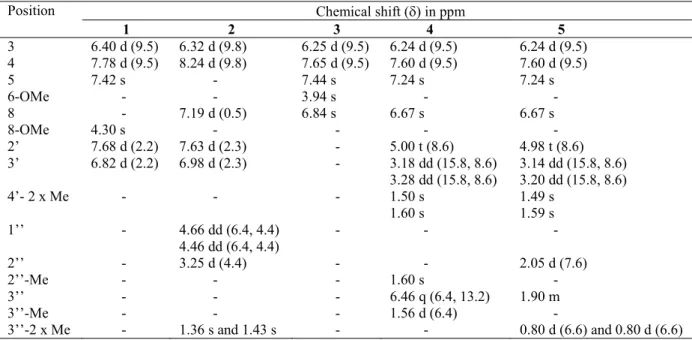
Rev. Bras. Farmacogn. Table 1. 1H (coupling constant J in Hz in parentheses) coumarins 1-5.
Table 2.13C NMR data of coumarins 1-5.
experiment was performed in duplicate and the average absorption was noted for each concentration. The same procedure was followed for the positive control Trolox®. The RC50 value, which is the concentration of the test material that reduces 50% of the free radical concentration, was calculated as mg/mL.
RESULTS AND DISCUSSION
Chromatographic analyses of the n-hexane extract of the aerial parts of P. uloptera afforded two furanocoumarins, xanthotoxin (1, Masuda et al., 1998) and prangenin (2, Miftakhova et al., 2001), two dihydrofuranocoumarins, deltoin (4, Baba et al., 1989) and prangolarin (5, Kapoor et al., 1972; Wei and Ito, 2006), and a simple coumarin, scopoletin (3, SDBS Database, 2008). The structures of the isolated coumarins (1-5) were elucidated by direct comparison of
Position Chemical shift (δ) in ppm
1 2 3 4 5
3 6.40 d (9.5) 6.32 d (9.8) 6.25 d (9.5) 6.24 d (9.5) 6.24 d (9.5) 4 7.78 d (9.5) 8.24 d (9.8) 7.65 d (9.5) 7.60 d (9.5) 7.60 d (9.5)
5 7.42 s - 7.44 s 7.24 s 7.24 s
6-OMe - - 3.94 s - -
8 - 7.19 d (0.5) 6.84 s 6.67 s 6.67 s
8-OMe 4.30 s - - - -
2’ 7.68 d (2.2) 7.63 d (2.3) - 5.00 t (8.6) 4.98 t (8.6) 3’ 6.82 d (2.2) 6.98 d (2.3) - 3.18 dd (15.8, 8.6)
3.28 dd (15.8, 8.6)
3.14 dd (15.8, 8.6) 3.20 dd (15.8, 8.6)
4’- 2 x Me - - - 1.50 s
1.60 s
1.49 s 1.59 s 1’’ - 4.66 dd (6.4, 4.4)
4.46 dd (6.4, 4.4)
- - -
2’’ - 3.25 d (4.4) - - 2.05 d (7.6)
2’’-Me - - - 1.60 s -
3’’ - - - 6.46 q (6.4, 13.2) 1.90 m
3’’-Me - - - 1.56 d (6.4) -
3’’-2 x Me - 1.36 s and 1.43 s - - 0.80 d (6.6) and 0.80 d (6.6)
Position Chemical shift (δ) in ppm
1 2 3 4 5
2 161.0 162.4 160.9 161.4 161.3
3 114.7 113.6 112.5 112.7 112.6
4 144.4 144.9 144.3 143.6 143.6
5 113.0 149.0 110.5 123.2 123.2
6 126.3 114.6 146.5 124.6 124.6
6-OMe - - 58.7 - -
7 147.9 158.5 148.4 163.5 163.2
8 132.7 95.3 102.3 97.9 97.9
9 143.8 152.9 148.6 155.8 155.8
10 116.5 107.9 110.8 112.7 112.7
8-OMe 61.0 - -
2’ 146.7 139.4 - 88.9 88.7
3’ 107.2 104.9 - 29.6 29.7
4’ - - - 81.9 8.9
4’- 2 x Me - - - 22.1
21.3
21.9 21.1
1’’ - - 60.0 167.3 172.3
2’’ - - 61.5 129.4 44.5
2’’-Me - - - 11.8 25.8
3’’ - 72.8 137.1 -
3’’-Me - - - 14.3 -
3’’- 2 x Me 25.0
19.4
their respective UV, specifi c rotation (where applicable), CIMS, 1H and 13C NMR data with published data, and by comprehensive 1D and 2D NMR analyses. The unambiguous assignment of all 1H and 13C NMR signals for these compounds has been presented in Tables 1 and 2.
Although coumarins have previously been reported from the roots and fruits of P. uloptera, to our knowledge, this is the fi rst report on the occurrence of coumarins in the aerial parts of this plant. Also, except xanthotoxin (1) and prangenin (2), none of these coumarins (3-5) have ever been reported from this plant. Xanthotoxin (1) and scopoletin (3) occur in many genera of the family Apiaceae as well as other families, e.g. Rutaceae. The genus Prangos is well-known for producing simple and furanocoumarins with various degrees of oxygenation and prenylations (ISI Database, 2008). Within the genus Prangos, prangenin (2) occurs in a number of species, including P. equisetoides
(Kuznetsova et al., 1979), P. fedtschenkoii,P. ferulaceae,
P. hissarica (Combined Chemical Dictionary, 2008; ISI Database, 2008), P. lamellate (Donchul et al., 1979),
P. pabularia (Sood et al., 1978; Tada et al., 2002),
P. sarawschanica (Combined Chemical Dictionary, 2008) andP. uloptera (Abyshev and Denisenko, 1973). However, apart from the genus Prangos, prangenin (2) has also been reported from a few other genera, e.g. Atalantia, Chlamydomonas, Citrus, Eriostemon, Halocnemum, Heracleum,Phebalium and Stauranthus,
(ISI Database, 2008; Combined Chemical Dictionary, 2008). The occurrence of deltoin (4) within the genus
Prangos is rather restricted mainly to P. uloptera and
P. fedtschenkoi, but it has been isolated from a few other genera, e.g. Peucedanum, Saposhnikovia, Seseli
and Zosima. Marmesin isovalerate (prangolarin or oxypeucedanin,5) occurs widely in the family Apiaceae, and also in the genera Atalantia, Citrus and Poncirus of the family Rutaceae (Combined Chemical Dictionary, 2008).
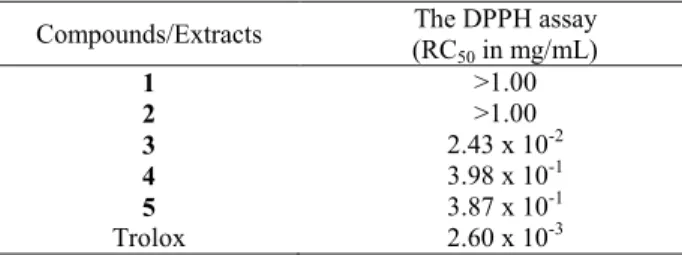
The antioxidant potential of 1-5 was evaluated by the DPPH assay (Kumarasamy et al., 2007). In the qualitative DPPH assay, except 3, all compounds showed extremely low levels of antioxidant activity by displaying faint white spots against a purple background on the TLC plates. In the quantitative DPPH assay, scopoletin (3) was the most active among all compounds, and displayed a signifi cant antioxidant activity with a
RC50 value of 2.43 x 10⁻² (Table 3).
REFERENCES
Abyshev AZ, Denisenko PP 1970. Coumarins and
furocoumarins from fruits of Prangos uloptera.
Khim Prir Soedin (6): 758.
Abyshev AZ, Denisenko PP 1973. Coumarins composition of
Prangos uloptera roots. Khim Prir Soedin (1): 767. Baba K, Yoneda Y, Kozawa M, Fujita E, Wang NH, Yuan
CQ 1989. Studies on Chinese traditional l medicine ‘Feng’ (II). Comparison of several Fang-Feng by coumarins, chromones and polyacetylenes.
Shoyakugaku Zasshi 43: 216-221.
Combined Chemical Dictionary 2008. Chapman & Hall/CRC Press LLC, USA. Available on-line at: http://www. chemnetbase.com/
Dokoric D, Bulatoric VM, Bozic BD, Kataronovski MV, Zrakie TM, Kovacenic N 2004. 3,5-Nonadiyne isolated from the rhizome of Cachrys ferulaceae inhibits endogenous nitric oxide release by rat peritoneal macrophages.Chem Pharm Bull 52: 853-854. Donchul TYU, Kuznetsova GA, Sokolova EA, Kuzmina
LV 1979. Coumarins from the roots of Prangos
lamellate.Khim Prir Soedin (6): 849-850.
Evans WC 1989. Trease and Evan’s Pharmacognosy, 13th edn.
Bailliere Tindall, London.
GRIN Database 2008. USDA, ARS, National Genetic Resources Program, Germplasm Resources Information Network (GRIN) online database, National Germsplasm Resources Laboratory, Beltsville, Maryland. Available on-line at: http:// w w w. a r s - g r i n . g o v / c g i - b i n / n p g s / h t m l / t a x o n . pl?29559.
ISI Database 2008. ISI Web of Knowledge Service for UK Education, supported by MIMAS at The University of Manchester and hosted by Thomson Scientifi c. Available on-line at: http://portal.isiknowledge.com/ portal.cgi?DestApp=WOS&Func=Frame.
Kapoor SK, Zaman A, Sharma YN 1972. Extractives of
Angelica glauca.Phytochemistry 11: 475.
Kumarasamy Y, Byres M, Cox PJ, Jaspars M, Nahar L, Sarker SD 2007. Screening seeds of some Scottish plants for free-radical scavenging activity. Phytother Res 21: 615-621.
Kuznetsova GA, Danchul TYU, Medvedev VN, Sokolova EA, Kuzmina LV 1979. Coumarins of the roots undergrounds and fruits of Prangos equisetoides.
Khim Prir Soedin (6): 850.
Masuda T, Takasugi M, Anetaki 1998. Psoralen and other linear furanocoumarins as phytoalexins in Glehnia littoralis.Phytochemistry 47: 13-16.
Mazloomifar H, Bigdeli M, Saber M, Rustaiyan A 2004. Essential oil of Prangos uloptera DC. from Iran. J Essent Oil Res 16: 415-416.
Miftakhova AF, Burasheva GS, Abilov ZA, Ahmad VU,
Compounds/Extracts The DPPH assay (RC50 in mg/mL)
1 >1.00
2 >1.00
3 2.43 x 10⁻²
4 3.98 x 10⁻¹
5 3.87 x 10⁻¹
Trolox 2.60 x 10⁻³
5
Rev. Bras. Farmacogn.
Zahid M 2001. Coumarins from the aerial part of Halocnemum strobilaceum. Fitoterapia 72: 319-321.
Nazemiyeh H, Razavi SM, Delazar A, Hajiboland R, Mozaffarian V, Nahar L, Sarker SD 2007. Essential oil composition of the umbels and fruits of Prangos uloptera DC. Nat Prod Commun 2: 91-93.
SDBS Database 2008. Spectral Database for Organic Compounds, National Institute of Advanced Industrial Science and Technology (AIST), Japan. Available on-line at: http://www.aist.go.jp/RIODB/ SDBS/cgi-bin/cre_index.cgi.
Sefi dkon F, Navaii MN 2001. Chemical composition of the oil of Prangos uloptera DC. J Essent Oil Res 13: 84-85.
Sood S, Gupta BD, Banerjee SK, Rao PR 1978. Coumarins from umbels of Prangos pabularia Lind,. J Indian Chem Soc 55: 850-851.
Tada Y, Shikishima Y, Takaishi Y, Shibata H, Higuti H, Honda G, Ito M, Takeda Y, Kodzimatov L, Ashurmatov O, Ohmoto Y 2002. Coumarins and gamma-pyrone derivatives from Prangos pabularia: antibacterial activity and inhibition of cytokine release.
Phytochemistry 59: 649-654.
Takao T, Watanabe N, Yagi I, Sakata K 1994. A simple screening method for antioxidants and isolation of several antioxidants produced by marine bacteria from fi sh and shellfi sh. Biosci Biotech Bioch 58: 1780-1783.
Wei Y, Ito Y 2006. Preparative isolation of imperatorin, oxypeucedanin and isoimperatorin from traditional Chinese herb “bai zhi” Angelica dahurica (Fisch ex Hoffm) Benth. et Hook using multidimensional high-speed counter-current chromatography. J Chromatogr A 1115: 112-117.
Yasuhiro S, Yoshishima T, Gisho H, Michiho I, Yoshio T, Olimjon K, Kodzimator O, Ashurmator O 2001. Terpenoids and gamma pyrone derivatives from