259
Review Articles
Trajectories of social participation in old age: a systematic literature review
Juliana Martins Pinto1
Anita Liberalesso Neri1
1 Universidade Estadual de Campinas, Faculdade de Ciências Médicas, Programa de Pós-Graduação em Gerontologia. Campinas, SP, Brasil.
Study financing: Conselho Nacional de Desenvolvimento Científico e Tecnológico (the National Council for Scientific and Technological Development) (CNPq) and the Ministério da Ciência e Tecnologia (the Department of Science and Technology) (MCT), process Nº 555087/2006-9.
Correspondence Juliana Martins Pinto
E-mail: [email protected]
Abstract
Objective: the present study aimed to identify patterns of social participation in old age and the theories used to explain them. Method: A systematic review was performed using the Medical Literature Analysis and Retrieval System Online (MEDLINE / PUBMED), Scientific Electronic Library Online (Scielo) and Web of Science (ISI Web of Knowledge) databases. The keywords used were: social participation, social engagement, social involvement and social activities; combined with seniors, the elderly, older adults, older people and aging. Research was performed between January and February. Results:
thirty-one longitudinal studies on social participation among old and healthy middle-aged adults were included for analysis. In three studies social engagement levels increased, especially at the beginning of old age (up to 75 years). Twenty-one studies presented results that described the reduction of social engagement levels in old age, and five studies found that there was no change in levels of social involvement. The most used theories were: the activity theory, the social disengagement theory, the continuity theory and the theory of socioemotional selectivity. Conclusion: the results point to the need for reflection on what is envisioned and what is practiced in terms of policies and practices aimed at achieving successful aging. Future attempts should include not only incentives to remain active, but a description of factors that influence the social disengagement associated with poor adaptation in old age.
260
INTRODUCTION
The search for successful aging has motivated the development of several social and psychological theories in the field of gerontology1,2. The first conceptual models, such as the social disengagement theory, were predominantly negative and emphasized the inevitability of functional decline and dependence in old age3. According to this theory, successful aging involves mutual distancing between the individual and society, resulting from the decline of skills and the shortening of remaining life.
Nowadays, literature on the aging experience is replete with considerations on productivity and success, and adopts a more positive approach in relation to the experience of aging. Its main foundations are the theories of activity4, continuity5 and socioemotional selectivity6.
The activity theory emerged from the observation of the positive relationship between greater levels of social involvement and satisfaction with life among the elderly4. According to this theory, a person is most likely to succeed in old age if they continue to be active and take on productive roles in society, replacing those that have been lost. These productive roles include community-based social activities, such as paid work, volunteering, and participation in social or religious groups4.
The activity theory brings together an extensive amount of empirical data that corroborates practical applications such as policies to encourage health promotion through the practice of physical activities, voluntary work and, more recently, the active aging policy proposed by the World Health Organization (WHO)1.
The continuity theory postulated that, although individuals adapt to the aging process by adjusting the duration, mode, and distribution of activities, they tend to participate in similar activities and to continue the lifestyles adopted in adult life and middle-age. Therefore, social participation patterns remain relatively stable during one’s life course5. Therefore, dynamism in the patterns and levels of social engagement is accepted, and includes as determinants personal motivations and preferences for activities and institutional factors.
Fol low ing t he l ife course perspect ive, Carstensen6 argues that people actively modify their social network in old age, selecting relationships and activities that are meaningful and sources of support, pleasure, and satisfaction, and setting aside relationships and activities that are burdensome, complex, stressful or the source of negative affect. This selection process is an important mechanism of adaptation in the sense of preserving emotional well-being, which is why it is known as socioemotional selectivity theory.
These important theoretical changes, accompanied by the dissemination of empirical data, have driven conceptual transitions in the field of Gerontology, challenging scholars and practitioners to deal with aging as a complex and heterogeneous process. In this context, engagement or social participation has become an important object of study. Defined as the involvement of the elderly in social activities practiced in the community, social participation is associated with a lower risk of morbidities7,8, disability9-12, cognitive decline8,12,13 and death14,15, and as a determinant of good quality of life and well-being in old age16,17.
As people age, various aspects of their lives are modified, including the quantity and composition of their social networks, as well as the frequency of their participation in social activities. In addition, social behavior is influenced by personal aspects (health, gender, income, schooling), contextual (social support, physical barriers and opportunities), as well as by common events of old age that characterize socially transient moments, for example, retirement and widowhood18-25.
The objective of the present study was to identify trajectories of social participation in old age and the theories used to explain them.
METHOD
261 The databases consulted were the Medical
Literature Analysis and Retrieval System Online (MEDLINE/PubMed), the Scientific Electronic Library Online (SciELO) and the Web of Science (ISI Web of Knowledge). The following descriptors were used: social participation, social engagement, social involvement and social activities; combined with seniors, elderly, older adults, older people and aging. The search was carried out between January 1, 2016 and February 1, 2016.
The inclusion criteria were longitudinal studies; year of publication after 2001; publications in the Portuguese, English or Spanish languages and investigation of the social participation of healthy elderly persons and healthy middle-aged adults. Studies with caregivers and with institutionalized or hospitalized elderly persons were excluded; as were studies with other designs (such as review, cross-sectional, qualitative, and instrument validation
studies). Studies that were repeated in more than one database were considered only once, according to the criteria mentioned.
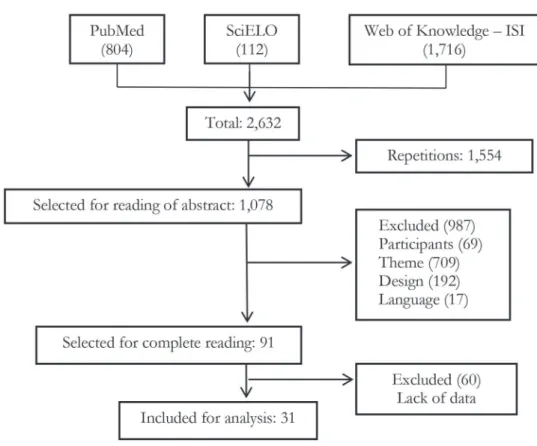
The selection of articles was carried out separately by two researchers, based on the title and abstract. When there was disagreement, a third researcher was asked to decide whether to include or exclude the study. Subsequently, the researchers read the articles in full and extracted the relevant information for this study. In this stage, new exclusions were required, as demonstrated in Figure 1.
Thirty-one longitudinal studies on social participation among healthy elderly and middle-aged adults were included for analysis. Table 1 shows the relevant characteristics of the studies, such as follow-up time, sample characteristics, and the instruments and indicators used to assess social participation.
262
to be continued Table 1. Characteristics of studies investigating trajectories of social participation in old age, based on information relating to follow-up, participants, indicators of social participation and results of interest. Campinas, São Paulo, 2016.
Author, year, country
Duration and participants
Participation
indicators Results of interest
Agahi et al.22,
2013, Sweden
36 years, 5 phases, 729 elderly persons or middle aged individuals.
Make and receive visits.
Reduction in levels of social engagement associated with the advance of age and incapacity.
Avlund et al.9, 2004,
Denmark
3 years, 2 phases, 1,396 elderly persons aged 75 years and above; 51% men.
Make and receive visits and participate in activities outside the home.
Levels of social participation declined as individuals aged for both genders. Higher SP levels were associated with lower risk of disability.
Benjamins et al.7, 2003,
USA
3 years, 2 phases, 2,958 elderly persons; 2/3 were women, average age 73 years.
Religious activities.
Elderly persons reduced their levels of social participation due to health problems. However, these levels tended to subsequently stabilize.
Bennett14,
2002, UK
5 years, 2 phases, 406 elderly persons, average age 72.8 (+3.9), 65.7% women.
BASE (Brief Assessment of Social Engagement) which includes religious and civic activities, holidays, and passive leisure.
Social participation diminished with advancing age and this decline was a predictor for mortality. Reduced levels of SP can signal subclinical health problems which are not otherwise recognized by professionals. SP can be a marker for health and mortality elderly persons. The results corroborate the activity theory.
Buchman et al.10, 2009,
USA
2-11 years (mean 5 years), 2 phases, 906 elderly persons.
Inventory with 6 items including cultural, religious, volunteer and group activities, trips and visits.
Levels of social activity were inversely proportional to increasing age. Lower levels of social engagement were associated with faster motor and functional decline among elderly persons.
Bukov et al.24, 2002,
Germany
4 years, 3 phases, 516 elderly persons.
Inventory with 11 activities cultural, political, leisure and voluntary.
Elderly persons who performed more complex activities also carried out less complex activities. This cumulative effect remained stable during old age. After the age of 90, more than 30% of elderly persons are socially inactive. Productive and political activities become rarer, particularly among women.
Chiao et al.26,
2011, China
18 years, 6 phases, 1,388 elderly persons; 63.3% men.
Inventory with 6 cultural/leisure, religious, and political activities, groups for retirees and voluntary groups.
Excluding elderly persons who had never taken part in social activities, 35.5% began to participate in such activities from the age of 70; 26% interrupted activities before the age of 70 and 38.4% interrupted social activities after the age of 70. A little social involvement is better for the mental health of the elderly than no such involvement.
Curl et al.23,
2014, USA
12 years, 7 phases, individuals aged 50 years or more.
Paid and voluntary work and frequency of contact with neighbors.
263 Author, year, country Duration and participants Participation
indicators Results of interest
Donnelly and Hinterlong18,
2009, USA
8 years, 3 phases, 228 elderly persons.
Cultural, leisure, and religious activities, frequency of contact with family members and friends.
Levels of social participation remained the same or increased following the death of a spouse in an attempt to compensate for the loss. Current levels were associated with previous levels of engagement.
Fairfall et al.27, 2014,
Australia
2 years, 1,327 men aged 70 years or over; Average age: 76.3 (+5.1).
Scale with 20 items constructed from four known instruments (Physical Activity Scale for the Elderly, Older Americans Resource Scale for Instrumental Activities of Daily Living, Duke Social Support Index
and Short Form-SF12)
In two years, social participation declined in 47.3% of men, remained the same in 20.7% and increased in 32%. In general, there was
a signiicant reduction in levels of social
participation.
Hank and Erlinghagen25,
2009, Germany
3 years, 2 phases, 18,057 elderly persons.
Voluntary or charity.
As they get older, the chance of people engaging in voluntary activities decreases. Commonly, elderly persons become less socially involved, because of the lack of environmental and personal resources.
Hong et al.8,
2009, USA
6 years, 3 phases, 5,294 elderly persons aged 70 years or older; 57.7% women; Average age 77 years.
Inventory with eight activities involving voluntary and paid work, physical, leisure, cultural and religious activities.
The average age of elderly persons with a greater degree of engagement was lower, and was also lower among elderly persons with a lower degree of social engagement; 47.5% of elderly persons were involved in more complex social activities. Greater levels of engagement were associated with a lower risk of depression.
Hoppmann et al.28, 2008,
Australia
11 years, 4 phases, 565 couples with a mean age of 76 years.
Four items from the
Adelaide Activity Proile
were used. These considered domestic visits, telephone conversations, participation in social groups and activities outside the home.
Wives with greater social engagement tended to reduce their participation over time. The trajectories of social activities were similar between spouses.
Hughes et al.12, 2013,
USA
3 years, 2 phases, 816 elderly persons aged 65 years or older; 62.4% women, average age 68.1 (+7.4).
Inventory with four activities including religious and family and social activities, centers for the elderly, and voluntary work.
Social engagement declined with age and is associated with cognitive decline.
Huxhold et al.29, 2013,
Germany
6 years, 3 phases, 4,862 individuals aged 40 to 85 years; 47.9% women, average age: 73.7 years
Make visits, cultural, physical and leisure activities, meetings with social groups.
Advanced age was related to a more accentuated reduction in the structure of the network and social engagement. Levels of social engagement and emotional support were predictors of changes in health and satisfaction with life.
continued from Table 1
264
continued from Table 1
Author, year, country
Duration and participants
Participation
indicators Results of interest
Huxhold et al.16, 2014,
Germany
6 years, 2 phases, 2,034 elderly persons aged 65 years or older; 47.9% women.
Frequency of contact with social network + inventory with nine activities including cultural, political and sporting activities.
The inluence of aging on the development of
social network characteristics is in keeping with the idea that the overall size of these networks, at more advanced ages, tends to decrease, while close relationships are maintained.
James et al.30,
2011, USA
5 years, 954 elderly persons aged 65 years or older; 74.7 women, average age 79.6 (+7.2) years.
Scale with six items including leisure, visits, voluntary activities, participation in groups for elderly persons.
Younger individuals had the highest levels of participation. Older, more socially active people are less likely to become incapacitated.
Kanamori et al.31, 2014,
Japan
4 years, 12,951 elderly persons aged 65 years or more, 51.2% women, average age 72,7 (+5,9) years.
Participate in
associations, religious, voluntary, sporting, and leisure activities, and paid work.
Social participation reduces the risk of disability. Younger elderly persons and men tend to participate more in organizations.
Kim et al.32,
2013, North Korea
3 years, 2 phases, 2,565 women aged between 45-64 years and 2,356 women aged 65 years or older.
Participate in religious, productive, recreational, political and voluntary activities.
Currently, more elderly women are involved in social activities, and such activities appear to have
a positive inluence on their state of health in
both middle age and old age.
Kim et al.33,
2014, USA
8 years, 965 subjects aged 55 years or older.
Two questions regarding the decline in engagement in social, religious and occupational activities.
Fewer than half of those interviewed described a decline in their social engagement, without stress. The proportion of respondents experiencing social isolation and social decline with distress declined over time. Older individuals (>85) appeared less frequently among those who suffered social isolation. Age and cohort were
signiicantly associated with the decline of social
participation.
Lancee and Radl20, 2012,
Germany
24 years, 10,225 workers aged 55 years or older.
Frequency of contact with friends and family members; participation in community activities.
65% of participants did not take part in community activities. Most met with friends and family at least once a month. A greater frequency of social contact leads to early retirement, while participation in community activities has the opposite effect in individuals under 60 years of age. Those who are heavily involved in civic life retire later.
Mendes de Leon et al.11,
2003, USA
9 years, 9 phases, 2,761 elderly persons; 45% aged 75 years or older and 58,4% women.
Social and productive activities.
The protective effect of engagement on disability declines over time.
265 Author, year, country Duration and participants Participation
indicators Results of interest
Lodi-Smith and Roberts34,
2012, USA
3 years, 159 elderly persons aged 60 years or older; 58.4% women; average age 72.4 (+7.5) years.
Inventory with 7 items including religious, recreational and voluntary activities.
Engagement diminishes with age, accompanied by reciprocal changes in personality traits.
Min et al.19,
2012, North Korea
2 years, 1,531 men aged 55 years and older; average age 63.7 years
Participation in family reunions, leisure, cultural, political, and religious activities.
Older elderly persons are more often unemployed and such status is closely related to low social engagement.
Minagawa and Saito15, 2014,
Japan
10 years, 5 phases, 13,225 elderly persons.
Educational, leisure and sporting activities.
Age was inversely related to social engagement. Greater engagement is associated with reduced risk of death.
Morrow-Howel et al.35,
2014, USA
2 years, 4.593 elderly persons; 59% women; average age 69.4 (+8.9) years
Composition of social network, social support and passive leisure.
41% of elderly persons exhibited trajectories characterized by moderate or low levels of activity. Social activities are most affected.
Allyn et al.17,
2015, USA
40 years, 4 phases,
4,000 individuals. Volunteering.
Participation in voluntary organizations increased over 17 years and declined over 12 years. Volunteering was associated with well-being.
Sabbath et al.21, 2015,
USA
12 years, 2 phases, 10,692 individuals; 81.3% men; 32.8% aged 62 years or older.
Berkman Social Network Index (marital status, family ties and friendship and participation in social organizations).
The earlier that retirement occurs, the more positive changes were observed in relation to participation in social activities. Frequency of contact with friends and family did not change, however.
Small et al.36,
2012, USA
12 years, 5 phases, 952 elderly persons; 66.9% women, average age 69.2 years.
Cultural activities and visiting friends.
Worse cognitive status was related to declining future social engagement. Continuing a lifestyle allows the maintenance of cognitive functions with advancing age.
Saczynski et al.13, 2006,
Hawaii (USA)
32 years, 2,513 men.
Marital status, home arrangement, participation in community groups, contacts with friends, and the existence of a relationship of trust.
Older men were less socially involved. Fifteen percent of participants decreased their level of social engagement from middle to advanced age; 32% increased their level of social engagement; 12% had a high level of social engagement in both middle and advanced age; And 10% had low engagement at both times.
Zunzunegui37,
2003, Spain
4 years, 2 phases, 964 elderly persons aged 65 years or older.
Participation in social, church and community center organizations.
Social participation is a protector against cognitive decline and dementia. The levels and characteristics of social involvement were similar after the follow-up period.
266
RESULTS
Most of the studies were published between 2009 and 2015 and mainly in the United States and Germany. No Brazilian study fulfilled the inclusion criteria for the analysis proposed in this study. Approximately half of the studies adopted the increase, decrease or maintenance of the incapacity to participate socially and of cognitive decline or dementia as their outcome or variable dependent. Other outcomes investigated were mortality, depression, well-being and retirement (Table 1).
Trajectories of social participation in old age
In order to answer the first research question, regarding the reduction, increase or maintenance of levels of social participation as people grow older, the results of the studies included were analyzed. It was found that in three studies levels of social engagement increased, especially in the onset of old age (up to 75 years). Twenty-one studies presented results that described a decrease in levels of social engagement as people age. Five studies reported the absence of significant changes in levels of social involvement between middle age and old age, suggesting the continuity of activities based
on previous experiences accumulated during the life course of an individual (Table 2).
Use of theories
With regard to the use of theories to explain social participation in old age and its effects, we identified five theoretical reasonings that were grouped according to the best-known theories: activity, social disengagement, continuity and socioemotional selectivity. Each theory was classified based on studies that mentioned it explicitly and those that did not explicitly refer to any theory, but used their principles implicitly to explain its results. Only one study explained the use of the activity theory, while 16 studies used its principles implicitly. Studies that presented data and arguments about the positive effects of social engagement on functional, health, cognition and mortality outcomes were included in this group. Only one study implicitly used the theory of social disengagement, and none applied it explicitly. The continuity theory was explicitly mentioned in one study and implicitly addressed in two studies. The socioemotional selectivity theory was explicitly addressed in six studies and no study referred to it implicitly (Table 3). These findings relate to the second question proposed for this study.
Table 2. Report of studies analyzed in terms of the trajectories of social participation of elderly persons over time. Campinas, São Paulo, 2016.
Studies that identified an increase in the social participation of elderly persons over time.
Kim et al., 201332; Allyn et al., 201517; Sabbath et al., 201521
Studies that identified a reduction in the social participation of elderly persons over time.
Agahi et al., 201322; Avlund et al., 20049; Benjamins et al., 20037; Bennett, 200214; Chiao et al., 201126; Curl et al., 201323;
Fairfall et al., 201427; Hank and Erlinghagen., 201025; Hoppmann et al., 200828; Hughes et al., 201312; Huxhold et al.,
201416; Huxhold et al., 201329; Kanamori et al., 201431; Kim et al., 201433; Mendes de Leon et al., 200311; Lodi-Smith
and Roberts, 201234; Min et al., 201219; Minagawa and Saito, 201415; Morrow-Howell et al., 201435; Small et al., 201236;
Saczynski et al., 200613.
Studies that identified a continuation of the social participation of elderly persons over time.
267 Table 3. Report of studies analyzed, based on gerontological theories used to explain trajectories of social
participation in old age. Campinas, São Paulo, 2016.
Explicit Implicit
Activity Theory
Bennett, 200214 Agahi et al., 201322; Avlund et al., 20049; Chiao et al.,
201126; Curl et al., 201323; Fairfall et al., 201427; Hughes
et al., 201312; Kanamori et al., 201431; Kim et al., 201332;
Mendes de Leon et al., 200311; Min et al., 201219; Minagawa
and Saito, 201415; Allyn et al., 201017; Morrow-Howell et
al., 201435; Small et al., 201236; Saczynski et al., 200613
Disengagement Theory
--- Benjamins et al., 20037
Theory of continuity/lifecourse
Lancee and Radl, 201220 Sabbath et al., 201521; Zunzunegui, 200337
Socioemotional Selectivity Theory
Donnelly and Hinterlong, 201018; Hoppmann et al.,
200828; Huxhold et al., 201416; Huxhold et al., 201329; Kim
et al., 201433; Lancee and Radl, 201220
---DISCUSSION
According to the information obtained and set out in Table 1, there was significant heterogeneity among the studies regarding publication location, sample characteristics and the methods by which social participation was evaluated. The cultural and socioeconomic aspects determined by the country of origin of the study samples may have influenced the profile of the participants in terms of age, gender and living conditions. The proportion of elderly women and men differed among countries, influencing their representation in the samples of the studies. While studies on aging generally involve more women than men, the present review identified a number of studies with a higher proportion of men than women9,16,21,26. In addition, some studies investigated only women or only men19,28-32. These aspects may influence the results presented by these studies especially in relation to the social engagement of the elderly persons.
It is known that the profile and characteristics of social participation are closely related to culture, beliefs and socially acceptable habits, as well as the opportunities and resources available in the community24,33-35. The same characteristics are also influenced by gender and age. Thus, the place of
origin of the elderly may imply greater or lesser participation, in spite of personal aspects related to aging. In some European and North American countries, volunteering is a widespread activity practiced by the majority of adults and elderly persons throughout their lives, while it is little practiced
in Latin America and the Caribbean25. The same
applies to regard to sports, religious and educational activities. This explains the variety of indicators used in literature to assess social participation. These aspects should be considered in the interpretation of the results and in the conclusions of these studies.
268
of health and social sciences to understand the mechanisms involved in the behaviors observed in practice and the implications for the health and well-being of the elderly.
The most frequently observed trajectory of social participation was the identification of diminished participation in social actions or the reduction of contact with friends and family, especially among older age groups. Several studies have identified reduced levels of social participation associated with age22. This trajectory has been observed for both men and women9, but with different characteristics. While men tend to disengage from political and organizational activities and work, women discontinue community activities and volunteer work. This disengagement is most pronounced at age 75, and maybe influenced by common events in old age, such as widowhood, retirement, health problems, and functional decline10,18,30,31,33,36,37.Benjamins et al.7 observed that acute events such as hip fractures, cancer and cerebrovascular accidents compromise participation in social activities. According to Buchman et al.10, levels of social activity are inversely proportional to the advancement of age. Lower levels of social engagement lead to more rapid motor and functional decline among the elderly. In addition, reduced social connections, the limited frequency of participation in social activities and social disengagement are predictors of cognitive decline36,37 and dementia12.
Less frequent was the observation that levels of social engagement remain stable throughout life, including in old age18,20,21,24,37. The results of these studies point to the existence of continuity in relation to the social behaviors that are constructed and nourished throughout life and therefore influence outcomes in old age. This rationale has important practical implications. Considering that social behavior in old age is determined by previous events and experiences, the approach of these individuals to promote health and well-being through social engagement must begin in stages of life prior to old age. This implies that collective efforts must be employed to enable young people and adults to engage socially and to maintain these relationships and activities for longer, in such spaces as school, university, community and work.
According to Bukov et al.24, old age can bring a mixture of stability, reactivation and the reduction of social participation. The results of this study showed that 87% of elderly persons who performed activities in groups in the first phase of the study, continued to perform them after four years of follow-up, and 11 out of 20 socially inactive people at the beginning of the study had begun social activities by the end of the follow-up period. However, the number of participants in political and productive activities declined by half from one measurement time to another. According to the authors, when selection occurs in advanced age, it will probably be in favor of less demanding activities, and participation in more demanding activities will be interrupted. The cumulative pattern of social participation is maintained even after such selection. This argument reinforces the idea of continuity from a life course perspective.
The trajectory of increasing levels of social engagement in old age was described by three studies17,21,32. These results may have been influenced by the methods used to measure social participation, as depending on the social activity or instrument used, certain trajectories may be favored. For example, if the study considers participation in a remunerated activity as an indicator of social engagement, elderly populations will probably reveal a declining trend, as it is common for such individuals to retire and, therefore, to abandon such activities. However, in studies in which voluntary activity was adopted as an indicator of social participation, trajectories of increased social engagement were observed. After retirement older people are likely to enjoy more free time to engage in pleasurable and optional activities, such as volunteering18. The increase in social participation after retirement is a sign of selection and adaptation, to achieve or maintain favorable levels of functioning and active aging20.
269 or the notion that inactivity and disuse entails a loss
of skills. These precepts were contemplated by this theory and have guided important public policies for active and healthy aging1. It is true that evidence of the benefits of social participation for health and well-being is robust and has been repeatedly demonstrated in several studies 16,26,28,29. Empirical data have pointed out that elderly people with worse cognition are less engaged than their peers whose cognition is preserved12,36,37. This suggests that social involvement may be an early marker of cognitive loss and that engaging in social activities provides protection against the progression of moderate cognitive impairment to a more serious condition12. People with higher levels of social engagement not only live longer but also have lower risks of health and disability issues. Other findings have stated that facilitating social activities in old age, as well as in the transition between middle age and old age, may help delay functional disability25, especially in relation to mobility10.
Although most studies identified levels of the decline of social engagement in old age, the theory of social disengagement was mentioned by only one study, and even then implicitly. This contradiction may be due to criticisms of the theory, which accuse it of suggesting that such disengagement is an inevitable, reciprocal, normative and beneficial development process for both the elderly and society. This argument was not univocally confirmed by subsequent research, and although the theory is supported by real-life data, it was discredited and practically excluded from literature until the 1990s. From that time on, new theoretical efforts, such as the socioemotional selectivity theory, have contributed important conceptual advances in the field of gerontology2.
Today the social disengagement observed in old age is largely explained by the socioemotional selectivity theory, which proposes that, in old age, changes in the composition of the social network, family structure, work and leisure relations, and especially in social roles, influence social behavior. The social needs of old age are different from those of young adults and, therefore, social networks assume other functions among the elderly. These individuals need more social and emotional support and fewer contacts that generate recognition and social status,
which is why they select a more restricted, but significant and positively affective social network18.
Donnelly and Hinterlong18 found that widows
exhibited greater levels of participation than non-widowers and widowed women were more likely to describe greater degrees of social participation than widowed men. Elderly widowers did not exhibit lower levels of participation in voluntary work than married elderly people, as was expected. The explanations for this are based on the socioemotional selectivity theory, which postulates that, in old age, there is a greater emphasis on the fulfillment of emotional and social goals.
The composition of a social network has less influence on health outcomes in middle age than in old age33,35. In the former period, activities practiced with friends are more significant and more frequently described as sources of pleasure than activities practiced with family members. In contrast, Huxhold et al.16 found that with increasing age, elderly persons reduce their level of social activity with relatives more than they do with friends. Informal social activities with friends were associated with the reduction of negative affect, but social and mandatory activities with family members were associated with increased negative affect16.
270
The socioemotional selectivity theory argues that focusing on affectively close relationships is an important method of improving emotional well-being, and is often associated with a reduction in the size of a social network. However, this strategy may inhibit the maintenance or development of some aspects of successful aging if such reductions occur at the expense of social commitment. This possibility posits the assumption that prioritizing close relationships, decreasing network size, and maintaining close network partners is universally adaptive. Probably the most adaptive factor for development in old age is a balance of social network characteristics that offer both emotional support and adequate levels of stimulation, challenge and activity. Theoretical and empirical studies on the socioemotional selection theory indicate a need for caution regarding adopting a negative view of the decline of social engagement in old age. Kim et al.32 argue that it is fundamental to distinguish voluntary disengagement from the forced social disengagement that is associated with psychic suffering.
The composition of the social network and the practice of social activities in the community configure social behavior, which influences the health and well-being of the elderly. It is a continuous, dynamic, complex and multifaceted process, which assumes diverse trajectories throughout life and in old age, according to personal and contextual factors. In this sense, some theoretical postulations are pertinent: a) social disengagement is the predominant process among aging individuals; b) this process is often associated with negative outcomes, so that being socially active is a way of preserving physical, cognitive and emotional abilities and functions, and avoiding death; and, c) contrastingly, this process may be the result of a selective, compensatory and adaptive process that promotes emotional well-being in old age.
The present study contributes to gerontological literature through a critical analysis of the main studies published on the topic in the last fifteen years. However, it is noted that the study of social participation in old age, especially in emerging countries, is little explored. Generally, this phenomenon integrates comprehensive concepts such as quality of life and well-being, which hinders its characterization and understanding. In this sense, the conclusions of this article must be interpreted carefully. Possibly, the trajectories described reflect the behavior of the elderly persons, which includes certain personal and contextual attributes that influence their participation in social activities. Thus, subsequent studies should explore these factors in order to understand the determinants of social participation in old age.
CONCLUSION
The most commonly described social participation trajectory in literature is the reduction of social networks and the reduction of participation in social activities, or in other words, of social disengagement, both in terms of its negative value as an intentional and adaptive selection process. The theories most present in the literature were the activity (implicitly) and socioemotional selectivity (explicitly) theories. These results point to the need for more careful reflection on what is idealized and what is practiced in terms of policies and practices to achieve successful aging. Future efforts should include not only incentives to remain active, but also factors that influence the social disengagement associated with the poor adaptation of the elderly.
The knowledge revealed by the present study can contribute to gerontological practice and research by helping researchers and professionals to understand the social behavior of the elderly.
REFERENCES
1. World Health Organization. Active Ageing: a Policy Framework [Internet]. Geneva: WHO; 2001. [acesso em 16 jan 2016]. Disponível em: http://apps.who. int/iris/bitstream/10665/67215/1/WHO_NMH_ NPH_02.8.pdf.
271
17. Allyn J, Siegl E, Piliavin JA. Health Benefits in the Wisconsin of Volunteering Longitudinal Study. J Health Soc Behav. 2015;48(4):450-64.
18. Donnelly EA, Hinterlong JE. Changes in social participation and volunteer activity among recently widowed older adults. Gerontologist. 2010;50(2):158-69.
19. Min J, Lee K, Park J, Cho S, Park S, Min K. Social engagement, health, and changes in occupational status: analysis of the Korean Longitudinal Study of Ageing (KLoSA). PLoS ONE. 2012;7(10):1-7.
20. Lancee B, Radl J. Social connectedness and the transition from work to retirement. J Gerontol Ser B Psychol Sci Soc Sci. 2012;67(4):481-90.
21. Sabbath EL, Lubben J, Goldberg M, Zins M,
Berkman LF. Social engagement across the retirement transition among “young-old” adults in the French GAZEL cohort. Eur J Ageing. 2015;12(4):311-20.
22. Agahi N, Lennartsson C, Kåreholt I, Shaw BA. Trajectories of social activities from middle age to old age and late-life disability: a 36-year follow-up. Age Ageing. 2013;42(6):790-3.
23. Curl AL, Stowe JD, Cooney TM, Proulx CM. Giving up the keys: how driving cessation affects engagement in later life. Gerontologist. 2014;54(3):423-33.
24. Bukov A, Maas I, Lampert T. Social participation in very old age: cross-sectional and longitudinal findings from BASE: Berlin Aging Study. J Gerontol Ser B Psychol Sci Soc Sci. 2002;57(6):510-7.
25. Hank K, Erlinghagen M. Dynamics of volunteering in older Europeans. Gerontologist. 2010;50(2):170-8.
26. Chiao C, Weng LJ, Botticello AL. Social participation reduces depressive symptoms among older adults: an 18-year longitudinal analysis in Taiwan. BMC Public Health. 2011;11:1-9.
27. Fairhall N, Sherrington C, Cameron ID, Blyth F, Naganathan V, Clemson L, et al. Predicting participation restriction in community-dwelling oldermen: the Concord Health and Ageing in Men Project. Age Ageing. 2014;43(1):31-7.
28. Hoppmann CA, Gerstorf D, Luszcz M. Spousal social activity trajectories in the Australian Longitudinal Study of Ageing in the context of cognitive, physical, and affective resources. J Gerontol Ser B Psychol Sci Soc Sci [Internet]. 2008 [acesso em 23 fev 2016] 63(1): 41-50. Disponível em: https://www.ncbi.nlm.nih.gov/ pubmed/18332195
29. Huxhold O, Fiori KL, Windsor TD. The dynamic interplay of social network characteristics, subjective well-being, and health: the costs and benefits of socio-emotional selectivity. Psychol Aging [Internet]. 2013 [acesso em 23 fev 2016] 28(1):3-16. Disponível em: https://www.ncbi.nlm.nih.gov/pubmed/23066804 3. Cumming E, Henry W. Growing old. New York:
Basic Books; 1961.
4. Knapp MRJ. The activity theory of aging: an examination in the English context. Gerontologist. 1977;17(6):553-9.
5. Atchley R. A Continuity Theory of Normal Aging. Gerontologist. 1989;29(2):183-90.
6. Carstensen LL. Social and emotional patterns in adulthood: support for socioemotional selectivity theory. Psychol Aging. 1992;7(3):331-8.
7. Benjamins MR, Musick MA, Gold DT, George LK. Age-related declines in activity level: the relationship between chronic illness and religious activities. J Gerontol Ser B Psychol Sci Soc Sci. 2003;58(6):377-85.
8. Hong SI, Hasche L, Bowland S. Structural relationships between social activities and
longitudinal trajectories of depression among older adults. Gerontologist [Internet]. 2009 [acesso em 01 fev 2016]. 49(1):1-11. Disponível em: https://www. ncbi.nlm.nih.gov/pubmed/19362999
9. Avlund K, Lund R, Holstein BE, Due P. Social relations as determinant of onset of disability in aging. Arch Gerontol Geriatr. 2004;38(1):85-99.
10. Buchman AS, Boyle PA, Wilson RS, Fleischman DA, Leurgans S, Bennett DA. Association between late-life social activity and motor decline in older adults. Arch Intern Med [Internet]. 2009 [acesso em 01 fev 2016] 169(12):1139-46. Disponível em: https://www. ncbi.nlm.nih.gov/pubmed/19546415
11. Mendes de Leon CF, Glass TA, Berkman LF. Social engagement and disability in a community population of older adults: the New Haven EPESE. Am J Epidemiol. 2003;157(7):633-42.
12. Hughes TF, Flatt JD, Fu B, Chang CCH, Ganguli M. Engagement in social activities and progression from mild to severe cognitive impairment: the MYHAT Study. Int Psychogeriatr. 2013;25(4):587-95.
13. Saczynski JS, Pfeifer LA, Masaki K, Korf ESC, Laurin D, White L, et al. The effect of social engagement on incident dementia: the Honolulu-Asia Aging Study. Am J Epidemiol . 2006;163(5):433-40.
14. Bennett KM. Low level social engagement as a precursor of mortality among people in later life. Age Ageing. 2002;31(3):165-8.
15. Minagawa Y, Saito Y. Active social participation and mortality risk among older people in Japan: results from a nationally representative sample. Res Aging. 2015;37(5):481-99.
272
Received: April 30, 2016 Reviewed: December 29, 2016 Accepted: March 11, 2017
30. James BD, Boyle PA, Buchman AS, Bennett DA. Relation of late-life social activity with incident disability among community-dwelling older adults. J Gerontol Ser A Biol Sci Med Sci. 2011;66(4):467-73.
31. Kanamori S, Kai Y, Aida J, Kondo K, Kawachi I, Hirai H, et al. Social participation and the prevention of functional disability in older Japanese: JAGES cohort study. PLoS ONE. 2014;9(6):1-10.
32. Kim JH, Kim M, Kim J. Social activities and health of korean elderly women by age groups. Educ Gerontol. 2013;39(9):640-54.
33. Kim J, Yamada N, Heo J, Han A. Health benefits of serious involvement in leisure activities among older Korean adults. Int J Qual Study Health Well-being [Internet]. 2014 [acesso em 23 fev 2016]; 9:1-9. Disponível em: https://www.ncbi.nlm.nih.gov/pmc/ articles/PMC4110381/pdf/QHW-9-24616.pdf
34. Lodi-Smith J, Roberts BW. Concurrent and
prospective relationships between social engagement and personality traits in older adulthood. Psychol Aging. 2012;27(3):720-7.
35. Morrow-Howell N, Putnam M, Lee YS, Greenfield JC, Inoue M, Chen H. An investigation of activity profiles of older adults. J Gerontol Ser B Psychol Sci Soc Sci. 2014;69(5):809-21.
36. Small BJ, Dixon RA, McArdle JJ, Grimm KJ. Do Changes in Lifestyle Engagement Moderate Cognitive Decline in Normal Aging? Evidence from the Victoria Longitudinal Study. Neuropsychology. 2012;26(2):144-55.