DOI: http://dx.doi.org/10.5007/1980-0037.2013v15n2p256
review article
RBCDH
Licence Creative Commom
CC
¹ Universidade Estadual Paulista. Instituto de Biociências. Depar-tamento de Educação Física. Laboratório de Atividade Física e Envelhecimento. Rio Claro, SP. Brasil.
² University of Illinois at Urbana--Champaign. Department of Kine-siology and Community Health, Urbana, IL, USA.
Received: 30 May 2012 Accepted: 03 September 2012
Methods for assessing physical activity: a
systematic review focused on older adults
Métodos de avaliação de atividade física: uma revisão
sistemática focada em idosos
Deisy Terumi Ueno¹ Émerson Sebastião² Danilla Icassatti Corazza¹ Sebastião Gobbi¹
Abstract– Among the large array of instruments for measuring physical activity (PA), the use of questionnaires, pedometers, and accelerometers with older adults is frequent. his study aimed to analyze the most widely adopted protocol for each instrument that is most commonly used to assess PA in older adults, and explore possible advantages and disadvantages of the methods used for these instruments. hereby, we performed a search in databases and cross references of the articles selected. his procedure yielded in 16 studies being included. he in-depth analyzed studies demonstrate that questionnaires are usually applied either as an interview or self-administered, assessing the domains of leisure, sports, and household chores with a recall period of a typical week in the last month. Regarding pedometers and accelerometers, the length of time considered to be suicient for data collection is ive days. he devices are frequently used on the waist or hip with a belt or attached to clothing and removed only for water activities or during sleeping time. he use of either instrument should take into account the advantages and disadvantages that inluence choosing one over the other, such as the number of participants to be evaluated, the time available for assessment, among others. he use of accelerometer along with PA questionnaire may yield more reliable and accurate measurements of PA level. In addi-tion, it is recommended that, for older adults, questionnaires should be applied employing the interview format, in order to minimize possible misinterpretation of the questions.
Key words: Assessment; Older adults; Physical activity.
Despite the beneits of regular physical activity are well established in the literature, and the public health eforts to promote such practice within the
population as a whole, physical inactivity remains a concern worldwide1.
Analyzing physical inactivity among diferent age groups, the prevalence of physical inactivity is higher among older adults.
Parallel with the concern to promote and increase physical activity levels among the population, how to measure physical activity has drawn the attention of researchers. What would be the best method for assessing physical activity? In the literature it is possible to observe a large array of methods ranging from sophisticated methods that require highly special-ized personnel and high cost, such as doubly labeled water, to questionnaires that are simple, practical, and inexpensive. Among the diferent instru-ments to measure physical activity, the use of questionnaires, pedometers, and accelerometers within the older population is quite common, most likely because of the possibility of evaluating a large number of participants. Questionnaires are instruments normally used in epidemiological studies mainly for enabling the assessment of physical activity in a large sample size. In addition, questionnaires can be applied in diferent formats, such as interview, telephone, or self-administered. Furthermore, most of questionnaires are able to assess duration, intensity, frequency, and types of physical activity in the domains of household activities, leisure, sports/
exercise, or occupation2-4.
Pedometers are mechanical counters that record the number of steps
in response to a vertical acceleration of the body5. hese devices are
light-weight, portable, and low cost, and are based on horizontal hip movement
inherent in the swing phase of a step in humans6,7.
Accelerometers are motion sensors that are sensitive to changes in acceleration of the body in one or all three axes and are able to provide a more direct measurement of the frequency, intensity, and duration of the
movements related to the activity performed8.
However, studies have presented diferent methods for the application
of the same instrument. For example, Castro et al.9 evaluated the level of
physical activity in older adults using the short form of the International Physical Activity Questionnaire (IPAQ) as interview. Diferently, Ferreira
et al.10 used the same questionnaire, but as self-administered. he same is
observed for pedometers11,12 and accelerometers13,14. However, the
varia-tion of the latter instruments is in the fastening posivaria-tion and days of the week used.
Physical activity assessment in older adults Ueno et al.
he importance of a systematic review with these objectives is based on both the professional application as well as the orientation of future research for evaluating physical activity in older adults. Knowing the best protocol to be adopted with a given instrument can guarantee more reli-able information.
METHODS
he methodological process of this study consisted of a systematic review of the literature based on a bibliographic search in the following
data-bases: Web of Science, SPORTDiscus, Biological Abstracts, and Medline.
he Boolean operators and keywords used were as follows: (Assessment
OR Evaluation OR Measurement) AND (Older Adults OR Older People OR Elderly) AND (Physical Activity) AND (Questionnaire OR Pedometer OR Accelerometer). In addition to thedatabase search, a manual search was also employed using the reference list of the selected articles. he search for the articles was conducted in November 2011, and the selected articles should meet the following inclusion criteria: a) original articles reporting research with humans, b) studies describing the methods of application, use, and information regarding the data collected from the questionnaires, pedometers, and accelerometers, c) using older adults as sample, and d) being published in the last 5 years. First of all, the articles were selected by the title.
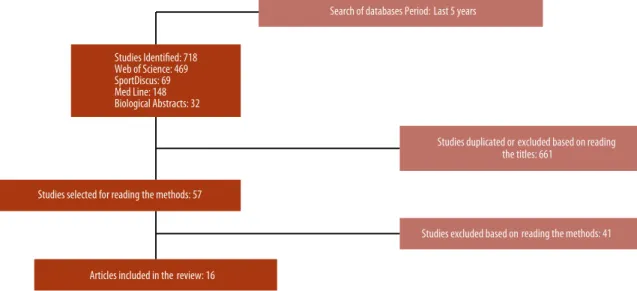
A total of 718 articles were identiied. Ater the irst screening, 661 ar-ticles were excluded whose titles were not related to the topic proposed or were repeated between databases. Subsequently, 41 articles were excluded based on methods that did not meet the inclusion criteria adopted for the study or were review articles. his procedure yielded in 16 articles being included and in-depth analyzed. Figure 1 illustrates the steps for selecting the articles.
he main information regarding methodological characteristics of the selected articles is summarized in the tables below and divided by type of instrument (Box 1, questionnaire; Box 2, pedometer and; Box 3, ac-celerometer).
Box 1. Methodological characteristics regarding the use of questionnaires in the studies selected.
Study Questionnaire Form Domains Recall period Harris et al.15 17-item Zutphen Physical
Activ-ity Questionnaire
Self-administered Leisure and sports Usual activity during last week of month Colbert et al.16 CHAMPS (Physical Activity
Questionnaire for Older Adults)
Self-administered Leisure, exercise, and daily activities
Typical week of last 4 weeks YPAS (Yale Physical Activity
Survey)
Interview Leisure, exercise, and household chores
Typical week of last month modPASE (modiied version of
the Physical Activity Scale for the Elderly)
Interview Leisure, work, and house-hold chores Last 7 days
Banda et al.17 BRFSS (Behavioral Risk Factor
Surveillance System) Interview
Physical activities of mod-erate intensity for at least
10 minutes
Usual week PASS (Physical Activity Short
Survey) Self-administered
Physical activity of
moder-ate and vigorous intensity Last 7 days PALS (Physical Activity Long
Survey) Self-administered
Traditional aerobic
activi-ties and sports Last 3 months Moore et al.18 PASE (Physical Activity Scale for
the Elderly)
Interview, Self-administered
Leisure, work, household chores
1 week
CHAMPS (Physical Activity Questionnaire for Older Adults)
Interview,
Self-administered Leisure, exercises, and daily living activities Typical week of last 4 weeks YPAS (Yale Physical Activity
Survey) Interview
Leisure, exercise, and household chores
Typical week of last month Modiied Baecke Questionnaire
for Older Adults
Interview Leisure, sports, and household chores
Past year
Yasunaga et al.19 PAQ-EJ (Physical Activity
Ques-tionnaire for Elderly Japanese)
Self-administered Personal transportation, exercises/sports, house chores, and work
Typical week of last month Ewald, McEvoy
and Attia7
PASE (Physical Activity Scale for the Elderly)
Phone or self-admin-istered
Leisure, work, and
house-hold chores Last 7 days Gill et al.20 Phone-FITT (Brief Physical
Activ-ity Interview for Older Adults)
Telephone recreation, and structured Household chores, activities
Physical activity assessment in older adults Ueno et al.
Box 2. Methodological characteristics regarding the use of pedometers in the studies selected.
Study Type/Brand Position Days Removal Data considered Harris et al.15 Yamax Digi-walker SW-200
(Yamax, Corp)
On the hip 7 days Showering/ Swimming
<5 days excluded Colbert et al.16 Pedometer with 7-d memory
(NL-2000; New-Lifestyles, Inc. Lee´s Summit, MO)
Left side of waist using an elastic strap
7 days - Any day of less than 10h of usage was excluded McMurdo et al.21 Omron HJ-113 piezoeletric
pedometer (Omron Healthcare UK Ltd, Milton Keynes, UK)
One on the waist and another on the neck
- -
-Croteau et al.22 Yamax Digi-walker SW-200
electronic pedometer (Yamax Corporation, Tokyo, Japan)
Clipped to belt or clothing, and centered on the dominant foot
7 days -
-Togo et al.23 Electronic physical
activ-ity monitor (modiied Kenz Lifecorder, Suzuken Co., Ltd., Nagoya, Aichi, Japan)
Attached to a belt at the waist, used uni-formly on the left side of the subject’s body.
- Showering/ Changing clothes
-Ewald, Mcevoy, and Attia7
Pedometer (Yamax DW200, Yamax, Tokyo, Japan)
Attached to clothing (each side), close to the anterior iliac spine
7 days Changing clothes
-Snyder, Colvin, and Gammack24
Accusplit Eagle 120XL pedom-eter (ACCUSPLIT, Livermore, CA)
Worn on the hip or belt 4 periods of 7 days
-
-Bergman, Basset Jr., and Klein25
Yamax Digi-Walker SW-200 (DW; Yamax Corporation, Tokyo, Japan)
On belt or waistband at midline of right thigh
7 days Showering
-StepWatch 3 Step Activity Monitor (SW3; Cyma Incorpo-rated, Seattle, WA)
Attached above the lateral malleolus of the right leg
7 days Showering/ When in bed
-Box 3. Methodological characteristics regarding the use of accelerometers in the studies selected.
Trial Brand Type Positioning Days Removal Data considered Harris et al.15 GT1M Actigraph
(Manu-facturing Technology Inc) Uniaxial
On the hip, attached by a
belt 7 days
Showering/
swimming ≥ 5 days Copeland
and Esliger26
Actigraph model 7164 accelerometer Uniaxial
Two side by side, positioned on the right hip using an adjustable nylon belt
7 days Bedtime 10h/day for at least 5 to 7 days Colbert et
al.16
GT1M uniaxial accel-erometer (Actigraph, LLC, Pensacola, FL)
Uniaxial Right side of waist using an
elastic strap 7 days
-Any day of <10h of usage was excluded Banda et al.17 Actical accelerometer Uniaxial
Attached to a neoprene belt that allowed easy and safe position-ing of the device on the right hip
7 days
-≥4 days of valid use with ≥12 h of time of valid use Yasunaga et
al.19
Electronic accelerometer (modiied Kenz Lifecord-er, Suzuken Co., Ltd., Nagoya, Aichi, Japan)
Attached to a belt on either
left or right side of the body 1 month
<1.5 MET were excluded
McMurdo et al.21
RT3 (RT3 Accelerom-etry Research Tracker, Stayhealthy Inc., Monrovia, CA)
Triaxial Device used on waistband 14 days
-The irst set of 24-hour data was discarded and days lost were excluded from the analysis Koizumi et al.27 Kenz Lifecorder accelerometer (ACCEL; Suzuken Company, Nagoya, Japan)
Uniaxial Able to use the device at waist level 7 days - Minimum of 5 days
Morie et al.28 Triaxial accelerometers
(Actigraph, Pensacola, FL) Triaxial
On an elastic belt on left or
right hip 7 days - ≥ 5 days Gill et al.20
Actigraph GT1M mon-itor (Actigraph, LLC, Fort Walton Beach, FL)
Uniaxial
Attached to an elastic band on one side of subjects’ body
7 days
Activity in water (show-ering) and at bedtime
≥ 5 days of valid data, of which at least one should be a day on a weekend. Harris et al.29 GT1M Actigraph
(Acti-graph GT1M, Fl, USA) Uniaxial
Worn around the hip on a
belt 7 days
Showering/
Considering the purpose of this study, which aimed to analyze the most adopted protocol of questionnaires, pedometers, and accelerometers, as well as to explore their advantages and disadvantages, the results found will be discussed by type of instrument.
Questionnaires
Among the indirect techniques for measuring physical activity level, ques-tionnaires are characterized as being a descriptive survey instrument that aims to measure intensity, frequency, duration, and type of physical activity performed in diferent areas without manipulation of facts, phenomena, or behaviors of individuals. Questionnaires have been the most used method in large population studies due to low cost and practicality. In addition, less time is required for the application of questionnaires and most of them
present good applicability, feasibility, and accuracy2,4.
It was observed in the studies related to the use of questionnaires included in this review that questionnaires are oten administered by
interview or self-administered16-19 with a recall period of a typical week in
the last month16-20. he most assessed physical activity domains are leisure,
sports, and household chores25-29.
Age has a strong inluence when measuring physical activity as for the accuracy of the information provided. hat is because vision problems, interpretation of questions, and recall period of the physical activities performed in a certain period of time (requiring memory) could make self-administration diicult. A suggestion for questionnaires is their ap-plication using the interview format, in order to minimize errors commonly committed by older people who have diiculties measuring amount of days (normal/usual week), time (hours and minutes per day and week), and intensity (mild or moderate or vigorous) when performing physical activi-ties. Questionnaires also exhibit low to moderate levels of validity when compared to more direct measuring instruments such as accelerometers,
doubly labeled water, and others30-32.
It is not possible to recommend one questionnaire over another since the choice of the questionnaire to be used should take into account the characteristics of the population/sample, because many times the popula-tion for which the quespopula-tionnaire was designed does not present the same living conditions as the population being studied. Furthermore, the objec-tives of the study, sensitivity to typical physical activities, domains, and
dimensions of physical activity to be measured, measurement of current vs.
usual physical activity, unit of measurement in which the level of physical activity is expressed, as well as human resources and materials available,
should also be taken into consideration33.
Pedometers
Physical activity assessment in older adults Ueno et al.
evaluation with pedometers15,16,22,24,25; b) as a general rule, the pedometer
is attached to the hip or waist using an elastic strap or attached to clothing
using a clip16,22-25; c) the instrument was removed only for sleeping,
shower-ing, and water activities7,15,23,25.
he following main advantages of using pedometers could be men-tioned: they have reduced size and cost, are not invasive, can be used in various contexts without interfering with daily life, and can be easily used in large groups. As for their disadvantages, pedometers are not sensitive to sedentary activities, isometric exercises, and activities involving the arms,
and they are also not resistant to water32. Ainsworth et al.34 and Hensley et
al.5 report that these devices tend to underestimate distances at low speeds
and overestimate distances in walks and fast runs. Imprecise records can result from its location on the body as well as from the spring tension dif-ference between the instruments. But, despite the lack of precision, these devices can diferentiate changes in patterns of physical activity.
Accelerometers
he uniaxial accelerometer measures the body acceleration only on the vertical axis, whereas the triaxial detects acceleration on three axes (me-dial-lateral, anteroposterior, and vertical). Given that body movement is pluridirecional, several authors indicate that the most appropriate method for assessing physical activity and energy expenditure is to measure on
three axes instead of performing an uniaxial measurement35,36. However,
in the selected studies with older adults, the vast majority used uniaxial
accelerometers17,20,26,27,29, which may be partially explained by the cost of
the uniaxial devices compared to the triaxial ones, but none of the studies justiied their reason for using such model.
he minimum number of days required to collect data has important implications for conducting a study and its overall costs, and consequently the duration of the time of use to be considered. Researches require meas-urements of a suicient number of days to relect the average of a normal
physical activity level37. hus, the number of monitoring days will depend
on the outcome of interest (i.e., routine physical activity, time spent doing an activity of moderate intensity, inactivity), though normally the data collected and validated for analysis is between three and seven days for
the population in general38.
In our analysis, the studies selected collected data for seven days, and
the data collected below ive days were excluded19-21,28,29, which seems to
indicate that data collected equal to or greater than ive full days are the minimum amount to evaluate the physical activity level in the older adult population. Similar to the pedometers, the accelerometers are oten
at-tached to the hip or waist by a belt20,21,26-28, and are removed only for water
activities and during sleeping time26,29.
the movement. However, many activities such as cycling, swimming, and liting weights, which do not involve vertical movement, are not well
measured by this device39.
Within this perspective, Reis et al.40 reported that while we do not have
an instrument that meets all the desired characteristics, the combination of diferent instruments such as motion sensors and questionnaires can provide more reliable and accurate data.
FINAL CONSIDERATIONS
he studies analyzed show that questionnaires are usually applied with older adults using the interview or self-administered format; however, it is recommended that questionnaires used with older adults be conducted in the form of interview in order to minimize possible misinterpretation of the questions. he domains to be assessed should be leisure, sports, and household chores, which are the ones most commonly done by older adults. he recall period is oten a typical week in the last month. As for pedometers and accelerometers, they are frequently used over a period of seven days, and ive days can already be considered suicient for data collection. hey are oten attached to the waist or hip with a belt or attached to clothing and are removed only for water activities and during sleeping time.
Regarding the advantages and disadvantages in relation to using one of the instruments over the other, we should take into account a series of factors that will inluence this choice, such as the number of participants to be evaluated, the time available for assessment, among others. herefore, since there is an absence of instrument that meets all the advantages de-sired, if it is feasible, we recommend the use of accelerometers along with physical activity questionnaire for obtaining more reliable and accurate measurements on the level of physical activity.
Acknowledgments
Conselho Nacional de Desenvolvimento Cientíico e Tecnológico (CNPq).
REFERENCES
1. Dumith SC, Hallal PC, Reis RS, Kohl III HW. Worldwide prevalence of physical
inactivity and its association with human development index in 76 countries. Prev Med 2011;53:24-8.
2. Rabacow FM, Gomes MA, Marques P, Benedetti TRB. Questionários de
medi-das de atividade física em idosos. Rev Bras Cineantropom Desempenho Hum 2006;8(4):99-106.
3. Santos FNC, Hirayama MS, Gobbi S. Validade e Coniabilidade dos Questionários
de Avaliação do Nível de Atividade Física em Idosos. Textos sobre Envelhecimento 2005;8(1):117-36.
4. Mattos MG, Rosseto AJ, Blecher S. Teoria e Prática da Metodologia da pesquisa em
Educação Física. São Paulo: Phorte Editora; 2004.
5. Hensley LD, Ainsworth BE, Ansorge CJ. Assessment of physical activity –
Physical activity assessment in older adults Ueno et al.
6. Rosa CSC, Messias KP, Fernandes RA, Silva CB, Monteiro HL, Freitas Jr IFF.
Atividade física habitual de crianças e adolescents mensurada por pedômetro e sua relação com índices nutricionais. Rev Bras Cineantropom Desempenho Hum 2011, 13(1):22-28.
7. Ewald B, McEvoy M, Attia J. Pedometer counts superior to physical activity scale
for identifying health markers in older adults. Br J Sports Med 2008;44(10):756-61.
8. Oliveira MM, Maia JA. Avaliação da actividade física em contextos
epidemi-ológicos. Uma revisão da validade e iabilidade do acelerómetro Tritrac–R3D, do pedómetro Yamax Digi-Walker e do questionário de Baecke. Rev Port Cien Desp 2001;1(3):73-88.
9. Castro J, Vale R, Cader S, Moreira MH, Dantas E. Nível de atividades físicas em
mulheres idosas frequentadoras das agências de assistência a saúde do idoso resi-dentes em Belém do Pará. Rev Bras Cênce Mov 2010;18(4):39-44.
10. Ferreira GM, Haefner MP, Barreto, SSM, Dall’Ago P. Espirometria de incentivo
com pressão positiva expiratória é benéica após revascularização miocárdio. Arq Bras Cardiol 2010;94(2):246-51.
11. Benedetti TRB, Antunes PC, Rodriguez-Añez CR, Mazo GZ, Pestroki
EL. Reprodu-tibilidade e validade do Questionário Internacional de Atividade Física (IPAQ) em homens idosos. Rev Bras Med Esporte 2007;13(1):11-6.
12. Lima RA, Freitas CMSM, Smethurst WS, Santos CM, Barros MVG. Nível de
ativi-dade física em idosos com doença de Alzheimer mediante aplicação do IPAQ e de pedômetros. Rev Bras Ativ Fis Saúde 2010;15(3):180-5.
13. Hernandes NA, Teixeira DC, Probst VS, Brunetto AF, Ramos EMC, Pitta F. Peril
do nível de atividade física na vida diária de pacientes portadores de DPOC no Brasil. J Bras Pneumol 2009;35(10):949-56.
14. Gonçalves PB, Reis RS, Rodriguez-Añez CR, Florindo AA. Validade e Fidedignidade
de um instrumento para avaliar o ambiente doméstico relacionado à atividade física em idosas. Rev Bras Ativ Fís Saúde 2010; 15(2):82-7.
15. Harris TJ, Owen CG, Victor CR, Adams A, Ekelund U, Cook D. A Comparison
of Questionnaire, Accelerometer, and Pedometer: Measures in Older People. Med Sci Sports Exerc 2009; 43(6):442-50.
16. Colbert LH, Matthews CE, Havighhurst TC, Kim K, Schoeller DA. Comparative
Validity of Physical Activity Measures in Older Adults. Med Sci Sports Exerc 2011;43(5):867-76.
17. Banda JA, Hutto B, Feeney A, Pfeifer KA, McIver K, Lamonte MJ, et al. Comparing
Physical Activity Measures in a Diverse Group of Midlife and Older Adults. Med Sci Sports Exerc 2010;42(12):2251-8.
18. Moore DS, Ellis R, Allen PD, Cherry KE, Monroe PA, O´Neil CE, et al. Construct
validation of physical activity surveys in culturally diverse older adults: A compari-son of four commonly used questionnaires. Res Q Exerc Sport 2008;79(1):42-50.
19. Yasunaga A, Park H, Watanabe E, Togo F, Park S, Shephard RJ, et al. Development
and evaluation of the physical activity questionnaire for elderly japanese: he Nakanojo study. J Aging Phys Activ 2007;15:398-401.
20. Gill DP, Jones GR, Zou GY, Speechley M. he Phone-FITT: A Brief Physical Activity
Interview for Older Adults. J Aging Phys Activ 2008;16:292-315.
21. McMurdo ME, Sugden J, Argo I, Boyle P, Johnston DW, Sniehotta FF, et al. Do
pedometers increase physical activity in sedentary older women? A randomized controlled trial. J Am Geriatr Soc 2010; 58(11):2099-17. Doi: 10.1111/j.1532-5415.2010.03127.x.
22. Croteau KA, Richeson NE, Farmer BC, Jones DB. Efect of a Pedometer-Based
Intervention on Daily Step Counts of Community-Dwelling Older Adults. Res Q Exerc Sport 2007;78(5):401-6.
23. Togo F, Watanabe E, Park H, Yasunaga A, Park S, Shephard RJ, et al. How many
Corresponding author
Deisy Terumi Ueno
Avenida 46 A, 1175 – apto 6. Vila Nova CEP 13506-600 - Rio Claro. SP. Brasil E-mail: [email protected]
25. Bergman RJ, Basset Jr DR, Klein DA. Validity of 2 Devices for Measuring Steps Tak-en by Older Adults in Assisted-Living Facilities. J Phys Activ Health 2008;5(Suppl 1):S166-S175.
26. Coopeland JL, Esliger DW. Accelerometer Assessment of Physical Activity in
Ac-tive, Healthy Older Adults. J Aging Phys Activ 2009;17(1):17-30.
27. Koizumi D, Rogers NL, Rogers ME, Islam MM, Kusunoki M, Takeshima N. Eicacy
of an accelerometer-guided physical activity intervention in community-dwelling older women. J Phys Activ Health 2009; 6:467-74.
28. Morie M, Reid KF, Miciek R, Lajevardi N, Choong K, Krasnof JB, et al. Habitual
physical activity levels are associated with performance in measures of physical function and mobility in older men. J Am Geriatr Soc 2010; 58(9):1727-34.
29. Harris TJ, Owen CG, Victor CR, Adams A, Cook D. What factors are associated
with physical activity in older people, assessed objectively by accelerometry? Br J Sports Med 2009, 41(7):1392-403.
30. Glaner M. F. Concordância de questionários de atividade física com a aptidão
cardiorrespiratória. Rev Bras Cineantropom Desempenho Hum 2007;9(1);661-66.
31. Farias Jr JC. Mensuração de atividade física em estudos epidemiológicos. In:
Flo-rindo AA, Hallal PC, organizadores. Epidemiologia da Atividade Física. São Paulo: Editora Atheneu, 2011. p. 37-56.
32. Mazo GZ, Benedetti TRB. Adaptação do questionário internacional de atividade
física para idosos. Rev Bras Cineantropom Desempenho Hum 2010,12(6):480-4.
33. Melansson EL, Freedson PS. Physical activity assessment: A review of methods.
Crit Rev Food Sci Nut 1996;36(5):385-96.
34. Ainsworth BE, Montoye HJ, Leon AS. Methods of assessing physical activity during
leisure and work. In Bouchard C, Shepard R, Stephens T, editors. Physical activity, itness and health: Consensus Statement. Human Kinetics. Champaign,IL. 1994. p. 146-159
35. Murphy SL. Review of physical activity measurement using accelerometers in older
adults: Considerations for research design and conduct. Prev Med 2009; 48:108-14.
36. Rowlands AV, homas PWM, Eston RG, Topping R. Validation of the RT3 Triaxial
Accelerometer for the Assessment of Physical Activity. Med Sci Sports Exerc 2004; 36(3):518-24.
37. Garatachea N, Luque GT, Gallego JG. Physical activity and energy expenditure
measurements using accelerometers in older adults. Nutr Hosp 2010; 25(2):224-30.
38. Trost SG, McIver KL, Pate RR. Conducting accelerometer-based activity
assess-ments in ield-based research. Med Sci Sports Exerc 2005; 37(Suppl 11):S531-S543.
39. Sallis JF, Owen N. (1999). Physical Activity & Behavioral Medicine. London, UK: Sage.
40. Reis RS, Petroski EL, Lopes AS. Medidas da atividade física: Revisão de Métodos.