Comparative antiplaque and
antigingivitis efficacy of three antiseptic
mouthrinses: a two week randomized
clinical trial
Abstract: The objective of this randomized, examiner blind, parallel group, controlled clinical trial was to compare the antiplaque and an-tigingivitis eficacy of an essential oil-containing mouthrinse (EO) to two mouthrinses containing 0.05% Cetylpyridinium Chloride (CPC), one with alcohol and one alcohol-free, using a two-week experimental gingivitis validated-model with a 5% hydroalcohol rinse serving as the negative control. One hundred and ifty-nine subjects, 56 males and 103 females; ranging in age from 18 to 58 years in good general health were assigned to one of the four treatment groups: EO (n = 40), 0.05% CPC with alcohol (CPCa, n = 39), 0.05% CPC alcohol-free (CPCna, n = 40), and 5% hydroalcohol negative control (n = 40). The Mean Turesky Modiication of the Quigley-Hein Plaque Index (PI) and the Mean Modi-ied Gingival Index (MGI) were the primary eficacy endpoints and were evaluated at baseline and at two weeks. Following baseline examina-tions, subjects received a complete dental prophylaxis and began super-vised rinsing with their assigned mouthrinse twice daily for two weeks, as their sole oral hygiene measure; 151 subjects completed the trial. Two weeks after baseline the EO adjusted mean PI and MGI scores were signiicantly lower than those of both CPC rinses and negative control (p < 0.001). In conclusion, the EO mouthrinse demonstrated signiicantly greater antiplaque and antigingivitis eficacy than both CPC-containing mouthrinses and the negative control.
Descriptors: Dental plaque; Gingivitis / prevention & control; Antiseptics; Oral hygiene.
Pejmon Amini(a)
Marcelo Werneck Barata Araujo(b) Mei-Miau Wu(b)
Christine Ann Charles(b) Naresh Chandera Sharma(c)
(a) BioSci America, Las Vegas, NV, USA. (b) Johnson & Johnson Consumer Companies,
Inc., Morris Plains, NJ, USA.
(c) BioSci Canada, Mississauga, ON, Canada.
Corresponding author:
Marcelo Werneck Barata Araújo Johnson & Johnson Consumer & Personal Products Worldwide, A Division of Johnson & Johnson Consumer Companies, Inc. 185 Tabor Rd.
Morris Plains - NJ - USA ZIP 07950
E-mail: [email protected]
Introduction
Dental plaque has been considered the main etiologic agent in the initiation of gingivitis and its progression to periodontitis.1 To this day, mechani-cal methods of dental plaque removal are widely re-garded as being a highly effective means of helping to control progression of dental caries and periodon-tal diseases,2 which rank among the most common diseases in humans. However, for a variety of rea-sons, this mechanical routine does not appear to be enough for the vast majority of patients, as support-ed by incidence and prevalence data. For example, gingivitis was present in 63 percent of the adult U.S. population sampled in the Third National Health and Nutrition Examination Survey.3 In Latin Amer-ica, some studies have shown gingivitis prevalence as high as 100%.4
Chemotherapeutic agents can be used as ad-juncts to mechanical plaque control5 because these agents can provide an additional beneit in helping to control plaque and gingivitis.6 Numerous stud-ies support the use of antiseptic-containing mouth-rinses as a component of a complete oral hygiene regimen.
An essential oil-containing mouthrinse (EO) has demonstrated signiicant antiplaque and antigingivi-tis eficacy in short-term7,8,9 and long-term clinical studies6,10,11,12,13 designed within the guidelines re-quired by the American Dental Association Council on Scientiic Affairs for evaluating the clinical ef-icacy of chemotherapeutic mouthrinses.14 One six-month trial15 reported antiplaque and antigingivitis eficacy of a cetylpyridinium chloride (CPC) mouth-rinse. However, till this date, a comparison of the clinical antiplaque and antigingivitis effectiveness of EO and 0.05% CPC has not been reported in con-trolled clinical trials.
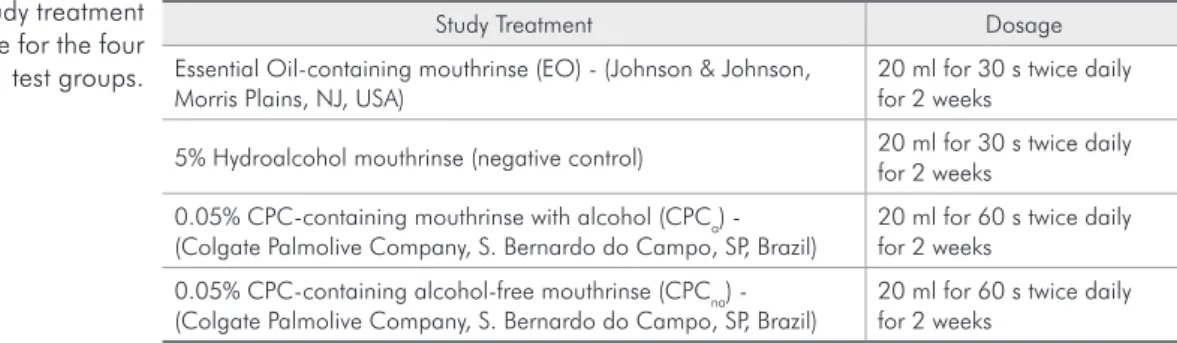
The present short-term randomized clinical trial was conducted to compare the antiplaque and antig-ingivitis eficacy of a ixed combination of essential oils (EO) to 0.05% CPC-containing mouthrinses, one with alcohol (CPCa) and one alcohol-free for-mulation (CPCna), in a two week, experimental gin-givitis model, with a 5% hydroalcohol mouthrinse serving as a negative control.
Material and Methods
This was a single-center, randomized, examin-er-blind, parallel-group, two week no oral hygiene controlled clinical trial. The study was conducted in BioSci Research Canada Ltd. (Mississauga, ON, Canada), from February to March 2008. It was calculated that 36 subjects in each group should be included in the study, with a total of 144 subjects. This sample size provides a 90% power to detect a between-treatment difference of 0.23 for PI and 0.11 for MGI, based on standard deviations of 0.19 for PI and 0.13 for MGI, at the 0.025 signiicance level, two-sided. The standard deviations estimates were based on a previous study conducted at the same cen-ter and with the same examiner (data not published). Attrition of 10% of the subjects was assumed, there-fore 160 subjects were planned to be included.
After approval by the Ethics Review Committee, 159 generally healthy adults meeting the eligibility criteria were assigned to treatment. This study includ-ed male and female volunteers 18 to 58 years of age with a minimum of 20 natural teeth, a baseline mean gingival index ≥ 1.95 according to the Modiied Gin-gival Index,16 a baseline mean plaque index ≥ 1.95 according to the Turesky modiication of the Quig-ley-Hein Plaque Index17 and good general and oral health. Exclusion criteria were: presence of moderate (ADA type III, pockets 6 to 7 mm with bone loss and bleeding on probing) or advanced periodontitis (ADA type IV, pockets 7 mm or greater, bleeding on prob-ing) based on clinical examination (ADA Type III, IV) and presence of ixed or removable orthodontic appliance or removable partial dentures. All subjects provided written informed consent.
mea-sure (no brushing or lossing). Twice daily rinsing was supervised Monday through Friday. Unsuper-vised rinsing took place on the weekends and was documented in a diary completed by the subject. At the end of the trial (week 2) subjects returned the bottles in order to measure their residual weights. Subjects refrained from the use of test rinses for at least 4 hours prior to the examinations at the two week visit.
Mean Plaque Index (PI) and Mean Modiied Gin-gival Index (MGI) at 2 weeks after baseline were the primary eficacy endpoints. Gingivitis was assessed at baseline and at 2 weeks by scoring the Modiied Gingival Index on the buccal and lingual margin-al gingivae and interdentmargin-al papillae of margin-all scorable teeth by a blinded and calibrated examiner. Plaque area was scored at baseline and at 2 weeks by the Turesky modiication of the Quigley-Hein Plaque Index, on six surfaces (distobuccal, midbuccal and mesiobuccal, distolingual, midlingual and mesio-lingual) of all scorable teeth, following disclosing. The examiner was previously calibrated (correlation coeficients were at least 0.9 for PI and for MGI). An oral examination was conducted at baseline and inal visit to monitor oral tissues. The examiner evaluated the buccal, labial and sublingual mucosa, tongue, hard and soft palate, uvula and oropharynx, and teeth. All subjects who used at least one dose of the study test mouthrinse and had any follow-up in-formation were included in the safety analysis and were monitored for adverse effects.
For each of the primary eficacy variables, treat-ment means and between-treattreat-ment differences at 2 weeks after baseline were assessed by means of a one-way analysis of covariance (ANCOVA) model with treatment as a factor and the corresponding
baseline value as a covariate. In order to compare the EO with CPC-containing rinses, it was required that the EO be signiicantly better than the negative control with respect to both PI and MGI. Compari-sons were each tested at the 0.05 level, two-sided. Comparisons between the EO and the two CPC-containing mouthrinses with respect to PI and MGI used a Bonferroni-type multiplicity adjustment. In each case the test signiicance level was 0.025, with one exception: If the EO rinse was concluded su-perior to at least one of the CPC-containing rinses with respect to both PI and MGI, in each case us-ing a test signiicance level of 0.025, two-sided, the corresponding statistical inference for the EO rinse
vs. the other CPC-containing rinse would be recon-sidered based on a test signiicance level of 0.05, for both PI and MGI. This procedure controls the fam-ily-wise type I error rate at 5%.
Results
Of the 159 randomized subjects, 151 completed the study (EO = 39; CPCa = 37; CPCna = 37; nega-tive control = 38). Subjects ranged in age from 18 to 58 years old with a mean of 30.7 years. The major-ity of the subjects were female (64.8%), Caucasian (50.9%); non-smokers (74.2%), and none of the sub-jects were smokeless tobacco users. Treatment groups were balanced with respect to all baseline character-istics. The distribution of the subjects according to demographic variables is shown in Table 2.
At two weeks, the CPCna, CPCa and EO groups presented statistically signiicantly lower mean PI scores than the negative control (p < 0.025), with percent reductions of 6.2%, 9.4% and 21.2%, re-spectively. Furthermore, EO PI scores were statis-tically signiicantly lower than both CPC rinses
Study Treatment Dosage
Essential Oil-containing mouthrinse (EO) - (Johnson & Johnson, Morris Plains, NJ, USA)
20 ml for 30 s twice daily for 2 weeks
5% Hydroalcohol mouthrinse (negative control) 20 ml for 30 s twice daily for 2 weeks
0.05% CPC-containing mouthrinse with alcohol (CPCa) - (Colgate Palmolive Company, S. Bernardo do Campo, SP, Brazil)
20 ml for 60 s twice daily for 2 weeks
0.05% CPC-containing alcohol-free mouthrinse (CPCna) - (Colgate Palmolive Company, S. Bernardo do Campo, SP, Brazil)
20 ml for 60 s twice daily for 2 weeks
(p < 0.001) with percent reductions of 16% and 13.1% compared to the CPCna and CPCa groups, re-spectively (Table 3).
Gingivitis adjusted mean scores (Table 4) for the CPCna, CPCa and EO groups were statisti-cally signiicantly lower than the negative control (p < 0.001) group, with percent reductions of 6.1%, 5.8% and 12%, respectively. Furthermore, the EO group MGI scores were statistically signiicantly lower than both CPC rinse groups (p < 0.001) with percent reductions of 6.3% and 6.6% relative to the CPCna and CPCa groups, respectively.
No subject experienced any adverse event during the study. Furthermore, no serious adverse events occurred during the study or the 30 days following the last application of the study treatment.
Discussion
The results of this trial demonstrated that the use of the EO mouthrinse resulted in signiicantly greater plaque and gingivitis reductions than both the 0.05% CPC-containing mouthrinses (CPCna and CPCa).
There are very few full reports published on the antiplaque and antigingivitis eficacy of 0.05% CPC rinses tested in our clinical study. After extended lit-erature search, the only full report found was the article by Allen et al.15 (1998), that reported percent reductions vs. control of 24% for plaque and gingi-vitis. In addition, an abstract was found; however, there is not enough information regarding the spe-ciic product tested and the long term effect of the 0.05% CPC mouthrinse.18
Recently, Gunsolley19 (2006) published a
meta-Negative Control (N = 40)
CPCna Rinse (N = 40)
CPCa Rinse (N = 39)
EO Rinse
(N = 40) p
Age (Mean ± SD) 29.6 ± 11.4 31.2 ± 11.3 29.3 ± 10.1 32.5 ± 11.2 0.54
Gender Males 11 (27.5%) 13 (32.5%) 16 (41.0%) 16 (40.0%) 0.54
Females 29 (72.5%) 27 (67.5%) 23 (59.0%) 24 (60.0%)
Smokers 32 (80.0%) 29 (72.5%) 26 (66.7%) 31 (77.5%)
0.54
Non-smokers 8 (20.0%) 11 (27.5%) 13 (33.3%) 9 (22.5%)
Table 2 - Distribution of subjects according to demographic characteristics.
Negative Control (N = 38)
CPCna Rinse (N = 37)
CPCa Rinse (N = 37)
EO Rinse (N = 39)
Baseline Means 2.52 ± 0.19 2.53 ± 0.20 2.54 ± 0.19 2.55 ± 0.18
2 Weeks Adjusted means 2.64 ± 0.33 2.48† ± 0.34 2.39† ± 0.28 2.08† ± 0.22*
Reduction vs. Control 6.2% 9.4% 21.2%
Reduction vs. CPCna 16.0%
Reduction vs. CPCa 13.1%
†Statistically significantly different from Negative Control (p < 0.025). *Statistically significantly different from
each of the CPC Rinses (p < 0.001).
Table 3 - Whole Mouth Mean Plaque Index.
Negative Control (N = 38)
CPCna Rinse (N = 37)
CPCa Rinse (N = 37)
EO Rinse (N = 39)
Baseline Means 2.24 ± 0.11 2.22 ± 0.11 2.25 ± 0.07 2.25 ± 0.08
2 Weeks Adjusted means 2.27 ± 0.12 2.13† ± 0.15 2.14†± 0.14 2.00† ± 0.11*
Reduction vs. Control 6.1% 5.8% 12.0%
Reduction vs. CPCna 6.3%
Reduction vs. CPCa 6.6%
†Statistically significantly different from Negative Control (p < 0.001). *Statistically significantly different from
each of the CPC Rinses (p < 0.001).
analysis of six-month clinical trials evaluating the antiplaque and antigingivitis eficacy of mouth-rinses, including published studies as well as unpub-lished data that was provided by the product manu-facturers. The results of the meta-analysis included data for over-the-counter mouthrinses containing a ixed combination of essential oils (EO) or cetylpyri-dinium chloride (CPC), and revealed that EO dem-onstrated antiplaque and antigingivitis eficacy in clinical trials. However, the author could not draw a conclusion regarding the eficacy of CPC-containing mouthrinses. The formulations of the CPC-contain-ing mouthrinses varied, with concentrations rangCPC-contain-ing from 0.045 to 0.07% CPC.
In addition to clinical trials, ex vivo laboratory models have also been used to assess the eficacy of commercially available mouthrinses by providing a mechanistic rationale for a variety of therapeutic ef-fects including antimicrobial eficacy20 and effect on oral bioilm formation.21 Three ex vivo studies22,23,24 showed that an EO rinse was up to two times more effective in killing oral-bioilm bacteria than three different 0.05% CPC formulations. However, till this date, a comparison of the clinical antiplaque and antigingivitis effectiveness of EO and 0.05% CPC has not been reported in controlled trials. As far as we know, this is the irst published trial that directly compared the antiplaque and antigingivi-tis eficacy of EO and CPC rinses, which limits the possibility of comparison with the literature.
In the present study, a short-term experimen-tal gingivitis model was used. In 1965, Löe et al.1 showed that people will generally develop gingivitis after 10-21 days of plaque accumulation using a 3 week experimental gingivitis study model. Clini-cal trials utilizing experimental gingivitis models have been frequently used as a short-term model to evaluate the antiplaque and antigingivitis eficacy of mouthrinses containing antimicrobial agents. These trials have tested a ixed combination of essential oils,8,9 0.12% chlorhexidine gluconate,25,26 cetyl-pyridinium chloride,27 0.1% hexetidine,28 and other noncommercial antimicrobial agents.29 Therefore, there is enough evidence to support that experimen-tal gingivitis study designs, like long-term models, have been accepted as a valid model to determine
and compare eficacy of antiseptic mouthrinses.30 It is also important to point out that this model allows estimation of the effect of the mouthrinse use, with-out the inluence of the mechanical plaque control.
The present study conirms the antiplaque and antigingivitis eficacy of an EO mouthrinse which has been demonstrated in short-term,7,8,9 as well as in longer-term studies6,10,11,12,13 following the ADA guidelines for clinical trials. These studies showed up to 56% greater plaque reduction and up to 34% greater gingivitis reduction than control in subjects with mild-to-moderate plaque and gingivitis.19
The results of this study demonstrated all rins-es to have statistically signiicantly better eficacy than the negative control rinse. The EO-containing rinse presented percent reductions vs. negative con-trol in PI and MGI of 21.2% and 12.0%, respec-tively. CPCna provided percent reductions (compared to negative control) of 6.2% and 6.1%, and CPCa showed reductions of 9.4% and 5.8% for PI and MGI, respectively.
Finally, the present study showed greater anti-plaque and antigingivitis eficacy for the EO-con-taining mouthrinse when compared to the 0.05% CPC-containing mouthrinses. These differences between the EO and CPC-containing mouthrinses were statistically signiicant (p < 0.001). The EO group demonstrated 16.0% and 13.1% PI reductions and 6.3% and 6.6% MGI reductions compared to the CPCna and CPCa groups, respectively.
It is clear from this study that mouthrinses con-taining antimicrobial ingredients, such as 0.05% CPC or a ixed combination of essential oils (EO), are effective antiplaque and antigingivitis agents when used as the only means of oral hygiene. Fur-thermore these results show clinical proof of the hypothesis that EO containing mouthrinses have superior eficacy when compared to 0.05% CPC containing mouthrinses, despite the alcohol content or other ingredients in the formula.
Conclusions
The results of this study conirm the superior ef-icacy of a mouthrinse containing a ixed combina-tion of essential oils compared to 0.05% CPC rinses which have previously been observed in ex vivo lab-oratory studies.
Finally, this clinical report proves that a
com-mercially available, daily-use ixed combination of essential oil mouthrinse has statistically signii-cantly greater antiplaque and antigingivitis eficacy than 0.05% CPC-containing mouthrinses, with and without alcohol.
References
1. Löe H, Theilade E, Jensen SB. Experimental gingivitis in man. J Periodontol. 1965;36(3):177-87.
2. Axelsson P, Lindhe J. Effect of controlled oral hygiene pro-cedures on caries and periodontal disease in adults. Results after 6 years. J Clin Periodontol. 1981;8(3):239-48.
3. US Department of Health and Human Services. Oral health in America: a report of the surgeon general – executive sum-mary. Rockville, MD: US Department of Health and Human Services, National Institute of Dental and Craniofacial Re-search, National Institutes of Health; 2000.
4. Oppermann RV. An overview of the epidemiology of periodon-tal diseases in Latin America. Braz Oral Res. 2007;21(Spec Iss 1):8-15.
5. Addy M. Evaluation of clinical trials of agents and procedures to prevent caries and periodontal disease: choosing products and recommending procedures. Int Dent J. 1995;45(3):185-96.
6. Sharma N, Charles CH, Lynch MC, Qaqish J, McGuire JA, Galustians JG et al. Adjunctive benefit of an essential oil-containing mouthrinse in reducing plaque and gingivitis in patients who brush and floss regularly: a six-month study. J Am Dent Assoc. 2004;135(4):496-504.
7. Lusk SS, Bowers BS, Tow BS, Watson WJ, Moffitt WC. Effects of an oral rinse on experimental gingivitis, plaque formation, and formed plaque. J Am Soc Prev Dent. 1974;4(4):31-3. 8. Mankodi SM, Ross NM, Mostler K. Clinical efficacy of
Lis-terine in inhibiting and reducing plaque and experimental gingivitis. J Clin Periodontol. 1987;14(5):41-3.
9. Ross NM, Mankodi SM, Mostler KL, Charles CH, Bartels LL. Effect of rinsing time on antiplaque-antigingivitis efficacy of Listerine. J Clin Periodontol. 1993;20(4):279-81. 10. Charles CH, Mostler KM, Bartels LL, Mankodi SM.
Compar-ative antiplaque and antigingivitis effectiveness of a chlorhexi-dine and an essential oil mouthrinse: 6-month clinical trial. J Clin Periodontol. 2004;31(10):878-84.
11. DePaola LG, Overholser CD, Meiller TF, Minah GE, Nie-haus C. Chemotherapeutic inhibition of supragingival den-tal plaque and gingivitis development. J Clin Periodontol. 1989;16(5):311-5.
12. Lamster IB, Alfano MC, Seiger MC, Gordon JM. The effect of Listerine Antiseptic on reduction of existing plaque and gingivitis. Clin Prev Dent. 1983;5:12-6.
13. Overholser CD, Meiller TF, DePaola LG, Minah GE, Niehaus C. Comparative effects of 2 chemotherapeutic mouthrinses on the development of supragingival dental plaque and gingivitis. J Clin Periodontol. 1990;17(8):575-9.
14. American Dental Association Council on Scientific Affairs. Acceptance Program Guidelines: Chemotherapeutic Products for Control of Gingivitis. Chicago: American Dental Associa-tion; 1997.
15. Allen DR, Davies R, Bradshaw B, Ellwood R, Simone AJ, Robinson R et al. Efficacy of a mouthrinse containing 0.05% cetylpyridinium chloride for the control of plaque and gingivi-tis: a 6-month clinical study in adults. Compend Contin Educ Dent. 1998;19(2 Suppl): 20-6.
16. Lobene RR, Weatherford T, Ross NM, Lamm RA, Menaker L. A Modified Gingival Index for use in clinical trials. Clin Prev Dent. 1986;8(1):3-6.
17. Turesky S, Gilmore ND, Glickman I. Reduced Plaque Forma-tion by the Chloromethyl Analogue of Victamine C. J Peri-odontol. 1970;41(1):41-3.
18. Trivedi HM, Barnes VM, Tack V, Blanvalet C, Joziak M, Richter R et al. Plaque Control Effect of a Non-Alcohol Cetyl-pyridinium Chloride Mouth Rinse. J Dent Res. 2006; abstract 2052.
19. Gunsolley JC. A meta-analysis of six-month studies of antiplaque and antigingivitis agents. J Am Dent Assoc. 2006:137(12):1649-57.
20. Bacca LA, Leusch M, Lanzalaco AC, Macksood D, Bouwsma OJ, Shaffer JB et al. A comparison of intraoral antimicrobial effects of stabilized stannous fluoride dentifrice, baking soda/ peroxide dentifrice, conventional NaF dentifrice and essential oil mouthrinse. J Clin Dent. 1997;8(2):54-61
21. Auschill TM, Hein N, Hellwig E, Follo M, Sculean A, Ar-weiler NB. Effect of two antimicrobial agents on early in situ biofilm formation. J Clin Periodontol. 2005;32(2):147-52. 22. Araujo MWB, Pan P, Lux R, Shi W. Plaque Biofilm penetration
by essential-oil and CPC containing mouthrinses. J Dent Res. 2008; Abstract 0285.
23. Lux R, Pan P, Castaneda SD, Sim JH, Harper DS, Shi W. Biocidal Activity of antiseptic mouthrinses in saliva-derived biofilm model. J Dent Res. 2008; Abstract 1339.
25. Gründemann LJ, Timmerman MF, van der Velden U, van der Weijden GA. Reduction of stain, plaque and gingivitis by mouth rinsing with chlorhexidine and peroxyborate. Ned Tijdschr Tandheelkd. 2002;109(7):255-9.
26. Zanatta FB, Antoniazzi RP, Rösing CK. The effect of 0.12% chlorhexidine gluconate rinsing on previously plaque-free and plaque-covered surfaces: a randomized, controlled clinical trial. J Periodontol. 2007;78(11):2127-34.
27. Witt JJ, Walters P, Bsoul S, Gibb R, Dunavent J, Putt M. Comparative clinical trial of two antigingivitis mouthrinses. Am J Dent. 2005 Jul;18 Spec No:15A-17A.
28. Sharma NC Galustians HJ, Qaqish J, Charles CH, Vin-cent JW, McGuire JA. Antiplaque and antigingivitis ef-fectiveness of a hexetidine mouthwash. J Clin Periodontol. 2003 Jul;30(7):590-4.
29. Preus HR, Aass AM, Hansen BF, Moe B, Gjermo P. A ran-domized, single-blind, parallel-group clinical study to evalu-ate the effect of soluble beta-1,3/1,6-glucan on experimental gingivitis in man. J Clin Periodontol. 2008;35(3):236-41. 30.Moran J, Pal D, Newcombe R, Addy M. Comparison of a