Characterization of oral cancer diagnostic delay in the state of
Alagoas
Abstract
Luiz Carlos Oliveira dos Santos 1, Olívio de Medeiros Batista 2, Maria Cristina Teixeira Cangussu 3
1 Doctoral thesis in stomatology, Integrated Doctoral Program in Denistry, UFPB/UFBA. Adjunct professor of stomatology, UFAL. 2 Doctoral thesis in sciences biologiques et santé, Rennes I University (URI), France. Adjunct professor of stomatology, UFPB.
3 Doctoral thesis in public health, Sao Paulo University. Adjunct professor in the Social and Pediatric Denistry Department. Paper submited to the BJORL-SGP (Publishing Management System – Brazilian Journal of Otorhinolaryngology) on April 24, 2010;
and accepted on February 20, 2010. cod. 6378
O
ral cancer in Brazil still presents high levels of incidence and mortality bearing different traits throughout the national territory. In most of the cases the diagnosis is late; however there is a great possibility for cure when treated early on.Aim: to assess factors associated with the late diagnosis of oral cancer in the state of Alagoas.
Material and Methods: a prospective cross-sectional study was carried out in 74 patients, all of them diagnosed with oral squamous cell carcinoma in a hospital of Alagoas, between July of 2007 and September of 2008. A semi-structured interview was given, obtaining socio-demographic data, the type of professional help sought, symptom onset, referrals and tumor clinical stage at the moment of diagnosis.
Results: According to the results obtained in this study, the patients usually sought professional medical help, rather than dental help when a lesion in the mouth appeared, being always referred to a specialist by the dentist, in advanced stages of the disease.
Conclusions: This study suggests the need for continued education programs for the population and professionals aiming at the early identification of symptoms of the illness; however needing further studies.
ORIGINAL ARTICLE Braz J Otorhinolaryngol.
2010;76(4):416-22.
BJORL
Keywords:
diagnostic services, epidemiology, mouth neoplasms.
INTRODUCTION
The purpose of an epidemiological study of mouth cancer has been an ongoing problem because of health
and quality of life issues in patients.1
Epidemiology allows us to state that the incidence of mouth cancer is high worldwide; it has become a public health issue, for which prevention and early diagnosis are
the best approaches to revert this situation.2
The mouth can be easily accessed for examination purposes, making is possible for dental surgeons, general practitioners, and even patients themselves (by self-exa-mination) to visualize suspected alterations, particularly in their early stages, for the purpose of an early diagnosis. In
most cases, however, the diagnosis is delayed.3,4
An early diagnosis is not necessarily easy, because patients and healthcare professionals underrate the initial lesions, which are generally asymptomatic. This reality suggests that physicians have gaps in their knowledge of pathology, that patients delay seeking medical care, and that access to and the quality of medical care is deficient, which reflect the absence of preventive public health programs and an effective healthcare system.
An increasing number of cases of cancer have been identified in the state of Alagoas, in a context of delayed diagnoses and poor access to treatment; 110 new cases
of mouth cancer alone were diagnosed in 2008,5 which
has raised the number of incurable cancer patients. These patients are generally sent to their homes where they are in pain and suffer other symptoms of this disease until
their deaths.6
As mentioned above, most of the cases of mouth cancer are diagnosed when the disease is at an advanced stage; it is thus necessary to find the factors that will have led to this situation. In this context, a study was carried out to establish and analyze such factors, thereby helping medical referral units to become better organized for de-aling with mouth cancer in this state.
METHODS
A prospective exploratory quantitative study was carried out in a sample of 74 squamous cell carcinoma patients diagnosed at a state hospital in Alagoas from July 2007 to September 2008 with the purpose of investigating the epidemiological profile of these patients.
The survey was undertaken at the Head & Neck Surgery Unit of the aforementioned hospital, which is a reference center in oncology in Alagoas, receiving pa-tients from 102 municipalities grouped into 13 healthcare micro-regions.
An individual questionnaire with the following variables was applied: age, gender, marital status, race, profession, education level, habits (smoking and drinking
alcohol), duration of initial disease symptoms, disease pro-gression time (in months), whether visited a neighboring healthcare unit, the time elapsed until referral to a spe-cialized unit, the healthcare professional that was sought, the medical approach and tumor staging.
Patients with a diagnosis of mouth cancer, seen at the outpatient unit by a hospital physician (head & neck surgeon or oncologist) signed the free informed consent form and were interviewed by the stomatologist (resear-cher in charge).
For the purpose of this study, a late diagnosis was that made three weeks or more after the onset of symp-toms; the public health units recommend that patients with “lesions or ulcers” that do not heal within two weeks
should visit a healthcare unit.7
Tumors were recorded based on the Classification of Oncological Diseases (ICD-O) and the TNM classifica-tion of the Internaclassifica-tional Union Against Cancer or IUAC. Tumors are defined as advanced when in stages T3 or T4 according to the T classification. Tumors were staged as
I-II (T1 or T2 and N0) and III-IV (T3, T4 or N>0).8
A late diagnosis was counted in months from the date of onset until the diagnosis at a referral healthcare unit and tumor staging at the time of diagnosis.
The data were stored in a Windows Excel 2003 da-tabase; a descriptive analysis consisted of central tendency measures and dispersion for continuous variables, and the number and percentage of categorical variables. The chi-square test and Student’s t test (at a 95% significance level) were applied to test the differences among groups.
This study had formal approval from all sectors involved, and abided by the current ethical standards as defined by the Resolution 196/96 of the National Health Council; the identity of patients and healthcare profes-sionals remained confidential. The patients were free to participate or not in this study without any effect on their subsequent therapy.
The institutional review board assessed and appro-ved this study (no. 005567/2006-17).
RESULTS
Characterizing the Study Population
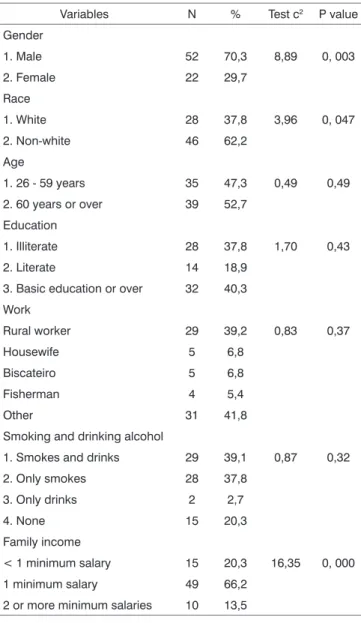
The sample consisted of the files of 74 patients that sought the healthcare unit in a 14-month period. The mean age was 57.22 years (SD=14.01), ranging from 26 to 85 years. Table 1 shows other social and demographic data.
The family income of most subjects ranged from less than a minimum salary (20.3%) to a minimum salary (66.2%), notwithstanding their social and demographic features.
Patients were referred from 31 municipalities in Alagoas, which corresponds to 30.4% of the 102 munici-palities of that state; most patients came from the capital Maceio, followed by Arapiraca.
Fifty-two patients (70.3%) had sought a physician before being referred to the hospital in Alagoas, 21 patients (28.4%) had sought a dentist, and one patient (1.3%) had sought a community healthcare agent.
The prevalence of disease in the tongue was statis-tically higher compared to other sites (Fig. 1).
Most patients (78.4%) had tumors staged above T2N0M0 (stages III and IV), which characterized advanced disease. T1N0M0 and T2N0M0 were defined in 21.6% of patients, corresponding to stages I and II (therefore, early disease). Advanced disease predominated in most patients.
Figure 2 shows the stages of disease. Lesions at advanced stages predominated, which was statistically
sig-nificant compared to stages T1 and T2 (k2= 37.33; p< 0.00)
Table 1. Social and demographic features and habits of patients pre-senting at the Head & Neck Unit outpatient unit of the Holy House of Mercy Hospital (Hospital Santa Casa de Misericórdia) in Maceio, Alagoas, 2008.
Variables N % Test c2 P value
Gender
1. Male 52 70,3 8,89 0, 003
2. Female 22 29,7
Race
1. White 28 37,8 3,96 0, 047
2. Non-white 46 62,2
Age
1. 26 - 59 years 35 47,3 0,49 0,49
2. 60 years or over 39 52,7
Education
1. Illiterate 28 37,8 1,70 0,43
2. Literate 14 18,9
3. Basic education or over 32 40,3
Work
Rural worker 29 39,2 0,83 0,37
Housewife 5 6,8
Biscateiro 5 6,8
Fisherman 4 5,4
Other 31 41,8
Smoking and drinking alcohol
1. Smokes and drinks 29 39,1 0,87 0,32
2. Only smokes 28 37,8
3. Only drinks 2 2,7
4. None 15 20,3
Family income
< 1 minimum salary 15 20,3 16,35 0, 000
1 minimum salary 49 66,2
2 or more minimum salaries 10 13,5
c2 = chi-square statistics N = number of patients
Figure 1. Anatomical site of lesions.
Diagnosis and Referral to Healthcare Units
The reported time by patients from the onset of symptoms to the first visit to a specialist at the Head & Neck Unit of the reference hospital in Alagoas was 1-3 months (24 patients - 32.4%), 4-6 months (20 patients - 27.0%), 7-9 months (20 patients - 27.0%), and over 9 months (10 patients - 13.5%).
The time elapsed between the first visit to the re-ferring physician at the place of origin of patients and the
visit to the Head & Neck Unit of the reference hospital in Alagoas was less than 2 months (20 patients - 27.0%), 2-6 months (41 patients - 55.4%), and over 6 months (13 patients - 17.6%).
Information about the referral to a reference hospital made by a physician or dentist of patients with early or advanced disease, a dentist referred 6 patients (8.1%) with early disease and 15 patients (20.3%) with advanced dise-ase, totaling 21 patients (28.4%). A physician referred 10 patients (13.5%) with early disease and 42 patients (56.8%) with advanced disease, totaling 52 patients (70.3%); a healthcare community agent referred one patient (1.4%) with advanced disease (T3). Thus, healthcare professionals referred most patients; a significant number of the cases were at an advanced stage of the disease upon referral.
The open question yielded homogeneous thought categories; a method used previously in the state of
Pa-raiba9 was applied to select similar responses expressing
the same ideas.
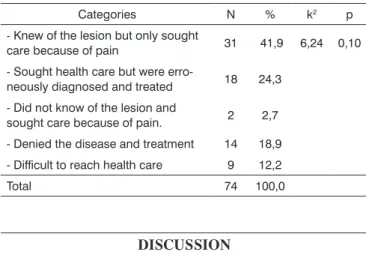
Five categories were defined based on the answers of patients about the reason for delaying their visit to he-althcare centers; these are shown on Table 2.
The category with most patients (41.9% of the total) was the group that reported they knew about the lesion but sought healthcare only when it started to bother. There was not statistical difference among the answer percentages (p=0.10).
ferred mouth cancer patients to the reference hospital in that state. Most originated from the capital city, followed by the city of Arapiraca. This is similar to another survey
done in Alagoas,12 which underlined the importance of
medical services in the capital city and the lack of decen-tralized middle and high complexity healthcare units in Alagoas. The absence of municipalities in the aforemen-tioned statistics may be explained by geographic distance and poor transportation in many rural towns, besides the lack of an effective referral and counter-referral system between basic healthcare and reference hospitals for the treatment of cancer.
There were 74 patients diagnosed with mouth cancer during the study period, which were seen at the reference hospital. Lesions predominated at ages over 60
years, which was generally similar to published results,13-15
except for some authors who found a higher predominance
of disease in the 50-60 years age group.16-19
The sample consisted mostly of male patients; this male predominance in dentistry for this disease may be
seen in several studies.5,14-16,18 This trend in male patients
has been observed frequently; in recent decades, howe-ver, there has been an increase in the incidence of mouth squamous cell carcinoma in females, because of behavioral
changes.19
There was a high rate of patients with less than basic education (42 patients), of which 28 patients were illiterate. This number is lower than the data in a study in the state of Paraiba (2006)9 where 75% of interviewees were illiterate. Most patients were rural workers, again
similar to the data in other published papers.16,19
A higher incidence was found in non-whites, which
is dissimilar to several findings in the literature,20 where
whites predominated, but similar to other papers.21 It has
been suggested that involvement by race varies
depen-ding on the study method and the region,22 which makes
comparisons difficult.
Among the sample, 37.8% smoked tobacco cigaret-tes, 39.1% smoked and consumed alcoholic drinks, and 20.3% neither smoked not drank alcohol. Note that these habits are frequent in this sample. Smoking and drinking alcohol have often been reported as the main risk factors for mouth cancer; both habits operate synergically, thereby
increasing the incidence of this disease.21-24
The tongue was the most common site, followed by the soft palate, which is similar to published results in
the literature,15,18,19 but which differs from some papers.25,26
Most patients had clinical advanced tumors (T3
or T4), which is similar to some published studies,9,12
suggesting that patients arrive at healthcare centers with advanced stage disease.
Several factors may affect the quality of care for can-cer patients, such as promptness of care and availability of material and professional resources. However, even when
Table 2. Frequency of responses to the open question: Why did you not seek health care before?
Categories N % k2 p
- Knew of the lesion but only sought
care because of pain 31 41,9 6,24 0,10
- Sought health care but were
erro-neously diagnosed and treated 18 24,3
- Did not know of the lesion and
sought care because of pain. 2 2,7
- Denied the disease and treatment 14 18,9
- Difficult to reach health care 9 12,2
Total 74 100,0
DISCUSSION
The most frequent type of mouth cancer in the study sample was the squamous cell carcinoma (100% of cases), which is similar to published results.10 Because of its significant incidence, papers on this histopathologi-cal type merge with those dealing with mouth cancer in general; our discussion, therefore, will deal with mouth
cancer as a whole.11
re-these resources are present, their effect on the outcome is weak; patient survival is more strongly related with an early diagnosis of this disease.
According to several authors,4,27,28,29 the time elapsed
between the perception of symptoms and correct diagnosis and treatment affects the outcome and the quality of life of patients.
Our data revealed that 41.9% of patients knew they had a lesion but only sought healthcare when symptoms arose (Table 1). This was the largest category, suggesting lack of self-care in seeking therapy and poor knowledge about the signs of this lesion, which are usually asymp-tomatic to begin with. A considerable percentage of in-correct treatments showed that healthcare professionals were unprepared to deal with mouth cancer. Similarly, denial of disease underlines its negative stigma among the population, which generally regards cancer as a death sentence with no reprieve - not the case when the dise-ase is diagnosed early. Difficulty in accessing the unified healthcare system (SUS) for middle and high complexity care was evidenced in 12.2% of cases, showing that the system is not easily available for these workers.
Fifty-two patients were first seen by a physician, and 21 patients were first seen by a dentist. The patient preference for seeking physicians initially, rather than
dentists, concurs with published results in the literature.4,9
The time elapsed between perception of the first symptoms and arrival at the reference hospital in Alagoas showed that this time period was 1-3 months for most patients, followed by over 9 months in a smaller propor-tion. There was a proportional balance among these time
periods, similar to reports in the literature;9,27,30,31 another
study,32 however, found that the mean delay of patients
was 273.19 days.
This situation reflects lack of information among
patients; as lesions are initially asymptomatic,33 they only
seek healthcare when tumors are at advanced stages,
which incurs in drastically decreased survival.28
The referral time for professionals was mostly 2-6 months, which may be considered high, although
coin-cident with published reports in the literature.9,30 Access
to healthcare, the medical visit scheduling system, the transportation system, cultural and financial issues, and recognition of lesions by first-visit healthcare professionals
are the main reasons for delayed referrals.33-39
Physicians or dentists referred mostly patients with advanced disease to a reference center; the referral rate of advanced cases was 56.8% for the former and 20.3% for the latter. These results suggest that lack of professional knowledge and preparedness about suspect mouth lesions increase the time before referral for these patients.
The role of the first healthcare professional to see these cases is extremely important, given the difficulty of
diagnosing incipient malignancies;40 these professionals
are responsible for referring such patients to specialized healthcare facilities.
Of 74 patients in the sample, 73.4% were referred to other professionals. More numerous visits before the diagnosis suggest a longer duration of complaints. An excessive number of healthcare professionals that were visited indicates that the patient will have seen many physi-cians and healthcare units and undergone many laboratory tests before a final diagnosis was made.
There are knowledge gaps about mouth cancer among healthcare professionals working in public health units, family health physicians and private clinics; there is, however, willingness to supplant these shortcomings
by continued medical courses.19,33
Further points of debate in the literature are pre-vention and education strategies and professional training. The main concern focuses on undergraduate medical and
dentistry courses.3
Lack of knowledge about mouth cancer among patients and healthcare professionals, fear of the diag-nosis, and difficulties in accessing the healthcare system are important causes of delayed diagnoses. Healthcare professionals at times suggest that patients are responsi-ble for their diseases. Such professionals are essential for diagnosing mouth cancer, and should be aware of this responsibility, rather than blaming patients for delays in the diagnosis. Successful therapy requires knowledge, positive attitudes, personal values, relationship abilities,
psychological command, and self-confidence.41
Other factors were investigated in this study, such as the use of prostheses and difficulty in accessing healthcare services; no associations, however, were encountered, which became one of the shortcomings of this study.
The findings above suggest that continued edu-cation programs are needed for the population and for healthcare professionals to help identify the early signs of this disease, given its importance in defining the prognosis.
CONCLUSION
Based on the results, we concluded that:
occurred mostly because of lack of information in patients, rather than healthcare professionals, although a significant number of these professionals were unprepared or lacked knowledge about suspected mouth lesions, which delayed patient referral; the number of patients that sought general practitioners was higher than those that sought specialists or dentists, which delayed referral since those healthcare professionals are more likely not to recognize the signs and symptoms of mouth cancer.
REFERENCES
1. Hamada GS, Bös AJG, Kasuga H, Hirayama T. Comparative epide-miology of oral cancer in Brazil and India. Tokai J Exp Clin Med. 1991;16(1):63-72.
2. Martins MAT, Marques FGOA, Pavesi VCS, Romão MMA, Lascala CA, Martins MD. Avaliação do conhecimento sobre o câncer bucal entre universitários. Rev Bras Cir Cabeça Pescoço. 2008;37(4):191-7. 3. Lima AAS, França BHS, Ignácio SA, Baioni CS. Conhecimento
de alunos universitários sobre câncer bucal. Rev Bras Cancerol. 2005;51(4):283-8.
4. Kowalski LP, Franco EL, Torloni H, Fava AS, de Andrade Sobrinho J, Ramos G, Oliveira BV, et al. Lateness of diagnosis of oral and oro-pharyngeal carcinoma: factors related to the tumour, the patient and health professionals. Eur J Cancer B Oral Oncol. 1994;30B(3):167-73. 5. Brasil. Ministério da Saúde. INCA - Instituto Nacional de Câncer. Secretaria de Atenção à Saúde. Instituto Nacional de Câncer. Co-ordenação de Prevenção e Vigilância de Câncer. Estimativas 2008: Incidência de Câncer no Brasil. Rio de Janeiro, 2007.
6. Costa RB. Cuidados paliativos em pacientes com câncer avançado: projeto social de atendimento ambulatorial, hospitalar, domiciliar (home care) e de doação de opioides da unidade do câncer de Alagoas (UNICA). Disponível em http://www.saudebrasilnet.com. br/premios/oncologia/premio2/. Acesso em 17 de março de 2007. 7. Kowalski LP. Carcinoma da boca: epidemiologia, diagnóstico e
tra-tamento. Acta AWHO. 1991; 10(3): 128-34.
8. Brasil. Ministério da Saúde. INCA - Instituto Nacional de Câncer. Secretaria de Atenção à Saúde. Instituto Nacional de Câncer. TNM: classificação de tumores malignos / traduzido por Ana Lúcia Amaral Eisenberg. 6. ed. - Rio de Janeiro, 2004. p.254
9. Cunha PASM de A. Fatores relacionados ao diagnóstico tardio do câncer de boca no estado da Paraíba. [Tese]. UFPB-UFBA / PIPGO, João Pessoa, 2006.
10. Brasil. Ministério da Saúde. INCA - Instituto Nacional de Câncer. Coor-denação de Programas de Controle do Câncer. Divisão de Educação. Manual de detecção de lesões suspeitas. Câncer de Boca. Ministério da Saúde; 1996.
11. Brasil. Ministério da Saúde. INCA - Instituto Nacional de Câncer. Secre-taria de Atenção à Saúde. Instituto Nacional de Câncer. Coordenação de Prevenção e Vigilância de Câncer. Alimentos, nutrição, atividade física e prevenção de câncer: uma perspectiva global / traduzido por Athayde Hanson Tradutores - Rio de Janeiro, 2007. p.12
12. Santos LCO, Cangussu MCT, Batista OM, Santos JP. Câncer bucal: amostra populacional do estado de Alagoas em hospital de referência. Braz J Otorhinolaryngol. 2009;75(4):524-9.
13. Oliveira CE, Bernini GF, Myazaki LCY, Tomita NE. Características sociodemográficas da mortalidade por câncer de boca em Bauru, SP, no período de 1991 a 2001: uso de geoprocessamento. Rev Bras Epidemiol. 2008;11(2):185-95.
14. Jotz GP, Damazzini R, Deboni M, Dreher MV, Dias J, Deboni ALS et al. Prognóstico em dois anos do câncer de cavidade oral. Rev Bras Cir Cabeça Pescoço. 2007;36(3):146-51.
15. Liuzzi JF, Estanga N, Nuñez ZC, Paccheco SCF, Gardie J. Factores pronósticos en el carcinoma de células escamosas de cavidad oral. Rev Venez Oncol. 2007;19(2):129-34.
16. Alvarenga LM, Ruiz MT, Pavarino-Bertelli EC, Ruback MJC, Maniglia JV, Goloni-Bertollo EM. Avaliação epidemiológica de pacientes com câncer de cabeça e pescoço em um hospital universitário do noroeste do estado de São Paulo. Braz J Otorhinolaryngol. 2008;74(1):68-73. 17. Noce CW, Rebelo MS. Avaliação da relação entre tamanho do tumor e características sociais em pacientes com carcinoma de células es-camosas bucal. Rev Bras Cancerol. 2008;54(2):123-9.
18. Antunes AA, Antunes AP, Silva PV, Avelar RL, Santos TS. Câncer da língua: estudo retrospectivo de vinte anos. Rev Bras Cir Cabeça Pescoço. 2007;36(3):152-4.
19. Gervasio OLAS, Dutra RA, Tartaglia SMA, Vasconcellos WA, Barbosa AA, Aguiar MC. Oral squamous cell carcinoma: a retrospective study of 740 cases in a Brazilian population. Braz Dent J. 2001;12(1):57-61. 20. Perez RS, Freitas SM, Dedivits RA, Rapoport A, Denardin OVP,
An-drade Sobrinho J. Estudo epidemiológico do carcinoma espinocelular da boca e orofaringe. Arq Int Otorrinolaringol/ Intl Arch Otorhino-laryngol. 2007;11(3):271-7.
21. Morse DE, Kerr AR. Disparities in oral and pharyngeal cancer inci-dence, mortality and survival among black and white Americans. JADA 2006;37:203-12.
22. Riera P, Martinez B. Morbilidad y mortalidad por cáncer oral y faríngeo en Chile. Rev Méd Chile. 2005;133(5):555-63.
23. Brener S, Jeunon FA, Barbosa AA, Grandinetti HAM. Carcinoma de células escamosas bucal: uma revisão de literatura entre o perfil do paciente, estadiamento clínico e tratamento proposto. Rev Bras Cancerol. 2007;53(1):63-9.
24. Gangane N, Chawla S, Anshu, Subodh A, Gupta SS, Sharma SM. Reassessment of risk factors for oral cancer. Asian Pac J Cancer Prev. 2007;8(2):243-8.
25. Brasil. Ministério da Saúde. INCA - Instituto Nacional de Câncer. Esti-mativas 2006: incidência de câncer no Brasil. Rio de Janeiro (Brasil), 2005.
26. Rosenquist K. Risk factors in oral and oropharyngeal squamous cell carcinoma: a population-based case-control study in southern Swe-den. Swed Dent J Suppl. 2005;179:1-66.
27. Rosemberg J. Nicotina: a droga universal. São Paulo: Secretaria de Estado da Saúde - SES/CVE; 2003. p. 240.
28. Abdo EM, Garrocho AA, Aguiar MCF. Perfil do paciente portador de carcinoma epidermoide da cavidade bucal, em tratamento no Hospital Mário Penna em Belo Horizonte. Rev Bras Cancerol. 2002; 48(3):357-62.
29. Scott S, McGURK M, Grunfeld E. Patient delay for potentially malig-nant oral symptoms. Eur J Oral Sci. 2008, 116(2):141-7.
30. McLeod NM, Saeed NR, Ali EA. Oral cancer: delays in referral and diagnosis persist. Br Dent J. 2005;198(11):681-4.
31. Kumar S, Heller RF, Pandey U, Tewari V, Bala N, Oanh KT. Delay in presentation of oral cancer: a multifactor analytical study. Delay in presentation of oral cancer: a multifactor analytical study. Natl Med J India. 2001;14(1):13-7.
32. Yu T, Wood RE, Tenenbaum HC. Delays in Diagnosis of Head and Neck Cancers. J Can Dent Assoc. 2008;74(1):61-4.
33. Campos JLG, Chagas JFS, Magna LA. Fatores de atraso no diagnós-tico do câncer de cabeça e pescoço e sua relação com sobrevida e qualidade de vida. Rev Bras Cir Cabeça Pescoço. 2007;36(20):65-8. 34. Matos IB, Araújo LA. Práticas acadêmicas, cirurgiões-dentistas,
po-pulação e câncer bucal. Revista da ABENO. 2003;3(1):76-81. 35. Morelatto RA, Herrera MC, Fernández EN, Corball AG, López de Blanc
AS. Diagnostic delay of oral squamous cell carcinoma in two diagnosis centers in Córdoba Argentina. J Oral Pathol Med. 2007;36(7):405-8. 36. Garcia-Roco Pèrez ON, Arredondo Lòpez M, Castillo Betancourt EM.
Factores contribuyentes al diagnóstico tardío del carcinoma bucofa-ríngeo. Rev Cuba Estomatol. 2006; 43(1): 52-9.
37. Tromp MD, Rbrouh X, Hordjik GJ, Winnubst JAM, Leeuw RJ. Pacient and tumor factors associated with advanced carcinomas of head and neck. Oral Oncol. 2005; 41(3):313-9.
39. Costa EG, Migliorati CA. Câncer bucal: avaliação do tempo decorrente entre a detecção da lesão e o início do tratamento. Rev Bras Cancerol. 2001;47(3):283-9.
40. Onizawa K, Nishihara K, Yamagata K, Yusa H, Yanagawa T, Yoshida H. Factors associated with diagnostic delay of oral squamous cell carcinoma. Oral Oncol. 2003; 39(8): 781-8.