Hospital Pró-Cardíaco and Universidade Estadual do Rio de Janeiro Mailing address: Lúcia Pimenta – Pró-Cardíaco - Rua Dona Mariana, 219 – 22280-020 – Rio de Janeiro, RJ, Brazil - e-mail: [email protected] English version by Stela Maris C. e Gandour
Objective – To assess whether female sex is a factor independently related to in-hospital mortality in acute myocardial infarction.
Methods – Of 600 consecutive patients (435 males and 165 females) with acute myocardial infarction, we stu-died 13 demographic and clinical variables obtained at the time of hospital admission through uni- and multivariate analysis, and analyzed their relation to in-hospital death.
Results – Females were older (p<0.001) and had a higher incidence of hypertension (p<0.001). Males were more frequently smokers (p<0.001). The remaining risk factors had a similar incidence among both sexes. All va-riables underwent uni- and multivariate analysis. Throu-gh univariate analysis, the following variables were found to be associated with in-hospital death: female sex (p<0.001), age >70 years (p<0.001), the presence of pre-vious coronary artery disease (p=0.0004), prepre-vious myo-cardial infarction (p<0.001), infarction in the anterior wall (p=0.007), presence of left ventricular dysfunction (p<0.001), and the absence of thrombolytic therapy (p=0.04). Through the multivariate analysis of logistic re-gression, the following variables were associated with in-hospital mortality: female sex (p=0.001), age (p=0.008), the presence of previous myocardial infarction (p=0.02), and left ventricular dysfunction (p<0.001).
Conclusion – After adjusting for all risk variables, fe-male sex proved to be a variable independently related to in-hospital mortality in acute myocardial infarction.
Key words: female sex, in-hospital mortality, acute
myo-cardial infarction
Arq Bras Cardiol, volume 77 (nº 1), 44-50, 2001
Lúcia Pimenta, Roberto Bassan, Alfredo Potsch, José Francisco Soares, Francisco Manes Albanesi Filho
Rio de Janeiro, RJ - Brazil
Is Female Sex an Independent Predictor of In-Hospital
Mortality in Acute Myocardial Infarction?
Cardiovascular disease is the major cause of death in industrialized countries, acute myocardial infarction being its major representative 1. Official mortality statistics in our country show a difference regarding the sexes 2. Males comprise the most victims of the disease in the entire world. Brazilian females, on the other hand, have an elevated risk of death, much higher than that in other places, particularly in the age bracket from 45 to 64 years 3. Approximately 1 in every 2 females will die due to acute myocardial infarction or cerebral stroke, far exceeding mortality due to all combined types of neoplasias 4.
Most epidemiological studies about morbidity and mortality due to coronary artery disease have been based on male models, and their results have been extrapolated to the female population 5. The possibility that the female sex may have peculiarities regarding risk factors, disease presentation, and prognosis has only recently been suggested 6.
Our study aims to analyze in-hospital mortality due to acute myocardial infarction regarding sex based on demo-graphic and clinical characteristics at the time of hospital admission. We also aimed to identify the variables associa-ted with in-hospital mortality, and whether, after adjust-ments for all risk variables, female sex is a factor indepen-dently related to in-hospital mortality.
Methods
sugges-ting acute coronary heart disease with a minimum duration of 30 minutes; 2) electrocardiographic criterion: presence of elevation of the J-ST segment in at least 2 contiguous leads (1mm in the leads of the frontal plane and 2 mm in the leads of the horizontal plane); 3) enzymatic criterion: elevation of the serum levels of the creatine phosphokinase enzyme (CK) and its myocardial fraction (CK-MB) observed at least in 2 serial measurements in the first 24 hours of evolution of acute myocardial infarction with a typical fall; CK-MB le-vels should be 10% higher than those of total CK.
Data consisted of dichotomous, polychotomous, and continuous variables. The response of interest was in-hospital death. The dichotomous variables were sex, hypertension, tobacco use, diabetes mellitus, familial history of coronary artery disease, previous myocardial infarction, previous coronary artery disease, hypercholesterolemia, use of thrombolytic therapy, and electrocardiographic location of the infarct site defined as the inferior, anterior, or lateral wall, or absence of the Q-wave. Left ventricular dysfunction classified according to the Killip-Kimball heart failure classification was treated as a polychotomous variable and ranged from 1 to 4. The continuous variables were age and ∆t interval. The results of the continuous variables were presented as their mean value and respective standard deviation. For analyzing the relation between the continuous variables and in-hospital mortality, the continuous variables were transformed into dichotomous variables (age >70 years and ∆t >120min). The diverse variables of the study were analyzed with the statistical program SPSS for version 6.0 of MS Windows.
To determine the statistical significance of the differences between the proportions, the chi-square test was used; for differences between the means of independent samples, the Student t test was used. The Cochran test was used to verify the existence of a linear trend between the Killip-Kimball heart failure classification and death. Univariate analysis was used to compare the in-hospital mortality rate between individuals with and without a certain variable. Odds ratio (OR) was used as a measure of association. The pre-established level of significance was 5%. To assess the statistical significance of the association, the null hypothesis was OR=1.
For age adjustment, the Mantel-Haenszel test was used. The measure of association used was the relative risk (RR). Aiming to avoid incorrect inferences due to confo-unding factors, the patients were subdivided into homoge-neous extracts of age bracket, at 10-year intervals.
Data were also subjected to multivariate analysis of logistic regression. Therefore, the variables age and Killip-Kimball heart failure classification were treated as conti-nuous, and the remaining as binary. As the step-by-step ap-proach to build the regression model was used, the superior threshold for p at entrance and exit was established as 0.15 and 0.10, respectively.
Results
The demographic and clinical characteristics of the population studied are shown in tables I and II.
Most patients (72.5%) were males in a proportion of 2.6:1. Females were significantly older, by a mean of 8 years. The risk factors for developing coronary artery disease did not differ between the sexes, except for a higher prevalence of hyperten-sion in females and tobacco use in males (Table III).
The time interval between symptom onset and arrival at the emergency department (∆t interval) was greater for females than for males, being 5.46±7.23 hours and 4.6±7.06 hours, respectively; this difference, however, did not reach statistical significance. When analyzing the groups with ∆t interval up to 2 hours, we observed that a lower contingent of females than of males arrived earlier at the hospital (36.5% and 48.6%, respectively); this difference, however, was sta-tistically significant (p=0.007). No difference between the
Table I – Demographic characteristics of the global population of patients with acute myocardial infarction
Characteristics Number %
Age (years) 64.6+13.4
Male sex 435 72.5%
Hypertension 289 48.2%
Diabetes mellitus 99 16.5% Hypercholesterolemia 211 35.2%
Tobacco use 229 38.2%
Familial hist of coronary artery disease 263 43.9% Previous infarction 111 18.5% Previous coronary artery disease 181 30.2%
Table II – Clinical characteristics of the global population of patients with acute myocardial infarction
Characteristics Number %
∆t (h) 4.85+7.11
Thrombolytic agent use 239 39.8% Infarct location
Inferior wall 234 39.0%
Anterior wall 223 37.2%
Lateral wall 017 2.80%
No “Q” wave 126 21.0%
Ventricular dysfunction
Killip-Kimball class I 506 84.3% Killip-Kimball class II 060 10.0% Killip-Kimball class III 020 3.30% Killip-Kimball class IV 014 2.30%
Table III – Demographic characteristics of the population differentiated by sex
Variables Males Females p value
Age 62.2±13.2 70.9±11.8 <0.001 Hypertension 41.8% 64.8% <0.001 Diabetes mellitus 16.3% 16.9% ns Hypercholesterolemia 36.3% 32.1% ns Tobacco use 43.7% 23.6% <0.001 Familial history of 44.1% 43.0% ns coronary artery disease
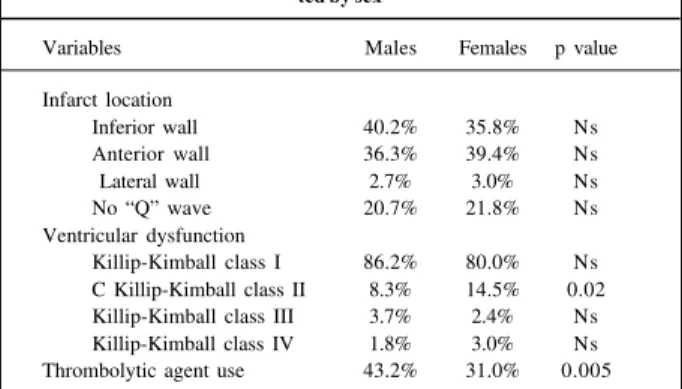
sexes was observed regarding the location of myocardial infarct. Most patients were admitted to the hospital in Killip-Kimball heart failure classification I. However, a higher pre-valence of females admitted in Killip-Kimball heart failure clas-sification II was observed. The thrombolytic therapy was used more frequently in males than in females (Table IV).
Global in-hospital mortality was 13.5%; in-hospital mortality being significantly higher (p<0.001) in the female sex (23.0%) as compared with that in the male sex (9.9%).
In univariate analysis, the variables associated with in-hospital mortality were as follows: age above 70 years (p<0.001; OR=4.21), the female sex (p=0.001; OR=2.73), hy-percholesterolemia (p=0.008; 0R=0.48), familial history of coronary artery disease (p=0.001; OR=0.37), tobacco use (p=0.001; OR=0.32), previous coronary artery disease (p=0.0004; OR=2.32), previous myocardial infarction (p<0.001; OR=2.97), use of thrombolytic therapy (p=0.04; OR=0.6), infarct located in the anterior wall (p=0.007; OR=1.90), infarct located in the inferior wall (p=0.002; OR=0.43), and left ventricular dysfunction (p<0.001; OR=10.26). Knowing that for assessing the statistical signi-ficance of the association the null hypothesis was OR=1, those variables with OR<1 were associated with a reduction in the risk of mortality. The remaining variables did not cor-relate with the response of interest.
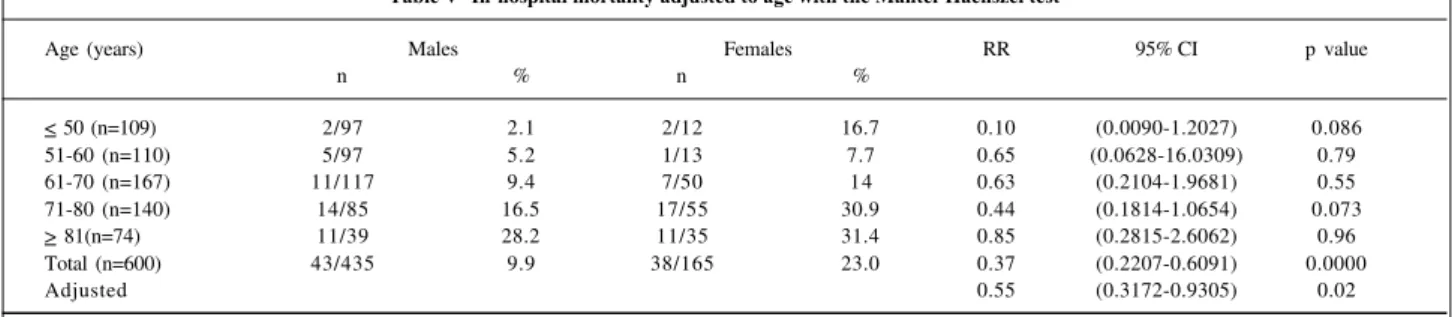
In regard to the adjustment of in-hospital mortality to age, we have the following scenario. As females had acute myocardial infarction later than males did (a mean of 8 years of delay), advanced age was predicted as the major explanation for the worse survival of the female sex. For assessing this hypothesis, mortality was adjusted for age using the Mantel-Haenszel test (Table V). The patients were divided by sex into 5 homogeneous extracts according to the age bracket. We observed that, even though statistical significance was not obtained between the differences of each isolated age bracket, the total effect existed and was kept the same after correction, confirming the higher mortality among females as compared with males, independently of age (p=0.02).
In multivariate analysis of logistic regression, all pre-viously established demographic and clinical variables were included. The ∆t interval variable was not included in this phase of the analysis because it was available only in 445
patients, which would reduce the size of the sample to be analyzed.
We observed as independently related to in-hospital mortality the following variables: age, the male sex, and Killip-Kimball heart failure classification >1 (Table VI). The presence of previous myocardial infarction was a marginal variable (p=0.06).
Even though age had a lower OR, it is a very expressive variable, because by being continuous, it allows the growth of the coefficient in each additional year. It is worth noting that the male sex has a negative coefficient, which indicates an inverse relation with the response being assessed. The-refore, the female sex is associated with higher in-hospital mortality.
Interactions between sex and pertinent clinical varia-bles were tested and none of them proved statistically sig-nificant.
We observed that in nonadjusted (univariate) and in adjusted (multivariate) analyses, the associations involving mortality and female sex reached statistical significance, in-dicating a higher risk for females. Therefore, these data pro-vide epro-vidence that the female sex is, by itself, an important independent predictor of in-hospital mortality from myocar-dial infarction.
Discussion
For many years, morbidity and mortality in coronary ar-tery disease have been reported as occurring 5 to 10 years later in females than in males 7-12. An important paradox has been reported in several studies, when acute myocardial infarction occurs: females have a higher in-hospital mortality 5,6,13-15. However, in other studies 10,16,17, the mortality reported is si-milar or even lower among females. Different methodologies applied, the varied inclusion criteria used, and the type of study (prospective or retrospective) account for these con-flicting data.
In our study, we observed that females with acute myocardial infarction have significantly higher in-hospital mortality (2.3-fold) than males do.
Whether this worse prognosis in the female sex is in fact due to a biological factor or to a methodological bias is still a matter of discussion 18,19. Confounding factors, such as advanced age and a higher incidence of comorbidity, may influence the prognosis and, once corrected or adjusted, the results previously obtained no longer exist, mortality being equivalent for both sexes 18,19.
Aiming at assessing these hypotheses, we carried out a prospective study in 600 consecutive patients at a single private hospital in the city of Rio de Janeiro. We analyzed 13 variables obtained from the clinical history, the physical examination, and from electrocardiographic data, which were easily collected at the time of hospital admission, and we assessed their relation to in-hospital mortality. Data were subjected to nonadjusted and adjusted analyses, so all pre-established risk variables would have their effects correc-ted, avoiding methodological bias. Therefore, the presence
Table IV – Clinical characteristics of the population differentia-ted by sex
Variables Males Females p value
Infarct location
Inferior wall 40.2% 35.8% Ns Anterior wall 36.3% 39.4% Ns
Lateral wall 2.7% 3.0% Ns
No “Q” wave 20.7% 21.8% Ns
Ventricular dysfunction
or absence of the so-called biological factor of the female sex could be correctly assessed.
Most patients were males in a proportion of 2.6 males to 1 female, as in other great epidemiological studies 20. At the time of acute myocardial infarction, in addition to the more advanced age (mean of 8 years in the population stu-died), females had a higher association with hypertension, which turned them into a higher risk group for mortality, ac-cording to a few reports 6,8,13,16,21. On the other hand, males exhibited a higher incidence of tobacco use, as in most stu-dies, which has been surprisingly related to lower in-hos-pital mortality in acute myocardial infarction 22-25. Gottlieb et al 22 attribute the better prognosis of smokers to their lower age and their more favorable risk profile, and not to any real benefit of tobacco use. We observed a similar prevalence (around 16%) of diabetes mellitus for males and females, in disagreement with the literature that shows a higher prevalence in the female sex 6,8,13,16,21.
Studies analyzing the clinical characteristics have shown that females more often than males have congestive heart failure, both at the time of hospital admission and during hospi-tal evolution of acute myocardial infarction 5,6,12,15,18,21,26-28. Con-trary to these observations, studies including assessment of left ventricular dysfunction showed that females had a higher ejection fraction than did males 15,26. Hemodynamic disorders are supposedly derived from diastolic dysfunction, which is triggered by the highest incidence of hypertension and dia-betes mellitus 5,12,13,27. Attempts exist to correlate the fin-dings of better left ventricular function with data on corona-ry anatomy. Hochman et al 12 reported that females have less
extensive coronary artery lesions and a lower degree of fixed coronary artery obstructions, maintaining, therefore, a better ejection fraction. Behar et al 27, on the other hand, attri-buted the preservation of left ventricular function to a more prominent collateral circulation, because the coronary artery lesions found were more severe. In our study, we did not confirm the higher incidence of left ventricular dysfunc-tion in females. The diagnosis of heart failure was exclusive-ly based on clinical criteria (Killip-Kimball heart failure clas-sification), which could constitute a limitation, in addition to patients being assessed only at the time of hospital admis-sion. We found a similar incidence for both sexes. Most patients were admitted in Killip-Kimball heart failure classi-fication I (86% of the males and 80% of the females). Even knowing that left ventricular dysfunction, when present in acute myocardial infarction, brings with it a high risk for mortality, differences in its incidence could not explain the inequalities between the sexes in regard to mortality. Only in the studies by Tofler et al 15 and Lincoff et al 26, was the as-sessment of left ventricular function performed at the time of hospital admission. In the remaining studies, this assess-ment was performed later, which may have interfered with the results. Until the present time, no clear demonstration exists that females with acute myocardial infarction have po-orer ventricular function. The role of diastolic dysfunction in the genesis of the symptoms of congestive heart failure re-mains speculative, because no study was carried out aiming at observing this fact.
Unequal in-hospital management could also account for different mortality rates between sexes 9. Females are re-ported to be less aggressively approached than males are, ranging from the lower probability of admission to a corona-ry unit to the possibility of undergoing coronacorona-ry angiogra-phy, even if the probability of ischemia is equivalent for males and females 9,29. Males are traditionally known as hi-gher risk individuals. Eligibility for thrombolytic therapy in patients with acute myocardial infarction is suggested to be different depending on the sex. In the Western Washington Emergency Department, r-TPA, only 16% of the females as compared with 25% of the males were eligible for thromboly-sis, and among those eligible, only 55% of the females as compared with 78% of the males effectively received this medication 30,31.
Table V- In-hospital mortality adjusted to age with the Mantel-Haenszel test
Age (years) Males Females RR 95% CI p value
n % n %
< 50 (n=109) 2/97 2.1 2/12 16.7 0.10 (0.0090-1.2027) 0.086
51-60 (n=110) 5/97 5.2 1/13 7.7 0.65 (0.0628-16.0309) 0.79
61-70 (n=167) 11/117 9.4 7/50 14 0.63 (0.2104-1.9681) 0.55
71-80 (n=140) 14/85 16.5 17/55 30.9 0.44 (0.1814-1.0654) 0.073
> 81(n=74) 11/39 28.2 11/35 31.4 0.85 (0.2815-2.6062) 0.96
Total (n=600) 43/435 9.9 38/165 23.0 0.37 (0.2207-0.6091) 0.0000
Adjusted 0.55 (0.3172-0.9305) 0.02
RR- relative risk; 95% CI - 95% confidence interval for the RR.
Table VI - Variables related to in-hospital mortality through the logistic regression analysis
Variable β SD OR 95% CI p value
Constant β - 5.3329 1.4189 - 0.0002 Age 0.0317 0.0144 1.03 (1.00-1.06) 0.02 Male sex - 1.0320 0.3250 0.35 (0.19-0.67) 0.001 Previous infarction 0.8430 0.4488 2.32 (0.96-5.60) 0.06 Killip-Kimball 1.5672 0.2216 4.79 (3.10-7.40) <0.001 class
Even though the efficacy of thrombolytic agents has been well established in restoring arterial patency, in preser-ving left ventricular function, and in reducing mortality, the responses to the different methods of revascularization and reperfusion in females have not been well demonstrated 32. Previous analyses of great clinical trials, such as the GISSI-2 (Gruppo Italiano per lo Studio della Sopravivenza Nell’ In-farto Miocardioco) 33, the ISIS-2 (Second International Study of Infarct Survival) 34, and the ASSET (Anglo-Scan-dinavian Study of Early Thrombolysis) 35 showed that fema-les had a lower reduction in mortality, when compared with the placebo group, than males did. Lincoff et al 26 reported that the differences disappeared after an adjustment for risk variables, with a similar benefit for both sexes. The TIMI II Study (Thrombolysis in Myocardial Infarction Phase II) 36, however, provided valuable information when investigating the potential influence of sex in the results after acute myo-cardial infarction. Independent of the strategy adopted in acute myocardial infarction, conservative or interventio-nist, females had higher mortality, and this cannot be explai-ned by the higher prevalence of risk variables 36.
We observed that females had a significantly lower rate of thrombolytic therapy than males did (31% against 43.2%), which could be partially explained by the advanced age of the females studied (mean of 71 years), and, in addi-tion, we should not forget that females arrived later (± 60 min) at the hospital. With a cut in the ∆t interval at the secon-d hour, we observesecon-d that a significantly lower number of females had arrived at the emergency department. This de-lay may perhaps have influenced the indication for the use of thrombolysis, determining a loss in the opportunity to access the benefits of thrombolysis.
Several authors 11,36 have shown that the late arrival at the hospital after chest pain onset was the major reason for ineligibility of females for thrombolytic therapy. Other rea-sons are also reported as follows: advanced age; a higher prevalence of comorbid conditions, such as hypertension, diabetes mellitus, and congestive heart failure; undervalua-tion or negaundervalua-tion of the symptoms; and atypical initial clini-cal findings of acute myocardial infarction 19,26,31,37.
This preselection regarding the use of thrombolytic agents, which does not favor females, may explain part of the difference in regard to mortality. However, the fact that no reduction in mortality among females using thrombolytic agents was observed makes us believe that the nonuse of those agents did not account for the higher mortality in the female sex, suggesting that intrinsic factors related to sex may exist, interfering with the thrombolytic response.
To establish whether the higher in-hospital mortality rate for females with acute myocardial infarction is exclusi-vely determined by the difference in sex and not by the diffe-rences in prevalence of the risk variables, we used univa-riate and multivauniva-riate analysis. We also used the isolated adjustment of mortality to age, which is potentially the major factor of confusion, because the remaining risk variables did not show great differences between the sexes.
Initially, we used the univariate analysis of the global
population to determine which demographic and clinical variables obtained at the time of hospital admission would be associated with a higher in-hospital mortality rate. The female sex was identified as a risk variable, the fourth in im-portance, being surpassed only by the classically recogni-zed variables: left ventricular dysfunction, advanced age, and the presence of previous acute myocardial infarction.
Knowing the limitations of a method in which varia-bles are not adjusted for, such as univariate analysis, the pre-established data were subjected to multivariate analysis of logistic regression, in which the interactions between the diverse variables were corrected. Therefore, the pure effect of each variable in the response of interest, which in our ca-se was in-hospital death, could be determined. We confir-med the results obtained in the univariate analysis: female sex was solidly identified as an important isolated predicti-ve factor of in-hospital death in acute myocardial infarction, the second in degree of importance (OR = 2.6), being sur-passed only by the presence of left ventricular dysfunction. The degree of left ventricular dysfunction represented by Killip-Kimball heart failure classifications II, III, and IV was individually the major factor for predicting in-hospital death in males and females. Patients in Killip-Kimball heart failure classification I had a mortality rate of 6.3%; those in classifications II and III had mortality rates reaching 45%; and those in classification IV had mortality rates reaching 92.9%. The OR ranged from 7.03 to 171.39 for classifications ranging from II to IV. In the model proposed by Lee et al 38, left ventricular dysfunction was also present, with OR ran-ging from 2.9 to 25.7 for the mentioned classifications.
The highest mortality among patients with previous acute myocardial infarction, as compared with those having their first infarction, has already been reported previously in several studies 13,15,39, because of the higher predispositi-on to ventricular dysfunctipredispositi-on and cardiogenic shock at the time of hospital admission. In the univariate analysis, the im-portance of the previous acute myocardial infarction could be felt, increasing the chance of death by 2.97 times (OR).
As in most studies 40,41, advanced age proved to be an important independent predictive factor of mortality. This piece of information is easily obtained and may identify high-risk patients, who may benefit from a more aggressive therapy. As a refinement of the statistical method, we che-cked the hypothesis that advanced age would be the major explanation for higher mortality among females. Adjustment for age, even though mildly reducing female mortality, ma-intained a significant difference. This suggested that, even though the difference in mortality observed between the se-xes was partially caused by the more advanced age of fema-les, the biological factor persisted, explaining part of the result found.
studies by Tofler et al 15 and Greenland et al 13 reported that, after adjustment to age and other covariables of risk, the fe-male sex remained as an important predictor of mortality. On the other hand, in a study with 1,551 males and 538 females with acute myocardial infarction, Dittrich et al 42, after adjusting for age and risk variables, showed that the female sex is no longer a predictor of mortality, but advanced age continues to be. Maynard et al 9, analyzing 4,891 patients wi-th acute myocardial infarction in wi-the MITI Study (Myocar-dial Infarction Triage and Intervention Registry), after cor-rection for age, observed a reduction in the difference in mortality between males and females, which, nevertheless, remained significantly higher among females.
We were puzzled by the fact that diabetes mellitus was not identified as a risk variable in our study. Classical stu-dies 43,44 emphasize the strict correlation of this pathology and mortality in acute myocardial infarction. Our results may perhaps have been limited by the small number of dia-betic patients (99 patients) in our study. Certainly the role played by diabetes mellitus could be better established wi-th a larger sample, as its importance was marginal (p=0.06). Vaccarino et al 18, in a set of studies about coronary ar-tery disease in females, reported that, in reality, the studies that used proper adjustments for risk variables, as ours did, found the greatest differences in mortality rates.
Our results confirm the hypothesis that males and
fe-males may have different natural histories regarding acute myocardial infarction, the female’s being a more aggressive form with a high mortality rate.
The recognition of a biological factor specific for the female sex, perhaps with a hormonal substrate, may lead to the identification of changeable factors and the adequacy of therapeutical managements to decrease the differences in the in-hospital prognosis for females with acute myocardial infarction.
In conclusion, among the 600 patients with acute myo-cardial infarction, we found a proportion of 2.6 males to 1 female, with in-hospital mortality 2.3 times higher in the female population.
Univariate analysis showed that in-hospital mortality was associated with the following variables: female sex, age above 70 years, presence of previous myocardial infarction, infarct localized in the anterior wall, absence of thrombolytic therapy, and presence of left ventricular dysfunction (Killip-Kimball heart failure classifications II to IV). Multivariate analysis showed that the variables independently related to in-hospital mortality were the following: age, female sex, pre-vious myocardial infarction, and left ventricular dysfunc-tion (Killip-Kimball heart failure classificadysfunc-tions II and IV).
After adjusting for all risk variables, the female sex proved to be an independent variable related to in-hospital mortality in acute myocardial infarction.
1. Farmer JA, Gotto AM. Dyslipidemia and other risk factors for coronary artery disease. In: Braunwald E. Heart Disease: A Text book of cardiovascular medicine. 5th ed Philadelphia: WB Saunders Co., 1997: 1126-60.
2. Brasil- Ministério da Saúde. Fundação Nacional de Saúde. Anuário Estatístico - IBGE 1994: 2-49, 2-123.
3. Lotufo PA. Doenças cardiovasculares no Brasil: por que altas taxas de mortalida-de entre mulheres? Rev Soc Cardiol Estado mortalida-de São Paulo 1996; 6: 667-71. 4. Kuhn FE, Rackley CE. Coronary artery disease in women. Arch Intern Med
1993; 153: 2626-36.
5. Bueno H, Vidán MT, Almazán A, López Sendón JL, Delcán JL. Influence of sex on the short-term outcome of elderly patients with a first acute myocardial infarction. Circulation 1995; 92:1133-40.
6. Coronado BE, Griffith JL, Beshansky JR, Selkor HP. Hospital mortality in women and men with acute cardiac ischemia: A prospective multicenter study. J Am Coll Cardiol 1997; 29: 1490-6.
7. Wenger NK. Hypertension and other cardiovascular risk factors in women. AJH 1995; 8: 945-95.
8. Murabito JM, Evans JC, Larson MG, Levy D. Prognosis after the onset of corona-ry heart disease. Circulation 1993; 88: 2548-55.
9. Maynard C, Litwin PE, Martin JS, Weaver WD. Gender differences in the treat-ment and outcome of acute myocardial infarction. Results from the Myocardial In-farction Triage and Intervention Registry. Arch Intern Med 1992; 152: 972-6. 10. Robinson K, Conroy RM, Mulcahy R, Hickey N. The 15-year prognosis of a first
acute coronary episode in women. Eur Heart J 1992; 13: 67-9.
11. Behar S, Gottlieb S, Hod H, Narunsky R, Benari B, for the Thrombolytic Survey Group. Influence of gender in the therapeutic management of patients with acute myocardial infarction in Israel. Am J Cardiol 1994; 73: 438-43.
12. Hochman JS, Mc Cabe CH, Stone PH, Becker RC, Cannon CP, for the TIMI Inves-tigators. Outcome and profile of women and men presenting with acute coronary syndromes: A report from TIMI III B. J Am Coll Cardiol 1997; 30: 141-8. 13. Greenland P, Reicher-Reiss H, Goldbourt U, Behar S, and the Israeli SPRINT
vestigators. In-hospital and 1 year mortality in 1.524 women after myocardial in-farction. Circulation 1991; 83: 484-91.
14. Demirovic J, Blackburn H, Mc Govern PG, Luepkor R, Sprafka JM, Gilberstson
D. Sex differences in early mortality after acute myocardial infarction (The Minne-sota Heart Survey). Am J Cardiol 1995; 75: 1096-101.
15. Tofler GH, Stone PH, Muller JE, et al, for the MILIS Study group. Effects of gender and race on prognosis after myocardial infarction: adverse prognosis for women, particularly black women. J Am Coll Cardiol 1987; 9: 473-82.
16. Gottlieb S, Moss AJ, Mc Dermott M, Shirley E. Comparison of Posthospital survival after acute myocardial infarction in women and men. Am J Cardiol 1994; 74: 727-30. 17. Pohjola S, Siltnen P, Romo M. Five-year survival of 728 patients after myocardial
infarction. Br Heart J 1980; 43: 176-83.
18. Vaccarino V, Krumholz HM, Berckman LF, Horwitz RI. Sex differences in mortali-ty after myocardial infarction. Is there evidence for an increased risk for women? Circulation 1995; 91: 1861-71.
19. White HD, Barbash GI, Modan M, Simes J, Diaz R, for the investigators of the In-ternational Tissue Plasminogen Activator/Streptokinase mortality study. After correcting for worse baseline characteristics, women treated with thrombolytic therapy for acute myocardial infarction have the same mortality and morbidity as men except for a higher incidence of hemorrhagic stroke. Circulation 1993; 88: 2097-103.
20. Lerner DJ, Kannel WB. Patterns of coronary heart disease morbidity and morta-lity in the sexes. A 26-year follow-up of the Framingham population. Am Heart J 1986; 111: 382-90.
21. Johansson S, Bergstrand R, Ulvenstam G, et al. Sex differences in preinfarction characteristics and long-term survival among patients with myocardial infarc-tion. Am J Epidemiol 1984; 119: 610-23.
22. Gottlieb S, Boykov V, Zahger D, Balkin J, Hod H, for the Israeli Thrombolytic Survey Group. Smoking and prognosis after myocardial infarction in the trombo-lytic era (Israeli Thrombolitic National Survery) J Am Coll Cardiol 1996; 28: 1506-13.
23. Klein HH, Hengstenberg C, Peuckert M, Jürgensen R. Comparison of death rates from acute myocardial infarction in a single hospital in two different periods (1977-1978 versus 1988-1989). Am J Cardiol 1993; 71: 518-23.
25. Bassan R, Potsch A, Pimenta L, et al. Mortalidade hospitalar no infarto agudo do miocárdio: é possível prever utilizando dados de admissão? Arq Bras Cardiol 1996; 67: 149-58.
26. Lincoff AM, Califf RM, Ellis SG, et al, for the Thrombolysis and Angioplasty in Myocardial Infarction study group. Thrombolytic therapy for women with myo-cardial infarction: is there a gender gap? J Am Coll Cardiol 1993; 22: 1780-7. 27. Behar S, Reicher-Reiss H, Abinader E, et al. The prognostic significance of angina
pectoris preceding the occurrence of a first acute myocardial infarction in 4.166 consecutive hospitalized patients. Am Heart J 1992; 123: 1481-6.
28. Pagley PR, Yarzebski J, Goldberg R, et al. Gender differences in the treatment of patients with acute myocardial infarction. Arch Intern Med 1993; 153: 625-9. 29. Green LA, Ruffin MT. Differences in management of suspected myocardial
infarc-tion in men and women. J Fam Parct 1993; 36: 389-93.
30. Cerqueira MD, Maynard C, Ritchie JL, Davis KB, Kennedy JW. Long-term sur-vival in 618 patients from the Western Washington Streptokinase in Myocardial Infarction Trials. J Am Coll Cardiol 1992; 20: 1452-9.
31. Maynard C, Althouse R, Cerqueira M, Olsufka M, Kennedy JW. Underutilization of thrombolytic therapy in eligible women with acute myocardial infarction. Am J Cardiol 1991; 68: 529- 30.
32. The Gusto investigators. An international randomized trial comparing four thrombolytics strategies for acute myocardial infarction. N Engl J Med, 1993; 329: 673-82.
33. Gruppo italiano per lo studio della sopravvivenza nell’ infarto miocardioco GIS-SI-2: in hospital mortality and clinical course of 20.891 patients with suspected acute myocardial infarction randomized between alteplase and streptoquinase with or without heparin. Lancet 1990; 336: 71-5.
34. ISIS-2 (Second Internation Study of infarct survival) Collaborative group.
Randomized trial of intravenous streptokinase, oral aspirin, both, or neither among 17.187 cases of susppected acute myocardial infarction. Lancet 1988; ii: 349-60. 35. Wilcox RG, von der Lippe G, Olsson CG, Jensen G, Skene AM, Hampton JR. Trial of tissue plasminogen activator for mortality reduction in acute myocardial infarction. Anglo-Scandinavian Study of Early Thrombolysis (ASSET). Lancet 1988; ii: 525-30.
36. Becker RC, Terrin M, Ross R, et al and the Trombolysis in Myocardial Infarction Investigators. Ann Intern Med 1994; 120: 635-45.
37. Pilote L, Heatky MA. Attitudes of women toward hormone therapy and preven-tion of heart disease. Am Heart J 1995; 129: 1237-8.
38. Lee KL, Woodlief LH, Topol EJ, et al. Predictors of 30-day mortality in the era of reperfusion for acute myocardial infarction. Results from internacional trial of 41.021 patients. Circulation 1995; 91: 1659-68.
39. Norris RM, Brandt PWT, Caughey DE, Lee AJ, Scott PJ. A new coronary prog-nostic index. Lancet 1969; i: 274-8.
40. Piérard LA, Dubois C, Albert A, Smeets JP, Kulbertus HE. Prediction of mortali-ty after myocardial infarction by simple clinical variables recorded during hospi-talization. Clin Cardiol 1989; 12: 500-4.
41. Sahasakul Y, Chaithiraphan S, Panchavinnin P, et al. Multivariate analyses in the pre-diction of death in hospital after myocardial infartion. Br Heart J 1990; 64: 182-5. 42. Dittrich H, Gilpin E, Nocod P, Cali G, Henning H, Ross J Jr. Acute myocardial
in-farction in women:influence of gender on mortality and prognostic variables. Am J Cardiol 1988; 62: 1-7.
43. Wenger NK. Gender differences in coronary risk and risk factors. In: Prevention of heart disease in women: special issues 1997; 387-411.