UNIVERSIDADE CATÓLICA PORTUGUESA
MOVING PHYSIOTHERAPY FROM EVIDENCE BASED PRACTICE TOWARDS EVIDENCE INFORMED PRACTICE
Tese apresentada à Universidade Católica Portuguesa para obtenção do grau de Doutor em Ciências da Saúde
por
Paul Christiaan Beenen
Instituto de Ciências da Saúde
UNIVERSIDADE CATÓLICA PORTUGUESA
MOVING PHYSIOTHERAPY FROM EVIDENCE BASED PRACTICE TOWARDS EVIDENCE INFORMED PRACTICE
Tese apresentada à Universidade Católica Portuguesa para obtenção do grau de Doutor em Ciências da Saúde
por
Paul Christiaan Beenen
Instituto de Ciências da Saúde
Sob a orientação de Professor Doutor Alexandre Castro Caldas
v Index Index ... v Preface ... vii Abbreviations ... viii Abstract ... ix Introduction ... 11 Research approach ... 14
Chapter 1 - Theoretical background and theoretical research framework... 19
1.1 Knowledge and epistemology. ... 20
1.1.1 Epistemology, a cognitive psychology perspective ... 21
1.1.2 Epistemological challenges in professional practice ... 22
1.1.3 The (super)complexity and uncertainty of the world ... 24
1.1.4 Professional education ... 27
1.1.5 Understanding of practice ... 31
1.2 The struggle of knowledge in health care ... 36
1.2.1 Health care system reform ... 36
1.2.2 Evidence Based Practice ... 36
1.2.3 Towards a practice based evidence ... 39
1.2.4 Implementation research; translating evidence into practice... 40
1.2.5 Conclusion ... 43
Chapter 2 - Research outline ... 45
2.1 Relevance and Goals ... 45
2.1 Research questions ... 46
2.1.1 Research question 1 ... 46
2.1.2 Research question 2 ... 47
2.1.3 Research question 3 ... 49
Chapter 3 - Studies Developed ... 51
3.1 Study 1 - Synthesizing knowledge for physiotherapy practice. - Key steps towards review methodology– a critical review. ... 51
3.2 Study 2 - Multi-country (Europe) cross-cultural adaptation process for DEQB, CAEB and EBP Questionnaires ... 69
3.3 Study 3 - Epistemic beliefs and attitudes towards evidence based practice in physiotherapy - A multi-country (Europe) cross sectional online survey study ... 113
Final Discussion and Conclusions ... 149
Diversity and language ... 149
Research design and methodology ... 150
Understanding of practice ... 150
A climate for change ... 151
Further future considerations ... 152
References ... 153
vii
Preface
In the last twenty years I have been searching for dialogue and traction for the ideas described in this thesis. And as my friend and colleague Martin told me; ‘this is what you have been doing since ever’. During this study I realized how little we still understand of our own practice, despite the enormous amount of experiences and research. It gave me the validation, the tools and the energy to keep going in this project. I strongly believe in the necessity and possibility to change how we organize health and knowledge in this world.
This project was unthinkable without the generous support of the people who I have met over the years throughout Europe. To get teams working in 10 countries made be proud and shows that an international community of physiotherapy is alive and kicking. Networks like ENPHE and COHEHRE made this possible.
I would like to thank Prof. Dr. Alexandre Castro Caldas for the tutoring and believing in the project.
The Hanze gave me the conditions to really focus on the job the last year. The conversations and help of prof. dr. Hugo Veldhuijsen en prof. dr. Johan de Jong where inspiring and helpful.
This project wouldn’t have been started with the support of my friends Martin, Bas and Harald.
My great gratitude goes to Patricia. She kept me in healthy proportions of insanity when I was totally lost in translation and lost in numbers in the last intensive period. Tough years we had together, both doing PhD’s, building a house, the kids, moving between countries and culture. Keeping up with me, having your own great drive, always is a bumpy road.… love you more! Thanks Julia and Margarida for being so patient and being the best girls we could possibly have.
viii
Abbreviations
CAEB: Connotative Aspect of Epistemological Beliefs
CEDEFOP: European Centre for the Development of Vocational Training
COHEHRE: Consortium of institute of Higher Education in Health and Rehabilitation in Europe.
DEBQ: Domain specific Epistemological Beliefs Questionnaire EBP: Evidence Based Practice
EB: Epistemic or Epistemological Beliefs
ENPHE: European Network of Physiotherapy for Higher Education WCPT: World Confederation of Physical Therapy
ix
Abstract
The context in which health professionals’ function is rapidly changing and demands proactive change. Health care is not adequately reforming towards a structure, which orientates to the health questions of an ageing population and the exploding prevalence of non-communicable diseases. The demand of the society to show more efficiency in the work done is failing, as innovations don’t get incorporated into practice and expenses for both research and practice keep rising. All these developments are set in the context of the knowledge society with its ability to collect and share more knowledge, more globally. This dissertation focuses in this context on the failure of the community of physiotherapy to manage the knowledge innovation and knowledge circulation in its theory and practice. The aim is to rethink the framework in which we manage knowledge in the profession, the evidence based practice movement, and define factors that can positively influence the impasse.
An alternative framework, called Evidence Informed Practice, is formulated, to improve the knowledge management.
Based on this new framework three studies were performed. The first one is a critical analysis of review methodology, representing one of the main EBP-tools used at the moment. In this analysis alternative and complementary directions for both the theory and practice of review methodology are formulated. The second and third study explores epistemic beliefs as one of the factors relevant for developing the evidence informed practice of the physiotherapist. This is done in a European perspective. The second study is the development of a survey by cross-cultural adapting two questionnaires measuring the epistemic beliefs of physiotherapist and one questionnaire to measure the attitude towards EBP. This is done in 10 different countries in Europe. The third study performs this survey in these countries. The results show that physiotherapists in Europe are similar in a moderate positive attitude towards EBP and that they have moderate epistemic beliefs.
The conclusion of this dissertation is that the framework of evidence based practice and, consequently, its tools needs to be reformulated in order to solve the apparent knowledge management problem. The study offers an alternative framework and emphasize the
x
‘understanding of practice’ and, more specifically within this broad concept, epistemic beliefs as a determinant for innovation within physiotherapy.
11
Introduction
Thirty years ago physiotherapy could be characterized as profession functioning as an extended arm of the physician, getting their knowledge predominantly from biomedical sciences and from copying authorities in the field. This has been changed quickly in the last decennia. The profession is working more autonomous, is in the majority of the western countries direct accessible, formulates its own diagnosis based on a multidimensional (biopsychosocial) health perspective, strives for integral or tuned health care with other disciplines and strives for quality and accountability (WCPT, 2007). One of the main drivers of this professionalization is the emphasize on science and evidence based practice. Research and a broad eclectic knowledge base, derived from a wide range of relevant research areas, accumulates in a body of knowledge of physiotherapy that grows exponentially (van der Wees et al., 2008; Moseley, Herbert, Sherrington & Maher, 2002). To illustrate this, in one of the main research areas physiotherapy draws on; “It is estimated that the doubling time of medical knowledge in 1950 was 50 years; in 1980, 7 years; and in 2010, 3.5 years. In 2020 it is projected to be 0.2 years—just 73 days” (Densen, 2011). This exponential knowledge grow is entwined and strongly facilitated by an increasing globalization. This technology driven process offers databases and communication networks enabling to create and share more and more knowledge. However this process has been so successful that the individual practitioner is overwhelmed and doesn’t know how to get to this information and how to select and judge what is relevant. New knowledge doesn’t reach practice and innovation is staggered. The profession invest a lot to develop instruments in order to keep knowledge accessible in developing evidence based practice tools which aims to decrease the perceived ‘knowledge-to-action-gap. It also aims to facilitate high-level evidence and implementation research. All this efforts seem to have little result. The research creates knowledge, which is expensive and time consuming but is perceived to be not relevant enough for practice (Parry, 1997; Petty, Thomson & Stew, 2012A, 2012B). The answer to the question; how long does it take before original research is implemented?, is answered with ‘17 years’ (Morris, Wooding & Grant, 2011). This comes together with the notion that the turn-over time of knowledge get shorter and shorter (Arbesman, 2013). The
12
translation of knowledge into practice fails on all fronts and interventions turn out to be little effective (Grimshaw et al., 2012). In physiotherapy both processes are well illustrated in the investment of developing guidelines with ‘high level’ evidence, the little ‘adherence’ of practice and the increasing investment of research orientating on how to get the guidelines implemented (Van Der Wees et al., 2007; Wilfred et al., 2013).
In medicine it has been already suggested that the evidence based practice movement is in a crisis and that it is time for a renaissance (Greenhalgh, Howick and Maskrey, 2014). This research is built on the assumption that this crisis is equivalent in physiotherapy. The profession is failing to manage the knowledge innovation and knowledge circulation in physiotherapy and the strategies employed to resolve this are largely insufficient, with the consequence of omitting patients the best possible care (Grol & Grimshaw, 2003). It also creates an ineffective and expensive EBP movement unable to notice and deliver innovative solutions for the contemporary ‘wicked’ health problems (Matheson et al., 2013; Dean et al., 2014). Besides that the problems are not recognized enough, the EBP movement also fails to exploit innovative possibilities, for example from big data and personal digital health. The central problem of this dissertation is therefor:
Physiotherapy is failing to manage the knowledge innovation and knowledge circulation in its theory and practice.
The goal of this research is to rethink the evidence based practice movement drastically. To start a renaissance we need to acknowledge that the premises on which evidence based practice is built throughout the last decennia are seriously flawed. This acknowledgment starts fundamentally with the perception of knowledge and how we can get to this knowledge. This view is in the EBP movement largely built on the belief that knowledge is objective and context free and should therefore be (statistically) generalizable (Marks, 2002). The evidence pyramid, the existence of a knowledge-to-action gap, the research methods, the knowledge synthesis and the accompanying research industry are all largely built on these premises. Financial, organizational and quality structures in health care have been developed in accordance.
13
These premises has been wildly contested from different perspectives; scholars, researchers, practitioners and management from all kinds of professions, but with little effect (Matheson et al., 2013). As far back as in 1999, Main already noted that; “the incorporation of evidence into practice would prove “disappointingly small” until its advocates have a better understanding of clinical realities” (Main, 1999). This research collects some of these different perspectives and formulates an alternative framework for Evidence Based Practice called Evidence Informed Practice. This is done in the theoretical framework in chapter 1.
In chapter 2 the research questions are formulated. The main purpose of this study is to start validating the framework of Evidence Informed Practice. In order to do so two central elements are researched with a different focus. The first focus is on the consequences of the framework for the current EBP movement, using the illustrative case of review methodology. The second focus is on the understanding and justification of knowledge of physiotherapists as part of the ‘understanding of practice’; an assumed important determinant in the incorporation of Evidence informed Practice.
Under the assumptions of Evidence Informed Practice, many evidence based practice tools need to be reconsidered. One illustrative example is the way the evidence based practice movement select and judge what knowledge is relevant and of enough quality for practice (knowledge synthesis). The first study presented in chapter 3 offers a critical review of review methodology in physiotherapy practice and offers key steps and recommendations towards the implementation of evidence informed practice.
One of the main pillars of Evidence Informed Practice is the understanding of the nature and justification of human knowledge, also called epistemological beliefs (Hofer, 2001, 2008). This is an elementary part of the understanding of practice of the physiotherapist and is closely related to other elements of the understanding of practice. Our identity, the identity of the profession, our theory development and the concrete behavior in practice are other elements (Trede, Macklin & Bridges, 2012). Since we are an international community dealing equally with the presented complex problems we need to increase our understanding of practice together, not to strive for uniformity but more to recognize and learn from the diversity available in so many different cultural practices. In the second
14
study of chapter 3 a report is presented from a multi-country cross-cultural adaption study for three questionnaires. Two complementary instruments are adapted for measuring the epistemological beliefs. One instrument is adapted to confirm the assumption that, internationally, physiotherapists have a positive attitude towards EBP and to find out if physiotherapists have the accompanying knowledge and skills.
In the third study of chapter 3, the instruments will be used to explore how sophisticated the epistemological beliefs of physiotherapists are in the community of physiotherapists in Europe. In order to see how uniform and differentiated these beliefs are in the international community, the results will be compared between the different countries and in between the respondents from their clinical experience, their education, their gender and their professional role (student, educator, practitioner).
Inchapter 4; the final discussion and conclusions, considerations are given for further development of the framework of Evidence Informed Practice and the simultaneous incorporation in physiotherapy practice. Also the obvious significance for other professions is briefly discussed.
In the next paragraph the research approach is described.
Research approach
Research is done to generate knowledge in a specific context and with specific beliefs, values en technics from individuals and the community (Kuhn, 1970). Guba described, following Kuhn, a paradigm as “a basic set of beliefs that guides action” (Guba, 1990). A research paradigm consists of three congruent elements of what can be known (ontology), ways of knowing (epistemology), and techniques used to generate knowledge (methods). Following this, a researcher needs to state his research paradigm and his theoretical framework. This chapter discusses the research approach followed by the theoretical framework in the next chapter.
15
Typically there are three major research paradigms. Before positioning this research, a brief overview is given. The empirical analytical perspective searches for knowledge to be independent of time, place and people’s values and culture. Empirical analytical research is based on the (ontological) view that everything is natural and therefore belongs to the world of nature (objective physical reality), which can be studied by objective methods. This is known as positivism or positive realism. The researcher’s task is to make accurate observations about objective reality, ensuring to isolate variables in order to eliminate error and bias to be able to identify cause-effect relationships (Marks, 2002).
The second, the interpretive paradigm focuses on interpretations of phenomena, human interactions, their meanings and subjectivities that are brought to the interpretation (Holloway & Wheeler, 1996). Trede (2006) describes this as followed:
“In the interpretive paradigm, knowledge is generated by studying phenomena in context and as they are perceived by the actors. Its ontology assumes that reality is socially constructed; the world is available to people only through their construction of it (McIntyre, 1998). Social constructionists believe that foundations and knowledge are value-laden, and, contra positive realism, that the distinction between objective and subjective knowledge is unclear. All knowledge is mediated by interpretations (Morrow & Brown, 1994) and knowledge is also created through interpretation” (Trede, 2007, p.7).
The extreme ontological viewpoint is that reality can be only subjective which gives a relativist perspective; there is no real world outside our thoughts we can know. A less extreme point is that of critical realism. This form of realism accepts an external world but asserts that meanings, interpretations, social and political relations must have an influence. The third paradigm is the critical paradigm. This paradigm shares the critical realism view but is skeptical towards knowledge being generated by just interpreting meaning. Trede, (2007):
“Such researchers seek also to reform the phenomenon under study by making the ideology of the status quo transparent (Altenbernd & Johnson, 2000; Silverman, 1991). At the core of this paradigm is transformation and change (Habermas,
16
1981/1984). The assumption in critical epistemology is that knowledge is generated through critique and critical self-reflection” (Trede, 2007, p.8).
The empirical analytical perspective remains the dominant paradigm in health care. This is visible in the high value given to empirical evidence as shown in the evidence hierarchy in research and the evidence based practice movement. The recommended method in the movement is the Randomized Controlled Trial. However the positive realism perspective is widely accepted not to be sufficient, as the outside world cannot be known to be objective and true in an absolute sense. (Van der Ven & Johnson, 2006). In order to understanding health care as a complex, dynamic and social phenomena Pettigrew states that; “the only sensible way forward can be conscious pluralism” (Pettigrew, 2001). This takes distance from the positive realism perspective, embracing a critical realist perspective with the possibility to use various research methods and in a mixed way. For health care this means a better balance between the three paradigms; interpretive and critical paradigms, largely associated with qualitative evidence, and the empirical analytical paradigm more associated with quantitative evidence. Van der Ven & Johnson (2006) state that; “research knowledge advances through a comparison of the relative contributions and perspectives provided by different models. A pluralist approach of comparing multiple plausible models of reality is therefore essential for developing objective (researcher: or robust) scientific knowledge” (Van der Ven & Johnson, 2008). A researcher must therefore be critically reflexive, stating clearly whose point of view and interests are served in a model proposed to represent reality (Van Maanen, 1995). A researcher puts in this perspective his research question central in a certain context, instead of a research paradigm, offering him the choice between what would be the best fitting (mixed) methods (Asberg, 2011). This study is based on this pluralistic critical realist perspective1.
A host of strategies and methods acknowledge the need to triangulate between different perspectives in both practice and research. One of them is the concept of arbitrage. Van der Ven and Johnson (2006) define this as followed; “ arbitrage represents a dialectical method of inquiry where understanding and synthesis of a common problem evolve from
1 The vocabulary on this issue differs. In some literature these epistemological assumptions are differently named with similar meaning
for example; realist, contextualist and relativist. In sources discussing epistemological beliefs; dualist, multiplist and relativist is used (Schraw, 2013). In this thesis we follow the wording used here, unless epistemological beliefs are specifically discussed.
17
the confrontation of divergent theses and antitheses”. They continue; “By exploiting multiple perspectives, the robust features of reality become salient and can be distinguished from those features that are merely a function of one particular view or model”. In the development of a new framework this method is followed.
The challenge for researchers is to consider explicitly how generated knowledge is embedded (applied) in practice and what the generalizability or transferability of the generated knowledge to other contexts is. This means roughly the challenge for empirical-analytical methods to work more within the real context that is studied, and a constantly reflecting of the researchers, preferably together with practitioners, on the inherent tradeoff between methodological rigidity (control) and clinical relevance. All methods need to consider how they their newly created knowledge could fit in other models and situations.
19
Chapter 1 - Theoretical background and theoretical research framework
This part of chapter 1 draws a theoretical background about knowledge and knowledge management in health care. Parallel and derived from the theory several assumptions will be formulated accumulating to the theoretical framework of this research.
The classical question how to understand the relation between knowledge and action is in this age of information and increasing complexity more actual then ever. This seems to be especially true for health care, worldwide under siege for being outdated and unable to deliver adequate services (Matheson et al., 2013). The last 20 years the health care sector, like other sectors, has seen an enormous grow in information and knowledge2 and an increasing demand to value and use this knowledge critically. In reaction to these developments a host of different concepts and knowledge industries are developed which all resort under the term ‘knowledge management’: “The systematic process of identifying, capturing and transforming information and knowledge people can use to create, compete and improve” (Nicolini, Powell, Conville & Martinez-Solano, 2008). Initiatives, and thus literature of knowledge management, are highly segmented in different disciplinary lines like information science, business and management and medical and allied health sciences (Nicolini et al., 2008). The first part of this chapter draws a general overview of the description of knowledge and epistemology and the central challenges in knowledge management within the literature. This literature comes predominantly from the areas of management, health care, (cognitive) psychology and education. The second part describes the struggle with knowledge for the health care sector in particular.
2 This thesis distinguish in accordance with Tsoukas and Vladimiros between data; “an ordered sequence of given items or events”,
information; “a context-based arrangement of items whereby relations between them are shown” and knowledge “the judgment of the significance of events and items, which comes from a particular context and/or theory” (Tsoukas and Vladimiros 2001).
20
1.1 Knowledge and epistemology.
Knowledge can be defined as ‘the capacity to exercise judgement’ (Greenhalgh, 2010). Individuals exercise this judgment autonomous but within their domain of action. This domain of action is dynamically formed though a continuous socialization of a mixture of social-cultural, professional and organizational aspects, conditioning but also offering the ability to the individual to recognize and value aspects of the local context (Tsoukas & Vladimiros, 2001). Tsoukas and Vladimiros take the work of Michael Polanyi (who argued that all knowledge is personal) and Ludwig Wittgenstein (who argued that all knowledge is collective) and argue that each of these positions complements and extends the other ((Tsoukas & Vladimiros, 2001). Knowledge can then be described as; ‘the inseparable contribution of individually embodied and socially shared meaning-systems within a ‘ domain of action’. In this interpretation knowledge is rich in shared cultural assumptions, unwritten rules, and taken-for-granted cognitive maps. (Tsoukas & Vladimiros, 2001). In this dissertation it is called ‘embodied knowledge’ to distinguish it from the general idea within health care viewing knowledge as a context free object. As Greenhalgh summarizes, an extensive body of research describe similar domain of actions. Bourdieu calls it ‘field’, Stones and Giddens are calling it “external social structures” and Scott calls it the “normative and cultural-cognitive pillars” of institutional life (Greenhalgh, 2010).
Literature from studies more orientated to the practical dynamic process of how individuals get to know in these ‘domain of actions’ use different parallel terms like “structuration” (Stones, 2005), “collective sensemaking” (Weick, 1995), “communities of practice” (Lave & Wenger, 1988), Landscapes of practice (Wenger-Trayner, Fenton-O’Creevy, Hutchinson, Kubiak & Wenger-Trayner, 2015) and “mindlines” (Gabbay & le May, 2010).
Theoretical framework: Assumption 1
Knowledge is embodied knowledge; being the inseparable contribution of individually embodied and socially shared meaning-systems within a ‘ domain of action’.
21
The awareness of knowledge being socially and culturally embodied offers within an opening, globalizing world a rich opportunity of learning but at the same time a challenge as the diversity is endless (Mansour & Wegerif, 2013).
1.1.1 Epistemology, a cognitive psychology perspective
The understanding of knowledge is the territory of epistemology, which can be defined as the nature and justification of human knowledge (Hofer, 2001). This area has its roots in cognitive psychology. How individuals view knowledge and knowing is studied in the field of personal epistemology. This research area focuses on what individuals believe in what counts as knowledge, where it resides, how individuals come to know, and how knowledge is constructed and evaluated (Hofer & Pintrich, 1997). This influence how an individual resolves competing knowledge claims, evaluates new information and takes decisions (King & Kitchener, 1994; Roex, Clarebout, Dory & Degryse, 2009).
Many models used in epistemological research share the assumption of stages from a naive view of knowledge towards more sophisticated views. This naive view starts with the idea that knowledge is certain, unambiguous, and dichotomous. Knowledge is either true or not true and is learned from an authority. This objectivist view is challenged when someone is recognizing shades of grey and different authorities, meaning different perspectives of trues. Knowledge is then viewed as highly subjective; a multiplistic stance.
This subjectivity is in its turn challenged by the notion that some points of view are better than others and that evidence plays a role in supporting one’s position. In the final stage people have a critical stand towards knowledge and knowing is coordinated with justification of knowledge (Hofer, 2001). This stand is equivalent to the critical realist perspective described in the research approach. A host of research show that more sophisticated epistemic beliefs are related with an acceptance of uncertainty and changeability of truth and the notion that knowledge is more construed in stead of ‘given’. The earlier description of knowledge being the inseparable contribution of individually embodied and socially shared meaning-systems within a ‘ domain of action’ is an epistemology that fits this constructed and dynamic interpretation of knowledge. (Bromme, Pieschl & Stahl, 2010; Mason & Boscolo, 2004; Qian & Alvermann, 1995;
22
Kardash & Howell, 2000; Hofer & Pintrich,1997; Bråten & Strømsø, 2005; Cano, 2005; Cano & Cardelle-Elawar, 2008; Dahl, Bals & Turi, 2005; Neber & Schommer-Aikins, 2002; Paulsen & Feldman 1999; Urhahne & Hopf, 2004).
Theoretical framework: Assumption 2
Sophisticated epistemological beliefs are a prerequisite to understand knowledge as embodied knowledge.
The conceptual background of epistemological beliefs will be discussed in more detail in the second and third study in chapter 3 of this dissertation, studying the epistemological beliefs in physiotherapists.
1.1.2 Epistemological challenges in professional practice
In contrast to the concept of embodied knowledge, there is a dominant tendency in professional practice and research to separate between knowledge and knower and, in the same process, to decontextualize and ‘objectify’ this knowledge (Tanenbaum, 1993). This has given way to many concepts and theories establishing a language between two seemingly incompatible views of knowledge. One view holding knowledge as value-free quotas of information and the other as a strongly politicalized, subjective, vague and negotiated product.
In the literature the complexity of the concept of knowledge stimulated the development of a variety of axes to explain different, seemingly opposing aspects like individual-collective, explicit-tacit, generic-specific and the value free-value laden nature of knowledge. These perspectives are often providing space for nuances and bridging, but can equally be used to polarize and validate the created dualism. So is explicit knowledge often connected and ‘owned’ by prodigies of ‘hard’ objective knowledge, say the scientist, and tacit ‘soft’ knowledge more to the local health professional. Because we are all part of this language this seem at a first glance logical but doesn’t make sense in its essence as both parties are equally subject to both explicit and more tacit knowledge. Another example is that sources and types of knowledge can be described as distal and proximal knowledge (Clarke & Wilcockson, 2002). Distal knowledge (knowledge for practice) is
23
more prescriptive, codified knowledge often derived from outside the clinical setting in the form of research based knowledge. Proximal knowledge (knowledge from the practice) is the knowledge from the local context and involves the more tacit understanding, insight, and judgment used for practical action (Leblond, 2013). Health care seem to have the tendency to favor more proximal knowledge while knowledge management often seem to favor more distal knowledge (Nicolli, 2008; Clarke & Wilcockson, 2002). The circulation of knowledge between health care professionals happens mainly in the local context of a team or practice (Gabbey & Le May, 2010) arguing for the importance of social and physical proximity in knowledge exchange (Tagliaventi & Mattarelli, 2006).
The artificial separation of knowledge and knower has the great benefit of the existence of an objective held body of knowledge. From a practical point of view this is convenient and functional, as we can collect, share and create (manage) vast amounts of knowledge on a platform. However this separation also creates different challenges. One of the challenges is the existence of this external knowledge platform as a life of its own with institutions and positions separate from practice. Consequently, this platform can position itself independently, often resulting in creating more distance from the often-perceived ‘muddy’, soft and intrinsically subjective reality. Another challenge is that an external knowledge platform creates packages of high valued ‘objective’ knowledge, pressuring the professional to incorporate this in his daily practice. This platform really exists in the form of databases and implementation researchers. But the often used clean image of the ‘pipeline of knowledge’ in which knowledge flows from this platform to practice is seriously obstructed. This created the knowledge-to-action-gap and along with it the necessity to decrease this gap, which turns out to be costly and ineffective (Grol & Grimshaw, 2003; Greenhalgh & Wieringa, 2011; Grimshaw et al., 2012).
In the intention to develop a practical model to find an answer on how individuals and organizations relate theory and practice for addressing complex problems in the world, Van de Ven and Johnson described three different ways to conceptualize this relationship (Van De Ven & Johnson, 2006). They assert two basic conceptualizations in how people relate theory to practice; by truth claim (ontology) and method (epistemology). ‘The first begins with knowledge and considers how it is transferred into practice. The second, drawing on Aristotle’s notions of episteme, techne, and praxis, views theory and practice
24
as different kinds of knowledge and considers that the former (which is oriented to building context-free generalizations) cannot be translated into the latter (which is situated, contextualized, and oriented to addressing here- and-now problems)’ (Greenhalgh & Wieringa, 2011). The assumption under both conceptualizations are presumed to be false and this is where the debate often stops (Ellett, 2012). Instead of the reflex to focus on the differences and oppose to one of these conceptions, Van der Ven and Johnson looked for complementarity between these views. In doing so they derive to a more sophisticated third conceptualization; ‘engaged scholarship’, in which researchers and practitioners coproduce knowledge that can advance theory and practice in a given domain. They define ‘engaged scholarship’ as: ‘a collaborative form of inquiry in which academics and practitioners leverage their different perspectives and competencies to coproduce knowledge about a complex problem or phenomenon that exists under conditions of uncertainty found in the world’. Engaged scholarship works is based in a (evolutionary) realist epistemology, which is a pluralistic methodology for advancing knowledge by leveraging the relative contributions and conceptual frameworks of researchers and practitioners (Van Der Ven & Johnson, 2006).
Central in this research is the assumption that defining knowledge separately from the knower is creating a knowledge-to-action gap which based on the given description of embodied knowledge does not hold water and shows major negative consequences for both the quality and efficacy of health care. However the ‘gap’ is illustrated, widened and often validated by several societal developments, (the building of) theories and the organization within health care, the remainder of this background will give a brief overview of these processes.
Theoretical framework: Assumption 3
Engaged scholarship is consistent with embodied knowledge and offers in this perspective a practical concept to relate theory with practice.
1.1.3 The (super)complexity and uncertainty of the world
We live in an increasingly complex world that can be described by the acronym of VUCA: Volatility; the nature and dynamics of change, and the nature and speed of change forces
25
and change catalysts. Uncertainty; the lack of predictability; the prospects for surprise, and the sense of awareness and understanding of issues and events. Complexity; the multiplex of forces, the confounding of issues and the chaos and confusion that surround organizations. Ambiguity; the haziness of reality, the potential for misreads, and the mixed meanings of conditions (Johansen, 2009). This (world) view is widely accepted and converges with the development of complexity science and complexity theories representing different types of ideas and theories to address the nonlinearity and dynamics of the real world systems, often known as Complex Adaptive Systems (Sturmberg & Martin, 2013). This development goes together with the observed decline of the industrial world favoring a universal ‘true’ knowledge creating the foundation that facilitated growth, jobs, and social cohesion. The industrial world is scrutinized for being unsustainable and a contextual view on knowing is gaining strength (Tuomi, 2015). This is especially visible in business firms, working increasingly with a large variety of open, ‘user-centric’, collaborative, and co-creating models of knowledge production and innovation like design thinking and appreciative inquiry.
Health care is slowly moving from their original simplistic, “reductionist” scientific worldview to a complex and dynamic “holistic” scientific worldview (Sturmberg & Martin, 2013; Begun & Kaissi, 2004). This slowness can be related to the highly successful results of reductionist thinking in health care in the last 100 years. Ferie and Wood (2003), among others, have observed another possible reason, more related to interest and power. They noticed that with the separation of knowledge production and consumption the opportunity is given for subtle defense strategies for the basic academic disciplines by retaining control over knowledge creation and what counts as valid knowledge ( Beer, 2001; Ferlie & Wood, 2003; Greenhalgh & Wieringa, 2011).
Stehr describes the world where knowledge is produced in and across society as the knowledge society (Stehr, 1994). Barnett (2000) concluded that we live in a supercomplex world in which knowledge is increasingly developed throughout all levels of an (international) society and in which the demands for validity and the criteria for validating knowledge claims are widening (Barnett, 2000). In 1996, UNESCO defined the four pillars of learning as ‘learning to know’, ‘learning to do’, ‘learning to be’, and ‘learning to live together’. Tuomi (2015) formulates this as followed:
26
“In a heterogeneous world of knowing, these four pillars of learning need to be integrated in a new way. Learning to know requires a capability to understand how knowledge organises individual and social lives. Beyond the skills to access existing knowledge, we need an active capacity to create knowledge and make sense of the world. We could call this skill epistemic literacy. Epistemic literacy helps us to cope with heterogeneous and dynamic knowledge landscapes. “It means that we understand how knowledge is created and what constitutes the social basis for learning and education” (Tuomi, 2015).
Interesting is the reference of Tuomi (2015) to Sen, who pointed out that our capabilities are rooted in social, cultural, and bodily contexts that are not universal. Development is about the expansion of these personal and highly contextual capabilities (Tuomi, 2015). This is consistent with the description of embodied knowledge as being a close knit between knowledge and knower.
The highly prized universal knowledge gets competition of newer forms of action and engagement with and in the world, which Gibbons coined ‘performative knowledge’ (Gibbons et al., 1994). He describes two different kinds of epistemologies. Mode 1 knowledge, which is the classic propositional ‘universal’ knowledge normally available in peer reviewed journals. Mode 2 knowledge is, in contrast, created in the problem solving of daily work, or knowledge-in-use. The work situation is put central; knowledge is always created in, mostly temporary, interdisciplinary teams. Disciplines and individuals are seen as resources to the problem solving. It is an epistemology that moved from knowing to doing (performing).
This performative knowing leaves individuals or institutions seeking embodied knowledge by bringing along our being, our social, cultural and bodily rooted capacities, in the work context and such a knowing is a process of ‘becoming to know’ (Barnett, 2009). This is sharp contrast with the interpretation of T1 and T2 knowledge in much literature. Rather than acknowledging that Mode 2 research represents a fundamental shift in the way knowledge is produced it is often conceptualized in a linear research/implementation process (Nowotny, Scott & Gibbons, 2003). This can be illustrated for health care with an example of Pierson (2009), suggesting four ‘translational’ steps first from T1; clinical efficacy studies to T2;
27
“moving from efficacy to clinical effectiveness, including outcomes research, comparative effectiveness research, and health services research. Included in this second “T” is the development of evidence-based clinical practice guidelines for application of the knowledge gained in the first step to the care of individual patients” (Pierson, 2009; Dougherty & Conway, 2008). Continuing in these translational steps; “T3 and T4 research extend translation from effectiveness to implementation and then to policy and broad public health implementation concerned with larger-scale public health impact” (Kessler & Glasgow, 2011).
In practice there is still a tendency of polarization and overemphasis on either knowledge or performance, in parallel with the first two conceptualization of Van der Ven and Johnson. ( Van der Ven & Johnson, 2006; Hodges, 2006)
Theoretical framework: Assumption 4
The increasing complexity and uncertainty in the world created the knowledge society, in which the concept of embodied knowledge is a ‘condition sine qua non’.
Theoretical framework: Assumption 5
In order to manage knowledge in the knowledge society professionals need epistemic literacy.
1.1.4 Professional education
Education is traditionally the place where knowledge is situated. The development towards an open knowledge society challenged (higher) education, especially professional education, to redefine itself in the last 25 years (Barnett, 2009). This challenge is focused on the nature of knowledge and the short turn-over time of this knowledge base (temporalisation), pressing the ability of professionals to constantly renew their knowledge base (Pfadenhauer, 2006 cited in Scanlon, 2011). Another challenge is the loss of exclusive owing this knowledge base, what used to be one of the key defining attributes of professional practice. This comes with the loss of the position of power, trust and discretion (Eraut, 1994; Scuilli, 2005).
Education is on the way to make the shift from once-and-for-all qualification to a lifelong learning process and in that process moving from the traditional authoritive knowledge
28
transfer (preaching the truth) to a more contextualised, flexible, self-directed and reflective learning. This resulted up till now, in most contexts, in a hybrid system in which classical forms of teaching and new forms of learning co-exist with a strong focus on socialization, lifelong learning or continuous professional development. In other words building expertise is based on practical knowledge, theoretical knowledge and self-regulative knowledge (Bereiter, 2002). The relationships between those three factors are the essential pedagogical challenge for professional education (Shulman, 1987 cited in Scanlon, 2011).
These developments in (professional) education are in line with the earlier discussed embodied knowledge and influence each other reciprocally. In learning theory, the learning process is in this fashion often described as a socially, culturally en bodily embodied continuum of becoming an expert by integrating ways of knowing, acting and being (Scanlon, 2011; Barnett, 2001, 2009; Giddens, 1991; Lave & Wenger, 1988; Wenger Trayner et.al, 2015; Dall’alba & Barnacle, 2007; Dall’alba, 2009; Sandberg & Pinnington, 2009; Kegan, 1994; Shulman, 2005).
Hager and Hodkinson explain that the language in education is often based on metaphors that dominate how education is viewed and discussed (Hager & Hodkinson, 2011). Acknowledging the quite abstract description of the learning processes by educationalists, they argue we should be consistent with the changes in the use of our language. In professional education the metaphor of learning as being an ‘acquisition’ or ‘transfer’ of knowledge is then not sufficient as it focuses mainly on knowledge as an object. Other metaphors put learning more in a social context, like the metaphors of ‘participation’ or ‘construction’. Hager and Hodkinson propose the metaphor of ‘becoming’ as it captures the essential relation between the individual learner and as they call ‘the learning culture’ (similar as the earlier described ‘domain of actions’ or fields). They see three central insides in the use of ‘becoming’:
“1. Professional learning takes place in the interactions between the individual and the learning cultures found in the situations where they live and learn.
2. Professional learning entails combinations of change and consolidation. These combinations vary over time, from place to place, and from person to person. 3. Because learning is relational and is influenced by so many interacting forces
29
and factors, the specifics of particular situations and individuals are fundamentally important in determining that learning”. (Hager & Hodkinson, 2011).
Van Merrienboer and Kirschner (2007) are putting it simply: “Its no longer enough for the health professional to master the tools of the trade during their studies and then apply and perfect them throughout their carreers” (Van Merrienboer & Kirschner, 2007). The risk of the historically formulated static, fixed view of expertise needs to be avoided by acknowledging the embodiment of knowledge. The variability in ways of experiencing and enacting practice and the associated potential of this variation will warrant a constant ‘becoming’ of individual professionals and renewal of practice. This opens the question how professionals develop their expertise in their careers and how the get to this ‘integrated ways of knowing, acting and being’ (Dall’alba & Barnacle, 2007).
Partly based on the criticism of too much focus on a pedagogy based on delivery of content, the research area of ‘professional development’ have been researching alternatives under many different names and slightly different orientations but with similar epistemological grounds (Hager & Hodkinson, 2011; Webster-Wright, 2009). An overview of this literature is beyond the scope of this study. Scanlon (2011) and Higgs (2013) offer excellent overviews. (Scanlon, 2011; Higgs, Sheehan, Baldry Currens, Letts & Jensen, 2013)
Offering concrete solutions for the challenges with regard to knowledge and knowledge management two orientations are briefly mentioned here. The first is Practiced Based Education; a framework based on embodied knowledge and aiming to achieve effective professional (higher) education through a pedagogical perspective, a curriculum framework and a set of pedagogical practices or teaching and learning strategies (Higgs et al., 2013).
The other orientation worth mentioning is Authentic Professional Learning; focusing more on the support for professionals as they inquire into and adapt their practices in the contemporary workplace, emphasizing the importance of personal experience and intentionality as the key premises for professionals’ ongoing learning. Authentic learning focusses strongly on the set of beliefs and interests which individuals exercise in their
30
learning (Webster-wright, 2010). The view is that embodied understanding of practice as a whole, rather than attributes, forms the basis for professional skill and its development. More specifically, the knowledge and skills that professionals use in performing their work depend on their embodied understanding of the practice in question. Such embodied understanding of professional practice constitutes an unfolding “professional way-of-being” (Dall’Alba, 2004; Dall’Alba & Sandberg, 2006).This closely related to the term ‘becoming’ as described earlier and focuses on being a professional.
The professionals’ way of understanding their practice forms and organizes their knowledge and skills into a particular form of professional skill. “When practice is understood in a certain way, (further) knowledge and skills will be developed accordingly” (Dall’alba, 2009). This is researched in a variety of professions (Dall’Alba, 2004, Dall’Alba & Sandberg, 2006). Dall’alba (2006) shows in medicine for example that if an undergraduate student has the understanding of practice that he is the technician and heals the patient. He will keep this viewpoint unless thoroughly challenged in this ‘disposition’. Just offering this student another perspective, like introducing, a biopsychosocial perspective or the possibility of a more coaching role of the physician won’t change his view. Simply teaching another viewpoint is an often used but little effective strategy (Dall’allba, 2009).
All described sources till now, from embodied epistemology, to literature from health care, business, psychology and education, seem to have one thing in common, the need to develop better the ‘(embodied) understanding of practice’ of professionals. “Professionals are required to develop a sense of who they are in terms of professional practice, how they inhabit the professional world and on what terms and how they interact with others in that world. Professionals must learn to ‘become’ in the context of the twenty-first century” (Scanlon, 2011). This key concept is operationalized for this study in the next paragraph. Collectively, this research demonstrates that ‘understanding of practice’ is a necessary foundation for the successful practitioners to have ways and methods for effectively and efficiently managing knowledge. In this perspective it is also the foundation of contemporary higher education learning outcomes such as critical thinking, understanding complexity, negotiating multiple perspectives, intercultural maturity, lifelong learning, and the capacity for interdependence with others.
31 Theoretical framework: Assumption 6
Embodied knowledge put demands on professional education to facilitate a learning process described as a socially, culturally en bodily embodied continuum or of becoming an expert by integrating ways of knowing, acting and being.
1.1.5 Understanding of practice
The term practice can refer broadly to social practice and, more precisely, it frequently denotes professional practice’ (Higgs et al., 2013). Practice may be collective (e.g. a profession’s practice) or individual (an individual practitioner’s practice). Collectively, practice comprises; rituals, social interactions, language, discourse, thinking and decision making, technical skills, identity, knowledge, and practice wisdom, framed and contested by interests, practice philosophy, regulations, practice cultures, ethical standards, codes of conduct and societal expectations. Individually, a practitioner’s practice model and enacted practice are framed by the views of the practice community as well as the practitioner’s interests, preferences, experiences, perspectives, meaning making, presuppositions and practice philosophy.
Understanding of practice can be broadly defined as a continuum of knowing, acting and being (Dall’Alba & Sandberg, 2006). This definition is closely related to other concepts with similar dimensions. For example the earlier mentioned epistemic literacy (Tuomi, 2015). Another example is the three dimensions of Barnett’s constructs of epistemology (knowing), ontology (self-identity), and praxis (action) (Barnett, 2000). According to Kegan there are three major intertwined dimensions of meaning making in adulthood: epistemological, intrapersonal (i.e., identity), and interpersonal (i.e., relationships). The ability to generate one’s own internal belief system (epistemological complexity) also requires an internal sense of self and values (intrapersonal complexity) and the capacity to consider but not be overwhelmed by the views of others (interpersonal complexity) (Kegan, 1994). Wenger (1998) proposes learning to consist of four intertwined components: meaning (learning as experiencing), practice (learning as doing), community (learning as belonging) and identity (learning as becoming) (Wenger, 1998). Yielder (2004) puts professional practice in the middle and recognizes four dimensions; knowledge base, cognitive processes, internal integrative processes and interpersonal
32
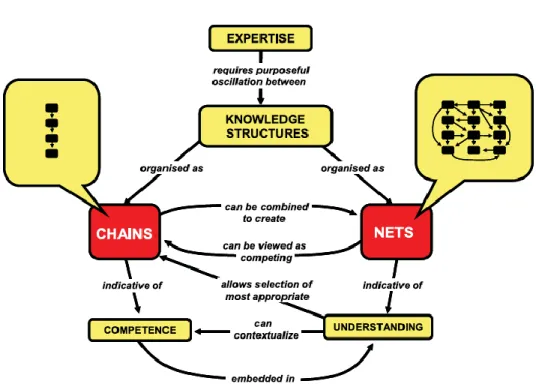
relationships provision (Yielder, 2004). Kinchin and Cabot simplify Yielders model in putting the integration and synergy of the knowledge base and professional practice central. They see the cognitive processes, internal integrative processes and interpersonal relationships provision as part of the context in which this linking occurs (Kinchin & Cabot, 2010). They also propose another model; ‘A dual-processing knowledge structures perspective on the nature of expertise’ (figure 1). The model recognizes two, separated knowledge structures; one in chains and one in nets (networks). The chains resemble more the classical learning perspective of linear sequences of information. The chains resemble more the complexity within practice; understanding is here based on a network of non-linear related resources.
Figure 1 - A dual-processing knowledge structures perspective on the nature of expertise’ Copied from (Kinchin & Cabot, 2010)
The relation between the two structures is parallel but depending on the experience of the professional;
“The implication that the development of net structures among students may be the goal of higher education is one that may be contested, particularly where chains of practice
33
seemingly have more immediate practical application than networks of understanding. In the clinical context, the chains and networks need to develop in parallel. As an individual develops expertise, the networks of understanding will develop sophistication whilst the choice of embedded chains of practice will also grow. The smoothness of transition between the two will increase with increasing expertise” (Kinchin & Cabot, 2010).
Wenger and colleagues offer a similar interpretation, making the distinction between competences and knowledgeability, the later term is used to describe the ability to translate the complex experiences (journey) within the landscape of practice (or similar; domain of actions) in something meaningful or action (Wenger-Trayner et al., 2015).
In their model Kinchin and Cabot emphasize the explicating of tacit knowledge available in practice as the key information/ connection for progress in learning. This is done by constantly connecting the chain(s) of knowledge with the nets of knowledge (Kinchin & Cabot, 2010). One of the critical features of this connecting professional is the constant search for meaning in order to develop and adapt (new) knowledge in practice. Wenger et al.(2015) are describing a similar process as the ‘expressibility of an identity’ (Wenger-Trayner et al., 2015).
Another driver of the knowledge process is identity. Although identity is often coined to be of essential importance in professional development, it turns out to be little researched and defined (Trede, Macklin & Bridges, 2012). Higgs (1993) assumes that professional identity occurs when a member of a profession develops the “attitudes, beliefs and standards which support the practitioner role and the development of an identity as a member of the profession with a clear understanding of the responsibilities of being a health professional” (Higgs et al., 1993). In higher education there is a strong focus on the ability of students to be critical independent lifelong learners as part of the professional identity. This is confirmed in the review of Trede, Macklin, Bridges (2012); “the role of self, such as self-reflection, agency and self- authorship as being a key part of the process of professional identity development” (Trede, Macklin & Bridges, 2012). They also notice an often implicit link between personal epistemology formation and professional identity development.
34
Wenger-Trayner et al. (2015) describe the role of identity as essential in the development of Knowledgeability;
“It combines many relationships of identification and dis-identification through multiple modes. These relationships to the landscape are resources and fragments of experience to be assembled dynamically in moments of engagement in practice. Practitioners need to negotiate their role, optimize their contribution, know where relevant sources of knowledge are, and be practiced at bringing various sources of knowledge to bear on unforeseen and ambiguous situations”(Wenger-Trayner et al., 2015).
In an increasingly complex and uncertain world the identity of a person is no longer ‘predestinated’ as it was in a local community or as it was being socialized in a small professional world. Identity in a knowledge society means a close relation between identity and a constant identification with other individuals and resources continuously redefining and developing the identity, making it a task for life (Bauman, 2009; Wenger-Trayner et al., 2015). This assumes an awareness that knowledge is built in both individual and social systems (Kimmerle, Cress & Held, 2009). Knowledge structures are then a dynamic mixture of knowledge, and identities, held in individuals and collectives like teams, groups, professions but also in (social) technologies (Moskaliuk & KIimmerle, 2009).
In this interplay of identities it is a key question for individuals how to distinct between what is part of ‘me’ versus what is ‘not (yet) part of me’. This demands a constant connecting and mobilizing across practices to avoid fragmentation and to keep learning (Akkerman & Bakker, 2011). These socio-cultural differences leading to discontinuity in action or interaction are in the literature described as boundaries (Akkerman & Bakker, 2011). Wenger et al. (2015) state: ‘Crossing boundaries, boundary encounters, and boundary partnerships are necessary for the integration of a landscape of practice’. (Wenger-Trayner et al., 2015) This demands the ability of social-cultural dialogue and the use of instruments to cross these boundaries (social media for example), which could well be one of the reasons that ‘21st
century skills’ are high on the agenda of both education and workplaces.
35
A term for an open and global knowledge society aware of a dual knowledge structure and the possibilities of boundary crossing could be called (originating by Tapscotte (2008) ‘networked intelligence’ (Tapscott, 2008). A dual processing and the intention to challenges borders demands a sophisticated epistemology or epistemic literacy in professional practice in order to step outside the chained knowledge concepts and to start the dialogue in a dualistic knowledge process (Tuomi, 2015; Otting, Zwaal, Tempelaar & Gijselaers, 2010).
Individual practitioners interpret and implement practice through their practice models and theories (Rycroft-Malone & Bucknall, 2010). Or as Ilott and colleagues (2012) are putting it; “theories, models and conceptual frameworks are tools to structure thinking and action about a problem. They provide a rationale, to justify decisions and explain findings” (Ilott, Gerrish, Laker & Bray, 2012). An important task is to formulate these models and theories explicit and constantly as they help to understand and organize the complexity of knowledge resources (Eccles, Grimshaw, Walker, Johnston & Pitts 2005; Thomas, Menon, Boruff, Rodriquez & Ahmed, 2014; Higgs et al., 2013). Within a dualistic knowledge process it is also important to acknowledge the diversity within practice and use and formulate theories out of and within the specificity of the practice (Lettinga & Mol, 1999).
Theoretical framework: Assumption 7
Understanding of practice is an important determinant in integrating embodied knowledge in the knowledge society
Theoretical framework: Assumption 8
Understanding of practice is an integration of knowin, acting and being, which is conceptualized as a dual processing of chains and nets of dynamically interacting knowledge structures.
Theoretical framework: Assumption 9
Understanding of practice assumes the continuous process of: 1. Sophistication of epistemic beliefs
2. Explication of tacit knowledge
3. Social (community) and individual identity building 4. Proliferation of practice models and theories
36
1.2 The struggle of knowledge in health care
Health care is increasingly confronted with challenges to manage knowledge created by the complexity of the knowledge society, the interpretation of knowledge, new demands towards health care and the failure to manage knowledge with the instruments developed in health care to create and implement knowledge. In the following these challenges are briefly discussed.
1.2.1 Health care system reform
The care for health is increasingly an inter-sectorial collaborative endeavor (Jamison, Summers & Alleyne, 2013). This collaboration is demanding the sharing of knowledge between informed and empowered clients, people and institutions in their daily environment and the professionals within health care, but also between sectors like education, sports and health care. Health care systems are little responsive to the knowledge available and collaboration is hampered. Ageing, new conceptions of health (Huber, 2012), global health issues (WHO, 2014) and the massive financial burden of current health care systems demand innovation (Matheson et al., 2013). The current problems of health care are perceiver as ‘wicked problems’; multilevel, complex, and interrelated (Kessler & Glasgow, 2011; WHO, 2014; NICE, 2012), however little recognized like that in health care (Matheson, 2013). The strong social and cognitive or epistemological boundaries between and within professions and sectors are among the reasons of the difficulties to act adequately to the challenges (Ferlie, Fitzgerald, Wood & Hawkins, 2005). Also the neglect of a more complex worldview, as earlier discussed, prevents an innovative reformulation of health care reform (Sturmberg & Martin 2013).
1.2.2 Evidence Based Practice
Not so much knowledge management but evidence based practice has been the dominant model in health care to define the nature of its knowledge. Since the 1990 of the last century evidence based practice has been the norm for health care professionals and is instrumentalized by policymakers and financers. Evidence based practice originates from evidence based medicine. Sackett (1996) defined Evidence-based medicine (EBM) as:
37
“the conscientious, explicit and judicious use of current best evidence in making decisions about the care of individual patients. The practice of evidence based medicine means integrating individual clinical expertise with the best available research evidence and patient values” (Sackett 1996). The major paradigm shift evidence based practice tries to establish is the move from predominantly authority based practice in which knowledge was uncritically accepted towards the critical use and judgment of scientific evidence. The Evidence Based Practice (EBP-)movement aims to cumulate ‘high level’ experimental evidence and integrate this in the daily practice. To reach this goal the movement has been fiercely advocating experimental knowledge and a broad range of strategies and ‘EBP-resources’ were developed for practitioners (Dijkers, Murphy & Krellman, 2012). Ranging from search strategies, evidence hierarchies, to the development of high level systematic reviews and the development of guidelines in order to support evidence based decision making.
The knowledge production has been highly successful. The current health sector produces an exponential growing amount of primary research, reviews, guidelines and other information that could inform the health professional (Davenport & Glaser, 2006; Kessler, 2011). This information is more and more accessible due to an increasingly attainable and efficient information technology, which offer databases and other platforms to share information. The result is that the individual health professional has to resolve an information paradox; in which they are overwhelmed with presumably relevant evidence but cannot find particular information when and where they need it.
Regardless of its massive success, there have been fundamental criticism and discussion since the start of the EBP, movement (Marks, 2002; Tonelli, 2006; Dijkers, Murphy & Krellman, 2012; Greenhalgh, Howick & Maskrey, 2014). Marks unmasked EBP thoroughly in 2002 as being seriously flawed in its epistemological premises and other assumptions, stating; that “It is supremely ironic that the principles of EBP are unsupported or contradicted by evidence, that they are themselves nothing more than opinion-based theory, a faith” (Marks, 2002).
At the core of most critics on Evidence Based Practice are the epistemological premises of the movement. Knowledge in EBP is considered to be of a positivistic nature (or a naïve version of positive realism). In this view EBP is producing objective knowledge that need