This article was downloaded by: [85.246.51.89] On: 05 August 2014, At: 09:02
Publisher: Routledge
Informa Ltd Registered in England and Wales Registered Number: 1072954 Registered office: Mortimer House, 37-41 Mortimer Street, London W1T 3JH, UK
Journal of Loss and Trauma: International Perspectives
on Stress & Coping
Publication details, including instructions for authors and subscription information: http://www.tandfonline.com/loi/upil20
Distress in Portuguese Family Members Bereaved by
Suicide: An Exploratory Study
Sara Santos a , Sofia Tavares b & Rui C. Campos b
a
Clinical Psychologist, Portuguese Red Cross, Évora, Portugal, Department of Psychology , University of Évora , Évora , Portugal
b
Department of Psychology and Center for Research on Education and Psychology (CIEP) , University of Évora , Évora , Portugal
Accepted author version posted online: 30 Jun 2014.
To cite this article: Sara Santos , Sofia Tavares & Rui C. Campos (2014): Distress in Portuguese Family Members Bereaved
by Suicide: An Exploratory Study, Journal of Loss and Trauma: International Perspectives on Stress & Coping, DOI: 10.1080/15325024.2014.934618
To link to this article: http://dx.doi.org/10.1080/15325024.2014.934618
Disclaimer: This is a version of an unedited manuscript that has been accepted for publication. As a service
to authors and researchers we are providing this version of the accepted manuscript (AM). Copyediting, typesetting, and review of the resulting proof will be undertaken on this manuscript before final publication of the Version of Record (VoR). During production and pre-press, errors may be discovered which could affect the content, and all legal disclaimers that apply to the journal relate to this version also.
PLEASE SCROLL DOWN FOR ARTICLE
Taylor & Francis makes every effort to ensure the accuracy of all the information (the “Content”) contained in the publications on our platform. However, Taylor & Francis, our agents, and our licensors make no
representations or warranties whatsoever as to the accuracy, completeness, or suitability for any purpose of the Content. Any opinions and views expressed in this publication are the opinions and views of the authors, and are not the views of or endorsed by Taylor & Francis. The accuracy of the Content should not be relied upon and should be independently verified with primary sources of information. Taylor and Francis shall not be liable for any losses, actions, claims, proceedings, demands, costs, expenses, damages, and other liabilities whatsoever or howsoever caused arising directly or indirectly in connection with, in relation to or arising out of the use of the Content.
This article may be used for research, teaching, and private study purposes. Any substantial or systematic reproduction, redistribution, reselling, loan, sub-licensing, systematic supply, or distribution in any
form to anyone is expressly forbidden. Terms & Conditions of access and use can be found at http:// www.tandfonline.com/page/terms-and-conditions
ACCEPTED MANUSCRIPT
Distress in Portuguese family members bereaved by suicide: An exploratory study
Sara Santos1,Sofia Tavares2, Rui C. Campos2
Sara Santos is a clinical psychologist at the Portuguese Red Cross and a PhD student at Department of Psychology, University of Évora, Portugal.
Sofia Tavares & Rui C. Campos are in the Department of Psychology and Center for Research on Education and Psychology (CIEP) at the University of Évora, Portugal.
1Clinical Psychologist, Portuguese Red Cross, Évora, Portugal, Department of Psychology, University of Évora, Évora, Portugal, 2Department of Psychology and Center for Research on Education and Psychology (CIEP), University of Évora, Évora,
Portugal
Received 4-10-14, accepted 5-23-14
Address correspondence to Sofia Tavares, Department of Psychology, University of Évora, Apartado 94, Évora, Portugal 7002–554. E-mail: [email protected]
Abstract
The present study examined the impact of several sociodemographic and suicide related variables on the distress of family members bereaved by suicide. A sample of Portuguese family members bereaved by suicide (N=93) living in the Alentejo region completed a sociodemographic and suicide information questionnaire and the Brief Symptom Inventory. Forward Multiple Linear Regression Analysis demonstrated that several sociodemographic and suicide variables related with general distress, depression and anxiety. Results contribute to characterize family members bereaved by suicide and have implications for the implementation of postvention programmes.
KEYWORDS: suicide survivors, distress, sociodemographic variables, suicide related
variables, depression, anxiety.
ACCEPTED MANUSCRIPT
Suicide is a major mental health issue in clinical and non clinical populations throughout the life span. The World Health Organization (2011) estimated that every year almost one million people die by suicide in the world. In Portugal, over a thousand people die every year, with suicide being the leading cause of unnatural death (National Institute of Statistics, 2013).
For those who commit suicide the pain comes to an end but, for the victims' loved ones the suicide is usually the beginning of an intense journey of suffering and distress (Chow, 2006). This is what Edwin Shneidman (1973, p. 33) meant when he stated that "a person’s death is not only an ending: it is also a beginning – for the survivors". According to Jordan and McIntosh (2011a, p.7) “a suicide survivor is someone who experiences a high level of self-perceived psychological, physical, and/or social distress for a
considerable length of time after the exposure to the suicide of another person". Several authors (e.g. Jordan & McMenamy, 2004) have suggested that for each suicide there are between six to ten survivors. In Portugal, therefore, more than a thousand of suicides per year may be translated into approximately 6,000 to 10,000 new survivors every year.
Suicide survivors have been characterized as a significantly distressed population that reports a high number and persistent degree of psychological symptoms (Jordan, Feigelman, McMenamy, & Mitchell, 2011). In fact, research has found high rates of psychiatric disorders in survivors (e.g. Mitchell, Sakraida, Kim, Bullian, & Chiappetta, 2009; Tsuchiya, Agerbo, & Mortensen, 2005), like depression (e. g., Brent, Melhem, Donohoe, & Walker, 2009; de Groot, de Keijser, & Neeleman, 2006; Li & Zhang, 2010;
ACCEPTED MANUSCRIPT
Mitchell et al., 2009; Zhang, Tong, & Zhou, 2005), anxiety (e. g., Brent, Moritz, Bridge, Perper, & Canobbio, 1996; Mitchell et al., 2009) and suicidal ideation (e. g., Cerel & Roberts, 2005; Kuramoto, Stuart, Runenson, Lichtenstein, Långström, & Wilcox, 2010) as well as risk behaviours (Cerel & Roberts, 2005). The literature also suggests that survivors may be particularly vulnerable to complicated grief (de Groot,et al.,2006; Dyregrov, Nordanger, & Dyregrov, 2003). Individuals with complicated grief present high rates of psychiatric comorbidity, including high rates of comorbid major depression (Newson, Boelen, Hek, Hofman, & Tiemeier, 2011) and are at high risk for suicidal ideation and behavior (Mitchell, Kim, Prigerson, & Mortimer, 2005). However, contradictory results can be found in the literature. While some authors have found elevated rates of depression, anxiety and suicidal ideation, others find no difference when suicide bereaved individuals are compared with those bereaved by other causes of death (see Bolton et al., 2013).
Gender and age have been related to distress, depression and anxiety in survivors, namely suicide survivors (Brent et al., 2009; de Groot et al., 2006; Newson et al.,2011), with women generally reporting more depressive symptoms (Brent et al., 2009; de Groot et al., 2006) and more anxiety (Farberow, Gallagher-Thompson, Gilewski, & Thompson, 1992) than men. Greater age (Newson et al., 2011) and lower levels of education (Tomarken et al., 2008) were found to be significantly associated with complicated grief and lower education in survivors correlated with distress (Dyregrov et al., 2003) and depression (Zhang et al., 2005). It has been reported that complicated grievers are more likely to be divorced (Newson et al., 2011) and single people have a significantly higher risk of
ACCEPTED MANUSCRIPT
suicide compared to married people (McIntosh, Santos, Hubbard, & Overholser, 1994; Qin et al., 2003). Being divorced or widowed has also been associated with high risk (McIntosh et al., 1994).
Previous studies have also demonstrated that suicide survivors of a close relative, for example a spouse, presented significantly higher levels of depression (Kessing, Agerbo, Mortensen,2003; Zhang et al., 2005) and anxiety (Mitchell et al., 2009).
Whilst some studies show that the length of time elapsed since suicide is predictive of the presence of complicated grief (e. g., Newson et al., 2011) and mental disorders in
survivors (Saarinen, Hintikka, Lehtinen, Lönnqvist, & Viinamäki, 2002), other studies show that as time passes, trauma caused by the suicide of a loved one decreases (Li & Zhang, 2010). Brent, Melhem, Donohoe and Walker (2009) found that bereavement due to suicide is associated with a high risk of depression from 9 to 21 months following the death. Feigelman, Jordan and Gorman (2009) reported that an elapsed time of 3 to 5 years usually marks the turning point, with a decrease in acute grief difficulties accompanying the loss. Murphy, Johnson, Wu, Fan and Lohan (2003) found an elapsed time of 3 to 4 years to be the crucial turning point in the acceptance of loss. Some clinicians (e.g. Archibald, 2011) describe cases of suicide survivors that are emotionally disturbed several decades after the occurrence of the suicide.
Research also shows that survivors of victims with multiple past suicide attempts reported higher psychological distress than survivors of those who had no such past
ACCEPTED MANUSCRIPT
history (Kaslow et al., 2000). Chiu et al. (2006) also reported that multiple past suicide attempts are associated with higher psychological distress and greater difficulties in the mourning process (Feigelman et al., 2009).
Survivors of younger victims report high levels of guilt and shame (Reed & Greenwald, 1991), and the suicide of a younger relative is also associated with higher levels of psychological distress (Séguin, Lesage, & Kiely, 1995). Finally, poor coping strategies (Marty, Segal, & Coolidge, 2010) have been related with suicide ideation in survivors.
This exploratory study targeted other potentially important variables that, to the best of our knowledge, have yet to be tested for their relationship to suicide survivor distress. Some suicide survivors benefit from professional help, which potentially attenuates distress. Additionally, a suicide related variable may also potentially contribute to suicide survivors' distress: suicide in other family members. A family history of suicidality could have been experienced as a traumatic event and traumatic re-experiencing (see for
example Bower & Sivers, 1998) may potentially occur as a result of the current suicide, possibly increasing survivor distress. Method of suicide will also be investigated. In Portugal, hanging is a commonly used method, especially in the Alentejo region (Saraiva, 2010), so the impact of this variable will also be tested. As far as we know, no one has proposed a convincing explanation for the high rate of this violent method of death in the region. We expect that this study would further the understanding of distress in this population, and thus aid in the implementation of effective postvention programmes amongst Portuguese family members bereaved by suicide with high levels of distress.
ACCEPTED MANUSCRIPT
Aim Of The Study
Despite the traumatic consequences of dealing with a suicide, the effect on family members bereaved by suicide has received less attention in Suicidology literature than other issues (Jordan & McIntosh, 2011b). In Portugal, as far as we know, no other study has examined either the impact of suicide on survivors' well being or the relationship between sociodemographic and suicide related variables with survivors' distress. Reported studies have usually looked at a limited number of variables in their
relationship with distress. In order to fill in this gap, this exploratory study intended to assess distress (general distress, depression and anxiety) in a sample of family members bereaved by suicide (household' survivors) collected at the Portuguese region with the highest rate of suicide, Alentejo (National Institute of Statistics, 2013), and its
relationship with a pool of 12 variables previous described in the introduction: sociodemographic variables (age, education, gender, marital status, spouse of the
deceased, survivor coping strategies and recourse to professional help) and suicide
related variables (time elapsed since the suicide, family history of suicide, age of
deceased, suicide method and previous suicide attempts by the deceased). We expect
that these variables will relate to general distress, depression and anxiety.
METHOD Participants And Procedure
An initial convenience sample of 120 family members bereaved by suicide (household' survivors) living in the Alentejo region, in Portugal, was contacted to participate in this study. Twenty seven participants refused to participate resulting in a final sample of 93,
ACCEPTED MANUSCRIPT
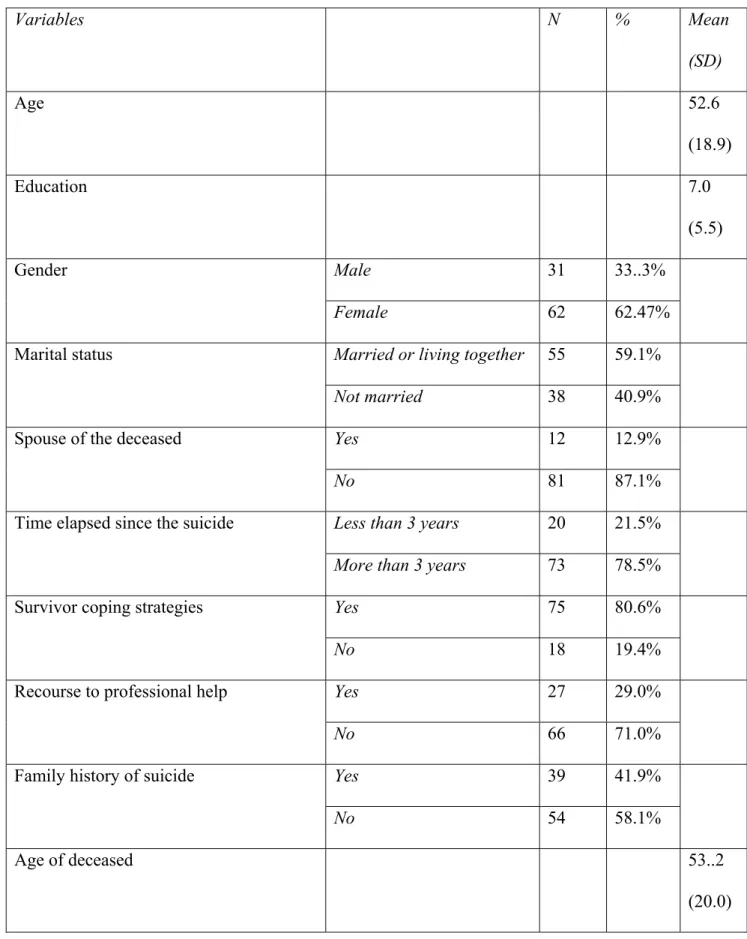
comprising 62 (66.7%) female participants and 31 (33.3%) male, and ranging in age from 18 to 89 years (M=52.6; SD=18.9), with a mean education level of 7.0 years (SD= 5.5). Participants were recruited in several community services such as Private Institutions of Social Solidarity. Each potential participant was personally contacted by the first author and asked to take part in a study about the impact of suicide on the family. Participants gave written informed consent and were given the opportunity to discontinue their participation at any time. None of the participants chose to do so. The guidelines of the
Portuguese Psychologists Board were followed. Data collection was conducted in
individual sessions and met all ethical guidelines regarding the confidentiality and psychosocial well being of the participant. When the participant had a low educational level or difficulties reading, items and questions were presented orally. Sessions took an average time of 27 minutes and were conducted by the first author. Participants were not paid or compensated for their participation. All potential risk cases were referred to the Department of Psychiatry of Évora Hospital. Data collection took approximately 12 months.
Measures
Sociodemographic And Suicide Information Questionnaire
Participants responded to a questionnaire to supply information regarding
sociodemographic and suicide related variables. The questionnaire gathered information regarding 12 variables: age, education, gender, marital status, spouse of the deceased,
time elapsed since the suicide, survivor coping strategies, recourse to professional help (family doctor or mental health professional), family history of suicide, age of deceased,
ACCEPTED MANUSCRIPT
suicide method and, previous suicide attempts by the deceased (see table 1). Coping
strategies were assessed through an open question: "In what way(s) did you try to cope with your loss?" All valid responses were coded as YES, and NO was coded if the participant failed to respond or said "none". Examples of valid responses were "using family support", "working", "support of friends", "hobbies" or "finding a meaning to the suicide".
Brief Symptom Inventory (Bsi)
General distress, depression and anxiety were assessed with the Brief Symptom Inventory (BSI; Derogatis, 1993), which is a 53-item self-report inventory that assesses several psychopathological dimensions. It also produces global indices, namely the positive symptom distress index (PSDI), which was developed to provide an overall assessment of psychopathology or distress. Items are answered according to a Likert scale ranging from 0 (not at all) to 4 (extremely). In the present study we used the depression and anxiety scales, and the PSDI (to assess general distress). The psychometric properties of the BSI are adequate and are available in the manual (Derogatis, 1993). The BSI was adapted for the Portuguese population by Canavarro (2007). In the Portuguese version (Canavarro, 2007), a score ≥1.7 in the PSDI suggests emotional disturbance. Cronbach Alphas for the Portuguese version (Canavarro, 2007) varied between .62 and .80 for the nine symptom subscales. In the present study, alpha values were .97 for the total scale, .91 for the depression scale and .84 for the anxiety scale.
Data Analysis
ACCEPTED MANUSCRIPT
In order to study the relationship between the 12 sociodemographic and suicide related variables and distress (general distress, depression and anxiety, assessed respectively with the PSDI and the depression and anxiety scales of the Brief Symptom Inventory), we performed three Multiple Linear Regression Analyses using software SPSS 21. As a multivariate method, multiple regressions estimate the unique contribution of each one of the sociodemographic and suicide related variables towards predicting each type of distress (i.e., it considers simultaneously the other independent variables and the shared variance between predictors).
We used the forward method to select variables for the models, given the exploratory nature of the study (Field, 2005) and the large number of predictors, in order to enable the software to define ‘the best models’, selecting the best set of predictors from the initial pool of 12 variables. In the first step of the regression, the forward method enters the independent variable that presents the highest correlation with the dependent variable. The next variables to enter, one at each step, are those with the highest correlations with the dependent variable after controlling for the shared variance with the independent variables previously entered. General distress, depression and anxiety were entered as dependent or criterion variables.
RESULTS
Participants obtained a mean value of 1.93 (SD= .63) in the PSDI, a mean value of 1.61 (SD= 1.16) in the depression scale and a mean value of 1.17 (SD= .86) in the anxiety scale. According to the Canavarro’s (2007) criteria for the Portuguese version of the BSI
ACCEPTED MANUSCRIPT
a score ≥1.7on the PSDI, 58 participants (62.4% of the sample, 51.6% of men and 67.7% of women) suffer significant distress.
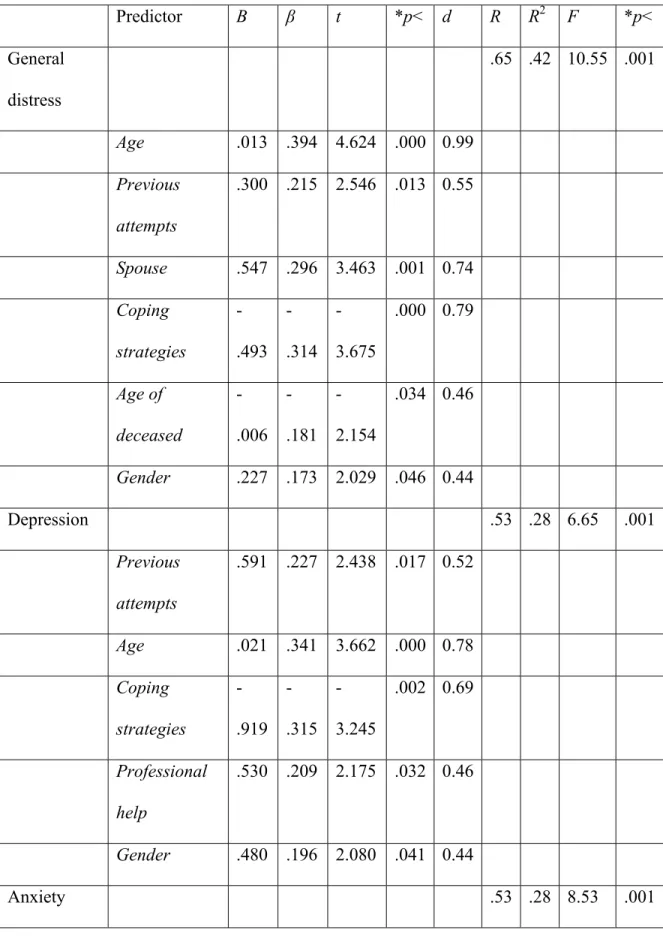
Three Forward Multiple Linear Regression Analysis were computed to predict general distress (BSI PSDI), depression and anxiety, allowing the 12 sociodemographic and suicide related variables to be entered as predictors in the models. Results appear in Table 2.
We examined the normality of residuals using the Kolmogorov-Smirnov Z test. The results indicated that the distributions of residuals form the three regression analysis were normal (p values > .05). Dependent variables were also normally distributed.
Homoscedasticity was confirmed using White test. We also examined the
multicollinearity between variables. Eigenvalues of the cross-products matrix, condition indexes along with variance inflation factors (VIF) and tolerances from multicollinearity analyses indicated the absence of any multicollinearity.
In the first analysis, to predict PSDI, the final model was obtained after six steps. The final regression model is significant (F = 10.55, p<.001, R2 = .42). Age (β = .39, p <
.001), previous attempts (β = .22, p < .05), spouse (β = .30, p < .005), coping strategies
(β= -.31, p < .001), age of deceased (β = -.18, p < .05) and gender (β = .17, p < .05), related with general distress. In the prediction of depression, the final model was obtained after five steps. The final regression model is significant (F = 6.65, p<.001, R2 = .28). Previous attempts (β = .23, p < .05), age (β = .34, p < .001), coping strategies (β= -.32, p
ACCEPTED MANUSCRIPT
< .005), professional help (β = .21, p < .05) and gender (β = .20, p < .05) related with
depression. Finally, in the third analysis, related to the prediction of anxiety, the final model was obtained after four steps. The final regression model is significant (F = 8.53,
p<.001, R2 = .28). Coping strategies (β = -.39, p < .001), gender (β = .30, p < .005), age (β = .25, p < .01) and age of deceased (β= -.20, p < .05) related with anxiety.
For the three analyses presented in Table 2, given the probability level of .05, the twelve predictors, the observed R2 (of .42, .28 and .28), and the sample size of 93 participants, the observed power (Cohen, Cohen, West, & Aiken, 2003) was found to be 1.00, 0.98 and 0.98, respectively.
DISCUSSION
The aim of the present study was to assess the relationship between a set of
sociodemographic and suicide related variables and distress (general distress, depression and anxiety) in a sample of Portuguese suicide family members bereaved by suicide.
Our observation that a large percentage of family members bereaved by suicide (62.4%) are significantly distressed is consistent with other studies where family members bereaved by suicide are at risk for developing psychiatric disorders, or poor physical health (Bailley, Kral & Dunham, 1999), and that suicide survivors closely related to the deceased experience higher levels of distress (Calhoun & Allen, 1991; Mitchell et al., 2009), depression (Brent et al., 2009; Kessing et al., 2003; Li & Zhang, 2010; Mitchell et al., 2009) and anxiety (Brent et al., 1996; Mitchell et al., 2009).
ACCEPTED MANUSCRIPT
In our study, several sociodemographic variables related to general distress, depression and anxiety. In particular, age was found to be significantly associated with general distress, depression and anxiety, with older adults being more vulnerable. This is not surprising given that elderly people present several characteristics (e.g. healthy problems, social isolation, multiple losses, poor social networks and low socioeconomic status) that may contribute to a more dysfunctional response to the suicide of a loved one (Balter, 1994; McIntosh et al., 1994).
We also found a relation between gender and distress, with women presenting higher levels of general distress, depression and anxiety. These results accord well with results from previous studies showing that women bereaved by suicide presented more
depressive symptoms (Brent et al., 2009; de Groot et al., 2006), more anxiety (Farberow et al., 1992) and more distress (Dyregrov, Nordanger, & Dyregrov, 2003) than men. Cultural and gender role factors may explain this difference, because different reactions to risk factors, specifically to bereavement, may be socially expected (Qin et al., 2003). Men may generally be more unwilling to recognize their own distress, depression and helplessness (Qin et al., 2003).
Lack of coping strategies is also associated with distress, depression and anxiety in our sample of suicide family members bereaved by suicide. According to Marty et al. (2010), poor coping skills may be related with suicidal ideation. According to their results using of coping strategies that are oriented toward disengagement and maladaptive avoidance of a problem, such as denial and reducing one’s effort to deal with a stressor, may be a
ACCEPTED MANUSCRIPT
risk factor for suicidal ideation (Marty et al., 2010). The way the individual copes with a traumatic event may in fact be more important than the traumatic event itself, and the use of effective coping strategies may decrease distress when responding to a traumatic event (e. g., Mikulincer & Florian, 1996).
According to our results, the age of the deceased is negatively related to general distress and anxiety. A death of a younger relative by suicide is a non normative, almost always unexpected and traumatic event, which may increase anxiety (Murphy et al., 1999), psychological distress (Séguin, Lesage, & Kiely, 1995) and grief symptoms (Keesee, Currier, & Neimeyer, 2008) in survivors.
We found that previous suicide attempts by the deceased are related to distress and depression. This agrees with the literature which mentions that a prolonged ‘death watch’ can be destructive (Osterweis, Solomon, & Green, 1984; Sanders, 1982-1983) and the idea of anticipating a suicide and being helpless to prevent it, can be extremely
distressing (see Callahan, 2000). Some family members bereaved by suicide may not have taken seriously past suicide attempts of the deceased and may believe that they did not do enough to prevent the suicide; an increase in psychological distress and depressive symptoms with associated feelings of guilt, shame and stigma (see Jordan & McIntosh, 2011c; Sveen & Walby, 2008) may result.
Our results also identified that being the spouse of the deceased is also related to distress. This result is consistent with the literature (e. g. Kitson, 2000; Saarinen et al., 2002)
ACCEPTED MANUSCRIPT
showing that distress and psychiatric symptoms in spouses of suicide victims may last as long as 10 years. According to Jordan and McIntosh (2011c), spouses may feel more distressed due to a perception that they may have had the opportunity to prevent the suicide and were unable to do so. Jordan and McIntosh (2011c) also report that spouses of individuals who have died by suicide feel generally guiltier and more ashamed than survivors of individuals who died of others causes.
Our results show that family members bereaved by suicide who have taken recourse to professional help present more depressive symptoms. At least two explanations can be proposed for this unexpected result. Firstly, mental health services provided to survivors in the region where the sample was collected may be ineffective. As far as we know, there is a complete absence of postvention programs in the region. It is very important that mental health professionals have a basic understanding of bereavement by suicide, both because of its prevalence and possible risk outcomes (Mitchell et al., 2005). Another possible explanation is the hypothesis that it is exactly the most depressed survivors who may be seeking out professional help. Some evidence exists (Horowitz, et al., 1984; Watson, 1991) that individuals who seek out psychotherapy are, in fact, more distressed than those who do not. The cross-sectional nature of the study does not allow for a more definitive explanation of this result.
Limitations And Conclusions
The present study has several limitations. The sample is heterogeneous, namely regarding age, is relatively small and not representative of Portuguese family members bereaved by
ACCEPTED MANUSCRIPT
suicide, since it was collected in just one Portuguese region – Alentejo. Another limitation is the cross sectional nature of the study. It is possible that participants were already distressed before the occurrence of suicide, that they are responding to other important issues that happened to them in the intervening years or that they are simply reporting normal reactions to a traumatic event. Another limitation is that a relatively large number of predictors were considered for the regression analysis. In addition, data may be relatively clustered because the interviewer collected data from more than one person per family, although this happened with just a small number of families. Finally it must be said that the coping measure used in the present study is relatively rough. Future studies should address these issues in longitudinal designs with more extensive and representative samples. Given the fact that suicide survivors are a group at major risk of suicide (Andriessen & Krysinska, 2012), it seems also important to further study
variables associated with suicide risk in this population in Portugal.
However, our results may have important implications, because they contribute to characterising the population of Portuguese family members bereaved by suicide. Our results point out that they face significant distress. The management of distress should be an important goal for postvention interventions (Andriessen & Krysinska, 2012). Our results also suggest that significant sociodemographic and suicide related variables may help to identify high risk family members bereaved by suicide, in need of professional help and assessment of distress.
ACKNOWLEDGMENTS
ACCEPTED MANUSCRIPT
We would like to extend our thanks to all of the participants in this study.
REFERENCES
ANDRIESSEN,K.,&KRYSINSKA,K. (2012). Essential questions on suicide bereavement
and postvention. International Journal of Environmental Research and Public Health, 9, 24-32.
BAILLEY,S.E.,KRAL,M.J.,&DUNHAM,K. (1999). Survivors of suicide do grieve
differently: Empirical support for a common sense proposition. Suicide and
Life-Threatening Behavior, 29, 256-271.
BALTER,R. (1994). The elderly suicide: Those left behind. In D. Lester, & M. Tallmer
(Eds.), Now I lay me down: Suicide in the elderly (pp. 105-178). Philadelphia, PA: Charles Press.
BOLTON,J.M.,AU,W.,LESLIE,W.D.,MARTENS,P.J.,ENNS,M.W.,&ROOS,L.L., et al.
(2013). Parents bereaved by offspring suicide: A population-based longitudinal case-control study. JAMA Psychiatry, 70, 158-6.
BOWER,G.,H.,&SIVERS,H. (1998). The cognitive impact of traumatic events.
Developmental Psychopathology, 10, 625-653.
BRENT D.A.,MELHEM,N.,DONOHOE,M.B.,&WALKER,M. (2009). The incidence and
course of depression in bereaved youth 21 months after the loss of a parent to suicide, accident, or sudden natural death. American Journal of Psychiatry, 166, 786–794. BRENT,D.A.,MORITZ,G.,BRIDGE,J.,PERPER,J.,&CANOBBIO,R. (1996). Long-term
impact of exposure to suicide: A three-year controlled follow-up. Journal of the
American Academy of Child & Adolescent Psychiatry, 35, 646-653.
ACCEPTED MANUSCRIPT
CALLAHAN,J. (2000). Predictors and correlates of bereavement in suicide support group
participants. Suicide and Life-Threatening Behavior, 30, 104-124.
CANAVARRO,M.C. (2007). Inventário de sintomas psicopatológicos (BSI): Uma revisão
crítica dos estudos efectuados em Portugal. In M. R. Simões, C. Machado, M. M.
Gonçalves, & L. S. Almeida (Eds.), Avaliação Psicológica: Instrumentos validados para
a população portuguesa. (vol. 3) (pp. 305–330). Coimbra, Portugal: Quarteto.
CEREL,J.,&ROBERTS,T.A. (2005). Suicidal behavior in the family and adolescent risk
behavior. Journal of Adolescent Health, 36, 9-16.
CHIU C.H.,KUO C.J.,CHEN Y.Y.,CHEN C.C.,LEE M.B.,LIN C.H.,HUANG DY, ET AL.
(2006). Comparison of epidemiological characteristics between first-ever and repeated suicide attempters. Taipei City Medical Journal, 3, 1000–1007.
CHOW,A.Y.M. (2006). The day after: The suicide bereavement experience of Chinese in
Hong Kong. In C. W. Chan, & A. M. Chow (Eds.), Death, dying and bereavement: The
Hong Kong Chinese experience (pp. 293–310). Hong Kong: Hong Kong University
Press.
COHEN,J.,COHEN,P.,WEST,S.G.,&AIKEN,L.S. (2003). Applied Multiple
Regression/Correlation Analysis for the Behavioral Sciences (3rd edition)". Mahwah, NJ:
Lawrence Erlbaum Associates
DE GROOT,M.H., DE KEIJSER,J.,&NEELEMAN,J. (2006). Grief shortly after suicide and
natural death: A comparative study among spouses and first-degree relatives. Suicide and
Life-Threatening Behavior, 36, 418-431.
DEROGATIS,L. (1993). Administration, scoring, and procedures for the brief symptom
inventory (3rd ed.). Minneapolis, MN: National Computer Systems.
ACCEPTED MANUSCRIPT
DYREGROV,K.,NORDANGER,D.,&DYREGROV,A. (2003). Predictors of psychosocial
distress after suicide, SIDS and accidents. Death Studies, 27, 143-165.
FARBEROW,N.L.,GALLAGHER-THOMPSON,D.,GILEWSKI,M.,&THOMPSON,L. (1992).
The role of social supports in the bereavement process of surviving spouses of suicide and natural deaths. Suicide Life-Threatening Behavior, 22, 107-124.
FEIGELMAN,W.,GORMAN,B.S.,&JORDAN,J.R. (2009). Stigmatization and suicide
bereavement. Death Studies, 33, 591-608.
FEIGELMAN,W.,JORDAN,J.R.,&GORMAN,B.S. (2008-2009). How they died, time since
loss, and bereaved outcomes. Omega, 58, 251-273.
FIELD,A. (2005). Discovering Statistics with the SPSS. London: Sage.
HOROWITZ,M.J.,WEISS,D.S.,KALTREIDER,N.,KRUPNICK,J.,MARMAR,C.,WILNERN,
N.,&DEWITT,K. (1984). Reactions to the death of a parent: Results from patients and
field subjects. Journal of Nervous and Mental Diseases, 172, 383-392.
JORDAN,J.R.,FIEGELMAN,W.,MCMENAMY,J.,&MITCHELL,A.M. (2011). Rechearch
on the needs os survivors. In J. R. Jordan, & J. L. McIntosh (Eds.), Grief after suicide:
Understanding the consequences and caring for the survivors (pp. 115-131). New York:
Routledge.
JORDAN,J.R.,&MCINTOSH,J.L. (2011a). Suicide bereavement: Why study survivors of
suicide loss? In J. R. Jordan, & J. L. McIntosh, Grief after suicide: Understanding the
consequences and caring for the survivors (pp. 3-17). New York: Routledge.
JORDAN,J.R.,&MCINTOSH,J.L. (2011b). Introduction. In J. R. Jordan, & J. L. McIntosh
(Eds.), Grief after suicide: Understanding the consequences and caring for the survivors (pp. xxvii-xxx). New York: Routledge.
ACCEPTED MANUSCRIPT
JORDAN,J.R.,&MCINTOSH,J.L. (2011c). The impact of suicide on adults. In J. R.
Jordan, & J. L. McIntosh (Eds.), Grief after suicide: Understanding the consequences
and caring for the survivors (pp. 43-79). New York: Routledge.
JORDAN,J.,&MCMENAMY,J.(2004). Interventions for suicide survivors: A review of the
literature. Suicide and Life-threatening Behavior, 34, 337-349.
KASLOW,N.J.,THOMPSON,M.,MEADOWS,L.,CHANCE,S.,PUETT,R.,HOLLINS,L., ET AL.. (2000). Risk factors for suicide attempts among African American women.
Depression and Anxiety, 12, 13–20.
KEESEE,N.J.,CURRIER,J.M.,&NEIMEYER,R.A. (2008). Predictors of grief following
the death of one’s child: The contribution of finding meaning. Journal of Clinical
Psychology, 64, 1145-1163.
KESSING,L.,AGERBO,E.,&MORTENSEN,P. (2003). Does the impact of major stressful
life events on the risk of developing depression change throughout life? Psychological
Medicine, 33, 1177-1184.
KITSON,G.C. (2000). Adjustment to violent and natural deaths in later and earlier life for
Black and White widows. Journal of Gerontology: Social Sciences, 55B, S341-S351. KURAMOTO,S.J.,STUART,E.A.,RUNENSON,B.,LICHTENSTEIN,P.L.,LÅNGSTRÖM,N.,&
WILCOX,H.C. (2010). Maternal or paternal suicide and offspring's psychiatric and
suicide-attempt hospitalization risk. Pediatrics, 126, 1026-1032.
LI,N.,&ZHANG,J. (2010). Influencing factors for depression among Chinese suicide
survivors. Psychiatry Research, 178, 97–100.
ACCEPTED MANUSCRIPT
MARTY,M.A.,SEGAL,D.L.,&COOLIDGE,F.L. (2010). Relationships among
dispositional coping strategies, suicidal ideation, and protective factors against suicide in older adults. Aging & Mental Health, 14, 1015-1023.
MCINTOSH,J.L.,SANTOS,J.F.,HUBBARD,R.W.,&OVERHOLSER,J.C. (1994). Elder
suicide: Research, theory and treatment. Washington, D.C.: American Psychological
Association.
MIKULINCER,M.,&FLORIAN,V. (1996). Coping and adaptation to trauma and loss. In
Zeidner, M., & Endler, N. (eds.), Handbook of coping (pp. 554-572). New York: Wiley. MITCHELL,A.M.,KIM,Y.,PRIGERSON,H.G.,&MORTIMER,M.K. (2005). Complicated
grief and suicidal ideation in adult survivors of suicide. Suicide and Life-Threatening
Behavior, 35, 498-506.
MITCHELL,A.M.,SAKRAIDA,T.J.,KIM,Y.,BULLIAN,L.,&CHIAPPETTA,L. (2009).
Depression, anxiety and quality of life in suicide survivors: A comparison of close and distant relationships. Archives of Psychiatric Nursing, 23, 2–10.
MURPHY,S.A.,JOHNSON,L.C.,WU,L.,FAN,J.J.,&LOHAN,J.(2003). Bereaved parents’
outcomes 4 to 60 months after their children’s deaths by accident, suicide or homicide: A comparative study demonstrating differences. Death Studies, 27, 39–61.
NATIONAL INSTITUTE OF STATISTICS (2013). Óbitos por lesões provocadas
intencionalmente. Retrived from http://www.ine.pt/xportal/xmain?xpid=INE
&xpgid=ine_indicadores&indOcorrCod =0001674&contexto=bd&selTab=tab2 NEWSON,R.,BOELEN,P.A.,HEK,K.,HOFMAN,A.,&TIEMEIER,H.(2011) The
prevalence and characteristics of complicated grief in older adults, Journal of Affective
Disorders, 132, 231–238.
ACCEPTED MANUSCRIPT
OSTERWEIS,M.,SOLOMON,F.,&GREEN,M.(1984). Bereavement: Reactions,
consequences, and care. Washington: National Academy Press.
PROVINI,C.,EVERETT,J.R.,&PFEFFER,C.R.(2000). Adults mourning suicide:
Self-report concerns about bereavement, needs for assistence, and help seeking behavior.
Death Studies, 24, 1-19.
QIN,P.,AGERBO,E.,&MORTENSE,P.B.(2003). Suicide risk in relation to
socioeconomic, demographic, psychiatric, and familial factors: A national register-based study of all suicides in Denmark, 1981-1997. Archives of General Psychiatry, 160, 765-772.
REED,M.D.,&GREENWALD,J.Y.(1991). Survivor-status, attachment, and sudden death
bereavement. Suicide and Life-Threatening Behavior, 21, 385-401.
SAARINEN,P.I.,HINTIKKA,J.,LEHTONEN,J.,LÖNNQVIST,J.K.,&VIINAMÄKI,H.(2002).
Mental health and social isolation among survivors ten years after a suicide in the family: A case-control Study. Archives of Suicide Research, 6, 221-226.
SANDERS,C.M.(1982-1983). Effects of sudden vs. chronic illness death on bereavement
outcome. Omega, 13, 227-241.
SARAIVA,C.B.(2010). Suicídio: De Durkheim a Shneidman, do determinismo social à
dor psicológica individual. Psiquiatria Clínica, 31, 185-205.
SÉGUIN,M.,LESAGE,A.,&KIELY,M.C. (1995). Parental bereavement after suicide and
accident: A comparative study. Suicide and Life-Threatening Behavior, 25, 489-498. SHNEIDMAN,E.S.(1973). Deaths of man. NewYork: Quadrangle.
STROEBE,M.S.,FOLKMAN,S.,HANSSON,R.O.,&SCHUT,H. (2006). The prediction of
ACCEPTED MANUSCRIPT
bereavement outcome: Development of an integrative risk factor framework. Social
Science & Medicine, 63, 2440-2451.
SVEEN,C.A.,&WALBY,F.A.(2008). Suicide survivors’ mental health and grief
reactions: A systematic review of controlled studies. Suicide and Life-Threatening
Behavior, 38, 13-29.
TOMARKEN,A.,HOLLAND,J.,SCHACHTER,S.,VANDERWERKEN,L.,ZUCKERMAN,E.,
NELSON,C., ET AL. (2008). Factors of complicated grief pre-death in caregivers of cancer
patients. Psycho-oncology, 17, 105–111.
TSUCHIYA,K.,AGERBO,E.,&MORTENSEN,P. (2005). Parental death and bipolar
disorder: A robust association was found in early maternal suicide. Journal of Affective
Disorders, 86, 151-159.
WATSON,S. (1991). The grief process of suicide survivors: A study on the effectiveness of
psychotherapy and support group intentions. Unpublished doctoral dissertation,
Northwestern University, Evanston, IL.
WORLD HEALTH ORGANIZATION (2011). WHO Suicide prevention (SUPRE). Retrived
from http://www.who.int/mental_health/prevention/suicide/suicideprevent/en/index.htm ZHANG,J.,TONG,H.Q.,&ZHOU,L. (2005). The effect of bereavement due to suicide on
survivors’ depression: A study of Chinese samples. Omega, 51, 217-227.
ACCEPTED MANUSCRIPT
Table 1. Sociodemographic and suicide related variables
Variables N % Mean (SD) Age 52.6 (18.9) Education 7.0 (5.5) Gender Male 31 33..3% Female 62 62.47%
Marital status Married or living together 55 59.1%
Not married 38 40.9%
Spouse of the deceased Yes 12 12.9%
No 81 87.1%
Time elapsed since the suicide Less than 3 years 20 21.5%
More than 3 years 73 78.5%
Survivor coping strategies Yes 75 80.6%
No 18 19.4%
Recourse to professional help Yes 27 29.0%
No 66 71.0%
Family history of suicide Yes 39 41.9%
No 54 58.1%
Age of deceased 53..2
(20.0)
ACCEPTED MANUSCRIPT
Suicide method Hanging 57 61.3%
Other 36 38.7%
Previous suicide attempts by the deceased Yes 25 26.9%
No 68 73.1%
ACCEPTED MANUSCRIPT
Table 2. Results of Forward Regression Analysis: Final models
Predictor B β t *p< d R R2 F *p< General distress .65 .42 10.55 .001 Age .013 .394 4.624 .000 0.99 Previous attempts .300 .215 2.546 .013 0.55 Spouse .547 .296 3.463 .001 0.74 Coping strategies -.493 -.314 -3.675 .000 0.79 Age of deceased -.006 -.181 -2.154 .034 0.46 Gender .227 .173 2.029 .046 0.44 Depression .53 .28 6.65 .001 Previous attempts .591 .227 2.438 .017 0.52 Age .021 .341 3.662 .000 0.78 Coping strategies -.919 -.315 -3.245 .002 0.69 Professional help .530 .209 2.175 .032 0.46 Gender .480 .196 2.080 .041 0.44 Anxiety .53 .28 8.53 .001 Downloaded by [85.246.51.89] at 09:02 05 August 2014
ACCEPTED MANUSCRIPT
Coping strategies -.832 -.386 -4.134 .000 0.88 Gender .547 .303 3.260 .002 0.69 Age .011 .253 2.744 .007 0.58 Age of deceased -.009 -.201 -2.197 .031 0.47Note: Age= Age of the survivor; Previous attempts = Previous suicide attempts by the
deceased; Spouse= Being the spouse of the deceased; Coping= Coping strategies used by the survivor; Gender= Gender of the survivor; Professional help= The survivor has benefitted from professional help.
N = 93; *(two-tailed)