
Integration of business intelligence system and managment information systems : an open-source approach
97
0
0
Texto
(2)
(3) INTEGRATION OF BUSINESS INTELLIGENCE SYSTEM AND MANAGEMENT INFORMATION SYSTEMS: AN OPEN-SOURCE APPROACH. Baghman Behbudov. Master in Technology and Management of Information Systems. Supervisor: Pedro Castro Co-supervisor: Miguel Bento Alves Program was supported by ERASMUS MUNDUS External Cooperation.
(4)
(5) I dedicate this master project to my Parents..
(6)
(7) Acknowledgement I would like to thank to my supervisor Professor Pedro Castro and co-supervisor Mr. Miguel Bento Alves for their support in the preparation of this thesis. In addition their comments were very important to improve the thesis. My other thanks to Professor Rui Gomes and Jorge Ribeiro for their some orientations. I also thank to Mr. Gasham Zeynalov, Associate Professor of Khazar University, Azerbaijan for his helpful advice..
(8)
(9) Abstract If we look at over past years, Business Intelligence (BI) and Management Information System (MIS) became unavoidable technological advantages that bring financial benefits to large companies which could purchase, implement and maintain the MIS and BI solutions. But small companies have limited budgets that can make unachievable the implementation of such systems because they cannot support, in general, the total cost of these solutions. In this context, open source software has the capability to reduce costs, providing the software industry with an alternative and competitive way of doing business, contributing to reduce the competitive disparity between large and small size enterprises. This document explores an open source (OS) approach to integration of BI and MIS, taking into account that open source software can be an alternative option to the commercial solutions where the most important factor for this purpose is cost saving. In other hand, we present a research indicating that the integration of these systems can be a promising and desirable solution for small sized enterprises where the cost saving is an issue.. Keywords: Open Source Software, Business Intelligence (BI), Enterprise Resource Planning (ERP), Small Enterprises..
(10)
(11) Table of Contents 1.. 2.. 3.. 4.. 5.. Introduction ............................................................................................................................. 1 1.1.. Background ....................................................................................................................... 1. 1.2.. Research Problem ............................................................................................................. 2. 1.3.. Research objective ............................................................................................................ 4. 1.4.. Chapter overview .............................................................................................................. 5. Open Source Initiative ............................................................................................................. 7 2.1.. Open Source Software ...................................................................................................... 7. 2.2.. Open Source Selection Requirements ............................................................................. 11. ERP Systems ......................................................................................................................... 17 3.1.. Commercial ERP vs. Open Source ERP ......................................................................... 17. 3.2.. Requirements for Open Source ERP .............................................................................. 19. Business Intelligence Systems ............................................................................................... 23 4.1.. Open Source BI vs. Commercial BI ............................................................................... 25. 4.2.. Requirements for Open Source BI Solution ................................................................... 28. Work Developed .................................................................................................................... 31 5.1.. 6.. 7.. Software selection ........................................................................................................... 32. 5.1.1.. Dolibarr ERP/CRM ................................................................................................. 32. 5.1.2.. Pentaho BI ............................................................................................................... 34. 5.2.. Implementation ............................................................................................................... 37. 5.3.. Practical samples ............................................................................................................. 49. 5.4.. Summary ......................................................................................................................... 53. Conclusion and Future Work................................................................................................. 55 6.1.. Conclusion ...................................................................................................................... 55. 6.2.. Future Work .................................................................................................................... 57. Bibliography .......................................................................................................................... 59. Appendices Appendix A. GNU GENERAL PUBLIC LICENSE……………………………………….i Appendix B. List of Top Open Source Business Intelligence Solutions…………............xvii.
(12)
(13) List of figures Figure 1 - Average cost per user, comparing traditional and open source across scenarios ........... 4 Figure 2 - Open Source Project ROI Cumulative Costs ................................................................ 16 Figure 3 - The global structure of the BI Systems ......................................................................... 24 Figure 4 - Dolibarr ERP/CRM....................................................................................................... 34 Figure 5 - Pentaho Administration Console .................................................................................. 36 Figure 6 - System model ................................................................................................................ 37 Figure 7 - Dolibarr ERP/CRM Modules........................................................................................ 38 Figure 8 - Sub-model of Dolibarr Database .................................................................................. 39 Figure 9 - Data warehouse schema ................................................................................................ 40 Figure 10 - Tools and data flow of the implemented BI ............................................................... 40 Figure 11 - Pentaho Data Integration Tool .................................................................................... 41 Figure 12 - Pentaho Data Integration Table Input step ................................................................. 41 Figure 13 - Pentaho Data Integration Value Mapper step ............................................................. 42 Figure 14 - Pentaho Data Integration Select Values step .............................................................. 42 Figure 15 - PDI Combination lookup-update step for product dimension .................................... 43 Figure 16 - Pentaho Data Integration Table Output step ............................................................... 43 Figure 17 - Star model of sales analysis ........................................................................................ 44 Figure 18 - Schema Workbench /ROLAP Cube ........................................................................... 45 Figure 19 - New Analysis View .................................................................................................... 45 Figure 20 - Drill down method example ....................................................................................... 46 Figure 21 - Sales by year in Vertical Bar 3D chart type................................................................ 46 Figure 22 - Creating an action sequence within Design Studio .................................................... 48 Figure 23 - Dashboard example..................................................................................................... 48 Figure 24 - Modified source code ................................................................................................. 49 Figure 25 - Cross Table of Sales by Years .................................................................................... 50 Figure 26 - Sales by Country ......................................................................................................... 50 Figure 27 - The most important customers .................................................................................... 51 Figure 28 - Sales by Year .............................................................................................................. 51 Figure 29 - Sales in 2009 by month ............................................................................................... 52 Figure 30 - Drill Down by products .............................................................................................. 52 Figure 31 - Number of sales in May 2010 ..................................................................................... 53.
(14)
(15) List of Tables Table 1 - Open Source BI customers ............................................................................................. 27 Table 2 - Dolibarr ERP/CRM selection criteria ............................................................................ 33 Table 3 - Pentaho BI selection criteria .......................................................................................... 35.
(16)
(17) 1. Introduction 1.1. Background Computer software is a revolutionary factor for businesses in the world economy. Software is one of the key elements of information and communication technology (ICT) that has a tremendous role in industry. If we look at early years of the computing, software was mainly free and it was evolved among researchers and software developers. However that tendency changed when computer technology started to be more common, and where the commercial and proprietary software became more suitable for many enterprises. In last several years the idea of Open Source Software (OSS) and free sharing of software products have become a base and perspective interest both for the software development and for economic concepts. Some organizations began to define that Open Source Software (OSS) can have benefits and profits. The most outstanding example of this is IBM, ―which continues to reap high returns from its approximately one billion-dollar investment in Linux‖ [1]. Open source software is getting to be one of the most interesting experiences of the whole information technology scenery and it increases the amount of attention by different organisations. The impact of open source technology is extremely perceptible in the software industry, as well in society as a whole. It grants for innovative development models, which have already been established to be especially compatible to competently take advantage of the work of developers which are across all corners of the over the world. It also gives totally new business models that are creating a network of groups and companies based on open source software development. Commonly OSS has a very progressive influence to the creation of new software markets and business opportunities. Therefore open source projects can be viewed and examined since their existence is based on Internet. The list of open source software increasingly changes every day. Already there is a lot of open source software for different business areas. Considering Management Information Systems (MIS) and Business Intelligence (BI), open source creates a playing field for many enterprises especially for small enterprises that in case of commercial software they have never had budget to pursue it. Small enterprises can be considered as economically and socially 1.
(18) important player in this field. In the context of Europe Union (EU) small-sized enterprises share is 7.4% of all small and medium-sized enterprises (SMEs) which are 23 million and represent 99% of all enterprises [2]. Europe Commission (EC) [3] reports that only 10% of all small firms used specific ICT solutions for marketing, sales and procurement compared with 20% of medium-sized and almost 30% of large firms. The same report presents that: ―SMEs (Small and Medium Enterprises) still suffer from limited understanding of ICTs and their potential, limited budget for ICT investments and difficulty in recruiting ICT professionals‖. However, if some years ago the only choice for business was to legalize or make illegal version of commercial software, now open source software is a new choice that can be realized on the business. Using open source technologies information management can intensely increase the complement of services and improve the effective organizational development through low cost and reasonable software solutions [4]. As the source codes are available for modification without any proprietary licensing issues organizations get noticeable opportunity and the freedom to customize the application for their own choice. So, considerably distinctive from proprietary solutions, the organizations have the full freedom to modify and customize the software product to their requirements which in case of traditional software the users are bound by copyright agreements. If we notice to the past years the use area of open source software was narrow while recently it is already applying to the management level solutions. Thus all of these give us a reason to find new alternatives in the market that can be used and bring MIS and BI to small businesses. In this context, the software offers that appear on the global market as open source can constitute an opportunity to have low cost solutions for enterprises, especially for small businesses that have low IT budgets.. 1.2. Research Problem Management Information Systems (MIS) are unavoidable and competitive technological advantage of the companies which can buy, implement and maintain these solutions. Management and decision makers need up-to-date information to run their businesses. In this case MIS are integral and leading factors of every modern organization. Today‘s competitive business environment makes it obligatory and important for organizations to develop these 2.
(19) systems and to compete in rapidly changing economy. Enterprise Resource Planning (ERP) implementations have changed the work landscape of companies and it is necessary for the business drivers because the ERP software packages provide the required work functions of MIS in an organisation. These systems are created for efficient data entry and storage in real time. But from time to time this growing data requires new tools and methods to manage and analyze, because ERPs are not oriented to design analytical reports. Business Intelligence (BI) fulfills this gap and can change strategic face of the company. In other words BI is simply a facilitator of these ERP systems. Furthermore, the integrated framework of BI and ERP adds another business value to enterprise systems. However in case of small sized enterprises there are some obstacles especially cost factor that prevents them to invest in the purchasing of commercial solutions in their business. Large businesses spend millions of dollars to implement powerful ERP and BI solutions and it makes possible to manage their businesses and still they can bear this load on their shoulders because of their budget capabilities. But all of these are financially out of reach of small enterprises. Small businesses are often faced with limited access of finance to support purchasing of commercial business intelligence [5]. It is undoubtedly true that there are a lot of small enterprises which are not able to buy expensive ERP and BI solutions from software vendors. Considering the cost of SAP ERP [6] licence for 25 users is about 140000$ or Oracle BI [7] costs for 25 users are about l7000$ this is unattainable for many small enterprises. If such kind of strength differences between big and small enterprises is increasing, small enterprises can lose their competitive development. Another way to see differences between open source and commercial vendors is the cost scales increasing with the number of users [7]. Figure 1 shows the average per‐user cost over three years between open source and traditional BI. First of all considering small businesses there is a significant difference between open source and traditional BI. Changing from small environment to a larger one actual average costs increase the per‐user cost with traditional BI while decreasing with open source. So these points give us a reason that it is very important to define the opportunities of open source solutions for Management Information System and Business Intelligence that can be desirable solution for small businesses and startup companies.. 3.
(20) Figure 1: Average cost per user, comparing traditional and open source across scenarios [7].. 1.3. Research objective The purpose of this research is an experimental project to deepen knowledge on opensource software, namely an open source BI suite and open source ERP, and to develop an integrated system of these tools which can facilitate for small enterprises to increase the competitiveness. We will consider that OS BI and ERP can be an alternative for small enterprises. Within the research we are going to support the following positive expectations: . The integration of open source management information system and business intelligence software is viable in order to create a business value and it can bring benefits to small enterprises.. . There is enough level of maturity, functionalities and potentialities that can be achieved with such a solution and the integration can provide enough business values and functionalities.. . The integration of OS systems is a solution that can provide cost savings for small enterprises.. . Another important aspect is that considering our individual requirements, selected tools are modifiable and customizable.. 4.
(21) This document provides to research Open Source Environments, namely to study and choose necessary open source ERP software and open source Business Intelligence Tool, to integrate them and implement a Business Intelligence System and to define the potential benefits of this integration. We will define an architecture that can be adopted by companies with a lower cost of implementation. This proposition can be useful either to small companies or start-up companies that don‘t have enough budgets to acquire and implement commercial solutions. Taking into account the objectives of this work and due to time limitations, the experimental system implemented in this project has been limited to the integration of two largely used open-source software and to a functional area of a business to be analysed with BI tools. However, we consider that, despite these limitations, the project is a contribution in an effort to give insight of the advantages and benefits to develop integrated open-source solutions that can be used by small enterprises.. 1.4. Chapter overview This thesis is composed of six chapters. Chapter 1 we present the introduction to this project and the purpose of the document. Chapter 2 describes the research background of Open Source Software Initiative. This chapter also elaborates the concept of open source software, open source development and evaluation of open source maturity. Chapter 3 describes the important requirements for an open source ERP. Chapter 4 explores Open Source Tools for Business Intelligence, the advantages of Open Source BI and the requirements for Open Source BI selection process. Chapter 5 describes the work developed, the backbone of the thesis. This chapter describes the selection of OS software, the implementation of the experimental solution and presents some of the functionalities that can be achieved with such a solution. Chapter 6 presents the conclusion that summarizes the key points of the project and future work.. 5.
(22) 6.
(23) 2. Open Source Initiative The Open Source Initiative (OSI) [8] is a non-profit organization that gives insight about open source software, supports for the advantages of open source and creates bridges among different people in the open-source community. The most important activity of OSI is to maintain the Open Source Definition for the gain of the community. The Open Source Initiative has an approved license trademark and a concrete program that creates a confidence for the developers, users, community members, corporations and governments who can organize opensource cooperation. Open-Source software (OSS) has been carried out the activity since the 1980s, it was not ready for the general use but in general it has been viewed as a domain IT types. As an organization, Open Source Initiative was founded in February 1998, by Bruce Perens and Eric S. Raymond. Nowadays more companies, organisations and large government departments such as the US Department of Defence are one of proponents of open-source software solutions [8]. They state that open-source software has a lower total cost of ownership, has a more rapid development process and is more secure than proprietary software. Their reasoning for greater security is that, while the source code of products are open for all to view, security weakness are found and resolved before they are exploited.. 2.1. Open Source Software Open source software (OSS) is a computer software for which the source code is available and some rights usually reserved for copyright holders are provided under an open source software license that meets the Open Source Definition or that is available for the public domain [9]. This condition allows users to use, modify, extent the software, and redistribute it in modified or unmodified forms. The most important and noticeable difference between open source software created for freely using and proprietary software offered by vendors is that open source software is published under license which elucidates that the source code is available for everyone to examine, download, change and explore as they wish. The basic meaning of open source is that the source code which is created in the OS programming language (PHP, Python, Ruby) can be accessed modify and extend by anyone with the suitable skills. 7.
(24) Open source is not only about accessing to the source code and modify it. There are several distribution terms that have been defined by the Open Source Definition (OSD) and these terms must comply with 10 criteria [8]: 1. Free Redistribution The license doesn‘t constrain and forbid any people for using, modifying and selling as a part of comprehensive software distribution that includes programs from different sources. The license also doesn‘t require a royalty or fee for such kind of sale. 2. Source Code The program should contain the source code well-defined and must permit to distribute the source code in a good compiled form. Open source product should be distributed with source code that programmer can improve and customize it, and normally should be available to download via Internet without any charge. ―Deliberately obfuscated source code is not allowed‖. 3. Derived Works Licence must permit not only modification of source code but also a new generated and obtained source code to be distributed and undertaken with the same licence of original software. 4. Integrity of the Author's Source Code ―The license may restrict source-code from being distributed in modified form only if the license allows the distribution of "patch files" with the source code for the purpose of modifying the program at build time‖. The license may control new generated program in order to hold new release name or version number comparing with original software. 5. No Discrimination against Persons or Groups ―The license must not discriminate against any person or group of persons.‖ 6. No Discrimination against Fields of Endeavour The scope of licence should be large. The license must not discriminate anyone while using the program in a particular field of science. For instance, the licence must allow program to be used in different fields of economy, research and so on.. 8.
(25) 7. Distribution of License ―The rights attached to the program must apply to all to whom the program is redistributed without the need for execution of an additional license by those parties.‖ 8. License Must Not Be Specific to a Product ―The rights attached to the program must not depend on the program's being part of a particular software distribution‖. The rights which program is holding don‘t depend on a specific software distribution. If the program is the extraction of redistributed software the terms of licence and rights will be the same as in original version. 9. License Must Not Restrict Other Software Open source licence can‘t make any limitation and restrictions for already distributed and licensed software. For instance, licence must not put any condition that other programs should be open source. 10. License Must Be Technology-Neutral ―No provision of the license may be predicated on any individual technology or style of interface‖. The act of supplying or fitting out of the license may not be particular technology but should be neutral.. Recently it is true that open source development models are studied, while these new methods and models are being successfully tested. One of the first efforts which emphasized some of the characteristics of these new open source development models was by Eric Raymond‘s ―The Cathedral and the Bazaar‖ [10]. In his book the author states how successful open software projects are created and managed. Eric Raymond analyses two different types of software development models: ―cathedral‖ and ―bazaar‖. “Cathedral development model” (like in Middle Ages cathedrals were built) is distinguished and indicated as proprietary software development. It has relatively strong control on designing and implementation of models. The cathedral model is the traditional style of software development. In this model there is a strict control while attaching patches to the source code. This model has a well-defined development structure but there is a strict control on releasing of codes. So no one can access source code and improve it. 9.
(26) “Bazaar development model” is based on informal exchange of knowledge and improving source code between the developers, and several programming styles can be chosen while building the software projects like in a bazaar where anyone can choose what they wish. There is no control on release code. This model as stated in the book may be characterized with an expression: ―release early and often‖. As author explained if the objective is to have fewer bugs, why to release a version in every six month, it is better to ―work like a dog on debugging between releases‖. This method allows users to be informed regularly on how the program is developed and it works like an indicator for developers. Seeing this ―indicator‖, informal developers or users extend the functionality of software ―scratching the itch‖. While this open source software can be improved, commercial or proprietary projects cannot get these benefits. Considering ―The Cathedral & Bazaar‖ we will enumerate Raymond's some points that we defined which are very important and useful to understand open source software development [10]: . ―Every good work of software starts by scratching developer‘s personal itch.‖ While fixing the bugs in same time we improve the software.. . ―Linus Torvalds' style of development is release early and often, delegate everything you can, be open to the point of promiscuity.‖. . ―Users are wonderful things to have, and not just because they demonstrate that you're serving a need, that you've done something right. Properly cultivated, they can become co-developers.‖. . ―If you have the right attitude, interesting problems will find you.‖. . ―Good programmers know what to write. Great ones know what to rewrite.‖. . ―When you lose interest in a Program, your last duty it is to hand it off to a competent successors.‖. . ―The Open Source world behaves in many respects like a free market or an ecology, a collection of selfish agents attempting to maximize utility which in the process produces a self-correcting spontaneous order more elaborate and efficient than any amount of central planning could have achieved.‖. . ―A happy programmer is one who is neither underutilized nor weighed down with illformulated goals and stressful process friction. Enjoyment predicts efficiency.‖. 10.
(27) . ―It may well turn out that one of the most important effects of open source's success will be to teach us that play is the most economically efficient mode of creative work.‖. 2.2. Open Source Selection Requirements Many enterprises are gradually using and adopting open source projects because of their effective cost savings and free license policies. All open source systems grant to the users continuous and permanent rights and freedom that users can use, study, modify, and redistribute the product. Despite of this, when end users chose open source products there can be a lot of discrepancy in terms of the product quality, functions, performance and the available support. So while selecting open source elements for an enterprise, it is important to make several initial checks to be sure that chosen open source product is compatible with our enterprise business requirements and IT standards. According to Chamindra de Silva there are 10 questions that we can ask to evaluate open source maturity [11]: 1. Are the open source license terms compatible with my business requirements? Basically open source product is protected by copyright law, and the product license provides the fundamentals and principles for the rights that we hold on the selected software. Considering as any open source product we need to have some main freedoms on it: freely download, use, modify and redistribute. But on the other hand, these licenses can have other terms that are incompatible with specific business models. For instance, the well-known General Public License (GPL) (See Appendix A) license asks that any changes, enhancements and derivative works also should be released under the same terms of license. Although it sounds affordable condition and will not be problematic for general usage, it can be inappropriate to business models of proprietary product company that desires a GPL element in its software product. So it is important to understand open source definition and terms of licences before select them for our enterprise. 2. What is the strength of the community? Open source projects are not only about the source codes, also about the open communities that extend and support the project. ―These communities can range from the lone teen developer to a single organization to complex diverse multi-entity communities, such as found in Linux and 11.
(28) Firefox―[11]. In open source communities a wide range of users and developers test, maintain and fix the codes, security problems and bugs contributing to decrease the problematic source codes. That is why community can always be characterized as a key indicator of endurance of an open source project. 3.. How well is the product adopted by users?. The users of open source projects are like pointers that give a feedback and show the adaptation level of product to specific requirements. This gives us enough assurances how well the project will be successful especially when there are users similar to our enterprise. It can be more confident if the user is still using the product. In successful experience, it usual to have a mailing list of users where feedbacks from users can be a good guide. 4. Can I get a warranty or commercial support if I need it? All open source projects licenses are free and allow any modification on it but they don‘t give any warranty. In this case we can get support from community developers and before selecting the product we can notice the number of users that gives logical responsiveness to improve our confidence. There are particular users that are looking for open source software with fee-based or commercial support. But the ―ideal open source project has multiple vendors involved in the product that provide different types of support from customization to maintenance to 24×7 production assistance‖ [11]. 5. What quality assurance processes exist? Quality assurance process is a systematic process of controlling if the open source product is developed and meet our specified requirements. We can check this process following the project releases. If we see the quality assurance process is not appropriate to our business standards we have to improve this process in our enterprise internally or spend money to realize it by vendors. 6. How good is the documentation? One of the most important factors of open source projects are theirs documentation that can be clear and rich or confused and poor. Sometimes developers focus on the development of the project but they don‘t pay attention to the documentation process. At least all products need user manual and administrator guide that we can get online in suitable forums. 12.
(29) 7. How easily can the system be customized to my exact requirements? Open source, unlike proprietary products, has source code available for public which can be customized. But the cost of the customization differs depending on its system architecture and how well source code is written. Open source product should have flexible architecture that allows us to customize the product, or another choice, is to rely on a vendor that can do it for a fee. 8. How is this project governed and how easily can I influence the road map? There can be several open source projects that are based on different models and governed in different ways. But the most successful governance model can be created if all developers, users and other contributors participate in the development of the open source system. So depending on the influence of users to community developers, open source projects can be oriented to our requirements. 9. Will the product scale to my enterprise’s requirements? Scalability is the ability of a computer software or product to keep the continuity of functioning even if its size, system environments and other elements are changed, for instance, changing the software to a new operating system. For example, more scalable open source software can be created on the base of WAMP (Windows, Apache, MySQL), LAMP (Linux, Apache, MySQL), J2EE technology and many of application‘s source code are written in PHP/Perl/Python. 10. Are there regular security patches? The release of security patches is significant not only for open source but also for proprietary project. However in case of open source project it is more efficient, because, first of all, we can internally fix them and we don‘t need to wait answer from community developers. Open source projects are developed under a free policy, containing many contributors from all over the world that have never met formally but still are sharing informal commitments. Gartner predicts [12] a significant diagnosis in all sectors: ―By 2012, 80 percent of all commercial software will include elements of open source technology. Many open source 13.
(30) technologies are mature, stable and well supported. They provide significant opportunities for vendors and users to lower their total cost of ownership and increase returns on investments. Ignoring this will put companies at a serious competitive disadvantage. Embedded open source strategies will become the minimal level of investment that most large software vendors will find necessary to maintain competitive advantages during the next five years‖. In order to earn a profitable income from the investment, companies evaluate ongoing project performance and effectiveness of their projects assessing their Return on Investment (ROI) accurately. The same scenario concerns to open source software. When we present an open source system to our company the real costs and commitments of new system become clear [13]. In finance the return on investment (ROI) or just return is a calculation used to determine whether a proposed investment is wise, and how well it will repay the investor. It is calculated as the ratio of the amount gained (taken as positive), or lost (taken as negative), relative to the basis [14]. Return On Investment (ROI) is the economic benefits comes from spending money in the creation and development of a system. ROI is a performance measure that evaluates the productivity of the investment or compares the efficiency of several investments. ROI is an important measure to be sure about sustainability of our business. Return on investment is equal the amount of benefit or a return that derived from the investment divided by the cost of the investment. We can get derived ROI number as percentage or just a ratio:. ROI= (Gain from Investment-Cost of investment)/ Cost of investment Return on investment is a very popular indicator that is, if the investment does not have a positive ROI or if a higher ROI is possible, then the investment shouldn‘t be undertaken [15]. Managers sometimes are annoyed while analysing ROI for several reasons [16]: . It is not easy to create a comprehensive approach. The expected results of any ROI can be changed by adjusting assumptions.. . Some intangible benefits such as time, flexibility or building simpler system architecture are frequently not taken into consideration.. . Managers have difficulty to make efficient estimation about how the new technology will increase profit.. 14.
(31) While we analyse the specific costs of calculating ROI of using open source, these costs can be classified in three main categories [17]: . License/support/maintenance/subscription costs,. . IT/Service provider costs,. . Organizational costs.. Each of these categories has different type of costs that allows analyse the ROI: 1. License/Support/Maintenance/Subscription Costs. These costs characterize the payments made to developers in order to get access for using software. License fees are advance payment for a vendor‘s delivering software, while Support/Maintenance refers to the annual payments required to get access to patches for software that has already been licensed. Subscription may be a less familiar term, but it is often used for both commercial and open source products. Subscription is a yearly fee paid to maintain access to the regular releases and enables limited time for using products. 2. IT/Service Provider Costs. These costs can also be called technical costs that include the work of evaluation, installation, configuration, customization and operating the software. The expected costs for all these elements depend on how much programming, integration and customization are required for modification of product. Also these costs can be comparatively different depending on technical personnel that can be internal or external. That is why it is important to be careful to define the amount of work needed to implement and hold an open source system. 3. Organizational Costs Organizational costs are those derived by the end users of a new system. These costs reflect the learning of new software. When end users start to use new software productivity decreases till they are more familiar with the new system. The all cost experienced during this period is accumulated in organizational costs. Figure 2 illustrates the effect of the project time duration can have on the relationship of the different cost elements of a project. While license fees during the first year of the project 15.
(32) represent a smaller percentage of project costs than IT/Services costs, after this, percentage begins to increase because of their recurring maintenance fees and they ultimately become the majority of total project cost.. Figure 2: Open Source Project ROI Cumulative Costs [17] Consequently when we make an open source ROI calculation, it is essential to use a realistic project till this will make a more accurate ROI assessment [17]. Then it is recommended to create a table with ROI calculations based on several years‘ project durations. This allows to assists managers in the decision process based on ROI information.. 16.
(33) 3. ERP Systems ERP systems are important strategic tools in today‘s competitive business and IT environment. ERP - Enterprise Resource Planning is an information system which integrates and controls all the business processes in the enterprise. According to Nah and Lau [18] ERP is ―a. packaged business software system that enables a company to manage the efficient and effective use of resources (materials, human resources, finance, etc.) by providing a total, integrated solution for the organization‘s information-processing needs‖. ERPs are powerful systems for the comprehensive management of the company and the integration of all the functional information, enabling operations on the collected data, based on common database. ERPs allow easy and immediate access to information about inventory, product, customer and sales.. 3.1. Commercial ERP vs. Open Source ERP Enterprise resource planning exists in two forms. One of them is standing as commercial while another is called open source ERP. Commercial and Open Source ERPs have many differences [19]: . Pricing First of all commercial ERP software is possessed and managed by an owner company and the package is normally expensive and is developed for corporations. The price depends on the size of the enterprise and business. Commercial ERP packages are not flexible and modifiable. Any modification and customization can cause troubles.These packages are not subject to flexibility and moulding. Their usage modalities are rarely liberal and cause troubles when they are modified. The biggest advantage of open source ERP packages is that they are available as free of charge in internet. This is a desired factor to companies since it decreases the number of costs in the table of expenses. Also licenses are available with source code and any customization process is allowed without any expense.. 17.
(34) . Flexibility The flexibility criteria is a technical concept that is related with the platform independence of the package. Comparing open source ERP with commercial one, this important feature can be classified under some sub-criterias: o Customization: depending upon the skills of enterprise it is allowed to customize for our business requirements. In contrast, the use of commercial ERP can have the consequence to change the way of the business. o Database independence: the database has high influence on the scalability of the system. We can easily access to the relational model of the system in OS ERP, while commercial ERP makes this access difficult. o Programming language: the programming languages usually used in open source ERP Systems are open source scripting languages like PHP, Python, Perl and Java. We can use these languages and make our modifications. However when it comes to commercial ERP systems, above processes are complicated. These major differences between commercial and open source ERP show that open source ERPs are more flexible.. . Dependence and Results Open source ERP is built by different informal developers and as the source codes are open, the companies rely less on vendors and they take care of their ERP system themselves. So the future of the ERP system depends on the activity of the company and they can control the productivity of the system. This condition can affect and decrease the failure rates of ERP system and this can be characterized as a way of relegating the level of dependence on the ERP vendor.. . Security As open source enables to access source code and everything is transparent and available, anyone can examine the software to identify security insufficiencies. So the users and volunteer developers can make the elimination of security defects that can be missed, that improve the security level of the software. But in case of commercial ERPs they are more risk, since they are vulnerable to traps and pitfalls of hackers [19].. 18.
(35) Open source ERP systems are often used by companies whose requirements are not met by standard software since they can make adaptive software modifications in order to adapt to changing process and requirements. ―For a long time, smaller companies purchased individual accounting and payroll packages and then migrated to expensive ERP solutions as they grew‖ [20]. Now, with much Open Source software there are many possibilities for Small and Medium-Sized Enterprises (SMEs) to choose ERPs. There are several Open Source ERPs in the market including Compiere, Dolibarr, ERP5 and Openbravo. However, while selecting ERPs companies have to carefully define the individual requirements and test the software to determine fitness.. 3.2. Requirements for Open Source ERP One of the most important aspects in ERP selection is the process of evaluating and defining requirements for an open source ERP System and these aspects are never the same for any two companies. Only specific internal conditions will show exactly what work should be done. Selecting the right ERP software for our company can increase productivity, improve operational superiority and take customer satisfactions to new levels. There are a lot of ERP applications to choose from, but basically, we should choose an ERP offering that best fits our company's requirements. While choosing open source ERP, several unique factors must be considered. Considering the project the most important requirements for open source ERP should be as following [21]: 1. Customization Complexity Even if it is considered that ERP solution is complete and full, customization of the software is never avoidable. As the source code is freely available open source ERP solutions are easy to customize. In addition these systems are coded in popular, widely used computer programming languages, for instance, PHP and Java. One more important issue is in case of software has been customized internally, how this new code can be integrated with software upgrades. 2. Functionality In general all ERP solutions have enough procedural functions that can support main business processes, like functionalities to create customer, vendor and products, maintain customer orders. 19.
(36) However, ERP solutions can differ largely on functionalities that are not the core business process. There are, for example, solutions oriented to manufacturing and others to accounting. So it is important and necessary to define the strength and advantage of every open source ERP solution in order to make a decision which one meets our business requirements better. 3. User interface Nowadays ERPs use technologies that make possible to build friendly and satisfying user interfaces that allow users to easily find information and connect the ERP to the business process. User interface must be clear, comprehensive, with context based support and should facilitate the execution of daily tasks efficiently. 4. Development Activity In competitive IT market sometimes small companies are bought by big companies or they can go bankrupt with the consequence that software solutions can disappear. However in the case of products that are open source and available for public, we can develop the product from remaining condition till they meet our requirements even if the formal development doesn‘t continue. So a good development activity of ERP software makes a significant role in our future business decisions. 5. Knowledge One of the important and success factors of information system is knowledge about the product developed.. Sometimes some software products cannot be successful, because there is an. insufficient number of professional that know how to implement the software product. This also concerns to ERP software where it is important to have enough experienced consultants that can help customers in implementing ERP solutions. 6. Integration All ERP project needs integration. While using open source ERP we need to communicate with other software systems like mail servers, the software of ordering system, shipping companies. This kind of integration in commercial ERP systems is created by the vendor using several integration components. In open source ERP this level of integration is not supported. Generally,. 20.
(37) they only provide the standards that enable the integration with other software, for instance, using XML files we can import and export data or using web services. 7. Migration This is one of the most important factors of ERP systems. Migration provides functionalities to ERP systems that allow the migration of great amount of data from older ERP system to the new one. This migration depends on the complexity of accumulated data. Inefficient migration can cause failure of ERP system. Usually ERP systems provide export and import sources between several formats (text files ,excel file, XML files and so on) 8. Total Cost of Ownership (TCO) This is a financial factor of ERP software. We know that open source ERP is free for downloading and using. However we generally we will need to customize it and there is always an interesting question – what is the real cost of open source software? Without the licensing cost, we can spend money only for making customization, consulting, support and maintenance and in this way we can save money. 9. Community The open source existence is all related with community. There is a group of developers that always work on the project and creates a wide range of source code without being paid. All wellorganized open source projects should have a community providing everything needed to the project, including development but also documentation, as fixing and support forums. An open source project with a large community of developers and users has a greater probability of success.. While choosing any open source ERP for the project these factors will be the most important factors.. 21.
(38) 22.
(39) 4. Business Intelligence Systems In almost all companies the operational tasks are based on operational systems supported by Enterprise Resource Planning (ERP) systems. This kind of systems provides the main functionalities for their daily tasks to deal with customers, suppliers and some internal operations. However, the data stored on those systems during the time is growing and with the competitiveness of the markets the companies need to create new mechanisms to analyse the stored information and decide different kind of strategies in order to face with the concurrency. Unfortunately, the operational systems are designed to store normalized information and are not oriented to provide analytical reports. To solve in part this limitation, the data of these operating systems is stored in a database designed for this purposed. This kind of databases is called ―Data Warehouses‖ [22] [23], from which the analytical tools consume the data. Business intelligence (BI) is a group of software programs, applications, and technologies that support to gather an increasing data from business operations, store them and analyse them to get better business decisions. BI systems generate several activities of decision support systems, query and analytical reports, and online analytical process (OLAP). The transformation of data and all of these activities are accomplished through the data lifecycle of Business Intelligence illustrated on Figure 3. Traditionally, considering the among of data, the need to analyse the historical analytical data from different point of views, the OLAP [22] operate on the information from the Data Warehouses, pre-calculating and processing all combinations of the group-by operator and materializing them in Multidimensional Structures or Data Cubes. Based on these Multidimensional Structures the Business Intelligence (BI) tools provides a simple and easy way to give analytical and graphical reports to decision makers in order to provide different mechanisms to get better business decisions. 23.
(40) Figure 3: The global structure of the BI Systems In the figure 3 we present the global view of the BI Systems. In order to provide information to present to decision makers using the BI tools, the process starts from the data stored in the operational systems and transformed into a new formats (using the multidimensional Model) [23] [24] and stored in the Data Marts of the Data Warehouse. This type of integration is traditionally realized by the ETL (Extract, Transforming and Load) process [23]. Based on the data stored in the Data Warehouse the OLAP tools generate all the combinations of the group-by operation, creating the Data Cubes (or Multidimensional Structures). The BI tools provide a simple and easy way for visualize this kind of structures. With BI tools the decision makers are able to visualize the data in a different and better perspective in order to get better decisions for their business. In the corporations and organizations internal staff use a huge volume of data extracted from the ERP systems, databases and other data sources and now business intelligence is a fundamental and vital opportunity for strategic and tactic information management for decision makers. ―Business intelligence is becoming a strategic tool to help people lead, measure, optimize, discover, and innovate in order to change the landscape of their organization‖ [25]. Gartner [26] forecasts: ―Regardless of the impact of the recent economic downturn on organizations, there is a general consensus that the business and economic landscape will not return to the pre-crisis state — but will eventually stabilize into something different. New business patterns will emerge new ways of doing business will be exploited by early adopters to gain competitive advantage. Business Intelligence (BI) will play a significant role in helping 24.
(41) your organization identify and understand the potential impact of these new patterns, providing the vital insight that business leaders will find invaluable. New ways of using BI, coupled with the increasing sophistication of analytic applications and the emergence of mash-ups, offer huge potential for IT to help build the business in this new world‖. All of these allow us to conclude that Business Intelligence Solutions are getting to be very important tool to analyze information and make on time decisions for successful business strategy. Hence Business Intelligence technology is really calling world economy to make innovative changes in business decisions and more companies are trying to use this technology to be competitive.. 4.1. Open Source BI vs. Commercial BI As they are applied in different information management fields, open source tools are applied to business intelligence solutions. Open source BI is becoming well known and an important component for business level applications. Open source BI solutions such as Pentaho [36], Spago[41] and JasperSoft [42] have been developed by community-driven tools with professional support for enterprise adoption and growing demand. Moreover open source solutions give more organizational flexibility, in this way organizations are not limited and restricted with proprietary vendor‘s platforms [27]. Indeed the main attractive reason to organizations select open source business intelligence solution is that flexibility. It allows developers in organizations to enlarge business intelligence tools. That flexibility doesn‘t give this advantage only to IT staff and developers, but also to different users from the company to use the reporting tools that are available in open source BI packet. According to Manoy Jasra [28] ―if you‘re interested in bringing business intelligence tools to your company, but are concerned about both the cost and the complexity of it, consider open source BI. It will provide you with the flexibility you need and won‘t bust your budget. Make your life a little easier, and your company more successful, with open source business intelligence software‖. If we consider that open source tools are customizable open source BI is usually easier than most commercial software to customize. Depending upon our internal company resources, we can make our own changes, can ask for help to the open source community for improvements, hire a developer, or can do all these considering the situation.. 25.
(42) According Gartner‘s research [29] many commercial business intelligence (BI) vendors can pride with their long history and large marketing budgets. But open source software that are less popular, such as Pentaho, JasperSoft, Actuate BIRT, or Spago have already started to strengthen their condition in the market. Now not only ―report writers‖ for small businesses but also bigger enterprises are getting aware of available and possible open-source BI options [29]. Selecting the right Open Source Business Intelligence tool for new, small business just takes a little research. This research can be made by just someone in the company who has enough knowledge about requirements of the company to find the suitable open source software. Knowledge required by this process for Open Source BI can be such as traditional BI skills, enough knowledge on working with BI concepts, dimensions, metadata, metrics, open source system skills, etc. Open source business intelligence software depends on the requirements of the company. Big companies usually have enough IT professionals to handle the complexity and broadness of business intelligence software, but small companies, which have small IT budgets and fewer employees, don‘t have that advantage. However, these small companies have chances to get and profits from the BI tools by the flexibility of open source BI software. Certainly the advantage of this flexibility is that open source software is freely available, which allows companies to customize it for business solutions and for this step big investment is not needed. However, Davy Nys [30] shows that there are five myths of Open Source BI which customers fear to choose OS BI tools: . ―Nobody‘s using it.‖. . ―Open source licenses are risky.‖. . ―Open source BI will cost me more if I‘m ‗standardized‘.‖. . ―Open source BI is an all-or-none decision‖5. . ―Only Innovators and forward-looking organizations are using open source BI.‖ Answering to these opinions we elaborate a brief research of some open source business. intelligence customers (Table 1). As we can analyze we conclude that open source BI software is been used by some large companies, which demonstrate that these solutions strengthen their market position.. 26.
(43) Open source BI Customers. Open source BI. Description. Sun Microsystems. High Technology. Swissport. Global. Aviation. Software Pentaho. Ground. Services Pentaho. Company NAVAIR. U.S. Naval Air Systems Command. Pentaho. University of Montreal. Canada's Second Largest University. Pentaho. National Real Estate Brokerage ZipRealty. Leading. European. Otto International. Organization. Health. Care Pentaho Pentaho. Leading Multimedia Company Lifetime Networks. Digital Media Leader. Pentaho. DivX. Public university, USA. Pentaho. University of Nebraska. Private research university, USA. JasperSoft. Vanderbilt University. Financial Services. JasperSoft. Zurich Financial Services. Healthcare services. JasperSoft. McKesson Corporation. Global. Telvent. Information services provider. JasperSoft. Siemens. Electronics. RapidMiner. Philips. Electronics. RapidMiner. Honda. Automobile. RapidMiner. Lufthansa. Airlines. RapidMiner. T-Mobile. Mobile Operator. RapidMiner. IT. solutions. and. business JasperSoft. Note: for more information about OS BI solution see Appendix B. Table 1: Open Source BI customers. 27.
(44) 4.2. Requirements for Open Source BI Solution One of the most important factors that should be considered for open source Business Intelligence is the total cost of ownership for software [27]. The TCO concept calculates the costs related with the acquisition, deployment, operation and control of a BI solution. Though TCO measurement methods differ for different BI solutions, they are based on requirements and business needs of the company. Generally TCO is the well-known financial calculation for evaluating the BI solution. According to Gartner [31], we must ―know our mission and use TCO to prioritize, guide and test progress toward meeting enterprise goals‖. Sunil Mistri [27] states that the TCO factors that contribute to most BI application‘s cost are such as staffing (50%), software (20%) and hardware (8%). So if we consider that the software costs are the 20% of total costs of BI applications, using open source BI software we can save this money. There are several factors like user requirements, complexity of development and scalability of the solution that can be analysed to measure the total cost of ownership. According to Sunil Mistri [27] there are five factors that affect open source BI solution are: . BI product selection and user requirements,. . Complexity of development,. . BI project timelines,. . Product support and third party support,. . Performance and scalability.. BI product selection and user requirements Today in every company IT departments can identify and gather business needs and requirements for their purpose that they don‘t need to contact to the product owner because organization can define their requirements without purchasing BI tool. Depending on these requirements companies can choose internally accepted open source BI solution. Complexity of development While developing a BI solution the extension and development is dependent not only on the user‘s requirements, but also on the product features and flexibility of the platform. Comparing with commercial BI, open source BI products are based and built on the open source technologies that are available in the public domain. The resources and opportunities for 28.
(45) development and maintenance of the software can be easily found. Most open source BI platforms permit to make desirable modifications getting feedback from BI users. So the flexibility of the product allows decreasing the complexity of development and this factor can be a good criteria for selection open source BI. BI project timelines Almost every BI solution requires organized and coordinated team endeavor to develop and complete the solution on time. Selection of proprietary and open source technology influences the human cost. In case of the open source tool, companies should consider and attract all developers and supporting people of the solution such as database administrators and testers to get more knowledge and learn the selected technology. Sunil Mistri [27] states that ―open source BI products have simplified the use of tools and added features that can reduce the development timelines‖. Product support and third party support Support is a vital factor for open source projects. If we research a little we can define that comparing with proprietary vendors many open source companies make support for the products at very low subscription prices. But we can realize this wish with the support of community which the level of this support depends on the community activity.. 29.
(46) 30.
(47) 5. Work Developed In rapidly changing IT industry, Business Intelligence (BI) and Management Information Systems have reached a new level of importance for decision makers. Information Systems play progressive role in improving the competitiveness of the business. They handle repetitive tasks, guide and advance business processes. In order to increase the efficiency of accountants and different people of functional departments we have to understand linkage issues to be able to implement the communication between architectures. In this context ERP system makes the ideal platform for this communication and integrates different activities from product planning, purchasing, inventory control, distribution to order tracking. However it is important to notice that every enterprise has a specific list of requirements for Management Information System software application and it is impossible to define a single list of requirements appropriate for every enterprise. Enterprises differ for its IT infrastructure, required level of security, cash position, capabilities, etc. All these factors affect a software solution. On the other hand the number of BI users is constantly increasing. But depending on IT budgets and considering BI‘s high TCO, some new small and medium sized businesses meet actual problems to implement BI solutions which are related with the cost of software. Considering that solutions of Business intelligence systems and Management information systems are expensive, the purpose of this project is to investigate low cost solutions which are available as open-source. Open source software (OSS) is more than an opportunity for small and medium sized businesses to make cost savings and to bring in advanced technologies that in the past were available only to large organizations through expensive, proprietary packages. Concretely the objective is to use suitable environments free of charge in order to integrate Business Intelligence environment with a Management Information System. Under the realization of the project there are some objectives that are outlined in the following points: . To choose open-source ERP and BI software; The choice of software has to meet some requirements. ERP software should fit to our needs and objectives, for example, it should be possible to access the relational model of the database. Open source BI software should provide us with the necessary tools to create a business intelligence environment.. . To implement the system integration of the chosen ERP and BI software: 31.
(48) o Access to the relational model of ERP that will allow to identify data to be used; o Create dimensional Data Warehouse. It is undoubtedly true that each data warehouse is unique because it must adapt to the needs of business users in different functional areas, whose companies face different business conditions and competitive pressures. So before building data warehouse we have to specify our business needs. o Implementing business intelligence over open-source management information system. This task is the target goal of entire thesis. o OLAP analysing and reporting. Reporting is a broad BI category and we will get subject oriented reports and analyses.. 5.1. Software selection One of the first project steps is the selection of the open source software that we will use to develop the integrated system. Searching on internet, we can find that there are a lot of available open source solutions that we can use for ERP and BI (See Appendix B). Consulting the SITE – For Open Source ERP [32] we can verify that there are tens of different solutions available on the market. The large number of available OS ERP and OS BI ready to use on the market makes the choice of a solution, a process can be time consuming Considering that it was not the objective of the present project to experiment and analyse the different OS solutions existing on the market, we choose two solutions that meet the needs and requirements to develop the project and have an active community of users and a large number of downloads. While downloads are not an indicator of the project quality, a large number of downloads shows the level of user community adoption of the project. This option was due to time limitation for the execution of the project and considering that it was more important to focus on the integration of tools to create a system than in testing capabilities of different solutions available on the market. 5.1.1. Dolibarr ERP/CRM From the large number of open source ERP/CRM solutions available today we decided to choose Dolibarr ERP/CRM since it provides the characteristics needed for the project (Table 2), namely it is based on an open source database (MySQL), as well as a significant user community 32.
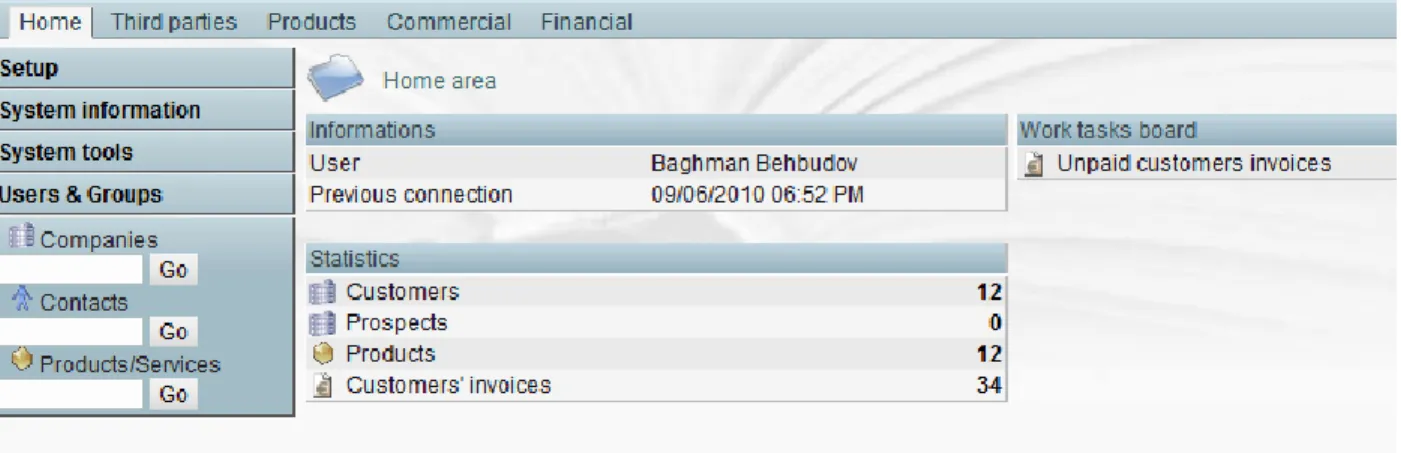
(49) and a large number of downloads (more than 1000 weekly downloads) [33]. Beyond that, Dolibarr ERP/CRM is one of those ERP systems where everything is centralized in a single, simple and flexible enterprise management system. CHARACTERISTICS. DOLIBARR ERP/CRM. -Architecture. Apache,MySQL,PHP. -Size. Small and Medium. -Customization Complexity. Simple to develop and customize. -Functionality and modules. Rich. -Products and services management. Yes. -Stock management. Yes. -Bank account managements. Yes. -Invoices managements. Yes. -Orders managements. Yes. -Payments managements. Yes. -Shipping management. Yes. -Emailings. Yes. -User Interface. Simple, clear. -Programming Language. PHP. -Scalability. Yes. -DB independence. Yes. -Development Activity. Yes. -Development status. Stable. -Integration. Yes. -Migration. Yes. -Localizable. Yes. -Community forum. Yes. Table 2: Dolibarr ERP/CRM characteristics Dolibarr ERP/CRM - Enterprise Resource Planning and Customer Relationship management (Figure 4) is software built by modules addition that allows to enable the needed features that can be used to manage small or medium companies, freelancers or foundations [34]. We can say Dolibarr is an ERP or CRM, depending on which modules we want to activate.. 33.
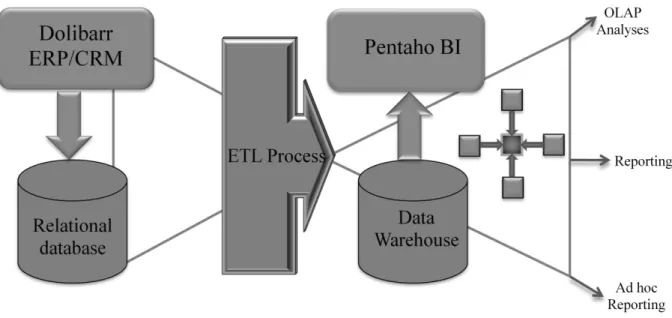
(50) Figure 4: Dolibarr ERP/CRM Dolibarr is an Open Source project built on a WAMP, MAMP or LAMP server (Apache, Mysql, and PHP for all Operating Systems). According to [34] the main difference between Dolibarr and other ERP or CRM software (such as Tiny ERP, ERP5, OpenBravo, OpenERP, Neogia, Compiere, etc) is that full packet was created to be simpler in all steps being simple to install, to use and to develop. Dolibarr is a full package with auto-installers. Any new users can install Dolibarr and its core architecture (Apache, Mysql, PHP) without any technical knowledge. So it makes exploitation easier. Dolibarr is designed for users looking to find software to manage activity of their company or foundation, easily and everywhere. Modularity of Dolibarr allows having software that fits our needs. As indicated above, Dolibarr ERP/CRM has several modules which can be activated that include: products and services catalog, stock management, bank account managements, customers, prospects and suppliers management, invoices managements, orders managements, payments managements, shipping management among others. 5.1.2. Pentaho BI The search we made of the available OS BI on the market has identified a group of alternatives like Pentaho BI, Japersoft, Openi, SpagoBI. From these available solutions we decide to choose Pentaho BI as it offers a full set of functionalities to implement our project (Table 3). However, this software has a large community of users and a high number of downloads.. 34.
(51) CHARACTERISTICS License. PENTAHO BI Several components: GPL 2, LGPL, MPL (Mozilla Public License) J2EE, CAS, ACEGI, JBoss Portal. Technology Database Environment Programming Language. Reporting Dashboard Reporting OLAP Analysis Data Mining Data Integration ETL Alerts Repository Localized & internationalized Ease of use. JDBC, MySQL , Firebird/InterBase, IBM DB2, Microsoft SQL Server, Oracle, PostgreSQL (pgsql) Java, JavaScript, JSP, XSL (XSLT/XPath/XSL-FO) Yes Yes Yes Yes Yes Yes Yes Yes Yes Yes Yes Medium. Export formats Web capabilities. PDF, HTML, XLS, RTF, text Admin, report retrieval, parameter support, drill-through, hypertext links. Report designing. Visual report designer. Modifiable system Desirable platform Installation. Yes Yes Easy. Scalability. Very Scalable, easy to embed into our architecture. Community activity. Rich. Downloads. 6700 downloads a week. Note: Information is taken from the Pentaho‘s official web site and Source Forge. Table 3: Pentaho BI selection criteria Pentaho BI is open source BI suite that can be installed on Windows or Linux. Pentaho BI combines applications for reporting, analysis, dashboards, data mining and business intelligence platform. Pentaho BI includes various components that can be used as a suite or as a stand-alone application [36]:. 35.
(52) . Pentaho BI platform provides the architecture and infrastructure required to build BI solutions, providing core services like authentication, logging, auditing, workflow, web services, and rules engines. It is the platform that integrates reporting, analysis, dashboards and data mining components to form a sophisticated and complete BI platform;. . Pentaho Data Integration (Kettle): provides the tool for the Extract, Transform, and Load (ETL) processes and it is generally used in data warehouses environments;. . Mondrian: an OLAP server that enables to analyze datasets stored in SQL databases using a multidimensional format to present results.. . Pentaho Reporting: provides tolls for the creation, generation and distribution of reports;. . Weka: provides a set of tools for machine learning and data mining. Pentaho also includes a collection of editors, viewers and administration modules that. provides a graphical user interface to facilitate the interaction with Pentaho components, like for example, the Pentaho Administration Console that provides a centralized administration that allows Pentaho deployments. This console holds many administrative tasks like managing databases connections (Figure 5).. Figure 5: Pentaho Administration Console. 36.
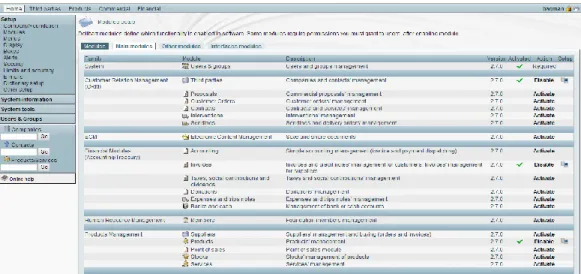
(53) 5.2. Implementation As previously described we have chosen open source Dolibarr ERP/CRM and open source Pentaho Business Intelligence to make an integrated system of these tools. The architecture of the implemented system is presented in figure 6. In this architecture, the relational database of Dolibarr ERP/CRM is accessed and transformed into a new format to be stored in the data warehouse through ETL process. Based on the data stored in the Data Warehouse, the OLAP tools are used to generate reports and analyses.. Figure 6: System model. Dolibarr ERP/CRM software has a single database that contains all data for various modules available like products, stocks, customer orders and invoices among others. Different modules of Dolibarr ERP/CRM can be activated to define which functionality is enabled in software (Figure 7).. 37.
Imagem
![Figure 1: Average cost per user, comparing traditional and open source across scenarios [7]](https://thumb-eu.123doks.com/thumbv2/123dok_br/14946858.1003065/20.918.273.632.154.350/figure-average-cost-user-comparing-traditional-source-scenarios.webp)


+7


Documentos relacionados
Este estudo quantitativo, descritivo e transversal, permitiu avaliar o nível de dependência da pessoa com doença respiratória da RAM, através da aplicação da EDC-R,
Para este estudo, a satisfação profissional baseia-se no modelo ASH, proposto por Quijano e Navarro (1999), o qual compreende as variáveis: retribuição (salário e forma de
possíveis de executar recorrendo à técnica de reflexão (reflection), sendo posteriormente adicionada a mesma camada de controlo de acesso disponível para os web services; e,
Diante desse contexto, da importância da capacitação de professores de escolas públicas brasileiras por meio de um programa de mestrado profissional em matemática e da
The mean protein concentration amongst seeds was 24.4% and the highest measured varieties (with values above the mean) were Du Puy, Kleine Schwarze, Rosana, Flora, Große Rote,
Entretanto, passados mais de dez anos do início das ofertas de cursos pela Universidade Aberta do Bra- sil na UFSM, os resultados dessa modalidade de ensino têm sido pouco
ANDREY ROGÉRIO CAMPOS GOLIAS(UNINGÁ)¹ JORGE LUIZ GRABOWSKI(UNINGÁ)¹ RESUMO: O seguinte artigo te como objetivo, traçar o perfil dos pacientes atendidos no Setor de Ortopedia
