COVER CROPS AND NITROGEN FERTILIZATION - NUTRITIONAL ASPECTS AND AGRONOMIC PERFORMANCE OF MAIZE GROWN IN SUCESSION
Abstract – Cover crops can contribute differently to the supply of nitrogen to
crops. The objective was to evaluate the response of maize to nitrogen doses (0, 70, 140, 210 and 280 kg ha-1) when grown in succession to cover crops (vetch, forage
turnip, black oat, ryegrass and fallow). The randomized block experimental design was used, with subdivided plots and four replications. Cover crops were allocated into plots, and N doses into sub-plots. As to cover crops, the aspects evaluated were phytomass production, N content and total accumulated; with regard to maize, the aspects evaluated were SPAD (Soil Plant Analysis Development) index, leaf N content, total grain protein, yield and agronomic efficiency of N. Black oat, ryegrass and forage turnip presented higher phytomass production. All species had similar results as to the total N accumulated in the aerial part (average value of 91.06 kg ha-1). In succession to black oat, ryegrass and fallow period, N
doses up to 140 kg ha-1 applied in maize result in higher yield and better agronomic
efficiency of nitrogen use. Without application of nitrogen (0.0 kg ha-1), forage
turnip and vetch provided higher total protein content in the grain, yield over 8,550 kg ha-1, and less agronomic efficiency of nitrogen use.
Keywords: Green manuring, nitrogen availability, agronomic efficiency.
PLANTAS DE COBERTURA E ADUBAÇÃO NITROGENADA – ASPECTOS NUTRICIONAIS E DESEMPENHO AGRONÔMICO DO MILHO EM SUCESSÃO
Resumo - Plantas de cobertura podem contribuir diferenciadamente no
suprimento de nitrogênio para as culturas. Objetivou-se avaliar a resposta do milho a doses de nitrogênio (0, 70, 140, 210 e 280 kg ha-1) cultivado em sucessão
a plantas de cobertura (ervilhaca, nabo forrageiro, aveia-preta, azevém e pousio). Utilizou-se o delineamento experimental de blocos casualizados com parcelas subdivididas, e quatro repetições. Nas parcelas, alocou-se as plantas de cobertura, e nas subparcelas, as doses de N. Avaliou-se, nas plantas de cobertura, a produção de fitomassa, teor e N total acumulado; no milho, o índice SPAD, teor foliar de N, proteína total no grão, produtividade e eficiência agronômica de N. A aveia preta, azevém e nabo forrageiro apresentaram maior produção de fitomassa. Todas as espécies foram similares quanto ao N total acumulado na parte aérea (valor médio de 91,06 kg ha-1). Em sucessão à aveia preta, azevém e pousio,
doses até 140 kg ha-1 de N no milho resultam em maior produtividade e melhor
eficiência agronômica do uso do N. Sem a aplicação de nitrogênio (0,0 kg ha-1),
nabo forrageiro e ervilhaca proporcionaram maior teor de proteína total no grão, produtividade superior a 8.550 kg ha-1 e menor eficiência agronômica do uso do N.
Palavras-chave: Adubação verde, disponibilidade de nitrogênio, eficiência
agronômica. Romano Roberto Valicheski1( ), Sihelio Júlio
Silva Cruz1, Jordano Gilberto Eger2, Sidinei Leandro Klockner Sturmer2, Fabricio Flávio Amler2 and Felipe José Estevão2.
(1) Instituto Federal Goiano – Campus Iporá, Iporá, GO.
E-mail:[email protected], [email protected].
(2) Instituto Federal Catarinense – Campus Rio do Sul, Rio do Sul, SC.
E-mail:[email protected], [email protected], [email protected], [email protected]. Corresponding author How to cite
VALICHESKI, R. R.; CRUZ, S. J. S.; EGER, G. J.; STURMER, K. L. S.; AMLER, F. F.; ESTEVÃO, J. F. Cover crops and nitrogen fertilization - Nutritional aspects and agronomic performance of maize grown in sucession. Revista Brasileira de Milho e Sorgo, v. 19, e1095, 2020.
Brazilian Journal of Maize and Sorghum ISSN 1980 - 6477
their stubble, associated with the presence of high solubility compounds, favors the rapid mineralization and decomposition of that phytomass, thus contributing to N input into the soil-plant system (Ferreira et al., 2011; Partelli et al., 2011; Costa et al., 2017). For producers with low investment in agroecological or organic inputs, the use of leguminous plants can supply all the nitrogen required to obtain maize yield over 6,000 kg ha-1 (Lázaro et al., 2013). On the other
hand, the use of grass plants such as black oat and ryegrass, which have a vigorous root system and are efficient in the process of nutrient recycling and immobilization in their phytomass (with high C:N ratio), can contribute to reduce the loss of nitrogen, since, due to the slow mineralization of stubble, they delay its availability for the crop in succession, thus providing more physical protection to the soil (Costa et al., 2017).
Therefore, the use of those vegetal species generates a differentiated potential in N supply for the crop in succession. This can significantly influence the yield of maize (Silva et al., 2007; Lázaro et al., 2013), which requires great amounts of nitrogen (around 1.5% to 3.0% of the total plant dry matter) and its deficiency may reduce grain yield and quality (Rambo et al., 2011).
Indicators such as N content in index leaf (França et al., 2011) and relative chlorophyll content - SPAD index (Rambo et al., 2011; Barros et al., 2017) have been used in maize cultivation, aiming at optimizing the nitrogen amount to be applied. Of those, efforts have been dedicated to standardizing methods that allow indirect In Santa Catarina, there is a predominance
of small agricultural properties, where the family agriculture represents more than 90% of the rural population, with farms smaller than 50 hectares (EPAGRI, 2019). Taking into account the climate characteristics and adaptation to the region, according to Valicheski et al. (2012), among the cover crops that are most used by those producers in soil conservation management systems, we can point out the ryegrass (Lolium multiflorum), black oat (Avena strigosa), common vetch (Vicia
sativa) and forage turnip (Raphanus sativus).
According to those authors, these species are cultivated in winter with the purpose to produce phytomass, aiming at soil protection and nutrient cycling, and later, due to the process of decomposition of those residues, provision of nutrients (mainly nitrogen) for the subsequent crop, especially maize.
Maintenance of an organic residue layer on the soil surface, associated with minimum soil revolving and plant root system effect, has enabled the enrichment of organic matter on the most superficial soil layer, thus contributing to the supply of nutrients to the plants, especially phosphorus, sulphur and nitrogen (Heinz et al., 2011; Partelli et al., 2011; Büchi et al., 2015). In addition to that, it plays a significant part in the maintenance of soil moisture (Gabriel et al., 2017).
Among the vegetal species used in conservationist systems, leguminous plants stand out due to the fact that they act in symbiosis with N2-fixing bacteria. The low C:N ratio of
Instituto Federal Catarinense - Campus Rio do Sul - SC. According to the Köppen climate classification, the region presents Humid Mesothermal climate - Cfa (no dry season), with average temperature of 19.2 oC and annual
precipitation of 1,300 to 1,400 mm. According to data provided by the Institution’s weather station, the volume of precipitation recorded from maize sowing to harvesting was 553 mm, well distributed along the crop cycle, which is considered normal for the period in that region.
The type of soil in the experimental area is dystrophic Tb Haplic Cambisol, with the following chemical attributes in the 0.0 – 0.20m deep layer: clay (270 g kg-1); organic matter
(33 g kg-1); pH in water 5.5; SMP index 5.7;
exchangeable Ca, Mg and Al (extracted with 1mol L-1 KCl) of 5.6, 2.7, and 0.0 cmolc/dm3,
respectively; P available and K exchangeable (both extracted with Mehlich-1) of 12.6 and 66.0
mg/dm3; pH 7.0 CEC of 12.1 cmolc/dm3; and
base saturation of 67.2%.
The treatments consisted of cover crop species (vetch - Vicia sativa, forage turnip –
Raphanus sativus, black oat - Avena strigosa,
ryegrass - Lolium multiflorum, besides an area left fallow) in plots (17.5m x 7.5m). Doses of nitrogen (0, 70, 140, 210 and 280 kg ha-1) were
applied in sub-plots (3.5m x 7.5m).
The randomized block experimental design was used, with subdivided plots and four replications.
The broadcast seeding of cover crops was done manually on June 14, 2016, followed by values to be obtained with the use of chlorophyll
content meters since they are fast, simple and not destructive. Research works have demonstrated the relation between values obtained by the chlorophyll meter and leaf chlorophyll content (Rambo et al., 2011; Barros et al., 2017). Therefore, for determining the nitrogen level in maize plants, chlorophyll meter readings higher than 45.4; 52.1; 55.3 and 58.0 for stages of three to four leaves, six to seven leaves, 10 to 11 leaves and silking, respectively, represent proper nitrogen levels (Argenta et al., 2003).
For Mascarello & Zanão Júnior (2015), nitrogen is one of the nutrients that have more expressive effects in maize yield increase, thus influencing leaf N content (Minato et al., 2017), grain protein content (Mascarello & Zanão Júnior, 2015), crude protein concentration, and shoot dry mass yield for silage (Damian et al., 2017). Therefore, taking into consideration that in Santa Catarina there is a predominance of small-scale farmers, who cultivate maize with the intention to use it to feed the animals, it becomes relevant to know the contribution of the main cover crops used regarding their nitrogen supply potential, as well as the influence of those species in grain yield and total protein content.
The purpose of this work was to assess the maize response to nitrogen fertilization, when cultivated in succession to different cover crops.
Material and Methods
When plants were in the phenological growth stage V5 (5th leaf fully developed), nitrogen doses were manually applied in top-dressing fertilization, using urea as source of nitrogen. To minimize losses by denitrification, nitrogen fertilizer was distributed at sunset (approximately 15 hours after a 19 mm precipitation), with the soil moisture close to its field capacity. Regardless of the tested dose, application was carried out only once. For weed control, three sprayings were carried out using glyphosate-based herbicide at doses of 1.5 kg ha-1, with the first being done when maize plants
were in stage V3, the second in stage V8, and the third in stage V12, corresponding, respectively, to the 3rd, 8th, and 12th leaf fully developed. All sprayings were performed manually with the use of a backpack sprayer.
When the plants were in full flowering period (collection 1) and 21 days later (collection 2), the relative chlorophyll content (SPAD index) was specified in the leaf below ear (index leaf). A Konica Minolta chlorophyll meter – model 502 was used to provide readings in five plants of each experimental sub-plot. The readings (two per plant leaf-1) were taken at two centimeters from
the leaf margin and, as of the base, between half and two thirds of the leaf length, as suggested by Argenta et al. (2001). After that, the index leaves of five plants were collected in each sub-plot, discarding the midrib, for determining the leaf nitrogen content. The collected material was then placed within a paper bag and subjected to drying in oven with forced air circulation (65 - 70o C),
a light harrowing to cover the seeds. Seeds of black oat, ryegrass, forage turnip and vetch were distributed in the amounts of 65, 25, 25 and 40 kg ha-1, respectively.
During the growing period of cover crops, invasive plants were manually removed on all experimental plots, including the area left fallow. On September 23, 2016, when the plants were at the beginning of grain-filling stage, the aerial part was collected and fresh mass was determined. Subsequently, the dry mass was determined after oven drying at 60o C until constant weight was
achieved. After that, the material was crushed in a Wiley type knife mill, and then placed into plastic packaging until it was taken for analysis. On October 6, 2016, cover crop species were desiccated, with the application of granular glyphosate - based herbicide at doses of 2.5 kg ha-1.
Due to the constant rainfall that occurred in the region, maize sowing (cultivar 32R22 YHR) was done on November 3, 2016 (28 days after dessication), with the use of a SEED MAX seeder-fertilizer. Eight rows were sown per block with spacing of 0.75m between rows, and distribution of 5.4 seeds per linear meter of furrow, in a total of 72,000 seeds ha-1. Fertilization was specified
in compliance with the recommendation from the Soil Chemistry and Fertility Commission - CQFS-RS/SC (2016) for an estimated yield of 8,000 kg ha-1, with a fertilizer obtained from a
mix of potassium chloride (80 kg ha-1 of K 2O)
+ triple superphosphate (120 kg ha-1 of P 2O5),
the factor 6.25 was used, as recommended by Villegas et al. (1985).
Also, the agronomic efficiency of using nitrogen applied was determined for each treatment. For that, the methodology described by Fageria & Baligar (2005) was followed, with the application of Equation 1:
Where: EA is the agronomic efficiency expressed in kg kg-1; PGcf is the production
of grains obtained with application of nitrogen fertilizer; PGsf is the production of grains without nitrogen fertilizer; and QNa is the quantity of nitrogen applied in kg.
After tabulation, data were submitted to analysis of variance, using the SASm Agri statistical package to verify whether there was or not effect of the treatments at 0.05 probability level. When significant, qualitative treatments were compared through Tukey’s test (p<0.05); quantitative treatments were compared through linear or polynomial regression models, depending on the case.
Results and Discussion
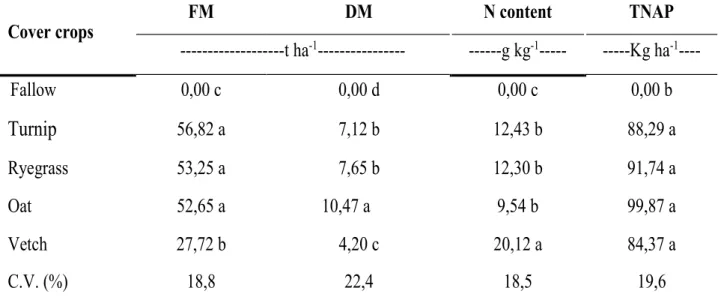
All cover crop species were promising as to the production of fresh mass by the aerial part (Table 1). However, forage turnip, black oat and ryegrass were statistically superior when compared to vetch. The greater fresh mass production of those species is due to their higher precocity, because in the harvest period, they
until constant weight was achieved. After that, the material was crushed in a Wiley type mill, equipped with stainless steel knives and sieves (2 mm mesh), and placed into plastic packaging until it was taken for analysis.
Harvest was carried out from the 21st to the 28th of March, 2017. In each experimental unit, in the four central cultivated rows, one linear meter was harvested, in a total of 4 linear meters. Also, the collected plants were counted in order to determine the final stand density in each treatment. Later, ears were threshed with the use of a Trapp DM 50 electric maize thresher, and grain mass was determined for each treatment with the use of a precision scale. After that, grain moisture was determined with the use of a Gehaka G810 STD moisture meter. Yield was estimated for each treatment based on grain dry mass, considering the final moisture of 13.0%. One sample of grain mass was collected from each plot, then placed into a paper bag and subjected to drying (65 - 70o C) in oven with forced air
circulation during approximately 24 hours. Those samples were crushed in a Wiley type mill, and passed through a sieve with 0.42mm mesh. The fine powder generated was collected and placed into plastic packaging, remaining stored until it was taken for analysis.
The methodology described by Tedesco et al. (1995) was followed for sulfuric acid digestion of the material collected (samples from the aerial part of cover crop species, leaves and crushed maize grains), as well as for determining total nitrogen content. For conversion to crude protein,
nitrogen content in the vetch phytomass is associated with its efficient symbiotic association with bacteria already present in the soil, thus becoming an important alternative when the target is nutrient cycling and soil nitrogen supply (Büchi et al., 2015). Regardless of the cover crop specie, with the process of nitrogen cycling and/or biological nitrogen fixation, the average accumulation of 91.06 kg ha-1 of nitrogen in the
phytomass of aerial part was possible. Considering an average maize yield of 8,146 kg ha-1, expected
for SC in the 2018/2019 crop season (EPAGRI, 2019), and the chemical conditions of soil, which is low weathered and presents medium to high fertility in more than 70% of the areas suitable for agriculture in the state, that amount of nitrogen is sufficient to meet the whole crop demand. In this context, results indicate that the plant species are efficient in the production of residues for stubble build-up (in the case of forage turnip, black oat and ryegrass), as well as in the nitrogen input to the system (in the case of vetch). Therefore, their cultivation must be encouraged, mainly in areas that are left fallow during winter.
With respect to nitrogen nutrition indexes in maize plants in collection 1 (full silking), there was no effect of the tested factors, with average values of 62.4 for SPAD index and 23.02 g kg-1
for leaf N content. As to collection 2 (21 days later), there was significant effect (P<0.01) of the factors on those variables, as well as on their interaction, which is considered in the discussion. Regardless of the cover crop or fallow period, there was a quadratic response for SPAD
were in full grain-filling stage, while the vetch was only at the beginning of flowering. That fact also influenced the shoot dry mass, with a greater production being observed for black oat, followed by forage turnip and ryegrass (which do not differ from each other), but were statistically superior to vetch. Although the dry mass yield was over 4.0 t ha-1 for all plant species, the black oat was more efficient, showing a production of 47.0, 36.8, and 149.3 % superior when compared to forage turnip, ryegrass and vetch, respectively. Despite the fact that the ryegrass and the black oat belong to the same family, the oat superiority can be associated with its higher fiber content, since it presented a visibly more advanced phenological stage in the harvest period. When comparing the results for shoot dry mass obtained in this work with those already published by Lázaro et al. (2013) for black oat (4.24 t ha-1), by Silva
et al. (2007) for forage turnip (4.7 to 5.7 t ha-1)
and by Aita et al. (2001) for vetch (2.7 t ha-1),
it can be observed that those plant species were very promising and can be excellent options for producers in the region of Alto Vale do Itajaí-SC, when the objective is to protect the soil and produce plant residues for stubble formation.
With regard to nitrogen content, despite having presented lower phytomass production, the vetch had almost double the amount of nitrogen in its plant tissue, which results in total N accumulated in the aerial part similar to the amount determined for forage turnip, black oat and ryegrass (Table 1). Although seed inoculation with rhizobium was not carried out, the high
Reduced response to nitrogen doses in succession to vetch and forage turnip can be associated with the rapid mineralization of their stubble (Aita et al., 2001), which results in a higher nitrogen supply to maize, when compared to the other treatments. For Argenta et al. (2013), a higher nitrogen supply facilitates chlorophyll formation in the plant, thus causing increase of SPAD index values until the dosage in which the nitrogen is not limiting its formation. That may possibly have occurred with doses over 70 kg ha-1
when in succession to forage turnip and vetch, and doses over 140 kg ha-1 when in succession to
black oat, ryegrass and fallow period.
With respect to leaf N content as a result of nitrogen fertilization, there was a quadratic response after vetch crop and a maximum value index in relation to nitrogen applied doses (Table
2). According to models, when in succession to forage turnip and vetch, maximum values of 55.5 and 55.1 of SPAD index are obtained, with application of 170 and 216 kg of nitrogen per hectare. When in succession to grass plants (black oat and ryegrass) and fallow period, maximum values of 55.8, 58.8 and 56.8 are obtained, with application of 224, 228 and 193 kg of N ha-1,
respectively. Despite the fact that the maximum value for SPAD index is reached at those nitrogen doses, when in succession to vetch and forage turnip, there was significant response only until application of 70 kg ha-1. When in succession to
black oat, ryegrass and fallow period, significant response was observed until application of 140 kg of nitrogen per hectare.
Table 1. Fresh and dry mass produced by the aerial part, nitrogen content and total nitrogen
accumulated in the phytomass of winter cover crops. Rio do Sul, SC, 2016/2017.
Means followed by the same letter in the column do not differ as per Tukey’s test (>0.05). FM – Fresh Mass, DM – Dry Mass, TNAP –Total Nitrogen accumulated in the Aerial Part, C.V. – Coefficient of Variation. NC - Nitrogen content.
Cover crops FM DM N content TNAP
---t ha-1--- ---g kg-1--- ---Kg ha-1---- Fallow 0,00 c 0,00 d 0,00 c 0,00 b
Turnip
56,82 a 7,12 b 12,43 b 88,29 a Ryegrass 53,25 a 7,65 b 12,30 b 91,74 a Oat 52,65 a 10,47 a 9,54 b 99,87 a Vetch 27,72 b 4,20 c 20,12 a 84,37 a C.V. (%) 18,8 22,4 18,5 19,6aerial parts (Table 1), as well as their chemical composition (high C:N ratio), which facilitates the proliferation of soil microorganisms that act in its decomposition (Partelli et al., 2011; Pereira et al., 2016), thus causing the temporary immobilization of part of the nitrogen available (Mascarello & Zanão Junior, 2015).
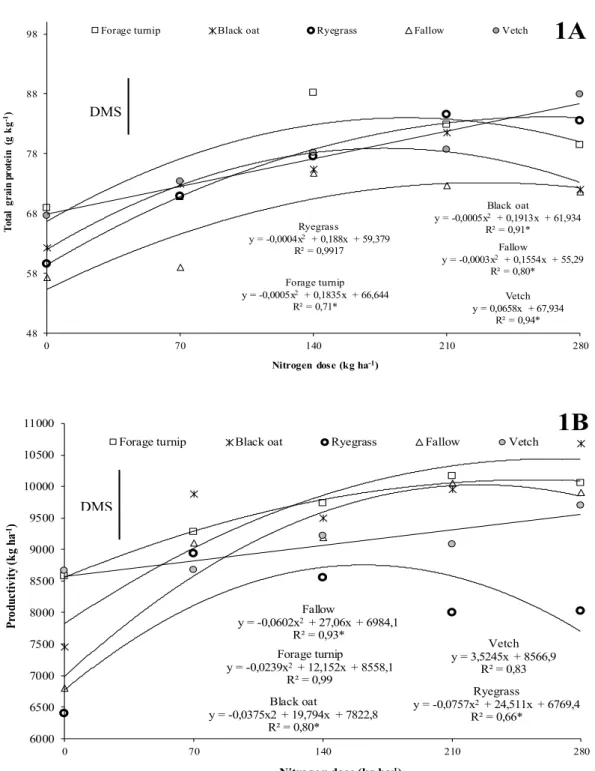
Both the cover crops and the doses of nitrogen significantly influenced total grain protein content (Figure 1 A) and maize yield (Figure 1B). In regard to doses of nitrogen, when in succession to vetch, there was a linear response, where the increment of 70 kg ha-1 in the dose of
nitrogen applied results in an increase of 4.6 g kg-1 in total grain protein content and of 246.7
kg ha-1 in yield. Despite that linear behavior with
increase in the amount of nitrogen supplied, there was only significant response with application of 280 kg ha-1 for the grain protein content, which
indicates the poor maize response to the nitrogen fertilization when in succession to vetch.
When in succession to forage turnip, black oat, ryegrass and fallow period, there was a quadratic response as a result of nitrogen doses for both variables. For total grain protein content, there was a significant increase up to the dose of 140 kg ha-1 of nitrogen (Figure 1A) and for yield,
up to 70 kg ha-1 of nitrogen, except for forage
turnip, which did not present significant response to the doses of nitrogen (Figure 1B).
According to models obtained for total grain protein content, after forage turnip, the maximum value was 83.5 g kg-1, with application
of 184 kg ha-1 of nitrogen. After fallow period, it of 27.07 g kg-1 was obtained, with application
of 184 kg ha-1 of nitrogen (Table 2). However,
despite that behavior, significant response was observed only until the application of 70 kg ha-1
of nitrogen. When in succession to forage turnip, black oat, ryegrass and fallow period, there was linear response and the maximum point was not reached with the tested doses. According to models obtained for those treatments, every increment of 70 kg ha-1 in applied nitrogen
produces an increase of 0.57 g kg-1 of nitrogen
in the leaf tissue when in succession to forage turnip; of 4.06 and 4.10 g kg-1 when in succession
to black oat and ryegrass; and of 1.99 g kg-1 when
after a fallow period.
Taking into account that maize sowing was carried out 28 days after dessication and that, according to Heiz et al. (2011), the forage turnip releases more nitrogen in a period of up to 30 days after its management, there was an increased nitrogen supply when compared with black oat, ryegrass and fallow period, thus resulting in a reduced response to doses of nitrogen applied in top dressing. Due to this fact, it is considered, along with vetch, a plant species of relevant importance when the target is the supply of nitrogen to the crops, nutrient cycling (Da Costa et al., 2017) or nitrogen input into soil through biological fixation process, in the case of vetch (Büchi et al., 2015). On the other hand, the significant response to nitrogen fertilization after black oat and ryegrass (7 times more than the forage turnip) can be associated with the increased stubble mass produced by their
of using cover crops during winter.
The maximum grain yield for forage turnip, black oat, ryegrass and fallow was 10.102; 10.434; 8.753 and 10.147 kg ha-1, which was
obtained with application of 254; 264; 161 and 229 kg ha-1, respectively. When in succession to black
oat, ryegrass and fallow period, although there was an increase with application of high doses of nitrogen on top dressing, it was significant only up to the supply of 70 kg of nitrogen per hectare. Maize cultivation after forage turnip and vetch did not present significant effect of the doses of nitrogen, which suggests that the nitrogen produced in the process of decomposition and was 75.4 g kg-1, with 260 kg ha-1 of nitrogen. After
black oat and ryegrass, it was 80.2 and 86.5 g kg -1, obtained with 190 and 236 kg ha-1 of nitrogen,
respectively. Regardless of the treatments, total grain protein content varied from 57.3 to 88.4 g kg-1, within the average interval for that cereal
(Silva et al., 2005). In succession to fallow period, the higher dose of nitrogen applied to reach the maximum protein content in the grain can be associated with higher losses of nitrogen by leaching and/or denitrification, since the lack of stubble on the soil surface and absence of roots in the fallow period may have facilitated this process, which emphasizes the importance
Table 2. SPAD index and leaf N content of maize, 21 days after full flowering (collection 2), as a
result of cover crops, fallow period and nitrogen doses (0, 70, 140, 210 and 280 kg ha-1) applied
in maize top-dressing. Rio do Sul, SC, 2016/2017.
CC 0 70 140 210 280 Regression Model R2
---SPAD index---
Ft. 45,7 Ab 53,4 Aa 55,7 Aa 55,0 Aa 54,6 Aa y = -0,0004x2 + 0,1357x + 43,912 0,94**
Bo. 43,0 Bc 50,5 Ab 55,9 Aa 53,3 Aab 54,9 Aab y = -0,0002x2 + 0,0898x + 45,767 0,88**
Rg. 42,7 Bb 52,1 Ab 56,0 Aa 55,7 Aa 55,6 Aa y = -0,0003x2 + 0,1367x + 43,235 0,97*
F. 41,5 Bc 52,4 Ab 54,2 Aab 59,1 Aa 55,1 Aab y = -0,0004x2 + 0,1543x + 41,945 0,97*
Ve. 49,8 Ab 55,1 Aa 55,8 Aa 52,4 Aab 55,6 Aa y = -0,0001x2 + 0,0409x + 50,927 0,33
---Leaf N content (g kg-1)---
Ft. 22,62 Aa 22,9 ABa 24,1 ABa 24,24 Aa 24,65 Aa y = 0,0077x + 22,647 0,90*
Bo. 15,22 Cc 23,6 ABb 22,05 Bb 24,91 Aab 27,04 Aa y = 0,032x + 18,094 0,62*
Rg. 16,1 BCd 21,61 BCc 22,87 Bbc 25,72 Aab 26,87 Aa y = 0,0366x + 17,513 0,93**
F. 20,13 Ab 19,2 Cb 24,1 ABa 24,27 Aa 27,58 Aa y = 0,0285x + 19,068 0,86*
Ve. 19,3 ABb 25,89 Aa 26,88 Aa 25,88 Aa 27,11 Aa y = -0,0002x2 + 0,0747x + 20,044 0,85*
Means followed by the same small letter (row) and capital letter (column) do not statistically differ as per Tukey’s test at 5.0%. CC – cover crops, Ft. – forage turnip, Bo. – black oat, Rg. – ryegrass, Ve. – vetch, and F – fallow.
Revista Brasileira de Milho e Sorgo, v.19, e1095, 2020 DOI: https://doi.org/10.18512/1980-6477/rbms 2020.v19.e1095
Forage turnip y = -0,0005x2 + 0,1835x + 66,644 R² = 0,71* Black oat y = -0,0005x2 + 0,1913x + 61,934 R² = 0,91* Ryegrass y = -0,0004x2 + 0,188x + 59,379 R² = 0,9917 Fallow y = -0,0003x2+ 0,1554x + 55,29 R² = 0,80* Vetch y = 0,0658x + 67,934 R² = 0,94* 48 58 68 78 88 98 0 70 140 210 280 Tot al g rai n p rot ei n (g k g -1) Nitrogen dose (kg ha-1)
1A
Forage turnip Black oat Ryegrass Fallow Vetch
Forage turnip y = -0,0239x2+ 12,152x + 8558,1 R² = 0,99 Black oat y = -0,0375x2 + 19,794x + 7822,8 R² = 0,80* Ryegrass y = -0,0757x2+ 24,511x + 6769,4 R² = 0,66* Fallow y = -0,0602x2+ 27,06x + 6984,1 R² = 0,93* Vetch y = 3,5245x + 8566,9 R² = 0,83 6000 6500 7000 7500 8000 8500 9000 9500 10000 10500 11000 0 70 140 210 280 Pr od uc tiv ity (k g ha -1) Nitrogen dose (kg ha-1)
1B
Forage turnip Black oat Ryegrass Fallow Vetch
Figure 1. Total grain protein (1A) and maize yield (1B) as a result of cover crops, fallow period and nitrogen doses (0, 70, 140, 210 and 280 kg ha-1) applied in maize top-dressing. Rio do Sul, SC, 2016/2017.
DMS – Least significant difference. DMS
a slow and synchronized way, according to the needs of plants.
Taking into account that the cover crops did not differ as to the amount of nitrogen accumulated in the phytomass, this difference is possibly associated with the amount of stubble produced by the aerial part (Table 1) and its chemical composition, with high C:N ratio in grass plants when compared with leguminous and cruciferous plants. In addition to that, those plant species present great quantity of soluble compounds in their phytomass, favoring a rapid decomposition and mineralization of stubble, and consequently contributing with a significant input of nitrogen into the soil-plant system (Ferreira et al., 2011; Partelli et al., 2011), which resulted in a better provision of nitrogen for maize plants, and consequently, a higher total grain protein content and yield.
For Silva et al. (2007), when there is no supply of nitrogen fertilization, higher yields are obtained for crops in succession to forage turnip or leguminous plant. Therefore, under such conditions, the use of a leguminous plant as the preceding crop increases maize yield (Santos et al., 2010). With regard to grass plants, although they provide less availability of nitrogen for plants, and consequently more immobilization in their phytomass, they present higher stubble production and lower decomposition rate which results in a topsoil cover that lasts for a longer period (Lázaro et al., 2011). Therefore, grass plants become of great relevance when it comes to nutrient cycling and soil protection.
mineralization of the phytomass of those plant species was sufficient to meet crop demand.
Taking into account that maize sowing was carried out 28 days after dessication of cover crops and that, according to Heinz et al. (2011), greater availability of nitrogen occurs in a period of up to 30 days after the aerial part management, by the time when nitrogen doses were applied in maize (stage V5), great part of the nitrogen contained in the phytomass of those plant species had already been released to the crop.
Making a comparison, the maize yield without application of nitrogen (0.0 kg ha-1),
after forage turnip and vetch, was similar to the yield obtained with application of 70 kg ha-1
in succession to black oat, ryegrass and fallow period. In such condition (0 dose), when we compare the total grain protein content and yield obtained after a fallow period (control) and in succession to cover crops, forage turnip provided an increase of 20.2 and 26.2 % and vetch, 17.9 and 27.4 %. After black oat, there was an increase of only 8.6 % in total grain protein content and 9.7 % in yield. After ryegrass there was an increase of 3.7 % in grain protein content and reduction of 5.9 % in yield. This fact demonstrates the capacity of forage turnip and vetch to supply nitrogen for maize cultivation in succession.
For Lázaro et al. (2013), the use of cover crops, mainly leguminous and cruciferous plants, is an efficient way of meeting the nutrional demand of plants concerning nitrogen. They can partially replace the mineral fertilizer, in addition to recycling other elements, releasing them in
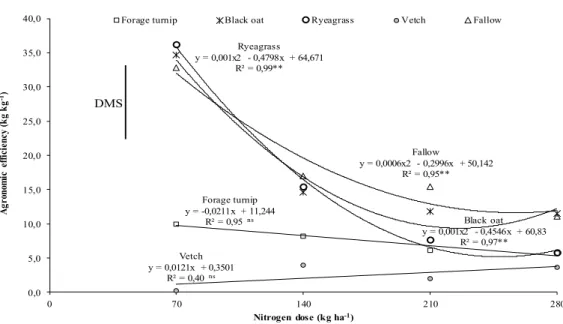
with doses of 140 kg ha-1, production was 14.6,
15.4 and 17.1 kg kg-1, respectively. Therefore,
under these conditions, supply of nitrogen fertilization is necessary, mainly up to 70 kg ha-1. Minimum production values were 9.16 kg
kg-1 after black oat, 7.11 kg kg-1 after ryegrass,
and 12.71 kg kg-1 after fallow period, which were
obtained with application of 227, 240 and 250 kg ha-1 of nitrogen, respectively. Taking into
consideration this decrease in maize response with the increase of the amount of nitrogen applied, and that doses of nitrogen over 120 kg ha-1 are generally recommended in order to
obtain high yield (Coelho et al., 2007), this will not always correspond to the amount that will provide effective gains in terms of agronomic efficiency, which can significantly contribute for loss of this element by leaching or denitrification. In succession to black oat, ryegrass and fallow period, results on agronomic efficiency obtained in this work are in accordance with the results published by Farinelle & Lemos (2010), who, while studying the efficiency of the use of nitrogen by maize in no-tillage and conventional cultivation systems, with doses of 0 to 160 kg ha-1 of nitrogen, reported decreasing utilization
with the increase of doses applied, for both cultivation systems. This reduction is associated with probable losses of ammonia and nitrate by leaching after nitrification process, which were more significant when higher doses were applied. It is of great importance to recognize
that, besides yield increase, there is an increase in grain protein content after cover plants are cultivated (mainly forage turnip and vetch). This can encourage producers to use those plant species, since they have been using this grain, in most of the cases, as one of the main components in animal feeding.
Regarding the agronomic efficiency of the use of nitrogen by maize grown in succession to cover crop species and fallow period, there were two distinct behaviors: one was of poor response to nitrogen fertilization and with no significant effect (after forage turnip and vetch), and the other was of good response, mainly at lower doses of nitrogen applied, after black oat, ryegrass and fallow period (Figure 2). When in succession to vetch, the average value of agronomic efficiency was 2.46 kg kg-1, which
remained stable with the increase of nitrogen doses. Considering forage turnip, the average value was 7.5 kg kg-1. This result reflects in the
capacity and efficiency of those plant species to make nitrogen available for maize through their stubble decomposition and mineralization, which results in lack of or poor response to nitrogen fertilization. On the other hand, after black oat, ryegrass and fallow period, efficiency of nitrogen usage decreased at lower doses applied (70 and 140 kg ha-1), with a tendency to stabilize at higher
doses (210 and 280 kg ha-1). For these treatments,
according to models obtained, grain production with application of nitrogen doses of 70 kg ha-1
fallow period, application of doses of up to 140 kg ha-1 of nitrogen resulted in higher
yield and better agronomic efficiency of the use of nitrogen.
4. Forage turnip and vetch were efficient in regard to the supply of nitrogen for maize. There was no significant response to the tested doses in relation to yield and agronomic efficiency of nitrogen use when in succession to those cover crops.
Conclusions
1. Cover crops were efficient in regard to phytomass production and nitrogen accumulation by the aerial part, acting differently as to nitrogen availability for maize.
2. In the absence of nitrogen fertilization, forage turnip and vetch provided better nitrogen supply for maize, resulting in higher values for SPAD index, leaf N content, total grain protein ande yield over 8,550 kg ha-1.
3. In succession to black oat, ryegrass and
1 Forage turnip y = -0,0211x + 11,244 R² = 0,95 ns Black oat y = 0,001x2 - 0,4546x + 60,83 R² = 0,97** Ryeagrass y = 0,001x2 - 0,4798x + 64,671 R² = 0,99** Vetch y = 0,0121x + 0,3501 R² = 0,40 ns Fallow y = 0,0006x2 - 0,2996x + 50,142 R² = 0,95** 0,0 5,0 10,0 15,0 20,0 25,0 30,0 35,0 40,0 0 70 140 210 280 Ag ro no m ic ef fici en cy (k g kg -1) Nitrogen dose (kg ha-1)
Forage turnip Black oat Ryeagrass Vetch Fallow
DMS
Figure 2. Agronomic efficiency of the use of nitrogen by maize cultivation, as a result of the
preceding cover crop species and nitrogen doses (0, 70, 140, 210 and 280 kg ha-1) applied on top
dressing. Rio do Sul, SC, 2016/2017. DMS – Least significant difference.
F.; SINAJ, S.; RAMSEIER, H.; CHARLES, R. Accumulation of biologically fixed nitrogen by legumes cultivated as cover crops in Switzerland. Plant and Soil, v. 393, n. 1, p.
163-175, 2015. DOI:
10.1007/s11104-015-2476-7.
COELHO, A. M. Manejo da adubação
nitrogenada na cultura do milho. Sete
Lagoas: Embrapa Milho e Sorgo, 2007. 11 p. (Embrapa Milho e Sorgo. Circular Técnica, 96).
COSTA, P. F.; OLIVEIRA, P. S. R.; PIANO, J. T.; TAFFAREL, L. E.; ARRÚA, M. A. M.; SARTO, M. V. M.; FRÓES, C. Q.; FERNANDES, S. S. L. Dry matter production, chemical composition and nutrient accumulation in winter crops. African Journal of Agricultural Research, v. 12, n. 29, p.
2421-2426, 2017. DOI: 10.5897/AJAR2016.11942.
DAMIAN, J. M.; DA ROS, C. O.; SILVA, R. F. da; COLDEBELLA, I. J.; SIMON, D. H. N, P or K doses on the dry matter and crude protein yield in maize and sorghum for
silage. Pesquisa Agropecuária Tropical, v.
47, n. 1, p. 53-61, 2017. DOI: 10.1590/1983-40632016v4742722.
ELIAS, H. T. Milho. Boletim Agropecuário, n. 68, p. 13-20, 2019.
FAGERIA, N. K.; BALIGAR, V. C. Enhancing nitrogen use efficiency in crop plants.
Advances in Agronomy, v. 88, p. 97-185,
2005. DOI: 10.1016/S0065-2113(05)88004-6.
References
AITA, C.; BASSO, C. J.; CERRETA, C. A.; GONÇALVES, C. N.; DA ROS, C. O. Plantas de cobertura de solo como fonte de nitrogênio
ao milho. Revista Brasileira de Ciência
do Solo, v. 25, n. 1, p. 157-165, 2001. DOI:
10.1590/S0100-06832001000100017.
ARGENTA, G.; SILVA, P. R. F. da; BORTOLINI, C. G.; FORSTHOFER, E. L.; STRIEDER, M. L. Relação da leitura do clorofilômetro com os teores de clorofila extraível e de nitrogênio na folha de milho.
Revista Brasileira de Fisiologia Vegetal,
v. 13, n. 2, p. 158-167, 2001. DOI: 10.1590/ S0103-31312001000200005.
ARGENTA, G.; SILVA, P. R. F.; FOSTHOFER, E. L.; STRIEDER, M. L.; SUHRE, E.; TEICHMANN, L. L. Adubação nitrogenada em milho pelo monitoramento do nível de nitrogênio na planta por meio do clorofilômetro.
Revista Brasileira de Ciência do Solo, v. 27,
n. 1, p. 109-119, 2003. DOI: 10.1590/S0100-06832003000100012.
BARROS, I.; SANTOS, W. M.; PACHECO,
E. P.; SOUZA, H. N. Índice SPAD como
indicador da nutrição nitrogenada do milho em Argissolos dos Tabuleiros Costeiros.
Aracaju: Embrapa Tabuleiros Costeiros, 2017. 37 p. (Embrapa Tabuleiros Costeiros. Boletim de Pesquisa, 129).
S0103-84782011000900010.
LÁZARO, R. L.; COSTA, A. C. T.; SILVA, K. F.; SARTO, M. V. M.; DUARTE JÚNIOR, J. B. Produtividade de milho cultivado em sucessão
à adubação verde. Pesquisa Agropecuária
Tropical, v. 43, n. 1, p. 10-17, 2013. 10.1590/ S1983-40632013000100008.
MANUAL de calagem e adubação para os estados do Rio Grande do Sul e de Santa Catarina. 11. ed. Porto Alegre: Sociedade Brasileira de Ciência do Solo: Comissão de Química e Fertilidade do Solo, 2016.
MASCARELLO, G.; ZANÃO JÚNIOR, L. A. Produtividade de milho em resposta a doses de nitrogênio e inoculação das sementes com Azospirillum brasilense. Revista Cultivando o Saber, p. 46-55, 2015. Edição especial.
MINATO, E. A.; ESPER NETO, M.; LIMA, R. S.; INOUE, T. T.; BATISTA, M. A. Teores foliares de macronutrientes e produção de milho (Zea mays L.) após gessagem em um Latossolo Vermelho distrófico típico. Scientia Agraria Paranaensis, v. 16, n. 2, p. 219-224,
2017.
PARTELLI, F. L.; VIEIRA, H. D.; FERREIRA, E. P. B.; VIANA, A. P.; ESPINDOLA, J. A. A.; URQUIAGA, S.; BODDEY, R. M. Biologic dinitrogen fixation and nutrient cycling in cover crops and their effect on
organic Conilon coffee. Semina: Ciências
Agrárias, v. 32, n. 3, p. 995-1006, 2011. DOI: 10.5433/1679-0359.2011v32n3p995.
FARINELLE, R.; LEMOS, L. B. Produtividade e eficiência agronômica do milho em função da adubação nitrogenada e manejos do solo.
Revista Brasileira de Milho e Sorgo, v. 9,
n. 2, p. 135-146, 2010. DOI: 10.18512/1980-6477/rbms.v9n2p135-146.
FERREIRA, E. P. B.; STONE, L. F.; PARTELLI, F. L.; DIDONET, A. D. Produtividade do feijoeiro comum influenciada por plantas de cobertura e sistemas de manejo do solo.
Revista Brasileira de Engenharia Agrícola e Ambiental, v. 15, n. 7, p. 695-701, 2011. DOI: 10.1590/S1415-43662011000700007.
FRANÇA, S.; MIELNICZUK, J.; ROSA, L. M. G.; BERGAMASCHI, H.; BERGONCI, J. I. Nitrogênio disponível ao milho: crescimento, absorção e rendimento de grãos.
Revista Brasileira de Engenharia Agrícola e Ambiental, v. 15, n. 11, p. 1143-1155, 2011.
DOI: 10.1590/S1415-43662011001100006.
GABRIEL, J. L.; QUEMADA, M.; MARTÍN-LAMMERDING, D.; VANCLOOSTER, M. Assessing the cover crop effect on soil hydraulic properties by inverse modelling in a 10 - year field trial. Hydrology Earth System Sciences, v. 2017, p. 1-16, 2017. DOI: 10.5194/ hess-2017-643.
HEINZ, R.; GARBIATE, M. V.; VIEGAS NETO, A. L.; MOTA, L. H. S.; CORREIRA, A. M. P.; VITORINO, A. C. T. Decomposição e liberação de nutrientes de resíduos culturais de crambe e nabo forrageiro. Ciência Rural,
90162005000500014.
TEDESCO, M. J.; GIANELLO, C.; BISSANI, C. A.; BOHNEM, H.; VOLKWEISS, S. J.
Análise do solo, plantas e outros materiais.
2. ed. Porto Alegre: Universidade Federal do Rio Grande do Sul, 1995.
VALICHESKI, R. R.; GROSSKLAUS, F.; STÜRMER, S. L. K.; TRAMONTIN, A.; BAADE, E. S. A. S. Desenvolvimento de plantas de cobertura e produtividade da soja conforme atributos físicos em solo compactado.
Revista Brasileira de Engenharia Agrícola e Ambiental, v. 16, n. 9, p. 969-977, 2012. DOI: 10.1590/S1415-43662012000900007.
VILLEGAS, E.; ORTEGA, E.; BAUER, R.
Métodos químicos usados en el CIMMYT para determinar la calidad de proteína de los cereales. Cidade do México, DF: Centro
Internacional de Mejoramiento de Mayz y Trigo, 1985. 34 p.
PEREIRA, N. S.; SOARES, I.; MIRANDA, F. R. Decomposition and nutrient release of leguminous green manure species in the Jaguaribe-Apodi region, Ceará, Brazil.
Ciência Rural, v. 46, n. 6, p. 970-975, 2016.
DOI: 10.1590/0103-8478cr20140468.
RAMBO, L.; SILVA, P. R. F.; STRIEDER, M. L.; SILVA, A. A.; SANGOI, L.; VIEIRA, V. M. Índices nutricionais de N e produtividade de milho em diferentes níveis de manejo e de adubação nitrogenada. Pesquisa Agropecuária Brasileira, v. 46, n. 4, p. 390-397, 2011. DOI: 10.1590/S0100-204X2011000400008.
SANTOS, P. A.; SILVA, A. F.; CARVALHO, M. A. C.; CAIONE, G. Adubos verdes e adubação nitrogenada em cobertura no cultivo do milho.
Revista Brasileira de Milho e Sorgo, v. 9,
n. 2, p. 123-134, 2010. DOI: 10.18512/1980-6477/rbms.v9n2p123-134.
SILVA, A. A.; SILVA, P. R. F.; SUHRE, E.; ARGENTA, G.; STRIEDER, M. L.; RAMBO, L. Sistemas de coberturas de solo no inverno e seus efeitos sobre o rendimento de grãos do milho em sucessão. Ciência Rural, v. 37, n.
4, p. 928-935, 2007. DOI:
10.1590/S0103-84782007000400002.
SILVA, P. R. F.; STRIEDER, M. L.; COSER, R. P. S.; RAMBO, L.; SANGOI, L.; ARGENTA, G.; FORSTHOFER, E. L.; SILVA, A. A. Grain yield and kernel crude protein contente increases of maize hybrids with late nitrogen side-dressing. Scientia Agricola, v. 62, n.