An iTV audio description service: suggesting
requirements and features for visually impaired users
Rita Oliveira1, Jorge Ferraz de Abreu1, Ana Margarida Almeida1
1 Comunication and Arts Department/Cetac.media, University of Aveiro, University Campus of Santiago, 3810-193 Aveiro, Portugal
{ritaoliveira, jfa, marga}@ua.pt
Abstract: The ongoing Digital Terrestrial Television (DTT) switchover leads
to an interesting opportunity for the implementation of advanced television services. Actually, these services can even be interactive, since it is foreseen that the required Set-Top Boxes (STB) could be equipped with an Internet connection. However, among the future clients of DTT there are a large number of elderly and visually impaired people who can not entirely benefit of these services due to their physical limitations. Nevertheless, considering that Interactive Television (iTV) services can contribute to improve life quality of this type of users, it is essential to apply accessibility, usability and design-oriented guidelines for their development. In this context, this paper introduces a research related to universal design applied to iTV, being its aim to propose an advanced and accessible audio description service. In order to perceive the visually impaired users’ problems and needs, a group of individuals was asked to participate in an interview.
Keywords: Audio Description, Interactive Television, Universal Design,
Visual Impairment
1 Introduction
Over the latest years, Television has suffered several technical changes that allow a transition in viewers’ behavior, enabling them to benefit of an interactive resource with great potential. This metamorphosis inherent to the Interactive Television (iTV) concept allows viewers the use of new services, in which they can take an interactive role. In this context, the release of Digital Terrestrial Television (DTT) in Portugal presents itself as an important opportunity to the implementation of new advanced iTV services– specially in the cases when the required Set-top Boxes (STB) are provided with an Internet connection. It is predictable that most people will not have problems dealing with this type of services because they do not require specific know-how. However, as users have to deal with on-screen instructions and buttons on the remote control, elderly and impaired people would be excluded from using it.
According to 2001 Portuguese Census data [1], 6.1% of the population (approximately 650 000 people) has some type of disability, where visual impairment represents 1.6% (approximately 170 000 citizens) of this value. Thus, the creation of
inclusion strategies becomes essential for increasing digital literacy and citizens’ ability to participate in different areas. During a survey organized by the Lusófona University [2], 45.3% of participants answered not having a commercial TV solution at home and 96.7% stated having an analog TV. This is a considerable number of potential DTT users in 2012 upon the switchover of analog television.
For these reasons, the majority of this considerable number of users probably will switch to DTT since it will be the only economic way for them to keep enjoying television. Thus, it will be of paramount importance to take in consideration not only a well-structured transition but also the migration of the existent TV services. The foreseen agenda is also a relevant opportunity to apply accessibility, usability and design-oriented guidelines to this type of services and, eventually, to improve some of them, as is the case of the audio description.
In this context, this research aims to propose a set of requirements and features to develop an interactive audio description service that meets the needs of visually impaired users, based on an interview that allowed the identification of the difficulties and needs of visually impaired users (VIU) as consumers of television contents.
This paper begins by presenting the prevalence of visual impairment in the world as well as the different levels of visual function, followed by an explanation of the audio description on TV. After that, we describe the research process and suggest a set of requirements and features to develop an interactive audio description service. Finally, we formulate the conclusions and talk about the work to be done in the future.
2 Visual Impairment
All over the world there are 284 million visually impaired people, 39 million of them are blind and the remaining 245 have low vision [3].
In 2006, The International Classification of Diseases recognized four levels of visual function, namely: normal vision, moderate visual impairment, severe visual impairment and blindness. The term “low vision” aggregates both moderate and severe visual impairments and, consequently, all visual impairment are represented by low vision level and blindness condition.
According to the World Health Organization [4] a “low vision” person has a visual acuity less than 6/181 and equal to or better than 3/60 in the better eye with best correction. On the other hand, “blindness” is the inability to see and there are two types [5]:
Chronic blindness – which includes cataract, glaucoma, age-related macular degeneration, corneal opacities, diabetic retinopathy, trachoma, and eye conditions in children (e.g. caused by vitamin A deficiency);
Blindness caused by infection – which is decreasing, due to efforts in developing public health actions.
1 This means that in a distance of 6 meters, a person with visual impairment sees what a person
Cataract pathology is the leading cause of visual impairment in developing countries (47,9%), despite all the advances in surgical techniques during the last ten years [6]. In 2002, other main causes of visual impairment are glaucoma (12.3%), age-related macular degeneration (AMD) (8.7%), corneal opacities (5.1%), diabetic retinopathy (4.8%), childhood blindness (3.9%), trachoma (3.6%), and onchocerciasis (0.8%) [6][7].
3 Audio Description on TV
Generally, the audio description on TV is based on an audio track that is added to the television program and verbally describes what happens on the screen [8]. The main objective of this assistive communication media is to support blind and low vision users when viewing television programs. During audio description, a narrator describes the scenes and images on the screen, allowing a better understanding of the audiovisual narrative [9]. The audio description is made between the characters speeches and in sync with other narrative information: facial expressions, clothing, and environment. Thus, this technical aid does not overlap to audio content, but operates with it in order to provide a better understanding of a scene (Fig. 1).
Fig. 1. Illustration of the audio description of ‘Elmo’s World’ [13]
In Portugal, the very first program to be broadcasted with audio description was the movie “Menina da Radio” (“Girl from the Radio”), broadcasted by the national television ‘RTP 1’, at the end of 2003 [10]. To have access to this service the user needed, and still needs, to use the radio and tune up the medium-wave (MW) of ‘Antena 1’ (a national radio station). In practical terms, the underlying model to this technique is based on two over-the-air frequencies: one supporting the television broadcast and the other a radio emission carrying the scenes and images description. Currently, people who are blind or have low vision can follow the series of ‘RTP1’ that have audio description using this technique [11]. At December of 2004, the audio description service on ZON (a Portuguese Cable TV provider) was released in a partnership with ‘Lusomundo’ channels (currently TVCine) [10]. This was the first
(and the only until today) service focused on people with special needs broadcasted by a digital television provider in Portugal. The ZON’s audio description process consists of an additional narration to the soundtrack of the audiovisual narrative. To access this service, ZON costumers should press the green button of the STB remote control and press “OK” on “Áudio Descrição” (“Audio Description”) option [12]. Note that no additional information is provided about the access to this service provided by ZON.
At present, in some countries there are some interactive audio description services supported by the DTT, mostly developed on United Kingdom. However, beyond the audio service activation and alerts when an audio description program starts, these services do not have additional functions. Therefore, there is an opportunity window to create an advanced audio description service that is in compliance with universal design principles and meet the needs of its viewers/users.
In pursuing this goal the authors are developing an interactive audio description service supported by an interaction model that allows the access of visually impaired users in an easy and intelligible way.
4 Research Process
The technical requirements of the aimed system and the special needs of its the target audience implied the design of a specific research process that is described in the following sections.
4.1 Research Method
The method that supports this research is the Grounded Theory [14] in order to obtain a significant and sufficient data to determine the difficulties and needs of VIU as consumers of television contents. The Grounded Theory is based on methodological procedures that have as main objective the data analysis, described and organized in a gradual sequence that looks for the integration of these data.
Thus, it aims to collect and analyze data systematically, guiding researchers through an inductive method of knowledge creation. The reason for choosing this method is related to the target audience heterogeneity and the innovative characteristics of DTT interactive services, requiring that data be acquired before advancing to the structuring of a theoretical interpretation.
4.2 Sample
The sample that integrates this research was selected arbitrarily from patients at the low vision appointment at the Instituto de Oftalmologia Dr. Gama Pinto [15] with the help of an ophthalmologist. In total, 20 subjects with visual impairment accepted to be interviewed; 10 of which are blind and the remaining 10 having low vision (these users ranged from almost blind users to people with glasses capable of distinguishing regular subtitles).
In terms of age, 5 subjects are between 10 to 18 years old, 3 are between 19 to 34 years old, 7 are between 35 to 60 years old and finally, 5 are more than 60 years old. Fig. 2 illustrates the relationship between the sample’s age and visual impairment type.
Fig. 2. Number of interviewees ordered by age and visual impairment type
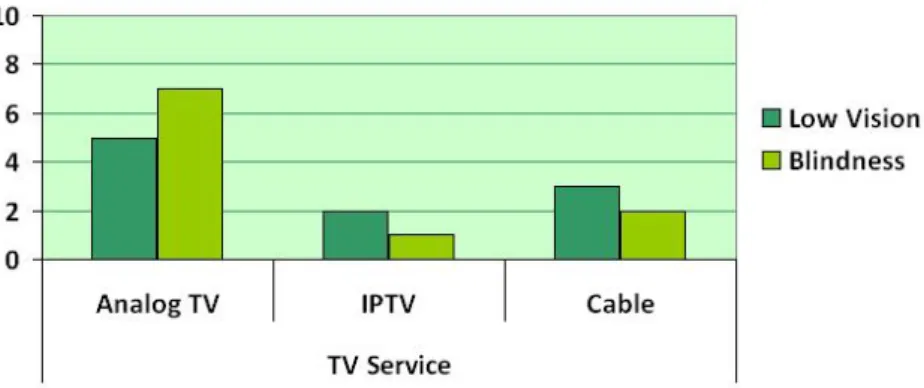
Regarding the type of television service that the interviewees have at home, 12 of the subjects only has access to the four over-the-air channels provided by Portuguese analog television. The 8 remaining subjects have a commercial digital television solution; 3 are clients of an Internet Protocol Television (IPTV) service and the remaining 5 of a cable TV provider. Fig. 3 shows the relationship between the TV service that the interviewees have at home and their visual impairment type.
Fig. 3. Number of interviewees order by TV Service and visual impairment type
4.3 Interview Guide
A semi-structured interview was conducted to gather subjects’ opinions about television and their problems in accessing and handle with it. According to Flick [16],
the semi-structured interview became widely used because the interviewees’ points of view are more easily expressed in an interview situation more open and flexible than a structured interview or a questionnaire. Consequently, the main advantages of this method are the greater depth of gathered data compared to the questionnaire and the inherent flexibility because face-to-face contact allows the explanation of questions and answers.
Thus, this type of interview was chosen not only to facilitate data processing, but also to give interviewees some freedom in their answers. The interview guide was structured in the following four parts in a total of 31 questions, mostly fixed-response. Part I – General Data:
Each subject was asked to express his/her visual impairment type (low vision or blindness); to indicate how long he/she has had his disability; what their job is; and finally, what TV service he/she has at home.
Part II – Television Consumption Patterns and Audio Description:
In this second part, the subjects were asked to answer questions related to their TV content consumption patterns (e.g.: how much time in a day is spent watching TV) and their knowledge about audio description (e.g.: if they know about this communication aid and if they have ever used it).
Part III – Television Access Problems:
Two open questions were placed asking the interviewee to speak about his difficulties as a consumer of television content and how he/she believed these problems could be solved. When the subject did not provide much feedback, the interviewer gave some suggestions to solve their problems.
Part IV – DTT and iTV:
In the final part of the interview, the subjects were asked about their knowledge of Digital Terrestrial Television (e.g.: if they knows this technology) and also about iTV (e.g.: if they had ever contacted with an interactive television system and if so how they use it).
After the interview, through data processing, the research object was described and interpreted. We attempted to classify subjects’ behaviors and procedures associated with the activity of watching television and also understand the problems they have to deal with in that situation.
5 Selected Findings
The interview results uncovered a significant number of findings, which are following presented and discussed.
Television Consumption Patterns and Audio Description
- The television genres they enjoy the most (regardless of their visual impairment type) are: television series and movies (70 percent); information (70 percent); talk shows and game shows (50 percent); and sport games (10 percent).
- 8 blind subjects say that they need help to adjust the television volume and other TV options.
- All interviewees state that they use the remote control and learned themselves the location of the keys.
- Only 5 subjects know what audio description is while 3 of them use it. - All subjects assign a high degree of usefulness to audio description. Television Access Problems
- 4 low vision users say they have image contrast difficulties when watching TV. - 6 low vision users say they sometimes can not read subtitles because they are too
small.
- 1 low vision user and the 10 blind users say they can not understand certain things that happen in TV programs.
- 5 of the mentioned above state they lose interest in the TV program they are watching.
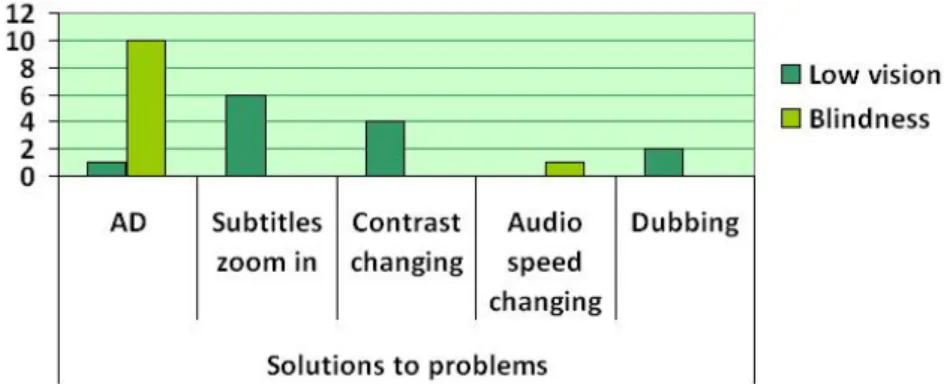
- In regards to the solutions proposed by interviewees to these problems, the 10 blind subjects think audio description could solve their difficulties. One of the users also thinks that the possibility of changing audio speed could help (Fig. 4). - Regarding low vision subjects, 6 consider that the zooming in of subtitles is a
helpful strategy, 4 subjects believe that the option of changing TV image and subtitles contrast are useful ways to solve their problems and 2 subjects consider that dubbing could help too. Finally, 1 subject thinks that audio description could be a solution to their difficulties (Fig. 4).
Fig. 4.Solutions given by interviewees to the problems they experience when they watch TV
DTT and iTV
- 11 interviewees think digital terrestrial television will complicate watching TV. - 11 interviewees already had contact with an interactive television system. - 7 of these 11 subjects say they had access problems when interacting with this
type of system: they did not know the option that was selected, got lost in menus, did not know how to turn back and also could not read text because it was too small or had low contrast.
- 19 subjects think that an iTV audio description service on DTT is useful, where the user could access different features such as the selection of the narrator's voice (e.g. male/female voice) and the adjustment of the audio description volume.
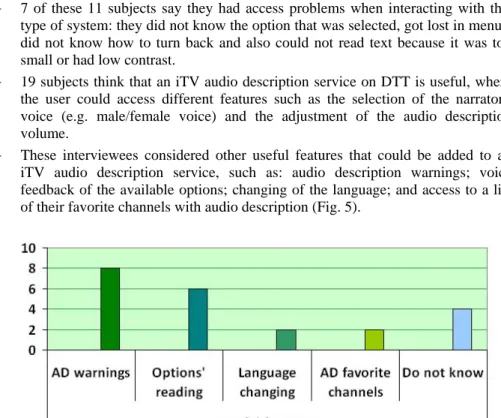
- These interviewees considered other useful features that could be added to an iTV audio description service, such as: audio description warnings; voice feedback of the available options; changing of the language; and access to a list of their favorite channels with audio description (Fig. 5).
Fig. 5. Features interviewees would find useful in an ITV audio description service
6 Proposed Requirements and Features
The selected findings enabled the proposal of a set of requirements to develop an interactive audio description service that meets the needs of VIU, which is briefly presented here.
Flexibility and Adaptability:
The system must give the user the choice to perform image and font-size magnification of its menus and television content. In addition, it is important to have the option to adjust brightness and contrast of the menus.
Audio Feedback:
The system audio feedback must be triggered when the user accesses the menu options or when he selects any menu item. It is also valuable to have audio feedback when a program with audio description starts.
Contextual Help:
The contextual help option must always be present and accessed by a hotkey with some sort of relief.
Audio Description Customization:
The user must be able to choose the narrator’s audio description voice (e.g.: female or male voice), the language (among those available in the TV program) as well as the control of the volume and speech speed.
System Personalization:
The system must be able to identify and filter programs with audio description on the EPG. As a result, the system must grant the user the possibility to choose what he wants to see from a list that includes all his favorite channels with audio description. User Automatic Identification:
The system must be able to identify the user automatically. Consequently, when the user is identified, theirs preferences must be loaded and the system must adjust to them.
7 Conclusions and Future Work
Viewers with different backgrounds react in different ways to television technological convergence, a condition that sets up a specifically advantageous context for the consideration on the issues related to accessibility and inclusive design.
The presented research project aims to study new strategies for the integration of people with visual impairment on the Interactive Television scope towards the development of an audio description service interaction model that meets the specifications and needs of this type of users. Thus, this research aims mainly to help VIU’s interaction in the iTV context and develop an interaction model that allows the access to an enhanced audio description service for VIU in an easy and universal way. From the presented results, we can extend this research to a more practical level, namely in what concerns the conceptualization and specification of features that are consistent to the identified requirements and the problems experienced by VIU. The designed research process has been revealed suited to the support the development of a prototype of an advanced iTV audio description service that will be evaluated by low vision and blind users through accessibility and usability testing.
Acknowledges
Our thanks to Instituto de Oftalmologia Dr. Gama Pinto for allowing us to interview its low vision appointment patients and to the interviewees for their openness and kindness.
References
1. Destaques INE: Censos 2001 – Análise de População com Deficiência, http://www.inr.pt/download.php?filename=Censos+2001&file=%2Fuploads%2Fdocs%2Fi nfestatistica%2FCensos2001Destaque.pdf
2. Inquérito da Universidade Lusófona sobre TV digital, http://adoptdtv.ulusofona.pt/index.php
3. WHO – Visual impairment and blindness, http://www.who.int/mediacentre/factsheets/fs282/en/
4. WHO – Priority eye diseases, http://www.who.int/blindness/causes/priority/en/index5.html 5. WHO – Blindness, http://www.who.int/topics/blindness/en/
6. WHO – Causes of blindness and visual impairment, http://www.who.int/blindness/causes/en/
7. Beumer, J. J., de Haan, A., van der Ven, J.: Implications of Computer-Mediated Communication for People Who Are Visually Impaired in Dealing with Complex Visualization Tasks. Journal of Visual Impairment & Blindness, Vol. 94-7, 453--456 8. Godinho, F.: Acessibilidade para cidadãos com necessidades especiais nos regulamentos da
televisão digital terrestre em Portugal. CERTIC, UTAD (2007)
9. Snyder, J.: Audio Description: The Visual Made Verbal. International Journal of the Arts in Society, Vol. 2 – 2, 99—104 (2007)
10. Quico, C: Acessibilidade e Televisão Digital e Interactiva: o caso particular do serviço de Áudio-Descrição destinado a pessoas invisuais ou com deficiências visuais graves. Estratégias de Produção em Novos Media, COFAC/ Universidade Lusófona de Humanidades e Tecnologias (2005)
11. RTP Acessibilidades – Áudio Descrição, http://www.rtp.pt/wportal/acessibilidades/
12. ZON Multimédia – Responsabilidade Social, http://www.zon.pt/Clientes/DetalheClientes.aspx?detail=XzU495
13. Audio Description Associates: Samples, http://www.audiodescribe.com/samples/
14. Glaser, B., Strauss, A.: The discovery of Grounded Theory: strategies for qualitative research. Aldine, Chicago (1967)
15. Instituto de Oftalmogia Dr. Gama Pinto, http://www.institutogamapinto.com
![Fig. 1. Illustration of the audio description of ‘Elmo’s World’ [13]](https://thumb-eu.123doks.com/thumbv2/123dok_br/15753212.1073908/3.892.196.698.567.803/fig-illustration-audio-description-elmo-s-world.webp)